

ISO 4717:2024
(Main)Water quality — Protactinium 231 — Test method using ICP-MS
General Information
- Abstract
This document specifies a method to determine 231Pa by inductively coupled plasma mass spectrometry (ICP-MS). The mass concentrations obtained can be converted into activity concentrations. The method described in this document is applicable to test samples of drinking water, rainwater, surface and ground water, marine water, as well as cooling water, industrial water, domestic and industrial wastewater after proper sampling and handling and test sample preparation. The limit of detection depends on the sample volume, the instrument used, the background count rate, the detection efficiency and the chemical yield. In this document, the limit of detection of the method using currently available apparatus is approximately 0,1 Bq·l−1 (or Bq·kg−1), which is the same as the WHO criteria for safe consumption of drinking water (0,1 Bq·l−1)[4]. The method described in this document covers the measurement of 231Pa in water at activity concentrations between 0,1 Bq·l−1 and 100 Bq·l−1. Samples with higher activity concentrations than 100 Bq·l−1 can be measured if a dilution is performed. The method described in this document is applicable in the event of an emergency. Filtration of the test sample is necessary for the method described in this document. The analysis of 231Pa adsorbed to suspended matter is not covered by this method. The analysis of the insoluble fraction requires a mineralization step that is not covered by this document. In this case, the measurement is made on the different phases obtained. It is the user’s responsibility to ensure the validity of this test method for the water samples tested.
- Status
- Published
- Publication Date
- 28-Nov-2024
- Technical Committee
- ISO/TC 147/SC 3 - Radioactivity measurements
- Drafting Committee
- ISO/TC 147/SC 3/WG 14 - ICP/MS
- Current Stage
- 6060 - International Standard published
- Start Date
- 29-Nov-2024
- Due Date
- 09-Jun-2024
- Completion Date
- 29-Nov-2024

Overview
ISO 4717:2024 - Water quality - Protactinium 231 - Test method using ICP‑MS specifies a validated procedure for determining protactinium‑231 (231Pa) in water by inductively coupled plasma mass spectrometry (ICP‑MS). The standard covers sample types including drinking water, rainwater, surface and ground water, marine water, cooling and industrial waters, and domestic/industrial wastewater after appropriate sampling and preparation. Results reported as mass concentration can be converted to activity concentration; the method is designed to support routine monitoring, regulatory compliance and emergency response.
Key technical topics and requirements
- Analytical principle: Determination of 231Pa by ICP‑MS with options for pre‑concentration and chemical separation.
- Scope & measurement range: Designed for activity concentrations between 0.1 Bq·L−1 and 100 Bq·L−1. Higher concentrations can be measured after dilution.
- Limit of detection (LOD): Approximately 0.1 Bq·L−1 using current apparatus - aligned with the WHO guidance level for drinking water. LOD depends on sample volume, instrument performance, background count rate, detection efficiency and chemical yield.
- Sample handling: Filtration of test samples is necessary; analysis of 231Pa adsorbed to suspended solids and the insoluble fraction (which requires mineralization) is not covered.
- Separation & preparation: Chemical separation procedures (e.g., extraction chromatography, anion exchange) are provided in informative annexes to isolate Pa prior to ICP‑MS measurement.
- Quality control: Instrument verification, method verification, use of internal standards, tracer recovery assessment, background correction, and calculation of uncertainty (per ISO/IEC Guide 98‑3) are specified.
- Expression of results: Procedures to convert mass concentration to activity concentration, calculate chemical recovery and correct for tracer contamination are included.
- Reporting: Requirements for test reports and documentation to ensure traceability and comparability.
Practical applications and users
- Environmental and public‑health monitoring of radionuclides in water (drinking water compliance).
- Emergency response laboratories evaluating radiological contamination in water after incidents.
- Water utilities, nuclear facility effluent monitoring, and industrial sites needing routine radioactivity checks.
- Accredited testing laboratories (ISO/IEC 17025) and radiochemistry ICP‑MS laboratories implementing radionuclide analyses.
Keywords: ISO 4717:2024, protactinium 231, 231Pa, ICP‑MS, water quality, limit of detection, WHO guidance, radionuclide monitoring, extraction chromatography.
Related standards
- ISO 17294‑1:2024 and ISO 17294‑2:2023 (ICP‑MS application guidance)
- ISO 5667 series (water sampling and handling)
- ISO/IEC Guide 98‑3 (uncertainty of measurement)
- ISO/IEC 17025 (laboratory competence)
- ISO 80000‑10 (quantities and units - atomic and nuclear physics)
This standard provides laboratories with a practical, ISO‑aligned method for accurate 231Pa measurement by ICP‑MS to support regulatory compliance, public health protection and emergency preparedness.
Relations
- Consolidated By
ISO/DTS 19844-1 - Health informatics — Identification of medicinal products (IDMP) — Part 1: Implementation of ISO 11238 (general) - Effective Date
- 06-Jul-2024
Get Certified
Connect with accredited certification bodies for this standard

BSMI (Bureau of Standards, Metrology and Inspection)
Taiwan's standards and inspection authority.
CIS Institut d.o.o.
Personal Protective Equipment (PPE) certification body. Notified Body NB-2890 for EU Regulation 2016/425 PPE.

Kiwa BDA Testing
Building and construction product certification.
Sponsored listings
Frequently Asked Questions
ISO 4717:2024 is a standard published by the International Organization for Standardization (ISO). Its full title is "Water quality — Protactinium 231 — Test method using ICP-MS". This standard covers: This document specifies a method to determine 231Pa by inductively coupled plasma mass spectrometry (ICP-MS). The mass concentrations obtained can be converted into activity concentrations. The method described in this document is applicable to test samples of drinking water, rainwater, surface and ground water, marine water, as well as cooling water, industrial water, domestic and industrial wastewater after proper sampling and handling and test sample preparation. The limit of detection depends on the sample volume, the instrument used, the background count rate, the detection efficiency and the chemical yield. In this document, the limit of detection of the method using currently available apparatus is approximately 0,1 Bq·l−1 (or Bq·kg−1), which is the same as the WHO criteria for safe consumption of drinking water (0,1 Bq·l−1)[4]. The method described in this document covers the measurement of 231Pa in water at activity concentrations between 0,1 Bq·l−1 and 100 Bq·l−1. Samples with higher activity concentrations than 100 Bq·l−1 can be measured if a dilution is performed. The method described in this document is applicable in the event of an emergency. Filtration of the test sample is necessary for the method described in this document. The analysis of 231Pa adsorbed to suspended matter is not covered by this method. The analysis of the insoluble fraction requires a mineralization step that is not covered by this document. In this case, the measurement is made on the different phases obtained. It is the user’s responsibility to ensure the validity of this test method for the water samples tested.
This document specifies a method to determine 231Pa by inductively coupled plasma mass spectrometry (ICP-MS). The mass concentrations obtained can be converted into activity concentrations. The method described in this document is applicable to test samples of drinking water, rainwater, surface and ground water, marine water, as well as cooling water, industrial water, domestic and industrial wastewater after proper sampling and handling and test sample preparation. The limit of detection depends on the sample volume, the instrument used, the background count rate, the detection efficiency and the chemical yield. In this document, the limit of detection of the method using currently available apparatus is approximately 0,1 Bq·l−1 (or Bq·kg−1), which is the same as the WHO criteria for safe consumption of drinking water (0,1 Bq·l−1)[4]. The method described in this document covers the measurement of 231Pa in water at activity concentrations between 0,1 Bq·l−1 and 100 Bq·l−1. Samples with higher activity concentrations than 100 Bq·l−1 can be measured if a dilution is performed. The method described in this document is applicable in the event of an emergency. Filtration of the test sample is necessary for the method described in this document. The analysis of 231Pa adsorbed to suspended matter is not covered by this method. The analysis of the insoluble fraction requires a mineralization step that is not covered by this document. In this case, the measurement is made on the different phases obtained. It is the user’s responsibility to ensure the validity of this test method for the water samples tested.
ISO 4717:2024 is classified under the following ICS (International Classification for Standards) categories: 13.060.60 - Examination of physical properties of water; 17.240 - Radiation measurements. The ICS classification helps identify the subject area and facilitates finding related standards.
ISO 4717:2024 has the following relationships with other standards: It is inter standard links to ISO/DTS 19844-1. Understanding these relationships helps ensure you are using the most current and applicable version of the standard.
ISO 4717:2024 is available in PDF format for immediate download after purchase. The document can be added to your cart and obtained through the secure checkout process. Digital delivery ensures instant access to the complete standard document.
Standards Content (Sample)
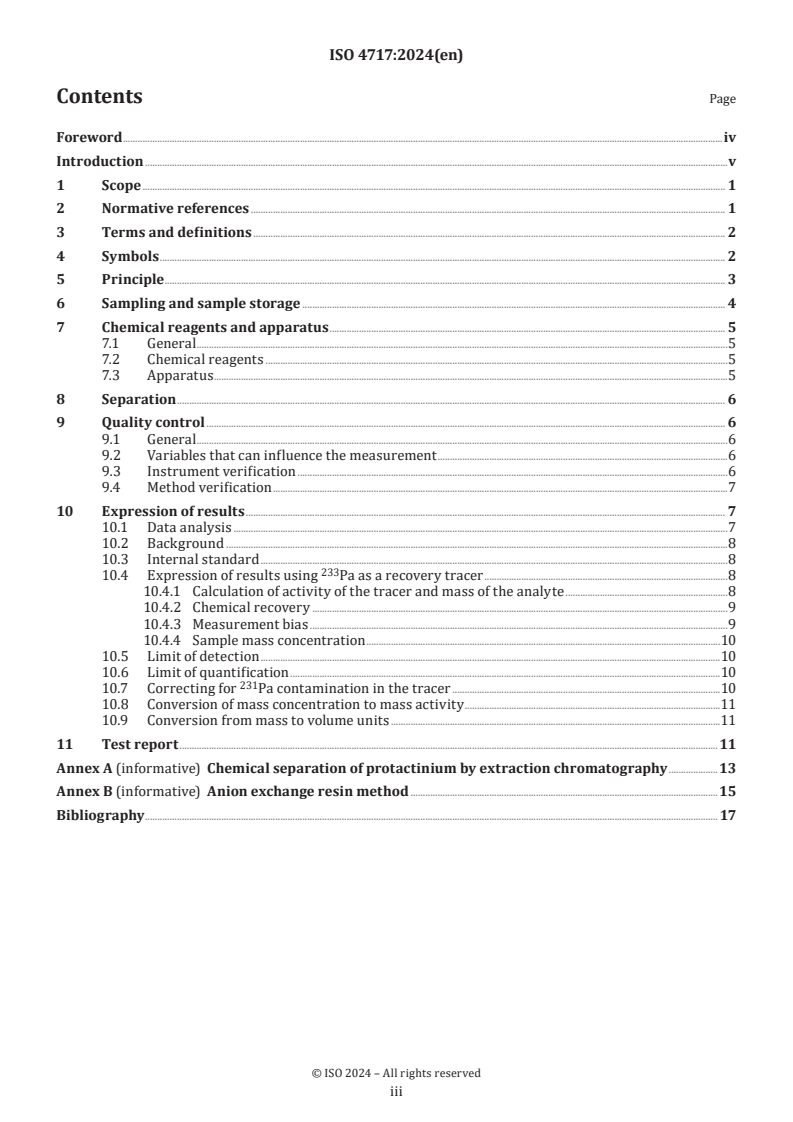
International
Standard
ISO 4717
First edition
Water quality — Protactinium 231
2024-11
— Test method using ICP-MS
Qualité de l’eau — Protactinium 231 — Méthode d’essai par ICP-MS
Reference number
© ISO 2024
All rights reserved. Unless otherwise specified, or required in the context of its implementation, no part of this publication may
be reproduced or utilized otherwise in any form or by any means, electronic or mechanical, including photocopying, or posting on
the internet or an intranet, without prior written permission. Permission can be requested from either ISO at the address below
or ISO’s member body in the country of the requester.
ISO copyright office
CP 401 • Ch. de Blandonnet 8
CH-1214 Vernier, Geneva
Phone: +41 22 749 01 11
Email: copyright@iso.org
Website: www.iso.org
Published in Switzerland
ii
Contents Page
Foreword .iv
Introduction .v
1 Scope . 1
2 Normative references . 1
3 Terms and definitions . 2
4 Symbols . 2
5 Principle . 3
6 Sampling and sample storage . 4
7 Chemical reagents and apparatus . 5
7.1 General .5
7.2 Chemical reagents .5
7.3 Apparatus .5
8 Separation . 6
9 Quality control . 6
9.1 General .6
9.2 Variables that can influence the measurement .6
9.3 Instrument verification .6
9.4 Method verification .7
10 Expression of results . 7
10.1 Data analysis .7
10.2 Background .8
10.3 Internal standard .8
10.4 Expression of results using Pa as a recovery tracer .8
10.4.1 Calculation of activity of the tracer and mass of the analyte .8
10.4.2 Chemical recovery .9
10.4.3 Measurement bias .9
10.4.4 Sample mass concentration .10
10.5 Limit of detection .10
10.6 Limit of quantification .10
10.7 Correcting for Pa contamination in the tracer .10
10.8 Conversion of mass concentration to mass activity .11
10.9 Conversion from mass to volume units .11
11 Test report .11
Annex A (informative) Chemical separation of protactinium by extraction chromatography .13
Annex B (informative) Anion exchange resin method .15
Bibliography . 17
iii
Foreword
ISO (the International Organization for Standardization) is a worldwide federation of national standards
bodies (ISO member bodies). The work of preparing International Standards is normally carried out through
ISO technical committees. Each member body interested in a subject for which a technical committee
has been established has the right to be represented on that committee. International organizations,
governmental and non-governmental, in liaison with ISO, also take part in the work. ISO collaborates closely
with the International Electrotechnical Commission (IEC) on all matters of electrotechnical standardization.
The procedures used to develop this document and those intended for its further maintenance are described
in the ISO/IEC Directives, Part 1. In particular, the different approval criteria needed for the different types
of ISO document should be noted. This document was drafted in accordance with the editorial rules of the
ISO/IEC Directives, Part 2 (see www.iso.org/directives).
ISO draws attention to the possibility that the implementation of this document may involve the use of (a)
patent(s). ISO takes no position concerning the evidence, validity or applicability of any claimed patent
rights in respect thereof. As of the date of publication of this document, ISO had not received notice of (a)
patent(s) which may be required to implement this document. However, implementers are cautioned that
this may not represent the latest information, which may be obtained from the patent database available at
www.iso.org/patents. ISO shall not be held responsible for identifying any or all such patent rights.
Any trade name used in this document is information given for the convenience of users and does not
constitute an endorsement.
For an explanation of the voluntary nature of standards, the meaning of ISO specific terms and expressions
related to conformity assessment, as well as information about ISO's adherence to the World Trade
Organization (WTO) principles in the Technical Barriers to Trade (TBT), see www.iso.org/iso/foreword.html.
This document was prepared by Technical Committee ISO/TC 147, Water quality, Subcommittee SC 3,
Radioactivity measurements.
Any feedback or questions on this document should be directed to the user’s national standards body. A
complete listing of these bodies can be found at www.iso.org/members.html.
iv
Introduction
Radionuclides are present throughout the environment; thus, water bodies (e.g. surface waters, ground
waters and sea waters) contain radionuclides, which can be of either natural or anthropogenic origin.
3 14 40
— Naturally-occurring radionuclides, including H, C, K and those originating from the thorium and
210 210 222 226 228 227 231 234 238
uranium decay series, in particular Pb, Po, Rn, Ra, Ra, Ac, Pa, U and U, can be
found in water bodies due to either natural processes (e.g. desorption from the soil and runoff by rain
water) or released from technological processes involving naturally occurring radioactive materials (e.g.
mining, mineral processing, oil, gas, and coal production, water treatment, and production and use of
phosphate fertilisers).
55 59 63 90 99
— Anthropogenic radionuclides, such as Fe, Ni, Ni, Sr and Tc, transuranic elements (e.g. Np, Pu, Am
60 137
and Cm), and some gamma emitting radionuclides, such as Co and Cs, can also be found in natural
waters. Small quantities of anthropogenic radionuclides can be discharged from nuclear facilities to the
environment as a result of authorized routine releases. The radionuclides present in liquid effluents are
[1]
usually controlled before being discharged into the environment and water bodies. Anthropogenic
radionuclides used in medical and industrial applications can be released to the environment after use.
Anthropogenic radionuclides are also found in waters due to contamination from fallout resulting from
above-ground nuclear detonations and accidents such as those that have occurred at the Chernobyl and
Fukushima nuclear facilities.
Radionuclide activity concentrations in water bodies can vary according to local geological characteristics
and climatic conditions and can be locally and temporally enhanced by releases from nuclear facilities
[2],[3]
during planned, existing and emergency exposure situations . Some drinking water sources can thus
contain radionuclides at activity concentrations that can present a human health risk. The World Health
[4]
Organization (WHO) recommends to routinely monitor radioactivity in drinking waters and to take
proper actions when needed to minimize the health risk.
National regulations usually specify the activity concentration limits that are authorized in drinking waters,
water bodies and liquid effluents to be discharged to the environment. These limits can vary for planned,
existing and emergency exposure situations. As an example, during either a planned or existing situation,
231 −1
the WHO guidance level for Pa in drinking water is 0,1 Bq·l , see NOTES 1 and 2. Compliance with these
limits is assessed by measuring radioactivity in water samples and by comparing the results obtained, with
[5]
their associated uncertainties, as specified by ISO/IEC Guide 98-3 and ISO 5667-20 .
NOTE 1 If the value is not specified in Annex 6 of Reference [4], the value has been calculated using the formula
provided in Reference [4] and the dose coefficient data from References [6] and [7].
−1
NOTE 2 The guidance level calculated in Reference [4] is the activity concentration that, with an intake of 2 l·d of
−1
drinking water for one year, results in an effective dose of 0,1 mSv·a to members of the public. This is an effective
dose that represents a very low level of risk to human health and which is not expected to give rise to any detectable
[4]
adverse health effects .
This document contains method(s) to support laboratories, which need to determine Pa in water samples.
The method described in this document can be used for various types of waters (see Clause 1). For
radiometric methods, minor modifications such as sample volume and counting time can be made if needed
to ensure that the decision threshold, limit of detection, and uncertainties are below the required limits.
For ICP-MS methods, minor modifications to, for example, the sample pre-concentration volume and the
interference separation can be made if needed to ensure that the limit of detection, limit of quantification
and uncertainties are below the required limits. This can be done for several reasons such as emergency
situations, lower national guidance limits and operational requirements.
v
International Standard ISO 4717:2024(en)
Water quality — Protactinium 231 — Test method using ICP-MS
WARNING — Persons using this document should be familiar with normal laboratory practices. This
document does not purport to address all of the safety problems, if any, associated with its use. It is
the responsibility of the user to establish appropriate safety and health practices and to determine
the applicability of any other restrictions.
IMPORTANT — It is essential that tests conducted according to this document be carried out by
suitably trained staff.
1 Scope
This document specifies a method to determine Pa by inductively coupled plasma mass spectrometry
(ICP-MS). The mass concentrations obtained can be converted into activity concentrations.
The method described in this document is applicable to test samples of drinking water, rainwater, surface and
ground water, marine water, as well as cooling water, industrial water, domestic and industrial wastewater
after proper sampling and handling and test sample preparation.
The limit of detection depends on the sample volume, the instrument used, the background count rate, the
detection efficiency and the chemical yield. In this document, the limit of detection of the method using
−1 −1
currently available apparatus is approximately 0,1 Bq·l (or Bq·kg ), which is the same as the WHO criteria
−1 [4]
for safe consumption of drinking water (0,1 Bq·l ) .
The method described in this document covers the measurement of Pa in water at activity concentrations
−1 −1 −1
between 0,1 Bq·l and 100 Bq·l . Samples with higher activity concentrations than 100 Bq·l can be
measured if a dilution is performed.
The method described in this document is applicable in the event of an emergency.
Filtration of the test sample is necessary for the method described in this document. The analysis of Pa
adsorbed to suspended matter is not covered by this method. The analysis of the insoluble fraction requires
a mineralization step that is not covered by this document. In this case, the measurement is made on the
different phases obtained.
It is the user’s responsibility to ensure the validity of this test method for the water samples tested.
2 Normative references
The following documents are referred to in the text in such a way that some or all of their content constitutes
requirements of this document. For dated references, only the edition cited applies. For undated references,
the latest edition of the referenced document (including any amendments) applies.
ISO/IEC Guide 98-3, Uncertainty of measurement — Part 3: Guide to the expression of uncertainty in
measurement (GUM:1995)
ISO 5667-1, Water quality — Sampling — Part 1: Guidance on the design of sampling programmes and sampling
techniques
ISO 5667-3, Water quality — Sampling — Part 3: Preservation and handling of water samples
ISO 5667-10, Water quality — Sampling — Part 10: Guidance on sampling of waste water
ISO/IEC 17025, General requirements for the competence of testing and calibration laboratories
ISO 17294-1:2024, Water quality — Application of inductively coupled plasma mass spectrometry (ICP-MS) —
Part 1: General guidelines
ISO 17294-2:2023, Water quality — Application of inductively coupled plasma mass spectrometry (ICP-MS) —
Part 2: Determination of selected elements including uranium isotopes
ISO 80000-10, Quantities and units — Part 10: Atomic and nuclear physics
3 Terms and definitions
For the purposes of this document, the terms and definitions given in ISO/IEC Guide 98-3 and ISO 80000-10 apply.
ISO and IEC maintain terminology databases for use in standardization at the following addresses:
— ISO Online browsing platform: available at https:// www .iso .org/ obp
— IEC Electropedia: available at https:// www .electropedia .org/
4 Symbols
−1
C Mass activity Bq·kg
−1
C Specific activity corresponding to one gram of the radionuclide Bq·g
s
C Activity of the tracer Bq
T
−1
C Mass activity of the tracer added to a sample Bq·g
TS
k Coverage factor for uncertainties —
Limit of detection in mass concentration, the lowest mass concentration that can be
−1
L Counts·s
D
considered statistically different from a blank sample
Limit of quantification, the lowest mass concentration that can be quantified with sta-
−1
L Counts·s
Q
tistical uncertainty
m Mass of sample kg
m / z Mass-to-charge ratio measured by ICP-MS —
m Mass of analyte added to a spiked solution g
A
m Mass of analyte solution added to a control sample or for measurement calculation g
AS
m Mass of calibration standard solution tracer added to a sample g
C
m Mass of calibration standard solution added to a sample g
CS
m Mass of internal standard added to a blank and a sample g
IS
m Mass of internal standard solution added to a blank or a sample g
ISS
m Mass of tracer solution added to a blank and a sample g
T
m Mass of tracer solution added to a reagent blank g
TB
m Mass of tracer solution added to a blank or a sample g
TS
Number of counts per second measured by ICP-MS of a sample at a given mass-to-
−1
N Counts·s
charge ratio
Number of counts per second measured by ICP-MS of a blank sample at a given mass-to-
−1
N Counts·s
charge ratio
Average number of counts per second for several blank samples measured by ICP-MS at
−1
N Counts·s
a given mass-to-charge ratio
−1
N Net number of counts per second, N − N Counts·s
net 0
−1
N Net number of counts per second at the internal standard mass-to-charge ratio Counts·s
netIS
Net number of counts per second in samples where a tracer has been added to assess
−1
N Counts·s
netT
chemical recovery
−1
N Net number of counts per second in the spiked reagent blank Counts·s
SP
−1
N Number of counts per second at analyte mass-to-charge ratio present as impurities Counts·s
T
−1
N Net number of counts per second in the unspiked reagent blank sample Counts·s
US
R Chemical recovery following purification measured by ICP-MS —
c
−1
S
Standard deviation obtained by measurement of 10 test portions of the blank sample Counts·s
N
−1
U Expanded uncertainty and the coverage factor k with k = 1, 2,…, U = k · u Bq·kg
u Relative standard uncertainty —
rel
−1
u(C) Standard uncertainty of the mass activity result Bq·kg
−1
u(ρ) Standard uncertainty associated with the measurement result g·kg
V Volume of sample l
Measurement bias constant which allows a correction for signal intensity bias between
α —
the tracer and the analyte
−1
ρ Mass concentration of the analyte g·kg
−1
ρ Mass concentration of the analyte in the standard solution g·g
A
−1
ρ Mass concentration of the calibration standard solution g·g
C
Mass concentration of the internal standard element or isotope per unit volume of the
−1
ρ g·g
IS
internal standard solution
−1
ρ Mass concentration of the tracer solution g·g
T
−1
ρ Mass of analyte per sample unit volume g·l
V
5 Principle
The principle of measurement of analysis using ICP-MS is described in ISO 17294-1 and ISO 17294-2.
231 [8],[9]
ICP-MS has been successfully used to measure the concentration of Pa in water samples .
Protactinium-231 is a naturally occurring radionuclide.
The results can be converted in activity concentrations using the specific activity as a conversion factor
given in Table 1.
The typical measurement time is several minutes per sample, including sample uptake, counting time and
washout before the next sample.
231 [10]
Table 1 — Half-life and specific activity of Pa
Isotope Half-life Specific activity
−1
years Bq·g
231 4 9
Pa 3,267 0 (260) ∙ 10 1,753 (14) ∙ 10
An example of the limit of detection that can be obtained with ICP-MS is given in Table 2.
[1]
Table 2 — Example of limit of detection
Isotope Limit of detection Limit of detection
−1 −1
μg·l Bq·l
231 −5
Pa 5,7 ∙ 10 0,1
Radionuclide measurement by ICP-MS is affected by several interferences which are outlined in Table 3.
Table 3 — Interferences affecting ICP-MS measurement
Type of interference Description Pa interference
Isobaric Stable or radioactive isotopes with a similar mass to the analyte None
230 1 199 16
Stable or radioactive isotopes combining in plasma to form a Th H, Hg O ,
Polyatomic
191 40
polyatomic ion with a similar mass to the analyte Ir Ar
Stable or radioactive isotopes of one or two mass units on either side
6 232
Tailing of the analyte with a relatively high abundance (>10 ) relative to the Th
analyte
It is important to ensure that all potential interferences have been removed prior to measurement in order
to remove interferences and pre-concentrate Pa prior to measurement.
Chemical separation of Pa is required prior to measurement. This also removes elements that can form
polyatomic and tailing interferences.
It is important to know the interference separation factor achievable by chemical separation. This can
initially be assessed by running stable element standards at increasing concentrations to monitor the impact
at m / z = 231.
An aliquot of a water sample can be directly measured by ICP-MS to determine the stable element
composition. High matrix samples, such as seawater, can need to be diluted to a greater extent before this
measurement, depending on the sample introduction system of the instrument used; some designs offer
online aerosol dilution capability that can run high matrix samples without prior dilution.
If any interference has an impact on the Pa result that cannot be corrected for, then the result cannot be
considered to be valid.
Chemical separation can be required to remove interferences and pre-concentrate Pa prior to
measurement. As described in the ISO 17294 series, a tracer is needed to evaluate the recovery in chemical
separation. The tracer can be mixed with an aliquot of sample, followed by chemical isolation of the analyte.
Protactinium-233 is a suitable tracer that can be quantified by gamma spectrometry.
To quantify any potential interference coming from the reagents, a blank sample is prepared in the same
way as the test sample. This blank sample is prepared using ultrapure water.
6 Sampling and sample storage
Sampling, handling and storage of the water shall be done as specified in ISO 5667-1, ISO 5667-3 and
ISO 5667-10, and guidance is given for the different types of water in References [13] to [20]. It is important
that the laboratory receives a sample that is truly representative and has neither been damaged nor modified
during transportation or storage.
The sample is filtered to remove suspended matter using a 0,45 μm filter. A smaller pore size filter can also
be used, but the filtration can be more tedious and time-consuming. The sample shall be acidified after
filtration to a pH less than 2 with HNO .
Minimising contamination and losses is of primary concern. Impurities in the reagents and dust on the
laboratory equipment in contact with the samples can be potential sources of stable element contamination
that increases the background at m / z = 231. The sample containers can lead to either a positive or a negative
bias in the determination of trace elements by superficial desorption or adsorption.
7 Chemical reagents and apparatus
7.1 General
The chemical reagents and equipment used for chemical treatment and preparation of the samples are
described in Annexes A and B.
Use only reagents of recognized analytical grade.
7.2 Chemical reagents
7.2.1 Ultrapure water, with a resistivity of more than 18,2 MΩ·cm at 25 °C and a total organic carbon less
−1
than 1 µg·l .
Unless otherwise stated, water refers to ultrapure water.
−1
7.2.2 Instrument blank, for example 0,3 mol∙l nitric acid, used to determine the background count ra
...