

ISO/DIS 23323
(Main)Ships and marine technology -- Guidelines for software based planned maintenance system
Ships and marine technology -- Guidelines for software based planned maintenance system
Navires et technologie maritime -- Lignes directrices relatives à la gestion de maintenance assistée par ordinateur
General Information
Buy Standard
Standards Content (sample)
DRAFT INTERNATIONAL STANDARD
ISO/DIS 23323
ISO/TC 8/SC 11 Secretariat: KATS
Voting begins on: Voting terminates on:
2020-09-28 2020-12-21
Ships and marine technology — Guidelines for software
based planned maintenance system
ICS: 35.240.60; 47.020.99
THIS DOCUMENT IS A DRAFT CIRCULATED
FOR COMMENT AND APPROVAL. IT IS
THEREFORE SUBJECT TO CHANGE AND MAY
NOT BE REFERRED TO AS AN INTERNATIONAL
STANDARD UNTIL PUBLISHED AS SUCH.
IN ADDITION TO THEIR EVALUATION AS
BEING ACCEPTABLE FOR INDUSTRIAL,
This document is circulated as received from the committee secretariat.
TECHNOLOGICAL, COMMERCIAL AND
USER PURPOSES, DRAFT INTERNATIONAL
STANDARDS MAY ON OCCASION HAVE TO
BE CONSIDERED IN THE LIGHT OF THEIR
POTENTIAL TO BECOME STANDARDS TO
WHICH REFERENCE MAY BE MADE IN
Reference number
NATIONAL REGULATIONS.
ISO/DIS 23323:2020(E)
RECIPIENTS OF THIS DRAFT ARE INVITED
TO SUBMIT, WITH THEIR COMMENTS,
NOTIFICATION OF ANY RELEVANT PATENT
RIGHTS OF WHICH THEY ARE AWARE AND TO
PROVIDE SUPPORTING DOCUMENTATION. ISO 2020
---------------------- Page: 1 ----------------------
ISO/DIS 23323:2020(E)
COPYRIGHT PROTECTED DOCUMENT
© ISO 2020
All rights reserved. Unless otherwise specified, or required in the context of its implementation, no part of this publication may
be reproduced or utilized otherwise in any form or by any means, electronic or mechanical, including photocopying, or posting
on the internet or an intranet, without prior written permission. Permission can be requested from either ISO at the address
below or ISO’s member body in the country of the requester.ISO copyright office
CP 401 • Ch. de Blandonnet 8
CH-1214 Vernier, Geneva
Phone: +41 22 749 01 11
Email: copyright@iso.org
Website: www.iso.org
Published in Switzerland
ii © ISO 2020 – All rights reserved
---------------------- Page: 2 ----------------------
ISO/DIS 23323:2020(E)
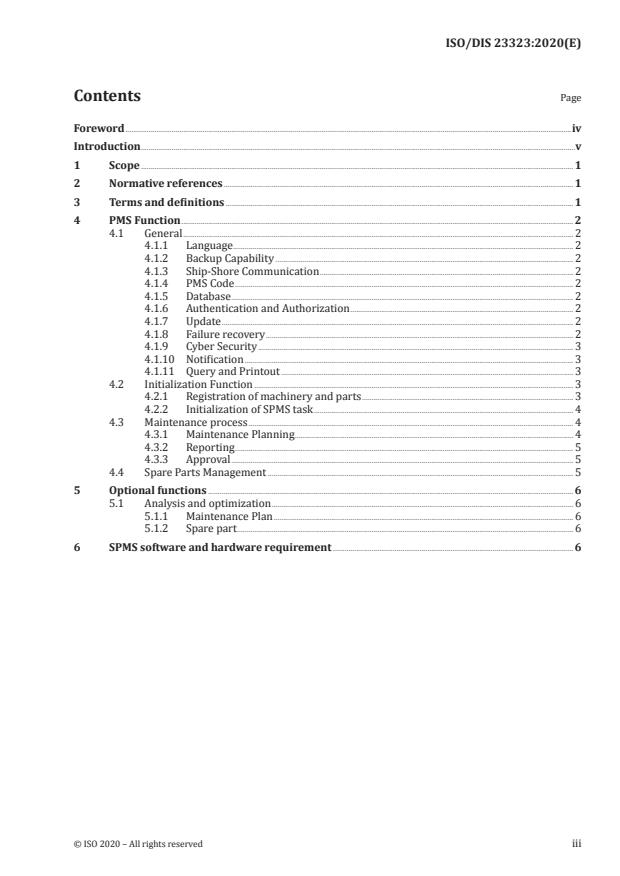
Contents Page
Foreword ........................................................................................................................................................................................................................................iv
Introduction ..................................................................................................................................................................................................................................v
1 Scope ................................................................................................................................................................................................................................. 1
2 Normative references ...................................................................................................................................................................................... 1
3 Terms and definitions ..................................................................................................................................................................................... 1
4 PMS Function ............................................................................................................................................................................................................ 2
4.1 General ........................................................................................................................................................................................................... 2
4.1.1 Language ................................................................................................................................................................................. 2
4.1.2 Backup Capability ........................................................................................................................................................... 2
4.1.3 Ship-Shore Communication .................................................................................................................................... 2
4.1.4 PMS Code ................................................................................................................................................................................ 2
4.1.5 Database .................................................................................................................................................................................. 2
4.1.6 Authentication and Authorization .................................................................................................................... 2
4.1.7 Update ....................................................................................................................................................................................... 2
4.1.8 Failure recovery ................................................................................................................................................................ 2
4.1.9 Cyber Security .................................................................................................................................................................... 3
4.1.10 Notification ........................................................................................................................................................................... 3
4.1.11 Query and Printout ........................................................................................................................................................ 3
4.2 Initialization Function ...................................................................................................................................................................... 3
4.2.1 Registration of machinery and parts .............................................................................................................. 3
4.2.2 Initialization of SPMS task ....................................................................................................................................... 4
4.3 Maintenance process ......................................................................................................................................................................... 4
4.3.1 Maintenance Planning ................................................................................................................................................. 4
4.3.2 Reporting ................................................................................................................................................................................ 5
4.3.3 Approval .................................................................................................................................................................................. 5
4.4 Spare Parts Management ............................................................................................................................................................... 5
5 Optional functions .............................................................................................................................................................................................. 6
5.1 Analysis and optimization ............................................................................................................................................................. 6
5.1.1 Maintenance Plan ............................................................................................................................................................ 6
5.1.2 Spare part ............................................................................................................................................................................... 6
6 SPMS software and hardware requirement ............................................................................................................................. 6
© ISO 2020 – All rights reserved iii---------------------- Page: 3 ----------------------
ISO/DIS 23323:2020(E)
Foreword
ISO (the International Organization for Standardization) is a worldwide federation of national standards
bodies (ISO member bodies). The work of preparing International Standards is normally carried out
through ISO technical committees. Each member body interested in a subject for which a technical
committee has been established has the right to be represented on that committee. International
organizations, governmental and non-governmental, in liaison with ISO, also take part in the work.
ISO collaborates closely with the International Electro-technical Commission (IEC) on all matters of
electro-technical standardization.The procedures used to develop this document and those intended for its further maintenance are
described in the ISO/IEC Directives, Part 1. In particular the different approval criteria needed for the
different types of ISO documents shall be noted. This document was drafted in accordance with the
editorial rules of the ISO/IEC Directives, Part 2 (see www .iso .org/ directives).
Attention is drawn to the possibility that some of the elements of this document may be the subject of
patent rights. ISO shall not be held responsible for identifying any or all such patent rights. Details of
any patent rights identified during the development of the document will be in the Introduction and/or
on the ISO list of patent declarations received (see www .iso .org/ patents).Any trade name used in this document is information given for the convenience of users and does not
constitute an endorsement.For an explanation on the meaning of ISO specific terms and expressions related to conformity assessment,
as well as information about ISO's adherence to the World Trade Organization (WTO) principles in the
Technical Barriers to Trade (TBT) see the following URL: www .iso .org/ iso/ foreword .html.
ISO/CD 23323 was prepared by Technical Committee ISO/TC 8, Ships and marine technology,
Subcommittee SC 11, Intermodal and short sea shipping.iv © ISO 2020 – All rights reserved
---------------------- Page: 4 ----------------------
ISO/DIS 23323:2020(E)
Introduction
International Maritime Organization defined a mandatory regulation on PMS of ships in the
International Safety Management Codes for the purpose of promoting efficiency of maintenance and
safe operation. Although PMS is regulated to be operated using paper or software, software-based PMS
is preferred due to systematization and computerization of the shipping industry. Software based PMS
has been used to help implementation of ISM 2018 Part A/10. Even though shipping company already
developed and equipped their own PMS software by themselves, standardized software PMS is needed
for further requirement such as era of e-Navigation or Autonomous ship(MASS).Even though large sized shipping company has been widely used and developed their own PMS software
by themselves, medium-small sized shipping companies have been suffered from poor conditions to
develop their own system. This guideline is useful for shipping company when developing the software
program of PMS by providing the method of inputting, planning, reporting and managing the data of
maintenance item and spare part.© ISO 2020 – All rights reserved v
---------------------- Page: 5 ----------------------
DRAFT INTERNATIONAL STANDARD ISO/DIS 23323:20
...
PROJET DE NORME INTERNATIONALE
ISO/DIS 23323
ISO/TC 8/SC 11 Secrétariat: KATS
Début de vote: Vote clos le:
2020-09-28 2020-12-21
Navires et technologie maritime — Lignes directrices
relatives à la gestion de maintenance assistée par
ordinateur
Ships and marine technology — Guidelines for software based planned maintenance system
ICS: 35.240.60; 47.020.99CE DOCUMENT EST UN PROJET DIFFUSÉ POUR
OBSERVATIONS ET APPROBATION. IL EST DONC
SUSCEPTIBLE DE MODIFICATION ET NE PEUT
ÊTRE CITÉ COMME NORME INTERNATIONALE
AVANT SA PUBLICATION EN TANT QUE TELLE.
OUTRE LE FAIT D’ÊTRE EXAMINÉS POUR
ÉTABLIR S’ILS SONT ACCEPTABLES À DES
FINS INDUSTRIELLES, TECHNOLOGIQUES ET
COMMERCIALES, AINSI QUE DU POINT DE VUE
Le présent document est distribué tel qu’il est parvenu du secrétariat du comité.
DES UTILISATEURS, LES PROJETS DE NORMESINTERNATIONALES DOIVENT PARFOIS ÊTRE
CONSIDÉRÉS DU POINT DE VUE DE LEUR
POSSIBILITÉ DE DEVENIR DES NORMES
POUVANT SERVIR DE RÉFÉRENCE DANS LA
RÉGLEMENTATION NATIONALE.
Numéro de référence
LES DESTINATAIRES DU PRÉSENT PROJET
ISO/DIS 23323:2020(F)
SONT INVITÉS À PRÉSENTER, AVEC LEURS
OBSERVATIONS, NOTIFICATION DES DROITS
DE PROPRIÉTÉ DONT ILS AURAIENT
ÉVENTUELLEMENT CONNAISSANCE ET À
FOURNIR UNE DOCUMENTATION EXPLICATIVE. ISO 2020
---------------------- Page: 1 ----------------------
ISO/DIS 23323:2020(F)
ISO/DIS 23323:2020(F)
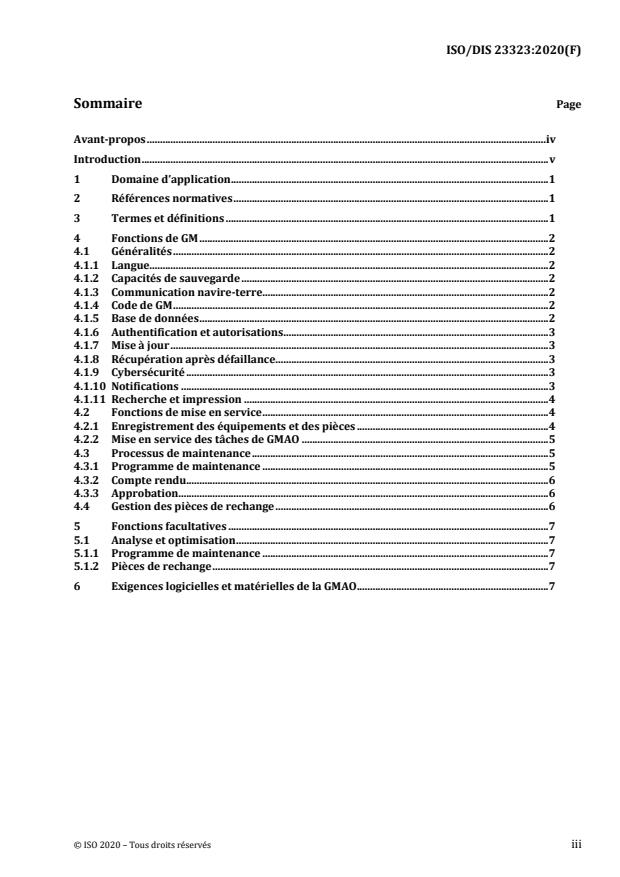
Sommaire Page
Avant-propos ........................................................................................................................................................ iv
Introduction ........................................................................................................................................................... v
1 Domaine d’application ......................................................................................................................... 1
2 Références normatives ........................................................................................................................ 1
3 Termes et définitions ........................................................................................................................... 1
4 Fonctions de GM ..................................................................................................................................... 2
4.1 Généralités ............................................................................................................................................... 2
4.1.1 Langue........................................................................................................................................................ 2
4.1.2 Capacités de sauvegarde ..................................................................................................................... 2
4.1.3 Communication navire-terre ............................................................................................................. 2
4.1.4 Code de GM ............................................................................................................................................... 2
4.1.5 Base de données ..................................................................................................................................... 2
4.1.6 Authentification et autorisations ..................................................................................................... 3
4.1.7 Mise à jour ................................................................................................................................................ 3
4.1.8 Récupération après défaillance ........................................................................................................ 3
4.1.9 Cybersécurité .......................................................................................................................................... 3
4.1.10 Notifications ............................................................................................................................................ 3
4.1.11 Recherche et impression .................................................................................................................... 4
4.2 Fonctions de mise en service ............................................................................................................. 4
4.2.1 Enregistrement des équipements et des pièces ......................................................................... 4
4.2.2 Mise en service des tâches de GMAO .............................................................................................. 5
4.3 Processus de maintenance ................................................................................................................. 5
4.3.1 Programme de maintenance ............................................................................................................. 5
4.3.2 Compte rendu .......................................................................................................................................... 6
4.3.3 Approbation............................................................................................................................................. 6
4.4 Gestion des pièces de rechange ........................................................................................................ 6
5 Fonctions facultatives .......................................................................................................................... 7
5.1 Analyse et optimisation ....................................................................................................................... 7
5.1.1 Programme de maintenance ............................................................................................................. 7
5.1.2 Pièces de rechange ................................................................................................................................ 7
6 Exigences logicielles et matérielles de la GMAO ......................................................................... 7
DOCUMENT PROTÉGÉ PAR COPYRIGHT© ISO 2020
Tous droits réservés. Sauf prescription différente ou nécessité dans le contexte de sa mise en oeuvre, aucune partie de cette
publication ne peut être reproduite ni utilisée sous quelque forme que ce soit et par aucun procédé, électronique ou mécanique,
y compris la photocopie, ou la diffusion sur l’internet ou sur un intranet, sans autorisation écrite préalable. Une autorisation peut
être demandée à l’ISO à l’adresse ci-après ou au comité membre de l’ISO dans le pays du demandeur.
ISO copyright officeCase postale 401 • Ch. de Blandonnet 8
CH-1214 Vernier, Geneva
Tél.: +41 22 749 01 11
Fax: +41 22 749 09 47
E-mail: copyright@iso.org
Website: www.iso.org
© ISO 2020 – Tous droits réservés iii
Publié en Suisse
ii © ISO 2020 – Tous droits réservés
---------------------- Page: 2 ----------------------
ISO/DIS 23323:2020(F)
Sommaire Page
Avant-propos ........................................................................................................................................................ iv
Introduction ........................................................................................................................................................... v
1 Domaine d’application ......................................................................................................................... 1
2 Références normatives ........................................................................................................................ 1
3 Termes et définitions ........................................................................................................................... 1
4 Fonctions de GM ..................................................................................................................................... 2
4.1 Généralités ............................................................................................................................................... 2
4.1.1 Langue........................................................................................................................................................ 2
4.1.2 Capacités de sauvegarde ..................................................................................................................... 2
4.1.3 Communication navire-terre ............................................................................................................. 2
4.1.4 Code de GM ............................................................................................................................................... 2
4.1.5 Base de données ..................................................................................................................................... 2
4.1.6 Authentification et autorisations ..................................................................................................... 3
4.1.7 Mise à jour ................................................................................................................................................ 3
4.1.8 Récupération après défaillance ........................................................................................................ 3
4.1.9 Cybersécurité .......................................................................................................................................... 3
4.1.10 Notifications ............................................................................................................................................ 3
4.1.11 Recherche et impression .................................................................................................................... 4
4.2 Fonctions de mise en service ............................................................................................................. 4
4.2.1 Enregistrement des équipements et des pièces ......................................................................... 4
4.2.2 Mise en service des tâches de GMAO .............................................................................................. 5
4.3 Processus de maintenance ................................................................................................................. 5
4.3.1 Programme de maintenance ............................................................................................................. 5
4.3.2 Compte rendu .......................................................................................................................................... 6
4.3.3 Approbation............................................................................................................................................. 6
4.4 Gestion des pièces de rechange ........................................................................................................ 6
5 Fonctions facultatives .......................................................................................................................... 7
5.1 Analyse et optimisation ....................................................................................................................... 7
5.1.1 Programme de maintenance ............................................................................................................. 7
5.1.2 Pièces de rechange ................................................................................................................................ 7
6 Exigences logicielles et matérielles de la GMAO ......................................................................... 7
© ISO 2020 – Tous droits réservés iii---------------------- Page: 3 ----------------------
ISO/DIS 23323:2020(F)
Avant-propos
L’ISO (Organisation internationale de normalisation) est une fédération mondiale d’organismes
nationaux de normalisation (comités membres de l’ISO). L’élaboration des Normes internationales est en
général confiée aux comités techniques de l’ISO. Chaque comité membre intéressé par une étude a le droit
de faire partie du comité technique créé à cet effet. Les organisations internationales, gouvernementales
et non gouvernementales, en liaison avec l’ISO participent également aux travaux. L’ISO collabore
étroitement avec la Commission électrotechnique internationale (IEC) en ce qui concerne la
normalisation électrotechnique.Les procédures utilisées pour élaborer le présent document et celles destinées à sa mise à jour sont
décrites dans les Directives ISO/IEC, Partie 1. En particulier, il doit être pris note des différents critères
d’approbation requis pour les différents types de documents ISO. Le présent document a été rédigé
conformément aux règles de rédaction données dans les Directives ISO/IEC, Partie 2
(voir www.iso.org/directives).L’attention est attirée sur le fait que certains des éléments du présent document peuvent faire l’objet de
droits de propriété intellectuelle ou de droits analogues. L’ISO ne saurait être tenue pour responsable de
ne pas avoir identifié de tels droits de propriété et averti de leur existence. Les détails concernant les
références aux droits de propriété intellectuelle ou autres droits analogues identifiés lors de l’élaboration
du document sont indiqués dans l’Introduction et/ou dans la liste des déclarations de brevets reçues par
l’ISO (voir www.iso.org/brevets).Les appellations commerciales éventuellement mentionnées dans le présent document sont données
pour information, par souci de commodité, à l’intention des utilisateurs et ne sauraient constituer un
engagement.Pour une explication de la signification des termes et expressions spécifiques de l’ISO liés à l’évaluation
de la conformité, ou pour toute information au sujet de l’adhésion de l’ISO aux principes de l’Organisation
mondiale du commerce (OMC) concernant les obstacles techniques au commerce (OTC), voir le lien
suivant : www.iso.org/iso/fr/avant-propos.L’ISO/CD 23323 a été élaboré par le comité technique ISO/TC 8, Navires et technologie maritime, sous-
comité SC 11, Transport intermodal et transport maritime à courte distance.iv © ISO 2020 – Tous droits réservés
---------------------- Page: 4 ----------------------
ISO/DIS 23323:2020(F)
Introduction
L’Organisation maritime internationale a élaboré une réglementation obligatoire relative à la gestion de
maintenance (GM) des navires dans le Code international de gestion de la sécurité, afin de favoriser une
maintenance efficace et une exploitation sûre. Bien que la réglementation relative à la GM prévoie
l’utilisation de supports papier ou de logiciels, la GM assistée par ordinateur est privilégiée en raison de
la systématisation et de l’informatisation du secteur du transport maritime. La GM assistée par ordinateur
a été utilisée pour faciliter la mise en œuvre du code ISM 2018, partie A/10. Bien que certaines
compagnies maritimes aient déjà développé et installé leur propre logiciel de GM, il est nécessaire de
disposer d’un logiciel de GM normalisé afin de répondre à d’autres exigences contemporaines, telles que
l’e-navigation ou les navires de surface autonomes (MASS).Certes les grandes compagnies maritimes ont largement pu utiliser et développer leur propre logiciel de
GM, en...
Questions, Comments and Discussion
Ask us and Technical Secretary will try to provide an answer. You can facilitate discussion about the standard in here.