

ISO 16364:2026
(Main)Corrosion of metals and alloys — Guidelines for galvanic corrosion control
- Abstract
This document specifies standard methods for avoiding galvanic corrosion in the design stage and for determining whether actual corrosion damage was caused by galvanic corrosion. It also specifies guideline for standard methods for suppressing galvanic corrosion. This document also provides guidance for predicting galvanic corrosion in different environments (e.g. in water and in atmospheric and soil environments) by numerical calculation based on polarization data. This document does not establish the grounds for indexes related to safety or the loss of functions of materials in actual use. However, this document can be used to estimate the function maintenance life and safety maintenance life of these materials in advance. The responsibility for using the guideline rests with the reader.
- Status
- Published
- Publication Date
- 09-Aug-2026
- Technical Committee
- ISO/TC 156 - Corrosion of metals and alloys
- Drafting Committee
- ISO/TC 156 - Corrosion of metals and alloys
- Current Stage
- 6060 - International Standard published
- Start Date
- 10-Aug-2026
- Due Date
- 10-Jul-2026
- Completion Date
- 10-Aug-2026
Buy Documents
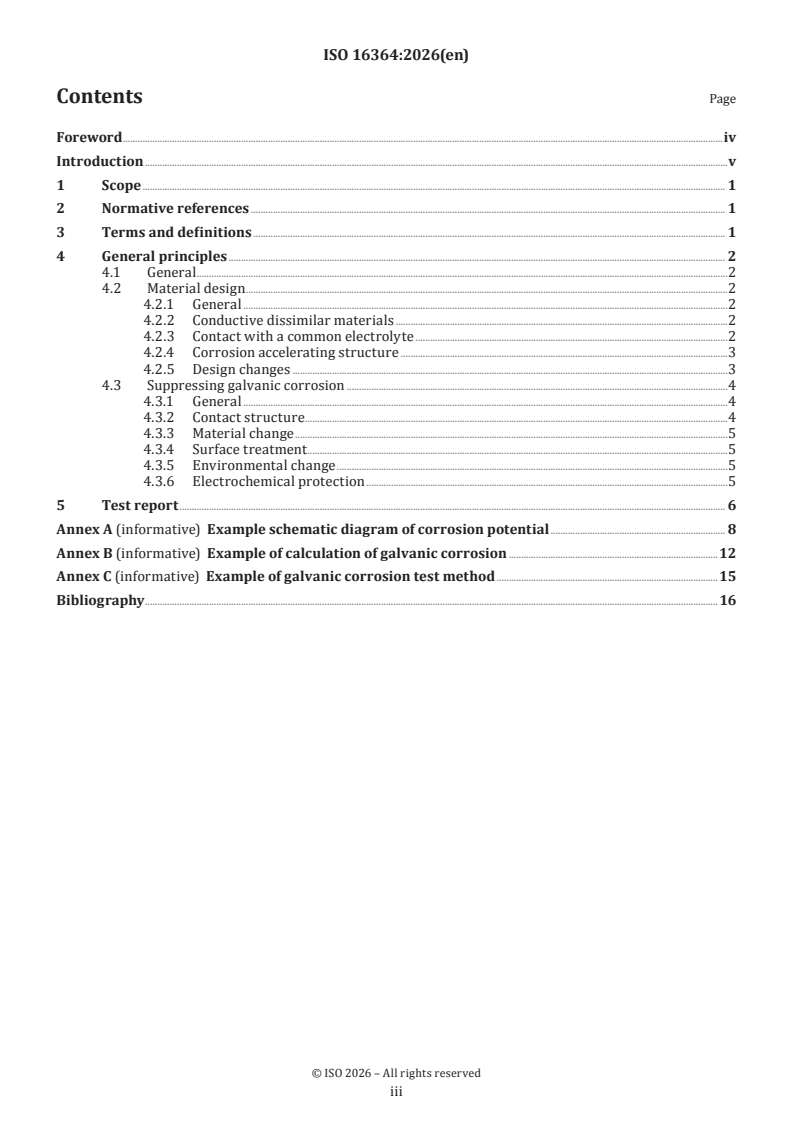

ISO 16364:2026 - Corrosion of metals and alloys — Guidelines for galvanic corrosion control
ISO 16364:2026 - Corrosion des métaux et alliages — Lignes directrices pour le contrôle de la corrosion galvanique
ISO 16364:2026 is an International Standard from ISO on guidelines for galvanic corrosion control in metals and alloys. It gives designers, corrosion engineers, test personnel, and quality teams standard methods for avoiding galvanic corrosion in the design stage, judging whether observed damage was caused by galvanic corrosion, and suppressing it by structural, material, surface, environmental, or electrochemical measures. It also gives guidance for predicting galvanic corrosion in water, atmospheric, and soil environments from polarization data.
What does ISO 16364:2026 specify?
ISO 16364:2026 specifies a practical approach for controlling galvanic corrosion across design, investigation, prediction, and mitigation. It is organized into a short main body - Scope, Normative references, Terms and definitions, General principles, and Test report - plus three informative annexes that give visual, calculation, and test examples.
The scope is narrow in one important way: ISO 16364:2026 is a guideline for control and assessment, not a basis for safety or functional-loss indexes in actual use. At the same time, it can be used to estimate function maintenance life and safety maintenance life in advance, so it is useful when a team needs an engineering judgment before service.
| Annex | What it covers |
|---|---|
| Annex A | An example schematic diagram of corrosion potential, including practical metal and alloy behavior in seawater and in other electrolytes |
| Annex B | An example calculation of galvanic corrosion using numerical methods and electrochemical boundary conditions |
| Annex C | An example galvanic corrosion test method, including typical test conditions and evaluation approaches |
What are the key requirements of ISO 16364:2026?
ISO 16364:2026 is built around a flow-based method: first identify whether a galvanic couple exists, then decide whether the environment allows galvanic action, then choose a prevention or suppression measure, and finally confirm the outcome by test or analysis. In practice, that means the document is useful both for new designs and for troubleshooting damage in service.
Identify the galvanic couple and the electrolyte
Clause 4.2.2 requires checking whether dissimilar conductive materials are electrically connected, including indirect continuity through wiring or other conductive paths. If there is no electrical continuity, galvanic corrosion between those materials does not occur.
Clause 4.2.3 then requires checking whether the same materials also share a common electrolyte. This matters because the electrolyte closes the circuit needed for galvanic corrosion. The clause also points out that condensation can create intermittent electrolyte conditions, so the reader should consider whether moisture can appear even if it is not always visible.
Check whether the structure accelerates corrosion
Clause 4.2.4 asks whether the pair forms a corrosion-accelerating structure. It highlights the importance of potential difference, cathode-to-anode area ratio, and electrolyte resistance. In practice, a small anodic area against a large cathodic area, or a more conductive electrolyte, can increase attack on the anodic material.
Use design changes, prediction, or testing to judge the risk
Clause 4.2.5 allows the design to be changed after a data search, predictive calculation, or accelerated testing. The document names the finite element method (FEM) and the boundary element method (BEM) as calculation approaches, and it also describes salt spray tests, cyclic corrosion tests, galvanic current measurement with a zero-shunt ammeter, and electrochemical testing using the constant potential polarization method set to the coupling potential. In practice, this gives teams several ways to estimate corrosion amount and rate before committing to a final design.
Choose a suppression method in a practical order
Clause 4.3 presents suppression methods as a selection flow, and it notes that some options can be used in parallel. The choice should consider degree of effect, economy, convenience, and practicality.
The main options are:
- change the contact structure, for example by insulating the mating surfaces or blocking electrolyte access
- change the material combination, for example by replacing one material with a non-conductive or non-metallic material or by using similar materials
- change the surface, for example by coating or plating
- change the environment, for example by reducing humidity, removing aggressive species, or adding a corrosion inhibitor
- use electrochemical protection, including cathodic protection or sacrificial anodes where suitable
In practice, this means the document is not limited to one fix. It guides the reader to the least disruptive measure that can be confirmed by test.
Confirm the effect before closing the issue
Several subclauses in 4.3 say to confirm the corrosion-protection effect by corrosion test. That is important because a theoretical fix may fail if coating defects, structural limits, or environmental conditions remain. ISO 16364:2026 therefore treats verification as part of the control process, not an afterthought.
Report the work in a traceable way
Clause 5 requires a report that records the materials, environment, coating details, additives, cathodic protection details, the standard used, the method used, the results with a reference to the calculation clause where relevant, the evaluation method for determining whether the damage was caused by galvanic corrosion, any deviations, unusual observations, and the test date. For a buyer, lab, or auditor, this is the part that makes the conclusion traceable.
What terms does ISO 16364:2026 define?
- corrosion potential - The potential measured when materials A and B are immersed separately in the relevant electrolyte; the document distinguishes noble and base potential, which helps compare which material is more likely to act as the anode.
- coupling potential - The potential measured when materials A and B are electrically short-circuited while in contact with the electrolyte; this is useful when assessing the driving force for galvanic action in the coupled state.
- electrolyte - An ionically conductive liquid or solid medium covering the surfaces of both materials; without it, galvanic current cannot pass.
- area ratio - The ratio between the area of the base-potential material and the noble-potential material; this matters because a small anode against a large cathode can accelerate attack.
- corrosion accelerate structure - A structure that increases corrosion mass loss on the base side through anodic reaction; the document uses this to describe geometries or conditions that make galvanic corrosion worse.
Who uses ISO 16364:2026?
ISO 16364:2026 is aimed at people who design, assess, test, or troubleshoot structures made from dissimilar materials. It is relevant in electronic components, automobiles, aircraft, plant systems, and infrastructure, where multi-material designs are increasingly common.
Typical users include design engineers choosing material pairs, corrosion engineers evaluating failure mechanisms, test laboratories running galvanic corrosion tests, quality managers documenting conclusions, and maintenance or reliability teams estimating service life and repair risk. A buyer or specifier can also use it to check whether a proposed design has a clear galvanic corrosion control plan.
Which standards are used with ISO 16364:2026?
ISO 16364:2026 cites several related standards in its informative material and bibliography that help with testing or comparison work.
- ISO 7441 - used in Annex C as a typical standard for determining bimetallic corrosion in atmospheric exposure corrosion tests.
- ISO 21746 - used in Annex C for galvanic corrosion tests of carbon fibre reinforced plastics (CFRPs) related bonded or fastened structures in artificial atmospheres.
- ASTM G71 - used in Annex C as a guide for conducting and evaluating galvanic corrosion tests in electrolytes.
- ISO 9227 - cited with salt spray tests in Annex C as a reference for artificial atmosphere testing.
- ASTM G82 - cited in the bibliography as a guide for developing and using a galvanic series for predicting galvanic corrosion performance.
What does the ISO 16364:2026 document contain?
ISO 16364:2026 contains a flow-based method for design review, damage assessment, and suppression of galvanic corrosion. It includes a general principle section that explains the galvanic current path and how corrosion rate rises with current density.
The informative annexes add practical support. Annex A gives an example corrosion-potential diagram for practical metals and alloys, including seawater behavior and notes on how the noble/base order can change with environment and time. Annex B sets out calculation examples with mass transfer, charge balance, polarization boundary conditions, and numerical methods such as FEM and BEM. Annex C provides a test-method example with typical conditions such as specimen form, coupling method, temperature, duration, and evaluation approach.
Buy Documents
ISO 16364:2026 - Corrosion of metals and alloys — Guidelines for galvanic corrosion control
ISO 16364:2026 - Corrosion des métaux et alliages — Lignes directrices pour le contrôle de la corrosion galvanique
Get Certified
Connect with accredited certification bodies for this standard

Element Materials Technology
Materials testing and product certification.

Inštitut za kovinske materiale in tehnologije
Institute of Metals and Technology. Materials testing, metallurgical analysis, NDT.
Sponsored listings
Frequently Asked Questions
ISO 16364:2026 is a standard published by the International Organization for Standardization (ISO). Its full title is "Corrosion of metals and alloys — Guidelines for galvanic corrosion control". This standard covers: This document specifies standard methods for avoiding galvanic corrosion in the design stage and for determining whether actual corrosion damage was caused by galvanic corrosion. It also specifies guideline for standard methods for suppressing galvanic corrosion. This document also provides guidance for predicting galvanic corrosion in different environments (e.g. in water and in atmospheric and soil environments) by numerical calculation based on polarization data. This document does not establish the grounds for indexes related to safety or the loss of functions of materials in actual use. However, this document can be used to estimate the function maintenance life and safety maintenance life of these materials in advance. The responsibility for using the guideline rests with the reader.
This document specifies standard methods for avoiding galvanic corrosion in the design stage and for determining whether actual corrosion damage was caused by galvanic corrosion. It also specifies guideline for standard methods for suppressing galvanic corrosion. This document also provides guidance for predicting galvanic corrosion in different environments (e.g. in water and in atmospheric and soil environments) by numerical calculation based on polarization data. This document does not establish the grounds for indexes related to safety or the loss of functions of materials in actual use. However, this document can be used to estimate the function maintenance life and safety maintenance life of these materials in advance. The responsibility for using the guideline rests with the reader.
ISO 16364:2026 is classified under the following ICS (International Classification for Standards) categories: 77.060 - Corrosion of metals. The ICS classification helps identify the subject area and facilitates finding related standards.
ISO 16364:2026 is available in PDF format for immediate download after purchase. The document can be added to your cart and obtained through the secure checkout process. Digital delivery ensures instant access to the complete standard document.
Standards Content (Sample)
International
Standard
ISO 16364
First edition
Corrosion of metals and alloys —
2026-08
Guidelines for galvanic corrosion
control
Corrosion des métaux et alliages — Lignes directrices pour le
contrôle de la corrosion galvanique
Reference number
© ISO 2026
All rights reserved. Unless otherwise specified, or required in the context of its implementation, no part of this publication may
be reproduced or utilized otherwise in any form or by any means, electronic or mechanical, including photocopying, or posting on
the internet or an intranet, without prior written permission. Permission can be requested from either ISO at the address below
or ISO’s member body in the country of the requester.
ISO copyright office
CP 401 • Ch. de Blandonnet 8
CH-1214 Vernier, Geneva
Phone: +41 22 749 01 11
Email: copyright@iso.org
Website: www.iso.org
Published in Switzerland
ii
Contents Page
Foreword .iv
Introduction .v
1 Scope . 1
2 Normative references . 1
3 Terms and definitions . 1
4 General principles . 2
4.1 General .2
4.2 Material design .2
4.2.1 General .2
4.2.2 Conductive dissimilar materials .2
4.2.3 Contact with a common electrolyte .2
4.2.4 Corrosion accelerating structure .3
4.2.5 Design changes .3
4.3 Suppressing galvanic corrosion .4
4.3.1 General .4
4.3.2 Contact structure .4
4.3.3 Material change .5
4.3.4 Surface treatment .5
4.3.5 Environmental change .5
4.3.6 Electrochemical protection .5
5 Test report . 6
Annex A (informative) Example schematic diagram of corrosion potential . 8
Annex B (informative) Example of calculation of galvanic corrosion .12
Annex C (informative) Example of galvanic corrosion test method .15
Bibliography .16
iii
Foreword
ISO (the International Organization for Standardization) is a worldwide federation of national standards
bodies (ISO member bodies). The work of preparing International Standards is normally carried out through
ISO technical committees. Each member body interested in a subject for which a technical committee
has been established has the right to be represented on that committee. International organizations,
governmental and non-governmental, in liaison with ISO, also take part in the work. ISO collaborates closely
with the International Electrotechnical Commission (IEC) on all matters of electrotechnical standardization.
The procedures used to develop this document and those intended for its further maintenance are described
in the ISO/IEC Directives, Part 1. In particular, the different approval criteria needed for the different types
of ISO document should be noted. This document was drafted in accordance with the editorial rules of the
ISO/IEC Directives, Part 2 (see www.iso.org/directives).
ISO draws attention to the possibility that the implementation of this document may involve the use of (a)
patent(s). ISO takes no position concerning the evidence, validity or applicability of any claimed patent
rights in respect thereof. As of the date of publication of this document, ISO had not received notice of (a)
patent(s) which may be required to implement this document. However, implementers are cautioned that
this may not represent the latest information, which may be obtained from the patent database available at
www.iso.org/patents. ISO shall not be held responsible for identifying any or all such patent rights.
Any trade name used in this document is information given for the convenience of users and does not
constitute an endorsement.
For an explanation of the voluntary nature of standards, the meaning of ISO specific terms and expressions
related to conformity assessment, as well as information about ISO's adherence to the World Trade
Organization (WTO) principles in the Technical Barriers to Trade (TBT), see www.iso.org/iso/foreword.html.
This document was prepared by Technical Committee ISO/TC 156, Corrosion of metals and alloys.
Any feedback or questions on this document should be directed to the user’s national standards body. A
complete listing of these bodies can be found at www.iso.org/members.html.
iv
Introduction
Use of multi-materials (i.e. use of metal materials as well as ceramics, semiconductors, carbon fibre and resins
in structures) is advancing rapidly in industrial fields like electronic components, automobiles, aircraft,
plant systems and infrastructure, among others. This has increased the possibility of galvanic corrosion,
heightening the necessity of a comprehensive, cross-sectorial guideline for galvanic corrosion suppression
that includes materials and their environments. However, there are no clear provisions concerning galvanic
corrosion or standards other than bolting of dissimilar materials. The boundary element method (BEM)
and the finite element method (FEM) enable modelling and numerical calculation of galvanic corrosion.
Simulations by these methods have progressed and are already used in practical applications. Moreover,
accompanying the application of multi-materials such as carbon and other non-metallic materials eluted
from ceramics, carbon fibre reinforced plastic (CFRP) or resins is related to galvanic corrosion. This galvanic
corrosion has become a critical issue in automobiles, aircraft, etc.
Under these circumstances, a cross-sectorial guideline on galvanic corrosion, with its many inherent issues,
is necessary.
v
International Standard ISO 16364:2026(en)
Corrosion of metals and alloys — Guidelines for galvanic
corrosion control
1 Scope
This document specifies standard methods for avoiding galvanic corrosion in the design stage and for
determining whether actual corrosion damage was caused by galvanic corrosion. It also specifies guideline
for standard methods for suppressing galvanic corrosion.
This document also provides guidance for predicting galvanic corrosion in different environments (e.g. in
water and in atmospheric and soil environments) by numerical calculation based on polarization data.
This document does not establish the grounds for indexes related to safety or the loss of functions of
materials in actual use. However, this document can be used to estimate the function maintenance life and
safety maintenance life of these materials in advance. The responsibility for using the guideline rests with
the reader.
2 Normative references
There are no normative references in this document.
3 Terms and definitions
For the purposes of this document, the following terms and definitions apply.
ISO and IEC maintain terminology databases for use in standardization at the following addresses:
— ISO Online browsing platform: available at https:// www .iso .org/ obp
— IEC Electropedia: available at https:// www .electropedia .org/
3.1
corrosion potential
potential measured when materials A and B are immersed individually in the environmental electrolyte
(3.3) concerned
Note 1 to entry: Corrosion potential is given as either noble or base potential. Noble potential indicates a potential on
the positive side. Base potential indicates a potential on the negative side.
3.2
coupling potential
potential measured when an electrical short circuit is established between materials A and B which are in
contact with the electrolyte (3.3) concerned
3.3
electrolyte
ionically conductive liquid or solid medium covering the surfaces of material A and material B
3.4
area ratio
ratio of the area of material A with a base corrosion potential (3.1) and material B with a noble corrosion
potential
3.5
corrosion accelerate structure
structures where galvanic corrosion increases the corrosion (corrosion mass loss on the base side due to
anodic reaction)
Note 1 to entry: The usual unit of corrosion is g/m .
EXAMPLE When the potential difference between metals is large or the anode area is small compared to the
cathode.
4 General principles
4.1 General
This document provides guidance to minimise galvanic corrosion.
Galvanic corrosion is caused by an electric current flow from a material A (anode) with a base potential
to a material B (cathode) with a noble potential via an electrolyte and then returned to the base material
A through conductive wiring, a conducting body or the material itself (see Annex A). This current causes
galvanic corrosion and, as the current increases, the anodic current density on the surface of material A
increases and the galvanic corrosion rate correspondingly rises. Galvanic corrosion is accelerated by
electrical contact between materials with different electric potentials.
The method of preventing galvanic corrosion involves reviewing the process and mitigation using a
flowchart that includes one or more of the following:
a) materials designed for avoiding galvanic corrosion;
b) evaluation method for determining whether actual corrosion damage was caused by galvanic corrosion;
c) corrosion protection method for suppressing galvanic corrosion.
4.2 Material design
4.2.1 General
Figure 1 shows a material design flowchart for avoiding galvanic corrosion. It shows when material selection
or, if possible, removal or change in electrolyte should be considered as a design change. It can also be used as
an evaluation method for determining whether actual corrosion damage was caused by galvanic corrosion.
The process is described in 4.2.2 to 4.2.5.
4.2.2 Conductive dissimilar materials
It may be verified whether conductive dissimilar materials are in electrical contact. In addition to direct
contact, “electrical contact” also includes electrical continuity (conduction) by way of wiring, etc. In the
absence of electrical continuity, galvanic corrosion does not take place between those materials.
4.2.3 Contact with a common electrolyte
It may be verified whether the dissimilar materials are in electrical contact and whether they are also in
contact with a common electrolyte. This means verifying whether electrical continuity exists between
the two materials and whether the two materials have also formed an external circuit that has electrical
conduction by the electrolyte. If an electrolyte is not present, galvanic corrosion is avoided. In case of
condensation which can lead to the presence of electrolyte, it is possible that the presence is only cyclical and
therefore not permanently observable. It can be ascertained whether or not there is a risk of condensation.
4.2.4 Corrosion accelerating structure
If dissimilar materials are in electrical contact and an electrolyte also exists between the materials, it may
be verified whether there are factors that accelerate corrosion. Even in the case of dissimilar materials, if
the potentials of the two materials are on approximately the same level in the electrolyte, galvanic corrosion
is avoided. If the cathode/anode area ratio of the surfaces in contact with the electrolyte is sufficiently small,
galvanic corrosion is suppressed. In addition, if the electrolyte has high resistance, the effective area ratio
will differ from the apparent area ratio. Galvanic corrosion can be avoided in structures in which these
corrosion-suppressing actions occur. Conversely, if these actions do not occur and a corrosion-accelerating
structure is formed, galvanic corrosion can occur. Corrosion accelerate structure can be made by increasing
the potential difference with time, increasing the cathode/anode area ratio with time or increasing the
conductivity on the electrolyte with time. In such a case, the design of the non-contacted materials may be
changed.
4.2.5 Design changes
The design may be changed by conducting a data search on galvanic corrosion, predictive calculations for
galvanic corrosion or accelerated galvanic corrosion testing. Calculation methods of galvanic corrosion
are outlined in Annex B. Typical test methods of galvanic corrosion are outlined in Annex C. In accelerated
testing, the amount of corrosion and the corrosion rate may be evaluated by preparing galvanic corrosion
test specimens and conducting a salt spray test or cyclic corrosion test. Alternatively, the amount of corrosion
and the corrosion rate may be evaluated by preparing galvanic corrosion test specimens and measuring
the galvanic current using a zero-shunt ammeter or electrochemical testing using the constant potential
polarization method set to the coupling potential. In predictive calculations, the amount of corrosion and
the corrosion rate may be predicted by either:
— the FEM, the numerical simulation to solve corrosion related equations by dividing the geometry into
finite elements;
— the BEM, the numerical simulation to solve corrosion related equations by dividing the boundary into
elements).
Corrosion may be evaluated quantitatively by either of these methods (see Annex B). In predictive
calculations, it can be possible to consider diffusion of dissolved oxygen for cases where the cathodic
reaction becomes rate-controlling and the effect of corrosion products that are influential to control both
(cathodic and anodic) reactions. If the design is modified, it can be necessary to recommence the process
beginning with the "Contact of dissimilar materials?" step (see Figure 1). Finally, when all the judgement
items are confirmed as “No”, the design may be fixed.
Figure 1 — Material design flowchart
4.3 Suppressing galvanic corrosion
4.3.1 General
Figure 2 shows a flowchart for the selection of methods for suppressing galvanic corrosion. Some of the
methods in Figure 2 should be executed in parallel and cannot be arranged in order. For example, when two
or more methods are possible at the same time, the method chosen should take into account the degree of
effect, economy, convenience and practicality. The process is described in 4.3.2 to 4.3.6.
4.3.2 Contact structure
The contact structure of the dissimilar materials may be changed. A structure can be provided, for example,
with an insulating material between the contact
...
Norme
internationale
ISO 16364
Première édition
Corrosion des métaux et alliages —
2026-08
Lignes directrices pour le contrôle
de la corrosion galvanique
Corrosion of metals and alloys — Guidelines for galvanic
corrosion control
Numéro de référence
DOCUMENT PROTÉGÉ PAR COPYRIGHT
© ISO 2026
Tous droits réservés. Sauf prescription différente ou nécessité dans le contexte de sa mise en œuvre, aucune partie de cette
publication ne peut être reproduite ni utilisée sous quelque forme que ce soit et par aucun procédé, électronique ou mécanique,
y compris la photocopie, ou la diffusion sur l’internet ou sur un intranet, sans autorisation écrite préalable. Une autorisation peut
être demandée à l’ISO à l’adresse ci-après ou au comité membre de l’ISO dans le pays du demandeur.
ISO copyright office
Case postale 401 • Ch. de Blandonnet 8
CH-1214 Vernier, Genève
Tél.: +41 22 749 01 11
E-mail: copyright@iso.org
Web: www.iso.org
Publié en Suisse
ii
Sommaire Page
Avant-propos .iv
Introduction .v
1 Domaine d’application . 1
2 Références normatives . 1
3 Termes et définitions . 1
4 Principes généraux . 2
4.1 Généralités .2
4.2 Conception des matériaux .2
4.2.1 Généralités .2
4.2.2 Matériaux conducteurs dissemblables .2
4.2.3 Contact avec un électrolyte commun .3
4.2.4 Structure accélérant la corrosion .3
4.2.5 Modifications de conception .3
4.3 Suppression de la corrosion galvanique .4
4.3.1 Généralités .4
4.3.2 Structure contact .4
4.3.3 Changement de matériaux .5
4.3.4 Traitement de surface .5
4.3.5 Changement d’environnement .5
4.3.6 Protection électrochimique .5
5 Rapport d’essai . 6
Annexe A (informative) Exemple de diagramme schématique du potentiel de corrosion . 8
Annexe B (informative) Exemple de calcul de la corrosion galvanique .12
Annexe C (informative) Exemple de méthode d’essai de la corrosion galvanique .15
Bibliographie .16
iii
Avant-propos
L’ISO (Organisation internationale de normalisation) est une fédération mondiale d’organismes nationaux
de normalisation (comités membres de l’ISO). L’élaboration des Normes internationales est en général
confiée aux comités techniques de l’ISO. Chaque comité membre intéressé par une étude a le droit de faire
partie du comité technique créé à cet effet. Les organisations internationales, gouvernementales et non
gouvernementales, en liaison avec l’ISO participent également aux travaux. L’ISO collabore étroitement avec
la Commission électrotechnique internationale (IEC) en ce qui concerne la normalisation électrotechnique.
Les procédures utilisées pour élaborer le présent document et celles destinées à sa mise à jour sont
décrites dans les Directives ISO/IEC, Partie 1. Il convient, en particulier, de prendre note des différents
critères d’approbation requis pour les différents types de documents ISO. Le présent document
a été rédigé conformément aux règles de rédaction données dans les Directives ISO/IEC, Partie 2
(voir www.iso.org/directives).
L’ISO attire l’attention sur le fait que la mise en application du présent document peut entraîner l’utilisation
d’un ou de plusieurs brevets L’ISO ne prend pas position quant à la preuve, à la validité et à l’applicabilité
de tout droit de brevet revendiqué à cet égard. À la date de publication du présent document, l’ISO n’avait
pas reçu notification qu’un ou plusieurs brevets pouvaient être nécessaires à sa mise en application.
Toutefois, il y a lieu d’avertir les responsables de la mise en application du présent document que des
informations plus récentes sont susceptibles de figurer dans la base de données de brevets, disponible à
l’adresse www.iso.org/patents. L’ISO ne saurait être tenue pour responsable de ne pas avoir identifié tout ou
partie de tels droits de brevet.
Les appellations commerciales éventuellement mentionnées dans le présent document sont données pour
information, par souci de commodité, à l’intention des utilisateurs et ne sauraient constituer un engagement.
Pour une explication de la nature volontaire des normes, la signification des termes et expressions
spécifiques de l’ISO liés à l’évaluation de la conformité, ou pour toute information au sujet de l’adhésion de
l’ISO aux principes de l’Organisation mondiale du commerce (OMC) concernant les obstacles techniques au
commerce (OTC), voir www.iso.org/iso/fr/avant-propos.html.
Le présent document a été élaboré par le comité technique ISO/TC 156, Corrosion des métaux et alliages.
Il convient que l’utilisateur adresse tout retour d’information ou toute question concernant le présent
document à l’organisme national de normalisation de son pays. Une liste exhaustive desdits organismes se
trouve à l’adresse www.iso.org/fr/members.html.
iv
Introduction
L’usage de multi-matériaux (autrement dit le recours à des matériaux métalliques combinés à des céramiques,
des semi-conducteurs, des fibres de carbones et des résines dans certaines structures) progresse rapidement
dans divers secteurs industriels tels que les composants électroniques, l’automobile, l’aéronautique, les
systèmes et les infrastructures destinés aux usines, pour n’en citer que quelques-uns. Cette tendance a accru
le risque de corrosion galvanique et accentué la nécessité de disposer de lignes directrices trans-sectorielles
détaillées pour la suppression de la corrosion galvanique, couvrant les matériaux et leurs environnements.
Il n’existe toutefois aucune disposition claire concernant la corrosion galvanique ni aucune norme autre que
celles abordant le boulonnage de matériaux dissemblables. La méthode des éléments de frontière (BEM) et
la méthode des éléments finis (FEM) permettent de modéliser et de calculer numériquement la corrosion
galvanique. Les simulations réalisées avec ces méthodes ont progressé et sont déjà employées dans des
applications pratiques. De plus, l’accompagnement de l’application de multi-matériaux tels que le carbone
et d’autres matériaux non métalliques obtenus à partir de céramiques, de polymères renforcés de fibres
de carbone (PRFC) ou de résines peut influer sur la corrosion galvanique. Cette corrosion galvanique est
devenue un problème crucial dans l’automobile, l’aéronautique…
Dans ces circonstances, il est nécessaire de disposer de lignes directrices trans-sectorielles sur la corrosion
galvanique et ses nombreux aspects inhérents.
v
Norme internationale ISO 16364:2026(fr)
Corrosion des métaux et alliages — Lignes directrices pour le
contrôle de la corrosion galvanique
1 Domaine d’application
Le présent document spécifie les méthodes normalisées permettant d’éviter la corrosion galvanique durant
la phase de conception et de déterminer si un dommage de corrosion existant a été provoqué par la corrosion
galvanique. Il donne également les lignes directrices des méthodes normalisées permettant de supprimer la
corrosion galvanique.
Le présent document fournit aussi des recommandations pour prédire la corrosion galvanique dans
différents environnements (par exemple dans l’eau ou dans les environnements atmosphériques et du sol)
par des calculs numériques basés sur des données de polarisation.
Le présent document ne définit pas les fondements des indices liés à la sécurité ou à la perte de fonctions des
matériaux dans le cadre de leur utilisation réelle. Il peut toutefois servir à estimer à l’avance la durée de vie
résiduelle des matériaux avec maintien des fonctions et la durée de vie résiduelle des matériaux en sécurité.
Il est de la responsabilité du lecteur d’utiliser ces lignes directrices.
2 Références normatives
Le présent document ne contient aucune référence normative.
3 Termes et définitions
Pour les besoins du présent document, les termes et définitions suivants s’appliquent.
L’ISO et l’IEC tiennent à jour des bases de données terminologiques destinées à être utilisées en normalisation,
consultables aux adresses suivantes:
— ISO Online browsing platform: disponible à l’adresse https:// www .iso .org/ obp
— IEC Electropedia: disponible à l’adresse https:// www .electropedia .org/
3.1
potentiel de corrosion
potentiel mesuré lorsque deux matériaux A et B sont immergés individuellement dans l’électrolyte (3.3)
environnemental concerné
Note 1 à l'article: Le potentiel de corrosion est donné sous la forme d’un potentiel noble ou d’un potentiel de base. Un
potentiel noble indique un potentiel du côté positif. Un potentiel de base indique un potentiel du côté négatif.
3.2
potentiel de couplage
potentiel mesuré lorsqu’un court-circuit électrique est établi entre deux matériaux A et B qui sont en contact
avec l’électrolyte (3.3) concerné
3.3
électrolyte
milieu liquide ou solide conducteur d’ions et recouvrant la surface du matériau A et du matériau B
3.4
rapport de surface
rapport entre la surface d’un matériau A présentant un potentiel de corrosion (3.1) de base et un matériau B
présentant un potentiel de corrosion noble
3.5
structure accélérant la corrosion
structures dans lesquelles la corrosion galvanique accroît la corrosion (perte de masse par corrosion sur le
côté de base provoquée par une réaction anodique)
Note 1 à l'article: La corrosion est habituellement exprimée en g/m .
EXEMPLE Lorsque la différence de potentiel entre métaux est grande ou lorsque la surface de l’anode est petite
par rapport à celle de la cathode.
4 Principes généraux
4.1 Généralités
Le présent document fournit des recommandations pour réduire le plus possible la corrosion galvanique.
La corrosion galvanique est causée par un courant électrique circulant d’un matériau A (anode) avec un
potentiel de base à un matériau B (cathode) avec un potentiel noble via un électrolyte, puis retournant au
matériau de base A par le biais d’un câblage conducteur, d’un corps conducteur ou du matériau lui-même
(voir l’Annexe A). Ce courant provoque une corrosion galvanique et, à mesure que le courant augmente,
la densité du courant anodique à la surface du matériau A augmente et le taux de corrosion galvanique
augmente en conséquence. La corrosion galvanique est accélérée par le contact électrique entre des
matériaux présentant des potentiels électriques différents.
La méthode permettant de prévenir la corrosion galvanique consiste à examiner le processus et les mesures
d’atténuation à l’aide d’un organigramme comprenant un ou plusieurs des éléments suivants:
a) des matériaux conçus pour éviter la corrosion galvanique;
b) une méthode d’évaluation permettant de déterminer si un dommage de corrosion existant est dû à la
corrosion galvanique;
c) une méthode de protection contre la corrosion permettant de supprimer la corrosion galvanique.
4.2 Conception des matériaux
4.2.1 Généralités
La Figure 1 montre un organigramme de la conception des matériaux permettant d’éviter la corrosion
galvanique. Il indique quand il convient d’envisager de modifier la conception en changeant le choix des
matériaux ou, si possible, en retirant ou en remplaçant l’électrolyte. Il peut également servir de méthode
d’évaluation pour déterminer si un dommage de corrosion existant est dû à la corrosion galvanique. Le
processus est décrit en 4.2.2 à 4.2.5.
4.2.2 Matériaux conducteurs dissemblables
Il est possible de vérifier si des matériaux conducteurs dissemblables sont en contact électrique. Outre un
contact direct, le “contact électrique” implique également une continuité électrique (conduction) par le biais
de câbles, etc. En l’absence de continuité électrique, aucune corrosion galvanique ne se produit entre ces
matériaux.
4.2.3 Contact avec un électrolyte commun
Il est possible de vérifier si les matériaux dissemblables sont en contact électrique et s’ils sont également en
contact avec un électrolyte commun. Il s’agit de vérifier s’il existe une continuité électrique entre les deux
matériaux et si les deux matériaux forment aussi un circuit externe dont la conduction électrique est assurée
par l’électrolyte. En l’absence d’électrolyte, la corrosion galvanique est évitée. En cas de condensation
pouvant conduire à la présence d’électrolyte, il est possible que cette présence ne soit que cyclique et donc
non observable en permanence. Il est possible de déterminer s’il existe ou non un risque de condensation.
4.2.4 Structure accélérant la corrosion
Si des matériaux dissemblables sont en contact électrique et si un électrolyte est également présent entre
les matériaux, il est possible de vérifier s’il existe des facteurs qui accélèrent la corrosion. Même dans
le cas de matériaux dissemblables, si les potentiels des deux matériaux sont à peu près du même niveau
dans l’électrolyte, la corrosion galvanique est évitée. Si le rapport des surfaces cathode/anode en contact
avec l’électrolyte est suffisamment faible, la corrosion galvanique est supprimée. En outre, si l’électrolyte
présente une résistance élevée, le rapport de surface effectif sera différent du rapport de surface apparent.
La corrosion galvanique peut être évitée dans les structures dans lesquelles sont mises en œuvre ces actions
de suppression de la corrosion. Inversement, si ces actions ne sont pas mises en œuvre et si une configuration
de structure accélérant la corrosion est formée, une corrosion galvanique peut se produire. Il est possible de
créer une structure accélérant la corrosion en augmentant la différence de potentiel au cours du temps, en
augmentant le rapport de surface cathode/anode au cours du temps ou en augmentant la conductivité de
l’électrolyte au cours du temps. Dans ce cas, la conception des matériaux sans contact peut être modifiée.
4.2.5 Modifications de conception
La conception peut être modifiée en effectuant une recherche de données sur la corrosion galvanique, des
calculs prédictifs de la corrosion galvanique ou des essais de corrosion galvanique accélérée. Les méthodes
de calcul de la corrosion galvanique sont décrites à l’Annexe B. Les méthodes d’essai typiques de la corrosion
galvanique figurent à l’Annexe C. Au cours d’essais accélérés, l’ampleur de la corrosion et la vitesse de
corrosion peuvent être évaluées en préparant des éprouvettes pour la corrosion galvanique et en effectuant
un essai au brouillard salin ou un essai de corrosion cyclique. Il est également possible d’évaluer l’ampleur
de la corrosion et la vitesse de corrosion en préparant des éprouvettes pour la corrosion galvanique et en
mesurant le courant galvanique à l’aide d’un ampèremètre à shunt nul ou d’un essai électrochimique selon
la méthode de la polarisation à potentiel constant réglée sur le potentiel de couplage. Dans les calculs
prédictifs, l’ampleur de la corrosion et la vitesse de corrosion peuvent être prédites par l’une ou l’autre des
méthodes suivantes:
— la FEM, avec une simulation numérique permettant de résoudre les équations de la corrosion en divisant
la géométrie en éléments finis;
— la BEM, avec une simulation numérique permettant de résoudre les équations de la corrosion en divisant
la frontière en éléments.
La corrosion peut être évaluée quantitativement par l’une ou l’autre de ces méthodes (voir l’Annexe B). Dans
les calculs prédictifs, il est possible de prendre en compte la diffusion de l’oxygène dissous dans les cas où la
réaction cathodique devient cinétiquement limitante et l’effet des produits de corrosion qui influent sur le
contrôle des deux réactions (cathodique et anodique). Si la conception est modifiée, il peut s’avérer nécessaire
de recommencer le processus en commençant par l’étape “Contact entre matériaux dissemblables?”
(voir Figure 1). Pour finir, lorsqu’il est confirmé que tous les éléments d’appréciation correspondent à “non”,
la conception peut être figée.
Figure 1 — Organigramme concernant la conception d’une structure de matériaux
4.3 Suppression de la corrosion galvanique
4.3.1 Généralités
La Figure 2 montre un organigramme concernant la sélection des méthodes de suppression de la corrosion
galvanique. Il convient d’appliquer en parallèle certaines des méthodes de la Figure 2 qui ne peuvent être
suivies consécutivement. Par exemple, lorsqu’il est possible d’opter en même temps deux méthodes ou plus,
il convient de choisir la méthode en fonction de l’ampleur de l’effet, de l’économie, de la commodité et de la
praticité. Le processus est décrit en 4.3.2 à 4.3.6.
4.3.2 Structure contact
La structure du contact entre les matériaux dissemblables peut être modifiée. Une structure peut être
assortie, par exemple, d’un matériau isolant entre les s
...