

ISO 2587:1972
(Main)Side and face milling cutters with plain bore and key drive — Metric series
General Information
- Abstract
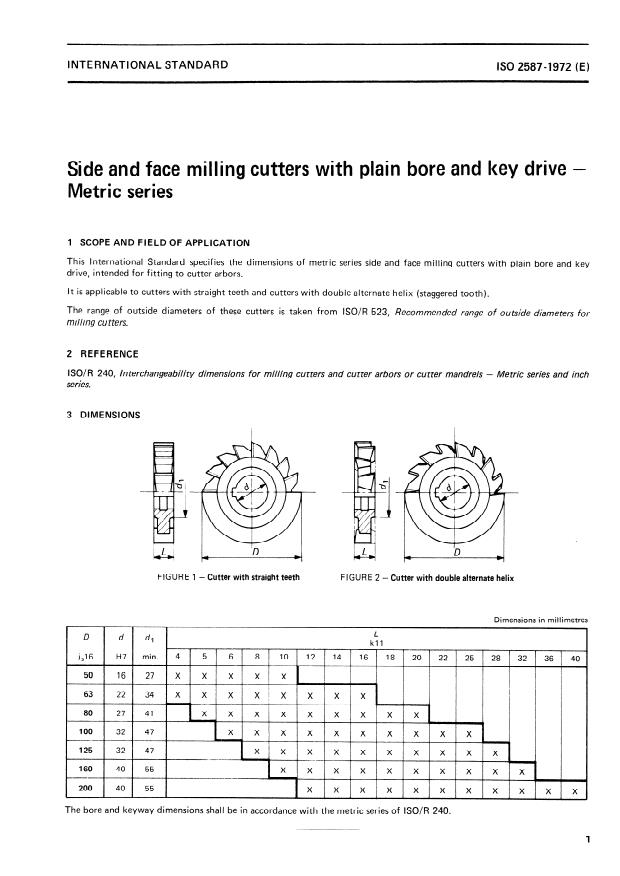
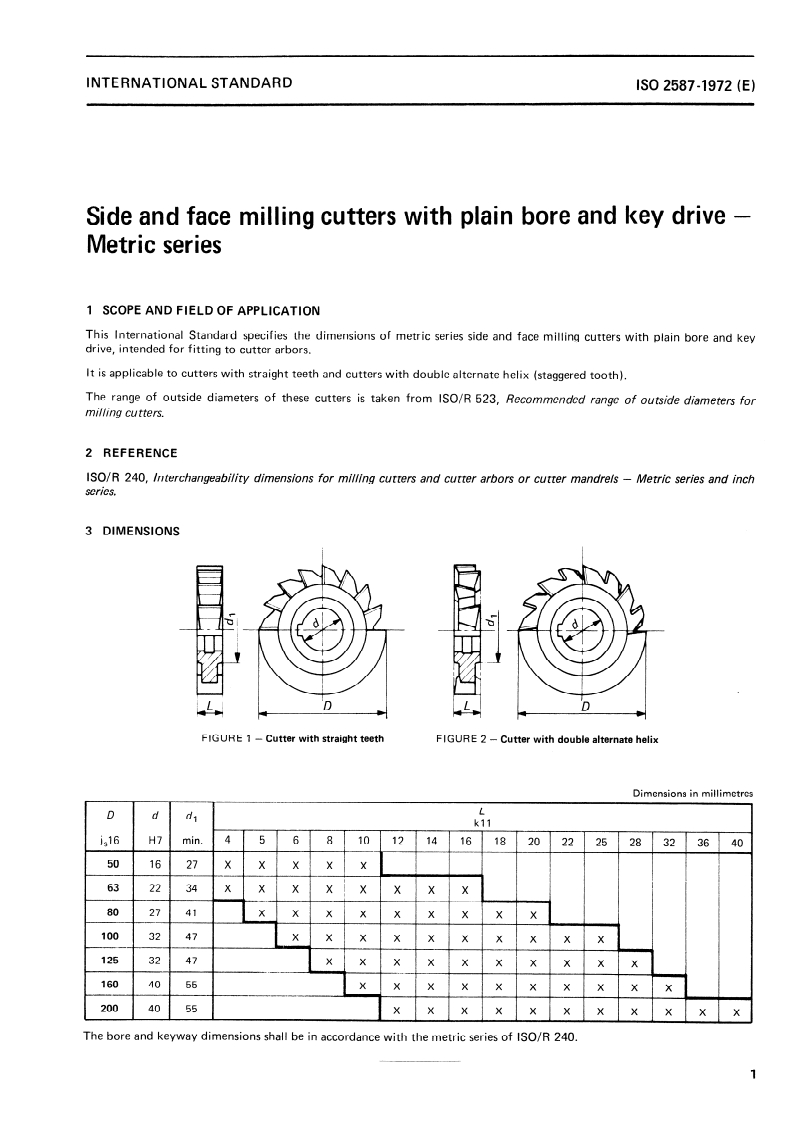
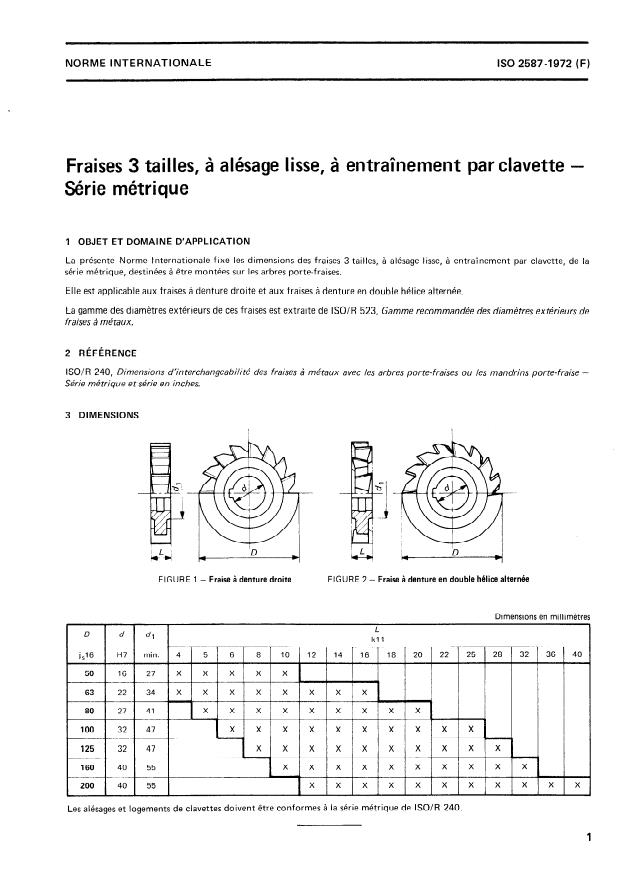
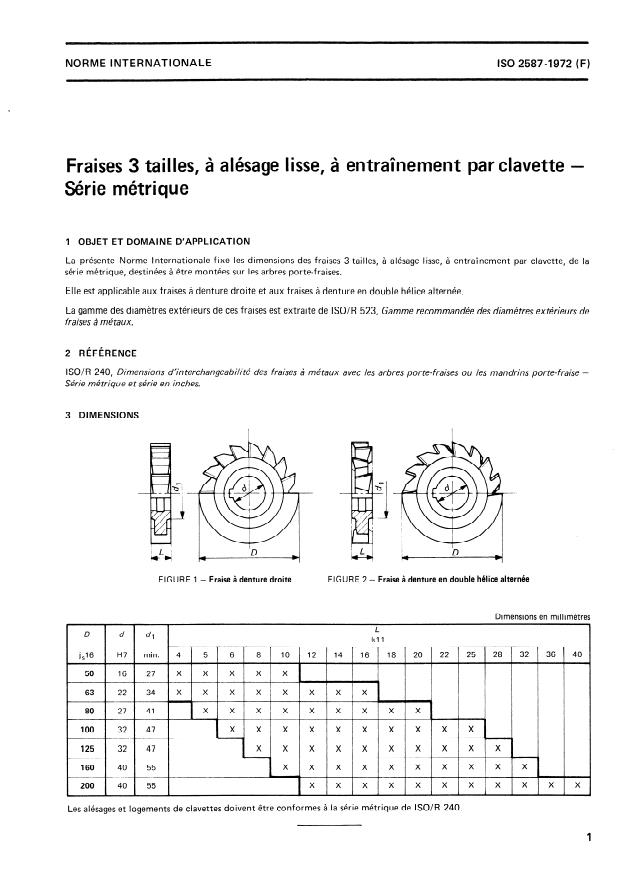
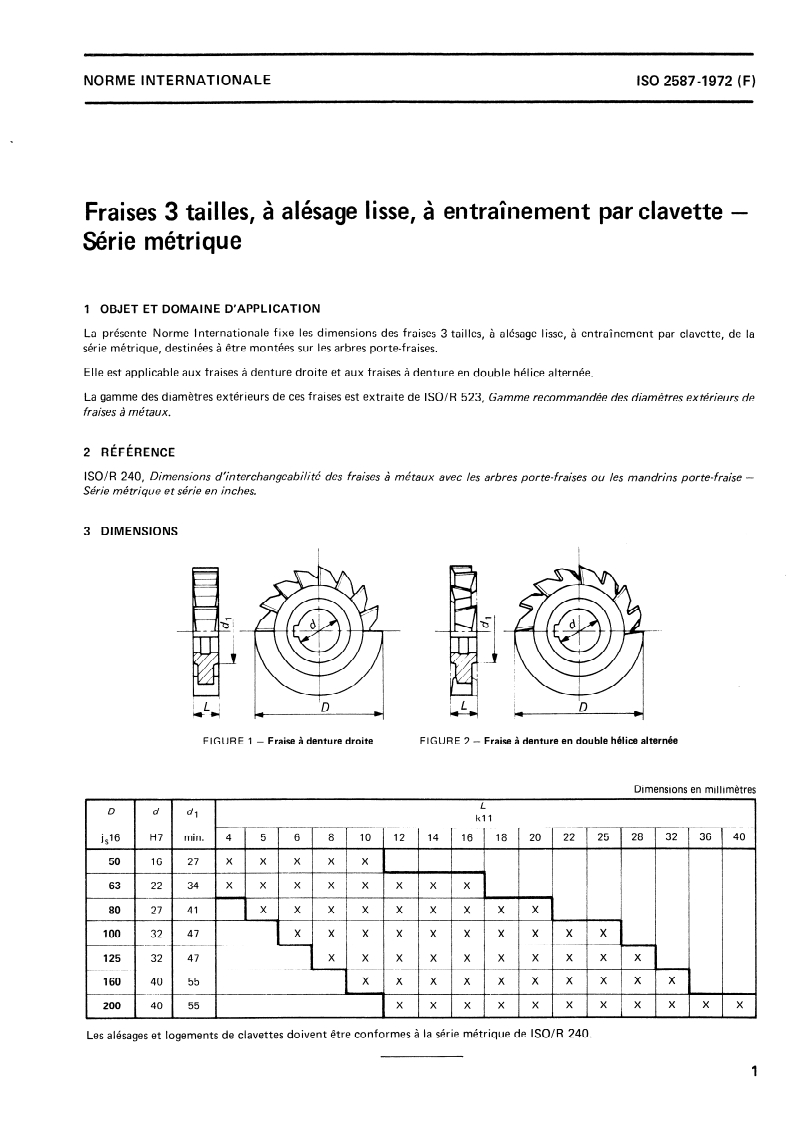
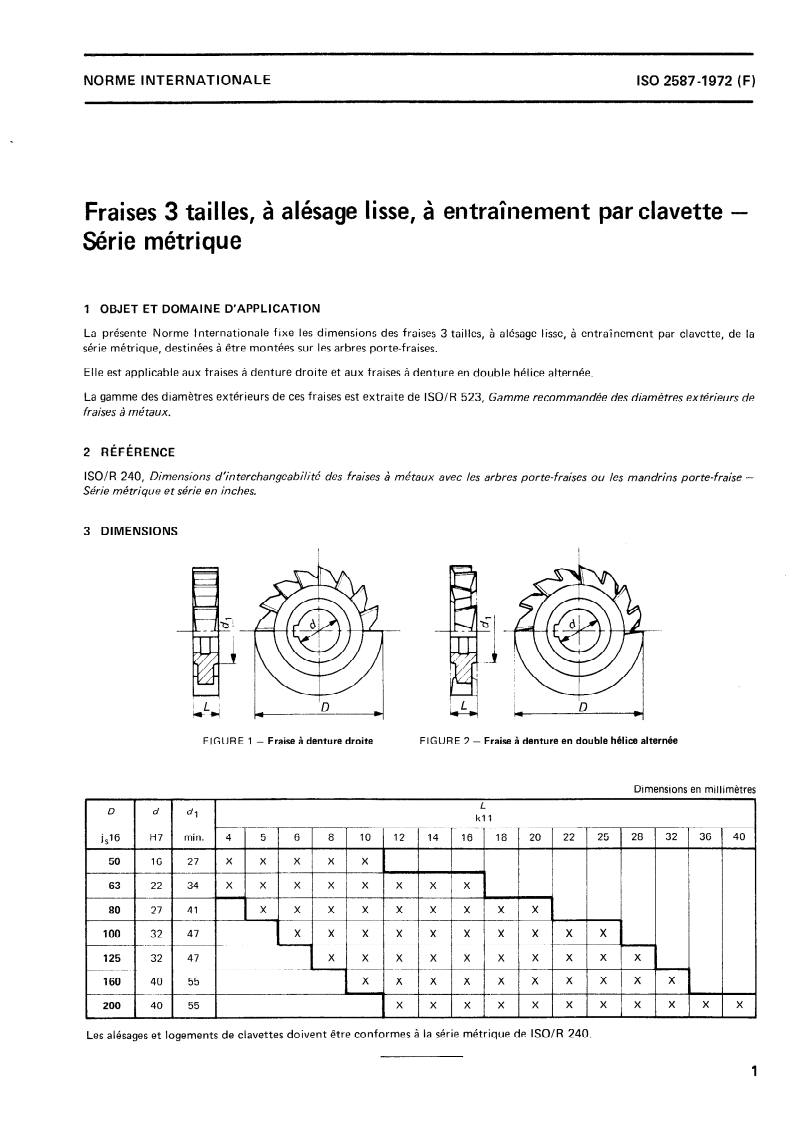
Specifies the dimensions of these side and face milling cutters intended for fitting to the ends of cutter arbors. Applies to cutters, with straigth-sided teeth and with double helical teeth. The range of outside diameters is taken from ISO 523.
- Status
- Published
- Publication Date
- 30-Nov-1972
- Current Stage
- 9093 - International Standard confirmed
- Start Date
- 23-Dec-2022
- Completion Date
- 29-Aug-2026
Buy Documents

ISO 2587:1972 - Side and face milling cutters with plain bore and key drive -- Metric series

ISO 2587:1972 - Side and face milling cutters with plain bore and key drive — Metric series/1/1972

ISO 2587:1972 - Fraises 3 tailles, a alésage lisse, a entraînement par clavette -- Série métrique

ISO 2587:1972 - Fraises 3 tailles, a alésage lisse, a entraînement par clavette -- Série métrique
ISO 2587:1972 - Fraises 3 tailles, à alésage lisse, à entraînement par clavette — Série métrique/1/1972
ISO 2587:1972 - Fraises 3 tailles, à alésage lisse, à entraînement par clavette — Série métrique/1/1972
Overview
ISO 2587:1972 is an international standard published by the International Organization for Standardization (ISO) that specifies the precise dimensions for side and face milling cutters with plain bore and key drive in metric series. These milling cutters are designed to fit on cutter arbors and are used primarily in machining processes involving the milling of materials. This standard covers cutters with straight-sided teeth and those with double helical (staggered) teeth, ensuring consistency and interchangeability in manufacturing and industrial applications. The range of outside diameters for these cutters aligns with the recommendations set out in ISO 523.
Key Topics
- Dimensional Specifications: Defines the exact size parameters of the cutters, including outside diameter, bore, and keyway sizes, facilitating compatibility with cutter arbors.
- Tooth Types: Applies to cutters featuring both straight teeth and double alternate helix teeth, expanding versatility for different milling needs.
- Metric Series Focus: All dimensions and tolerances are standardized according to the metric system, supporting global consistency.
- Compliance with ISO/R 240: The standard references ISO/R 240 for bore and keyway dimensions to maintain interchangeability across milling cutter components.
- Applications in Tooling: Primarily intended for use in metalworking and precision machining industries that rely on milling operations.
Applications
ISO 2587:1972 is essential in various industrial and manufacturing settings, particularly those involving precision milling tasks:
- Metalworking Shops: Enables the selection of milling cutters with guaranteed dimensional accuracy, improving tool fit and machining quality.
- Cutter Arbor Manufacturing: Helps ensure that cutter arbor designs can accommodate cutters with standardized bores and key drives.
- Automotive and Aerospace Industries: Supports the machining of high-precision components by providing cutters conforming to exact specifications.
- Tool & Die Making: Offers reliable cutter options necessary for producing detailed dies and molds requiring exact cuts.
- Mechanical Engineering: Facilitates maintenance of machinery involved in milling by providing standardized cutter choices.
By adhering to ISO 2587, manufacturers and end-users achieve enhanced compatibility between cutters and arbors, reducing downtime and tool replacement costs.
Related Standards
To fully leverage the benefits of ISO 2587, it is important to consider it alongside related ISO standards:
- ISO 523 - Recommended range of outside diameters for milling cutters: Defines the overall sizing range integrated into ISO 2587’s dimensional specifications.
- ISO/R 240 - Interchangeability dimensions for milling cutters and cutter arbors or cutter mandrels (Metric and Inch Series): Dictates bore and keyway dimensions ensuring compatibility across different tooling components.
- ISO 8688 series - Milling cutters with indexable inserts: Complements ISO 2587 by focusing on a different category of milling tools used in modern machining practices.
- ISO 26623 - Milling tool holders: Relevant for selection and standardization of tooling setups involving milling cutters.
Conclusion
ISO 2587:1972 provides crucial guidelines for the design and manufacturing of side and face milling cutters with plain bore and key drive in metric sizes. By standardizing dimensions for cutters with both straight and double helical teeth, this standard promotes interchangeability, efficiency, and safety in milling operations. Industries relying on precise milling tooling benefit from its adoption through minimized errors, streamlined inventory management, and enhanced product quality. For manufacturers and users in machining, adherence to ISO 2587 ensures reliable tool performance and service life.
Relations
- Effective Date
- 06-Jun-2022
Buy Documents
ISO 2587:1972 - Side and face milling cutters with plain bore and key drive -- Metric series
ISO 2587:1972 - Side and face milling cutters with plain bore and key drive — Metric series/1/1972
ISO 2587:1972 - Fraises 3 tailles, a alésage lisse, a entraînement par clavette -- Série métrique
ISO 2587:1972 - Fraises 3 tailles, a alésage lisse, a entraînement par clavette -- Série métrique
ISO 2587:1972 - Fraises 3 tailles, à alésage lisse, à entraînement par clavette — Série métrique/1/1972
ISO 2587:1972 - Fraises 3 tailles, à alésage lisse, à entraînement par clavette — Série métrique/1/1972
Get Certified
Connect with accredited certification bodies for this standard

DVS-ZERT GmbH
German welding certification society.
CARES (UK Certification Authority for Reinforcing Steels)
UK certification for reinforcing steels and construction.
EWF/IIW (European/International Welding Federation)
International welding personnel certification.
Sponsored listings
Frequently Asked Questions
ISO 2587:1972 is a standard published by the International Organization for Standardization (ISO). Its full title is "Side and face milling cutters with plain bore and key drive — Metric series". This standard covers: Specifies the dimensions of these side and face milling cutters intended for fitting to the ends of cutter arbors. Applies to cutters, with straigth-sided teeth and with double helical teeth. The range of outside diameters is taken from ISO 523.
Specifies the dimensions of these side and face milling cutters intended for fitting to the ends of cutter arbors. Applies to cutters, with straigth-sided teeth and with double helical teeth. The range of outside diameters is taken from ISO 523.
ISO 2587:1972 is classified under the following ICS (International Classification for Standards) categories: 25.100.20 - Milling tools. The ICS classification helps identify the subject area and facilitates finding related standards.
ISO 2587:1972 has the following relationships with other standards: It is inter standard links to ISO 15004:1997. Understanding these relationships helps ensure you are using the most current and applicable version of the standard.
ISO 2587:1972 is available in PDF format for immediate download after purchase. The document can be added to your cart and obtained through the secure checkout process. Digital delivery ensures instant access to the complete standard document.
Standards Content (Sample)
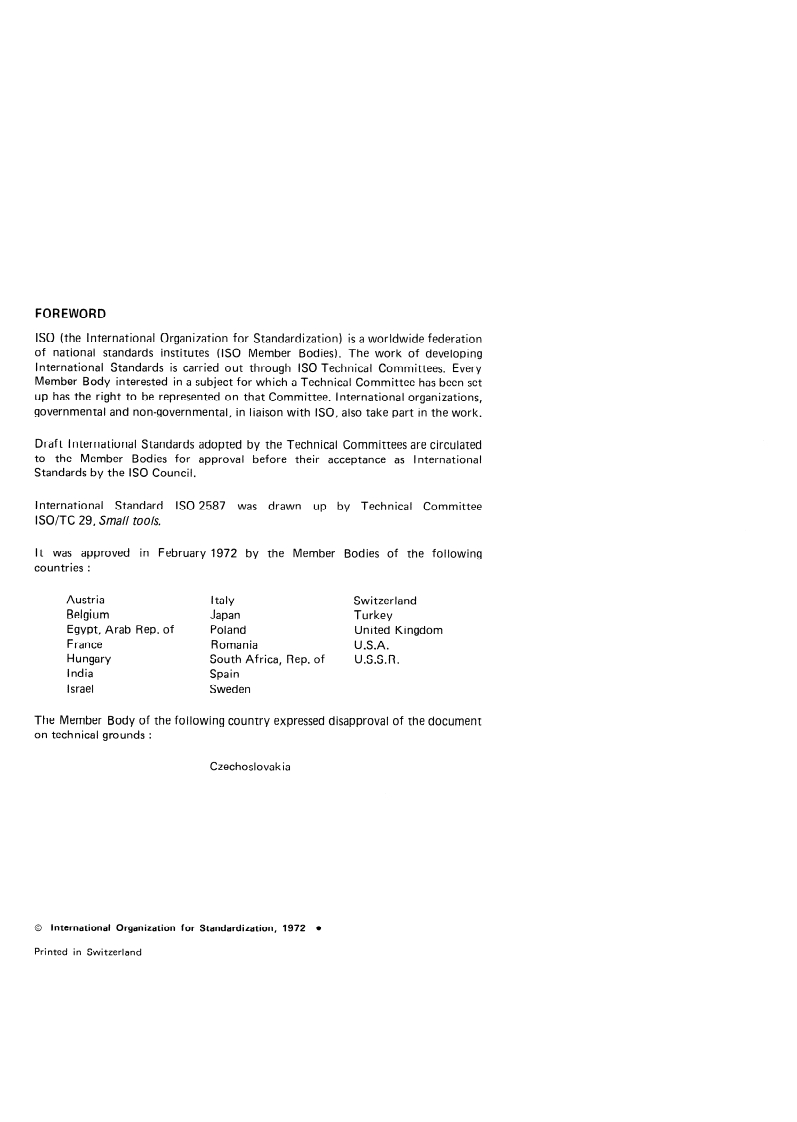
INTERNATIONAL STANDARD
INTERNATIONAL ORGANIZATION FOR STANDARDIZATION l MEXfiYHAPOJJHAX OPTAHW3ALGiff l-IO CTAHAAPTW3AWiW~ORGANISATION INTERNATIONALE DE NORMALISATION
Side and face milling cutters with plain bore and key drive -
Metric series
First edition - 1972- 12-01
~--
UDC 621.914.28
Ref. No. IS0 25874972 (E)
Descriptors : toots, cutting tools, milling cutters, dimensions.
Price based on 1 page
FOREWORD
IS0 (the International Organization for Standardization) is a worldwide federation
of national standards institutes (IS0 Member Bodies). The work of developing
International Standards is carried out through IS0 Technical Committees. Every
Member Body interested in a subject for which a Technical Committee has been set
up has the right to be represented on that Committee. International organizations,
governmental and non-governmental, in liaison with ISO, also take part in the work.
Draft International Standards adopted by the Technical Committees are circulated
to the Member Bodies for approval before their acceptance as International
Standards by the IS0 Council.
International Standard IS0 2587 was drawn up by Technical Committee
ISO/TC 29, Small took.
It was approved in February 1972 by the Member Bodies of the following
countries :
Austria
Italy Switzerland
Belgium Japan Turkey
Egypt, Arab Rep. of Poland United Kingdom
France Romania U.S.A.
Hungary South Africa, Rep. of U.S.S.R.
India Spain
Israel Sweden
The Member Body of the following country expressed disapproval
...
INTERNATIONAL STANDARD
INTERNATIONAL ORGANIZATION FOR STANDARDIZATION l MEXfiYHAPOJJHAX OPTAHW3ALGiff l-IO CTAHAAPTW3AWiW~ORGANISATION INTERNATIONALE DE NORMALISATION
Side and face milling cutters with plain bore and key drive -
Metric series
First edition - 1972- 12-01
~--
UDC 621.914.28
Ref. No. IS0 25874972 (E)
Descriptors : toots, cutting tools, milling cutters, dimensions.
Price based on 1 page
FOREWORD
IS0 (the International Organization for Standardization) is a worldwide federation
of national standards institutes (IS0 Member Bodies). The work of developing
International Standards is carried out through IS0 Technical Committees. Every
Member Body interested in a subject for which a Technical Committee has been set
up has the right to be represented on that Committee. International organizations,
governmental and non-governmental, in liaison with ISO, also take part in the work.
Draft International Standards adopted by the Technical Committees are circulated
to the Member Bodies for approval before their acceptance as International
Standards by the IS0 Council.
International Standard IS0 2587 was drawn up by Technical Committee
ISO/TC 29, Small took.
It was approved in February 1972 by the Member Bodies of the following
countries :
Austria
Italy Switzerland
Belgium Japan Turkey
Egypt, Arab Rep. of Poland United Kingdom
France Romania U.S.A.
Hungary South Africa, Rep. of U.S.S.R.
India Spain
Israel Sweden
The Member Body of the following country expressed disapproval
...
NORME INTERNATIONALE
INTERNATIONAL ORGANIZATION FOR STANDARDIZATION l MEXflYHAPOAHAX OPTAHM3ALUï5i l-I0 CTAH)JAPTM3ALJWW-ORGANISATION INTERNATIONALE DE NORMALISATION
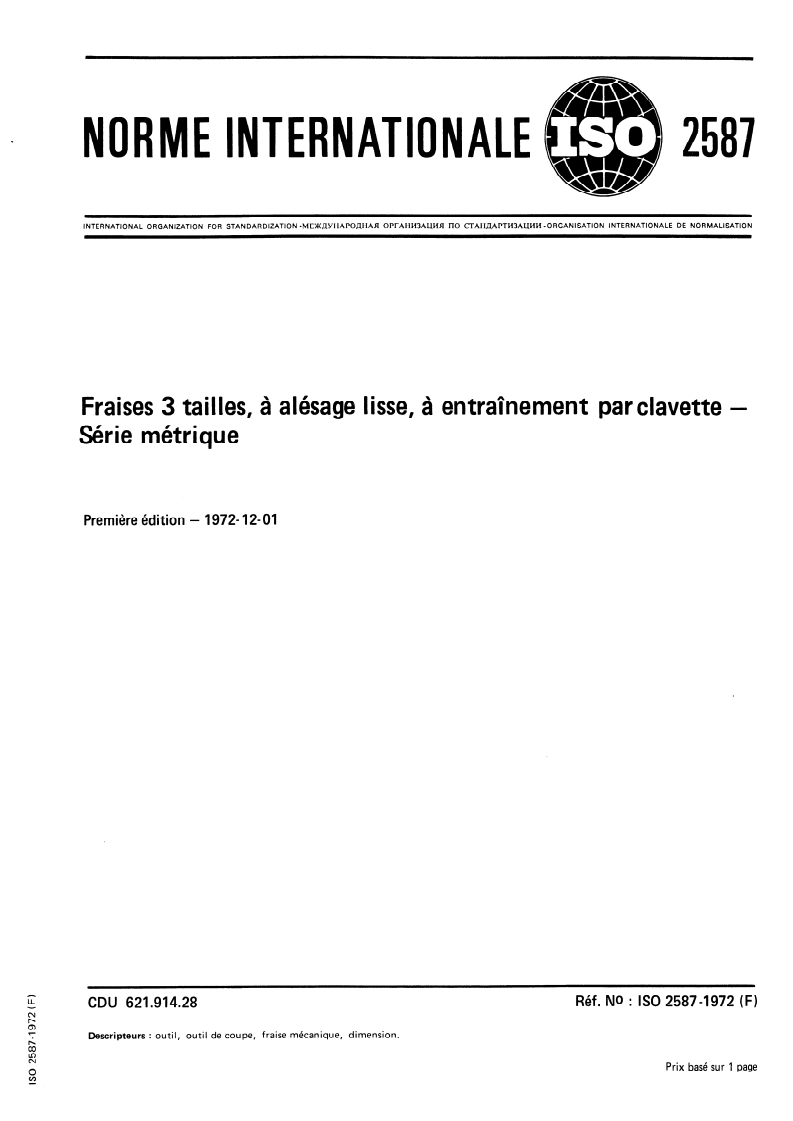
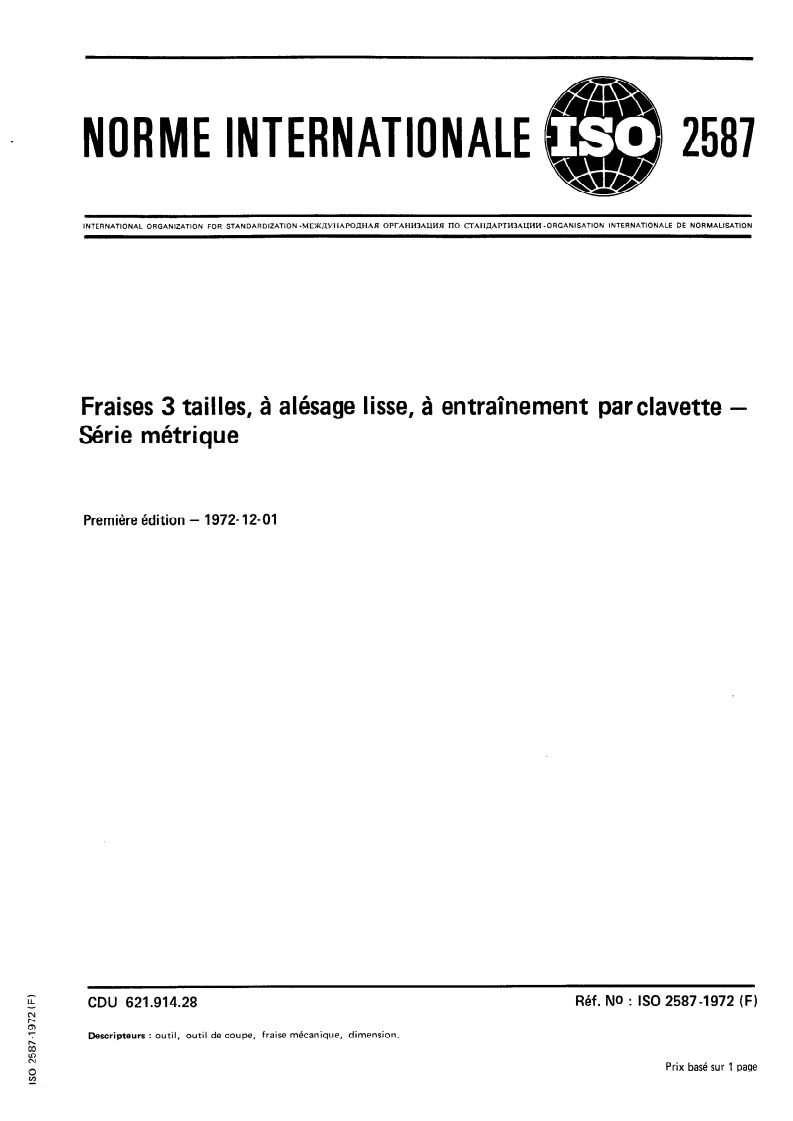
Fraises 3 tailles, à alésage lisse, à entraînement parclavette -
Série métrique
Première édition - 1972- 12- 01
Réf. No : ISO 2587-1972 (F)
CDU 621.914.28
: outil, outil de coupe, fraise mécanique, dimension.
Descripteurs
Prix basé sur 1 page
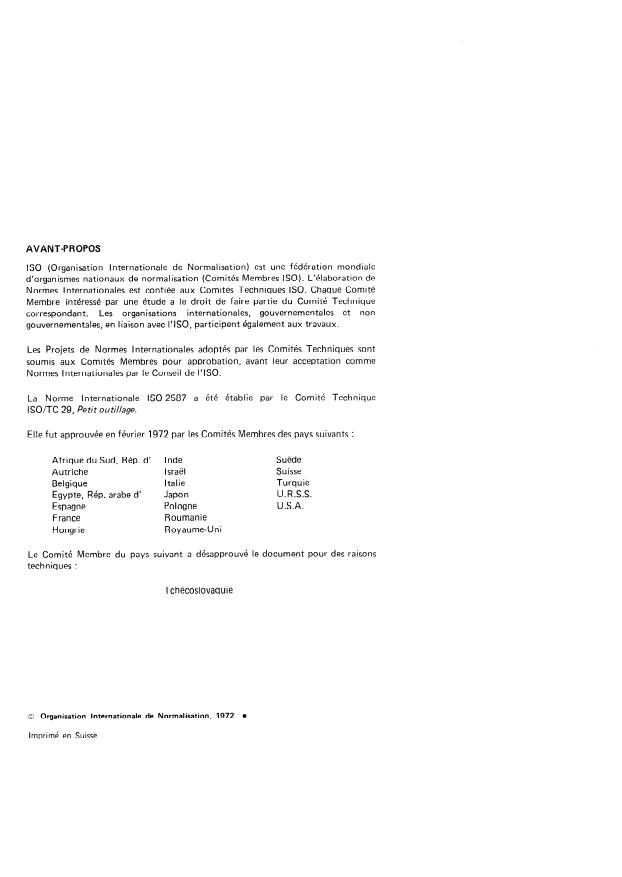
AVANT-PROPOS
KO (Organisation Internationale de Normalisation) est une fédération mondiale
d’organismes nationaux de normalisation (Comités Membres KO). L’élaboration de
Normes Internationales est confiée aux Comités Techniques ISO. Chaque Comité
Membre intéressé par une étude a le droit de faire partie du Comité Technique
correspondant. Les organisations internationales, gouvernementales et non
gouvernementales, en liaison avec I’ISO, participent également aux travaux.
Les Projets de Normes Internationales adoptés par les Comités Techniques sont
soumis aux Comités Membres pour approbation, avant leur acceptation comme
Normes Internationales par le Conseil de I’ISO.
La Norme Internationale ISO 2587 a été établie par le Comité Technique
ISO/TC 29, Petit outillage.
Elle fut approuvée en février 1972 par les Comités Membres des pays suivants :
Afrique du Sud, Rép. d’ Inde Suède
Autriche Israël Suisse
Belgique Italie Turquie
Egypte, Rép. arabe d’ Japon U.R.S.S.
Pologne
Espagne U.S.A.
France Roumanie
Hongrie Royaume-Uni
Le Comité Membre du pays suivant a désapprouvé le document pour des raisons
techniques :
Tchécos
...
NORME INTERNATIONALE
INTERNATIONAL ORGANIZATION FOR STANDARDIZATION l MEXflYHAPOAHAX OPTAHM3ALUï5i l-I0 CTAH)JAPTM3ALJWW-ORGANISATION INTERNATIONALE DE NORMALISATION
Fraises 3 tailles, à alésage lisse, à entraînement parclavette -
Série métrique
Première édition - 1972- 12- 01
Réf. No : ISO 2587-1972 (F)
CDU 621.914.28
: outil, outil de coupe, fraise mécanique, dimension.
Descripteurs
Prix basé sur 1 page
AVANT-PROPOS
KO (Organisation Internationale de Normalisation) est une fédération mondiale
d’organismes nationaux de normalisation (Comités Membres KO). L’élaboration de
Normes Internationales est confiée aux Comités Techniques ISO. Chaque Comité
Membre intéressé par une étude a le droit de faire partie du Comité Technique
correspondant. Les organisations internationales, gouvernementales et non
gouvernementales, en liaison avec I’ISO, participent également aux travaux.
Les Projets de Normes Internationales adoptés par les Comités Techniques sont
soumis aux Comités Membres pour approbation, avant leur acceptation comme
Normes Internationales par le Conseil de I’ISO.
La Norme Internationale ISO 2587 a été établie par le Comité Technique
ISO/TC 29, Petit outillage.
Elle fut approuvée en février 1972 par les Comités Membres des pays suivants :
Afrique du Sud, Rép. d’ Inde Suède
Autriche Israël Suisse
Belgique Italie Turquie
Egypte, Rép. arabe d’ Japon U.R.S.S.
Pologne
Espagne U.S.A.
France Roumanie
Hongrie Royaume-Uni
Le Comité Membre du pays suivant a désapprouvé le document pour des raisons
techniques :
Tchécos
...
NORME INTERNATIONALE
INTERNATIONAL ORGANIZATION FOR STANDARDIZATION l MEXflYHAPOAHAX OPTAHM3ALUï5i l-I0 CTAH)JAPTM3ALJWW-ORGANISATION INTERNATIONALE DE NORMALISATION
Fraises 3 tailles, à alésage lisse, à entraînement parclavette -
Série métrique
Première édition - 1972- 12- 01
Réf. No : ISO 2587-1972 (F)
CDU 621.914.28
: outil, outil de coupe, fraise mécanique, dimension.
Descripteurs
Prix basé sur 1 page
AVANT-PROPOS
KO (Organisation Internationale de Normalisation) est une fédération mondiale
d’organismes nationaux de normalisation (Comités Membres KO). L’élaboration de
Normes Internationales est confiée aux Comités Techniques ISO. Chaque Comité
Membre intéressé par une étude a le droit de faire partie du Comité Technique
correspondant. Les organisations internationales, gouvernementales et non
gouvernementales, en liaison avec I’ISO, participent également aux travaux.
Les Projets de Normes Internationales adoptés par les Comités Techniques sont
soumis aux Comités Membres pour approbation, avant leur acceptation comme
Normes Internationales par le Conseil de I’ISO.
La Norme Internationale ISO 2587 a été établie par le Comité Technique
ISO/TC 29, Petit outillage.
Elle fut approuvée en février 1972 par les Comités Membres des pays suivants :
Afrique du Sud, Rép. d’ Inde Suède
Autriche Israël Suisse
Belgique Italie Turquie
Egypte, Rép. arabe d’ Japon U.R.S.S.
Pologne
Espagne U.S.A.
France Roumanie
Hongrie Royaume-Uni
Le Comité Membre du pays suivant a désapprouvé le document pour des raisons
techniques :
Tchécos
...
NORME INTERNATIONALE
INTERNATIONAL ORGANIZATION FOR STANDARDIZATION l MEXflYHAPOAHAX OPTAHM3ALUï5i l-I0 CTAH)JAPTM3ALJWW-ORGANISATION INTERNATIONALE DE NORMALISATION
Fraises 3 tailles, à alésage lisse, à entraînement parclavette -
Série métrique
Première édition - 1972- 12- 01
Réf. No : ISO 2587-1972 (F)
CDU 621.914.28
: outil, outil de coupe, fraise mécanique, dimension.
Descripteurs
Prix basé sur 1 page
AVANT-PROPOS
KO (Organisation Internationale de Normalisation) est une fédération mondiale
d’organismes nationaux de normalisation (Comités Membres KO). L’élaboration de
Normes Internationales est confiée aux Comités Techniques ISO. Chaque Comité
Membre intéressé par une étude a le droit de faire partie du Comité Technique
correspondant. Les organisations internationales, gouvernementales et non
gouvernementales, en liaison avec I’ISO, participent également aux travaux.
Les Projets de Normes Internationales adoptés par les Comités Techniques sont
soumis aux Comités Membres pour approbation, avant leur acceptation comme
Normes Internationales par le Conseil de I’ISO.
La Norme Internationale ISO 2587 a été établie par le Comité Technique
ISO/TC 29, Petit outillage.
Elle fut approuvée en février 1972 par les Comités Membres des pays suivants :
Afrique du Sud, Rép. d’ Inde Suède
Autriche Israël Suisse
Belgique Italie Turquie
Egypte, Rép. arabe d’ Japon U.R.S.S.
Pologne
Espagne U.S.A.
France Roumanie
Hongrie Royaume-Uni
Le Comité Membre du pays suivant a désapprouvé le document pour des raisons
techniques :
Tchécos
...