


ISO 8528-5
(Main)Reciprocating internal combustion engine driven alternating current generating sets — Part 5: Generating sets
Reciprocating internal combustion engine driven alternating current generating sets — Part 5: Generating sets
This document specifies design and performance criteria arising out of the combination of a reciprocating internal combustion (RIC) engine and an alternating current (AC) generator when operating as a unit. This unit can run in parallel to the grid or not. This document applies to AC generating sets driven by RIC engines for land and marine use, excluding generating sets used on aircraft, or to propel land vehicles and locomotives. For some specific applications (e.g. essential hospital supplies and high-rise buildings), supplementary requirements can apply. The provisions of this document are a basis for establishing any supplementary requirements. For generating sets driven by other reciprocating-type prime movers (e.g. steam engines), the provisions of this document can be used as a basis for establishing these requirements.
Groupes électrogènes à courant alternatif entraînés par moteurs alternatifs à combustion interne — Partie 5: Groupes électrogènes
Le présent document spécifie les critères de conception et de performance résultant de la combinaison d'un moteur alternatif à combustion interne et d'un alternateur lorsqu'ils fonctionnent comme une entité. Cette entité peut fonctionner couplée ou non avec le réseau. Le présent document s'applique aux groupes électrogènes à courant alternatif entraînés par moteurs alternatifs à combustion interne utilisés dans les applications terrestres et marines, à l'exclusion des groupes électrogènes utilisés à bord des aéronefs ou pour la propulsion de véhicules terrestres et de locomotives. Pour des applications particulières (par exemple alimentation principale d'hôpitaux, immeubles de grande hauteur), des exigences supplémentaires peuvent s'appliquer. Les dispositions du présent document doivent être considérées comme base pour définir toute exigence supplémentaire. Pour les groupes électrogènes entraînés par d'autres machines d'entraînement de type alternatif (par exemple les moteurs à vapeur), les dispositions du présent document peuvent être utilisées comme base pour établir les exigences correspondantes.
General Information
Relations
Buy Standard

Standards Content (Sample)
FINAL DRAFT
International
Standard
ISO/FDIS 8528-5
ISO/TC 70
Reciprocating internal combustion
Secretariat: SAC
engine driven alternating current
Voting begins on:
generating sets —
2025-01-22
Part 5:
Voting terminates on:
2025-03-19
Generating sets
Groupes électrogènes à courant alternatif entraînés par moteurs
alternatifs à combustion interne —
Partie 5: Groupes électrogènes
RECIPIENTS OF THIS DRAFT ARE INVITED TO SUBMIT,
WITH THEIR COMMENTS, NOTIFICATION OF ANY
RELEVANT PATENT RIGHTS OF WHICH THEY ARE AWARE
AND TO PROVIDE SUPPOR TING DOCUMENTATION.
IN ADDITION TO THEIR EVALUATION AS
BEING ACCEPTABLE FOR INDUSTRIAL, TECHNO-
LOGICAL, COMMERCIAL AND USER PURPOSES, DRAFT
INTERNATIONAL STANDARDS MAY ON OCCASION HAVE
TO BE CONSIDERED IN THE LIGHT OF THEIR POTENTIAL
TO BECOME STAN DARDS TO WHICH REFERENCE MAY BE
MADE IN NATIONAL REGULATIONS.
Reference number
ISO/FDIS 8528-5:2025(en) © ISO 2025
FINAL DRAFT
ISO/FDIS 8528-5:2025(en)
International
Standard
ISO/FDIS 8528-5
ISO/TC 70
Reciprocating internal combustion
Secretariat: SAC
engine driven alternating current
Voting begins on:
generating sets —
Part 5:
Voting terminates on:
Generating sets
Groupes électrogènes à courant alternatif entraînés par moteurs
alternatifs à combustion interne —
Partie 5: Groupes électrogènes
RECIPIENTS OF THIS DRAFT ARE INVITED TO SUBMIT,
WITH THEIR COMMENTS, NOTIFICATION OF ANY
RELEVANT PATENT RIGHTS OF WHICH THEY ARE AWARE
AND TO PROVIDE SUPPOR TING DOCUMENTATION.
© ISO 2025
IN ADDITION TO THEIR EVALUATION AS
All rights reserved. Unless otherwise specified, or required in the context of its implementation, no part of this publication may
BEING ACCEPTABLE FOR INDUSTRIAL, TECHNO-
LOGICAL, COMMERCIAL AND USER PURPOSES, DRAFT
be reproduced or utilized otherwise in any form or by any means, electronic or mechanical, including photocopying, or posting on
INTERNATIONAL STANDARDS MAY ON OCCASION HAVE
the internet or an intranet, without prior written permission. Permission can be requested from either ISO at the address below
TO BE CONSIDERED IN THE LIGHT OF THEIR POTENTIAL
or ISO’s member body in the country of the requester.
TO BECOME STAN DARDS TO WHICH REFERENCE MAY BE
MADE IN NATIONAL REGULATIONS.
ISO copyright office
CP 401 • Ch. de Blandonnet 8
CH-1214 Vernier, Geneva
Phone: +41 22 749 01 11
Email: copyright@iso.org
Website: www.iso.org
Published in Switzerland Reference number
ISO/FDIS 8528-5:2025(en) © ISO 2025
ii
ISO/FDIS 8528-5:2025(en)
Contents Page
Foreword .iv
1 Scope . 1
2 Normative references . 1
3 Terms, definitions and symbols . 1
3.1 Terms and definitions .1
3.2 Symbols .10
4 Other regulations and additional requirements . 14
5 Frequency characteristics . 14
5.1 General .14
5.2 Safety frequency . 15
6 Voltage characteristics .15
7 Sustained short-circuit current .15
8 Factors affecting generating set performance .16
8.1 General .16
8.2 Power .16
8.3 Frequency and voltage.16
8.4 Load acceptance .16
9 Cyclic irregularity. 19
10 Starting characteristics.21
11 Stop time characteristics .23
12 Parallel operation .23
12.1 Generating sets coupled with each other without grid. . 23
12.1.1 Active power sharing .24
12.1.2 Reactive power sharing . 25
12.2 Generating sets connected to the grid in a paralleling application. .27
12.2.1 General .27
12.2.2 Influence on operating behaviour . .27
12.2.3 Design features required for paralleling to a public grid network . 28
13 Rating plates .35
14 Additional factors influencing generating set performance. .36
14.1 Starting methods . 36
14.2 Shutdown methods . 36
14.3 Fuel and lubrication oil supply . 36
14.4 Combustion air . 36
14.5 Exhaust system . 36
14.6 Cooling and room ventilation .37
14.7 Monitoring .37
14.8 Noise emission .37
14.9 Coupling . 38
14.10 Vibration . 38
14.10.1 General . 38
14.10.2 Torsional vibration . 38
14.10.3 Linear vibration . 38
14.11 Foundations . 39
15 Performance class operating limit values .39
15.1 General . 39
15.2 Recommendation for gas engine operating limit values . 39
Bibliography .44
iii
ISO/FDIS 8528-5:2025(en)
Foreword
ISO (the International Organization for Standardization) is a worldwide federation of national standards
bodies (ISO member bodies). The work of preparing International Standards is normally carried out through
ISO technical committees. Each member body interested in a subject for which a technical committee
has been established has the right to be represented on that committee. International organizations,
governmental and non-governmental, in liaison with ISO, also take part in the work. ISO collaborates closely
with the International Electrotechnical Commission (IEC) on all matters of electrotechnical standardization.
The procedures used to develop this document and those intended for its further maintenance are described
in the ISO/IEC Directives, Part 1. In particular, the different approval criteria needed for the different types
of ISO document should be noted. This document was drafted in accordance with the editorial rules of the
ISO/IEC Directives, Part 2 (see www.iso.org/directives).
ISO draws attention to the possibility that the implementation of this document may involve the use of (a)
patent(s). ISO takes no position concerning the evidence, validity or applicability of any claimed patent
rights in respect thereof. As of the date of publication of this document, ISO had not received notice of (a)
patent(s) which may be required to implement this document. However, implementers are cautioned that
this may not represent the latest information, which may be obtained from the patent database available at
www.iso.org/patents. ISO shall not be held responsible for identifying any or all such patent rights.
Any trade name used in this document is information given for the convenience of users and does not
constitute an endorsement.
For an explanation of the voluntary nature of standards, the meaning of ISO specific terms and expressions
related to conformity assessment, as well as information about ISO's adherence to the World Trade
Organization (WTO) principles in the Technical Barriers to Trade (TBT), see www.iso.org/iso/foreword.html.
This document was prepared by Technical Committee ISO/TC 70, Internal combustion engines.
This sixth edition cancels and replaces the fifth edition (ISO 8528-5:2022), which has been technical
...
ISO/DISFDIS 8528-5:20XX(en)
Date: 2024-11-05
ISO/TC 70
Secretariat: SAC
Reciprocating internal combustion engine driven alternating current
generating sets —
Part 5:
Generating sets
Groupes électrogènes à courant alternatif entraînés par moteurs alternatifs à combustion interne — Partie 5:
Groupes électrogènes
Partie 5: Groupes électrogènes
FDIS stage
ISO DIS//FDIS 8528-5:20XX2025(en)
All rights reserved. Unless otherwise specified, or required in the context of its implementation, no part of this publication
may be reproduced or utilized otherwise in any form or by any means, electronic or mechanical, including photocopying,
or posting on the internet or an intranet, without prior written permission. Permission can be requested from either ISO
at the address below or ISO'sISO’s member body in the country of the requester.
ISO Copyright Officecopyright office
CP 401 • Ch. de Blandonnet 8
CH-1214 Vernier, Geneva
Phone: + 41 22 749 01 11
Email: copyright@iso.org
E-mail: copyright@iso.org
Website: www.iso.orgwww.iso.org
Published in Switzerland.
ii © ISO 2022 – All rights reserved
ii
ISO/DISFDIS 8528-5:20XX2025(en)
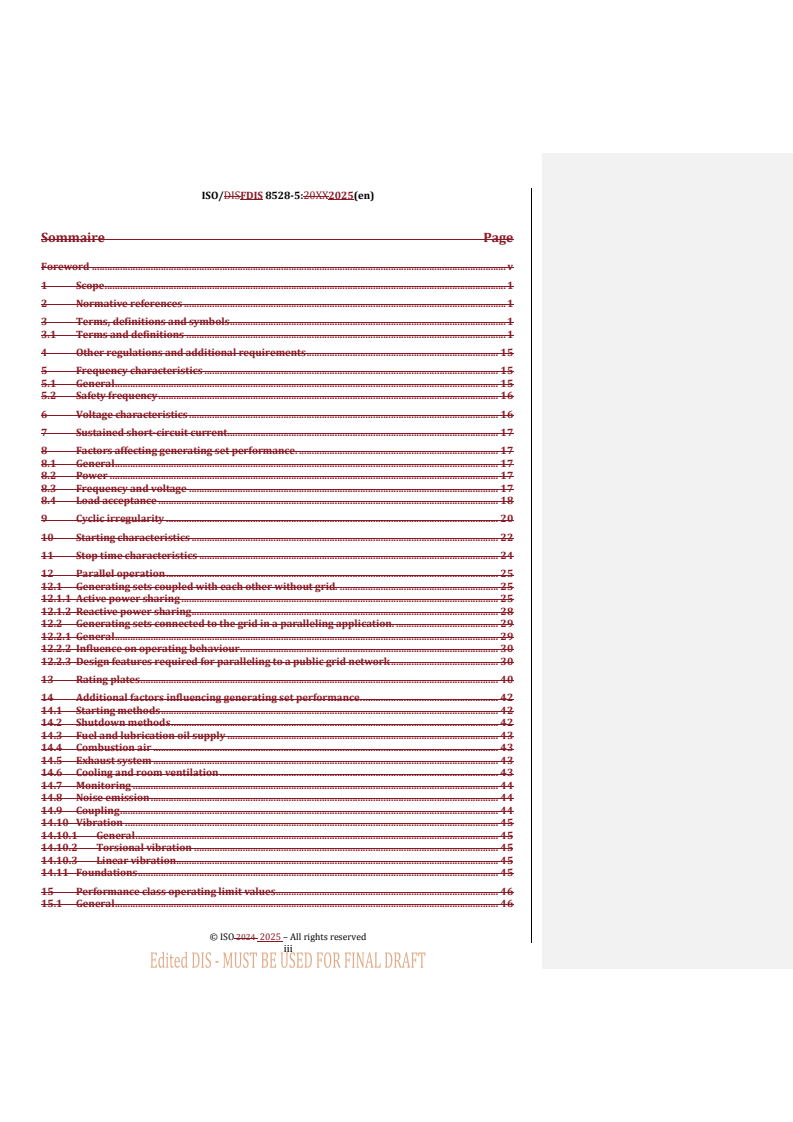
Sommaire Page
Foreword . v
1 Scope . 1
2 Normative references . 1
3 Terms, definitions and symbols . 1
3.1 Terms and definitions . 1
4 Other regulations and additional requirements . 15
5 Frequency characteristics . 15
5.1 General . 15
5.2 Safety frequency . 16
6 Voltage characteristics . 16
7 Sustained short-circuit current. 17
8 Factors affecting generating set performance. . 17
8.1 General . 17
8.2 Power . 17
8.3 Frequency and voltage . 17
8.4 Load acceptance . 18
9 Cyclic irregularity . 20
10 Starting characteristics . 22
11 Stop time characteristics . 24
12 Parallel operation . 25
12.1 Generating sets coupled with each other without grid. . 25
12.1.1 Active power sharing . 25
12.1.2 Reactive power sharing . 28
12.2 Generating sets connected to the grid in a paralleling application. . 29
12.2.1 General . 29
12.2.2 Influence on operating behaviour . 30
12.2.3 Design features required for paralleling to a public grid network . 30
13 Rating plates . 40
14 Additional factors influencing generating set performance. . 42
14.1 Starting methods . 42
14.2 Shutdown methods . 42
14.3 Fuel and lubrication oil supply . 43
14.4 Combustion air . 43
14.5 Exhaust system . 43
14.6 Cooling and room ventilation . 43
14.7 Monitoring . 44
14.8 Noise emission . 44
14.9 Coupling . 44
14.10 Vibration . 45
14.10.1 General . 45
14.10.2 Torsional vibration . 45
14.10.3 Linear vibration. 45
14.11 Foundations . 45
15 Performance class operating limit values . 46
15.1 General . 46
iii
ISO DIS//FDIS 8528-5:20XX2025(en)
15.2 Recommendation for gas engine operating limit values . 46
Bibliography . 49
iv © ISO 2022 – All rights reserved
iv
ISO/DISFDIS 8528-5:20XX2025(en)
Contents
Foreword . vi
1 Scope . 1
2 Normative references . 1
3 Terms, definitions and symbols . 1
4 Other regulations and additional requirements . 17
5 Frequency characteristics . 17
6 Voltage characteristics . 19
7 Sustained short-circuit current . 20
8 Factors affecting generating set performance . 20
9 Cyclic irregularity . 24
10 Starting characteristics . 27
11 Stop time characteristics . 30
12 Parallel operation . 31
13 Rating plates . 48
14 Additional factors influencing generating set performance. . 49
15 Performance class operating limit values . 52
Bibliography . 56
v
ISO DIS//FDIS 8528-5:20XX2025(en)
Foreword
ISO (the International Organization for Standardization) is a worldwide federation of national standards
bodies (ISO member bodies). The work of preparing International Standards is normally carried out through
ISO technical committees. Each member body interested in a subject for which a technical committee has been
established has the right to be represented on that committee. International organizations, governmental and
non-governmental, in liaison with ISO, also take part in the work. ISO collaborates closely with the
International Electrotechnical Commission (IEC) on all matters of electrotechnical standardization.
The procedures used to develop this document and those intended for its further maintenance are described
in the ISO/IEC Directives, Part 1. In particular, the different approval criteria needed for the different types of
ISO document should be noted. This document was drafted in accordance with the editorial rules of the
ISO/IEC Directives, Part 2 (see www.iso.org/directives).
ISO draws attention to the possibility that the implementation of this document may involve the use of (a)
patent(s). ISO takes no position concerning the evidence, validity or applicability of any claimed patent rights
in respect thereof. As of the date of publication of this document, ISO had not received notice of (a) patent(s)
which may be required to implement this document. However, implementers are cautioned that this may not
represent the latest information, which may be obtained from the patent database available at
www.iso.org/patents.www.iso.org/patents. ISO shall not be held responsible for identifying any or all such
patent rights.
Any trade name used in this document is information given for the convenience of users and does not
constitute an endorsement.
For an explanation of the voluntary nature of standards, the meaning of ISO specific terms and expressions
related to conformity assessment, as well as information about ISO's adherence to the World Trade
Organization (WTO) principles in the Technical Barriers to Trade (TBT), see
www.iso.org/iso/foreword.htmlwww.iso.org/iso/foreword.html.
This document was prepared by Technical Committee ISO/TC 70, Internal combustion engines.
This sixth edition cancels and replaces the fifth edition (ISO 8528-5:2022), which has been technically revised.
The main changes are as follows:
— — Clause 3Clause 3 has been revised;
— — a list of symbols has been added in 3.2;3.2;
— — errors have been corrected in Table 4;Table 4;
— — previous Figures 3, 7, 8, 14Figures 3, 7, 8, 14 and 1616 have been modified and renumbered;
— — previous Figures 1Figures 1 and 1717 have been deleted;
— — Annex A has been deleted.
A list of all parts in the ISO 8528 series can be found on the ISO website.
Any feedback or questions on this document should be directed to the user’s national standards body. A
complete listing of these bodies can be found at www.iso.org/members.html.
Field Code Changed
vi © ISO 2022 – All rights reserved
vi
ISO/DISFDIS 8528-5:20XX2025(en)
vii
ISO/DISFDIS 8528-5:20242025(en)
Reciprocating internal combustion engine driven alternating current
generating sets —
Part 5:
Generating sets
1 Scope
This document specifies design a
...
PROJET FINAL
Norme
internationale
ISO/FDIS 8528-5
ISO/TC 70
Groupes électrogènes à courant
Secrétariat: SAC
alternatif entraînés par moteurs
Début de vote:
alternatifs à combustion interne —
2025-01-22
Partie 5:
Vote clos le:
2025-03-19
Groupes électrogènes
Reciprocating internal combustion engine driven alternating
current generating sets —
Part 5: Generating sets
LES DESTINATAIRES DU PRÉSENT PROJET SONT
INVITÉS À PRÉSENTER, AVEC LEURS OBSERVATIONS,
NOTIFICATION DES DROITS DE PROPRIÉTÉ DONT ILS
AURAIENT ÉVENTUELLEMENT CONNAISSANCE ET À
FOURNIR UNE DOCUMENTATION EXPLICATIVE.
OUTRE LE FAIT D’ÊTRE EXAMINÉS POUR
ÉTABLIR S’ILS SONT ACCEPTABLES À DES FINS
INDUSTRIELLES, TECHNOLOGIQUES ET COM-MERCIALES,
AINSI QUE DU POINT DE VUE DES UTILISATEURS, LES
PROJETS DE NORMES
INTERNATIONALES DOIVENT PARFOIS ÊTRE CONSIDÉRÉS
DU POINT DE VUE DE LEUR POSSI BILITÉ DE DEVENIR DES
NORMES POUVANT
SERVIR DE RÉFÉRENCE DANS LA RÉGLEMENTATION
NATIONALE.
Numéro de référence
ISO/FDIS 8528-5:2025(fr) © ISO 2025
PROJET FINAL
ISO/FDIS 8528-5:2025(fr)
Norme
internationale
ISO/FDIS 8528-5
ISO/TC 70
Groupes électrogènes à courant
Secrétariat: SAC
alternatif entraînés par moteurs
Début de vote:
alternatifs à combustion interne —
2025-01-22
Partie 5:
Vote clos le:
2025-03-19
Groupes électrogènes
Reciprocating internal combustion engine driven alternating
current generating sets —
Part 5: Generating sets
LES DESTINATAIRES DU PRÉSENT PROJET SONT
INVITÉS À PRÉSENTER, AVEC LEURS OBSERVATIONS,
NOTIFICATION DES DROITS DE PROPRIÉTÉ DONT ILS
AURAIENT ÉVENTUELLEMENT CONNAISSANCE ET À
FOURNIR UNE DOCUMENTATION EXPLICATIVE.
DOCUMENT PROTÉGÉ PAR COPYRIGHT
OUTRE LE FAIT D’ÊTRE EXAMINÉS POUR
ÉTABLIR S’ILS SONT ACCEPTABLES À DES FINS
© ISO 2025 INDUSTRIELLES, TECHNOLOGIQUES ET COM-MERCIALES,
AINSI QUE DU POINT DE VUE DES UTILISATEURS, LES
Tous droits réservés. Sauf prescription différente ou nécessité dans le contexte de sa mise en œuvre, aucune partie de cette
PROJETS DE NORMES
INTERNATIONALES DOIVENT PARFOIS ÊTRE CONSIDÉRÉS
publication ne peut être reproduite ni utilisée sous quelque forme que ce soit et par aucun procédé, électronique ou mécanique,
DU POINT DE VUE DE LEUR POSSI BILITÉ DE DEVENIR DES
y compris la photocopie, ou la diffusion sur l’internet ou sur un intranet, sans autorisation écrite préalable. Une autorisation peut
NORMES POUVANT
être demandée à l’ISO à l’adresse ci-après ou au comité membre de l’ISO dans le pays du demandeur.
SERVIR DE RÉFÉRENCE DANS LA RÉGLEMENTATION
NATIONALE.
ISO copyright office
Case postale 401 • Ch. de Blandonnet 8
CH-1214 Vernier, Genève
Tél.: +41 22 749 01 11
E-mail: copyright@iso.org
Web: www.iso.org
Publié en Suisse Numéro de référence
ISO/FDIS 8528-5:2025(fr) © ISO 2025
ii
ISO/FDIS 8528-5:2025(fr)
Sommaire Page
Avant-propos .v
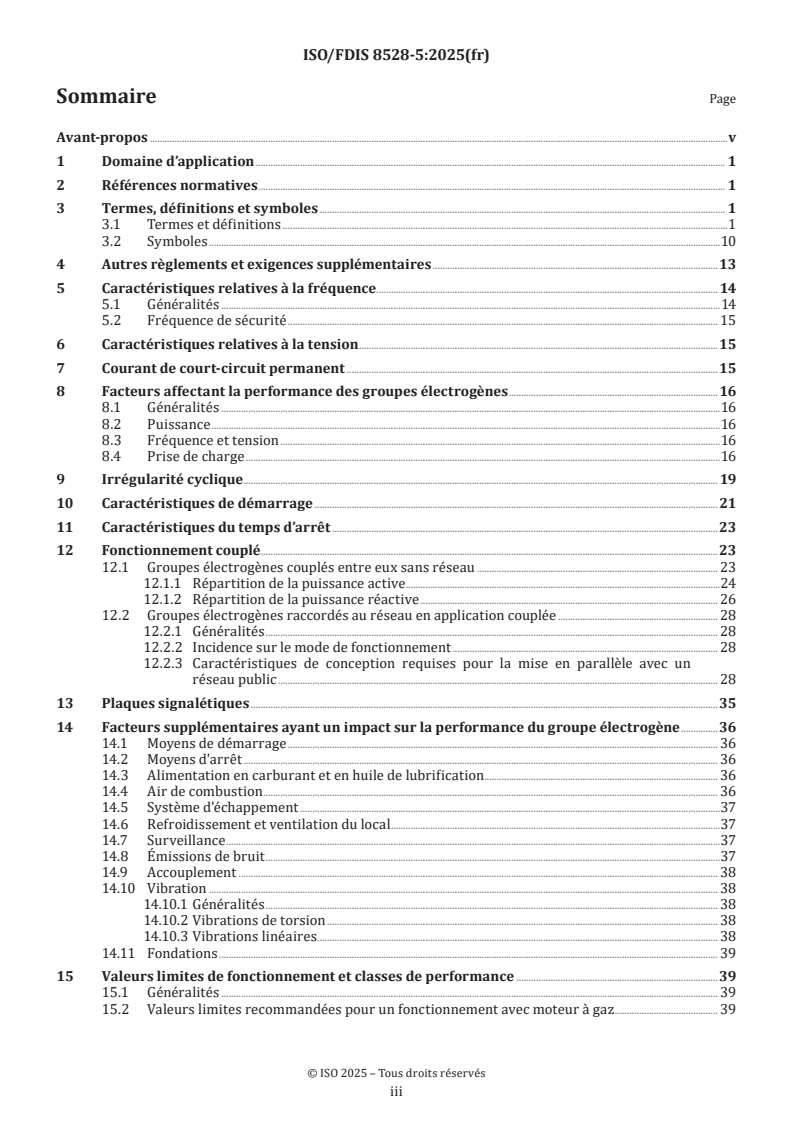
1 Domaine d’application . 1
2 Références normatives . 1
3 Termes, définitions et symboles . 1
3.1 Termes et définitions .1
3.2 Symboles .10
4 Autres règlements et exigences supplémentaires .13
5 Caractéristiques relatives à la fréquence. 14
5.1 Généralités .14
5.2 Fréquence de sécurité . 15
6 Caractéristiques relatives à la tension .15
7 Courant de court-circuit permanent .15
8 Facteurs affectant la performance des groupes électrogènes .16
8.1 Généralités .16
8.2 Puissance .16
8.3 Fréquence et tension .16
8.4 Prise de charge .16
9 Irrégularité cyclique . 19
10 Caractéristiques de démarrage .21
11 Caractéristiques du temps d’arrêt .23
12 Fonctionnement couplé.23
12.1 Groupes électrogènes couplés entre eux sans réseau . 23
12.1.1 Répartition de la puissance active .24
12.1.2 Répartition de la puissance réactive . 26
12.2 Groupes électrogènes raccordés au réseau en application couplée . 28
12.2.1 Généralités . 28
12.2.2 Incidence sur le mode de fonctionnement . 28
12.2.3 Caractéristiques de conception requises pour la mise en parallèle avec un
réseau public . 28
13 Plaques signalétiques .35
14 Facteurs supplémentaires ayant un impact sur la performance du groupe électrogène .36
14.1 Moyens de démarrage . 36
14.2 Moyens d'arrêt . 36
14.3 Alimentation en carburant et en huile de lubrification . 36
14.4 Air de combustion . 36
14.5 Système d'échappement .37
14.6 Refroidissement et ventilation du local .37
14.7 Surveillance .37
14.8 Émissions de bruit .37
14.9 Accouplement . 38
14.10 Vibration . 38
14.10.1 Généralités . 38
14.10.2 Vibrations de torsion . 38
14.10.3 Vibrations linéaires . 38
14.11 Fondations . 39
15 Valeurs limites de fonctionnement et classes de performance .39
15.1 Généralités . 39
15.2 Valeurs limites recommandées pour un fonctionnement avec moteur à gaz . 39
iii
ISO/FDIS 8528-5:2025(fr)
Bibliographie .42
iv
ISO/FDIS 8528-5:2025(fr)
Avant-propos
L'ISO (Organisation internationale de normalisation) est une fédération mondiale d'organismes nationaux
de normalisation (comités membres de l'ISO). L'élaboration des Normes internationales est en général
confiée aux comités techniques de l'ISO. Chaque comité membre intéressé par une étude a le droit de faire
partie du comité technique créé à cet effet. Les organisations internationales, gouvernementales et non
gouvernementales, en liaison avec l'ISO participent également aux travaux. L'ISO collabore étroitement avec
la Commission électrotechnique internationale (IEC) en ce qui concerne la normalisation électrotechnique.
Les procédures utilisées pour élaborer le présent document et celles destinées à sa mise à jour sont
décrites dans les Directives ISO/IEC, Partie 1. Il convient, en particulier, de prendre note des différents
critères d'approbation requis pour les différents types de documents ISO. Le présent document a
été rédigé conformément aux règles de rédaction données dans les Directives ISO/IEC, Partie 2 (voir
www.iso.org/directives).
L'attention est attirée sur le fait que certains des éléments du présent document peuvent faire l'objet de
droits de propriété intellectuelle ou de droits analogues. L'ISO ne saurait être tenue pour responsable
de ne pas avoir identifié de tels droits de propriété et averti de leur existence. Les détails concernant les
références aux droits de propriété intellectuelle ou autres droits analogues identifiés lors de l'élaboration du
document sont indiqués dans l'Introduction et/ou dans la liste des déclarations de brevets reçues par l'ISO
(voir www.iso.org/brevets).
Les appellations commerciales éventuellement mentionnées dans le présent document sont données pour
information, par souci de commodité, à l’intention des utilisateurs et ne sauraient constituer un engagement.
Pour une explication de la nature volontaire des normes, la signification des termes et expressions
spécifiques de l'ISO liés à l'évaluation de la conformité, ou pour toute information au sujet de l'adhésion de
l'ISO aux principes de l’Organisation mondiale du commerce (OMC) concernant les obstacles techniques au
commerce (OTC), voir www.iso.org/avant-propos.
Le
...
Questions, Comments and Discussion
Ask us and Technical Secretary will try to provide an answer. You can facilitate discussion about the standard in here.