


ISO 9041-1:1990
(Main)Information technology — Open Systems Interconnection — Virtual Terminal Basic Class Protocol — Part 1: Specification
Information technology — Open Systems Interconnection — Virtual Terminal Basic Class Protocol — Part 1: Specification
Technologies de l'information — Interconnexion des systèmes ouverts — Protocole de classe de base de terminal virtuel — Partie 1: Spécification
General Information
- Status
- Withdrawn
- Publication Date
- 31-Oct-1990
- Withdrawal Date
- 31-Oct-1990
- Technical Committee
- ISO/IEC JTC 1 - Information technology
- Drafting Committee
- ISO/IEC JTC 1 - Information technology
- Current Stage
- 9599 - Withdrawal of International Standard
- Start Date
- 19-Jun-1997
- Completion Date
- 12-Feb-2026
Relations
- Effective Date
- 06-Jun-2022
- Effective Date
- 06-Jun-2022
- Effective Date
- 15-Apr-2008
- Effective Date
- 15-Apr-2008
- Effective Date
- 15-Apr-2008
Get Certified
Connect with accredited certification bodies for this standard

BSI Group
BSI (British Standards Institution) is the business standards company that helps organizations make excellence a habit.

NYCE
Mexican standards and certification body.
Sponsored listings
Frequently Asked Questions
ISO 9041-1:1990 is a standard published by the International Organization for Standardization (ISO). Its full title is "Information technology — Open Systems Interconnection — Virtual Terminal Basic Class Protocol — Part 1: Specification". This standard covers: Information technology — Open Systems Interconnection — Virtual Terminal Basic Class Protocol — Part 1: Specification
Information technology — Open Systems Interconnection — Virtual Terminal Basic Class Protocol — Part 1: Specification
ISO 9041-1:1990 is classified under the following ICS (International Classification for Standards) categories: 35.100.70 - Application layer. The ICS classification helps identify the subject area and facilitates finding related standards.
ISO 9041-1:1990 has the following relationships with other standards: It is inter standard links to ISO 9041-1:1990/Amd 2:1992, ISO 9041-1:1990/Cor 1:1992, ISO/IEC 9041-1:1997; is excused to ISO 9041-1:1990/Amd 2:1992, ISO 9041-1:1990/Cor 1:1992. Understanding these relationships helps ensure you are using the most current and applicable version of the standard.
ISO 9041-1:1990 is available in PDF format for immediate download after purchase. The document can be added to your cart and obtained through the secure checkout process. Digital delivery ensures instant access to the complete standard document.
Standards Content (Sample)
I NTER NATIONAL IS0
STANDARD 9041-1
First edition
1990-11-15
/
Information technology - Open Systems
Interconnection - Virtual Terminal Basic Class
Protocol -
Part 1 :
Specification
Technologies de l'information - Interconnexion des systèmes ouverts - Protocole
de classe de base de terminal virtuel
Partie 1: Spécification
IS0 9041-1:1990(E)
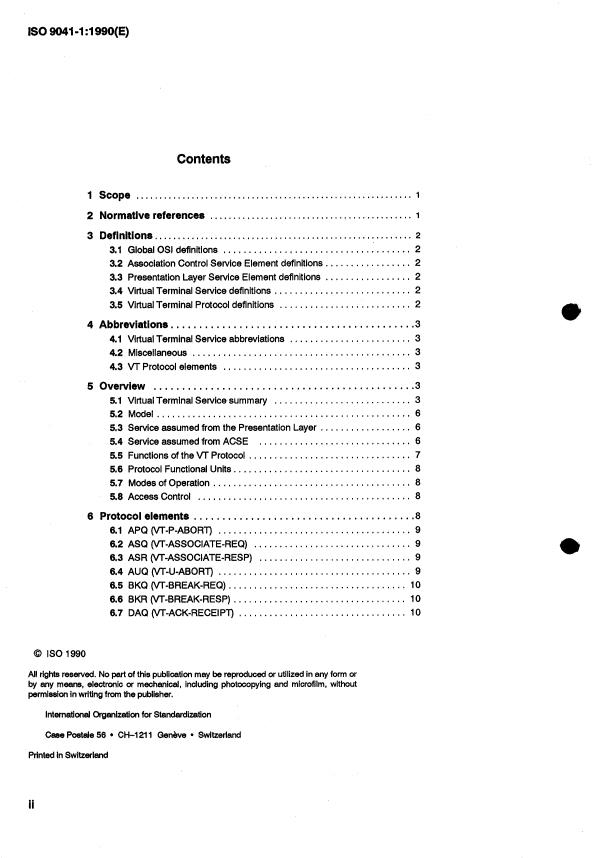
Contents
1 Scope . i
2 Normative references . i
3 Definitions . 2
3.1 Global OSI definitions . 2
3.2 Association Control Service Element definitions . 2
3.3 Presentation Layer Service Element definitions . 2
3.4 Virtual Terminai Service definitions . 2
3.5 Virtual Terminai Protocol definitions . 2
4 Abbreviations. . 3
4.1 Virtual Terminal Service abbreviations . 3
4.2 Miscellaneous . 3
4.3 VT Protocol elements . 3
5 Overview . 3
5.1 Virtual Terminal Service summary . 3
5.2 Model., . 6
5.3 Service assumed from the Presentation Layer . 6
5.4 Service assumed from ACSE . 6
5.5 Functions of the VT Protocol . 7
5.6 Protocol Functional Units . 8
5.7 Modes of Operation . 8
5.8 Access Control . 8
6 Protocol elements . 8
6.1 APQ (VT-P-ABORT) . 9
6.2 ASQ (VT-ASSOCIATE-REQ) . 9
6.3 ASR (VT-ASSOCIATE-RESP) . 9
6.4 AUQ (Vr-U-ABORT) . 9
6.5 BKQ (VT-BREAK-REQ) . 10
6.6 BKR (VT-BREAK-RESP) . 10
6.7 DAQ (VT-ACK-RECEIPT) . 10
O is0 1990
All rights reserved . No part of this publication may be reproduced or utilized in any form or
by any means. electronic or mechanical. including photocopying and microfilm. without
permission in writing from the publisher .
International Organizaîion for Sîandardization
Case Pastale 56 CH-121 1 (3enève Switzerland
Printed in Switzerland
ii
IS0 9041 -1 :I 99O(E)
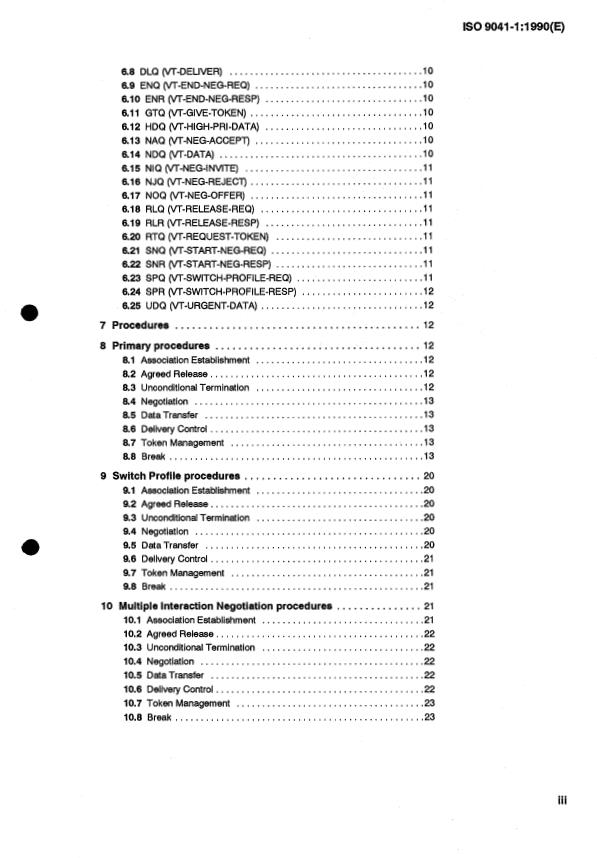
6.8 DLQ (VT-DELIVER) . -10
6.9 ENQ (VT-END-NEG-REQ) . 10
6.10 ENR (VT-END-NEG-RESP) . 10
6.11 GTQ (VT-GIVE-TOKEN) . -10
6.12 HDQ (VT-HIGH-PRI-DATA) . 10
6.13 NAQ (VT-NEG-ACCEPT) . -10
6.14 NDQ (VT-DATA) . -10
6.15 NIQ (VT-NEG-INVITE) . 11
6.16 NJQ (VT-NEG-REJECT) . -11
6.17 NOQ (VT-NEG-OFFER) . 11
6.18 RLQ (VT-RELEASE-REQ) . 11
6.19 RLR(VT-RELEASE-RESP) . 11
6.20 RTQ (VT-REQUEST-TOKEN) . 11
6.21 SNQ (VT-START-NEG-REQ) . 11
6.22 SNR (VT-START-NEG-RESP) . 11
6.23 SPQ (VT-SWITCH-PROFILE-REQ) . 11
6.24 SPR (VT-SWITCH-PROFILE-RESP) . 12
6.25 UDQ (VT-URGENT-DATA) . -12
e
7 Procedures . 12
8 Primary procedures . 12
8.1 Association Establishment . 12
8.2 Agreed Release . 12
8.3 Unconditional Termination . 12
8.4 Negotiation . 13
8.5 Data Transfer . 13
8.6 Delivery Control . 13
8.7 Token Management . 13
8.8 Break 13
..................................................
9 Switch Profile procedures . 20
9.1 Association Establishment . 20
9.2 Agreed Release . -20
9.3 Unconditional Termination . -20
9.4 Negotiation . 20
9.5 DataTransfer . 20
e
9.6 Delivery Control . -21
9.7 Token Management . 21
9.8 Break 21
..................................................
10 Multiple Interaction Negotiation procedures . 21
10.1 Association Establishment . 21
10.2 Agreed Release 22
.........................................
10.3 Unconditional Termination . 22
10.4 Negotiation . 22
10.5 Data Transfer 22
..........................................
10.6 Delivery Control . 22
10.7 TokenManagement . 23
10.8 Break . 23
iii
IS0 9041 -1 :199O(E)
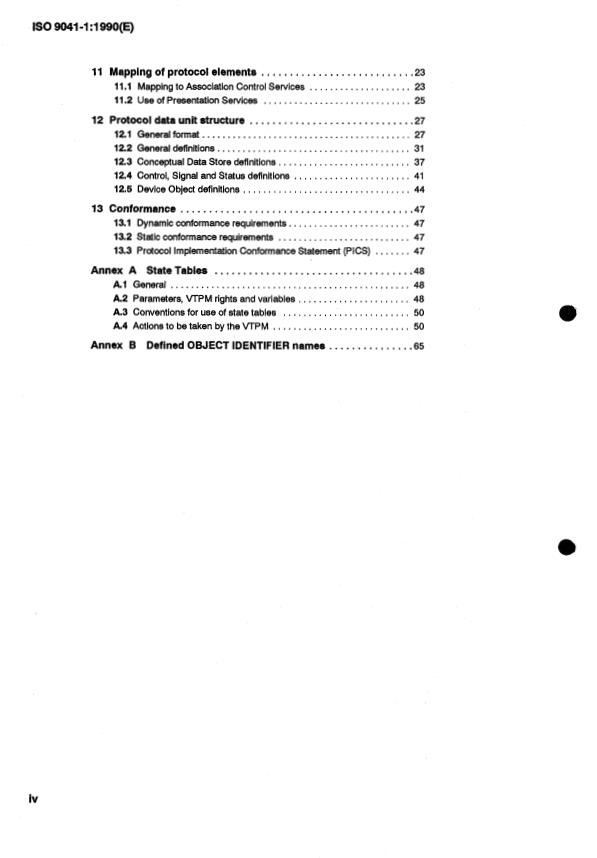
11 Mapping of protocol elements . 23
11.1 Mapping to Association Control Services . 23
11.2 Use of Presentation Services . 25
12 Protocol data unit structure . -27
12.1 General format . 27
12.2 General definitions. . 31
Conceptual Data Store definitions . 37
12.3
12.4 Control. Signai and Status definitions . 41
12.5 Device Object definitions . 44
13 Conformance . 47
13.1 Dynamic conformance requirements . 47
13.2 Static conformance requirements . 47
13.3 Protocol Implementation Conformance Statement (PICS) . 47
Annex A State Tables . 48
A.1 Generat . 48
A.2 Parameters. VTPM rights and variables . 48
A.3 Conventions for use of state tables . 50
Actions to be taken by the VTPM . 50
A.4
Annex B Defined OBJECT IDENTIFIER names . 65
IS0 9041 -1 :199O(E)
Foreword
IS0 (the International Organization for Standardization) is a worldwide federation of
(IS0 member bodies). The work of preparing International
national standards bodies
Standards is normally carried out through IS0 technical committees. Each member
body interested in a subject for which a technical committee has been established has
the right to be represented on that committee. International organizations, govern-
mental and non-governmental, in liaison with EO, also take part in the work. IS0
collaborates closely with the International Electrotechnical Commission (IEC) on all
matters of electrotechnical standardization.
Draft International Standards adopted by the technical committees are circulated to
the member bodies for voting. Publication as an International Standard requires
approval by at least 75 YO of the member bodies casting a vote.
International Standard IS0 9041-1 was prepared by Technical Committee ISO/TC 97,
Informa tion processing s ystems .
IS0 9041 -1 :I 99O(E)
Introduction
IS0 9041 is one of a set of International Standards produced to facilitate the
interconnection of computer systems. It is related to other International Standards in
the set as defined in the Reference Model for Open Systems Interconnection (IS0
7498). The Reference Model subdivides the area of standardization for interconnec-
tion into a series of layers of specification, each of manageable size.
This part of IS0 9041 defines the manner in which two protocol machines (called
Virtual Terminai Protocol Machines or VTPMs) in the Application Layer of the
Reference Model for Open Systems interconnection communicate in order to provide
the Virtual Terminal Basic Class Service defined in IS0 9040 making use of the
Presentation Layer and of the association control service of ACSE within the Appli-
cation Layer.
vi
INTERNATIONAL STANDARD IS0 9041 -1 : 199o(E)
Information technology - Open Systems Interconnection -
Virtual Terminal Basic Class Protocol - Part 1 : Specification
1 Scope 2 Normative references
The following standards contain provisions which, through
This pari of IS0 9041 specifies
reference in this text, constitute provisions of this part of IS0
9041. At the time of publication, the editions indicated were
a) a set of procedures for the connection-oriented transfer
valid. All standards are subject to revision, and parties to
of data, control and reference information between protocol
agreements based on this part of IS0 9040 are encouraged
machines which implement the functions of a provider of the
to investigate the possibility of applying the most recent edi-
Basic Class Virtual Terminal Service;
tions of the standards listed below. Members of IEC and IS0
maintain registers of currently valid International Standards.
b) the two modes in which those procedures operate;
IS0 2022: 1 986, Information processing systems - IS0 7-bit
c) the structure of protocol elements used for the transfer of
and &bit Coded Character Sets - Code Extension Tech-
data and control information and the mapping of these
niques.
protocol elements onta ACSE and lower layer services;
IS0 6429: 1 988, Information processing systems - Control
d) the means of negotiating the functional units to be used
functions for 7-bit and 8-bit Coded Character Sets.
by the protocol machines and the parameters of the service;
IS0 7498: 1 984, Information processing systems -Open Sys-
e) the structure and mapping of protocol elements used for
tems Interconnection - Basic Reference Model.
the transfer of data and control information.
IS0 8326: 1 987, Information processing systems - Open Sys-
The procedures are defined in terms of
tem Interconnection - Basic connection oriented session ser-
vice definition.
9 the interactions between Virtual Terminal Protocol Ma-
ISO/TR 8509: 1987, Information processing systems - Open
chines through the exchange of Virtual Terminai protocol
Systems Interconnection - Service conventions.
elements;
IS0 8649: 1 988, Information processing systems - Open Sys-
g) the interactions between a Virtual Terminal Protocol Ma-
tems Interconnection -Association Control Service Element.
chine and the Virtual Terminal service user in the same
@
system through the exchange of Virtual Terminal service
IS0 8822: 1 988, Information processing systems - Open Sys-
primitives;
tems Interconnection - Connection oriented presentation ser-
vice definition.
h) the interactions between a Virtual Terminal Protocol Ma-
chine and the ACSE and Presentation Service providers
IS0 8824: 1 987, Information processing systems - Open Sys-
through the exchange of service primitives.
tems Interconnection - Specification of Abstract Syntax Nota-
tion One (ASN. l).
IS0 9041 also specifies conformance requlre-
This part of
ments (see clause 13) for systems implementing these proce-
IS0 8825: 1 987, Information processing systems - Open Sys-
dures. It does not contain tests which can be used to
tems Interconnection - Specification of Basic Encoding Rules
demonstrate this conformance.
for Abstract Syntax Notation One (ASN. 1).
IS0 9040: 1 990, Information technology - Open Systems In-
These procedures are applicable to instances of ccmmunica-
tion between systems that support the Basic Class Virtual terconnection - Virtual Terminal Basic Class Sewice.
-.”
Terminal Service In the Application Layer of the Reference
Model for Open Systems interconnection and which wish to
The International Register of Coded Character Sets to be used
interconnect in an open systems environment. with Escape Sequences. ’)
1) Available from theEuropean Computer Manufacturers Association (ECMA), 114 Rue du Rhane, CH 1204 Genève, Switzerland.
IS0 9041 -1 :199O(E)
3 Definitions Field Entry instruction (FEI);
Field Entry Instruction Control Object (FEiCO);
3.1 Global OS1 definitions
Fieid Entry Instruction Record (FER);
Field Entry Pilot Control Object (FEPCO);
This part of IS0 9041 is based on the concepts developed in
Field Entry Pilot Record (FEPR);
IS0 7498, and makes use of the following terms defined in it:
Field Entry Reaction (FER);
1) application entity;
full-VTE;
2) application layer;
Initial Facility Set;
3) protocol data unit;
net-effecting ;
4) user element.
Reference Information Object (RIO);
Definitions of the following terms are given in ISORR 8509:
repertoire;
5) primitive;
S-mode, Synchronous Mode;
6) confirm (prlmitive);
Terminal VT-user;
7) indication (primitive);
Transmission Policy Control Object (TPCO);
8) request (primitive);
VT-association;
9) response (primitive);
VT-context-value;
1 O) service provider;
VT-environment (VTE) ;
1 1 ) service user.
VT-user;
VTE-parameter.
3.2 Association Control Service Element
definitions
3.5 Virtual Terminal Protocol definitions
Thispart of IS09041 makesuseofthefollowingtermsdefined
For the purposes of this part of is0 9041 the following defini-
in IS0 8649:
tions apply.
1) application association;
2) application context.
3.5.1 protocol element: An abstract unit of information,
6, communicated between peer VTPMs, that
defined in clause
3.3 Presentation Layer Service Element
maps
definition
1) directly to an ACSE or presentation service primitive;
andlor
This part of IS0 9041 makes use of the term abstract syntax
which is defined in IS0 8822.
2) to a PDU type that is conveyed by a user information
parameter of ACSE or a user data parameter of the presen-
3.4 Virtual Terminal Service definitions tation service.
This part of IS0 9041 uses the following definitions contained
3.5.2 Initiating VTPM: The VTPM that initiates an individual
in IS0 9040:
procedure.
A-mode, Asynchronous Mode;
1)
3.5.3 target VTPM: The VTPM to which the protocol element
2) access-rule;
initiating a procedure is directed.
3) Application VT-user;
4) Block;
3.5.4 sending VTPM: The initiating VTPM for a data transfer
5) character-box graphic element;
procedure.
6) Context Control Object (CCO);
3.5.5 receiving VTPM: The target VTPM for a data transfer
7) current-WE;
procedure.
8) drait-WE;
9) Field;
3.5.6 dynamic conformance requirements: All those re-
quirements (and options) which determine what observable
10) Field Definition Control Object (FDCO);
behaviour is permitted in instances of communication.
11) Fieid Definition Record (FDR);
12) Field Element;
3.5.7 static conformance requirements: Constraints
13) Fieid Entry Condition (FEC);
which facilitate interworking by defining the requirements for
14) Field Entry Event (FEE); kernel sets of capabilities of an implementation.
IS0 9041 -1 :199O(E)
3.5.8 protocol lmplementation conformance statement PAB Provider Abort
(PICS): A statement made by the supplier of an implementa-
PDU Protocol Data Unit
tion which states the capabilities and options which have been
PICS Protocol lmplementation
Implemented, and any features which have been omitted.
Conformance Statement
3.5.9 VT-token: A single entity which maps onto all of the
TWA Two-way Alternate
available session tokens provided by the Presentation Layer.
TWS Two-way Simultaneous
If there are no session tokens available then both sides are
VTP Virtual Terminal Protocol
considered to hold this token.
VTPM Virtual Terminal Protocol Machine
4 Abbreviations
4.3 VT Protocol elements
VT- P-AB0 RT
APQ
4.1 Virtual Terminal Service abbreviations
VT-ASSOCIATE-REQ
ASQ
Asynchronous Mode
A-mode
VT-ASSOCIATE-RESP
ASR
Access Control Store
ACS
VT-U-ABORT
AUQ
CCA Conceptual Communication Area
BKQ VT-BREAK-REQ
cco Context Control Object
BKR VT-BREAK-RESP
CDS Conceptual Data Store
VT-ACK-RECEIPT
DAQ
m CO Control Object
D LQ VT-DELIVER
css Control, Signal and Status Store
ENQ VT-END-NEG-REQ
DO Display Object
ENR VT-END-NEG-RESP
DSD Data Structure Definition
GTQ VT-GIVE-TOKEN
FDCO Field Definition Control Object
VT-HIGH-PRI-DATA
HDQ
FDR Field Definition Record
VT-NEG-ACCEPT
NAQ
FEC Field Entry Condition
VT-DATA
NDQ
FEE Filed Entry Event
VT-NEG-INVITE
N IQ
FEI Field Entry Instruction
NJQ VT-NEG-REJECT
FEICO Field Entry Instruction Control Object
VT-NEG-OFFER
NOQ
FER Field Entry Instruction Record
VT-RELEASE-REQ
RLQ
FEPC0 Field Entry Pilot Control Object
RLR VT-RELEASE-RESP
FEPR Field Entry Pilot Record
VT-R EQ U EST-TO KEN
RTQ
FER Field Entry Reaction
SNQ VT-START-N EG -REQ
MIN Multiple Interaction Negotiation
SNR VT-START-N EG -R ES P
RIO Reference Information Object
VT-SWITCH-PROFILE-REQ
SPQ
0 S-mode Synchronous Mode
VT-SWITCH-PROFI LE-RESP
SPR
TPCO Transmission Policy Control Object
UDQ VT-URGENT-DATA
VT Virtual Terminal
--',-"M__<-=m.
VTE Virtual Terminal Environment
Overview
VTS Virtual Terminal Service
5.1 Virtual Terminal Service summary
4.2 Miscellaneous
ACSE Association Control Service
The protocol specified in this part of IS0 9041 provides the
Element
Basic ClassVirtual Terminal Service defined in IS0 9040. The
ASN.1 Abstract Syntax Notation One
VT-service primitives are listed in table 1.
IS0 9041 -1 :199O(E)
Table 1 -Virtual Terminal Service Primitives
Parameters
Primitive
~
Called Application Entity Title
request
VT-ASSOC I ATE
indication Calling Application Entity Title
VT-class
VT-functional-units
VT-mode
VT-WAVAR-owner
VT- profi le-nam e
VT-profile-arg-offer-list
Responding Application Entity Title
response
confirm VT-functional-units
VT-WAVAR-ow ner
VT-profile-arg-value-list
VT-result
VT-user-failure-reason
(confirm only)
indication VT-reason
VT-P-ABORT
request
VT-RELEASE
indication
VT-result
response
VT-user-failure-reason
confirm
VT-provider-failure-reason
(confirm only)
request VT-user-failure-reason
VT-U-ABORT
indication
VT-profile-name
request
VT-SWITCH-PROFILE
VT-profile-arg-offer-list
indication
response VT-profile-arg-value-list
VT-result
confirm
Vi-user-failure-reason
VT-provider-failure-reason
(confirm only)
request VT-profile-name
VT-START-N EG
indication VT-profile-arg-offer-list
VT-profile-arg-value-list
response
VT-result
confirm
VT-user-failure-reason
VT-provider-failure-reason
(confirm only)
IS0 9941 -1 :I 99O(E)
Table 1 (concluded)
Primitive Parameters
VT- EN D-N EG request VT-vte-choice
indication VT-vte-failure-allowed
response VT-vte-choice
confirm VT-result
VT-user-failure-reason
VT-provider-failure-reason
(confirm only)
VT-N EG-INVITE request
indication
VT- N EG-O F FER request VT-param-off er-list
indication
VT- N EG-ACC EPT request VT-param-value-list
indication
VT-NEG-REJECT request VT-param-ident-list
indication
VT-DATA request VT-echo-now
indication VT-start-entiy
VT-object-update
VT-object-descriptor
VT-object-data
VT-HIGH-PRI-DATA request VT-object-update
indication VT-object-descriptor
VT-object-data
VT- U RGENT-DATA request VT-object-update
indication VT-object-descriptor
VT-object-data
VT-DELIVER request VT-ac k-req uest
indication
VT-AC K-R ECEl PT request
indication
VT-BREAK request VT-token
indication VT-information
response VT-token
confirm VT-information
VT-GIVE-TOKEN request
indication
VT-REQU EST-TO KEN
request
indication
IS0 9041-1 :I 99O(E)
The CCA is conceptually accessed by VT-users via service
5.2 Model
primitives in which Information is transferred to or from the
VT-users. Each VTPM is modelled as having its own CCA, see
The Basic Class Virtual Terminal Protocol operates between
figure 1. These two CCAs constitute the VT context referred
two Virtual Terminal Protocol Machines (VTPMs) in the Appli-
to in the Basic Class VTS definition. Each VTPM may also
cation layer of the OSi model. Protocol elements are ex-
maintain a reset context which preserves the contents of all
changed between these, using the services of Association
DOS and COS as they existed at the time the current VTE was
Control and of the Presentation layer as defined in IS0 8649
established. This is used to provide the VT-context-value after
and IS0 8822.
completion of the break procedure, see 8.8.
The VT service is modelled as a single Conceptual Communi-
cation Area which is accessible to two communicating service 5.3 Service assumed from the Presentation
users and which contains all the necessary information to
Layer
allow these VT-users to derive a consistent view of the Virtual
Devices which constitute the Virtual Terminai. The CCA is
The protocol specified in this part of IS0 9041 assumes the
partitioned into four sub-areas:
use of the Presentation Service defined in IS0 8822. Informa-
tion is transferred to and from the Presentation service pro-
a) a conceptual data store (CDS) containing one or more
vider in the primitives listed in table 2.
display objects;
b) a control, signaling and status store (CSS) containing a
5.4 Service assumed from ACSE
number of control objects;
The protocol specified in this part of IS0 9041 assumes the 0
c) an access control store (ACS);
use of the Association Control service defined in is0 8649.
Information is transferred to and from ACSE in the service
d) a data structure definition (DSD) which parametrically
defines the structure of the CDS and CSS. primitives listed in table 3.
VT I
BASIC CLASS VIRTUAL
PROTOCOL
TERMINAL PROTOCOL
MACHINE
(CLASS: BAS IC)
-
ACSE
PSAP PSAP
PRESENTATION LAYER
Figure 1 - Model
IS0 9041-1 :199O(E)
d) either an initial VTE is agreed or it is agreed that the
VT-environment will be negotiated later before any data is
Table 2 - Presentation Service primitives
transferred.
5.5.2 Association Termination
presentation service prim It ives
The purpose of VT-association Termination is to cause the
request
P-DATA
VT-association to cease to exist.
indication
5.5.3 Negotiation
P-EXPEDITED-DATA request
indication
Negotiation provides a mechanism by which the VT-users and
P-RESY NCHRONIZE request VTPMs can agree upon the VT-environment to be used. Two
indication
forms of negotiation are supported, a single interaction profile
response
switch and a multiple interaction dialogue.
confirm
5.5.4 Data Transfer
P-SYNCHRONIZE-MAJOR request
indication
The purpose of Data Transfer is the sending, from one VTPM
response
to the other, of structured data representing operations upon
confirm
an object or objects in the CCA defined in the virtual terminai
model.
P-TOKEN-GIVE request
indication
5.5.5 Delivery Control
P-TO KEN-PLEAS E request
indication The purpose of Delivery Control is
a) to allow the VT-user sending data to indicate points at
P-TYPED-DATA request
indication
which operations on VT objects conceptually take effect;
b) to allow the receipt of such a delivery point indication to
be acknowledged;
Table 3 - ACSE service primitives
c) to allow data which update objects with the same access
rules to be grouped together and simultaneously be made
ACSE service primitive
available to the VT-user.
A-ASSOCi ATE request
5.5.6 Dialogue Management
indication
response
Dialogue Management provides the VT-users with access to
confirm
the lower layer functions. This dialogue management enforces
TWA discipline on the sending of some data and on the
A-RELEAS E request
exercise of some control functions.
indication
response
confirm 5.5.7 Error Handling
A-ABORT request Error Handling permits detection of non-compliance with the
indication
protocol, reception of error indications from other service
providers and the taking of appropriate action. The errors
A-P-ABORT indication
cause the association to be terminated with an appropriate
error indication (identifying the source of error).
NOTE - The procedure for Error Handling is included with that for
5.5 Functions of the W Protocol
unconditional termination of an association.
5.5.1 Association Establishment
5.5.8 Interrupt
The purpose of VT-association establishment is to astablish a
Two interrupt functions are provided. The first is a non-
VT-association between two VT-users such that
destructive mechanism which allows priority information to be
exchanged between the VT-users ouisidethe normal dataflow
a) the use of this VT-protocol is confirmed;
without disrupting that data flow. The second is a destructive
mechanism which aiiows a VT-user unconditionally to bring
b) the required dialogue discipline is agreed; the current dialogue to a halt. Information is exchanged be-
tween the VT-users to enable them to resynchronize their
c) a suitable transfer syntax is used;
operat ions.
IS0 9041-1 :199O(E)
5.6 Protocol functional units
Table 4 - VT protocol elements
This pari of IS0 9041 defines the following functions which are
available in the Basic Class Virtual Terminal Protocol inde-
Full name Cross
Protocol
element reference
pendently of which functional units have been selected:
a) Association Establishment;
VT-ASSOCIATE 6.2
ASQ
b) Association Termination;
VT-ASSOCIATE 6.3
ASR
VT-P-AB0 RT 6.1
c) DataTransfer; APQ
VT-U-ABORT
AUQ 6.4
d) Delivery Control (optional);
VT-RELEASE 6.18
RLQ
e) Dialogue Management (S-mode only);
VT-RELEASE 6.19
RLR
9 Error Handling.
6.12
HDQ VT-DATA
NDQ VT-DATA 6.14
This part of IS0 9041 also defines six functional units of the
VT-DATA 6.25
Basic ClassVirtual Terminai Protocol which correspond to the UDQ
sixservice functional units which are defined in IS0 9040. The
VT-ACK-RECEIPT 6.7
DAQ
are available only if the corresponding
following functions
VT-DELIVER 6.8
D LQ
functional unit has been selected:
g) Switch Profile Negotiation;
VT-GIVE-TOKEN 6.1 1
GTQ
h) Multiple Interaction Negotiation; VT- REQUEST-TO KEN 6.20
RTQ
VT-BREAK 6.5
BKQ
i) Negotiated Release;
BKR VT- B R EAK 6.6
j) Break;
VT-SWITCH-PROF1 LE 6.23
k) Urgent Data. SPQ
VT-SWITCH-PRO FI LE 6.24
SPR
I) Reference Information Objects
6.9
ENQ VT-END-NEG
The Multiple Interaction Negotiation functional unit may only
ENR VT-END-NEG 6.10
be selected If theswitch Profile functional unit is also selected.
VT-N EG-ACCEPT 6.13
NAQ
VT-N EG-I NVlTE 6.15
NIQ
5.7 Modes of operation
NJQ VT-NEG-REJECT 6.16
NOQ VT-NEG-OFFER 6.17
The protocol operates in two modes: Asynchronous and Syn-
SNQ VT-START-N EG 6.21
chronous. In the Synchronous mode (S-mode) the presenta-
VT-START-NEG 6.22
SNR
tion connection supporting the VT communication is treated
as a TWA connection, and the VTPMs send normal update
to each other alternately. In the Asynchronous mode
data
service or ACSE and their ASN.1 structure are specified in
(A-mode) the presentation connection is treated as a TWS
clauses 11 and 12.
connection, and the VTPMs are not restricted in the exchange
of data. in some implementations it may not be possible to provide the
parameters of the APQ and AUQ protocol elements. This is
due to possible length limitations in the supporting services.
5.8 Access control
Consequently, the decision whether to send these parameters
is a local one based upon a knowledge of the capability of the
The initiation and reception of some protocol elements by a
VT-user Is conditional upon the location of the token and upon supporting services. For the same reason the parameters of
the access-rules associated with the objects affected by the other protocol elements, while they may be sent, may be
elements. restricted as to their complexity. These latter are
a) ASQ;
b) ASR;
6 Protocol elements
c) SNQ;
Table 4 lists the elements of the Virtual Terminal Basic Class
d) SNR;
protocol along with the associated VT service and a cross
e) SPQ;
reference to the clause where the protocol element is further
9 SPR;
described. The description includes, for each element, its
purpose and a list of its parameters. g) UDQ.
NOTE - I n the following sub-clauses the pref ixVT- is used where there
Procedures specifying the use of the elements are specified
is a service parameter in IS0 9040 wiîh the same name.
in clauses 7 through 10 and their mapping to the presentation
IS0 9041 -1 :199O(E)
representsthe first version, bit 1 represents the second, etc.
6.1 APQ (VT-P-ABORT)
Multiple bits may be set indicating support of multiple ver-
sions. No trailing bits higher than the highest version of this
6.1.1 Purpose
standard that the VTPM supports shall be sent, i.e., the last
blt of the string must be set to one. The receiving VTPM shall
To force unconditional termination of the VT-association (in-
Ignore trailing bits higher than the one indicating the latest
itiated by the VTPM).
version of this part of IS0 9041 that it supports;
6.1.2 Parameter
j) implementation-identifier: Aiiows implementors to identify
VT-reason: Takes one of the values "local error" or "protocol their implementation and its version as a printable string for
error", or is absent. maintenance purposes. The format for these strings is to be
determined by implementors in a way convenient for their
implementation.
6.2 ASQ (VT-ASSOCIATE-REQ)
6.2.1 Purpose
6.3 ASR (VT-ASSOCIATE-RESP)
To request establishment of a VT-association.
6.3.1 Purpose
6.2.2 Parameters
To complete or refuse establishment of a VT-association.
a) called-application-entity-title: specifies the application
6.3.2 Parameters
entity with which a VT-association is to be established;
a) responding-application-entity-title: Identifies the appiica-
b) calling-application-entity-title: Identifies the application
tion entity which is responding to a VT-association request:
entity initiating the VT-association;
c) VT-class: Specifies the VT service class to be provided; b) VT-WAVAR-owner: As in 6.2 except that the value "ac-
takes the value "Basic";
ceptor chooses" is not allowed. Only present if the ASQ
parameter was "acceptor chooses";
d) VT-mode: Specifies whether A-mode or S-mode will be
in effect when the association is established and whether
c) VT-profile-arg-value-list: A list of parameters with unique
mode switching is to be permitted;
values of each parameter selected from the list or range of
values in the profile argument offer list; not present if the
e) VT-WAVAR-owner: Defines which side of the dialogue
value of result is "failure";
will Initially own the WAVAR token if this exists; takes one of
the values "initlator-side", "acceptor-side", or "acceptor-
d) VT-result: Takes one of the values "success", "success-
chooses":
with-warning" or "failure";
9 VT-profile-name: The name of the profile (see is0 9040);
e) failure-reason: Conveys either a text string supplied by
if value is absent, the default profile defined in IS0 9040 for
the responding VT-user or one of the values WE-incom-
A-mode or for S-mode, as selected by the VT-mode par-
plete", VTE-parameter-not-supported", "VTE-parameter-
ameter, is used;
combination-not-supported", or "VTE-profile-not-sup-
ported";
g) VT-profile-arg-offer-list: A list of items In which each
profile argument under negotiation is either a value, list of
9 protocol-version: In the case of successful establishment
values or range of values;
this is similar to the corresponding item in 6.2.2 except that
only a single bit may be set to one. This bit selects the version
h) VT-functional-units: Specifies the proposed functional
of the protocol which will be used during the association. If
units of the current VT service class; takes one or more
the VT-result value is "failure" this bit string indicates the
values from the following list:
protocol version(s) of this part of IS0 9041 that can be
1) Profile Switch,
supported by the rejecting VTPM;
2) Multiple Interaction Negotiatlon,
g) VT-functional units: As in 6.2.2 h);
3) Negotiated Release,
4) Urgent Data,
h) implementation-identifier: As in 6.2.2 j).
5) Destructive Break,
6.4 AUQ (VT-U-ABORT)
6) Enhanced Access-rules,
7) Structured Control Objects (Structured COS),
6.4.1 Purpose
8) Blocks,
9) Fields,
To force unconditional termination of the VT-association (in-
itiated by the VT-user).
10) Reference Information Objects (RIOS);
tt( IL, 3 & ~~~-~-~~~~
i) protocol-version: For the initiating VTPM this is a variable
6.4.2 Parameters
arc
length bit string where each bit set to one indicates that the
VT-user-failure-reason: User provided text string.
corresponding version of the protocol is supported. Bit O
IS0 9041 -1 :I 99O(E)
6.10 ENR O/T-END-NEG-RESP)
6.5 BKQ (W-BREAK-REQ)
6.5.1 Purpose 6.10.1 Purpose
To request a destructive priority Interrupt to be indicated to the
To respond to a request to terminate negotiation.
remote VT-user by the remote VTPM.
6.10.2 Parameters
6.5.2 Parameters
a) VT-vte-choice: May be present and takes one of the
a) VT-WAVAR-owner: Takes one of the values "initiator-
values "draft" or "current";
side", "acceptor-side" or "acceptor-chooses";
b) VT-result: Takes one of the values "success",
b) VT-information: Items as defined in IS0 9040.
"success-with-warning "or "failure" ;
6.6 BKR (VT-BREAK-RESP)
c) failure-reason: Conveys either a text string supplied by
responding VT-user or the value "WE Incomplete".
6.6.1 Purpose
GTQ O/T-GIVE-TOKEN)
To acknowledge to the remoteVTPM that adestructive priority
to the local VT-user.
interrupt was indicated
6.11.1 Purpose
6.6.2 Parameters
To pass all defined session tokens to the peer VTPM.
a) VT-token: Takes one of the values "initiator" or
"acceptor"; 6.1 1.2 Parameters
b) VT-information: Items as defined in IS0 9040.
None.
6.7 DAQ (W-ACK-RECEIPT)
6.12 HDQ (VT-HIGH-PRI-DATA)
6.7.1 Purpose
6.12.1 Purpose
To acknowledge a delivery point identified by the receipt of a
To convey updates to Control Objects for which the priority
DLQ.
parameter has the value "high".
6.7.2 Parameters
6.12.2 Parameters
None.
object updates: A sequence of zero or more data items. Each
data item is an (object id., operation) pair. Each object id
6.8 DLQ (W-DELIVER)
identifies a Control Object; the corresponding operation
identifies a permitted updateto that object. The operation list
6.8.1 Purpose
may be of zero length. The permitted operations on Control
Objects are defined in IS0 9040.
To designate delivery points In the stream of NDQ PDUs and,
if required, to request acknowledgement of receipt.
6.13 NAQ (VT-NEG-ACCEPT)
6.8.2 Parameters
6.13.1 Purpose
VT-ack-request: A single boolean indicating whether or not
an acknowledgement is explicitly required.
To select values for one or more of the VTE-parameters
specified In a previous VT-NEG-OFFER protocol element.
6.9 ENQ (VT-END-NEG-REQ)
6.13.2 Parameters
6.9.1 Purpose
VT-param-value-list: A list of VTE-parameters and corre-
To request the synchronized termination of a multiple interac- sponding values for those parameters selected from the
alternatives specified in a previous VT-NEG-OFFER.
tion negotiation and to cause a transition to the data handling
phase.
6.14 NDQ (VT-DATA)
6.9.2 Parameters
6.14.1 Purpose
a) VT-vte-choice: Takes one of the values
"draitnI "current" or "either";
To update objects in a "controlled" manner and, for A-mode,
to indicate if echoing or data entry may take place following
Is optional and takes one of the
b) VT-failure-allowed:
processing of a data item.
values "yes" or "no".
IS0 9041 -1 :199O(E)
6.14.2 Parameters 6.19 RLR O/T-RELEASE-RESP)
a) object updates: As in 6.12.2 but applies to Display Ob-
6.19.1 Purpose
jects as well as Control Objects;
To accept or reject a request for orderly termination of a
b) echo-now: May take the value "echo" or be absent;
VT-association.
c) start-entry: May take the value "start-entry" or be absent.
6,19.2 Parameters
Each operation is expressed as an identifier together with
a) VT-result: Takes one of the values "success" or "failure".
parameter values when required for that operation. The NDQ
The value "failure" may only be used if the Negotiated
is tagged to encode the "echo-now" boolean and the "start-
Release Session functional unit was successfully negotiated
entry" boolean. The operations are as defined for display
in the Session Requirements parameter of the A-ASSOCI-
objects and control objects in IS0 9040.
ATE, see 11.1.1;
b) failure-reason: Conveys either a text string provided by
6.1 5 NIQ (VT-NEG-INVITE)
the resDondina W-user or the value "collision-detected"
when the failure is determined by the VTPM.
6.15.1 Purpose
6.20 RTQ (VT-REQUEST-TOKEN)
To request the peer to provide values for specified VTE-par-
ameters once an agreement to enter into multiple interaction
negotiation has been reached. 6.20.1 Purpose
To request possession of all defined Session tokens.
6.15.2 Parameters
VT-param-ident-list: The names of WE-parameters for 6.20.2 Parameters
which values are to be provided.
None.
6.16 NJQ (VT-NEG-REJECT)
6.21 SNQ (VT-START-NEG-REQ)
6.16.1 Purpose
6.21.1 Purpose
To reject WE-parameters contained in previous NOQs whose
To request the establishment of the Negotiation Active phase.
values and/or value ranges are unacceptable.
6.21.2 Parameters
6.1 6.2 Parameters
a) VT-profiie-name: As in 6.2.2 9;
VT-param-ident-list: The names of VTE-parameters whose
values are being rejected.
b) VT-profiie-arg-offer-list: As in 6.2.2 9).
6.17 NOQ NT-NEG-OFFER) 6.22 SN R (VT-START- N EG - R ES P)
6.17.1 Purpose 6.22.1 Purpose
To indicate success or failure of the attempt to establish the
To pass a list of VTE-parameters and parameter values, lists
Negotiation Active phase.
of values, or value ranges to the peer once an agreement to
enter into multiple interaction negotiation has been reached.
6.22.2 Parameters
6.17.2 Parameters
a) VT-profile-arg-value-iist: As in 6.3.2 c);
param-offer-list : A list of VTE-parameters and corresponding
b) VT-result: Takes one of the values "success" or "failure";
values, lists or ranges for those parameters.
c) faiiure-reason: Conveys either a text string supplied by
6.1 8 RLQ (VT-RELEASE-REQ)
the responding VT-user or one of the values "coliision-de-
tected" or " profiie-not-supported".
6.18.1 Purpose
6.23 SPQ (VT-SWITCH-PROFILE-REQ)
To request the orderly termination of a VT-association.
6.23.1 Purpose
6.18.2 Parameters
To negotiate a switch to a new full-WE constructed from a
None.
named WE profile.
IS0 9041-1 :199O(E)
d) Action: specifies the action to be taken by the VTPM in
6.23.2 Parameters
response to the event.
a) VT-profile-name: As in 6.2.2 t);
NOTE 1 - The failure of some lower layer or some other senrice of
the OS1 model, which results in the loss of the VT-association, will be
b) VT-profile-arg-offer-list: As in 6.2.2 g).
signaled to both VTPMs. Since such a signal is not passed between
F--.
VTPMs it is not identified as a protocol element; it is however, a
6.24 SPR (vr-SWITCH-PROFILE-RESP)
significant event and is Mentified by the name Provider Abort (PAB).
6.24.1 Purpose Conditions causing branches are included in the description
of the event, Where an action concludes the sequence for an
To indicate success or failure of the negotiation attempt.
individual branch but is not the last one tabulated, the phrase
"sequence ends" is appended. Information that is neither an
6.24.2 Parameters
event nor an action is placed within parentheses.
a) VT-profile-arg-value-list: As in 6.3.2 c);
Each VTPM maintains a reset-context which was set from the
current-VTE when it was established and from the initial CO
b) VT-result: Takes one of the values "success" or "failure";
and DO contents as defined in IS0 9040. This is used to
provide the VT-context-value after completion of the break
c) failure-reason: Conveys either a text string supplied by
procedure, see 8.8 and table 15.
the responding VT-user or one of the values "collision-de-
tected", "parameter-not-supported", "parameter-combina-
NOTES
ti n-not-supported" or " profile-not-supported".
2 -The value of reset-context is determined by the values negotiated 0
9s
for various VTE-parameters as defined in IS0 9040, No extra values
6.25 UDQ (VT-URGENT-DATA)
need be explicitly stored.
6.25.1 Purpose
3 -The reset-context is oniy used by the break procedure; it need not
be maintained if the Break functional unit is not selected.
To convey updatesto Control Objectsforwhichthe CO-priority
WE-parameter has the value "urgent".
8 Primary procedures
This protocol element is always available but its mapping onto
lower layer services is dependent on the final value of the
This clause specifies the procedures to be used in terms of the
Session Requirements parameter, see 1 1.1.1.
sequences of actions to be performed by the communicating
WMs. The procedures of this clause are to be used when
6.25.2 Parameters
no negotiation is permitted.
As in 6.12.2.
8.1 Association Establishment
Establishment of a VT-association, as required by a VT-AS-
7 Procedures
SOCIATE request primitive, is effected by the procedures
defined in table 5. On successful completion, any of the
The procedures of the Basic Class VTP are specified in
available facilities (iaI data transfer, delivery control, token
Clauses 8 to 10 as sequences of actions performed by the
management and termination) may be used.
a
VTPMs. The sequences are presented in tabular form,
peer
indicating
Table 6 definesthe proceduresfor association refusal in terms
of variant actions in place of those of table 5.
a) Step: numerical order in the sequence; when a sequence
branches, the first step in each branch is suffixed with a
8.2 Agreed Release
in each branch retain
different letter and subsequent steps
this suffix (for example, if a branch occurs aiîer step 4, the
The procedures defined in table 7 are used to release the
next steps are numbered 5a and 5b; 6a then follows 5a and
VT-association. In S-mode a VTPM initiating a release action
6b follows 5b);
must hold the tokens. In A-mode collisions may occur between
an attempted release and another attempted release or be-
b) VTPM: distinguishes the VTPM by its role in the proce-
tween an attempted release and a delivery action requiring
dure concerned &eml initiating-I, target-TI either-E, sending-
confirmation. The refusal and collision portions of the table are
S, or receiving-R);
each in the form of variations to be applied to the first portion.
c) Event: one of
1) receipt of the named service primitive from the VT-
8.3 Unconditional Termination
user,
2) receipt of the named protocol element from the
Unconditional termination of aVT-association may be initiated
peer VTPM,
by a VT-user, a VTPM or by some supporting service. The
procedures are defined in table 8.
3) the event PAB (see note 1);
IS0 9041 -1 :199O(E)
Table 5 - Association Establishment procedures
Action
Step VTPM Event
Send ASQ.
1 I VT-ASSOCIATE request acceptable to
initiating VTPM
Issue VT-ASSOCIATE indication
2a T ASQ
...
Questions, Comments and Discussion
Ask us and Technical Secretary will try to provide an answer. You can facilitate discussion about the standard in here.
Loading comments...