

ISO/FDIS 12800
(Main)Nuclear fuel technology — Guidelines on the measurement of the specific surface area of uranium dioxide and plutonium dioxide powders by the BET method
General Information
- Abstract
ISO 12800:2017 gives guidelines on the determination of the specific surface area of as-fabricated uranium dioxide powder by volumetric or gravimetric determination of the amount of nitrogen adsorbed on the powder, and can be applied to other similar materials, e.g. U3O8, UO2-PuO2 powders, and other bodies with similar surface areas, e.g. powder granules or green pellets, provided that the conditions described are fulfilled. Modifications using other adsorbing gases are included. The method is relevant as long as the expected value is in the range between 1 m2/g and 10 m2/g.
- Status
- Not Published
- Technical Committee
- ISO/TC 85/SC 5 - Nuclear installations, processes and technologies
- Drafting Committee
- ISO/TC 85/SC 5/WG 1 - Analytical methodology in the nuclear fuel cycle
- Current Stage
- 5020 - FDIS ballot initiated: 2 months. Proof sent to secretariat
- Start Date
- 16-Sep-2026
- Completion Date
- 16-Sep-2026
Buy Documents

ISO/FDIS 12800 - Nuclear fuel technology — Guidelines on the measurement of the specific surface area of uranium dioxide and plutonium dioxide powders by the BET method
REDLINE ISO/FDIS 12800 - Nuclear fuel technology — Guidelines on the measurement of the specific surface area of uranium dioxide and plutonium dioxide powders by the BET method
Overview
ISO/FDIS 12800:2026 specifies internationally recognized guidelines for measuring the specific surface area of uranium dioxide and plutonium dioxide powders by the BET (Brunauer-Emmett-Teller) method. Developed by ISO Technical Committee 85, this standard is essential for the nuclear fuel technology sector, providing reliable and reproducible methods applicable to uranium dioxide (UO₂), plutonium dioxide (PuO₂), their mixed oxides (MOX), as well as other similar materials. The standard covers assessment guidelines using volumetric or gravimetric nitrogen adsorption techniques, ensuring measurements are valid for specific surface areas within clearly defined ranges.
Key Topics
- Measurement Principle: Utilizes the BET method to determine the amount of adsorbed gas (typically nitrogen) required to form a monomolecular layer on powder surfaces.
- Sample Preparation: Emphasizes removal of impurities such as water vapor, careful degassing, and heating under controlled conditions to prevent changes in material properties.
- Applicability: Methods are valid when nitrogen does not react with the sample, all pores are accessible, and adsorption curves meet specific criteria.
- Measurement Techniques:
- Volumetric: Determining the adsorbed gas amount by measuring pressure changes at controlled temperatures.
- Gravimetric: Direct weight measurement of gas adsorbed at constant conditions.
- Multipoint and Single-point: Options for precision based on available instrumentation and required accuracy.
- Dynamic (Carrier Gas) Method: Application in a flowing gas system using inert gas mixtures.
- Alternative Adsorptives: Includes procedures for using argon, krypton, xenon, and tracer methods as suitable alternatives.
- Calculation and Reporting: Provides formulas and guidance for data analysis, calculation of specific surface area, determination of uncertainty, and comprehensive test reporting.
Applications
The standardized measurement of specific surface area by the BET method is critical in nuclear fuel manufacturing and quality control. Practical applications include:
- Nuclear Fuel Fabrication: Ensures consistency in UO₂ and PuO₂ powder characteristics, impacting fuel pellet density, reactivity, and performance in reactors.
- Research and Development: Supports development of advanced fuel materials and helps optimize fabrication processes.
- Quality Assurance: Provides a benchmark for batch acceptance and material certification, crucial for regulatory compliance.
- Process Optimization: Facilitates the selection and modification of powders for desired surface area properties, improving sintering behavior and final product characteristics.
- Comparative Studies: Enables consistent results across laboratories and facilities by following harmonized measurement protocols.
Related Standards
- ISO 9277 - Determination of the specific surface area of solids by gas adsorption - BET method.
- ISO/IEC Guide 98-3 - Uncertainty of measurement - Guide to the expression of uncertainty in measurement (GUM:1995).
Additional references include classic scientific literature on the BET theory and its practical adaptations, supporting deeper understanding and cross-compatibility with existing measurement frameworks.
By following ISO/FDIS 12800:2026, organizations enhance the quality and reproducibility of specific surface area measurements for nuclear fuel powders, supporting operational safety, regulatory compliance, and continuous improvement within the nuclear industry.
Relations
- Effective Date
- 12-Feb-2026
- Effective Date
- 18-Jan-2025
Buy Documents
ISO/FDIS 12800 - Nuclear fuel technology — Guidelines on the measurement of the specific surface area of uranium dioxide and plutonium dioxide powders by the BET method
REDLINE ISO/FDIS 12800 - Nuclear fuel technology — Guidelines on the measurement of the specific surface area of uranium dioxide and plutonium dioxide powders by the BET method
Get Certified
Connect with accredited certification bodies for this standard

DNV
DNV is an independent assurance and risk management provider.

Lloyd's Register
Lloyd's Register is a global professional services organisation specialising in engineering and technology.
DNV Energy Systems
Energy and renewable energy certification.
Sponsored listings
Frequently Asked Questions
ISO/FDIS 12800 is a draft published by the International Organization for Standardization (ISO). Its full title is "Nuclear fuel technology — Guidelines on the measurement of the specific surface area of uranium dioxide and plutonium dioxide powders by the BET method". This standard covers: ISO 12800:2017 gives guidelines on the determination of the specific surface area of as-fabricated uranium dioxide powder by volumetric or gravimetric determination of the amount of nitrogen adsorbed on the powder, and can be applied to other similar materials, e.g. U3O8, UO2-PuO2 powders, and other bodies with similar surface areas, e.g. powder granules or green pellets, provided that the conditions described are fulfilled. Modifications using other adsorbing gases are included. The method is relevant as long as the expected value is in the range between 1 m2/g and 10 m2/g.
ISO 12800:2017 gives guidelines on the determination of the specific surface area of as-fabricated uranium dioxide powder by volumetric or gravimetric determination of the amount of nitrogen adsorbed on the powder, and can be applied to other similar materials, e.g. U3O8, UO2-PuO2 powders, and other bodies with similar surface areas, e.g. powder granules or green pellets, provided that the conditions described are fulfilled. Modifications using other adsorbing gases are included. The method is relevant as long as the expected value is in the range between 1 m2/g and 10 m2/g.
ISO/FDIS 12800 is classified under the following ICS (International Classification for Standards) categories: 27.120.30 - Fissile materials and nuclear fuel technology. The ICS classification helps identify the subject area and facilitates finding related standards.
ISO/FDIS 12800 has the following relationships with other standards: It is inter standard links to FprEN ISO 12800, ISO 12800:2017. Understanding these relationships helps ensure you are using the most current and applicable version of the standard.
ISO/FDIS 12800 is available in PDF format for immediate download after purchase. The document can be added to your cart and obtained through the secure checkout process. Digital delivery ensures instant access to the complete standard document.
Standards Content (Sample)
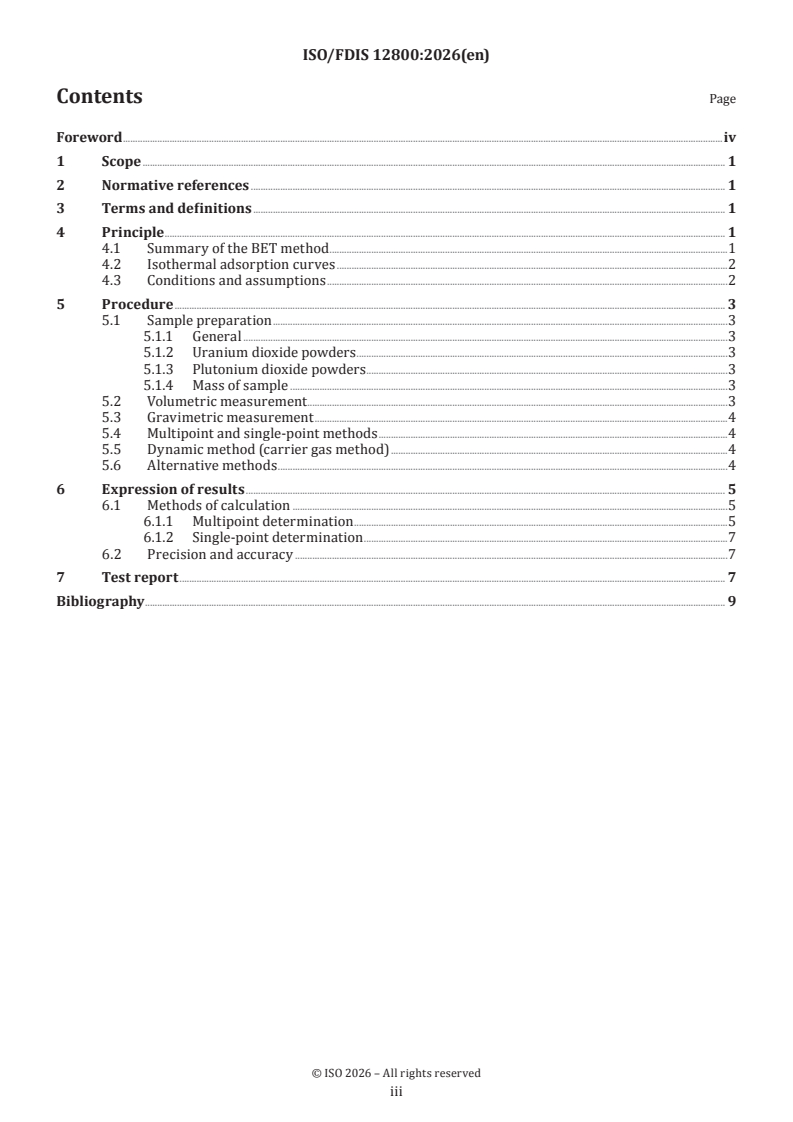
FINAL DRAFT
International
Standard
ISO/TC 85/SC 5
Nuclear fuel technology —
Secretariat: BSI
Guidelines on the measurement of
Voting begins on:
the specific surface area of uranium
2026-09-16
dioxide and plutonium dioxide
Voting terminates on:
powders by the BET method
2026-11-11
Technologie du combustible nucléaire — Lignes directrices pour
le mesurage de l'aire massique (surface spécifique) des poudres
d'oxyde d'uranium et de plutonium par la méthode BET
RECIPIENTS OF THIS DRAFT ARE INVITED TO SUBMIT,
WITH THEIR COMMENTS, NOTIFICATION OF ANY
RELEVANT PATENT RIGHTS OF WHICH THEY ARE AWARE
AND TO PROVIDE SUPPOR TING DOCUMENTATION.
IN ADDITION TO THEIR EVALUATION AS
BEING ACCEPTABLE FOR INDUSTRIAL, TECHNO
ISO/CEN PARALLEL PROCESSING LOGICAL, COMMERCIAL AND USER PURPOSES, DRAFT
INTERNATIONAL STANDARDS MAY ON OCCASION HAVE
TO BE CONSIDERED IN THE LIGHT OF THEIR POTENTIAL
TO BECOME STAN DARDS TO WHICH REFERENCE MAY BE
MADE IN NATIONAL REGULATIONS.
Reference number
FINAL DRAFT
International
Standard
ISO/TC 85/SC 5
Nuclear fuel technology —
Secretariat: BSI
Guidelines on the measurement of
Voting begins on:
the specific surface area of uranium
dioxide and plutonium dioxide
Voting terminates on:
powders by the BET method
Technologie du combustible nucléaire — Lignes directrices pour
le mesurage de l'aire massique (surface spécifique) des poudres
d'oxyde d'uranium et de plutonium par la méthode BET
RECIPIENTS OF THIS DRAFT ARE INVITED TO SUBMIT,
WITH THEIR COMMENTS, NOTIFICATION OF ANY
RELEVANT PATENT RIGHTS OF WHICH THEY ARE AWARE
AND TO PROVIDE SUPPOR TING DOCUMENTATION.
© ISO 2026
IN ADDITION TO THEIR EVALUATION AS
All rights reserved. Unless otherwise specified, or required in the context of its implementation, no part of this publication may
BEING ACCEPTABLE FOR INDUSTRIAL, TECHNO
ISO/CEN PARALLEL PROCESSING
LOGICAL, COMMERCIAL AND USER PURPOSES, DRAFT
be reproduced or utilized otherwise in any form or by any means, electronic or mechanical, including photocopying, or posting on
INTERNATIONAL STANDARDS MAY ON OCCASION HAVE
the internet or an intranet, without prior written permission. Permission can be requested from either ISO at the address below
TO BE CONSIDERED IN THE LIGHT OF THEIR POTENTIAL
or ISO’s member body in the country of the requester.
TO BECOME STAN DARDS TO WHICH REFERENCE MAY BE
MADE IN NATIONAL REGULATIONS.
ISO copyright office
CP 401 • Ch. de Blandonnet 8
CH-1214 Vernier, Geneva
Phone: +41 22 749 01 11
Email: copyright@iso.org
Website: www.iso.org
Published in Switzerland Reference number
ii
Contents Page
Foreword .iv
1 Scope . 1
2 Normative references . 1
3 Terms and definitions . 1
4 Principle . 1
4.1 Summary of the BET method .1
4.2 Isothermal adsorption curves .2
4.3 Conditions and assumptions .2
5 Procedure . 3
5.1 Sample preparation .3
5.1.1 General .3
5.1.2 Uranium dioxide powders .3
5.1.3 Plutonium dioxide powders .3
5.1.4 Mass of sample .3
5.2 Volumetric measurement .3
5.3 Gravimetric measurement .4
5.4 Multipoint and single-point methods .4
5.5 Dynamic method (carrier gas method) .4
5.6 Alternative methods .4
6 Expression of results . 5
6.1 Methods of calculation .5
6.1.1 Multipoint determination .5
6.1.2 Single-point determination .7
6.2 Precision and accuracy .7
7 Test report . 7
Bibliography . 9
iii
Foreword
ISO (the International Organization for Standardization) is a worldwide federation of national standards
bodies (ISO member bodies). The work of preparing International Standards is normally carried out through
ISO technical committees. Each member body interested in a subject for which a technical committee
has been established has the right to be represented on that committee. International organizations,
governmental and non-governmental, in liaison with ISO, also take part in the work. ISO collaborates closely
with the International Electrotechnical Commission (IEC) on all matters of electrotechnical standardization.
The procedures used to develop this document and those intended for its further maintenance are described
in the ISO/IEC Directives, Part 1. In particular, the different approval criteria needed for the different types
of ISO document should be noted. This document was drafted in accordance with the editorial rules of the
ISO/IEC Directives, Part 2 (see www.iso.org/directives).
ISO draws attention to the possibility that the implementation of this document may involve the use of (a)
patent(s). ISO takes no position concerning the evidence, validity or applicability of any claimed patent
rights in respect thereof. As of the date of publication of this document, ISO had not received notice of (a)
patent(s) which may be required to implement this document. However, implementers are cautioned that
this may not represent the latest information, which may be obtained from the patent database available at
www.iso.org/patents. ISO shall not be held responsible for identifying any or all such patent rights.
Any trade name used in this document is information given for the convenience of users and does not
constitute an endorsement.
For an explanation of the voluntary nature of standards, the meaning of ISO specific terms and expressions
related to conformity assessment, as well as information about ISO's adherence to the World Trade
Organization (WTO) principles in the Technical Barriers to Trade (TBT), see www.iso.org/iso/foreword.html.
This document was prepared by Technical Committee ISO/TC 85, Nuclear energy, nuclear technologies, and
radiological protection, Subcommittee SC 5, Nuclear installations, processes and technologies, in collaboration
with the European Committee for Standardization (CEN) Technical Committee CEN/TC 430, Nuclear energy,
nuclear technologies, and radiological protection, in accordance with the Agreement on technical cooperation
between ISO and CEN (Vienna Agreement) and with IEC/TC 76, Optical radiation safety and laser equipment.
This third edition cancels and replaces the second edition (ISO 12800:2017), which has been technically
revised.
The main changes are as follows:
— table of contents was adaptively revised;
— Figure 1 in 4.2 was replaced;
— new Subclauses 5.1.1 and 5.1.2 were added (headings only, the content was carried forward);
— new Subclauses 5.1.3 and 5.1.4 were added (entirely new text);
— content of 5.2 was partially revised;
— several editorial changes were added.
Any feedback or questions on this document should be directed to the user’s national standards body. A
complete listing of these bodies can be found at www.iso.org/members.html.
iv
FINAL DRAFT International Standard ISO/FDIS 12800:2026(en)
Nuclear fuel technology — Guidelines on the measurement of
the specific surface area of uranium dioxide and plutonium
dioxide powders by the BET method
1 Scope
This document is applicable to nuclear fuel fabrication. It gives guidelines on the determination of the
specific surface area of as-fabricated uranium dioxide and plutonium dioxide powders by volumetric or
gravimetric determination of the amount of nitrogen adsorbed on the powder. For the measurement of other
uranium oxide powders, such as UO and U O , reference is made to the procedure for uranium dioxide. For
3 3 8
the measurement of MOX(UO -PuO ) powders, reference is made to the procedure for plutonium dioxide.
2 2
When conditions described are fulfilled, modifications using other adsorbing gases are included.
2 2
The method is applicable as long as the expected value is in the range from 1 m /g to 10 m /g for uranium
2 2
dioxide powders, in the range from 0.1 m /g to 45 m /g for plutonium dioxide powders.
2 Normative references
The following documents are referred to in the text in such a way that some or all of their content constitutes
requirements of this document. For dated references, only the edition cited applies. For undated references,
the latest edition of the referenced document (including any amendments) applies.
ISO/IEC Guide 98-3, Uncertainty of measurement — Part 3: Guide to the expression of uncertainty in
...
ISO/TC 85/SC 5
Secretariat: BSI
Date: 2026-07-10xx
Nuclear fuel technology — Guidelines on the measurement of the
specific surface area of uranium dioxide and plutonium dioxide
powders by the BET method
Technologie du combustible nucléaire — Lignes directrices pour le mesurage de l'aire massique (surface
spécifique) des poudres d'oxyde d'uranium et de plutonium par la méthode BET
FDIS stage
TThihis drs draafftt i is s ssuubbmmiitttteedd ttoo aa ppaarraallellel l vvoottee i inn IISSOO,, CCEEN.N.
All rights reserved. Unless otherwise specified, or required in the context of its implementation, no part of this publication
may be reproduced or utilized otherwise in any form or by any means, electronic or mechanical, including photocopying,
or posting on the internet or an intranet, without prior written permission. Permission can be requested from either ISO
at the address below or ISO’s member body in the country of the requester.
ISO copyright office
CP 401 • Ch. de Blandonnet 8
CH-1214 Vernier, Geneva
Phone: + 41 22 749 01 11
E-mail: copyright@iso.org
Website: www.iso.org
Published in Switzerland
ii
Contents
Foreword . iv
1 Scope . 1
2 Normative references . 1
3 Terms and definitions . 1
4 Principle . 1
4.1 Summary of the BET method . 1
4.2 Isothermal adsorption curves . 1
4.3 Conditions and assumptions . 2
5 Procedure . 3
5.1 Sample preparation . 3
5.2 Volumetric measurement . 3
5.3 Gravimetric measurement . 4
5.4 Multipoint and single-point methods . 4
5.5 Dynamic method (carrier gas method) . 4
5.6 Alternative methods . 4
6 Expression of results . 5
6.1 Methods of calculation . 5
6.2 Precision and accuracy . 8
7 Test report . 8
Bibliography . 9
iii
Foreword
ISO (the International Organization for Standardization) is a worldwide federation of national standards
bodies (ISO member bodies). The work of preparing International Standards is normally carried out through
ISO technical committees. Each member body interested in a subject for which a technical committee has been
established has the right to be represented on that committee. International organizations, governmental and
non-governmental, in liaison with ISO, also take part in the work. ISO collaborates closely with the
International Electrotechnical Commission (IEC) on all matters of electrotechnical standardization.
The procedures used to develop this document and those intended for its further maintenance are described
in the ISO/IEC Directives, Part 1. In particular, the different approval criteria needed for the different types of
ISO document should be noted. This document was drafted in accordance with the editorial rules of the
ISO/IEC Directives, Part 2 (see www.iso.org/directives).
ISO draws attention to the possibility that the implementation of this document may involve the use of (a)
patent(s). ISO takes no position concerning the evidence, validity or applicability of any claimed patent rights
in respect thereof. As of the date of publication of this document, ISO had not received notice of (a) patent(s)
which may be required to implement this document. However, implementers are cautioned that this may not
represent the latest information, which may be obtained from the patent database available at
www.iso.org/patents. ISO shall not be held responsible for identifying any or all such patent rights.
Any trade name used in this document is information given for the convenience of users and does not
constitute an endorsement.
For an explanation of the voluntary nature of standards, the meaning of ISO specific terms and expressions
related to conformity assessment, as well as information about ISO's adherence to the World Trade
Organization (WTO) principles in the Technical Barriers to Trade (TBT), see www.iso.org/iso/foreword.html.
This document was prepared by Technical Committee ISO/TC 85, Nuclear energy, nuclear technologies, and
radiological protection, Subcommittee SC 5, Nuclear installations, processes and technologies, in collaboration
with the European Committee for Standardization (CEN) Technical Committee CEN/TC 430, Nuclear energy,
nuclear technologies, and radiological protection, in accordance with the Agreement on technical cooperation
between ISO and CEN (Vienna Agreement) and with IEC/TC 76, Optical radiation safety and laser equipment.
This third edition cancels and replaces the second edition (ISO 12800:2017), which has been technically
revised.
The main changes are as follows:
— table of contents was adaptively revised;
— Figure 1 in 4.2 was replaced;
— new Subclauses 5.1.1 and 5.1.2 were added (headings only, the content was carried forward);
— new Subclauses 5.1.3 and 5.1.4 were added (entirely new text);
— content of 5.2 was partially revised;
— several editorial changes were added.
Any feedback or questions on this document should be directed to the user’s national standards body. A
complete listing of these bodies can be found at www.iso.org/members.html.
iv
Nuclear fuel technology — Guidelines on the measurement of the
specific surface area of uranium dioxide and plutonium dioxide
powders by the BET method
1 Scope
This document is applicable to nuclear fuel fabrication. It gives guidelines on the determination of the specific
surface area of as-fabricated uranium dioxide and plutonium dioxide powders by volumetric or gravimetric
determination of the amount of nitrogen adsorbed on the powder. For the measurement of other uranium
oxide powders, such as UO and U O , reference is made to the procedure for uranium dioxide. For the
3 3 8
measurement of MOX(UO -PuO ) powders, reference is made to the procedure for plutonium dioxide. When
2 2
conditions described are fulfilled, modifications using other adsorbing gases are included.
2 2
The method is applicable as long as the expected value is in the range from 1 m /g to 10 m /g for uranium
2 2
dioxide powders, in the range from 0.1 m /g to 45 m /g for plutonium dioxide powders.
2 Normative references
The following documents are referred to in the text in such a way that some or all of their content constitutes
requirements of this document. For dated references, only the edition cited applies. For undated references,
the latest edition of the referenced document (including any amendments) applies.
ISO/IEC Guide 98-3, Uncertainty of measurement — Part 3: Guide to the expression of uncertainty in
measurement (GUM:1995)
3 Terms and definitions
No terms and definitions are listed in this document.
ISO and IEC maintain terminology databases for use in standardization at the following addresses:
— ISO Online browsing platform: available at http://www.iso.org/obp
— IEC Electropedia: available at http://www.electropedia.org/
4 Principle
4.1 Summary of the BET method
The BET method is based on the determination of the amount of gas necessary to cover the surface by a
monomolecular layer. This amount is determined from the isothermal adsorption curve of nitrogen (N ) at
[1]
the temperature of liquid nitrogen (77,4 K) according to Reference . The amount of N adsorbed at a given
[2]
pressure is determined by volumetric or gravimetric measurement . In order to remove surface
contamination of the adsorbent, the sample has to be evacuated and heated under appropriate conditions
before the measurement is performed.
4.2 Isothermal adsorption curves
The isothermal adsorption curve describes the relationship between the mass of the adsorbate, m (N ),
A 2
adsorbed per gram of adsorbent (e.g. UO powder) at an equilibrium pressure of p at constant temperature T,
as shown in Formula (1):
𝑚𝑚 = ƒ(𝑝𝑝,𝑇𝑇) (1)
A
Generally, the relative pressure p/p is introduced instead of the absolute pressure p, where p is the
0 0
saturation vapour pressure which is 1,013 × 10 Pa for nitrogen at 77,4 K.
[3]
Most isothermal adsorption curves can be classified according to Reference to be one of the five common
types (see Figure 1).
Materials with pure micropores (with a diameter<2 nm) result in a type 1 adsorption curve. Most frequently,
types 2 and 4 adsorption curves are observed where the adsorption energy of the first layer, E , is much higher
than that of subsequent layers, E . When E ≈ E , type 3 or type 5 adsorption curves result. The BET method
n 1 n
can be applied to type 2 and type 4 cur
...