

ISO 6123-1:2015
(Main)Rubber or plastics covered rollers — Specifications — Part 1: Requirements for hardness
General Information
- Abstract
ISO 6123-1:2015 specifies requirements for the measured hardness of rubber or plastics covered rollers.
- Status
- Published
- Publication Date
- 16-Aug-2015
- Technical Committee
- ISO/TC 45/SC 4 - Products (other than hoses)
- Drafting Committee
- ISO/TC 45/SC 4 - Products (other than hoses)
- Current Stage
- 9092 - International Standard to be revised
- Start Date
- 23-Dec-2025
- Completion Date
- 29-Aug-2026
Buy Documents

ISO 6123-1:2015 - Rubber or plastics covered rollers -- Specifications
ISO 6123-1:2015 - Rubber or plastics covered rollers — Specifications — Part 1: Requirements for hardness/17/2015
Overview
ISO 6123-1:2015 is an international standard specifying the requirements for the hardness of rubber or plastics covered rollers. These rollers, typically metal cores coated with rubber or plastic, are essential components in various industrial applications, where their hardness directly impacts performance and durability. This standard provides precise guidelines for measuring and specifying the hardness levels to ensure consistent quality and suitability for intended uses.
Key features of ISO 6123-1:2015 include:
- Clear definitions of hardness measurement units suitable for covered rollers.
- Detailed procedures for hardness testing on curved surfaces.
- Permitted tolerances and variation limits on hardness values.
- Guidance on specifying nominal hardness and compliance criteria.
Key Topics
Hardness Specification Units
The standard identifies three accepted units of hardness measurement for covered rollers:
- International Rubber Hardness Degrees (IRHD)
- Shore Hardness Degrees (Shore A or Shore D)
- Pusey and Jones Indentation Values
These units offer flexibility for different contexts and accuracy requirements, with specific correlations established between them.
Hardness Testing Methods
ISO 6123-1:2015 outlines three main test methods:
- IRHD Hardness: Tested using an IRHD hardness meter calibrated according to ISO 7267-1.
- Shore Hardness: Measured with Shore A or D durometers as specified in ISO 7267-2.
- Pusey and Jones Hardness: Determined using a Pusey and Jones indentation instrument following ISO 7267-3.
Each method requires controlled test conditions including standardized temperature (23°C ± 2°C or 27°C ± 2°C) and testing on smooth, clean surfaces. Temperature equilibrium before testing is emphasized because hardness readings can vary with temperature fluctuations.
Hardness Measurement Procedure
Hardness is measured at multiple points on the roller depending on its length:
- For rollers up to 2.5 meters: five points including three circumferential points at the roller's midpoint and one near each end.
- For rollers over 2.5 meters: nine points, including circumferential measurements at the midpoint and ends.
Results are averaged and rounded to the nearest integer for reporting.
Tolerances and Variations
The standard specifies:
- Tolerance ranges for nominal hardness values depending on the measurement scale.
- Maximum permissible hardness variation within a single roller, ensuring uniformity of the cover material.
- Flexibility for negotiating tighter tolerances between manufacturers and purchasers, though greater precision may be limited by testing and production constraints.
Applications
ISO 6123-1:2015 is critical for industries relying on rubber or plastics covered rollers, such as:
- Printing and paper processing - where consistent roller hardness affects ink transfer and paper quality.
- Textile production - maintaining fabric tension and surface treatment through rollers.
- Packaging and converting industries - where rollers shape and move materials without damage.
- Material handling and manufacturing - controlling friction and wear resistance.
By adhering to this standard, manufacturers and users ensure rollers meet performance requirements, leading to enhanced product reliability, extended equipment life, and reduced downtime.
Related Standards
ISO 6123 forms a multipart series covering the comprehensive specifications for covered rollers:
- ISO 6123-2: Surface characteristics of rubber or plastics covered rollers.
- ISO 6123-3: Dimensional tolerances of covered rollers.
Additional referenced standards that complement ISO 6123-1 include:
- ISO 7267 (all parts): Methods for determining the apparent hardness of rubber-covered rollers.
- ISO 23529: General procedures for preparing and conditioning rubber test pieces for physical testing.
These related standards provide a holistic framework for the quality assurance and testing of covered rollers in industrial environments.
By following ISO 6123-1:2015 guidelines, stakeholders benefit from standardized hardness measurement, facilitating interchangeability, quality assurance, and improved operational performance of rubber or plastics covered rollers.
Relations
- Effective Date
- 04-Nov-2015
Buy Documents
ISO 6123-1:2015 - Rubber or plastics covered rollers -- Specifications
ISO 6123-1:2015 - Rubber or plastics covered rollers — Specifications — Part 1: Requirements for hardness/17/2015
Get Certified
Connect with accredited certification bodies for this standard

DIN CERTCO
DIN Group product certification.

Smithers Quality Assessments
US management systems and product certification.
Sponsored listings
Frequently Asked Questions
ISO 6123-1:2015 is a standard published by the International Organization for Standardization (ISO). Its full title is "Rubber or plastics covered rollers — Specifications — Part 1: Requirements for hardness". This standard covers: ISO 6123-1:2015 specifies requirements for the measured hardness of rubber or plastics covered rollers.
ISO 6123-1:2015 specifies requirements for the measured hardness of rubber or plastics covered rollers.
ISO 6123-1:2015 is classified under the following ICS (International Classification for Standards) categories: 83.140.99 - Other rubber and plastics products. The ICS classification helps identify the subject area and facilitates finding related standards.
ISO 6123-1:2015 has the following relationships with other standards: It is inter standard links to ISO 6123-1:1982. Understanding these relationships helps ensure you are using the most current and applicable version of the standard.
ISO 6123-1:2015 is available in PDF format for immediate download after purchase. The document can be added to your cart and obtained through the secure checkout process. Digital delivery ensures instant access to the complete standard document.
Standards Content (Sample)
INTERNATIONAL ISO
STANDARD 6123-1
Second edition
2015-08-15
Rubber or plastics covered rollers —
Specifications —
Part 1:
Requirements for hardness
Cylindres revêtus de caoutchouc ou de plastique — Spécifications —
Partie 1: Spécifications de dureté
Reference number
©
ISO 2015
© ISO 2015, Published in Switzerland
All rights reserved. Unless otherwise specified, no part of this publication may be reproduced or utilized otherwise in any form
or by any means, electronic or mechanical, including photocopying, or posting on the internet or an intranet, without prior
written permission. Permission can be requested from either ISO at the address below or ISO’s member body in the country of
the requester.
ISO copyright office
Ch. de Blandonnet 8 • CP 401
CH-1214 Vernier, Geneva, Switzerland
Tel. +41 22 749 01 11
Fax +41 22 749 09 47
copyright@iso.org
www.iso.org
ii © ISO 2015 – All rights reserved
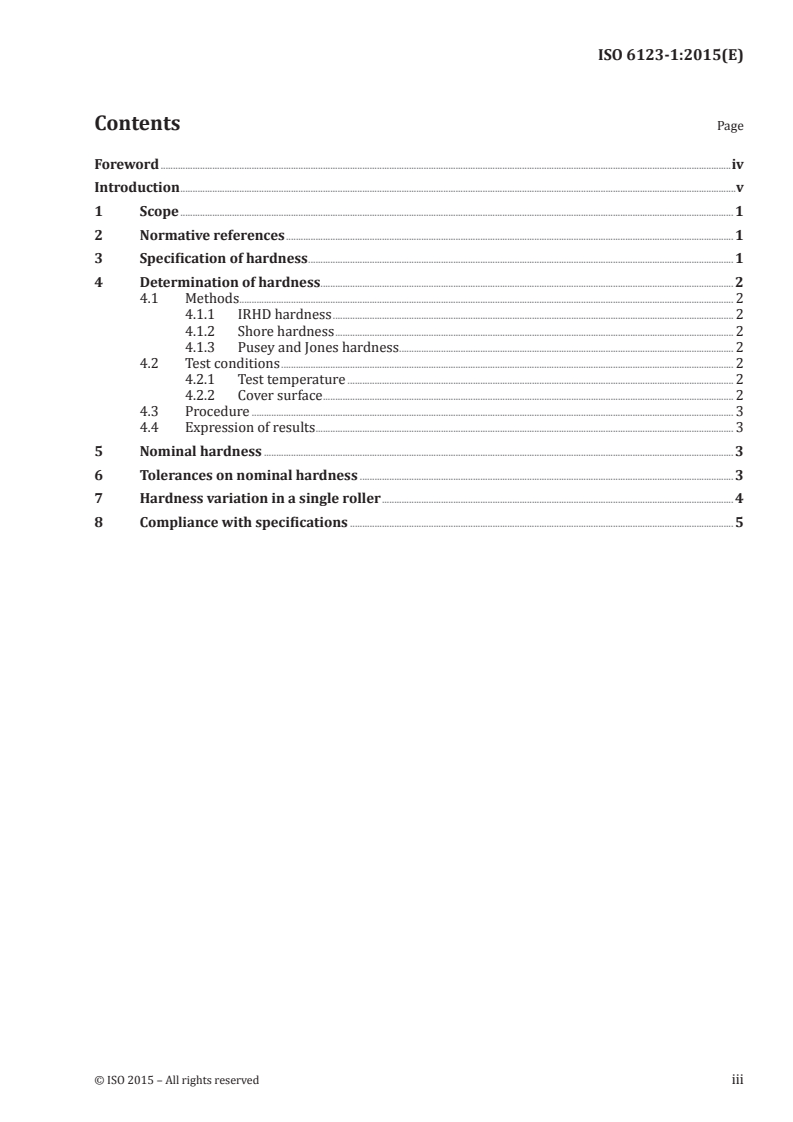
Contents Page
Foreword .iv
Introduction .v
1 Scope . 1
2 Normative references . 1
3 Specification of hardness . 1
4 Determination of hardness . 2
4.1 Methods . 2
4.1.1 IRHD hardness . 2
4.1.2 Shore hardness . 2
4.1.3 Pusey and Jones hardness . 2
4.2 Test conditions . 2
4.2.1 Test temperature . 2
4.2.2 Cover surface . 2
4.3 Procedure . 3
4.4 Expression of results . 3
5 Nominal hardness . 3
6 Tolerances on nominal hardness . 3
7 Hardness variation in a single roller . 4
8 Compliance with specifications . 5
Foreword
ISO (the International Organization for Standardization) is a worldwide federation of national standards
bodies (ISO member bodies). The work of preparing International Standards is normally carried out
through ISO technical committees. Each member body interested in a subject for which a technical
committee has been established has the right to be represented on that committee. International
organizations, governmental and non-governmental, in liaison with ISO, also take part in the work.
ISO collaborates closely with the International Electrotechnical Commission (IEC) on all matters of
electrotechnical standardization.
The procedures used to develop this document and those intended for its further maintenance are
described in the ISO/IEC Directives, Part 1. In particular the different approval criteria needed for the
different types of ISO documents should be noted. This document was drafted in accordance with the
editorial rules of the ISO/IEC Directives, Part 2 (see www.iso.org/directives).
Attention is drawn to the possibility that some of the elements of this document may be the subject of
patent rights. ISO shall not be held responsible for identifying any or all such patent rights. Details of
any patent rights identified during the development of the document will be in the Introduction and/or
on the ISO list of patent declarations received (see www.iso.org/patents).
Any trade name used in this document is information given for the convenience of users and does not
constitute an endorsement.
For an explanation on the meaning of ISO specific terms and expressions related to conformity
assessment, as well as information about ISO’s adherence to the WTO principles in the Technical
Barriers to Trade (TBT) see the following URL: Foreword - Supplementary information
The committee responsible for this document is ISO/TC 45, Rubber and rubber products, Subcommittee
SC 4, Products (other than hoses).
This second edition cancels and replaces the first edition (ISO 6123-1:1982), of which it constitutes a
minor revision, mainly to update the normative references.
ISO 6123 consists of the following parts, under the general title Rubber or plastics covered rollers —
Specifications:
— Part 1: Requirements for hardness
— Part 2: Surface characteristics
— Part 3: Dimensional tolerances
iv © ISO 2015 – All rights reserved
Introduction
Covered rollers are cylindrical cores, generally of metal, with a cover of rubber or plastics for a
particular use. They are manufactured in a wide variety of sizes and hardness grades depending on the
intended use.
INTERNATIONAL STANDARD ISO 6123-1:2015(E)
Rubber or plastics covered rollers — Specifications —
Part 1:
Requirements for hardness
1 Scope
This part of ISO 6123 specifies requirements for the measured hardness of rubber or plastics covered
rollers.
2 Normative references
The following documents, in whole or in part, are normatively referenced in this document and are
indispensable for its application. For dated references, only the edition cited applies. For undated
references, the latest
...
INTERNATIONAL ISO
STANDARD 6123-1
Second edition
2015-08-15
Rubber or plastics covered rollers —
Specifications —
Part 1:
Requirements for hardness
Cylindres revêtus de caoutchouc ou de plastique — Spécifications —
Partie 1: Spécifications de dureté
Reference number
©
ISO 2015
© ISO 2015, Published in Switzerland
All rights reserved. Unless otherwise specified, no part of this publication may be reproduced or utilized otherwise in any form
or by any means, electronic or mechanical, including photocopying, or posting on the internet or an intranet, without prior
written permission. Permission can be requested from either ISO at the address below or ISO’s member body in the country of
the requester.
ISO copyright office
Ch. de Blandonnet 8 • CP 401
CH-1214 Vernier, Geneva, Switzerland
Tel. +41 22 749 01 11
Fax +41 22 749 09 47
copyright@iso.org
www.iso.org
ii © ISO 2015 – All rights reserved
Contents Page
Foreword .iv
Introduction .v
1 Scope . 1
2 Normative references . 1
3 Specification of hardness . 1
4 Determination of hardness . 2
4.1 Methods . 2
4.1.1 IRHD hardness . 2
4.1.2 Shore hardness . 2
4.1.3 Pusey and Jones hardness . 2
4.2 Test conditions . 2
4.2.1 Test temperature . 2
4.2.2 Cover surface . 2
4.3 Procedure . 3
4.4 Expression of results . 3
5 Nominal hardness . 3
6 Tolerances on nominal hardness . 3
7 Hardness variation in a single roller . 4
8 Compliance with specifications . 5
Foreword
ISO (the International Organization for Standardization) is a worldwide federation of national standards
bodies (ISO member bodies). The work of preparing International Standards is normally carried out
through ISO technical committees. Each member body interested in a subject for which a technical
committee has been established has the right to be represented on that committee. International
organizations, governmental and non-governmental, in liaison with ISO, also take part in the work.
ISO collaborates closely with the International Electrotechnical Commission (IEC) on all matters of
electrotechnical standardization.
The procedures used to develop this document and those intended for its further maintenance are
described in the ISO/IEC Directives, Part 1. In particular the different approval criteria needed for the
different types of ISO documents should be noted. This document was drafted in accordance with the
editorial rules of the ISO/IEC Directives, Part 2 (see www.iso.org/directives).
Attention is drawn to the possibility that some of the elements of this document may be the subject of
patent rights. ISO shall not be held responsible for identifying any or all such patent rights. Details of
any patent rights identified during the development of the document will be in the Introduction and/or
on the ISO list of patent declarations received (see www.iso.org/patents).
Any trade name used in this document is information given for the convenience of users and does not
constitute an endorsement.
For an explanation on the meaning of ISO specific terms and expressions related to conformity
assessment, as well as information about ISO’s adherence to the WTO principles in the Technical
Barriers to Trade (TBT) see the following URL: Foreword - Supplementary information
The committee responsible for this document is ISO/TC 45, Rubber and rubber products, Subcommittee
SC 4, Products (other than hoses).
This second edition cancels and replaces the first edition (ISO 6123-1:1982), of which it constitutes a
minor revision, mainly to update the normative references.
ISO 6123 consists of the following parts, under the general title Rubber or plastics covered rollers —
Specifications:
— Part 1: Requirements for hardness
— Part 2: Surface characteristics
— Part 3: Dimensional tolerances
iv © ISO 2015 – All rights reserved
Introduction
Covered rollers are cylindrical cores, generally of metal, with a cover of rubber or plastics for a
particular use. They are manufactured in a wide variety of sizes and hardness grades depending on the
intended use.
INTERNATIONAL STANDARD ISO 6123-1:2015(E)
Rubber or plastics covered rollers — Specifications —
Part 1:
Requirements for hardness
1 Scope
This part of ISO 6123 specifies requirements for the measured hardness of rubber or plastics covered
rollers.
2 Normative references
The following documents, in whole or in part, are normatively referenced in this document and are
indispensable for its application. For dated references, only the edition cited applies. For undated
references, the latest
...