

ISO 12466-2:2007
(Main)Plywood — Bonding quality — Part 2: Requirements
General Information
- Abstract
ISO 12466-2:2007 specifies requirements for determination of bonding quality class of plywood, blockboard, battenboard, and laminboard, bonded with thermosetting resins, according to their intended end uses.
- Status
- Published
- Publication Date
- 06-Nov-2007
- Technical Committee
- ISO/TC 89/SC 3 - Plywood
- Drafting Committee
- ISO/TC 89/SC 3 - Plywood
- Current Stage
- 9093 - International Standard confirmed
- Start Date
- 11-Oct-2022
- Completion Date
- 29-Aug-2026

Overview
ISO 12466-2:2007 is an international standard specifying the requirements for bonding quality classification of plywood and related wood-based panels such as blockboard, battenboard, and laminboard. This part of the ISO 12466 series focuses on plywood bonded with thermosetting resins, outlining essential criteria for assessing bonding strength and durability according to the intended end-use conditions.
Published by the International Organization for Standardization (ISO), this standard is critical for manufacturers, quality controllers, and users aiming to ensure plywood products meet prescribed performance levels under varying moisture and environmental exposures.
Key Topics
Scope and Application
ISO 12466-2 applies to plywood and similar wood panels bonded with thermosetting resins. The classification helps determine suitability for different climate and moisture conditions based on standardized bonding quality tests.Bonding Quality Classes
The standard categorizes bonding into three main classes according to moisture resistance:- Class 1: Dry conditions – Suitable for interior environments with limited moisture exposure.
- Class 2: Tropical dry/humid conditions – Designed for protected outdoor environments, tolerating short-term weather exposure and moderately high humidity indoors.
- Class 3: High humidity/exterior conditions – For plywood exposed to prolonged weather and high humidity levels, ensuring long-term durability.
Pre-treatment and Testing Requirements
Different pre-treatment procedures, such as cold soak, boiling, and steam exposures, are mandated depending on the bonding class to simulate service conditions. Strict test criteria for mean shear strength and apparent cohesive wood failure rates are specified to verify bonding integrity.Evaluation Methodology
Bonding quality is measured through test methods defined in ISO 12466-1. Results are assessed against minimum strength and wood failure thresholds to classify plywood into the appropriate bonding class. Visual inspection methods like chisel/knife testing are also included to supplement mechanical testing.
Practical Applications
Quality Control for Manufacturers
Utilizing ISO 12466-2 ensures that plywood products meet minimum bonding strength standards, supporting product consistency and reliability in manufacturing processes.Material Selection for Construction
Builders and architects use this standard to select plywood types matched to the environmental conditions of a project-whether indoor dry areas or exterior applications subject to humidity and weather.Regulatory Compliance
Compliance with ISO 12466-2 supports adherence to building codes and regulations requiring proven bonding quality for safety and longevity in construction materials.Product Certification
Certification bodies apply this standard to validate bonding quality claims made by manufacturers, fostering market confidence and facilitating international trade of plywood products.
Related Standards
ISO 12466-1:2007 – Plywood - Bonding quality - Part 1: Test methods
Specifies the detailed test procedures used to measure bonding strength and wood failure that support the requirements set out in ISO 12466-2.ISO 12465 – Plywood - Specifications
Provides additional plywood specifications including grading, physical, and mechanical property requirements relevant to overall product quality alongside bonding performance.ISO 1096 – Plywood - Classification
Defines plywood types and classifications which complement bonding quality standards by addressing product identification and general characteristics.ISO 2074 – Plywood - Vocabulary
Ensures consistent terminology is used when referring to plywood and its bonding parameters, supporting clear communication across stakeholders.
By aligning plywood bonding quality with internationally recognized criteria, ISO 12466-2:2007 plays an essential role in optimizing the performance, safety, and reliability of plywood products for diverse climatic and structural conditions.
Relations
- Effective Date
- 15-Apr-2008
Get Certified
Connect with accredited certification bodies for this standard

Gozdarski inštitut Slovenije
Slovenian Forestry Institute. Forest management certification support, timber testing.
Sponsored listings
Frequently Asked Questions
ISO 12466-2:2007 is a standard published by the International Organization for Standardization (ISO). Its full title is "Plywood — Bonding quality — Part 2: Requirements". This standard covers: ISO 12466-2:2007 specifies requirements for determination of bonding quality class of plywood, blockboard, battenboard, and laminboard, bonded with thermosetting resins, according to their intended end uses.
ISO 12466-2:2007 specifies requirements for determination of bonding quality class of plywood, blockboard, battenboard, and laminboard, bonded with thermosetting resins, according to their intended end uses.
ISO 12466-2:2007 is classified under the following ICS (International Classification for Standards) categories: 79.060.10 - Plywood. The ICS classification helps identify the subject area and facilitates finding related standards.
ISO 12466-2:2007 has the following relationships with other standards: It is inter standard links to ISO 12466-2:1999. Understanding these relationships helps ensure you are using the most current and applicable version of the standard.
ISO 12466-2:2007 is available in PDF format for immediate download after purchase. The document can be added to your cart and obtained through the secure checkout process. Digital delivery ensures instant access to the complete standard document.
Standards Content (Sample)
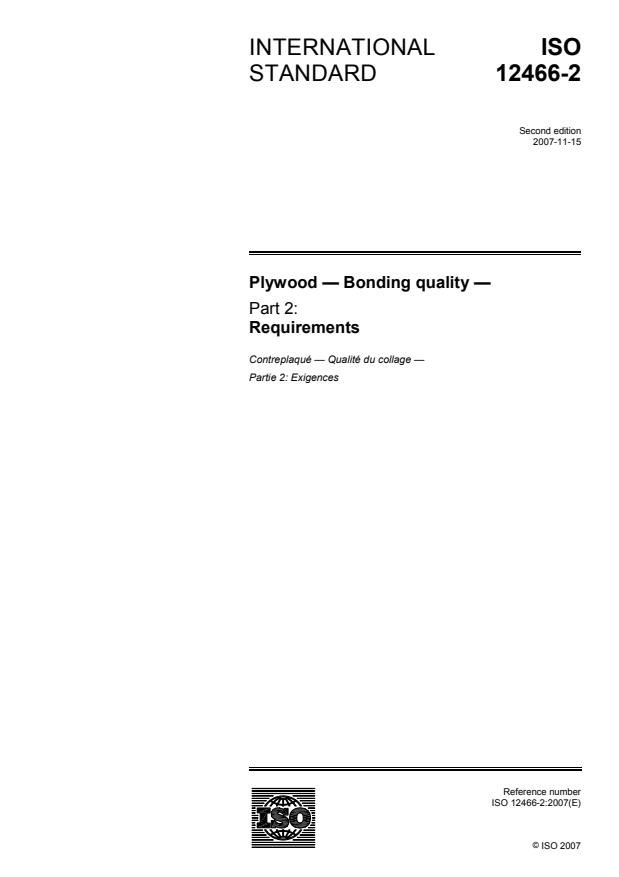
INTERNATIONAL ISO
STANDARD 12466-2
Second edition
2007-11-15
Plywood — Bonding quality —
Part 2:
Requirements
Contreplaqué — Qualité du collage —
Partie 2: Exigences
Reference number
©
ISO 2007
PDF disclaimer
This PDF file may contain embedded typefaces. In accordance with Adobe's licensing policy, this file may be printed or viewed but
shall not be edited unless the typefaces which are embedded are licensed to and installed on the computer performing the editing. In
downloading this file, parties accept therein the responsibility of not infringing Adobe's licensing policy. The ISO Central Secretariat
accepts no liability in this area.
Adobe is a trademark of Adobe Systems Incorporated.
Details of the software products used to create this PDF file can be found in the General Info relative to the file; the PDF-creation
parameters were optimized for printing. Every care has been taken to ensure that the file is suitable for use by ISO member bodies. In
the unlikely event that a problem relating to it is found, please inform the Central Secretariat at the address given below.
© ISO 2007
All rights reserved. Unless otherwise specified, no part of this publication may be reproduced or utilized in any form or by any means,
electronic or mechanical, including photocopying and microfilm, without permission in writing from either ISO at the address below or
ISO's member body in the country of the requester.
ISO copyright office
Case postale 56 • CH-1211 Geneva 20
Tel. + 41 22 749 01 11
Fax + 41 22 749 09 47
E-mail copyright@iso.org
Web www.iso.org
Published in Switzerland
ii © ISO 2007 – All rights reserved
Foreword
ISO (the International Organization for Standardization) is a worldwide federation of national standards bodies
(ISO member bodies). The work of preparing International Standards is normally carried out through ISO
technical committees. Each member body interested in a subject for which a technical committee has been
established has the right to be represented on that committee. International organizations, governmental and
non-governmental, in liaison with ISO, also take part in the work. ISO collaborates closely with the
International Electrotechnical Commission (IEC) on all matters of electrotechnical standardization.
International Standards are drafted in accordance with the rules given in the ISO/IEC Directives, Part 2.
The main task of technical committees is to prepare International Standards. Draft International Standards
adopted by the technical committees are circulated to the member bodies for voting. Publication as an
International Standard requires approval by at least 75 % of the member bodies casting a vote.
Attention is drawn to the possibility that some of the elements of this document may be the subject of patent
rights. ISO shall not be held responsible for identifying any or all such patent rights.
ISO 12466-2 was prepared by Technical Committee ISO/TC 89, Wood based panels, Subcommittee SC 3,
Plywood.
This second edition cancels and replaces the first edition (ISO 12466-2:1999) which has been technically
revised.
ISO 12466 consists of the following parts, under the general title Plywood — Bonding quality:
⎯ Part 1:Test methods
⎯ Part 2: Requirements
INTERNATIONAL STANDARD ISO 12466-2:2007(E)
Plywood — Bonding quality —
Part 2:
Requirements
1 Scope
This part of ISO 12466 specifies requirements for determination of bonding quality class of plywood,
blockboard, battenboard, and laminboard, bonded with thermosetting resins, according to their intended end
uses.
NOTE Appropriate test methods are specified in ISO 12466-1.
2 Normative references
The following referenced documents are indispensable for the application of this document. For dated
references, only the edition cited applies. For undated references, the latest edition of the referenced
document (including any amendments) applies.
ISO 124
...