

ISO 1288-4:2016
(Main)Glass in building — Determination of the bending strength of glass — Part 4: Testing of channel shaped glass
General Information
- Abstract
ISO 1288-4:2016 specifies a method for determining the bending strength (defined as the profile bending strength) of wired or unwired channel shaped glass for use in buildings. The limitations of this part of ISO 1288 are described in ISO 1288‑1.
- Status
- Published
- Publication Date
- 15-Feb-2016
- Technical Committee
- ISO/TC 160/SC 2 - Use considerations
- Drafting Committee
- ISO/TC 160/SC 2/WG 1 - Design strength of glazing
- Current Stage
- 9020 - International Standard under periodical review
- Start Date
- 15-Jul-2026
- Completion Date
- 15-Jul-2026
Buy Documents
ISO 1288-4:2016 - Glass in building -- Determination of the bending strength of glass
ISO 1288-4:2016 - Glass in building — Determination of the bending strength of glass — Part 4: Testing of channel shaped glass/16/2016
Overview
ISO 1288-4:2016 - Glass in building - Determination of the bending strength of glass - Part 4: Testing of channel shaped glass specifies a laboratory method to determine the profile bending strength of wired or unwired channel shaped glass used in buildings. The standard defines specimen preparation, test apparatus, environmental conditioning and the evaluation principles. Limitations and fundamental concepts are described in ISO 1288‑1.
Key topics and technical requirements
- Scope: Applies to wired or unwired channel shaped glass; limits referenced in ISO 1288‑1.
- Specimens: Standard specimen length is 2 100 mm ± 5 mm. Dimensions (web width, flange height, flange/web thickness) must comply with product tolerances. Specimens stored in the test environment for ≥ 4 hours before testing.
- Apparatus:
- Bending machine with stepless, shock‑minimizing loading and load accuracy of ±2.0%.
- Supporting and bending rollers 50 mm diameter, length ≥ 550 mm, free to rotate.
- Air bags and spreader plates to apply load: air bag pressurization 70 kPa for nominal widths ≤ 300 mm, 50 kPa for > 300 mm; air bag dimensions and spreader plate sizes are specified.
- Rubber strips (6 mm thick, hardness 40 ± 10 IRHD) between specimen and supporting rollers.
- Test conditions: Temperature (23 ± 5) °C, relative humidity 40–70%, with temperature constant to ±1 °C during testing.
- Loading rate: Specimen bent with a uniformly increasing bending stress at (2 ± 0.4) MPa/s until failure; record maximum force and time to failure.
- Measurement accuracy: Web width to nearest 1 mm, flange height to 0.5 mm, thicknesses to 0.1 mm.
- Evaluation: Profile bending strength is calculated from the maximum measured force plus specimen self‑weight, the test span and the applicable section modulus (different values when flange or web is in tension). Values for common profiles are provided in an informative annex.
- Reporting: Detailed per‑specimen data required (geometry, measured values, section modulus, whether flange or web in tension, profile strength in MPa, time to breakage). No averaging of individual results.
Applications and users
This standard is essential for:
- Glass manufacturers and product developers validating strength of channel shaped glass (wired or unwired).
- Accredited testing laboratories performing routine type testing and quality control.
- Structural engineers, façade designers and architects specifying channel glass in building envelopes, skylights or internal partitions.
- Certification bodies and regulators assessing compliance with building material performance requirements.
ISO 1288-4 helps ensure consistent, repeatable determination of bending performance so designers and specifiers can assess suitability and safety of channel shaped glass products.
Related standards
- ISO 1288-1 (Fundamentals of testing glass)
- Other parts of ISO 1288 (Parts 2, 3, 5 - alternative bending/ring tests)
- ISO 48 (Rubber hardness measurement referenced for pads)
- ISO 16293-1 (Basic soda lime silicate glass product properties)
Keywords: ISO 1288-4:2016, channel shaped glass, bending strength, profile bending strength, glass testing, glass in building, specimen testing.
Relations
- Effective Date
- 12-Feb-2026
Buy Documents
ISO 1288-4:2016 - Glass in building -- Determination of the bending strength of glass
ISO 1288-4:2016 - Glass in building — Determination of the bending strength of glass — Part 4: Testing of channel shaped glass/16/2016
Frequently Asked Questions
ISO 1288-4:2016 is a standard published by the International Organization for Standardization (ISO). Its full title is "Glass in building — Determination of the bending strength of glass — Part 4: Testing of channel shaped glass". This standard covers: ISO 1288-4:2016 specifies a method for determining the bending strength (defined as the profile bending strength) of wired or unwired channel shaped glass for use in buildings. The limitations of this part of ISO 1288 are described in ISO 1288‑1.
ISO 1288-4:2016 specifies a method for determining the bending strength (defined as the profile bending strength) of wired or unwired channel shaped glass for use in buildings. The limitations of this part of ISO 1288 are described in ISO 1288‑1.
ISO 1288-4:2016 is classified under the following ICS (International Classification for Standards) categories: 81.040.20 - Glass in building. The ICS classification helps identify the subject area and facilitates finding related standards.
ISO 1288-4:2016 has the following relationships with other standards: It is inter standard links to prEN 1288-4 rev. Understanding these relationships helps ensure you are using the most current and applicable version of the standard.
ISO 1288-4:2016 is available in PDF format for immediate download after purchase. The document can be added to your cart and obtained through the secure checkout process. Digital delivery ensures instant access to the complete standard document.
Standards Content (Sample)
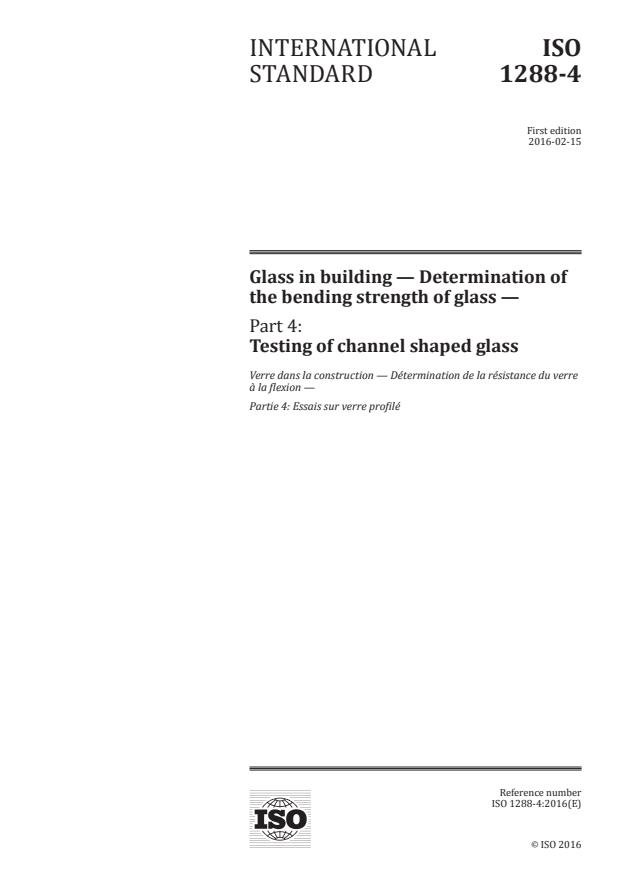
INTERNATIONAL ISO
STANDARD 1288-4
First edition
2016-02-15
Glass in building — Determination of
the bending strength of glass —
Part 4:
Testing of channel shaped glass
Verre dans la construction — Détermination de la résistance du verre
à la flexion —
Partie 4: Essais sur verre profilé
Reference number
©
ISO 2016
© ISO 2016, Published in Switzerland
All rights reserved. Unless otherwise specified, no part of this publication may be reproduced or utilized otherwise in any form
or by any means, electronic or mechanical, including photocopying, or posting on the internet or an intranet, without prior
written permission. Permission can be requested from either ISO at the address below or ISO’s member body in the country of
the requester.
ISO copyright office
Ch. de Blandonnet 8 • CP 401
CH-1214 Vernier, Geneva, Switzerland
Tel. +41 22 749 01 11
Fax +41 22 749 09 47
copyright@iso.org
www.iso.org
ii © ISO 2016 – All rights reserved
Contents Page
Foreword .iv
1 Scope . 1
2 Normative references . 1
3 Terms and definitions . 1
4 Symbols . 2
5 Apparatus . 2
5.1 Testing machine . 2
5.2 Measuring instruments . 3
6 Sample . 3
6.1 Number of specimens . 3
6.2 Specimen dimensions . 3
6.3 Specimen condition . 3
7 Procedure. 4
7.1 Determination of dimensions of each specimen . 4
7.2 Bending test . 4
8 Evaluation . 5
9 Test report . 5
Annex A (informative) Properties of channel shaped glass . 7
Bibliography . 8
Foreword
ISO (the International Organization for Standardization) is a worldwide federation of national standards
bodies (ISO member bodies). The work of preparing International Standards is normally carried out
through ISO technical committees. Each member body interested in a subject for which a technical
committee has been established has the right to be represented on that committee. International
organizations, governmental and non-governmental, in liaison with ISO, also take part in the work.
ISO collaborates closely with the International Electrotechnical Commission (IEC) on all matters of
electrotechnical standardization.
The procedures used to develop this document and those intended for its further maintenance are
described in the ISO/IEC Directives, Part 1. In particular the different approval criteria needed for the
different types of ISO documents should be noted. This document was drafted in accordance with the
editorial rules of the ISO/IEC Directives, Part 2 (see www.iso.org/directives).
Attention is drawn to the possibility that some of the elements of this document may be the subject of
patent rights. ISO shall not be held responsible for identifying any or all such patent rights. Details of
any patent rights identified during the development of the document will be in the Introduction and/or
on the ISO list of patent declarations received (see www.iso.org/patents).
Any trade name used in this document is information given for the convenience of users and does not
constitute an endorsement.
For an explanation on the meaning of ISO specific terms and expressions related to conformity
assessment, as well as information about ISO’s adherence to the WTO principles in the Technical
Barriers to Trade (TBT) see the following URL: Foreword - Supplementary information
The committee responsible for this document is ISO/TC 160, Glass in building, Subcommittee SC 2, Use
considerations.
ISO 1288 consists of the following parts, under the general title Glass in building — Determination of the
bending strength of glass:
— Part 1: Fundamentals of testing glass
— Part 2: Coaxial double ring test on flat specimens with large test surface areas
— Part 3: Test with specimen supported at two points (four point bending)
— Part 4: Testing of channel shaped glass
— Part 5: Coaxial double ring test on flat specimens with small test surface areas
iv © ISO 2016 – All rights reserved
INTERNATIONAL STANDARD ISO 1288-4:2016(E)
Glass in building — Determination of the bending
strength of glass —
Part 4:
Testing of channel shaped glass
1 Scope
This part of ISO 1288 specifies a method for determining the bending strength (defined as the profile
bending strength) of wired or unwired channel shaped glass for use in buildings.
The limitations of this part of ISO 1288 are described in ISO 1288-1.
2 Normative references
The following documents, in whole or in part, are normatively referenced in this document and are
indispensable for its application. For dated references, only the edition cited applies. For undated
references, the latest edition of the referenced document (including any amendments) applies.
ISO 48, Rubber, vulcanized or thermoplastic — Determination of hardness (hardness between 10 IRHD
and 100 IRHD)
ISO 1288-1, Glass in building — Determination of the bending strength of glass — Part 1: Fundamentals of
testing glass
NOTE ISO TC 160 SC1 is s
...
INTERNATIONAL ISO
STANDARD 1288-4
First edition
2016-02-15
Glass in building — Determination of
the bending strength of glass —
Part 4:
Testing of channel shaped glass
Verre dans la construction — Détermination de la résistance du verre
à la flexion —
Partie 4: Essais sur verre profilé
Reference number
©
ISO 2016
© ISO 2016, Published in Switzerland
All rights reserved. Unless otherwise specified, no part of this publication may be reproduced or utilized otherwise in any form
or by any means, electronic or mechanical, including photocopying, or posting on the internet or an intranet, without prior
written permission. Permission can be requested from either ISO at the address below or ISO’s member body in the country of
the requester.
ISO copyright office
Ch. de Blandonnet 8 • CP 401
CH-1214 Vernier, Geneva, Switzerland
Tel. +41 22 749 01 11
Fax +41 22 749 09 47
copyright@iso.org
www.iso.org
ii © ISO 2016 – All rights reserved
Contents Page
Foreword .iv
1 Scope . 1
2 Normative references . 1
3 Terms and definitions . 1
4 Symbols . 2
5 Apparatus . 2
5.1 Testing machine . 2
5.2 Measuring instruments . 3
6 Sample . 3
6.1 Number of specimens . 3
6.2 Specimen dimensions . 3
6.3 Specimen condition . 3
7 Procedure. 4
7.1 Determination of dimensions of each specimen . 4
7.2 Bending test . 4
8 Evaluation . 5
9 Test report . 5
Annex A (informative) Properties of channel shaped glass . 7
Bibliography . 8
Foreword
ISO (the International Organization for Standardization) is a worldwide federation of national standards
bodies (ISO member bodies). The work of preparing International Standards is normally carried out
through ISO technical committees. Each member body interested in a subject for which a technical
committee has been established has the right to be represented on that committee. International
organizations, governmental and non-governmental, in liaison with ISO, also take part in the work.
ISO collaborates closely with the International Electrotechnical Commission (IEC) on all matters of
electrotechnical standardization.
The procedures used to develop this document and those intended for its further maintenance are
described in the ISO/IEC Directives, Part 1. In particular the different approval criteria needed for the
different types of ISO documents should be noted. This document was drafted in accordance with the
editorial rules of the ISO/IEC Directives, Part 2 (see www.iso.org/directives).
Attention is drawn to the possibility that some of the elements of this document may be the subject of
patent rights. ISO shall not be held responsible for identifying any or all such patent rights. Details of
any patent rights identified during the development of the document will be in the Introduction and/or
on the ISO list of patent declarations received (see www.iso.org/patents).
Any trade name used in this document is information given for the convenience of users and does not
constitute an endorsement.
For an explanation on the meaning of ISO specific terms and expressions related to conformity
assessment, as well as information about ISO’s adherence to the WTO principles in the Technical
Barriers to Trade (TBT) see the following URL: Foreword - Supplementary information
The committee responsible for this document is ISO/TC 160, Glass in building, Subcommittee SC 2, Use
considerations.
ISO 1288 consists of the following parts, under the general title Glass in building — Determination of the
bending strength of glass:
— Part 1: Fundamentals of testing glass
— Part 2: Coaxial double ring test on flat specimens with large test surface areas
— Part 3: Test with specimen supported at two points (four point bending)
— Part 4: Testing of channel shaped glass
— Part 5: Coaxial double ring test on flat specimens with small test surface areas
iv © ISO 2016 – All rights reserved
INTERNATIONAL STANDARD ISO 1288-4:2016(E)
Glass in building — Determination of the bending
strength of glass —
Part 4:
Testing of channel shaped glass
1 Scope
This part of ISO 1288 specifies a method for determining the bending strength (defined as the profile
bending strength) of wired or unwired channel shaped glass for use in buildings.
The limitations of this part of ISO 1288 are described in ISO 1288-1.
2 Normative references
The following documents, in whole or in part, are normatively referenced in this document and are
indispensable for its application. For dated references, only the edition cited applies. For undated
references, the latest edition of the referenced document (including any amendments) applies.
ISO 48, Rubber, vulcanized or thermoplastic — Determination of hardness (hardness between 10 IRHD
and 100 IRHD)
ISO 1288-1, Glass in building — Determination of the bending strength of glass — Part 1: Fundamentals of
testing glass
NOTE ISO TC 160 SC1 is s
...