

ISO 22120:2026
(Main)Ships and marine technology — Specification for bunkering of methanol fuelled vessels
- Abstract
This document provides requirements for methanol bunkering transfer systems and equipment used to bunker methanol-fuelled vessels. This document covers the following five elements: transfer systems; operational procedures; risk assessment; safety protection; personnel training.
- Status
- Published
- Publication Date
- 09-Aug-2026
- Technical Committee
- SC 25 - Maritime GHG reduction
- Drafting Committee
- ISO/TC 8/SC 25/WG 1 - Alternative fuels for ships
- Current Stage
- 6060 - International Standard published - 60 Publication
- Start Date
- 10-Aug-2026
- Due Date
- 25-Aug-2026
- Completion Date
- 25-Aug-2026
ISO 22120:2026 is an International Standard published by ISO for the bunkering of methanol-fuelled vessels. It specifies requirements for methanol bunkering transfer systems, operating procedures, risk assessment, safety protection and personnel training for bunkering facilities, mobile facilities, ships and their crews.
What does ISO 22120:2026 specify?
ISO 22120:2026 specifies the safety and operational requirements for transferring methanol fuel into methanol-fuelled vessels. The document covers the transfer system, the way the bunkering is planned and carried out, the risk assessment behind the operation, the protective measures around the operation, and the training and records that support it.
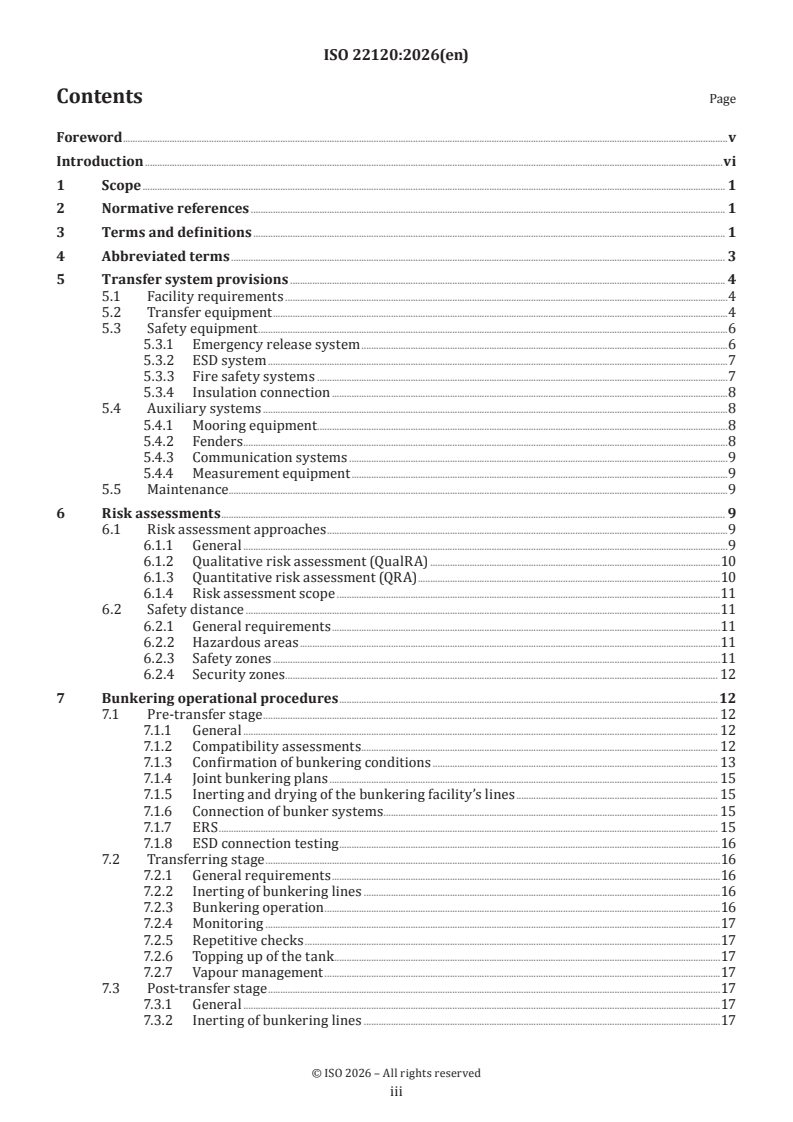
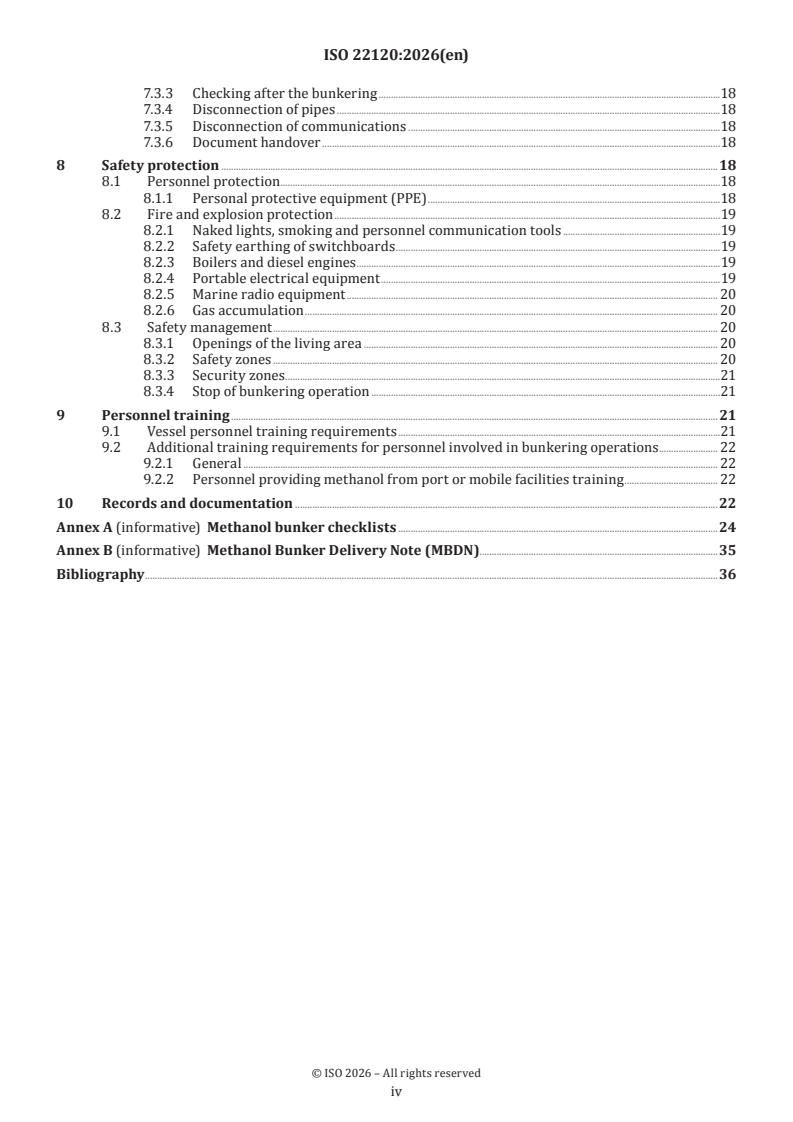
The document is organized into clauses on scope, normative references, terms, abbreviated terms, transfer system provisions, risk assessments, bunkering operational procedures, safety protection, personnel training, and records and documentation.
| Annex | What it covers |
|---|---|
| Annex A | Methanol bunker checklists for planning, pre-operation, transfer, repetitive checks, simultaneous operations and post-transfer |
| Annex B | Methanol Bunker Delivery Note (MBDN) with fuel properties, delivered quantity and signatures |
What are the key requirements of ISO 22120:2026?
ISO 22120:2026 focuses on practical safeguards around methanol transfer. The most important requirements are in clauses 5 to 10, and they tell operators what equipment to provide, how to assess risk, how to run the operation, what protection to use, and what to keep on record.
Transfer systems and equipment
Clause 5 requires the transfer system and associated equipment to be suitable for methanol and for the intended operating conditions. Mobile facilities, terminal arrangements and transfer components must be designed for safe handling and transfer, vapour release should be avoided except where needed for safety, and materials in contact with methanol or vapour must be compatible.
Clause 5 also points to component standards for hoses, flanges, loading arms and emergency shutdown systems. In practice, that means the buyer or operator needs equipment that matches recognized marine and industrial specifications, not just general-purpose piping.
Hoses, loading arms and connections
Clause 5 sets specific expectations for bunker hoses, loading arms and bunker connections. Hoses are to be approved for methanol, prototype-tested, pressure-tested before service, marked with key service data, and handled to avoid damage. Loading arms are to be checked before use and have a working envelope that matches the vessel and facility arrangement.
Dry disconnect couplings may be used for frequent hose operations and, in some cases, on loading arms. The connections also have to be checked for cleanliness and tightness before transfer starts. This matters because misconnection, leakage and mechanical overload are common failure points in bunkering.
Emergency release, shutdown and fire protection
Clause 5 requires an emergency release system (ERS) and an emergency shutdown system (ESD system), with coordinated ship/shore or ship/ship links. The ERS is meant to separate the transfer line safely if the vessel moves out of its operating envelope, while the ESD system stops methanol and vapour transfer when triggered by alarms or operator input.
Clause 5 also requires fire safety measures, insulation against dangerous electrical potential differences, and controls for static electricity. In practice, operators need to provide workable means of stopping transfer quickly, limiting spills, and preventing ignition from sparks or electrical faults.
Risk assessment and safety zones
Clause 6 requires a risk assessment for the bunkering operation. The assessment may be qualitative for standard bunkering scenarios, but a quantitative risk assessment (QRA) is expected when the operation is non-standard, when the design or operation differs from the document, when simultaneous operations are involved, or when authorities require it.
Clause 6 also requires hazardous areas, a safety zone and a security zone around the bunkering connection. The safety zone is based on the flammable extent of a credible release, and the security zone is set from port or ship movement conditions and is normally not smaller than the safety zone. For readers, this means the operation must be planned around physical separation, access control and release scenarios.
Operational procedure: before, during and after transfer
Clause 7 divides bunkering into pre-transfer, transfer and post-transfer stages. Before transfer, the parties are to confirm compatibility, check weather and communications, complete joint bunkering planning, inert and dry lines where needed, connect safely and test the ESD link.
During transfer, the flow rate, pressures, tank levels, leaks and communications must be monitored continuously, with special care during topping up. After transfer, lines are purged and inerted before disconnection, valves are closed in order, and the bunkering operation is formally closed out with documentation.
Safety protection, training and records
Clause 8 requires personal protective equipment (PPE), controls on naked lights, smoking, portable electrical equipment, radio use, openings to accommodation spaces, and conditions that stop bunkering such as severe weather, fire, release or loss of communication. Clause 9 requires vessel personnel to meet the relevant IMO training framework and adds methanol-bunkering-specific training and drills.
Clause 10 requires records for approvals, maintenance, checklists, training, risk assessments and the methanol bunkering procedure manual. In practice, this gives operators the evidence needed for internal control, management system audits and external review.
What terms does ISO 22120:2026 define?
- Bunkering - The transfer of methanol fuel from land-based or floating facilities into a ship’s permanent tanks, or connection of portable tanks to the fuel supply system.
- Bunkering facility - A shore-based or mobile facility that stores methanol and contains the bunkering systems used to transfer it.
- Methanol transfer system - The equipment between the delivering facility and the bunkering manifold on the receiving ship.
- Emergency release system (ERS) - A system that provides safe shut down, isolation and quick release of hoses or loading arms to prevent product release at disconnection time.
- Emergency shutdown system (ESD system) - A system that stops methanol and vapour transfer safely and effectively.
- Safety zone - The area around the bunkering station where only dedicated and essential personnel and activities are allowed during bunkering.
- Security zone - The area established by authorities around a bunkering facility or movement area where access and movement are restricted.
- Qualitative risk assessment (QualRA) - A risk assessment approach based on structured judgment methods such as what-if analysis, HAZOP, FMEA, FTA or ETA.
Who uses ISO 22120:2026?
ISO 22120:2026 is used by shipowners, vessel operators, bunkering terminal operators, truck-to-ship and ship-to-ship fuel providers, and port personnel involved in methanol transfer. It is also relevant to masters, deck officers, marine engineers, safety managers, quality managers and training coordinators who prepare procedures and supervise bunkering.
The document also matters to recognized organizations, classification societies, Flag States, competent authorities and auditors who review whether the facility, vessel and operating procedures align with the standard. Buyers and technical specifiers use it to define what they expect from methanol bunkering equipment and services.
Which standards are used with ISO 22120:2026?
ISO 22120:2026 names two normative references:
- IEC 60079-10-1 - Used for classification of hazardous areas with explosive gas atmospheres.
- IEC 60092-502 - Used for electrical installations in ships, especially tanker-related features.
The document also relies on several companion standards and industry references in the body and bibliography:
- ISO 27126 / EN 13765 / EN 12115 - Hose specifications for methanol transfer equipment.
- ASME B16.5 - Flange dimensions and types for product line connections.
- ASTM F1122-22 - Quick disconnect coupling dimensions and tolerances.
- IEC 31010 - Risk assessment techniques used for bunkering risk assessment.
- OCIMF loading arm and ESD guidance - Used for loading arms and linked ship/shore shutdown systems.
- IMO IGF Code, IBC Code and MSC.1/Circ.1621 - Used for the broader ship safety and training framework.
- STCW - Used for seafarer training, certification and watchkeeping.
What does the ISO 22120:2026 document contain?
ISO 22120:2026 contains detailed provisions for transfer system design, hose and loading arm checks, emergency release and shutdown arrangements, fire protection, insulation and static control, mooring and fendering, communication, measurement equipment and maintenance. It also contains a structured risk assessment framework, including qualitative and quantitative approaches and guidance for setting safety and security zones.
The operational part of the document breaks bunkering into pre-transfer, transfer and post-transfer stages and ties each stage to checks, testing, inerting, monitoring and disconnection steps. Annex A provides six practical checklist parts for planning, pre-operation, transfer, repetitive checks, simultaneous operations and post-transfer closeout.
Annex B provides the Methanol Bunker Delivery Note format, including methanol properties, delivered quantity and signatures. These annexes are useful for day-to-day bunkering control, documentation and audit traceability.
Get Certified
Connect with accredited certification bodies for this standard

DNV
DNV is an independent assurance and risk management provider.

Lloyd's Register
Lloyd's Register is a global professional services organisation specialising in engineering and technology.

FSC International
Forest Stewardship Council certification.
Sponsored listings
Frequently Asked Questions
ISO 22120:2026 is a standard published by the International Organization for Standardization (ISO). Its full title is "Ships and marine technology — Specification for bunkering of methanol fuelled vessels". This standard covers: This document provides requirements for methanol bunkering transfer systems and equipment used to bunker methanol-fuelled vessels. This document covers the following five elements: transfer systems; operational procedures; risk assessment; safety protection; personnel training.
This document provides requirements for methanol bunkering transfer systems and equipment used to bunker methanol-fuelled vessels. This document covers the following five elements: transfer systems; operational procedures; risk assessment; safety protection; personnel training.
ISO 22120:2026 is classified under the following ICS (International Classification for Standards) categories: 47.020.30 - Piping systems. The ICS classification helps identify the subject area and facilitates finding related standards.
ISO 22120:2026 is available in PDF format for immediate download after purchase. The document can be added to your cart and obtained through the secure checkout process. Digital delivery ensures instant access to the complete standard document.
Standards Content (Sample)
Contents
- Introduction
- 1 Scope
- 2 Normative references
- 3 Terms and definitions
- 3.1 bunkering
- 3.2 bunkering facility
- 3.3 bunkering ship
- 3.4 classification society
- 3.5 dry disconnect
- 3.6 emergency release coupling
- 3.7 emergency release system
- 3.8 emergency shutdown system
- 3.9 fender
- 3.10 loading arm
- 3.11 lower flammable limit
- 3.12 management system
- 3.13 mobile facility
- 3.14 methanol transfer system
- 3.15 recognized organization
- 3.16 receiving ship
- 3.17 safety zone
- 3.18 security zone
- 3.19 shore-based bunkering facility
- 4 Abbreviated terms
- 5 Transfer system provisions
- 5.1 Facility requirements
- 5.2 Transfer equipment
- 5.3 Safety equipment
- 5.4 Auxiliary systems
- 5.5 Maintenance
- 6 Risk assessments
- 6.1 Risk assessment approaches
- 6.2 Safety distance
- 7 Bunkering operational procedures
- 7.1 Pre-transfer stage
- 7.2 Transferring stage
- 7.3 Post-transfer stage
- 8 Safety protection
- 8.1 Personnel protection
- 8.2 Fire and explosion protection
- 8.3 Safety management
- 9 Personnel training
- 9.1 Vessel personnel training requirements
- 9.2 Additional training requirements for personnel involved in bunkering operations
- 10 Records and documentation
- Annex A
- 1. Weather/wave condi-
- 2. Mooring arrangement —— ——
- 3. Access between the
- 4. Communication is
- 8. The safety zone
- 10. Vessel entrance is —— —— ——
- 11. Third party visi- —— ——
- 12. Ignition source and
- 14. If applicable
- 3. If applicable
- 4. If applicable
- 1. Valves are closed and ready for
- 2. Methanol bunker hoses and
- 3. Remote and manually con-
- 4. After disconnection the safety
- 5. Competent authorities and
- 6. Near misses and incidents
- Annex B
- 1. Properties of methanol
- 2. Net Total delivered: ________________ t, _______________ m
- 3. Signature(s)
- Bibliography
Introduction
This document has been produced to meet an industry need for additional safety guidance related to the use of alternative fuels on board ships, as identified by the International Maritime Organization (IMO). This document has been designed to support the IMO International Code of Safety for Ships using Gases or other [12] Low-flashpoint Fuels (IGF Code) and the IMO Interim Guidelines for the Safety of Ships Using Methyl/ [10] Ethyl Alcohol as Fuel (IMO MSC.1/Circ.1621).
Due to numerous economic and environmental factors, the use of methanol as a vessel’s fuel has increased. The increase in methanol-fuelled vessels corresponds to an increase in methanol bunkering operations. Therefore, there is a need to standardize methanol bunkering operations internationally to a reasonable degree, so that vessel operators have the tools to select vessel fuel providers who meet set safety standards and so that methanol bunkering operations can be conducted safely. This document can be used for vessels involved in both international and domestic service, regardless of size. This document is flexible so that it can be applied in many situations and under various regulatory regimes as long as the requirements of this document are met.
International Standard ISO 22120:2026(en) Ships and marine technology — Specification for bunkering of methanol fuelled vessels
1 Scope
This document provides requirements for methanol bunkering transfer systems and equipment used to bunker methanol-fuelled vessels. This document covers the following five elements:
a) transfer systems; b) operational procedures; c) risk assessment; d) safety protection; e) personnel training.
2 Normative references
The following documents are referred to in the text in such a way that some or all of their content constitutes requirements of this document. For dated references, only the edition cited applies. For undated references, the latest edition of the referenced document (including any amendments) applies. IEC 60079-10-1, Explosive atmospheres — Part 10-1: Classification of areas — Explosive gas atmospheres IEC 60092-502, Electrical installations in ships — Part 502: Tankers — Special features
3 Terms and definitions
For the purposes of this document, the following terms and definitions apply. ISO and IEC maintain terminology databases for use in standardization at the following addresses:
- ISO Online browsing platform: available at https:// www .iso .org/ obp
- IEC Electropedia: available at https:// www .electropedia .org/
3.1 bunkering
transfer of methanol fuel from land-based or floating facilities into ships' permanent tanks or connection of portable tanks to the fuel supply system
3.2 bunkering facility
facility with methanol storage and bunkering (3.1) systems, which can be a fixed facility such as a shorebased bunkering facility (3.19) or mobile facility (3.13) e.g. bunkering ships (3.3), bunkering trucks
3.3 bunkering ship
ship provided with methanol tanks, bunker systems and metering equipment and used for the transfer of methanol fuel to a receiving ship (3.16)
ISO 22120:2026(en)
3.4 classification society
non-governmental organization that establishes and maintains technical standards for the construction and operation of ships and offshore structures
3.5 dry disconnect
method that reduces methanol liquid or vapours releases into the atmosphere under normal operation to a negligible amount consistent with safety by equipment design
3.6 emergency release coupling
ERC break-away coupling coupling installed on methanol liquid and vapour lines, as a component of an emergency release system (3.7), to ensure the quick physical disconnection of the transfer system from the unit to which it is connected, designed to prevent damage to loading/unloading equipment in the event that the transfer system’s operational envelope and/or parameters are exceeded beyond a predetermined point
3.7 emergency release system
ERS system that provides a safe shut down, transfer system isolation and quick release of hoses or loading arms between the facility or vessel providing the methanol, and the vessel receiving the methanol, preventing product release at disconnection time
3.8 emergency shutdown system
ESD system system that safely and effectively stops the transfer of methanol and vapour between the facility or vessel providing the methanol and the vessel receiving the methanol or vice versa
3.9 fender
large pad absorbing the impact energy to the ship while berthing, which has a sufficient width to keep the ships from contacting with each other or a shore facility
3.10 loading arm
articulated metal transfer system used for transferring methanol to the vessel being bunkered
3.11 lower flammable limit
LFL concentration of flammable gas or vapour in air, below which an explosive gas atmosphere does not form
3.12 management system
set of interrelated or interacting elements of an organization to establish policies and objectives, as well as processes to achieve those objectives [SOURCE: ISO 9000:2015, 3.5.3]
3.13 mobile facility
trucks, rail car, ship or other mobile device (including portable tanks) used to transfer methanol to a receiving ship (3.16)
3.14 methanol transfer system
equipment between the delivering facility and the bunkering manifold on the receiving ship (3.16)
ISO 22120:2026(en)
3.15 recognized organization
competent organization with delegated authority on behalf of an Administration to assist in the uniform and effective implementation of International Maritime Organization Codes and Conventions
3.16 receiving ship
vessel that uses methanol as a fuel and does not use methanol cargo for fuel purposes
3.17 safety zone
area around the bunkering station where only dedicated and essential personnel and activities are allowed during bunkering
3.18 security zone
area established by the national or local authorities around a bunkering facility (3.2) or area through which vessel and personnel movement is subject to regulatory restrictions
3.19 shore-based bunkering facility
onshore facility which is designed with methanol tanks, bunker systems and metering equipment to directly supply methanol to the receiving ship (3.16)
4 Abbreviated terms
Table 1 gives information on the abbreviated terms used in this document.
ISO 22120:2026(en) Table 1 — Abbreviated terms Term Description Explanation [11] IBC International Maritime Organization’s The IBC Code applies to ships involved in the carriage of bulk Code International Code for the Construc- dangerous chemicals and prescribes the design and construction tion and Equipment of Ships carrying standards of ships involved in such carriage and the equipment Dangerous Chemicals in Bulk they should carry.
[12] IGF International Maritime Organization’s The IGF Code applies to ships fuelled by gases or other International Code of Safety for Ships Code low-flashpoint fuels. The Code contains mandatory provisions for using Gases or other Low-flashpoint the arrangement, installation, control and monitoring of machin- Fuels ery, equipment and systems using low-flashpoint fuels.
IACS International Association of An organization that establishes, reviews, promotes and develops minimum technical requirements in relation to the design, Classification Societies construction, maintenance and survey of ships and other marine related facilities. IACS assists international regulatory bodies and standards organizations to develop, implement and interpret statutory regulations and industry standards in ship design, construction and maintenance, with a view to improving safety at sea and the prevention of marine pollution.
IMO International Maritime Organization A specialized agency of the United Nations whose purpose is to promote cooperation among governments in relation to the regulation and practices affecting international shipping, to encourage the adoption of high standards for navigational efficiency, and to prevent and control pollution from ships.
OCIMF Oil Companies International Marine Association that was formed in response to the growing pub- Forum lic concern about marine pollution, particularly by oil. OCIMF focuses on promoting best practice in the design, construction and operation of tankers, barges and offshore vessels and their interfaces with terminals inshore, onshore and offshore.
[13] STCW International Convention on Standards This Convention promotes the safety of life and property at of Training, Certification and Watch- sea and the protection of the marine environment by establishing keeping for Seafarers training, certification and watchkeeping for seafarers, in common agreement with international standards.
5 Transfer system provisions
5.1 Facility requirements
5.1.1 Mobile facilities including their tanks, piping, hoses, pumps and valves shall be designed and fabricated to ensure safe handling and transfer of methanol under the intended operating conditions. 5.1.2 The bunkering terminal shall ensure safe methanol bunkering operations. The terminal operator shall obtain a document issued by a competent organization or individual, such as a qualified engineer, confirming that the terminal achieves a level of safety consistent with good industry practice. 5.1.3 Proper devices or arrangements shall be fitted to the bunkering facility to avoid dispersal or venting methanol vapour to the atmosphere other than when necessary for emergency/safety reasons (e.g. use of vapour return lines from receiving ship to the bunkering ship).
5.2 Transfer equipment
5.2.1 All equipment used in the transfer system should meet the requirements defined for each specific piece of equipment as prescribed in 5.2.2 to 5.2.4. All the components of the transfer system should be
ISO 22120:2026(en) fabricated to meet or exceed the applicable standards indicated in Table 2. It is also expected that these [11] [12] components meet the IBC Code and IGF Code.
Table 2 — Standards relevant to transfer system components Component Function Standards Hoses Transfer of methanol ISO 27126 or EN 13765 or EN 12115 Flanges Product line connections ASME B16.5 OCIMF Design and Construction Specification Loading arms Methanol bunkering loading solution [16] for Marine Loading Arms OCIMF Linked Ship/Shore Emergency Shut- Emergency shutdown systems Emergency shutdown down Systems for Oil and Chemical Trans- [17] fers 5.2.2 All flanges used in transfer system should be at least Class 150 according to ASME B16.5. Flanges shall be of the welded-neck, slip-on or socket-welded type. However, socket-welded-type flanges shall not be used in nominal size above 50 mm.
5.2.3 If dry disconnect couplings of up to and including the nominal pipe size of 6 inches are used, the dimensions and tolerances should be according to ASTM F1122-22 to meet compatibility requirements. 5.2.4 Materials used in transfer equipment in contact with methanol or its vapour shall be compatible with the characteristics of methanol.
5.2.5 Hoses
5.2.5.1 Bunker hoses should be an approved type and be suitable for methanol. The bunker hoses should also conform to the applicable requirements of recognized standards, such as ISO 27126, EN 13765 and EN 12115.
5.2.5.2 Bunker hoses shall be prototype-tested at a normal ambient temperature, with 200 pressure
cycles from zero to at least twice the specified maximum working pressure. After this cycle pressure test has been carried out, the prototype test shall demonstrate a bursting pressure of at least 5 times its specified maximum working pressure at the upper and lower extreme service temperature. Hoses used for prototype testing shall not be used for bunker service.
5.2.5.3 Before being placed in service, each new length of bunker hose produced shall be hydrostatically tested at ambient temperature to a pressure not less than 1,5 times its specified maximum working pressure, but not more than two fifths of its bursting pressure. The hose shall be stencilled, or otherwise marked, with the date of testing, its specified maximum working pressure and, if used in services other than ambient temperature services, its maximum and minimum service temperature, as applicable. The specified maximum working pressure shall not be less than 1 MPa gauge.
5.2.5.4 Each hose assembly shall be visually examined with regards to pressure rating, tightness, other performance data if available and the marking as per the following list:
a) manufacturer's name or trademark; b) identification code of nominal specification of the manufacturer; c) factory test pressure (equivalent to rated working pressure, maximum working pressure and maximum allowable working pressure); d) diameter, range of working temperature and minimum bend radius, etc.; e) date of manufacture and manufacturer’s serial number;
ISO 22120:2026(en) f) instruction of the electrostatic properties and conductivity of hoses; g) designed service object type.
5.2.5.5 The nominal diameter of the hose line including connectors shall be determined based on the maximum flow velocity and the transfer rate.
5.2.5.6 The hose line shall have sufficient length, based on a detailed compatibility study between the bunkering facility and receiving ship manifold arrangement.
5.2.5.7 Hoses and hose assemblies shall be handled with care. They shall not be dragged over sharp edges or abrasive surfaces. They shall not be subjected to kinking and flattening. 5.2.5.8 Hoses and hose assemblies shall be used under normal operating conditions up to the maximum working pressure.
5.2.5.9 The hose manufacturer’s requirements regarding lifetime, inspection and maintenance shall be followed.
5.2.6 Loading arms
5.2.6.1 The condition of the loading arm shall be checked before operation. The pipes and swivels shall be visually examined regarding tightness and free rotation. Purging connections shall be checked for tight fit. Hydraulic or pneumatic lines, to operate the arm or the ERC, shall also be visually examined. 5.2.6.2 The working envelope of the loading arm shall cover the operating range, based on a detailed compatibility study between bunkering facility and receiving ship manifold arrangement. 5.2.6.3 The compatibility of the connector shall be checked before bunkering operation. Spool pieces and adapters may be used to achieve compatibility.
5.2.7 Bunkering connections
5.2.7.1 Dry disconnect couplings may be considered for frequent bunkering operations with hoses. They may be used on loading arms if the load case study shows that the loads are inside the limits of the coupling specification.
5.2.7.2 Before starting the bunker operation, a tightness test of the connection shall be performed. 5.2.7.3 Prior to connection, the connectors shall be checked to be free from debris, other foreign objects and mechanical damage. If necessary foreign objects shall be removed and cleaned from the interface.
5.3 Safety equipment
5.3.1 Emergency release system
5.3.1.1 The transfer system shall be fitted with an emergency release system (ERS) and connected to an emergency shutdown (ESD) system. The bunkering facility and receiving ship ESD systems shall be interconnected with a ship/shore or ship/ship ESD link, or an equivalent means, to ensure the coordinated operation of both the bunkering and receiving ESD systems and ERS. 5.3.1.2 The ERS shall be designed to protect the transfer system and the connections by disconnecting the transfer system, primarily in the event that the vessel drifts out of its operating envelope. The ERS shall
ISO 22120:2026(en) consist of an ERC including interlocked isolating valves to minimize the spill of methanol to the environment when the ERC is activated.
5.3.1.3 The ERS shall be designed to operate as a dry break system. The following shall also apply. a) The ERS shall be designed to separate before the hose or loading arm is overstressed, and the calculated force or bending moment shall be documented.
b) The ERS shall be designed to maintain integrity without leakage. c) The consequences of an emergency breakaway in terms of resultant surge pressures shall be determined and demonstrated to be within the capability of the supply system to not exceed the design pressure. 5.3.1.4 The arrangement of the ERC in the transfer line shall be considered to minimize risks such as creating sparks, causing mechanical damage, inducing pressure surges, or injuring personnel upon release.
5.3.1.5 Regular inspections and maintenance of ERS shall be carried out in accordance with the
manufacturer’s requirements. The records shall be stored for traceability.
5.3.2 ESD system
5.3.2.1 The ESD system shall be designed to be activated by operator-initiated signals as well as sensor input. When activated, the ESD system shall initiate the shutting down of the methanol transfer pumps and closing of the ESD valves. At a minimum, the ESD system shall include sensors that provide input in the event of:
a) fire or leakage detection, either leakage in liquid form or as vapour; b) loss of ventilation in the annular space in the bunkering line, or at the closed/semi-enclosed bunkering stations; c) overfilling of the receiving tank indicated by the high-level and high-high-level alarm; d) loading arm or hose reaching the ESD limits inside the operation envelope prior to ERC disconnection; e) manual initiation or other safety critical alarms.
5.3.2.2 The proper connection of the ESD link shall be checked prior to bunkering. 5.3.2.3 In case of an ESD, the bunker operation shall only be restarted after checking the safety functions and, if applicable, resetting the ERS and the ERCs according to manufacturer’s instructions. 5.3.2.4 The presence of a truck-to-ship bunker system can eliminate the requirement for the ESD link system to comply with Appendix A and B of the OCIMF Linked Ship/Shore Emergency Shutdown Systems for Oil [17] and Chemical Transfers.
5.3.3 Fire safety systems
5.3.3.1 Firefighting equipment of the bunkering facility and the receiving ship shall be ready for immediate use during the bunkering operation, and the power source shall readily provide power to the fire safety system, to cope with the potential dangers.
5.3.3.2 Methanol burns with a near-invisible flame in daylight. Therefore, the fire detection and
firefighting system should include an infrared flame detector. 5.3.3.3 The bunkering ship should be equipped with a fixed lightning arresting system to protect the vessel and associated equipment from potential lightning strikes. The lightning arresting system is expected
ISO 22120:2026(en) to be installed on the main and foremast. A fixed or portable lightning warning system is also expected to be provided to indicate lightning hazards.
5.3.3.4 Fire monitoring and alarm systems shall be engaged during the bunkering operation. 5.3.3.5 For shore-to-ship or truck-to-ship bunkering, two portable alcohol resistant foam extinguishers of at least 9 L capacity and portable flame-detection devices shall be provided within the bunkering operation area.
5.3.3.6 For shore-to-ship or truck-to-ship bunkering, emergency fire-fighting appliance, emergency
leakage equipment, emergency eye wash stations and showers should be provided within the bunkering operation area.
5.3.4 Insulation connection
5.3.4.1 Differences in the electrical potential between the bunkering facility and the receiving ship can be significant and pose a risk to sparking. Electrical insulation in the transfer line shall be provided, either by using insulation flanges or non-conductive hose lengths.
5.3.4.2 Static electricity is a potential source of sparks, which can ignite flammable liquids or vapours. Static control measures may include the following:
...