

ISO/TR 19032:2026
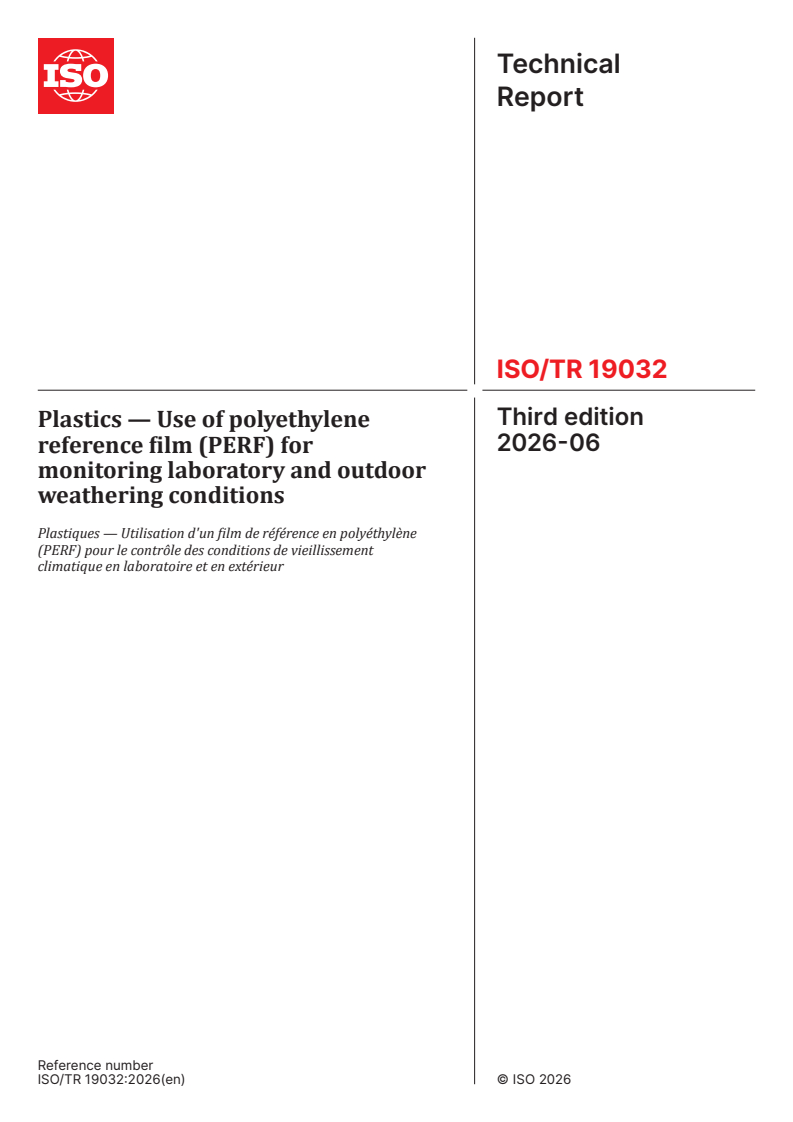
(Main)Plastics — Use of polyethylene reference film (PERF) for monitoring laboratory and outdoor weathering conditions
- Abstract
This document describes a method that demonstrates the use of polyethylene reference film (PERF) for monitoring laboratory and outdoor conditions as a weathering reference material in weathering tests used for plastics.
- Status
- Published
- Publication Date
- 18-Jun-2026
- Technical Committee
- ISO/TC 61/SC 6 - Ageing, chemical and environmental resistance
- Drafting Committee
- ISO/TC 61/SC 6/WG 2 - Exposure to light
- Current Stage
- 6060 - International Standard published
- Start Date
- 19-Jun-2026
- Due Date
- 28-Sep-2026
- Completion Date
- 19-Jun-2026

ISO/TR 19032:2026 is an ISO Technical Report for plastics weathering testing. It explains how polyethylene reference film (PERF) can be used to monitor laboratory and outdoor exposure conditions by tracking oxidation with FTIR spectroscopy and the carbonyl index.
The report is aimed at people who run or compare weathering tests, or who need a reference material to judge exposure severity. In practice, it helps laboratories and users check whether natural or artificial ageing conditions are producing comparable results.
What does ISO/TR 19032:2026 specify?
ISO/TR 19032:2026 describes a method for using PERF as a weathering reference material in weathering tests for plastics. The report focuses on monitoring exposure conditions in the laboratory and outdoors by measuring how PERF oxidizes during exposure.
The document is organized as a technical report with background, material description, a measurement method, interlaboratory test results, and an informative history of the earlier material used in previous editions.
| Annex | What it covers |
|---|---|
| Annex A | Informative history of polyethylene reference specimens (PERS), including preparation, properties, and earlier interlaboratory test results |
The main clauses are:
- Clause 1 Scope
- Clause 2 Normative references
- Clause 3 Terms and definitions
- Clause 4 Abbreviated terms
- Clause 5 Background information
- Clause 6 Material
- Clause 7 Method for measuring the carbonyl index of PERF
- Clause 8 Interlaboratory tests: exposure of PERF to laboratory light-sources
What are the key requirements of ISO/TR 19032:2026?
ISO/TR 19032:2026 sets out a practical approach for using PERF as a reference material, then shows how to measure its oxidation after exposure. The most useful points are the material controls in Clause 6, the FTIR-based carbonyl index method in Clause 7, and the exposure protocols and test evidence in Clause 8.
Clause 6 - PERF must be a well-characterized film
Clause 6 describes the physicochemical properties that define PERF, including infrared features, density, melt flow rate, melting point, crystallinity, molar-mass distribution, thermal phenolic stabilizer content, oxidation induction time, and film thickness. This matters because PERF must start from a consistent state so that changes in the carbonyl index can be linked to exposure rather than to raw-material variability.
Clause 6 also describes how PERF is prepared. The report states that the film is made from free-radical polymerized low-density polyethylene produced by a high-pressure autoclave process and then blown into film. That information matters because users comparing materials need to know the film history and processing route.
Clause 7 - oxidation is tracked by FTIR carbonyl index
ISO/TR 19032:2026 uses FTIR spectroscopy to measure the carbonyl index, C, after exposure. The method compares the carbonyl absorption band with a thickness-correction band, so the result reflects oxidation rather than simple film-thickness variation. In practice, laboratories need FTIR transmission measurements and consistent baseline handling to compare exposed samples.
Clause 7 explains that the index is derived from corrected absorbance values. The practical meaning is simple: a higher carbonyl index indicates a higher oxidation level in PERF, which reflects more severe ageing conditions.
Clause 8 - the report tests PERF in three laboratory exposure types and outdoors
ISO/TR 19032:2026 presents interlaboratory tests for three laboratory light-source types:
- xenon-arc lamps
- fluorescent UV lamps
- medium pressure mercury vapour lamps
For the laboratory tests, specimens are exposed without backing, identified after exposure, and measured after specified exposure durations. This matters because the report is not only describing PERF, but also showing how it behaves in real test equipment and how repeatable the measurements are across laboratories.
Outdoor exposure is part of the monitoring concept
Clause 8 also describes natural outdoor exposure on a Mediterranean site, with monthly carbonyl-index measurements over one year. The report uses that outdoor program to show that PERF responds to natural weathering as well as artificial ageing. For users, this means PERF can be used to check whether outdoor conditions are strong enough to produce measurable oxidation over time.
The report uses the test results to judge sensitivity and compare conditions
ISO/TR 19032:2026 interprets the interlaboratory results to show that PERF is sensitive to differences in exposure conditions. It also notes that the oxidation rate can change with device operating conditions, especially temperature effects. In practice, this helps users detect whether a weathering device is behaving consistently and whether different exposure methods produce similar ageing severity.
Clause 5 gives the scientific basis
Clause 5 explains why PERF works as a weathering reference material: polymer oxidation depends on UV radiation and temperature, and oxidation can be followed by infrared detection of carboxylic acid groups. This background matters because the report is not just empirical - it links the measured carbonyl index to the chemistry of photo-oxidation.
What terms does ISO/TR 19032:2026 define?
- Weathering reference material - a material with known performance under solar radiation, heat, and moisture, used to monitor weathering and irradiation testing.
- PERF - polyethylene reference film, the film used in this report as the weathering reference material.
- PERS - polyethylene reference specimens, the former material used in earlier editions and discussed in Annex A.
- FTIR - Fourier transform infrared, the spectroscopy method used to measure oxidation in PERF.
- carbonyl index, C - the ratio used to express the oxidation level of PERF from FTIR absorbance measurements.
- BST - black standard temperature, the temperature control term used in the exposure conditions for some laboratory tests.
- DSC - differential scanning calorimetry, the technique used in Clause 6 to characterize melting and crystallinity.
- GPC - gel permeation chromatography, the technique used in Clause 6 to characterize molar-mass distribution.
Who uses ISO/TR 19032:2026?
ISO/TR 19032:2026 is used by weathering-test laboratories, polymer and plastics manufacturers, and technical staff who compare artificial and outdoor exposure conditions. It is also relevant to quality managers and buyers who need to qualify a weathering device or verify that exposure conditions are reproducible.
Typical tasks include:
- monitoring laboratory weathering equipment
- comparing exposures from different light sources
- checking outdoor ageing severity
- measuring oxidation changes in a reference film
- interpreting whether a test run is behaving consistently
What changed in ISO/TR 19032:2026 from the previous edition?
ISO/TR 19032:2026 is the third edition and cancels and replaces ISO/TR 19032:2019.
The report states three main changes:
- the reference material has been replaced
- the physicochemical properties and use of the new PERF are described
- the interlaboratory test results for the new PERF are detailed and commented
Which standards are used with ISO/TR 19032:2026?
- ISO 472:2013 - supplies plastics vocabulary used for terms and definitions.
- ISO 10640 - provides the FTIR and UV/visible spectroscopy approach used for assessing polymer photoageing.
- ISO 4892-2:2013 + Amd 1:2021 - provides the xenon-arc laboratory exposure conditions used in Clause 8.
- ISO 4892-3:2016 - provides the fluorescent UV laboratory exposure conditions used in Clause 8.
- EN 16472:2014 - provides the medium pressure mercury vapour lamp exposure method used in Clause 8.
- ISO 877-1:2009 - gives general guidance for solar-radiation exposure used for the outdoor test.
- ISO 877-2:2009 - provides direct weathering and exposure behind window glass for the outdoor exposure context.
What does the ISO/TR 19032:2026 document contain?
ISO/TR 19032:2026 contains a material description, an FTIR-based measurement method, and exposure protocols for comparing laboratory and outdoor weathering conditions. It also includes physicochemical characterization of PERF and a set of interlaboratory test results presented with tables and figures.
The document includes:
- a table of PERF properties and the test methods used to characterize them
- a theoretical FTIR spectrum showing how the carbonyl index is derived
- exposure protocols for xenon-arc, fluorescent UV, and medium pressure mercury vapour lamps
- tables and figures showing carbonyl-index evolution across laboratories and devices
- outdoor exposure results from a natural weathering site
- an informative annex that explains the history of PERS and why it was replaced
Relations
- Effective Date
- 21-Oct-2023
Get Certified
Connect with accredited certification bodies for this standard

DIN CERTCO
DIN Group product certification.

Smithers Quality Assessments
US management systems and product certification.
Sponsored listings
Frequently Asked Questions
ISO/TR 19032:2026 is a technical report published by the International Organization for Standardization (ISO). Its full title is "Plastics — Use of polyethylene reference film (PERF) for monitoring laboratory and outdoor weathering conditions". This standard covers: This document describes a method that demonstrates the use of polyethylene reference film (PERF) for monitoring laboratory and outdoor conditions as a weathering reference material in weathering tests used for plastics.
This document describes a method that demonstrates the use of polyethylene reference film (PERF) for monitoring laboratory and outdoor conditions as a weathering reference material in weathering tests used for plastics.
ISO/TR 19032:2026 is classified under the following ICS (International Classification for Standards) categories: 83.080.01 - Plastics in general. The ICS classification helps identify the subject area and facilitates finding related standards.
ISO/TR 19032:2026 has the following relationships with other standards: It is inter standard links to ISO/TR 19032:2019. Understanding these relationships helps ensure you are using the most current and applicable version of the standard.
ISO/TR 19032:2026 is available in PDF format for immediate download after purchase. The document can be added to your cart and obtained through the secure checkout process. Digital delivery ensures instant access to the complete standard document.
Standards Content (Sample)
Technical
Report
ISO/TR 19032
Third edition
Plastics — Use of polyethylene
2026-06
reference film (PERF) for
monitoring laboratory and outdoor
weathering conditions
Plastiques — Utilisation d'un film de référence en polyéthylène
(PERF) pour le contrôle des conditions de vieillissement
climatique en laboratoire et en extérieur
Reference number
© ISO 2026
All rights reserved. Unless otherwise specified, or required in the context of its implementation, no part of this publication may
be reproduced or utilized otherwise in any form or by any means, electronic or mechanical, including photocopying, or posting on
the internet or an intranet, without prior written permission. Permission can be requested from either ISO at the address below
or ISO’s member body in the country of the requester.
ISO copyright office
CP 401 • Ch. de Blandonnet 8
CH-1214 Vernier, Geneva
Phone: +41 22 749 01 11
Email: copyright@iso.org
Website: www.iso.org
Published in Switzerland
ii
Contents Page
Foreword .iv
Introduction .v
1 Scope . 1
2 Normative references . 1
3 Terms and definitions . 1
4 Abbreviated terms . 1
5 Background information . 1
6 Material. 2
6.1 Properties .2
6.2 Preparation .3
7 Method for measuring the carbonyl index of PERF . 3
8 Interlaboratory tests: exposure of PERF to laboratory light-sources. 4
8.1 General .4
8.2 Protocol for the artificial exposures .5
8.2.1 General .5
8.2.2 Xenon-arc lamp exposure .5
8.2.3 Fluorescent UV lamp exposure .5
8.2.4 Medium pressure mercury vapour lamp exposure.6
8.2.5 Measurement of the carbonyl index C .6
i
8.3 Outdoor exposure test of PERF .6
8.4 Results and discussion .6
8.4.1 Artificial exposures of PERF to laboratory light-source . .6
8.4.2 Exposure of PERF to natural outdoor conditions .17
8.5 Conclusion .19
Annex A (informative) History of polyethylene reference specimens (PERS) .21
Bibliography .23
iii
Foreword
ISO (the International Organization for Standardization) is a worldwide federation of national standards
bodies (ISO member bodies). The work of preparing International Standards is normally carried out through
ISO technical committees. Each member body interested in a subject for which a technical committee
has been established has the right to be represented on that committee. International organizations,
governmental and non-governmental, in liaison with ISO, also take part in the work. ISO collaborates closely
with the International Electrotechnical Commission (IEC) on all matters of electrotechnical standardization.
The procedures used to develop this document and those intended for its further maintenance are described
in the ISO/IEC Directives, Part 1. In particular, the different approval criteria needed for the different types
of ISO documents should be noted. This document was drafted in accordance with the editorial rules of the
ISO/IEC Directives, Part 2 (see www.iso.org/directives).
ISO draws attention to the possibility that the implementation of this document may involve the use of (a)
patent(s). ISO takes no position concerning the evidence, validity or applicability of any claimed patent
rights in respect thereof. As of the date of publication of this document, ISO had not received notice of (a)
patent(s) which may be required to implement this document. However, implementers are cautioned that
this may not represent the latest information, which may be obtained from the patent database available at
www.iso.org/patents. ISO shall not be held responsible for identifying any or all such patent rights.
Any trade name used in this document is information given for the convenience of users and does not
constitute an endorsement.
For an explanation of the voluntary nature of standards, the meaning of ISO specific terms and expressions
related to conformity assessment, as well as information about ISO's adherence to the World Trade
Organization (WTO) principles in the Technical Barriers to Trade (TBT), see www.iso.org/iso/foreword.html.
This document was prepared by Technical Committee ISO/TC 61, Plastics, Subcommittee SC 6, Ageing,
chemical and environmental resistance.
This third edition cancels and replaces the second edition (ISO/TR 19032:2019), which has been technically
revised.
The main changes compared to the previous edition are as follows:
— the reference material has been replaced;
— the physicochemical properties and the use of new PERF are described;
— results of interlaboratory tests with new PERF are detailed and commented.
Any feedback or questions on this document should be directed to the user’s national standards body. A
complete listing of these bodies can be found at www.iso.org/members.html.
iv
Introduction
This document describes the physicochemical properties of polyethylene reference film (PERF) as well
as a method for using PERF as a weathering reference material to monitor the performance of natural or
artificial exposures. Under the action of UV radiation and heat, polyethylene materials undergo photo-
oxidation reactions leading to the formation and accumulation of various oxidation products. Among the
compounds formed during these photochemical processes, carboxylic acids end-groups are easily detected
by their specific infrared absorption in the carbonyl domain. Measuring the relative concentration of
carboxylic acids groups allows calculating a carbonyl index that reflects the polymer oxidation level. The
photo-oxidation rates being directly dependent on the environmental factors and especially UV radiation
and heat, determining the change in the carbonyl index of PERF during natural or artificial exposures allows
monitoring polymer ageing conditions.
v
Technical Report ISO/TR 19032:2026(en)
Plastics — Use of polyethylene reference film (PERF) for
monitoring laboratory and outdoor weathering conditions
1 Scope
This document describes a method that demonstrates the use of polyethylene reference film (PERF) for
monitoring laboratory and outdoor conditions as a weathering reference material in weathering tests used
for plastics.
2 Normative references
The following documents are referred to in the text in such a way that some or all of their content constitutes
requirements of this document. For dated references, only the edition cited applies. For undated references,
the latest edition of the referenced document (including any amendments) applies.
ISO 472:2013, Plastics — Vocabulary
3 Terms and definitions
For the purposes of this document, the terms and definitions given in ISO 472 and the following apply.
ISO and IEC maintain terminology databases for use in standardization at the following addresses:
— ISO Online browsing platform: available at https:// www .iso .org/ obp
— IEC Electropedia: available at https:// www .electropedia .org/
3.1
weathering reference material
material of known performance when exposed to solar radiation, heat, and moisture
Note 1 to entry: Weathering reference materials are used for weathering and irradiation testing.
Note 2 to entry: A weathering reference material is typically commercially available.
[1]
[SOURCE: ISO 4892-1:2024 , 3.5, modified – Note 2 to entry added]
4 Abbreviated terms
PERF Polyethylene reference film
PERS Polyethylene reference specimens
FTIR Fourier transform infrared
5 Background information
When subjected to natural or artificial environmental stresses (such as heat, light or humidity), polymer
[2]
materials are likely to degrade by photo-oxidative pathways. The rate of polymer photo-oxidation mainly
depends on two factors: spectral irradiance and temperature. However, the temperature dependence being
linked to an exponential law involving an activation energy (similar to an Arrhenius law), the influence of the
temperature on the global oxidation rate is the most important. Photo-initiated processes lead to thermally
activated oxidation reactions responsible for chain scissions of the polymer backbone and to the formation
[3],[4]
of a variety of oxidations products, including hydroperoxides, ketones, carboxylic acids, esters, lactones,
[5],[6]
etc. Some of these compounds are not retained by the polymer matrix because they are volatile whereas
other ones accumulate in the material as new functional groups linked to the polymer chains (often as end-
groups). Chain cleavages of polymer materials through oxidation reactions are often responsible for loss
of functional properties (such as aspect degradation or decrease in mechanical properties). Monitoring
the environmental conditions leading to these phenomena requires therefore precise and simultaneous
measurements of irradiance and temperature. Another way to evaluate environmental conditions consists
in monitoring the degradation of a suitable reference material whose oxidation rate was previously well
[7],[8],[9],[10]
characterized. This document refers to this approach and describes the properties and the use
of polyethylene reference film (PERF) to evaluate environmental ageing conditions resulting from the
combined effect of temperature and UV irradiance.
NOTE 1 The first and second edition of this document referred to PERS (polyethylene reference specimens) that
[7],[8],[9],[10]
were produced by the Japan Weathering Test Center. This material is no longer available (see Annex A).
NOTE 2 Relative humidity and wetness have no influence on PERF or this influence is unknown.
6 Material
6.1 Properties
Some physicochemical properties of PERF are reported in Table 1.
Table 1 — Physicochemical properties of PERF
Property Range of values Test method
a [27]
Relative infrared (IR) absorbance of vinylidene insaturations 0,6 to 0,8 ASTM E168
b [27]
Relative IR absorbance of carbonyl compounds (ketones) < 0,15 ASTM E168
3 [21]
Density 920 to 924 kg/m ISO 1183-1
[20]
Melt flow rate (temperature 190 °C, load 2,16 kg) 0,2 to 0,4 g/10 min ISO 1133-1
c [23]
Melting point 110-120 °C ISO 11357-3
c [23]
Crystallinity 20 to 40 % ISO 11357-3
d [25]
Number average molar mass (Mn) 25 000 g/mol to ISO 16014-4
40 000 g/mol
d [25]
Mass average molar mass (Mw) 400 000 g/mol to ISO 16014-4
600 000 g/mol
d [25]
Polydispersity index (PDI) 10 to 20 ISO 16014-4
e [26]
Thermal phenolic stabilizer content < 20 ppm ASTM D6953
[24]
Oxidation induction time (OIT) at 210 °C < 1 min ISO 11357-6
[22]
Film thickness 0,15 ± 0,02 mm ISO 4593
a
Determined by FTIR spectroscopy in transmission mode by calculating the ratio A /A , A corresponding to the
888 2 020 888
-1 -1
IR absorbance of vinylidene groups at 888 cm and A to the absorbance at 2020 cm of a polyethylene thickness correction
2 020
band.
b
Determined by FTIR spectroscopy in transmission mode by calculating the ratio A /A , A corresponding to the
1 723 2 020 1 723
-1 -1
IR absorbance of carbonyl compounds at 1 723 cm and A to the absorbance at 2020 cm of a polyethylene thickness
2 020 cm-1
correction band.
c
Determined by differential scanning calorimetry (DSC). The crystallinity was calculated using a heat of fusion of a 100 %
crystalline polyethylene of 293 J/g.
d
Determined by gel permeation chromatography (GPC) using a polystyrene calibration curve. The molar masses are therefore
expressed as “polystyrene-equivalent molecular weight”.
e
Determined by high-performance liquid chromatography (HPLC).
6.2 Preparation
PERF are made of a free-radical polymerized low-density polyethylene produced by a high-pressure
autoclave process. The films are obtained by blown film extrusion at 200 °C.
NOTE 1 The only known supplier of PERF at the time of publication of this document is the National Centre for
Evaluation of Photoprotection (Centre National d’Evaluation de Photoprotection, CNEP) in France. This information
is given for the convenience of users of this document and does not constitute an endorsement by ISO of the product
named. Equivalent products may be used if they can be shown to lead to the same results.
NOTE 2 Former PERS were obtained from a high-density polyethylene material polymerized with molybdenum
dioxide as a catalyst containing trans-form vinylene groups. The specimens were produced by a compression process.
The physicochemical properties as well as the production method being different, results obtained with former PERS
described in the first and second edition of this document are not comparable to the ones obtained with the new
material of this edition of this document (see Annex A).
7 Method for measuring the carbonyl index of PERF
[11]
An FTIR spectrophotometer is used in accordance with ISO 10640. The FTIR spectrum of PERF is
recorded in transmission mode after natural or artificial exposure in a range comprising at least the interval
–1 –1
(2 200 cm to 1 600 cm ).
A scanning speed suitable for a quantitative analysis is used and all preliminary steps for reliable FTIR
analyses (such as an atmosphere baseline acquisition) are performed prior to the measurements. The FTIR
-1 -1
spectrum of the exposed PERF is then used to measure the IR absorbance at 2 020 cm and 1 715 cm . The
–1
IR absorption at 2 020 cm is employed as an internal standard to correct potential thickness variations
–1
of the film while the IR band at 1 715 cm corresponds to the content of carboxylic groups formed in the
film by the photo-oxidation processes. A theoretical IR spectrum of an oxidized PERF (after exposure)
is shown in Figure 1. The absorbance of the two infrared bands is determined by a tangent method that
-1 -1
consists in measuring the absolute absorbance at each wavenumber, i.e. 2 020 cm and 1 715 cm , and in
subtracting the absorbance of a hypothetic baseline corresponding to each band. The baseline is a straight
-1 -1
line connecting the values of the spectrum comprised between 1 850 cm and 1 660 cm for the band at
-1 -1 -1 -1
1 715 cm , and between 2 100 cm and 1 980 cm for the band at 2 020 cm (see Figure 1).
Key
−1
X wavenumber (cm )
Y FTIR absorbance
−1
1 IR absorption at 2 020 cm
−1
2 IR absorption at 1 715 cm
-1
3 IR absorption at 2 100 cm
-1
4 IR absorption at 1 980 cm
-1
5 IR absorption at 1 850 cm
-1
6 IR absorption at 1 660 cm
Figure 1 — Theoretical FTIR spectrum of photo-oxidized PERF
The carbonyl index, C , is calculated according to Formula (1):
i
A
C = (1)
i
A
where
C is the carbonyl index;
i
-1
A is the absorbance at 1 715 cm determined by a tangent method:
1 715
A = I − B ;
1 715 1 715 1 715
-1
A is the absorbance at 2 020 cm determined by a tangent method:
2 020
A = I − B ;
2 020 2 020 2 020
-1 -1
I and I are the absolute values of absorbance measured at 1 715 cm and 2 020 cm , re-
1 715 2 020
spectively;
-1
B and B are the absorbance of a baseline corresponding to the bands at 1 715 cm and
1 715 2 020
-1
2 020 cm , respectively.
8 Interlaboratory tests: exposure of PERF to laboratory light-sources
8.1 General
As previously mentioned, PERF are designed to monitor artificial or natural ageing conditions leading to
thermally activated photo-oxidative pathways. Although the polyethylene chemical oxidation follows an
exponential development likely to lead to important oxidation levels, the oxidation rate of PERF must be high
enough to rapidly obtain oxidation levels that can be detected by FTIR spectroscopy with good reliability.
This prerequisite raises the important question of PERF sensitivity, in terms of photo-oxidizability, when
subjected to natural or artificial ageing conditions. Interlaboratory tests (hereafter called ILT) involving
artificial or natural exposures of PERF to different photochemical conditions were therefore conducted. The
main objective of these ILT was to evaluate the photochemical sensitivity of PERF under various photo-
oxidative conditions. The repeatability of the results was also studied, although this property can be also
strongly affected by the internal operating conditions of the artificial weathering device, potentially leading
to some deviations between several similar devices. The interpretation of these ILT was therefore focused
on the photochemical behaviour of PERF, and not on a comparison of several weathering devices of similar
or different types.
8.2 Protocol for the artificial exposures
8.2.1 General
A set of 4 specimens (50 mm × 50 mm) was provided to each participant to the ILT. The artificial exposure of
these specimens can be performed in any condition described in 8.2.2, 8.2.3 or 8.2.4. The participants were
asked to:
— expose the 4 specimens (50 mm × 50 mm) without any backing;
— pick up specimens after specified exposure durations (comprised between 50 h and 400 h, depending on
the artificial weathering device);
— indicate the exposed side and exposure duration on each specimen;
— rigorously respect the methods and corresponding International standard mentioned in 8.2.2, 8.2.3 and
8.2.4;
— check that all necessary maintenance and calibration steps were carried out prior to the test.
NOTE Without backing means that the specimen holder is an open frame. Nevertheless, there is always some sort
of background behind the specimen which can influence the UV reflection in the vicinity of the sample.
8.2.2 Xenon-arc lamp exposure
[12]
The tests were performed according to the conditions of ISO 4892-2:2013 + AMD 1:2021 shown in Table 2.
Table 2 — Exposure conditions for xenon-arc lamp
Filter Daylight filter type II according to ISO 4892-2:2013/Amd 1:2021, Annex C
2 2
Irradiance 0,51 W/(m ·nm) at 340 nm or 60 W/m in the range 300 nm to 400 nm
BST (65 ± 3) °C
Chamber temperature (38 ± 3) °C
Wetting 18 min water spray (light on) every 102 min of exposure in dry conditions
Relative humidity (50 ± 10) %
Exposure durations 100 h, 200 h, 300 h and 400 h
8.2.3 Fluorescent UV lamp exposure
[13]
The tests were performed according to the conditions of ISO 4892-3:2016 shown in Table 3.
Table 3 — Exposure conditions for fluorescent UV lamp
Lamp type UVA-340
Irradiance 0,76 W/m /nm at 340 nm
BST (60 ± 3) °C during UV exposure and (50 ± 3) °C during condensation cycles
Wetting 4 h condensation (light off) every 8 h of exposure in dry conditions
Relative Humidity Not controlled
Exposure durations 100 h, 200 h, 300 h and 400 h (total durations including the condensation cycles)
8.2.4 Medium pressure mercury vapour lamp exposure
[14]
The tests were performed in accordance with EN 16472:2014 in the experimental conditions shown in
Table 4.
Table 4 — Exposure conditions for medium pressure mercury vapour lamp
Filter No additional filter or a filter simulating daylight exposures
Irradiance 95 W/m in the range 300 to 400 nm
60 °C at the surface of the sample, controlled either by a BST/CHT system set at
Temperature
64 °C/54 °C, or by a white thermometer set at 65 °C or by a platinum sensor set at 60 °C
Wetting No
Relative Humidity Not controlled
Exposure durations 50 h, 75 h, 100 h and 125 h
8.2.5 Measurement of the carbonyl index C
i
The carbonyl index, C , was measured after each exposure duration by three different French laboratories
i
(A, B and C) according to the method described in Clause 7. These three analyses allowed checking the
repeatability of the FTIR measurements (in transmission mode). Average evolutions as well as standard
deviations were then calculated for each test.
8.3 Outdoor exposure test of PERF
Besides studying the photo-oxidative sensitivity of PERF under artificial weathering conditions, the carbonyl
index evolution of PERF when exposed to outdoor conditions was also characterized in order to evaluate the
relevancy of PERF for monitoring natural ageing conditions.
PERF was therefore exposed to natural outdoor conditions (45° tilted to the South, no backing), according
[15] [16]
to ISO 877-1:2009 and ISO 877-2:2009 for one year, from 1 July 2021 to 1 July 2022, on the Bandol site
(France). The carbonyl index was measured every month according to the method detailed in Clause 7.
NOTE The same type of backing is recommended if the intention is to compare artificial and outdoor exposure.
8.4 Results and discussion
8.4.1 Artificial exposures of PERF to laboratory light-source
8.4.1.1 Xenon-arc lamp exposure
The exposures to xenon-arc lamp were performed with nine devices from seven comp
...