


ISO 26623-1:2020
(Main)Polygonal taper interface with flange contact surface - Part 1: Dimensions and designation of shanks
Polygonal taper interface with flange contact surface - Part 1: Dimensions and designation of shanks
This document specifies dimensions for polygonal taper interfaces with flange contact surface - polygon shanks for automatic and manual tool exchange to be applied on machine tools (e. g. turning machines, drilling machines, milling machines and turn/milling centres as well as grinding machines). A range of shank sizes is specified. These shanks incorporate a grooved flange to enable automatic tool exchange. The clamping can be realized by a circular groove using clamping segments or internal screw threads using centre-bolts. The torque is transmitted by form lock (polygon).
Interfaces à cône polygonal avec face d'appui — Partie 1: Dimensions et désignation des queues
Le présent document spécifie les dimensions des interfaces à cône polygonal avec face d'appui — queues à cône polygonal pour changement automatique et manuel d'outils à utiliser sur des machines-outils (par exemple, machines de tournage, machines de perçage, machine de fraisage et les centre d'usinage ainsi que les rectifieuses). Une gamme de dimensions de queues est spécifiée. Les queues comprennent une collerette rainurée pour le changement automatique de l'outil. Le serrage peut être réalisé par une gorge pour segment de serrage ou un filetage intérieur pour boulon central. Le couple est transmis par blocage de forme (polygone).
General Information
Relations
Overview - ISO 26623-1:2020 (Polygonal taper interface, shank dimensions)
ISO 26623-1:2020 specifies the dimensions and designation of polygonal taper shanks with a flange contact surface for automatic and manual tool exchange on machine tools (turning, drilling, milling, turn/mill centres, grinding). The standard defines a range of nominal shank sizes (32, 40, 50, 63, 80, 100 mm), flange features for automatic exchange, clamping options (circular groove with clamping segments or internal screw thread with centre-bolts) and the method of torque transmission by form lock (polygon).
Example designation:
- POLYGON SHANK ISO 26623-1 - PSC 32
Key topics and technical requirements
- Dimensional data: Complete geometry for polygon shanks (external profile, gauges, flanges, chip-hole options) with detailed figures and Table 1 size data.
- Tolerances: Linear and geometric tolerances are to follow ISO 2768 (m / K classes); thread tolerances per ISO 965-2. Specific small-dimension tolerances are given (e.g., ±0.05 mm for 0–0.2 mm).
- Clamping and flange contact: Shanks include a grooved flange enabling automatic tool exchange. Clamping must ensure flange-to-receiver contact for interface stiffness.
- Clamping force guidance (Annex A): Recommended clamping forces by nominal size (kN): 32→15, 40→20, 50→25, 63→30, 80→40, 100→60. These values ensure at least 80% of the clamping force acts on the flange under tolerance variation.
- Medium-transfer unit: Interfaces must be compatible with medium-transfer units described in ISO 22402-2.
- Dynamical balancing & material: Annex A provides recommendations for dynamic balancing by design, surface hardness (e.g., HRC recommendations), heat treatment and balancing features for adapters and tools.
- Stationary tools: Annex B provides alternative dimensions where tools are stationary and require extra room for clamping or coolant.
Applications and who uses it
- Application: Design, manufacture and inspection of polygonal taper tool shanks and adapters used in automated tool changing systems on machine tools.
- Primary users:
- Tooling and machine-tool manufacturers (tool holders, adapters, cutters)
- Design and production engineers (automation and tool-change systems)
- Quality, inspection and R&D teams (tolerance control, balancing)
- Purchasers and standards/technical spec writers for machining centers
- Benefits: Ensures interchangeability, reliable torque transmission, consistent clamping behavior and supports automated tool-change workflows.
Related standards
- ISO 22402-2 - Medium-transfer units for polygonal taper interfaces (compatibility)
- ISO 965-2 - Metric thread tolerances (threads referenced)
- ISO 2768-1 / ISO 2768-2 - General linear and geometrical tolerances
Keywords: ISO 26623-1, polygonal taper interface, polygon shank, automatic tool exchange, clamping force, medium-transfer unit, tool holder, machine tools, dynamical balancing.
Frequently Asked Questions
ISO 26623-1:2020 is a standard published by the International Organization for Standardization (ISO). Its full title is "Polygonal taper interface with flange contact surface - Part 1: Dimensions and designation of shanks". This standard covers: This document specifies dimensions for polygonal taper interfaces with flange contact surface - polygon shanks for automatic and manual tool exchange to be applied on machine tools (e. g. turning machines, drilling machines, milling machines and turn/milling centres as well as grinding machines). A range of shank sizes is specified. These shanks incorporate a grooved flange to enable automatic tool exchange. The clamping can be realized by a circular groove using clamping segments or internal screw threads using centre-bolts. The torque is transmitted by form lock (polygon).
This document specifies dimensions for polygonal taper interfaces with flange contact surface - polygon shanks for automatic and manual tool exchange to be applied on machine tools (e. g. turning machines, drilling machines, milling machines and turn/milling centres as well as grinding machines). A range of shank sizes is specified. These shanks incorporate a grooved flange to enable automatic tool exchange. The clamping can be realized by a circular groove using clamping segments or internal screw threads using centre-bolts. The torque is transmitted by form lock (polygon).
ISO 26623-1:2020 is classified under the following ICS (International Classification for Standards) categories: 25.060.20 - Dividing and tool-workpiece holding devices. The ICS classification helps identify the subject area and facilitates finding related standards.
ISO 26623-1:2020 has the following relationships with other standards: It is inter standard links to ISO 26623-1:2014. Understanding these relationships helps ensure you are using the most current and applicable version of the standard.
You can purchase ISO 26623-1:2020 directly from iTeh Standards. The document is available in PDF format and is delivered instantly after payment. Add the standard to your cart and complete the secure checkout process. iTeh Standards is an authorized distributor of ISO standards.
Standards Content (Sample)
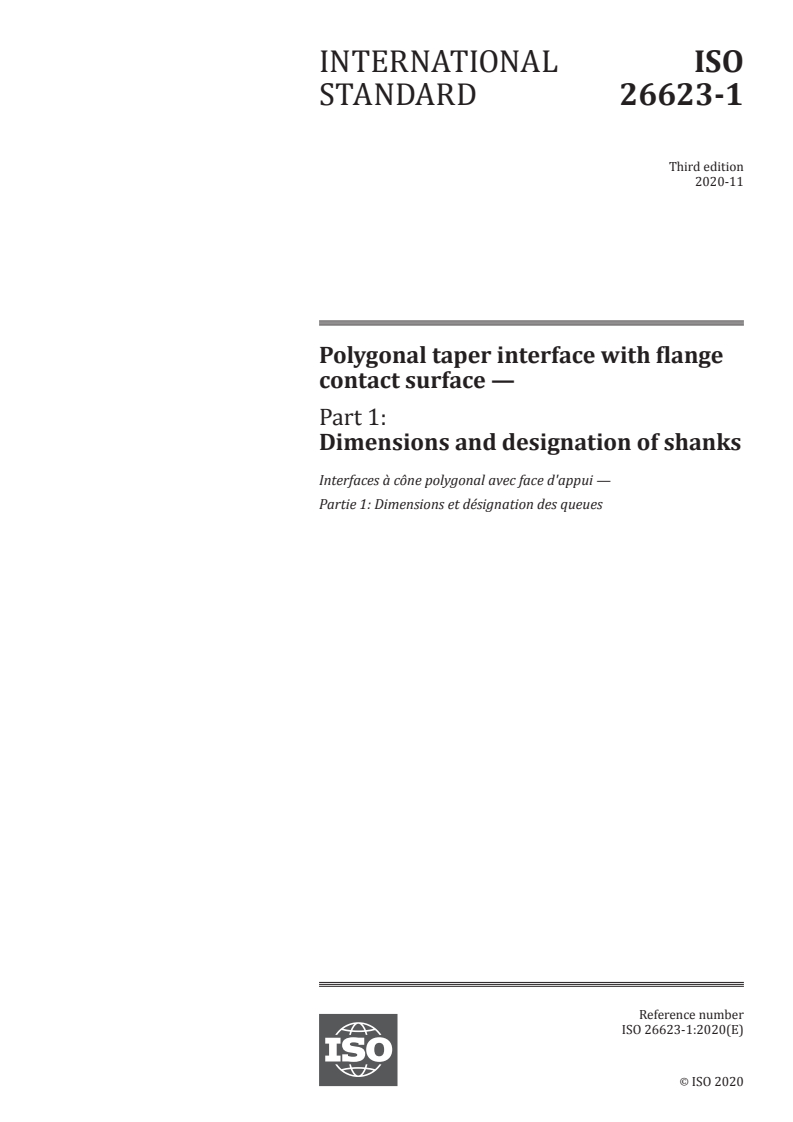
INTERNATIONAL ISO
STANDARD 26623-1
Third edition
2020-11
Polygonal taper interface with flange
contact surface —
Part 1:
Dimensions and designation of shanks
Interfaces à cône polygonal avec face d'appui —
Partie 1: Dimensions et désignation des queues
Reference number
©
ISO 2020
© ISO 2020
All rights reserved. Unless otherwise specified, or required in the context of its implementation, no part of this publication may
be reproduced or utilized otherwise in any form or by any means, electronic or mechanical, including photocopying, or posting
on the internet or an intranet, without prior written permission. Permission can be requested from either ISO at the address
below or ISO’s member body in the country of the requester.
ISO copyright office
CP 401 • Ch. de Blandonnet 8
CH-1214 Vernier, Geneva
Phone: +41 22 749 01 11
Email: copyright@iso.org
Website: www.iso.org
Published in Switzerland
ii © ISO 2020 – All rights reserved
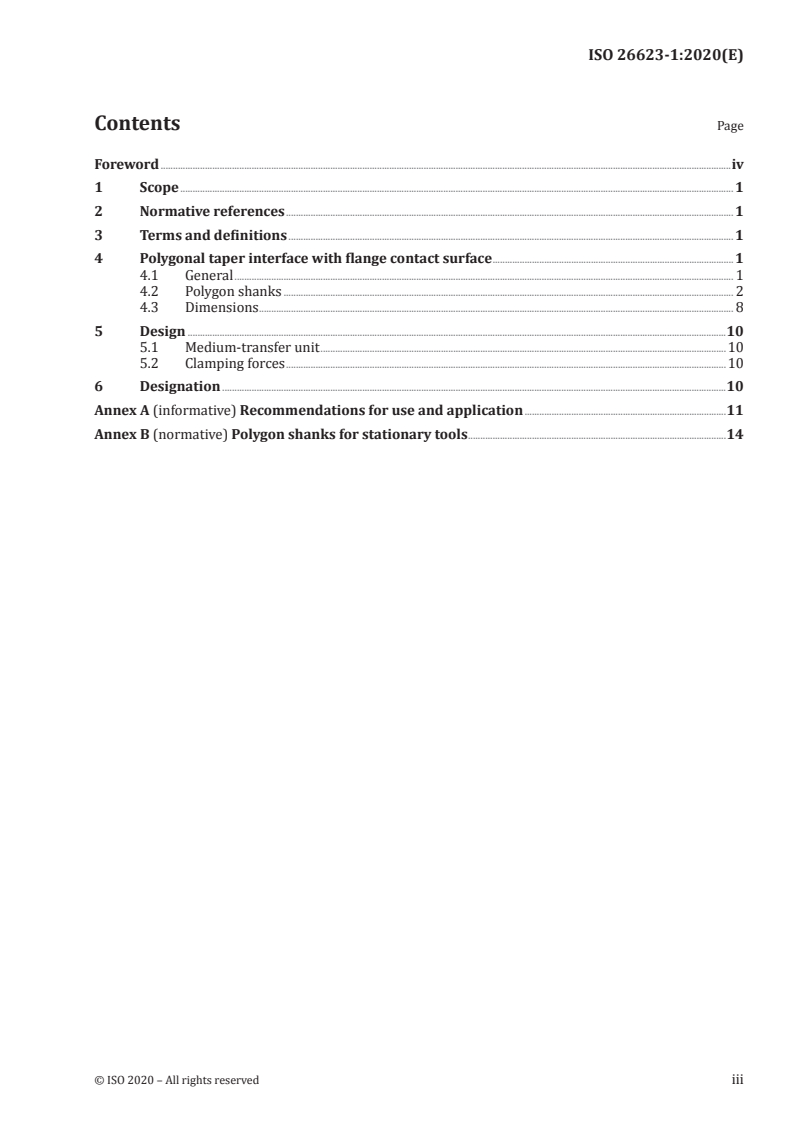
Contents Page
Foreword .iv
1 Scope . 1
2 Normative references . 1
3 Terms and definitions . 1
4 Polygonal taper interface with flange contact surface . 1
4.1 General . 1
4.2 Polygon shanks . 2
4.3 Dimensions . 8
5 Design .10
5.1 Medium-transfer unit .10
5.2 Clamping forces .10
6 Designation .10
Annex A (informative) Recommendations for use and application .11
Annex B (normative) Polygon shanks for stationary tools .14
Foreword
ISO (the International Organization for Standardization) is a worldwide federation of national standards
bodies (ISO member bodies). The work of preparing International Standards is normally carried out
through ISO technical committees. Each member body interested in a subject for which a technical
committee has been established has the right to be represented on that committee. International
organizations, governmental and non-governmental, in liaison with ISO, also take part in the work.
ISO collaborates closely with the International Electrotechnical Commission (IEC) on all matters of
electrotechnical standardization.
The procedures used to develop this document and those intended for its further maintenance are
described in the ISO/IEC Directives, Part 1. In particular, the different approval criteria needed for the
different types of ISO documents should be noted. This document was drafted in accordance with the
editorial rules of the ISO/IEC Directives, Part 2 (see www .iso .org/ directives).
Attention is drawn to the possibility that some of the elements of this document may be the subject of
patent rights. ISO shall not be held responsible for identifying any or all such patent rights. Details of
any patent rights identified during the development of the document will be in the Introduction and/or
on the ISO list of patent declarations received (see www .iso .org/ patents).
Any trade name used in this document is information given for the convenience of users and does not
constitute an endorsement.
For an explanation of the voluntary nature of standards, the meaning of ISO specific terms and
expressions related to conformity assessment, as well as information about ISO's adherence to the
World Trade Organization (WTO) principles in the Technical Barriers to Trade (TBT), see www .iso .org/
iso/ foreword .html.
This document was prepared by Technical Committee ISO/TC 29, Small tools, Subcommittee SC 9, Tools
with defined cutting edges, holding tools, cutting items, adaptive items and interfaces.
This third edition cancels and replaces the second edition ISO 26623-1:2014, which has been technically
revised.
The main changes compared to the previous edition are as follows:
— size 80X is removed;
— Figure 1 is divided in 6 figures to achieve better readability;
— internal design is changed to fit medium-transfer unit referenced (ISO 22402-2);
— information about medium-transfer unit is added;
— dimensions for dynamical balancing by design when used are added in Annex A;
A list of all parts in the ISO 26623 series can be found on the ISO website.
Any feedback or questions on this document should be directed to the user’s national standards body. A
complete listing of these bodies can be found at www .iso .org/ members .html.
iv © ISO 2020 – All rights reserved
INTERNATIONAL STANDARD ISO 26623-1:2020(E)
Polygonal taper interface with flange contact surface —
Part 1:
Dimensions and designation of shanks
1 Scope
This document specifies dimensions for polygonal taper interfaces with flange contact surface —
polygon shanks for automatic and manual tool exchange to be applied on machine tools (e. g. turning
machines, drilling machines, milling machines and turn/milling centres as well as grinding machines).
A range of shank sizes is specified.
These shanks incorporate a grooved flange to enable automatic tool exchange. The clamping can be
realized by a circular groove using clamping segments or internal screw threads using centre-bolts.
The torque is transmitted by form lock (polygon).
2 Normative references
The following documents are referred to in the text in such a way that some or all of their content
constitutes requirements of this document. For dated references, only the edition cited applies. For
undated references, the latest edition of the referenced document (including any amendments) applies.
ISO 965-2, ISO general purpose metric screw threads — Tolerances — Part 2: Limits of sizes for general
purpose external and internal screw threads — Medium quality
ISO 2768-1, General tolerances — Part 1: Tolerances for linear and angular dimensions without individual
tolerance indications
ISO 2768-2, General tolerances — Part 2: Geometrical tolerances for features without individual tolerance
indications
ISO 22402-2, Medium-transfer units for tool interfaces — Part 2: Transfer units for polygonal taper
interfaces in accordance with ISO 26623
3 Terms and definitions
No terms and definitions are listed in this document.
ISO and IEC maintain terminological databases for use in standardization at the following addresses:
— ISO Online browsing platform: available at https:// www .iso .org/ obp
— IEC Electropedia: available at http:// www .electropedia .org/
4 Polygonal taper interface with flange contact surface
4.1 General
Tolerances for linear dimensions for features without individual tolerance indications shall be of
tolerance class “m” in accordance with ISO 2768-1 and geometrical tolerances for features without
individual tolerance indications shall be of tolerance class “K” in accordance with ISO 2768-2.
Tolerances for threads where tolerance is not stated shall be in accordance with ISO 965-2.
4.2 Polygon shanks
The dimensions of polygon shanks shall be in conformance with Figure 1 to Figure 7 and Table 1.
Figure 6 only applies if chip hole bore is used.
NOTE Additio
...
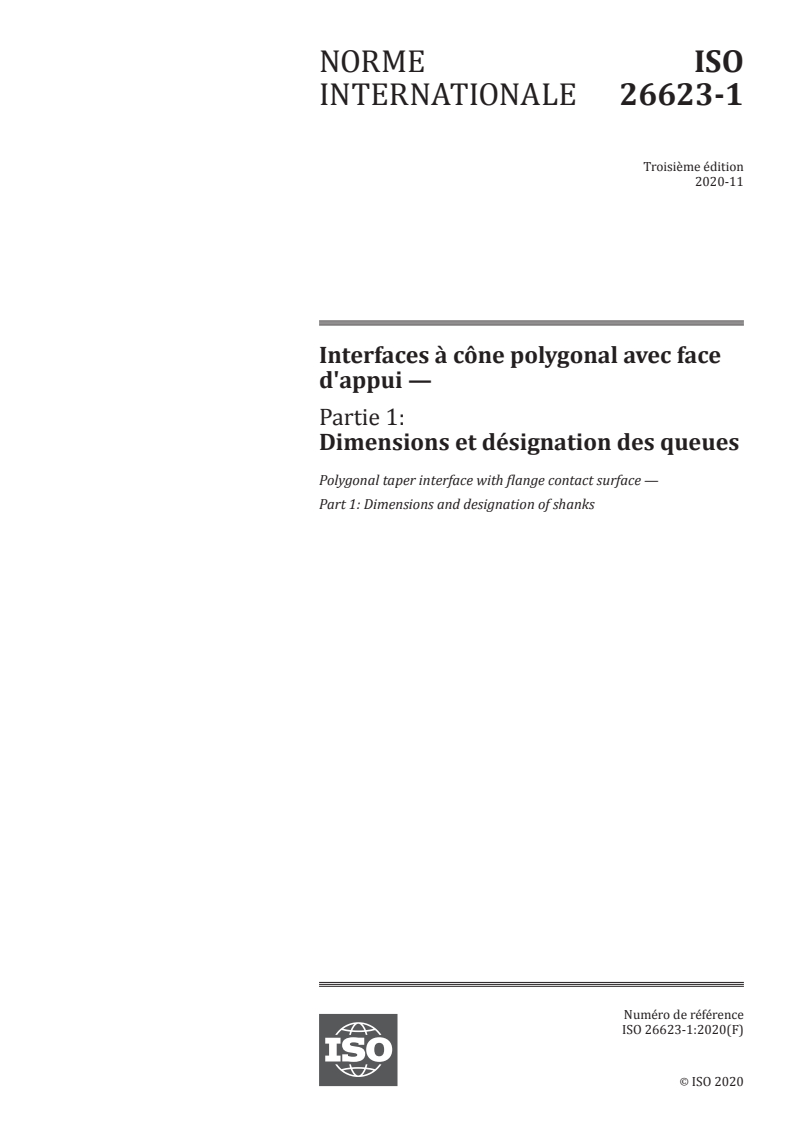
NORME ISO
INTERNATIONALE 26623-1
Troisième édition
2020-11
Interfaces à cône polygonal avec face
d'appui —
Partie 1:
Dimensions et désignation des queues
Polygonal taper interface with flange contact surface —
Part 1: Dimensions and designation of shanks
Numéro de référence
©
ISO 2020
DOCUMENT PROTÉGÉ PAR COPYRIGHT
© ISO 2020
Tous droits réservés. Sauf prescription différente ou nécessité dans le contexte de sa mise en œuvre, aucune partie de cette
publication ne peut être reproduite ni utilisée sous quelque forme que ce soit et par aucun procédé, électronique ou mécanique,
y compris la photocopie, ou la diffusion sur l’internet ou sur un intranet, sans autorisation écrite préalable. Une autorisation peut
être demandée à l’ISO à l’adresse ci-après ou au comité membre de l’ISO dans le pays du demandeur.
ISO copyright office
Case postale 401 • Ch. de Blandonnet 8
CH-1214 Vernier, Genève
Tél.: +41 22 749 01 11
E-mail: copyright@iso.org
Web: www.iso.org
Publié en Suisse
ii © ISO 2020 – Tous droits réservés
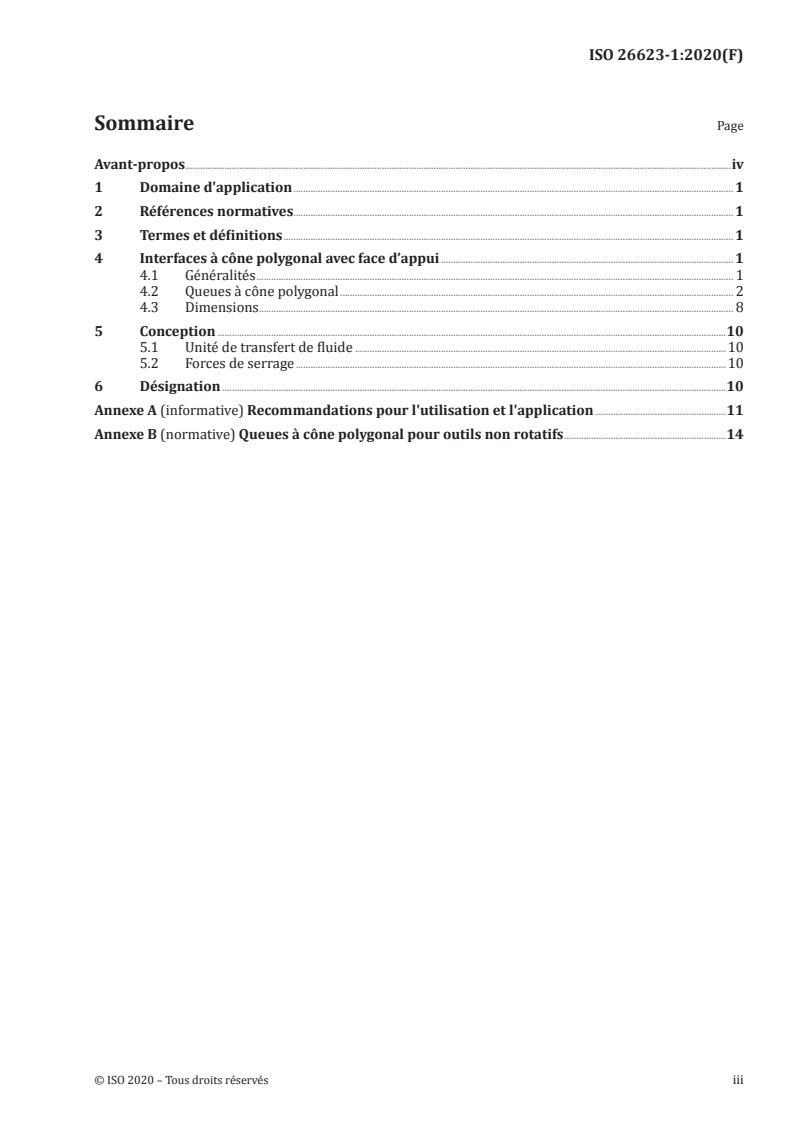
Sommaire Page
Avant-propos .iv
1 Domaine d'application . 1
2 Références normatives . 1
3 Termes et définitions . 1
4 Interfaces à cône polygonal avec face d’appui . 1
4.1 Généralités . 1
4.2 Queues à cône polygonal . 2
4.3 Dimensions . 8
5 Conception .10
5.1 Unité de transfert de fluide .10
5.2 Forces de serrage .10
6 Désignation .10
Annexe A (informative) Recommandations pour l'utilisation et l'application .11
Annexe B (normative) Queues à cône polygonal pour outils non rotatifs .14
Avant-propos
L'ISO (Organisation internationale de normalisation) est une fédération mondiale d'organismes
nationaux de normalisation (comités membres de l'ISO). L'élaboration des Normes internationales est
en général confiée aux comités techniques de l'ISO. Chaque comité membre intéressé par une étude
a le droit de faire partie du comité technique créé à cet effet. Les organisations internationales,
gouvernementales et non gouvernementales, en liaison avec l'ISO participent également aux travaux.
L'ISO collabore étroitement avec la Commission électrotechnique internationale (IEC) en ce qui
concerne la normalisation électrotechnique.
Les procédures utilisées pour élaborer le présent document et celles destinées à sa mise à jour sont
décrites dans les Directives ISO/IEC, Partie 1. Il convient, en particulier de prendre note des différents
critères d'approbation requis pour les différents types de documents ISO. Le présent document a été
rédigé conformément aux règles de rédaction données dans les Directives ISO/IEC, Partie 2 (voir www
.iso .org/ directives).
L'attention est attirée sur le fait que certains des éléments du présent document peuvent faire l'objet de
droits de propriété intellectuelle ou de droits analogues. L'ISO ne saurait être tenue pour responsable
de ne pas avoir identifié de tels droits de propriété et averti de leur existence. Les détails concernant
les références aux droits de propriété intellectuelle ou autres droits analogues identifiés lors de
l'élaboration du document sont indiqués dans l'Introduction et/ou dans la liste des déclarations de
brevets reçues par l'ISO (voir www .iso .org/ brevets).
Les appellations commerciales éventuellement mentionnées dans le présent document sont données
pour information, par souci de commodité, à l’intention des utilisateurs et ne sauraient constituer un
engagement.
Pour une explication de la nature volontaire des normes, la signification des termes et expressions
spécifiques de l'ISO liés à l'évaluation de la conformité, ou pour toute information au sujet de l'adhésion
de l'ISO aux principes de l’Organisation mondiale du commerce (OMC) concernant les obstacles
techniques au commerce (OTC), voir le lien suivant : www .iso .org/ iso/ fr/ avant -propos .html.
Le présent document a été élaboré par le comité technique ISO/TC 29, Petit outillage, sous-comité SC
9, Outils à arêtes de coupe définies, éléments coupants, porte-outils, éléments relatifs aux attachements et
interfaces.
Cette troisième édition annule et remplace la deuxième édition ISO 26623-1:2014, qui a fait l’objet d’une
révision technique.
Les principales modifications par rapport à l’édition précédente sont les suivantes :
— suppression de la dimension 80X ;
— division de la Figure 1 en 6 figures pour une meilleure lisibilité ;
— modification de la conception interne pour s'adapter à l'unité de transfert moyen référencée
(ISO 22402-2) ;
— ajout d'informations sur l'unité de transfert moyen ;
— ajout des dimensions pour l'équilibrage dynamique par conception, lorsqu'il est utilisé, à l'Annexe A.
Une liste de toutes les parties de la série ISO 26623 se trouve sur le site Web de l’ISO.
Il convient que l’utilisateur adresse tout retour d’information ou toute question concernant le présent
document à l’organisme national de normalisation de son pays. Une liste exhaustive desdits organismes
se trouve à l’adresse www .iso .org/ fr/ members .html.
iv © ISO 2020 – Tous droits réservés
NORME INTERNATIONALE ISO 26623-1:2020(F)
Interfaces à cône polygonal avec face d'appui —
Partie 1:
Dimensions et désignation des queues
1 Domaine d'application
Le présent document spécifie les dimensions des interfaces à cône polygonal avec face d’appui — queues
à cône polygonal pour changement automatique et manuel d’outils à utiliser sur des machines-outils
(par exemple, machines de tournage, machines de perçage, machine de fraisage et les centre d’usinage
ainsi que les rectifieuses). Une gamme de dimensions de queues est spécifiée.
Les queues comprennent une collerette rainurée pour le changement automatique de l’outil. Le serrage
peut être réalisé par une gorge pour segment de serrage ou un filetage intérieur pour boulon central.
Le couple est transmis par blocage de forme (polygone).
2 Références normatives
Les documents suivants cités dans le texte constituent, pour tout ou partie de leur contenu, des
exigences du présent document. Pour les références datées, seule l’édition citée s’applique. Pour les
références non datées, la dernière édition du document de référence s'applique (y compris les éventuels
amendements).
ISO 965-2, Filetages métriques ISO pour usages généraux — Tolérances — Partie 2: Dimensions limites
pour filetages intérieurs et extérieurs d'usages généraux — Qualité moyenne
ISO 2768-1, Tolérances générales — Partie 1: Tolérances pour dimensions linéaires et angulaires non
affectées de tolérances individuelles
ISO 2768-2, Tolérances générales — Partie 2: Tolérances géométriques pour éléments non affectés de
tolérances individuelles
ISO 22402-2, Unités de transfert de fluide pour les interfaces d’outils — Partie 2 : Unités de transfert pour
interfaces à cône polygonal conformes à l’ISO 26623
3 Termes et définitions
Aucun terme n’est défini dans le présent document.
L’ISO et l’IEC tiennent à jour des bases de données terminologiques destinées à être utilisées en
normalisation, consultables aux adresses suivantes :
— ISO Online browsing platform disponible à l’adresse : https:// www .iso .org/ obp
— IEC Electropedia disponible à l’adresse : http:// www .electropedia .org/
4 Interfaces à cône polygonal avec face d’appui
4.1 Généralités
Les tolérances pour les dimensions linéaires pour éléments non affectés de tolérances individuelles
doivent être des tolérances de classe « m » conformément à l’ISO 2768-1 et les tolérances géométriques
pour éléments non affectés de tolérances individuelles doivent être de classe « K » conformément à
l’ISO 2768-2.
Les tolérances pour les filetages, lorsqu'aucune tolérance n'est indiquée, doivent être conformes à
l’ISO 965-2.
4.2 Queues à cône polygonal
Les dimensions des queues à cône polygonal doivent être conformes aux Figures 1 à 7 et au Tableau 1.
La Figure 6 s’applique uniquement si l’alésage de la puce est utilisé.
NOTE Des recommandations supplémentaires pour l’utilisation et l’application (c’est-à-dire l’équilibrage
dynamique par conception) sont indiquées à l’Annexe A. Les dimensions indiquées à l'Annexe B ne sont valables
que dans les
...
The article discusses ISO 26623-1:2020, which specifies dimensions for polygonal taper interfaces with flange contact surfaces. These interfaces are used for automatic and manual tool exchange on various types of machine tools, such as turning machines, drilling machines, milling machines, turn/milling centers, and grinding machines. The shanks included in this specification have grooved flanges that enable automatic tool exchange. Clamping can be achieved through a circular groove with clamping segments or internal screw threads with center bolts. The transmission of torque is done through form lock using a polygon.
기사 제목: ISO 26623-1:2020 - 폴리곤 테이퍼 인터페이스와 베이스 접촉면 - 파트 1: 샤프의 치수와 지정 기사 내용: 이 문서는 기계 공구 (예: 터닝 기계, 드릴링 기계, 밀링 기계, 턴/밀링 센터 및 그라인딩 기계)에 적용되는 자동 및 수동 도구 교체를 위한 폴리곤 테이퍼 인터페이스와 베이스 접촉면의 치수를 명시합니다. 다양한 샤프 크기가 지정되어 있습니다. 이러한 샤프는 자동 도구 교환을 가능하게 하는 홈이 있는 베이스를 포함하고 있습니다. 클램핑은 클램핑 세그먼트를 사용한 원형 홈이나 센터 볼트를 사용한 내부 나사로 이루어질 수 있습니다. 토크는 폴리곤을 통해 형태 잠금되어 전달됩니다.
기사 제목: ISO 26623-1:2020 - 폴리곤 테이퍼 인터페이스와 플랜지 접촉면에 대한 제1부: 샤프의 치수와 명칭 기사 내용: 이 문서는 자동 및 수동 도구 교환을 위해 기계 도구 (예: 선반 기계, 드릴 기계, 밀링 기계, 회전/밀링 센터 및 그라인딩 기계)에 적용되는 폴리곤 테이퍼 인터페이스와 플랜지 접촉면의 치수를 규정합니다. 다양한 사이즈의 샤프가 명시되어 있습니다. 이러한 샤프에는 자동 도구 교환을 위해 물결 모양의 플랜지가 포함되어 있습니다. 클램핑은 클램핑 세그먼트를 사용한 원형 홈이나 센터 볼트를 사용한 내부 나사로 구현할 수 있습니다. 토크는 폴리곤을 이용한 형태 잠금으로 전달됩니다.
記事のタイトル:ISO 26623-1:2020 - ポリゴンテーパーインタフェース付きフランジ接触面- 第1部:シャンクの寸法と指定 記事の内容:この文書は、工作機械(旋盤、ドリル、フライス盤、旋削/フライス加工センター、研削機など)に適用される自動および手動のツール交換用のフランジ接触面付きポリゴンテーパーインタフェースの寸法を指定しています。複数のシャンクサイズが規定されています。これらのシャンクには、自動ツール交換を容易にするための溝付きフランジが組み込まれています。クランピングは、クランピングセグメントを使用した円溝またはセンターボルトを使用した内部ねじによって実現できます。トルクはポリゴンを通じて形状ロックによって伝達されます。
記事のタイトル: ISO 26623-1:2020 - ポリゴナルテーパーインターフェースとフランジ接触面 - パート1:シャンクの寸法と指定 記事内容: このドキュメントは、自動および手動のツール交換に使用されるフランジ接触面つきポリゴナルテーパーインターフェースの寸法を規定しています。対象となる機械工具には、旋盤、ドリル、フライス盤、ターン/ミリングセンター、研削盤などがあります。さまざまなシャンクサイズが指定されています。これらのシャンクには、自動ツール交換を可能にする溝付きフランジが組み込まれています。クランピングは、クランピングセグメントを使った円形の溝またはセンターボルトを使った内部ねじで実現することができます。トルクはポリゴンを介して形状ロックされます。
The article discusses ISO 26623-1:2020, which is a standard that specifies dimensions for polygonal taper interfaces with flange contact surface. These interfaces are used for automatic and manual tool exchange on machine tools such as turning machines, drilling machines, milling machines, turn/milling centres, and grinding machines. The shanks have a grooved flange to facilitate automatic tool exchange. The clamping can be achieved using a circular groove with clamping segments or internal screw threads with centre-bolts. Torque is transmitted through a form lock using a polygon.
Questions, Comments and Discussion
Ask us and Technical Secretary will try to provide an answer. You can facilitate discussion about the standard in here.
Loading comments...