

SIST ISO 7727:1996
(Main)Joints in building -- Principles for jointing of building components -- Accommodation of dimensional deviations during construction
General Information
- Abstract
Is one of a series dealing with general rules and principles for the jointing of building components. Establishes a classification system for joints in building based on the ability of joints to accommodate dimensional deviations during construction. Examples of types of joints are given in an annex.
- Status
- Published
- Publication Date
- 30-Nov-1996
- Technical Committee
- ISS SPL.GPO - Building construction
- Current Stage
- 6060 - National Implementation/Publication (Adopted Project)
- Start Date
- 01-Dec-1996
- Due Date
- 01-Dec-1996
- Completion Date
- 01-Dec-1996
Buy Documents


ISO 7727:1984 - Joints in building — Principles for jointing of building components — Accommodation of dimensional deviations during construction Released:11/1/1984


ISO 7727:1984 - Joints dans le bâtiment — Principes de jonction des composants de bâtiment — Aptitude des joints a s'accommoder des écarts dimensionnels en cours de construction Released:11/1/1984


ISO 7727:1984 - Joints dans le bâtiment — Principes de jonction des composants de bâtiment — Aptitude des joints a s'accommoder des écarts dimensionnels en cours de construction Released:11/1/1984



SIST ISO 7727:1996
Overview
SIST ISO 7727:1996 is an international standard developed by the International Organization for Standardization (ISO) that addresses the principles of jointing in building construction, specifically focusing on accommodating dimensional deviations during the construction process. This standard is part of a series dedicated to general rules and principles for building component joints, aiming to ensure that joints can effectively compensate for inevitable dimensional variances in materials and workmanship.
The standard introduces a classification system for joints based on their capacity to manage dimensional deviations, supporting better construction quality and longevity. It provides practical guidance to architects, engineers, builders, and quality control professionals on designing and selecting joints that accommodate construction tolerances without compromising structural integrity or aesthetic appeal.
Key Topics
Dimensional Deviations in Construction
The inherent dimensional deviations stem from manufacturing tolerances, assembly errors, and material movements (such as thermal expansion or settlement). ISO 7727 emphasizes that these deviations should not be corrected by adjusting components post-installation but rather absorbed by the jointing system.Joint Classification System
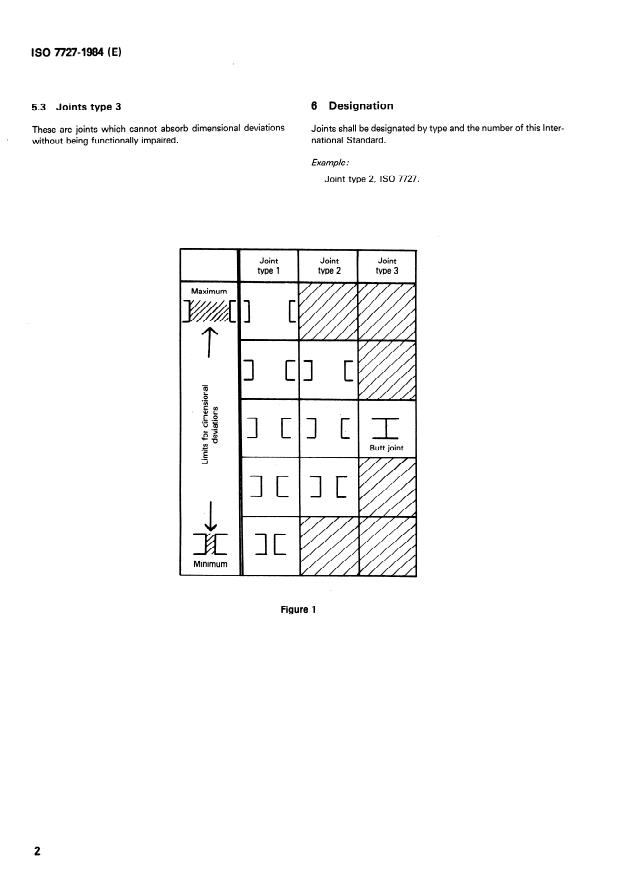
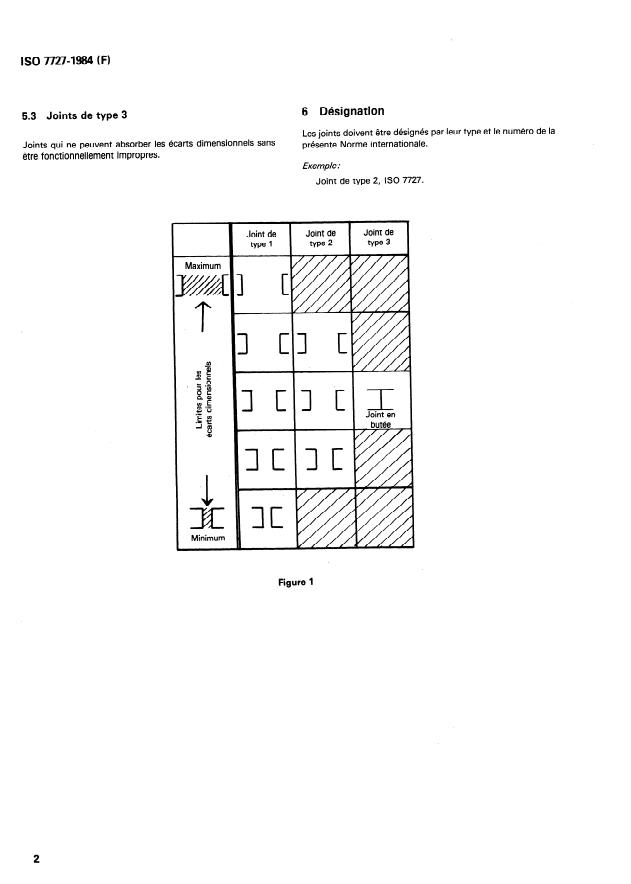
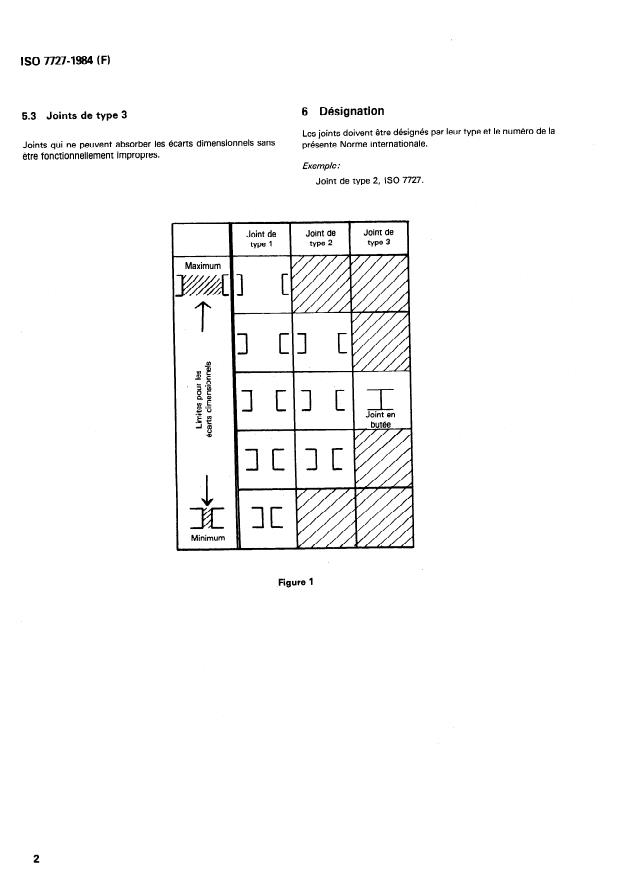
ISO 7727 classifies joints into three types based on their ability to absorb dimensional variations:- Type 1 Joints: Joints that can fully accommodate all dimensional deviations within the components they surround. Example solutions include adjustable bolts and sliding assemblies, allowing significant tolerance absorption.
- Type 2 Joints: Joints that absorb dimensional deviations only within certain limits, such as mortar joints or joints with compressible sealants. They offer moderate flexibility but require controlled dimensional accuracy in adjacent components.
- Type 3 Joints: Joints that cannot absorb dimensional deviations effectively without risking functional impairment, such as butt joints or tongue-and-groove floorboard joints.
Designation and Identification
Joints should be designated by type and reference to the ISO 7727 standard, facilitating clear communication and specification in design documents (e.g., "Joint Type 2, ISO 7727").Examples of Joint Types
The standard includes annexes with practical examples illustrating typical joint types, including sliding assemblies, mortar joints, compressible seals, and more, providing visual and descriptive guidance.
Applications
ISO 7727 is highly valuable in a wide range of construction scenarios where dimensional accuracy and component fitting are critical. Practical applications include:
- Building Envelope Design: Ensuring that window, door, and panel joints accommodate manufacturing and installation tolerances as well as thermal movements.
- Structural Assemblies: Assisting engineers in selecting appropriate joint types to accommodate settlements, expansions, and contractions without compromising structural performance.
- Interior Fit-Outs: Managing dimensional deviations in cabinetry, flooring, and partition walls to maintain finish quality and durability.
- Quality Assurance and Control: Establishing criteria for inspection, tolerance verification, and acceptance during construction and assembly processes.
- Modular and Prefabricated Construction: Accommodating the inherent variability of prefabricated components through suitable joint design to optimize onsite assembly.
Implementing ISO 7727 principles helps mitigate issues such as cracking, misalignment, undue stress on components, and premature material failure, thereby enhancing building durability, safety, and occupant comfort.
Related Standards
ISO 7727 aligns and complements other ISO standards related to building construction and joint design, including:
- ISO 1803: Tolerances for buildings - Vocabulary – Establishes terminology related to dimensional tolerances.
- ISO 2444: Joints in building - Vocabulary – Defines terms relating to joint types and materials.
- ISO 2445: Joints in building - Principles of design for basic joints – Provides fundamental design principles for joint construction.
Together, these standards offer a comprehensive framework for understanding, specifying, and implementing jointing solutions that address dimensional deviations in modern construction projects.
Keywords: ISO 7727, building joints, dimensional deviations, construction tolerances, joint classification, building components, adjustable joints, mortar joints, compressible sealants, joint design principles, construction standards.
Buy Documents
ISO 7727:1984 - Joints in building — Principles for jointing of building components — Accommodation of dimensional deviations during construction Released:11/1/1984
ISO 7727:1984 - Joints dans le bâtiment — Principes de jonction des composants de bâtiment — Aptitude des joints a s'accommoder des écarts dimensionnels en cours de construction Released:11/1/1984
ISO 7727:1984 - Joints dans le bâtiment — Principes de jonction des composants de bâtiment — Aptitude des joints a s'accommoder des écarts dimensionnels en cours de construction Released:11/1/1984
SIST ISO 7727:1996
Get Certified
Connect with accredited certification bodies for this standard

DIBt (Deutsches Institut für Bautechnik)
German Institute for Building Technology.
DIN CERTCO
DIN Group product certification.

Aboma Certification B.V.
Specialized in construction, metal, and transport sectors.
Sponsored listings
Frequently Asked Questions
SIST ISO 7727:1996 is a standard published by the Slovenian Institute for Standardization (SIST). Its full title is "Joints in building -- Principles for jointing of building components -- Accommodation of dimensional deviations during construction". This standard covers: Is one of a series dealing with general rules and principles for the jointing of building components. Establishes a classification system for joints in building based on the ability of joints to accommodate dimensional deviations during construction. Examples of types of joints are given in an annex.
Is one of a series dealing with general rules and principles for the jointing of building components. Establishes a classification system for joints in building based on the ability of joints to accommodate dimensional deviations during construction. Examples of types of joints are given in an annex.
SIST ISO 7727:1996 is classified under the following ICS (International Classification for Standards) categories: 91.060.99 - Other elements of buildings. The ICS classification helps identify the subject area and facilitates finding related standards.
SIST ISO 7727:1996 is available in PDF format for immediate download after purchase. The document can be added to your cart and obtained through the secure checkout process. Digital delivery ensures instant access to the complete standard document.
Standards Content (Sample)
International Standard
INTERNATIONAL ORGANIZATION FOR STANDARDIZATlON.MEX~YHAPO~HAR OPTAHWAUMR IlO CTAH~APTkl3A~Wl.ORGANlSATlON INTERNATIONALE DE NORMALISATION
Principles for jointing of building
Joints in building -
components - Accommodation of dimensional
deviations during construction
Joints dans le ba^timent - Principes de jonction des composants de batiment - Aptitude des joints ;i s’accommoder des &arts
dimensionnels en tours de construe tion
First edition - 1984-11-01
UDC 624.078.3 Ref. No. IS0 7727-1984 (E)
c
dimensional deviations, designation.
Descriptors : buildings, joints,
cn
- Price based on 5 pages
Foreword
IS0 (the International Organization for Standardization) is a worldwide federation of
national standards bodies (IS0 member bodies). The work of preparing International
Standards is normally carried out through IS0 technical committees. Each member
body interested in a subject for which a technical committee has been established has
the right to be represented on that committee. International organizations, govern-
mental and non-governmental, in liaison with ISO, also take part in the work.
Draft International Standards adopted by the technical committees are circulated to
the member bodies for approval before their acceptance as International Standards by
the IS0 Council. They are approved in accordance with IS0 procedures requiring at
least 75 % approval by the member bodies voting.
International Standard IS0 7727 was prepared by Technical Committee lSO/TC 59,
Building cons true tion.
0 International Organization for Standardization, 1984
Printed in Switzerland
IS0 7727-1984 (E)
INTERNATIONAL STANDARD
Principles for jointing of building
Joints in building -
Accommodation of dimensional
components -
deviations during construction
4 Joints and dimensional deviations
0 Introduction
As a general rule, the sizes of building components should not
This International Standard is one of a series dealing with
be adjusted during or after assembly. The dimensional devia-
general rules and principles for the jointing of building com-
tions which are inherent in the components, the dimensional
ponents.
deviations which occur during manufacture or assembly, and
the deviations which result from movement (for example,
settlement or thermal movement) in the building, shall,
1 Scope and field of application
therefore, be absorbed in the joints.
This International Standard establishes a classification system
Given the scope, this International Standard takes into
for joints in building based on the ability of joints to accom-
consideration only the dimensional deviations inherent in the
modate dimensional deviations during construction.
components when they are assembled and those which occur
during assembly.
Examples of types of joints are given in an annex, as an aid to
the understanding of the principles involved.
5 Classif ication
2 References
Three types of joints are specified, grouped according to their
ability to accommodate dimensional deviations’) (see figure 1).
IS0 1803, Tolerances for building - Vocabulary.
5.1 Joints type 1
IS0 2444, Joints in buifding - Vocabulary.
These are joints that can satisfactorily absorb all dimensional
I SO 2445, Joints in building - Fundamental principles for
deviations in connection with a given component, in the joints
design.
around the component.
3 Definitions 5.2 Joints type 2
These are joints which can absorb dimensional deviations to a
For the purpose of this International Standard, the definitions
given i
...
Norme internationale
INTERNATIONAL ORGANIZATION FOR STANDARDIZATIONW.‘lE~YHAPO~HAR OPl-AHM3AWlR fl0 CTAH~APTM3AL@Wl~ORGANISATION INTERNATIONALE DE NORMALISATION
Joints dans le bâtiment - Principes de jonction des
composants de bâtiment - Aptitude des joints à
s’accommoder des écarts dimensionnels en cours de
construction
Joints in building - Principles for join ting of building components - Accommodation of dimensional devia tions during
cons truc tion
Première édition - 1984-11-01
CDU 624.078.3 Réf. no : ISO 7727-1984 ($1
Descripteurs : bâtiment, joint, écart dimensionnel, désignation.
Prix basé sur 5 pages
Avant-propos
L’ISO (Organisation internationale de normalisation) est une fédération mondiale
d’organismes nationaux de normalisation (comités membres de I’ISO). L’élaboration
des Normes internationales est confiée aux comités techniques de I’ISO. Chaque
comité membre intéressé par une étude a le droit de faire partie du comité technique
creé à cet effet. Les organisations internationales, gouvernementales et non gouverne-
mentales, en liaison avec I’ISO, participent également aux travaux.
Les projets de Normes internationales adoptés par les comités techniques sont soumis
aux comités membres pour approbation, avant leur acceptation comme Normes inter-
nationales par le Conseil de I’ISO. Les Normes internationales sont approuvées confor-
mément aux procédures de I’ISO qui requièrent l’approbation de 75 % au moins des
comités membres votants.
La Norme internationale ISO 7727 a été élaborée par le comité technique ISO/TC 59,
Cons truc tion immobili&re.
Organisation internationale de normalisation, 1984
Imprimé en Suisse
NORME INTERNATIONALE ISO 7727-1984 (F)
Joints dans le bâtiment - Principes de jonction des
composants de bâtiment - Aptitude des joints à
s’accommoder des écarts dimensionnels en cours de
construction
4 Joints et écarts dimensionnels
0 Introduction
En règle générale, la dimension des composants de bâtiment ne
La présente Norme internationale appartient à une série de nor-
mes traitant des règles générales et des principes de jonction devrait pas être ajustée pendant ou aprés l’assemblage. Les
écarts dimensionnels qui sont inhérents aux composants, ceux
des composants de bâtiment.
qui surviennent durant la fabrication ou l’assemblage et ceux
qui résultent des mouvements (par exemple tassement ou mou-
vement thermique) dans la construction, doivent être absorbés
1 Objet et domaine d’application
par les joints.
La présente Norme internationale établit un système de classifi-
Étant donné son objet, la présente Norme internationale ne
cation des joints de bâtiment basé sur leur aptitude à absorber
prend en considération que les écarts dimensionnels inhérents
des écarts dimensionnels en cours de construction.
aux composants au moment du montage et ceux qui suivent
durant le montage.
Des exemples de types de joints sont donnés dans l’annexe afin
d’assurer une meilleure compréhension des principes mention-
nés.
5 Classification
Trois types de joints, groupés en fonction de leur aptitude à
2 Références
s’accommoder des écarts dimensionnelsl) (voir figure 11, sont
spécifiés.
ISO 1803, Tolérances pour le bâtiment - Vocabulaire.
5.1 Joints de type 1
ISO 2444, Joints dans le bâtiment - Vocabulaire.
Joints pouvant absorber de facon satisfaisante tous les écarts
ISO 2445, Joints dans le bâtiment - Principes de conception
dimensionnels relatifs à un composant donné dans les joints
fondamentaux.
entourant ce composant.
3 Définitions 5.2 Joints de type 2
Joints qui peuvent absorber les écarts dimensionnels dans une
Dans le cadre de la présente Norme internationale, les défini-
certaine limit
...
Norme internationale
INTERNATIONAL ORGANIZATION FOR STANDARDIZATIONW.‘lE~YHAPO~HAR OPl-AHM3AWlR fl0 CTAH~APTM3AL@Wl~ORGANISATION INTERNATIONALE DE NORMALISATION
Joints dans le bâtiment - Principes de jonction des
composants de bâtiment - Aptitude des joints à
s’accommoder des écarts dimensionnels en cours de
construction
Joints in building - Principles for join ting of building components - Accommodation of dimensional devia tions during
cons truc tion
Première édition - 1984-11-01
CDU 624.078.3 Réf. no : ISO 7727-1984 ($1
Descripteurs : bâtiment, joint, écart dimensionnel, désignation.
Prix basé sur 5 pages
Avant-propos
L’ISO (Organisation internationale de normalisation) est une fédération mondiale
d’organismes nationaux de normalisation (comités membres de I’ISO). L’élaboration
des Normes internationales est confiée aux comités techniques de I’ISO. Chaque
comité membre intéressé par une étude a le droit de faire partie du comité technique
creé à cet effet. Les organisations internationales, gouvernementales et non gouverne-
mentales, en liaison avec I’ISO, participent également aux travaux.
Les projets de Normes internationales adoptés par les comités techniques sont soumis
aux comités membres pour approbation, avant leur acceptation comme Normes inter-
nationales par le Conseil de I’ISO. Les Normes internationales sont approuvées confor-
mément aux procédures de I’ISO qui requièrent l’approbation de 75 % au moins des
comités membres votants.
La Norme internationale ISO 7727 a été élaborée par le comité technique ISO/TC 59,
Cons truc tion immobili&re.
Organisation internationale de normalisation, 1984
Imprimé en Suisse
NORME INTERNATIONALE ISO 7727-1984 (F)
Joints dans le bâtiment - Principes de jonction des
composants de bâtiment - Aptitude des joints à
s’accommoder des écarts dimensionnels en cours de
construction
4 Joints et écarts dimensionnels
0 Introduction
En règle générale, la dimension des composants de bâtiment ne
La présente Norme internationale appartient à une série de nor-
mes traitant des règles générales et des principes de jonction devrait pas être ajustée pendant ou aprés l’assemblage. Les
écarts dimensionnels qui sont inhérents aux composants, ceux
des composants de bâtiment.
qui surviennent durant la fabrication ou l’assemblage et ceux
qui résultent des mouvements (par exemple tassement ou mou-
vement thermique) dans la construction, doivent être absorbés
1 Objet et domaine d’application
par les joints.
La présente Norme internationale établit un système de classifi-
Étant donné son objet, la présente Norme internationale ne
cation des joints de bâtiment basé sur leur aptitude à absorber
prend en considération que les écarts dimensionnels inhérents
des écarts dimensionnels en cours de construction.
aux composants au moment du montage et ceux qui suivent
durant le montage.
Des exemples de types de joints sont donnés dans l’annexe afin
d’assurer une meilleure compréhension des principes mention-
nés.
5 Classification
Trois types de joints, groupés en fonction de leur aptitude à
2 Références
s’accommoder des écarts dimensionnelsl) (voir figure 11, sont
spécifiés.
ISO 1803, Tolérances pour le bâtiment - Vocabulaire.
5.1 Joints de type 1
ISO 2444, Joints dans le bâtiment - Vocabulaire.
Joints pouvant absorber de facon satisfaisante tous les écarts
ISO 2445, Joints dans le bâtiment - Principes de conception
dimensionnels relatifs à un composant donné dans les joints
fondamentaux.
entourant ce composant.
3 Définitions 5.2 Joints de type 2
Joints qui peuvent absorber les écarts dimensionnels dans une
Dans le cadre de la présente Norme internationale, les défini-
certaine limit
...
SLOVENSKI SIST ISO 7727
prva izdaja
STANDARD
december 1996
Gradbeni stiki - Osnove stikovanja gradbenih elementov - Izravnava
dimenzijskih odstopanj pri gradnji
(prevzet standard ISO 7727:1984 z metodo platnice)
Joints in building - Principles for jointing of building components -
Accommodation of dimensional deviations during construction
Joints dans le bâtiment - Principes de jonction des composants de
bâtiment - Aptitude des joints à s’accommoder des écarts dimensionnels
en cours de construction
Deskriptorji: stavbe, stiki, dimenzijska odstopanja, oznake
Referen~na {tevilka
ICS 91.100.50 SIST ISO 7727:1996 ((sl),en)
Nadaljevanje na straneh od II do III in od 1 do 5
© Standard je zalo`il in izdal Urad Republike Slovenije za standardizacijo in meroslovje pri Ministrstvu za znanost in tehnologijo.
Razmno`evanje ali kopiranje celote ali delov tega standarda ni dovoljeno.
SIST ISO 7727 : 1996
UVOD
Standard SIST ISO 7727 ((sl),en), Gradbeni stiki - Osnove stikovanja gradbenih elementov -
Izravnava dimenzijskih odstopanj pri gradnji, prva izdaja, 1996, ima status slovenskega
standarda in je z metodo platnice prevzet mednarodni standard ISO 7727, Joints in building -
Principles for jointing of building components - Accommodation of dimensional deviations
during construction, First edition, 1984-11-01, v angle{kem jeziku.
NACIONALNI PREDGOVOR
Mednarodni standard ISO 7727:1984 je pripravil tehni~ni odbor Mednarodne organizacije za
standardizacijo ISO/TC 59 Gradnja poslopij.
Odlo~itev za prevzem tega standarda po metodi platnice je sprejela delovna skupina
USM/TC GPO/WG 3 Stiki, potrdil pa tehni~ni odbor USM/TC GPO Gradnja poslopij.
Ta slovenski standard je dne 1996-11-21 odobril direktor USM.
ZVEZI S STANDARDOMA
S prevzemom tega mednarodnega standarda veljata naslednji zvezi:
SIST ISO 2444 Gradbeni stiki - Slovar
SIST ISO 2445 Gradbeni stiki - Osnove dimenzioniranja
OSNOVA ZA IZDAJO STANDARDA
- Prevzem standarda ISO 7727:1984
OPOMBI
- Povsod, kjer se v besedilu standarda uporablja izraz “mednarodni standard”, v
- Uvod in nacionalni predgovor nista sestavni del standarda.
II
SIST ISO 7727 : 1996
VSEBINA Stran
0 Uvod.1
1 Namen in podro~je uporabe.1
2 Zveze z drugimi standardi.1
3 Definicije.1
4 Stiki in dimenzijska odstopanja.1
5 Klasifikacija.1
6 Oznake.2
Dodatek.3
Po mnenju Ministrstva za informiranje Republike Slovenije z dne 18. februarja 1992, {tev. 23/96-92, spada ta publikacija med
proizvode informativne narave iz 13. to~ke tarifne {tevilke 3, za katere se pla~uje 5-odstotni prometni davek.
III
International Standard
INTERNATIONAL ORGANIZATION FOR STANDARDIZATlON.MEX~YHAPO~HAR OPTAHWAUMR IlO CTAH~APTkl3A~Wl.ORGANlSATlON INTERNATIONALE DE NORMALISATION
Principles for jointing of building
Joints in building -
components - Accommodation of dimensional
deviations during construction
Joints dans le ba^timent - Principes de jonction des composants de batiment - Aptitude des joints ;i s’accommoder des &arts
dimensionnels en tours de construe tion
First edition - 1984-11-01
UDC 624.078.3 Ref. No. IS0 7727-1984 (E)
c
dimensional deviations, designation.
Descriptors : buildings, joints,
cn
- Price based on 5 pages
Foreword
IS0 (the International Organization for Standardization) is a worldwide federation of
national standards bodies (IS0 member bodies). The work of preparing International
Standards is normally carried out through IS0 technical committees. Each member
body interested in a subject for which a technical committee has been established has
the right to be represented on that committee. International organizations, govern-
mental and non-governmental, in liaison with ISO, also take part in the work.
Draft International Standards adopted by the technical committees are circulated to
the member bodies for approval before their acceptance as International Standards by
the IS0 Council. They are approved in accordance with IS0 procedures requiring at
least 75 % approval by the member bodies voting.
International Standard IS0 7727 was prepared by Technical Committee lSO/TC 59,
Building cons true tion.
0 International Organization for Standardization, 1984
Printed in Switzerland
...