

SIST EN 351-2:2023
(Main)Durability of wood and wood-based products - Preservative-treated solid wood - Part 2: Guidance on sampling for the analysis of preservative-treated wood
General Information
- Abstract
This part of the EN 351 series gives guidance for the general procedures to be used in obtaining samples of preservative-treated wood for the determination of penetration and retention of wood preservative. It also gives guidance on the measurement of penetration and retention of a wood preservative in the treated wood.
This part of the EN 351 series is applicable to the production of preservative-treated solid wood, including glued laminated timber, suitable for use in those service conditions defined within the use classes in EN 335.
NOTE Glued laminated timber is not suitable for use in fresh or sea water.
This part of the EN 351 series is not applicable to preservative-treated wood in service. However, the sampling guidance provided within this part of the EN 351 series can be applied for the subsequent examination of treated wood in service.
Annex A (informative) provides a selection of number of sample units.
Annex B (informative) provides examples of retention measurements.
- Status
- Published
- Public Enquiry End Date
- 14-Sep-2020
- Publication Date
- 17-Aug-2023
- Technical Committee
- LLZ - Les, lesni izdelki in zaščita lesa
- Current Stage
- 6060 - National Implementation/Publication (Adopted Project)
- Start Date
- 20-Jun-2023
- Due Date
- 25-Aug-2023
- Completion Date
- 18-Aug-2023
Buy Documents


Overview
EN 351-2:2023 (CEN) - "Durability of wood and wood‑based products - Preservative‑treated solid wood - Part 2" provides harmonized guidance on sampling and measurement procedures for determining the penetration and retention of wood preservatives in treated solid wood products. It applies to production-stage preservative treatment (including glued laminated timber where appropriate) intended for the service classes defined in EN 335. The standard is a practical guide for test sampling during production and for subsequent examination of treated wood removed from service.
Key topics and technical requirements
- Scope & applicability
- Guidance is for preservative‑treated solid wood (including glued laminated timber) and is not primarily for in‑service treated wood, although sampling methods may be reused for later examinations.
- Glued laminated timber is excluded for use in fresh or sea water (note in EN 351-2).
- Selection principles
- How to select a representative batch and sample units, taking into account variation (cross-section, package composition, treatment charges).
- Sampling shall be as random as reasonably practicable and follow sampling plans referenced in ISO 2859‑1 (see Annex A for guidance on numbers of sample units).
- Test sample types
- Accepted sample forms: borings (increment borer cores), cross‑sections, and thin sections, with procedural guidance for each.
- Special instructions for round/part‑round timber vs sawn/profiled wood.
- Penetration measurement
- Procedures for obtaining samples suitable to evaluate specified penetration depths (e.g., full sapwood penetration vs defined depth).
- Borings should be taken with sharp increment borers (minimum 5 mm diameter); borer holes must be promptly plugged.
- Retention measurement
- New or updated clause on retention measurements and examples provided in Annex B.
- Notes on preservative fixation and timing of sampling relative to fixation processes.
- Normative references
- Related testing and terminology standards: EN 12490 (creosote), EN 1001‑2:2005, and ISO 2859‑1.
Practical applications and users
- Who uses EN 351‑2:2023:
- Timber preservative treatment plants and quality control teams
- Independent testing laboratories and inspection bodies
- Product specifiers, certifiers, and procurement teams
- Manufacturers of sawn timber, poles, sleepers, and glued laminated timber
- Regulatory authorities and standards writers
- Practical benefits:
- Ensures repeatable, representative sampling for accurate penetration and retention assessment
- Supports compliance with service‑class requirements in EN 335
- Provides traceable sampling methods for acceptance testing, QA and conformity assessment
Related standards
- EN 351‑1 (specification of penetration and retention requirements)
- EN 12490 (creosote penetration/retention)
- EN 1001‑2:2005 (terminology)
- ISO 2859‑1 (sampling schemes)
Keywords: EN 351-2:2023, preservative-treated wood, sampling for analysis, penetration measurement, retention measurement, glued laminated timber, EN 335, ISO 2859-1.
Relations
- Effective Date
- 01-Sep-2023
- Effective Date
- 25-Aug-2026
- Refers
SIST EN 1001-2:2006 - Durability of wood and wood based products - Terminology - Part 2: Vocabulary - Effective Date
- 28-Jan-2026
- Effective Date
- 28-Jan-2026
- Effective Date
- 16-Sep-2026
- Effective Date
- 28-Jan-2026
- Effective Date
- 28-Jan-2026
- Effective Date
- 28-Jan-2026
- Effective Date
- 28-Jan-2026
- Effective Date
- 28-Jan-2026
- Effective Date
- 28-Jan-2026
- Effective Date
- 28-Jan-2026
- Effective Date
- 28-Jan-2026
Buy Documents
Get Certified
Connect with accredited certification bodies for this standard

ECOCERT
Organic and sustainability certification.

Eurofins Food Testing Global
Global leader in food, environment, and pharmaceutical product testing.

Gozdarski inštitut Slovenije
Slovenian Forestry Institute. Forest management certification support, timber testing.
Sponsored listings
Frequently Asked Questions
SIST EN 351-2:2023 is a standard published by the Slovenian Institute for Standardization (SIST). Its full title is "Durability of wood and wood-based products - Preservative-treated solid wood - Part 2: Guidance on sampling for the analysis of preservative-treated wood". This standard covers: This part of the EN 351 series gives guidance for the general procedures to be used in obtaining samples of preservative-treated wood for the determination of penetration and retention of wood preservative. It also gives guidance on the measurement of penetration and retention of a wood preservative in the treated wood. This part of the EN 351 series is applicable to the production of preservative-treated solid wood, including glued laminated timber, suitable for use in those service conditions defined within the use classes in EN 335. NOTE Glued laminated timber is not suitable for use in fresh or sea water. This part of the EN 351 series is not applicable to preservative-treated wood in service. However, the sampling guidance provided within this part of the EN 351 series can be applied for the subsequent examination of treated wood in service. Annex A (informative) provides a selection of number of sample units. Annex B (informative) provides examples of retention measurements.
This part of the EN 351 series gives guidance for the general procedures to be used in obtaining samples of preservative-treated wood for the determination of penetration and retention of wood preservative. It also gives guidance on the measurement of penetration and retention of a wood preservative in the treated wood. This part of the EN 351 series is applicable to the production of preservative-treated solid wood, including glued laminated timber, suitable for use in those service conditions defined within the use classes in EN 335. NOTE Glued laminated timber is not suitable for use in fresh or sea water. This part of the EN 351 series is not applicable to preservative-treated wood in service. However, the sampling guidance provided within this part of the EN 351 series can be applied for the subsequent examination of treated wood in service. Annex A (informative) provides a selection of number of sample units. Annex B (informative) provides examples of retention measurements.
SIST EN 351-2:2023 is classified under the following ICS (International Classification for Standards) categories: 71.100.50 - Wood-protecting chemicals; 79.040 - Wood, sawlogs and sawn timber. The ICS classification helps identify the subject area and facilitates finding related standards.
SIST EN 351-2:2023 has the following relationships with other standards: It is inter standard links to SIST EN 351-2:2007, SIST ISO 2859-1:2003, SIST EN 1001-2:2006, SIST EN 196-1:1995, SIST EN 212:2026, SIST EN 351-1:2007, SIST-TP CEN/TR 16420:2013, SIST EN 212:2004, SIST-TP CEN/TR 16239:2011, SIST EN 12490:2010, SIST EN 13964:2014, SIST EN 1014-2:2011, SIST EN 13964:2004. Understanding these relationships helps ensure you are using the most current and applicable version of the standard.
SIST EN 351-2:2023 is associated with the following European legislation: EU Directives/Regulations: 305/2011; Standardization Mandates: M/112. When a standard is cited in the Official Journal of the European Union, products manufactured in conformity with it benefit from a presumption of conformity with the essential requirements of the corresponding EU directive or regulation.
SIST EN 351-2:2023 is available in PDF format for immediate download after purchase. The document can be added to your cart and obtained through the secure checkout process. Digital delivery ensures instant access to the complete standard document.
Standards Content (Sample)
SLOVENSKI STANDARD
01-september-2023
Nadomešča:
SIST EN 351-2:2007
Trajnost lesa in lesnih proizvodov - Masivni les, zaščiten z biocidnimi proizvodi - 2.
del: Navodilo za vzorčenje za analizo lesa, zaščitenega z biocidnimi proizvodi
Durability of wood and wood-based products - Preservative-treated solid wood - Part 2:
Guidance on sampling for the analysis of preservative-treated wood
Dauerhaftigkeit von Holz und Holzprodukten - Mit Holzschutzmitteln behandeltes
Vollholz - Teil 2: Leitfaden zur Probenahme für die Analyse des mit Holzschutzmitteln
behandelten Holzes
Durabilité du bois et des matériaux dérivés du bois - Bois massif traité avec produit de
préservation - Partie 2 : Guide d'échantillonnage pour l'analyse du bois traité avec un
produit de préservation
Ta slovenski standard je istoveten z: EN 351-2:2023
ICS:
71.100.50 Kemikalije za zaščito lesa Wood-protecting chemicals
79.040 Les, hlodovina in žagan les Wood, sawlogs and sawn
timber
2003-01.Slovenski inštitut za standardizacijo. Razmnoževanje celote ali delov tega standarda ni dovoljeno.
EN 351-2
EUROPEAN STANDARD
NORME EUROPÉENNE
April 2023
EUROPÄISCHE NORM
ICS 71.100.50; 79.040 Supersedes EN 351-2:2007
English Version
Durability of wood and wood-based products -
Preservative-treated solid wood - Part 2: Guidance on
sampling for the analysis of preservative-treated wood
Durabilité du bois et des matériaux dérivés du bois - Dauerhaftigkeit von Holz und Holzprodukten - Mit
Bois massif traité avec produit de préservation - Partie Holzschutzmitteln behandeltes Vollholz - Teil 2:
2 : Guide d'échantillonnage pour l'analyse du bois Leitfaden zur Probenahme für die Analyse des mit
traité avec un produit de préservation Holzschutzmitteln behandelten Holzes
This European Standard was approved by CEN on 17 July 2022.
CEN members are bound to comply with the CEN/CENELEC Internal Regulations which stipulate the conditions for giving this
European Standard the status of a national standard without any alteration. Up-to-date lists and bibliographical references
concerning such national standards may be obtained on application to the CEN-CENELEC Management Centre or to any CEN
member.
This European Standard exists in three official versions (English, French, German). A version in any other language made by
translation under the responsibility of a CEN member into its own language and notified to the CEN-CENELEC Management
Centre has the same status as the official versions.
CEN members are the national standards bodies of Austria, Belgium, Bulgaria, Croatia, Cyprus, Czech Republic, Denmark, Estonia,
Finland, France, Germany, Greece, Hungary, Iceland, Ireland, Italy, Latvia, Lithuania, Luxembourg, Malta, Netherlands, Norway,
Poland, Portugal, Republic of North Macedonia, Romania, Serbia, Slovakia, Slovenia, Spain, Sweden, Switzerland, Türkiye and
United Kingdom.
EUROPEAN COMMITTEE FOR STANDARDIZATION
COMITÉ EUROPÉEN DE NORMALISATION
EUROPÄISCHES KOMITEE FÜR NORMUNG
CEN-CENELEC Management Centre: Rue de la Science 23, B-1040 Brussels
© 2023 CEN All rights of exploitation in any form and by any means reserved Ref. No. EN 351-2:2023 E
worldwide for CEN national Members.
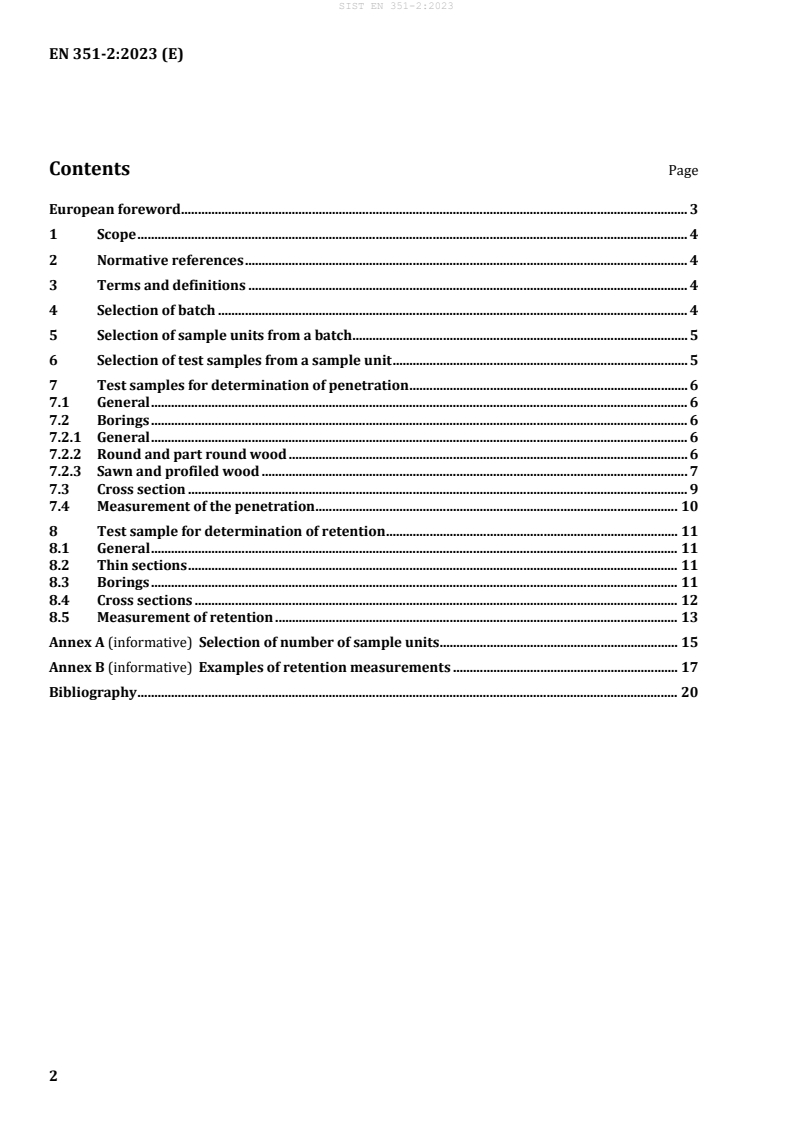
Contents Page
European foreword . 3
1 Scope . 4
2 Normative references . 4
3 Terms and definitions . 4
4 Selection of batch . 4
5 Selection of sample units from a batch . 5
6 Selection of test samples from a sample unit . 5
7 Test samples for determination of penetration . 6
7.1 General . 6
7.2 Borings . 6
7.2.1 General . 6
7.2.2 Round and part round wood . 6
7.2.3 Sawn and profiled wood . 7
7.3 Cross section . 9
7.4 Measurement of the penetration . 10
8 Test sample for determination of retention . 11
8.1 General . 11
8.2 Thin sections . 11
8.3 Borings . 11
8.4 Cross sections . 12
8.5 Measurement of retention . 13
Annex A (informative) Selection of number of sample units . 15
Annex B (informative) Examples of retention measurements . 17
Bibliography . 20
European foreword
This document (EN 351-2:2023) has been prepared by Technical Committee CEN/TC 38 “Durability of
wood and wood-based products”, the secretariat of which is held by SIS.
This European Standard shall be given the status of a national standard, either by publication of an
identical text or by endorsement, at the latest by October 2023, and conflicting national standards shall
be withdrawn at the latest by October 2023.
Attention is drawn to the possibility that some of the elements of this document may be the subject of
patent rights. CEN shall not be held responsible for identifying any or all such patent rights.
This document supersedes EN 351-2:2007.
The main changes compared to the previous edition are listed below:
— the sampling procedure for determination of longitudinal penetration has been deleted;
— a new clause on retention measurements has been introduced;
— the sampling plans in Annex A have been updated;
— a new annex showing examples on retention measurements has been introduced.
The EN 351 series consists of two parts. Part 1 gives guidance on the specification of penetration and
retention requirements for preservatives in preservative-treated solid wood. Part 2 gives guidance on
the general procedures to be followed in the sampling and analysis of preservative-treated solid wood.
Any feedback and questions on this document should be directed to the users’ national standards body.
A complete listing of these bodies can be found on the CEN website.
According to the CEN-CENELEC Internal Regulations, the national standards organisations of the
following countries are bound to implement this European Standard: Austria, Belgium, Bulgaria, Croatia,
Cyprus, Czech Republic, Denmark, Estonia, Finland, France, Germany, Greece, Hungary, Iceland, Ireland,
Italy, Latvia, Lithuania, Luxembourg, Malta, Netherlands, Norway, Poland, Portugal, Republic of North
Macedonia, Romania, Serbia, Slovakia, Slovenia, Spain, Sweden, Switzerland, Turkey and the United
Kingdom.
1 Scope
This part of the EN 351 series gives guidance for the general procedures to be used in obtaining samples
of preservative-treated wood for the determination of penetration and retention of wood preservative. It
also gives guidance on the measurement of penetration and retention of a wood preservative in the
treated wood.
This part of the EN 351 series is applicable to the production of preservative-treated solid wood,
including glued laminated timber, suitable for use in those service conditions defined within the use
classes in EN 335.
NOTE Glued laminated timber is not suitable for use in fresh or sea water.
This part of the EN 351 series is not applicable to preservative-treated wood in service. However, the
sampling guidance provided within this part of the EN 351 series can be applied for the subsequent
examination of treated wood in service.
Annex A (informative) provides a selection of number of sample units.
Annex B (informative) provides examples of retention measurements.
2 Normative references
The following documents are referred to in the text in such a way that some or all of their content
constitutes requirements of this document. For dated references, only the edition cited applies. For
undated references, the latest edition of the referenced document (including any amendments) applies.
EN 1001-2:2005, Durability of wood and wood based products - Terminology - Part 2: Vocabulary
EN 12490, Durability of wood and wood-based products - Preservative-treated solid wood - Determination
of the penetration and retention of creosote in treated wood
ISO 2859-1, Sampling procedures for inspection by attributes — Part 1: Sampling schemes indexed by
acceptance quality limit (AQL) for lot-by-lot inspection
3 Terms and definitions
For the purposes of this document, the terms and definitions given in EN 1001-2:2005 apply.
ISO and IEC maintain terminological databases for use in standardization at the following addresses:
— IEC Electropedia: available at https://www.electropedia.org/
— ISO Online browsing platform: available at https://www.iso.org/obp
4 Selection of batch
For the selection of batch, the following shall be considered:
— The batch shall be selected with respect to the aim of the subsequent sampling and analysis.
NOTE 1 In practice, the selection of a batch is the result of a compromise between the aim of the inspection
and the quality of the analysis in terms of technical and financial considerations.
— The batch is selected in such a way that the subsequent selection of sample units is representative
for the batch.
— A batch can consist of one charge or several charges treated on different occasions.
— If sampling is to be carried out from the same commodity manufactured at different plants at the
same site, the batch is selected in such a way that commodities from the different plants, treated
according to the same specification, are represented in the batch.
NOTE 2 For continuous processes, e.g. treating wood components in a spray tunnel, a batch can be defined
as the number of components treated during a specified period.
— A batch shall not consist of different commodities.
— A batch shall not consist of a mixture of round and sawn wood.
— The way the batch has been selected is described in the report from the sampling and analysis of the
preservative-treated wood.
NOTE 3 For example, a batch can be identified by wood treated during a certain time period or by charge
numbers.
5 Selection of sample units from a batch
Sample units shall be selected to be representative of the entire batch being considered. In order to be
representative, sample units shall be selected to take account the sources of variation that occur in the
batch.
This can include variation in cross-section in treated components and their relative proportions in the
batch. Selection should also take into account the number of packages of treated wood that make up the
batch, where relevant.
The number of sample units shall be in accordance with the guidance in ISO 2859-1. See Annex A for
guidance.
If sapwood penetration is to be determined, units consisting entirely of heartwood should be avoided.
A true random sampling is difficult to achieve, but it should be as random as reasonably practical; see
also Clause 4, Note 1.
Individual techniques for the determination of penetration and retention could impose special
requirements for sampling and subsequent handling which shall be reported.
6 Selection of test samples from a sample unit
Test samples shall be selected from the sample units according to the following principles:
— If penetration and retention can be determined from a single test sample, only one test sample per
sample unit is necessary. Otherwise, at least two test samples shall be taken per sample unit for the
separate determination of penetration and retention;
— For assessment of retention and penetration, test samples shall be taken from clear, straight-grained
wood, away from splits, checks or other defects and at least 100 mm away from knots, midway
between ends or greater than or equal to 300 mm from the end;
— For superficial treatments, the requirement on sampling ≥ 300 mm from the end does not apply
when determining the retention unless an erroneous value can be expected owing to end grain
penetration;
— Test samples shall be taken as borings, cross-sections, or thin sections (see Clauses 7 and 8) as
appropriate with respect to the commodities to be sampled and the methods to determine the
penetration and retention;
— Some preservatives undergo a fixation process after wood treatment. When sampling, it is
particularly important that the wood preservative fixation process is complete. Guidance on the
fixation should be found in wood preservative manufacturers’ data sheets.
7 Test samples for determination of penetration
7.1 General
The penetration of wood preservative shall be determined for each sample unit sampled from the batch.
Sampling of creosote-treated wood shall be carried out according to EN 12490.
7.2 Borings
7.2.1 General
Borings are normally restricted for commodities for which sampling by cross-sections is considered
highly unsuitable.
NOTE Examples of such commodities are round wood of poles and piles as well as thicker dimensions of sawn
timber such as railway sleepers.
Borings shall be taken with a sharp increment borer which extracts a core of minimum diameter of 5 mm.
If any part of the sample is lost the whole sample shall be rejected and a new one taken.
If material is incised, borings shall be taken at a point midway between adjacent incisions.
When borings are taken from timber to be used in UC4 according to EN 335, they shall be taken above
the point that will be in ground contact.
All borer holes should be promptly plugged with tight fitting wooden plugs pre-treated with an
appropriate preservative.
7.2.2 Round and part round wood
For round wood, the borer shall be directed towards the pith from any point on the surface.
For part-round wood, the borer shall be directed towards the pith (or the point where the pith would
have been in the original log) from a point on the curved surface which is furthest away from the cut
surface(s).
If a penetration depth less than complete penetration is specified, the borer shall penetrate to a depth
greater than the penetration measured (see Figure 1).
a) b) c)
Key
penetration of preservative
wood taken as sample
heartwood
no treatment required
Figure 1 — Sampling location in (a) round and (b and c) part-round wood if a defined
penetration depth is required
If the requirement is for complete penetration, it is necessary for the borer to penetrate to the geometrical
centre of the cross-section (see Figure 2).
Key
penetration of preservative
wood taken as sample
Figure 2 — Sampling location in round and part-round wood if complete penetration is required
7.2.3 Sawn and profiled wood
If a penetration depth less than full sapwood penetration is specified, borings shall be taken, as far as
possible, equidistant from the sides and perpendicular to the face being sampled to a depth greater than
the penetration being measured (see Figure 3).
a) Sampling location in samples containing both sapwood and heartwood
b) Sampling location in samples consisting entirely of sapwood or if it is impossible to identify
any heartwood before sampling
Key
penetration of preservative
wood taken as sample
heartwood
no treatment required
Figure 3 — Sampling location in sawn and profiled wood if a penetration depth is specified
If full sapwood penetration is required, borings shall be taken, as far as possible, in the radial direction
and where the
...
SLOVENSKI STANDARD
01-september-2023
Nadomešča:
SIST EN 351-2:2007
Odpornost lesa in lesnih proizvodov - Masivni les, zaščiten z biocidnimi proizvodi -
2. del: Navodilo za vzorčenje za analizo lesa, zaščitenega z biocidnimi proizvodi
Durability of wood and wood-based products - Preservative-treated solid wood - Part 2:
Guidance on sampling for the analysis of preservative-treated wood
Dauerhaftigkeit von Holz und Holzprodukten - Mit Holzschutzmitteln behandeltes
Vollholz - Teil 2: Leitfaden zur Probenahme für die Analyse des mit Holzschutzmitteln
behandelten Holzes
Durabilité du bois et des matériaux dérivés du bois - Bois massif traité avec produit de
préservation - Partie 2 : Guide d'échantillonnage pour l'analyse du bois traité avec un
produit de préservation
Ta slovenski standard je istoveten z: EN 351-2:2023
ICS:
71.100.50 Kemikalije za zaščito lesa Wood-protecting chemicals
79.040 Les, hlodovina in žagan les Wood, sawlogs and sawn
timber
2003-01.Slovenski inštitut za standardizacijo. Razmnoževanje celote ali delov tega standarda ni dovoljeno.
EN 351-2
EUROPEAN STANDARD
NORME EUROPÉENNE
April 2023
EUROPÄISCHE NORM
ICS 71.100.50; 79.040 Supersedes EN 351-2:2007
English Version
Durability of wood and wood-based products -
Preservative-treated solid wood - Part 2: Guidance on
sampling for the analysis of preservative-treated wood
Durabilité du bois et des matériaux dérivés du bois - Dauerhaftigkeit von Holz und Holzprodukten - Mit
Bois massif traité avec produit de préservation - Partie Holzschutzmitteln behandeltes Vollholz - Teil 2:
2 : Guide d'échantillonnage pour l'analyse du bois Leitfaden zur Probenahme für die Analyse des mit
traité avec un produit de préservation Holzschutzmitteln behandelten Holzes
This European Standard was approved by CEN on 17 July 2022.
CEN members are bound to comply with the CEN/CENELEC Internal Regulations which stipulate the conditions for giving this
European Standard the status of a national standard without any alteration. Up-to-date lists and bibliographical references
concerning such national standards may be obtained on application to the CEN-CENELEC Management Centre or to any CEN
member.
This European Standard exists in three official versions (English, French, German). A version in any other language made by
translation under the responsibility of a CEN member into its own language and notified to the CEN-CENELEC Management
Centre has the same status as the official versions.
CEN members are the national standards bodies of Austria, Belgium, Bulgaria, Croatia, Cyprus, Czech Republic, Denmark, Estonia,
Finland, France, Germany, Greece, Hungary, Iceland, Ireland, Italy, Latvia, Lithuania, Luxembourg, Malta, Netherlands, Norway,
Poland, Portugal, Republic of North Macedonia, Romania, Serbia, Slovakia, Slovenia, Spain, Sweden, Switzerland, Türkiye and
United Kingdom.
EUROPEAN COMMITTEE FOR STANDARDIZATION
COMITÉ EUROPÉEN DE NORMALISATION
EUROPÄISCHES KOMITEE FÜR NORMUNG
CEN-CENELEC Management Centre: Rue de la Science 23, B-1040 Brussels
© 2023 CEN All rights of exploitation in any form and by any means reserved Ref. No. EN 351-2:2023 E
worldwide for CEN national Members.
Contents Page
European foreword . 3
1 Scope . 4
2 Normative references . 4
3 Terms and definitions . 4
4 Selection of batch . 4
5 Selection of sample units from a batch . 5
6 Selection of test samples from a sample unit . 5
7 Test samples for determination of penetration . 6
7.1 General . 6
7.2 Borings . 6
7.2.1 General . 6
7.2.2 Round and part round wood . 6
7.2.3 Sawn and profiled wood . 7
7.3 Cross section . 9
7.4 Measurement of the penetration . 10
8 Test sample for determination of retention . 11
8.1 General . 11
8.2 Thin sections . 11
8.3 Borings . 11
8.4 Cross sections . 12
8.5 Measurement of retention . 13
Annex A (informative) Selection of number of sample units . 15
Annex B (informative) Examples of retention measurements . 17
Bibliography . 20
European foreword
This document (EN 351-2:2023) has been prepared by Technical Committee CEN/TC 38 “Durability of
wood and wood-based products”, the secretariat of which is held by SIS.
This European Standard shall be given the status of a national standard, either by publication of an
identical text or by endorsement, at the latest by October 2023, and conflicting national standards shall
be withdrawn at the latest by October 2023.
Attention is drawn to the possibility that some of the elements of this document may be the subject of
patent rights. CEN shall not be held responsible for identifying any or all such patent rights.
This document supersedes EN 351-2:2007.
The main changes compared to the previous edition are listed below:
— the sampling procedure for determination of longitudinal penetration has been deleted;
— a new clause on retention measurements has been introduced;
— the sampling plans in Annex A have been updated;
— a new annex showing examples on retention measurements has been introduced.
The EN 351 series consists of two parts. Part 1 gives guidance on the specification of penetration and
retention requirements for preservatives in preservative-treated solid wood. Part 2 gives guidance on
the general procedures to be followed in the sampling and analysis of preservative-treated solid wood.
Any feedback and questions on this document should be directed to the users’ national standards body.
A complete listing of these bodies can be found on the CEN website.
According to the CEN-CENELEC Internal Regulations, the national standards organisations of the
following countries are bound to implement this European Standard: Austria, Belgium, Bulgaria, Croatia,
Cyprus, Czech Republic, Denmark, Estonia, Finland, France, Germany, Greece, Hungary, Iceland, Ireland,
Italy, Latvia, Lithuania, Luxembourg, Malta, Netherlands, Norway, Poland, Portugal, Republic of North
Macedonia, Romania, Serbia, Slovakia, Slovenia, Spain, Sweden, Switzerland, Turkey and the United
Kingdom.
1 Scope
This part of the EN 351 series gives guidance for the general procedures to be used in obtaining samples
of preservative-treated wood for the determination of penetration and retention of wood preservative. It
also gives guidance on the measurement of penetration and retention of a wood preservative in the
treated wood.
This part of the EN 351 series is applicable to the production of preservative-treated solid wood,
including glued laminated timber, suitable for use in those service conditions defined within the use
classes in EN 335.
NOTE Glued laminated timber is not suitable for use in fresh or sea water.
This part of the EN 351 series is not applicable to preservative-treated wood in service. However, the
sampling guidance provided within this part of the EN 351 series can be applied for the subsequent
examination of treated wood in service.
Annex A (informative) provides a selection of number of sample units.
Annex B (informative) provides examples of retention measurements.
2 Normative references
The following documents are referred to in the text in such a way that some or all of their content
constitutes requirements of this document. For dated references, only the edition cited applies. For
undated references, the latest edition of the referenced document (including any amendments) applies.
EN 1001-2:2005, Durability of wood and wood based products - Terminology - Part 2: Vocabulary
EN 12490, Durability of wood and wood-based products - Preservative-treated solid wood - Determination
of the penetration and retention of creosote in treated wood
ISO 2859-1, Sampling procedures for inspection by attributes — Part 1: Sampling schemes indexed by
acceptance quality limit (AQL) for lot-by-lot inspection
3 Terms and definitions
For the purposes of this document, the terms and definitions given in EN 1001-2:2005 apply.
ISO and IEC maintain terminological databases for use in standardization at the following addresses:
— IEC Electropedia: available at https://www.electropedia.org/
— ISO Online browsing platform: available at https://www.iso.org/obp
4 Selection of batch
For the selection of batch, the following shall be considered:
— The batch shall be selected with respect to the aim of the subsequent sampling and analysis.
NOTE 1 In practice, the selection of a batch is the result of a compromise between the aim of the inspection
and the quality of the analysis in terms of technical and financial considerations.
— The batch is selected in such a way that the subsequent selection of sample units is representative
for the batch.
— A batch can consist of one charge or several charges treated on different occasions.
— If sampling is to be carried out from the same commodity manufactured at different plants at the
same site, the batch is selected in such a way that commodities from the different plants, treated
according to the same specification, are represented in the batch.
NOTE 2 For continuous processes, e.g. treating wood components in a spray tunnel, a batch can be defined
as the number of components treated during a specified period.
— A batch shall not consist of different commodities.
— A batch shall not consist of a mixture of round and sawn wood.
— The way the batch has been selected is described in the report from the sampling and analysis of the
preservative-treated wood.
NOTE 3 For example, a batch can be identified by wood treated during a certain time period or by charge
numbers.
5 Selection of sample units from a batch
Sample units shall be selected to be representative of the entire batch being considered. In order to be
representative, sample units shall be selected to take account the sources of variation that occur in the
batch.
This can include variation in cross-section in treated components and their relative proportions in the
batch. Selection should also take into account the number of packages of treated wood that make up the
batch, where relevant.
The number of sample units shall be in accordance with the guidance in ISO 2859-1. See Annex A for
guidance.
If sapwood penetration is to be determined, units consisting entirely of heartwood should be avoided.
A true random sampling is difficult to achieve, but it should be as random as reasonably practical; see
also Clause 4, Note 1.
Individual techniques for the determination of penetration and retention could impose special
requirements for sampling and subsequent handling which shall be reported.
6 Selection of test samples from a sample unit
Test samples shall be selected from the sample units according to the following principles:
— If penetration and retention can be determined from a single test sample, only one test sample per
sample unit is necessary. Otherwise, at least two test samples shall be taken per sample unit for the
separate determination of penetration and retention;
— For assessment of retention and penetration, test samples shall be taken from clear, straight-grained
wood, away from splits, checks or other defects and at least 100 mm away from knots, midway
between ends or greater than or equal to 300 mm from the end;
— For superficial treatments, the requirement on sampling ≥ 300 mm from the end does not apply
when determining the retention unless an erroneous value can be expected owing to end grain
penetration;
— Test samples shall be taken as borings, cross-sections, or thin sections (see Clauses 7 and 8) as
appropriate with respect to the commodities to be sampled and the methods to determine the
penetration and retention;
— Some preservatives undergo a fixation process after wood treatment. When sampling, it is
particularly important that the wood preservative fixation process is complete. Guidance on the
fixation should be found in wood preservative manufacturers’ data sheets.
7 Test samples for determination of penetration
7.1 General
The penetration of wood preservative shall be determined for each sample unit sampled from the batch.
Sampling of creosote-treated wood shall be carried out according to EN 12490.
7.2 Borings
7.2.1 General
Borings are normally restricted for commodities for which sampling by cross-sections is considered
highly unsuitable.
NOTE Examples of such commodities are round wood of poles and piles as well as thicker dimensions of sawn
timber such as railway sleepers.
Borings shall be taken with a sharp increment borer which extracts a core of minimum diameter of 5 mm.
If any part of the sample is lost the whole sample shall be rejected and a new one taken.
If material is incised, borings shall be taken at a point midway between adjacent incisions.
When borings are taken from timber to be used in UC4 according to EN 335, they shall be taken above
the point that will be in ground contact.
All borer holes should be promptly plugged with tight fitting wooden plugs pre-treated with an
appropriate preservative.
7.2.2 Round and part round wood
For round wood, the borer shall be directed towards the pith from any point on the surface.
For part-round wood, the borer shall be directed towards the pith (or the point where the pith would
have been in the original log) from a point on the curved surface which is furthest away from the cut
surface(s).
If a penetration depth less than complete penetration is specified, the borer shall penetrate to a depth
greater than the penetration measured (see Figure 1).
a) b) c)
Key
penetration of preservative
wood taken as sample
heartwood
no treatment required
Figure 1 — Sampling location in (a) round and (b and c) part-round wood if a defined
penetration depth is required
If the requirement is for complete penetration, it is necessary for the borer to penetrate to the geometrical
centre of the cross-section (see Figure 2).
Key
penetration of preservative
wood taken as sample
Figure 2 — Sampling location in round and part-round wood if complete penetration is required
7.2.3 Sawn and profiled wood
If a penetration depth less than full sapwood penetration is specified, borings shall be taken, as far as
possible, equidistant from the sides and perpendicular to the face being sampled to a depth greater than
the penetration being measured (see Figure 3).
a) Sampling location in samples containing both sapwood and heartwood
b) Sampling location in samples consisting entirely of sapwood or if it is impossible to identify
any heartwood before sampling
Key
penetration of preservative
wood taken as sample
heartwood
no treatment required
Figure 3 — Sampling location in sawn and profiled wood if a penetration depth is specified
If full sapwood penetration is required, borings shall be taken, as far as possible, in the radial direction
and where the
...