

SIST ES 201 980 V4.3.1:2024
(Main)Digital Radio Mondiale (DRM) - System Specification
General Information
- Abstract
The present document gives the specification for the Digital Radio Mondiale (DRM) system for digital transmissions in
the broadcasting bands below 300 MHz.
With respect to the previous published version, the present document adds loudness metadata provision and removes
certain options from coding parameters for xHE-AAC audio.
- Status
- Published
- Publication Date
- 20-Nov-2023
- Technical Committee
- MOC - Mobile Communications
- Current Stage
- 6060 - National Implementation/Publication (Adopted Project)
- Start Date
- 20-Nov-2023
- Due Date
- 25-Jan-2024
- Completion Date
- 21-Nov-2023
Buy Documents
ETSI ES 201 980 V4.3.0 (2023-09) - Digital Radio Mondiale (DRM); System Specification
ETSI ES 201 980 V4.3.1 (2023-11) - Digital Radio Mondiale (DRM); System Specification

Overview
SIST ES 201 980 V4.3.1:2024 defines the system specification for Digital Radio Mondiale (DRM), a globally recognized standard for digital radio transmission in the broadcasting bands below 300 MHz. This Slovenian standard, harmonized with ETSI ES 201 980 V4.3.1, establishes the technical framework for DRM, enabling robust and efficient digital audio broadcasting. The latest version introduces support for loudness metadata and updates to xHE-AAC audio coding parameters, ensuring compliance with evolving broadcasting needs and audio quality standards.
Key Topics
- DRM System Architecture: Outlines the end-to-end structure, including audio source coding, multiplexing, channel coding, and modulation schemes for consistent and high-quality digital radio transmission.
- Audio Source Coding: Specifies support for advanced codecs such as xHE-AAC and AAC, ensuring superior audio quality and spectrum efficiency.
- Introduction of loudness metadata provision in line with contemporary broadcasting requirements.
- Removal of certain older coding parameter options for xHE-AAC to streamline audio processing.
- Transmission Modes: Details system flexibility for operation in various channel conditions and bandwidths, maximizing coverage and listener experience.
- Multiplexing and Channels: Describes the organization of main service, fast access, and service description channels, enabling reliable delivery of audio, text messages, and supplementary data.
- Error Correction and Robustness: Emphasizes reliable transmission, offering mechanisms for concealment and correction of errors to maintain consistent quality under varied propagation environments.
- Text and Data Services: Includes standards for text message applications, service labels, and data packet modes to enhance user information and interaction.
Applications
Adoption of SIST ES 201 980 V4.3.1 enables broadcasters, receiver manufacturers, and service providers to implement efficient, high-quality digital radio systems in the HF, MF, and VHF bands below 300 MHz. Practical applications include:
- National and Regional Digital Radio Broadcasting: Replacement or enhancement of traditional AM/FM broadcasts with DRM to deliver noise-free, high-fidelity audio and data services.
- Emergency and Disaster Communications: Leveraging DRM’s capabilities for reliable dissemination of emergency alerts, multilingual messages, and public safety information.
- Mobile and Automotive Receivers: Enabling car radios and portable devices to receive robust digital signals with added services like text announcements and auxiliary data.
- International and Remote Area Coverage: Using DRM’s optimized modulation and error correction features for efficient signal delivery in challenging environments and across long distances.
- Multimedia and Interactive Services: Supporting integration of supplementary information including images, text, and applications for enhanced listener engagement.
Related Standards
SIST ES 201 980 V4.3.1 aligns with international standards and specifications, ensuring interoperability and compatibility across diverse broadcasting systems:
- ETSI ES 201 980: European reference specification for DRM systems.
- ITU-R Recommendations for Digital Broadcasting: Provides a global regulatory framework for digital radio transmission.
- DRM Receiver Guidelines: Implementation guides and conformance testing requirements for receiver manufacturers.
- Audio Codec Standards (AAC, xHE-AAC): Codifies supported audio coding formats for streamlined, high-quality audio.
For further details and the latest version updates, refer to the SIST and ETSI official websites. Compliance with this specification supports robust, future-ready digital broadcasting, benefiting the entire radio ecosystem from content creators to everyday listeners.
Buy Documents
ETSI ES 201 980 V4.3.0 (2023-09) - Digital Radio Mondiale (DRM); System Specification
ETSI ES 201 980 V4.3.1 (2023-11) - Digital Radio Mondiale (DRM); System Specification
Get Certified
Connect with accredited certification bodies for this standard

ANCE
Mexican certification and testing association.

Intertek Slovenia
Intertek testing, inspection, and certification services in Slovenia.

LNE (Laboratoire National de Métrologie et d'Essais)
French national laboratory for metrology and testing.
Sponsored listings
Frequently Asked Questions
SIST ES 201 980 V4.3.1:2024 is a standard published by the Slovenian Institute for Standardization (SIST). Its full title is "Digital Radio Mondiale (DRM) - System Specification". This standard covers: The present document gives the specification for the Digital Radio Mondiale (DRM) system for digital transmissions in the broadcasting bands below 300 MHz. With respect to the previous published version, the present document adds loudness metadata provision and removes certain options from coding parameters for xHE-AAC audio.
The present document gives the specification for the Digital Radio Mondiale (DRM) system for digital transmissions in the broadcasting bands below 300 MHz. With respect to the previous published version, the present document adds loudness metadata provision and removes certain options from coding parameters for xHE-AAC audio.
SIST ES 201 980 V4.3.1:2024 is classified under the following ICS (International Classification for Standards) categories: 33.060.01 - Radiocommunications in general. The ICS classification helps identify the subject area and facilitates finding related standards.
SIST ES 201 980 V4.3.1:2024 is available in PDF format for immediate download after purchase. The document can be added to your cart and obtained through the secure checkout process. Digital delivery ensures instant access to the complete standard document.
Standards Content (Sample)
Final draft ETSI ES 201 980 V4.3.0 (2023-09)
ETSI STANDARD
Digital Radio Mondiale (DRM);
System Specification
2 Final draft ETSI ES 201 980 V4.3.0 (2023-09)
Reference
RES/JTC-DRM-38
Keywords
broadcasting, digital, DRM, radio
ETSI
650 Route des Lucioles
F-06921 Sophia Antipolis Cedex - FRANCE
Tel.: +33 4 92 94 42 00 Fax: +33 4 93 65 47 16
Siret N° 348 623 562 00017 - APE 7112B
Association à but non lucratif enregistrée à la
Sous-Préfecture de Grasse (06) N° w061004871
Important notice
The present document can be downloaded from:
https://www.etsi.org/standards-search
The present document may be made available in electronic versions and/or in print. The content of any electronic and/or
print versions of the present document shall not be modified without the prior written authorization of ETSI. In case of any
existing or perceived difference in contents between such versions and/or in print, the prevailing version of an ETSI
deliverable is the one made publicly available in PDF format at www.etsi.org/deliver.
Users of the present document should be aware that the document may be subject to revision or change of status.
Information on the current status of this and other ETSI documents is available at
https://portal.etsi.org/TB/ETSIDeliverableStatus.aspx
If you find errors in the present document, please send your comment to one of the following services:
https://portal.etsi.org/People/CommiteeSupportStaff.aspx
If you find a security vulnerability in the present document, please report it through our
Coordinated Vulnerability Disclosure Program:
https://www.etsi.org/standards/coordinated-vulnerability-disclosure
Notice of disclaimer & limitation of liability
The information provided in the present deliverable is directed solely to professionals who have the appropriate degree of
experience to understand and interpret its content in accordance with generally accepted engineering or
other professional standard and applicable regulations.
No recommendation as to products and services or vendors is made or should be implied.
No representation or warranty is made that this deliverable is technically accurate or sufficient or conforms to any law
and/or governmental rule and/or regulation and further, no representation or warranty is made of merchantability or fitness
for any particular purpose or against infringement of intellectual property rights.
In no event shall ETSI be held liable for loss of profits or any other incidental or consequential damages.
Any software contained in this deliverable is provided "AS IS" with no warranties, express or implied, including but not
limited to, the warranties of merchantability, fitness for a particular purpose and non-infringement of intellectual property
rights and ETSI shall not be held liable in any event for any damages whatsoever (including, without limitation, damages
for loss of profits, business interruption, loss of information, or any other pecuniary loss) arising out of or related to the use
of or inability to use the software.
Copyright Notification
No part may be reproduced or utilized in any form or by any means, electronic or mechanical, including photocopying and
microfilm except as authorized by written permission of ETSI.
The content of the PDF version shall not be modified without the written authorization of ETSI.
The copyright and the foregoing restriction extend to reproduction in all media.
© ETSI 2023.
© European Broadcasting Union 2023.
All rights reserved.
ETSI
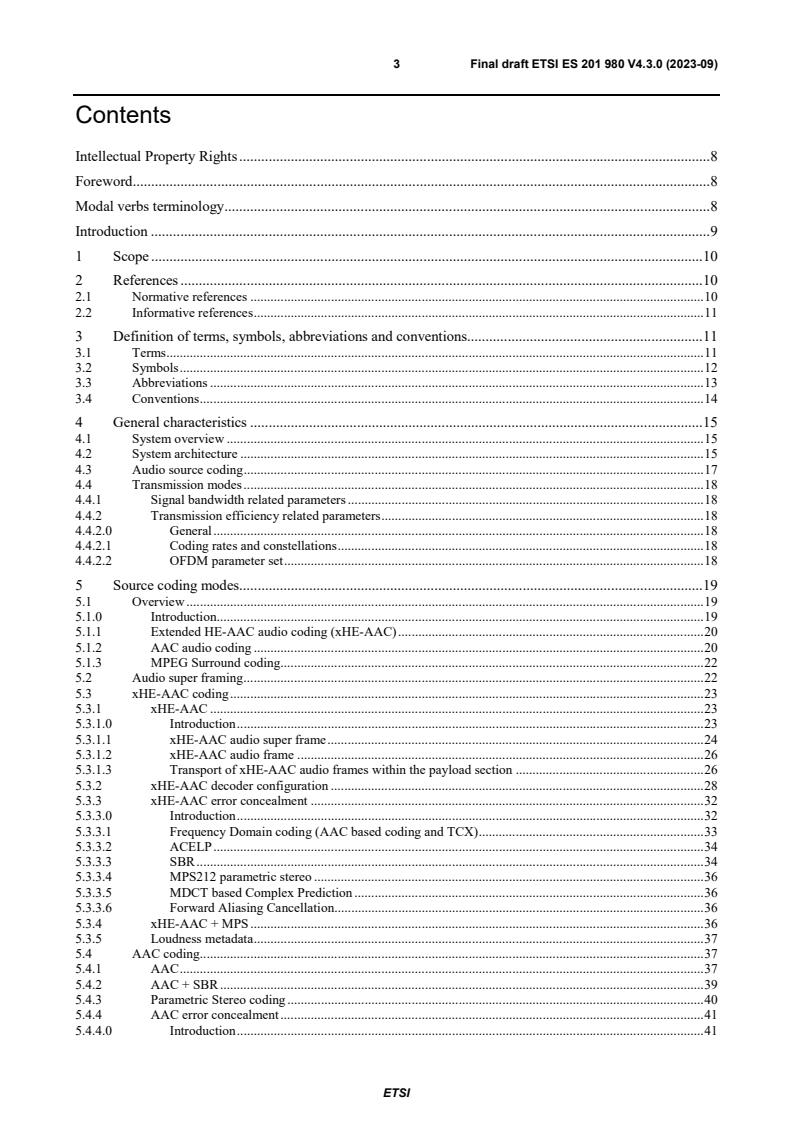
3 Final draft ETSI ES 201 980 V4.3.0 (2023-09)
Contents
Intellectual Property Rights . 8
Foreword . 8
Modal verbs terminology . 8
Introduction . 9
1 Scope . 10
2 References . 10
2.1 Normative references . 10
2.2 Informative references . 11
3 Definition of terms, symbols, abbreviations and conventions . 11
3.1 Terms . 11
3.2 Symbols . 12
3.3 Abbreviations . 13
3.4 Conventions . 14
4 General characteristics . 15
4.1 System overview . 15
4.2 System architecture . 15
4.3 Audio source coding . 17
4.4 Transmission modes . 18
4.4.1 Signal bandwidth related parameters . 18
4.4.2 Transmission efficiency related parameters . 18
4.4.2.0 General . 18
4.4.2.1 Coding rates and constellations . 18
4.4.2.2 OFDM parameter set . 18
5 Source coding modes. 19
5.1 Overview . 19
5.1.0 Introduction. 19
5.1.1 Extended HE-AAC audio coding (xHE-AAC) . 20
5.1.2 AAC audio coding . 20
5.1.3 MPEG Surround coding . 22
5.2 Audio super framing . 22
5.3 xHE-AAC coding . 23
5.3.1 xHE-AAC . 23
5.3.1.0 Introduction . 23
5.3.1.1 xHE-AAC audio super frame . 24
5.3.1.2 xHE-AAC audio frame . 26
5.3.1.3 Transport of xHE-AAC audio frames within the payload section . 26
5.3.2 xHE-AAC decoder configuration . 28
5.3.3 xHE-AAC error concealment . 32
5.3.3.0 Introduction . 32
5.3.3.1 Frequency Domain coding (AAC based coding and TCX) . 33
5.3.3.2 ACELP . 34
5.3.3.3 SBR . 34
5.3.3.4 MPS212 parametric stereo . 36
5.3.3.5 MDCT based Complex Prediction . 36
5.3.3.6 Forward Aliasing Cancellation. 36
5.3.4 xHE-AAC + MPS . 36
5.3.5 Loudness metadata . 37
5.4 AAC coding. 37
5.4.1 AAC . 37
5.4.2 AAC + SBR . 39
5.4.3 Parametric Stereo coding . 40
5.4.4 AAC error concealment . 41
5.4.4.0 Introduction . 41
ETSI
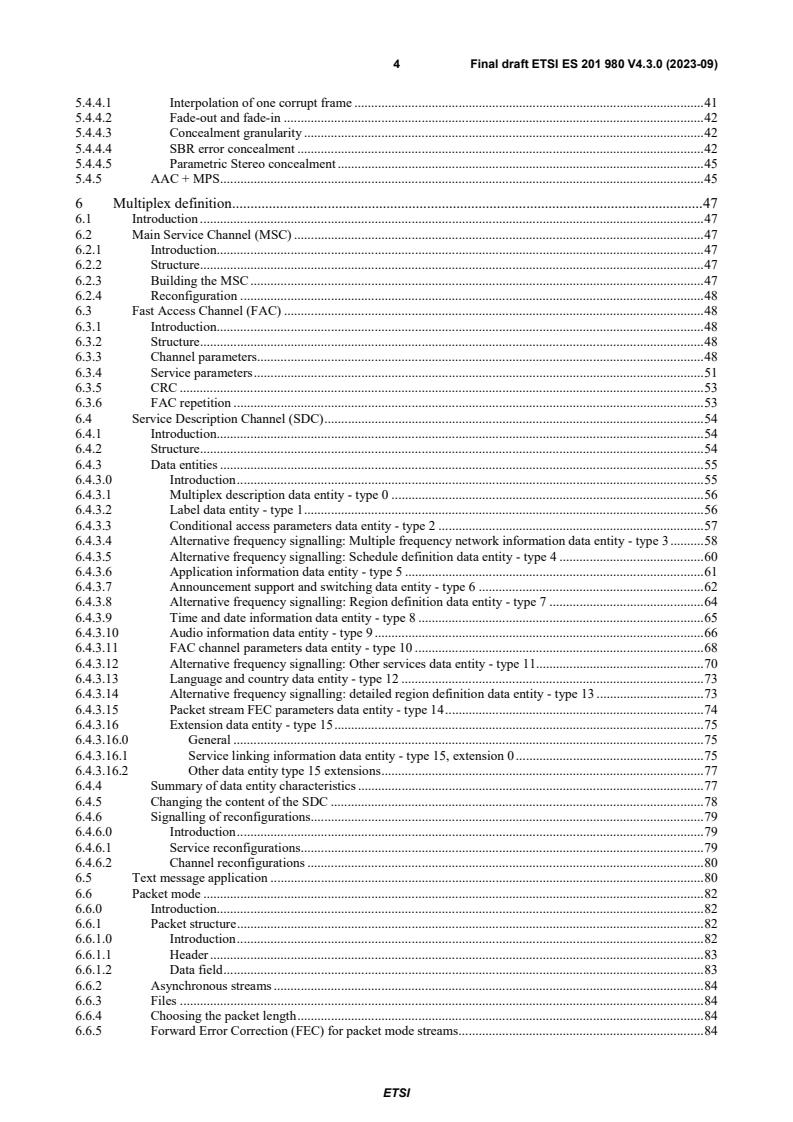
4 Final draft ETSI ES 201 980 V4.3.0 (2023-09)
5.4.4.1 Interpolation of one corrupt frame . 41
5.4.4.2 Fade-out and fade-in . 42
5.4.4.3 Concealment granularity . 42
5.4.4.4 SBR error concealment . 42
5.4.4.5 Parametric Stereo concealment . 45
5.4.5 AAC + MPS . 45
6 Multiplex definition . 47
6.1 Introduction . 47
6.2 Main Service Channel (MSC) . 47
6.2.1 Introduction. 47
6.2.2 Structure . 47
6.2.3 Building the MSC . 47
6.2.4 Reconfiguration . 48
6.3 Fast Access Channel (FAC) . 48
6.3.1 Introduction. 48
6.3.2 Structure . 48
6.3.3 Channel parameters. 48
6.3.4 Service parameters . 51
6.3.5 CRC . 53
6.3.6 FAC repetition . 53
6.4 Service Description Channel (SDC) . 54
6.4.1 Introduction. 54
6.4.2 Structure . 54
6.4.3 Data entities . 55
6.4.3.0 Introduction . 55
6.4.3.1 Multiplex description data entity - type 0 . 56
6.4.3.2 Label data entity - type 1 . 56
6.4.3.3 Conditional access parameters data entity - type 2 . 57
6.4.3.4 Alternative frequency signalling: Multiple frequency network information data entity - type 3 . 58
6.4.3.5 Alternative frequency signalling: Schedule definition data entity - type 4 . 60
6.4.3.6 Application information data entity - type 5 . 61
6.4.3.7 Announcement support and switching data entity - type 6 . 62
6.4.3.8 Alternative frequency signalling: Region definition data entity - type 7 . 64
6.4.3.9 Time and date information data entity - type 8 . 65
6.4.3.10 Audio information data entity - type 9 . 66
6.4.3.11 FAC channel parameters data entity - type 10 . 68
6.4.3.12 Alternative frequency signalling: Other services data entity - type 11. 70
6.4.3.13 Language and country data entity - type 12 . 73
6.4.3.14 Alternative frequency signalling: detailed region definition data entity - type 13 . 73
6.4.3.15 Packet stream FEC parameters data entity - type 14 . 74
6.4.3.16 Extension data entity - type 15 . 75
6.4.3.16.0 General . 75
6.4.3.16.1 Service linking information data entity - type 15, extension 0 . 75
6.4.3.16.2 Other data entity type 15 extensions . 77
6.4.4 Summary of data entity characteristics . 77
6.4.5 Changing the content of the SDC . 78
6.4.6 Signalling of reconfigurations. 79
6.4.6.0 Introduction . 79
6.4.6.1 Service reconfigurations . 79
6.4.6.2 Channel reconfigurations . 80
6.5 Text message application . 80
6.6 Packet mode . 82
6.6.0 Introduction. 82
6.6.1 Packet structure . 82
6.6.1.0 Introduction . 82
6.6.1.1 Header . 83
6.6.1.2 Data field . 83
6.6.2 Asynchronous streams . 84
6.6.3 Files . 84
6.6.4 Choosing the packet length . 84
6.6.5 Forward Error Correction (FEC) for packet mode streams . 84
ETSI
5 Final draft ETSI ES 201 980 V4.3.0 (2023-09)
6.6.5.0 Introduction . 84
6.6.5.1 Encoding of FEC Packets . 85
6.6.5.2 Transport of FEC packets . 87
6.6.5.3 Receiver considerations . 88
6.7 Presentation of service labels and text messages . 88
6.7.1 Introduction. 88
6.7.2 Encoding of the text control field . 89
6.7.3 Transport of the text control field . 90
6.7.3.1 SDC data entity type 1 labels . 90
6.7.3.2 Text messages . 91
6.7.4 Display of RTL and bidirectional text . 91
6.7.4.1 Introduction . 91
6.7.4.2 Minimum RTL implementation . 91
6.7.4.3 Simplified bidirectional algorithm . 92
7 Channel coding and modulation . 93
7.1 Introduction . 93
7.2 Transport multiplex adaptation and energy dispersal . 94
7.2.1 Transport multiplex adaptation . 94
7.2.1.0 General . 94
7.2.1.1 MSC . 94
7.2.1.2 FAC . 95
7.2.1.3 SDC . 95
7.2.2 Energy dispersal . 96
7.3 Coding . 97
7.3.1 Multilevel coding . 97
7.3.1.0 Introduction . 97
7.3.1.1 Partitioning of the bitstream . 98
7.3.2 Component code . 99
7.3.3 Bit interleaving . 104
7.3.3.0 Introduction . 104
7.3.3.1 FAC . 105
7.3.3.2 SDC . 105
7.3.3.3 MSC . 105
7.4 Signal constellations and mapping . 106
7.5 Application of coding to the channels . 108
7.5.1 Coding the MSC . 108
7.5.1.0 Introduction . 108
7.5.1.1 Coding . 108
7.5.2 Coding the SDC . 109
7.5.3 Coding the FAC . 110
7.6 MSC cell interleaving . 110
7.7 Mapping of MSC cells on the transmission super frame structure . 112
8 Transmission structure . 113
8.1 Transmission frame structure and robustness modes . 113
8.2 Propagation-related OFDM parameters . 115
8.3 Signal bandwidth related parameters . 115
8.3.1 Parameter definition . 115
8.3.2 Simulcast transmission . 117
8.4 Pilot cells . 117
8.4.1 Functions and derivation . 117
8.4.2 Frequency references . 117
8.4.2.0 Introduction . 117
8.4.2.1 Cell positions. 117
8.4.2.2 Cell gains and phases . 118
8.4.3 Time references . 119
8.4.3.0 Introduction . 119
8.4.3.1 Cell positions and phases . 119
8.4.3.2 Cell gains . 122
8.4.4 Gain references . 122
8.4.4.0 Introduction . 122
ETSI
6 Final draft ETSI ES 201 980 V4.3.0 (2023-09)
8.4.4.1 Cell positions. 122
8.4.4.2 Cell gains . 122
8.4.4.3 Cell phases . 123
8.4.4.3.0 Introduction . 123
8.4.4.3.1 Procedure for calculation of cell phases . 123
8.4.4.3.2 Robustness mode A . 124
8.4.4.3.3 Robustness mode B . 124
8.4.4.3.4 Robustness mode C . 124
8.4.4.3.5 Robustness mode D . 125
8.4.4.3.6 Robustness mode E . 125
8.4.5 AFS references . 125
8.4.5.0 Introduction . 125
8.4.5.1 Cell positions and phases . 126
8.4.5.2 Cell gains . 127
8.5 Control cells . 127
8.5.1 General . 127
8.5.2 FAC cells . 128
8.5.2.1 Cell positions. 128
8.5.2.2 Cell gains and phases . 130
8.5.3 SDC cells . 130
8.5.3.1 Cell positions. 130
8.5.3.2 Cell gains and phases . 131
8.6 Data cells . 131
8.6.1 Cell positions . 131
8.6.2 Cell gains and phases . 131
Annex A (informative): Simulated system performance . 132
Annex B (informative): Definition of channel profiles . 133
B.1 Robustness modes A, B, C and D . 133
B.2 Robustness mode E . 135
Annex C (informative): Example of mapping of logical frames to multiplex frames . 138
Annex D (normative): Calculation of the CRC word . 140
Annex E (informative): RF protection ratios . 142
Annex F (informative): Alternative Frequency and announcement signalling . 143
F.0 Introduction . 143
F.1 Possibilities of the Alternative Frequency Signalling feature . 143
F.2 Possibilities of the announcement feature . 144
F.3 SDC data entities overview for Alternative Frequency and announcement signalling . 146
F.4 SDC data entities and setup for alternative frequency signalling . 147
F.5 SDC data entities and setup for announcement . 147
F.6 Alternative frequency and announcement signalling - coding example . 149
Annex G (informative): Guidelines for receiver impl ementation . 152
G.0 Introduction . 152
G.1 Alternative Frequency checking and Switching (AFS) . 152
G.2 Station buttons for DRM services . 153
G.3 Seamless Alternative Frequency checking and Switching (AFS) . 154
Annex H (informative): Service capacity and bit rates . 157
ETSI
7 Final draft ETSI ES 201 980 V4.3.0 (2023-09)
Annex I: Void . 158
Annex J (informative): Numbers of input bits . 159
Annex K (informative): Simulcast transmission, alternate sources and enhancement
signalling . 161
Annex L (informative): Pilot reference illustrations . 164
Annex M (informative): MSC configuration examples . 171
Annex N (informative): Signalling Warning/Alarm announcements . 174
Annex O (normative): Interpretation of schedules for Alternative Frequency Signalling . 175
Annex P (informative): Transmit diversity. 177
Annex Q (informative): Seamless reconfiguration . 178
Annex R (informative): Seamless receiver switching between DRM, DAB, AM and FM
broadcasts . 180
R.1 Overview . 180
R.2 General network timing considerations . 180
R.3 Network synchronization rules . 181
R.4 Receiver implementation rules . 182
R.5 Definition of broadcast signal time references . 183
Annex S (informative): Combined transmission of DRM and FM . 184
Annex T (informative): Assignment of Service identifiers . 185
T.0 Introduction . 185
T.1 Domestic services . 185
T.2 International services . 185
History . 186
ETSI
8 Final draft ETSI ES 201 980 V4.3.0 (2023-09)
Intellectual Property Rights
Essential patents
IPRs essential or potentially essential to normative deliverables may have been declared to ETSI. The declarations
pertaining to these essential IPRs, if any, are publicly available for ETSI members and non-members, and can be
found in ETSI SR 000 314: "Intellectual Property Rights (IPRs); Essential, or potentially Essential, IPRs notified to
ETSI in respect of ETSI standards", which is available from the ETSI Secretariat. Latest updates are available on the
ETSI Web server (https://ipr.etsi.org/).
Pursuant to the ETSI Directives including the ETSI IPR Policy, no investigation regarding the essentiality of IPRs,
including IPR searches, has been carried out by ETSI. No guarantee can be given as to the existence of other IPRs not
referenced in ETSI SR 000 314 (or the updates on the ETSI Web server) which are, or may be, or may become,
essential to the present document.
Trademarks
The present document may include trademarks and/or tradenames which are asserted and/or registered by their owners.
ETSI claims no ownership of these except for any which are indicated as being the property of ETSI, and conveys no
right to use or reproduce any trademark and/or tradename. Mention of those trademarks in the present document does
not constitute an endorsement by ETSI of products, services or organizations associated with those trademarks.
DECT™, PLUGTESTS™, UMTS™ and the ETSI logo are trademarks of ETSI registered for the benefit of its
Members. 3GPP™ and LTE™ are trademarks of ETSI registered for the benefit of its Members and of the 3GPP
Organizational Partners. oneM2M™ logo is a trademark of ETSI registered for the benefit of its Members and of the ®
oneM2M Partners. GSM and the GSM logo are trademarks registered and owned by the GSM Association.
Foreword
This final draft ETSI Standard (ES) has been produced by Joint Technical Committee (JTC) Broadcast of the European
Broadcasting Union (EBU), Comité Européen de Normalisation ELECtrotechnique (CENELEC) and the European
Telecommunications Standards Institute (ETSI), and is now submitted for the ETSI standards Membership Approval
Procedure.
NOTE: The EBU/ETSI JTC Broadcast was established in 1990 to co-ordinate the drafting of standards in the
specific field of broadcasting and related fields. Since 1995 the JTC Broadcast became a tripartite body
by including in the Memorandum of Understanding also CENELEC, which is responsible for the
standardization of radio and television receivers. The EBU is a professional association of broadcasting
organizations whose work includes the co-ordination of its members' activities in the technical, legal,
programme-making and programme-exchange domains. The EBU has active members in about
60 countries in the European broadcasting area; its headquarters is in Geneva.
European Broadcasting Union
CH-1218 GRAND SACONNEX (Geneva)
Switzerland
Tel: +41 22 717 21 11
Fax: +41 22 717 24 81
Modal verbs terminology
In the present document "shall", "shall not", "should", "should not", "may", "need not", "will", "will not", "can" and
"cannot" are to be interpreted as described in cl
...
ETSI STANDARD
Digital Radio Mondiale (DRM);
System Specification
2 ETSI ES 201 980 V4.3.1 (2023-11)
Reference
RES/JTC-DRM-38
Keywords
broadcasting, digital, DRM, radio
ETSI
650 Route des Lucioles
F-06921 Sophia Antipolis Cedex - FRANCE
Tel.: +33 4 92 94 42 00 Fax: +33 4 93 65 47 16
Siret N° 348 623 562 00017 - APE 7112B
Association à but non lucratif enregistrée à la
Sous-Préfecture de Grasse (06) N° w061004871
Important notice
The present document can be downloaded from:
https://www.etsi.org/standards-search
The present document may be made available in electronic versions and/or in print. The content of any electronic and/or
print versions of the present document shall not be modified without the prior written authorization of ETSI. In case of any
existing or perceived difference in contents between such versions and/or in print, the prevailing version of an ETSI
deliverable is the one made publicly available in PDF format at www.etsi.org/deliver.
Users of the present document should be aware that the document may be subject to revision or change of status.
Information on the current status of this and other ETSI documents is available at
https://portal.etsi.org/TB/ETSIDeliverableStatus.aspx
If you find errors in the present document, please send your comment to one of the following services:
https://portal.etsi.org/People/CommiteeSupportStaff.aspx
If you find a security vulnerability in the present document, please report it through our
Coordinated Vulnerability Disclosure Program:
https://www.etsi.org/standards/coordinated-vulnerability-disclosure
Notice of disclaimer & limitation of liability
The information provided in the present deliverable is directed solely to professionals who have the appropriate degree of
experience to understand and interpret its content in accordance with generally accepted engineering or
other professional standard and applicable regulations.
No recommendation as to products and services or vendors is made or should be implied.
No representation or warranty is made that this deliverable is technically accurate or sufficient or conforms to any law
and/or governmental rule and/or regulation and further, no representation or warranty is made of merchantability or fitness
for any particular purpose or against infringement of intellectual property rights.
In no event shall ETSI be held liable for loss of profits or any other incidental or consequential damages.
Any software contained in this deliverable is provided "AS IS" with no warranties, express or implied, including but not
limited to, the warranties of merchantability, fitness for a particular purpose and non-infringement of intellectual property
rights and ETSI shall not be held liable in any event for any damages whatsoever (including, without limitation, damages
for loss of profits, business interruption, loss of information, or any other pecuniary loss) arising out of or related to the use
of or inability to use the software.
Copyright Notification
No part may be reproduced or utilized in any form or by any means, electronic or mechanical, including photocopying and
microfilm except as authorized by written permission of ETSI.
The content of the PDF version shall not be modified without the written authorization of ETSI.
The copyright and the foregoing restriction extend to reproduction in all media.
© ETSI 2023.
© European Broadcasting Union 2023.
All rights reserved.
ETSI
3 ETSI ES 201 980 V4.3.1 (2023-11)
Contents
Intellectual Property Rights . 8
Foreword . 8
Modal verbs terminology . 8
Introduction . 9
1 Scope . 10
2 References . 10
2.1 Normative references . 10
2.2 Informative references . 11
3 Definition of terms, symbols, abbreviations and conventions . 11
3.1 Terms . 11
3.2 Symbols . 12
3.3 Abbreviations . 13
3.4 Conventions . 14
4 General characteristics . 15
4.1 System overview . 15
4.2 System architecture . 15
4.3 Audio source coding . 17
4.4 Transmission modes . 18
4.4.1 Signal bandwidth related parameters . 18
4.4.2 Transmission efficiency related parameters . 18
4.4.2.0 General . 18
4.4.2.1 Coding rates and constellations . 18
4.4.2.2 OFDM parameter set . 18
5 Source coding modes. 19
5.1 Overview . 19
5.1.0 Introduction. 19
5.1.1 Extended HE-AAC audio coding (xHE-AAC) . 20
5.1.2 AAC audio coding . 20
5.1.3 MPEG Surround coding . 22
5.2 Audio super framing . 22
5.3 xHE-AAC coding . 23
5.3.1 xHE-AAC . 23
5.3.1.0 Introduction . 23
5.3.1.1 xHE-AAC audio super frame . 24
5.3.1.2 xHE-AAC audio frame . 26
5.3.1.3 Transport of xHE-AAC audio frames within the payload section . 26
5.3.2 xHE-AAC decoder configuration . 28
5.3.3 xHE-AAC error concealment . 32
5.3.3.0 Introduction . 32
5.3.3.1 Frequency Domain coding (AAC based coding and TCX) . 33
5.3.3.2 ACELP . 34
5.3.3.3 SBR . 34
5.3.3.4 MPS212 parametric stereo . 36
5.3.3.5 MDCT based Complex Prediction . 36
5.3.3.6 Forward Aliasing Cancellation. 36
5.3.4 xHE-AAC + MPS . 36
5.3.5 Loudness metadata . 37
5.4 AAC coding. 37
5.4.1 AAC . 37
5.4.2 AAC + SBR . 39
5.4.3 Parametric Stereo coding . 40
5.4.4 AAC error concealment . 41
5.4.4.0 Introduction . 41
ETSI
4 ETSI ES 201 980 V4.3.1 (2023-11)
5.4.4.1 Interpolation of one corrupt frame . 41
5.4.4.2 Fade-out and fade-in . 42
5.4.4.3 Concealment granularity . 42
5.4.4.4 SBR error concealment . 42
5.4.4.5 Parametric Stereo concealment . 45
5.4.5 AAC + MPS . 45
6 Multiplex definition . 47
6.1 Introduction . 47
6.2 Main Service Channel (MSC) . 47
6.2.1 Introduction. 47
6.2.2 Structure . 47
6.2.3 Building the MSC . 47
6.2.4 Reconfiguration . 48
6.3 Fast Access Channel (FAC) . 48
6.3.1 Introduction. 48
6.3.2 Structure . 48
6.3.3 Channel parameters. 48
6.3.4 Service parameters . 51
6.3.5 CRC . 53
6.3.6 FAC repetition . 53
6.4 Service Description Channel (SDC) . 54
6.4.1 Introduction. 54
6.4.2 Structure . 54
6.4.3 Data entities . 55
6.4.3.0 Introduction . 55
6.4.3.1 Multiplex description data entity - type 0 . 56
6.4.3.2 Label data entity - type 1 . 56
6.4.3.3 Conditional access parameters data entity - type 2 . 57
6.4.3.4 Alternative frequency signalling: Multiple frequency network information data entity - type 3 . 58
6.4.3.5 Alternative frequency signalling: Schedule definition data entity - type 4 . 60
6.4.3.6 Application information data entity - type 5 . 61
6.4.3.7 Announcement support and switching data entity - type 6 . 62
6.4.3.8 Alternative frequency signalling: Region definition data entity - type 7 . 64
6.4.3.9 Time and date information data entity - type 8 . 65
6.4.3.10 Audio information data entity - type 9 . 66
6.4.3.11 FAC channel parameters data entity - type 10 . 68
6.4.3.12 Alternative frequency signalling: Other services data entity - type 11. 70
6.4.3.13 Language and country data entity - type 12 . 73
6.4.3.14 Alternative frequency signalling: detailed region definition data entity - type 13 . 73
6.4.3.15 Packet stream FEC parameters data entity - type 14 . 74
6.4.3.16 Extension data entity - type 15 . 75
6.4.3.16.0 General . 75
6.4.3.16.1 Service linking information data entity - type 15, extension 0 . 75
6.4.3.16.2 Other data entity type 15 extensions . 77
6.4.4 Summary of data entity characteristics . 77
6.4.5 Changing the content of the SDC . 78
6.4.6 Signalling of reconfigurations. 79
6.4.6.0 Introduction . 79
6.4.6.1 Service reconfigurations . 79
6.4.6.2 Channel reconfigurations . 80
6.5 Text message application . 80
6.6 Packet mode . 82
6.6.0 Introduction. 82
6.6.1 Packet structure . 82
6.6.1.0 Introduction . 82
6.6.1.1 Header . 83
6.6.1.2 Data field . 83
6.6.2 Asynchronous streams . 84
6.6.3 Files . 84
6.6.4 Choosing the packet length . 84
6.6.5 Forward Error Correction (FEC) for packet mode streams . 84
ETSI
5 ETSI ES 201 980 V4.3.1 (2023-11)
6.6.5.0 Introduction . 84
6.6.5.1 Encoding of FEC Packets . 85
6.6.5.2 Transport of FEC packets . 87
6.6.5.3 Receiver considerations . 88
6.7 Presentation of service labels and text messages . 88
6.7.1 Introduction. 88
6.7.2 Encoding of the text control field . 89
6.7.3 Transport of the text control field . 90
6.7.3.1 SDC data entity type 1 labels . 90
6.7.3.2 Text messages . 91
6.7.4 Display of RTL and bidirectional text . 91
6.7.4.1 Introduction . 91
6.7.4.2 Minimum RTL implementation . 91
6.7.4.3 Simplified bidirectional algorithm . 92
7 Channel coding and modulation . 93
7.1 Introduction . 93
7.2 Transport multiplex adaptation and energy dispersal . 94
7.2.1 Transport multiplex adaptation . 94
7.2.1.0 General . 94
7.2.1.1 MSC . 94
7.2.1.2 FAC . 95
7.2.1.3 SDC . 95
7.2.2 Energy dispersal . 96
7.3 Coding . 97
7.3.1 Multilevel coding . 97
7.3.1.0 Introduction . 97
7.3.1.1 Partitioning of the bitstream . 98
7.3.2 Component code . 99
7.3.3 Bit interleaving . 104
7.3.3.0 Introduction . 104
7.3.3.1 FAC . 105
7.3.3.2 SDC . 105
7.3.3.3 MSC . 105
7.4 Signal constellations and mapping . 106
7.5 Application of coding to the channels . 108
7.5.1 Coding the MSC . 108
7.5.1.0 Introduction . 108
7.5.1.1 Coding . 108
7.5.2 Coding the SDC . 109
7.5.3 Coding the FAC . 110
7.6 MSC cell interleaving . 110
7.7 Mapping of MSC cells on the transmission super frame structure . 112
8 Transmission structure . 113
8.1 Transmission frame structure and robustness modes . 113
8.2 Propagation-related OFDM parameters . 115
8.3 Signal bandwidth related parameters . 115
8.3.1 Parameter definition . 115
8.3.2 Simulcast transmission . 117
8.4 Pilot cells . 117
8.4.1 Functions and derivation . 117
8.4.2 Frequency references . 117
8.4.2.0 Introduction . 117
8.4.2.1 Cell positions. 117
8.4.2.2 Cell gains and phases . 118
8.4.3 Time references . 119
8.4.3.0 Introduction . 119
8.4.3.1 Cell positions and phases . 119
8.4.3.2 Cell gains . 122
8.4.4 Gain references . 122
8.4.4.0 Introduction . 122
ETSI
6 ETSI ES 201 980 V4.3.1 (2023-11)
8.4.4.1 Cell positions. 122
8.4.4.2 Cell gains . 122
8.4.4.3 Cell phases . 123
8.4.4.3.0 Introduction . 123
8.4.4.3.1 Procedure for calculation of cell phases . 123
8.4.4.3.2 Robustness mode A . 124
8.4.4.3.3 Robustness mode B . 124
8.4.4.3.4 Robustness mode C . 124
8.4.4.3.5 Robustness mode D . 125
8.4.4.3.6 Robustness mode E . 125
8.4.5 AFS references . 125
8.4.5.0 Introduction . 125
8.4.5.1 Cell positions and phases . 126
8.4.5.2 Cell gains . 127
8.5 Control cells . 127
8.5.1 General . 127
8.5.2 FAC cells . 128
8.5.2.1 Cell positions. 128
8.5.2.2 Cell gains and phases . 130
8.5.3 SDC cells . 130
8.5.3.1 Cell positions. 130
8.5.3.2 Cell gains and phases . 131
8.6 Data cells . 131
8.6.1 Cell positions . 131
8.6.2 Cell gains and phases . 131
Annex A (informative): Simulated system performance . 132
Annex B (informative): Definition of channel profiles . 133
B.1 Robustness modes A, B, C and D . 133
B.2 Robustness mode E . 135
Annex C (informative): Example of mapping of logical frames to multiplex frames . 138
Annex D (normative): Calculation of the CRC word . 140
Annex E (informative): RF protection ratios . 142
Annex F (informative): Alternative Frequency and announcement signalling . 143
F.0 Introduction . 143
F.1 Possibilities of the Alternative Frequency Signalling feature . 143
F.2 Possibilities of the announcement feature . 144
F.3 SDC data entities overview for Alternative Frequency and announcement signalling . 146
F.4 SDC data entities and setup for alternative frequency signalling . 147
F.5 SDC data entities and setup for announcement . 147
F.6 Alternative frequency and announcement signalling - coding example . 149
Annex G (informative): Guidelines for receiver implementation . 152
G.0 Introduction . 152
G.1 Alternative Frequency checking and Switching (AFS) . 152
G.2 Station buttons for DRM services . 153
G.3 Seamless Alternative Frequency checking and Switching (AFS) . 154
Annex H (informative): Service capacity and bit rates . 157
ETSI
7 ETSI ES 201 980 V4.3.1 (2023-11)
Annex I: Void . 158
Annex J (informative): Numbers of input bits . 159
Annex K (informative): Simulcast transmission, alternate sources and enhancement
signalling . 161
Annex L (informative): Pilot reference illustrations . 164
Annex M (informative): MSC configuration examples . 171
Annex N (informative): Signalling Warning/Alarm announcements . 174
Annex O (normative): Interpretation of schedules for Alternative Frequency Signalling . 175
Annex P (informative): Transmit diversity. 177
Annex Q (informative): Seamless reconfiguration . 178
Annex R (informative): Seamless receiver switching between DRM, DAB, AM and FM
broadcasts . 180
R.1 Overview . 180
R.2 General network timing considerations . 180
R.3 Network synchronization rules . 181
R.4 Receiver implementation rules . 182
R.5 Definition of broadcast signal time references . 183
Annex S (informative): Combined transmission of DRM and FM . 184
Annex T (informative): Assignment of Service identifiers . 185
T.0 Introduction . 185
T.1 Domestic services . 185
T.2 International services . 185
History . 186
ETSI
8 ETSI ES 201 980 V4.3.1 (2023-11)
Intellectual Property Rights
Essential patents
IPRs essential or potentially essential to normative deliverables may have been declared to ETSI. The declarations
pertaining to these essential IPRs, if any, are publicly available for ETSI members and non-members, and can be
found in ETSI SR 000 314: "Intellectual Property Rights (IPRs); Essential, or potentially Essential, IPRs notified to
ETSI in respect of ETSI standards", which is available from the ETSI Secretariat. Latest updates are available on the
ETSI Web server (https://ipr.etsi.org/).
Pursuant to the ETSI Directives including the ETSI IPR Policy, no investigation regarding the essentiality of IPRs,
including IPR searches, has been carried out by ETSI. No guarantee can be given as to the existence of other IPRs not
referenced in ETSI SR 000 314 (or the updates on the ETSI Web server) which are, or may be, or may become,
essential to the present document.
Trademarks
The present document may include trademarks and/or tradenames which are asserted and/or registered by their owners.
ETSI claims no ownership of these except for any which are indicated as being the property of ETSI, and conveys no
right to use or reproduce any trademark and/or tradename. Mention of those trademarks in the present document does
not constitute an endorsement by ETSI of products, services or organizations associated with those trademarks.
DECT™, PLUGTESTS™, UMTS™ and the ETSI logo are trademarks of ETSI registered for the benefit of its
Members. 3GPP™ and LTE™ are trademarks of ETSI registered for the benefit of its Members and of the 3GPP
Organizational Partners. oneM2M™ logo is a trademark of ETSI registered for the benefit of its Members and of the ®
oneM2M Partners. GSM and the GSM logo are trademarks registered and owned by the GSM Association.
Foreword
This ETSI Standard (ES) has been produced by Joint Technical Committee (JTC) Broadcast of the European
Broadcasting Union (EBU), Comité Européen de Normalisation ELECtrotechnique (CENELEC) and the European
Telecommunications Standards Institute (ETSI).
NOTE: The EBU/ETSI JTC Broadcast was established in 1990 to co-ordinate the drafting of standards in the
specific field of broadcasting and related fields. Since 1995 the JTC Broadcast became a tripartite body
by including in the Memorandum of Understanding also CENELEC, which is responsible for the
standardization of radio and television receivers. The EBU is a professional association of broadcasting
organizations whose work includes the co-ordination of its members' activities in the technical, legal,
programme-making and programme-exchange domains. The EBU has active members in about
60 countries in the European broadcasting area; its headquarters is in Geneva.
European Broadcasting Union
CH-1218 GRAND SACONNEX (Geneva)
Switzerland
Tel: +41 22 717 21 11
Fax: +41 22 717 24 81
Modal verbs terminology
In the present document "shall", "shall not", "should", "should not", "may", "need not", "will", "will not", "can" and
"cannot" are to be interpreted as described in clause 3.2 of the ETSI Drafting Rules (Verbal forms for the expression of
provisions).
"must" and "must not" are NOT allowed in ETSI deliverables except when used in direct citat
...
SLOVENSKI STANDARD
01-januar-2024
Digitalni radio Mondiale (DRM) - Sistemska specifikacija
Digital Radio Mondiale (DRM) - System Specification
Ta slovenski standard je istoveten z: ETSI ES 201 980 V4.3.1 (2023-11)
ICS:
33.060.01 Radijske komunikacije na Radiocommunications in
splošno general
2003-01.Slovenski inštitut za standardizacijo. Razmnoževanje celote ali delov tega standarda ni dovoljeno.
ETSI STANDARD
Digital Radio Mondiale (DRM);
System Specification
2 ETSI ES 201 980 V4.3.1 (2023-11)
Reference
RES/JTC-DRM-38
Keywords
broadcasting, digital, DRM, radio
ETSI
650 Route des Lucioles
F-06921 Sophia Antipolis Cedex - FRANCE
Tel.: +33 4 92 94 42 00 Fax: +33 4 93 65 47 16
Siret N° 348 623 562 00017 - APE 7112B
Association à but non lucratif enregistrée à la
Sous-Préfecture de Grasse (06) N° w061004871
Important notice
The present document can be downloaded from:
https://www.etsi.org/standards-search
The present document may be made available in electronic versions and/or in print. The content of any electronic and/or
print versions of the present document shall not be modified without the prior written authorization of ETSI. In case of any
existing or perceived difference in contents between such versions and/or in print, the prevailing version of an ETSI
deliverable is the one made publicly available in PDF format at www.etsi.org/deliver.
Users of the present document should be aware that the document may be subject to revision or change of status.
Information on the current status of this and other ETSI documents is available at
https://portal.etsi.org/TB/ETSIDeliverableStatus.aspx
If you find errors in the present document, please send your comment to one of the following services:
https://portal.etsi.org/People/CommiteeSupportStaff.aspx
If you find a security vulnerability in the present document, please report it through our
Coordinated Vulnerability Disclosure Program:
https://www.etsi.org/standards/coordinated-vulnerability-disclosure
Notice of disclaimer & limitation of liability
The information provided in the present deliverable is directed solely to professionals who have the appropriate degree of
experience to understand and interpret its content in accordance with generally accepted engineering or
other professional standard and applicable regulations.
No recommendation as to products and services or vendors is made or should be implied.
No representation or warranty is made that this deliverable is technically accurate or sufficient or conforms to any law
and/or governmental rule and/or regulation and further, no representation or warranty is made of merchantability or fitness
for any particular purpose or against infringement of intellectual property rights.
In no event shall ETSI be held liable for loss of profits or any other incidental or consequential damages.
Any software contained in this deliverable is provided "AS IS" with no warranties, express or implied, including but not
limited to, the warranties of merchantability, fitness for a particular purpose and non-infringement of intellectual property
rights and ETSI shall not be held liable in any event for any damages whatsoever (including, without limitation, damages
for loss of profits, business interruption, loss of information, or any other pecuniary loss) arising out of or related to the use
of or inability to use the software.
Copyright Notification
No part may be reproduced or utilized in any form or by any means, electronic or mechanical, including photocopying and
microfilm except as authorized by written permission of ETSI.
The content of the PDF version shall not be modified without the written authorization of ETSI.
The copyright and the foregoing restriction extend to reproduction in all media.
© ETSI 2023.
© European Broadcasting Union 2023.
All rights reserved.
ETSI
3 ETSI ES 201 980 V4.3.1 (2023-11)
Contents
Intellectual Property Rights . 8
Foreword . 8
Modal verbs terminology . 8
Introduction . 9
1 Scope . 10
2 References . 10
2.1 Normative references . 10
2.2 Informative references . 11
3 Definition of terms, symbols, abbreviations and conventions . 11
3.1 Terms . 11
3.2 Symbols . 12
3.3 Abbreviations . 13
3.4 Conventions . 14
4 General characteristics . 15
4.1 System overview . 15
4.2 System architecture . 15
4.3 Audio source coding . 17
4.4 Transmission modes . 18
4.4.1 Signal bandwidth related parameters . 18
4.4.2 Transmission efficiency related parameters . 18
4.4.2.0 General . 18
4.4.2.1 Coding rates and constellations . 18
4.4.2.2 OFDM parameter set . 18
5 Source coding modes. 19
5.1 Overview . 19
5.1.0 Introduction. 19
5.1.1 Extended HE-AAC audio coding (xHE-AAC) . 20
5.1.2 AAC audio coding . 20
5.1.3 MPEG Surround coding . 22
5.2 Audio super framing . 22
5.3 xHE-AAC coding . 23
5.3.1 xHE-AAC . 23
5.3.1.0 Introduction . 23
5.3.1.1 xHE-AAC audio super frame . 24
5.3.1.2 xHE-AAC audio frame . 26
5.3.1.3 Transport of xHE-AAC audio frames within the payload section . 26
5.3.2 xHE-AAC decoder configuration . 28
5.3.3 xHE-AAC error concealment . 32
5.3.3.0 Introduction . 32
5.3.3.1 Frequency Domain coding (AAC based coding and TCX) . 33
5.3.3.2 ACELP . 34
5.3.3.3 SBR . 34
5.3.3.4 MPS212 parametric stereo . 36
5.3.3.5 MDCT based Complex Prediction . 36
5.3.3.6 Forward Aliasing Cancellation. 36
5.3.4 xHE-AAC + MPS . 36
5.3.5 Loudness metadata . 37
5.4 AAC coding. 37
5.4.1 AAC . 37
5.4.2 AAC + SBR . 39
5.4.3 Parametric Stereo coding . 40
5.4.4 AAC error concealment . 41
5.4.4.0 Introduction . 41
ETSI
4 ETSI ES 201 980 V4.3.1 (2023-11)
5.4.4.1 Interpolation of one corrupt frame . 41
5.4.4.2 Fade-out and fade-in . 42
5.4.4.3 Concealment granularity . 42
5.4.4.4 SBR error concealment . 42
5.4.4.5 Parametric Stereo concealment . 45
5.4.5 AAC + MPS . 45
6 Multiplex definition . 47
6.1 Introduction . 47
6.2 Main Service Channel (MSC) . 47
6.2.1 Introduction. 47
6.2.2 Structure . 47
6.2.3 Building the MSC . 47
6.2.4 Reconfiguration . 48
6.3 Fast Access Channel (FAC) . 48
6.3.1 Introduction. 48
6.3.2 Structure . 48
6.3.3 Channel parameters. 48
6.3.4 Service parameters . 51
6.3.5 CRC . 53
6.3.6 FAC repetition . 53
6.4 Service Description Channel (SDC) . 54
6.4.1 Introduction. 54
6.4.2 Structure . 54
6.4.3 Data entities . 55
6.4.3.0 Introduction . 55
6.4.3.1 Multiplex description data entity - type 0 . 56
6.4.3.2 Label data entity - type 1 . 56
6.4.3.3 Conditional access parameters data entity - type 2 . 57
6.4.3.4 Alternative frequency signalling: Multiple frequency network information data entity - type 3 . 58
6.4.3.5 Alternative frequency signalling: Schedule definition data entity - type 4 . 60
6.4.3.6 Application information data entity - type 5 . 61
6.4.3.7 Announcement support and switching data entity - type 6 . 62
6.4.3.8 Alternative frequency signalling: Region definition data entity - type 7 . 64
6.4.3.9 Time and date information data entity - type 8 . 65
6.4.3.10 Audio information data entity - type 9 . 66
6.4.3.11 FAC channel parameters data entity - type 10 . 68
6.4.3.12 Alternative frequency signalling: Other services data entity - type 11. 70
6.4.3.13 Language and country data entity - type 12 . 73
6.4.3.14 Alternative frequency signalling: detailed region definition data entity - type 13 . 73
6.4.3.15 Packet stream FEC parameters data entity - type 14 . 74
6.4.3.16 Extension data entity - type 15 . 75
6.4.3.16.0 General . 75
6.4.3.16.1 Service linking information data entity - type 15, extension 0 . 75
6.4.3.16.2 Other data entity type 15 extensions . 77
6.4.4 Summary of data entity characteristics . 77
6.4.5 Changing the content of the SDC . 78
6.4.6 Signalling of reconfigurations. 79
6.4.6.0 Introduction . 79
6.4.6.1 Service reconfigurations . 79
6.4.6.2 Channel reconfigurations . 80
6.5 Text message application . 80
6.6 Packet mode . 82
6.6.0 Introduction. 82
6.6.1 Packet structure . 82
6.6.1.0 Introduction . 82
6.6.1.1 Header . 83
6.6.1.2 Data field . 83
6.6.2 Asynchronous streams . 84
6.6.3 Files . 84
6.6.4 Choosing the packet length . 84
6.6.5 Forward Error Correction (FEC) for packet mode streams . 84
ETSI
5 ETSI ES 201 980 V4.3.1 (2023-11)
6.6.5.0 Introduction . 84
6.6.5.1 Encoding of FEC Packets . 85
6.6.5.2 Transport of FEC packets . 87
6.6.5.3 Receiver considerations . 88
6.7 Presentation of service labels and text messages . 88
6.7.1 Introduction. 88
6.7.2 Encoding of the text control field . 89
6.7.3 Transport of the text control field . 90
6.7.3.1 SDC data entity type 1 labels . 90
6.7.3.2 Text messages . 91
6.7.4 Display of RTL and bidirectional text . 91
6.7.4.1 Introduction . 91
6.7.4.2 Minimum RTL implementation . 91
6.7.4.3 Simplified bidirectional algorithm . 92
7 Channel coding and modulation . 93
7.1 Introduction . 93
7.2 Transport multiplex adaptation and energy dispersal . 94
7.2.1 Transport multiplex adaptation . 94
7.2.1.0 General . 94
7.2.1.1 MSC . 94
7.2.1.2 FAC . 95
7.2.1.3 SDC . 95
7.2.2 Energy dispersal . 96
7.3 Coding . 97
7.3.1 Multilevel coding . 97
7.3.1.0 Introduction . 97
7.3.1.1 Partitioning of the bitstream . 98
7.3.2 Component code . 99
7.3.3 Bit interleaving . 104
7.3.3.0 Introduction . 104
7.3.3.1 FAC . 105
7.3.3.2 SDC . 105
7.3.3.3 MSC . 105
7.4 Signal constellations and mapping . 106
7.5 Application of coding to the channels . 108
7.5.1 Coding the MSC . 108
7.5.1.0 Introduction . 108
7.5.1.1 Coding . 108
7.5.2 Coding the SDC . 109
7.5.3 Coding the FAC . 110
7.6 MSC cell interleaving . 110
7.7 Mapping of MSC cells on the transmission super frame structure . 112
8 Transmission structure . 113
8.1 Transmission frame structure and robustness modes . 113
8.2 Propagation-related OFDM parameters . 115
8.3 Signal bandwidth related parameters . 115
8.3.1 Parameter definition . 115
8.3.2 Simulcast transmission . 117
8.4 Pilot cells . 117
8.4.1 Functions and derivation . 117
8.4.2 Frequency references . 117
8.4.2.0 Introduction . 117
8.4.2.1 Cell positions. 117
8.4.2.2 Cell gains and phases . 118
8.4.3 Time references . 119
8.4.3.0 Introduction . 119
8.4.3.1 Cell positions and phases . 119
8.4.3.2 Cell gains . 122
8.4.4 Gain references . 122
8.4.4.0 Introduction . 122
ETSI
6 ETSI ES 201 980 V4.3.1 (2023-11)
8.4.4.1 Cell positions. 122
8.4.4.2 Cell gains . 122
8.4.4.3 Cell phases . 123
8.4.4.3.0 Introduction . 123
8.4.4.3.1 Procedure for calculation of cell phases . 123
8.4.4.3.2 Robustness mode A . 124
8.4.4.3.3 Robustness mode B . 124
8.4.4.3.4 Robustness mode C . 124
8.4.4.3.5 Robustness mode D . 125
8.4.4.3.6 Robustness mode E . 125
8.4.5 AFS references . 125
8.4.5.0 Introduction . 125
8.4.5.1 Cell positions and phases . 126
8.4.5.2 Cell gains . 127
8.5 Control cells . 127
8.5.1 General . 127
8.5.2 FAC cells . 128
8.5.2.1 Cell positions. 128
8.5.2.2 Cell gains and phases . 130
8.5.3 SDC cells . 130
8.5.3.1 Cell positions. 130
8.5.3.2 Cell gains and phases . 131
8.6 Data cells . 131
8.6.1 Cell positions . 131
8.6.2 Cell gains and phases . 131
Annex A (informative): Simulated system performance . 132
Annex B (informative): Definition of channel profiles . 133
B.1 Robustness modes A, B, C and D . 133
B.2 Robustness mode E . 135
Annex C (informative): Example of mapping of logical frames to multiplex frames . 138
Annex D (normative): Calculation of the CRC word . 140
Annex E (informative): RF protection ratios . 142
Annex F (informative): Alternative Frequency and announcement signalling . 143
F.0 Introduction . 143
F.1 Possibilities of the Alternative Frequency Signalling feature . 143
F.2 Possibilities of the announcement feature . 144
F.3 SDC data entities overview for Alternative Frequency and announcement signalling . 146
F.4 SDC data entities and setup for alternative frequency signalling . 147
F.5 SDC data entities and setup for announcement . 147
F.6 Alternative frequency and announcement signalling - coding example . 149
Annex G (informative): Guidelines for receiver implementation . 152
G.0 Introduction . 152
G.1 Alternative Frequency checking and Switching (AFS) . 152
G.2 Station buttons for DRM services . 153
G.3 Seamless Alternative Frequency checking and Switching (AFS) . 154
Annex H (informative): Service capacity and bit rates . 157
ETSI
7 ETSI ES 201 980 V4.3.1 (2023-11)
Annex I: Void . 158
Annex J (informative): Numbers of input bits . 159
Annex K (informative): Simulcast transmission, alternate sources and enhancement
signalling . 161
Annex L (informative): Pilot reference illustrations . 164
Annex M (informative): MSC configuration examples . 171
Annex N (informative): Signalling Warning/Alarm announcements . 174
Annex O (normative): Interpretation of schedules for Alternative Frequency Signalling . 175
Annex P (informative): Transmit diversity. 177
Annex Q (informative): Seamless reconfiguration . 178
Annex R (informative): Seamless receiver switching between DRM, DAB, AM and FM
broadcasts . 180
R.1 Overview . 180
R.2 General network timing considerations . 180
R.3 Network synchronization rules . 181
R.4 Receiver implementation rules . 182
R.5 Definition of broadcast signal time references . 183
Annex S (informative): Combined transmission of DRM and FM . 184
Annex T (informative): Assignment of Service identifiers . 185
T.0 Introduction . 185
T.1 Domestic services . 185
T.2 International services . 185
History . 186
ETSI
8 ETSI ES 201 980 V4.3.1 (2023-11)
Intellectual Property Rights
Essential patents
IPRs essential or potentially essential to normative deliverables may have been declared to ETSI. The declarations
pertaining to these essential IPRs, if any, are publicly available for ETSI members and non-members, and can be
found in ETSI SR 000 314: "Intellectual Property Rights (IPRs); Essential, or potentially Essential, IPRs notified to
ETSI in respect of ETSI standards", which is available from the ETSI Secretariat. Latest updates are available on the
ETSI Web server (https://ipr.etsi.org/).
Pursuant to the ETSI Directives including the ETSI IPR Policy, no investigation regarding the essentiality of IPRs,
including IPR searches, has been carried out by ETSI. No guarantee can be given as to the existence of other IPRs not
referenced in ETSI SR 000 314 (or the updates on the ETSI Web server) which are, or may be, or may become,
essential to the present document.
Trademarks
The present document may include trademarks and/or tradenames which are asserted and/or registered by their owners.
ETSI claims no ownership of these except for any which are indicated as being the property of ETSI, and conveys no
right to use or reproduce any trademark and/or tradename. Mention of those trademarks in the present document does
not constitute an endorsement by ETSI of products, services or organizations associated with those trademarks.
DECT™, PLUGTESTS™, UMTS™ and the ETSI logo are trademarks of ETSI registered for the benefit of its
Members. 3GPP™ and LTE™ are trademarks of ETSI registered for the benefit of its Members and of the 3GPP
Organizational Partners. oneM2M™ logo is a trademark of ETSI registered for the benefit of its Members and of the ®
oneM2M Partners. GSM and the GSM logo are trademarks registered and owned by the GSM Association.
Foreword
This ETSI Standard (ES) has been produced by Joint Technical Committee (JTC) Broadcast of the European
Broadcasting Union (EBU), Comité Européen de Normalisation ELECtrotechnique (CENELEC) and the European
Telecommunications Standards Institute (ETSI).
NOTE: The EBU/ETSI JTC Broadcast was established in 1990 to co-ordinate the drafting of standards in the
specific field of broadcasting and related fields. Since 1995 the JTC Broadcast became a tripartite body
by including in the Memorandum of Understanding also CENELEC, which is responsible for the
standardization of radio and
...