

SIST EN 301 489-50 V2.4.1:2025
(Main)ElectroMagnetic Compatibility (EMC) standard for radio equipment and services - Part 50: Specific conditions for Cellular Communication Base Station (BS), repeater and ancillary equipment - Harmonised Standard for ElectroMagnetic Compatibility
General Information
- Abstract
The present document specifies technical characteristics and methods of measurements in respect of ElectroMagnetic Compatibility (EMC) for the following equipment types:
1) digital cellular base station equipment, including BS with antenna ports and BS without antenna ports;
2) repeaters;
3) associated ancillary equipment.
Including individual and combinations of technologies listed in table 1.
Technical specifications related to conducted emission EMC requirements below 9 kHz on the AC mains port of radio equipment are not included in the present document.
NOTE 1: Such technical specifications are normally found in the relevant product family standards for AC mains powered equipment (e.g. EN 61000-3-2 [i.16] and EN 61000-3-3 [i.17]). Technical specifications related to the antenna port and emissions from the enclosure port of Base Station (BS), combinations of radio and associated ancillary equipment or repeaters are not included in the present document. Such technical specifications are found in the relevant product standards for the effective use of the radio spectrum. The environmental classification and the emission and immunity requirements used in the present document are as stated in ETSI EN 301 489-1 [1], except for any special conditions included in the present document.
NOTE 2: The relationship between the present document and essential requirements of article 3.1(b) of Directive 2014/53/EU [i.1] is given in Annex A.
- Status
- Published
- Public Enquiry End Date
- 31-Jul-2025
- Publication Date
- 08-Oct-2025
- Technical Committee
- MOC - Mobile Communications
- Current Stage
- 6060 - National Implementation/Publication (Adopted Project)
- Start Date
- 07-Oct-2025
- Due Date
- 12-Dec-2025
- Completion Date
- 09-Oct-2025
Buy Documents
ETSI EN 301 489-50 V2.4.0 (2025-06) - ElectroMagnetic Compatibility (EMC) standard for radio equipment and services; Part 50: Specific conditions for Cellular Communication Base Station (BS), repeater and ancillary equipment; Harmonised Standard for ElectroMagnetic Compatibility
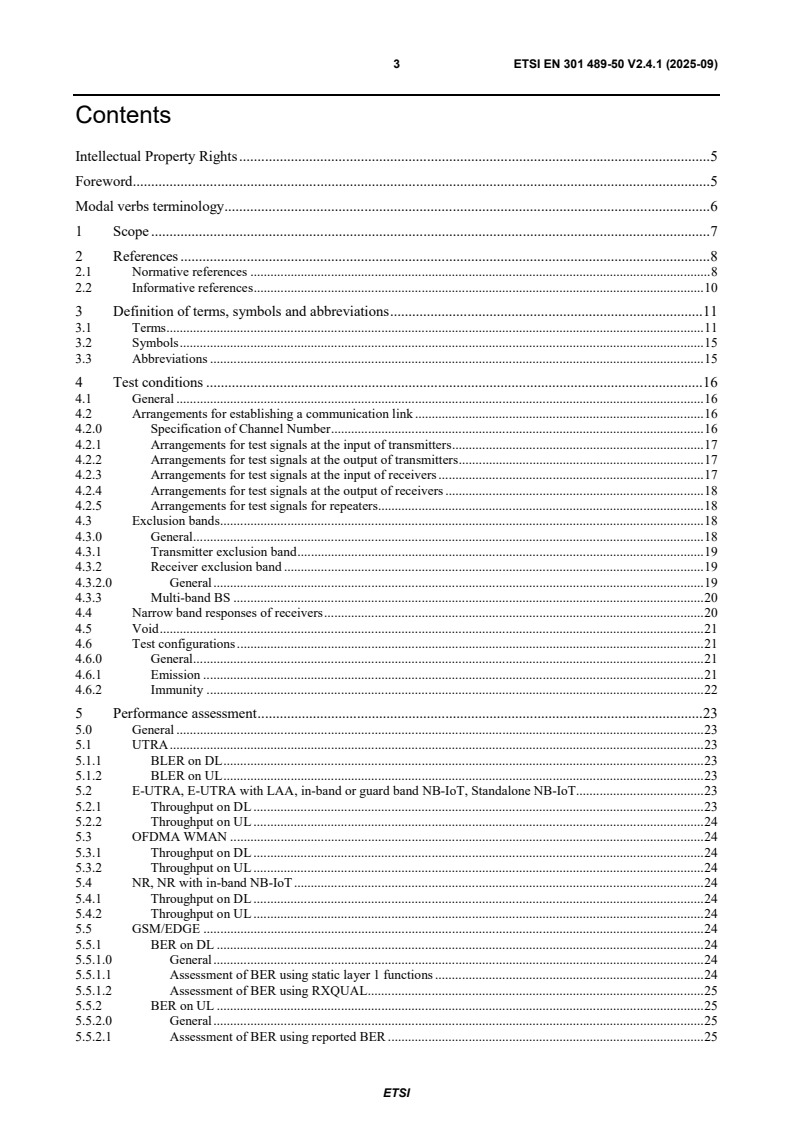
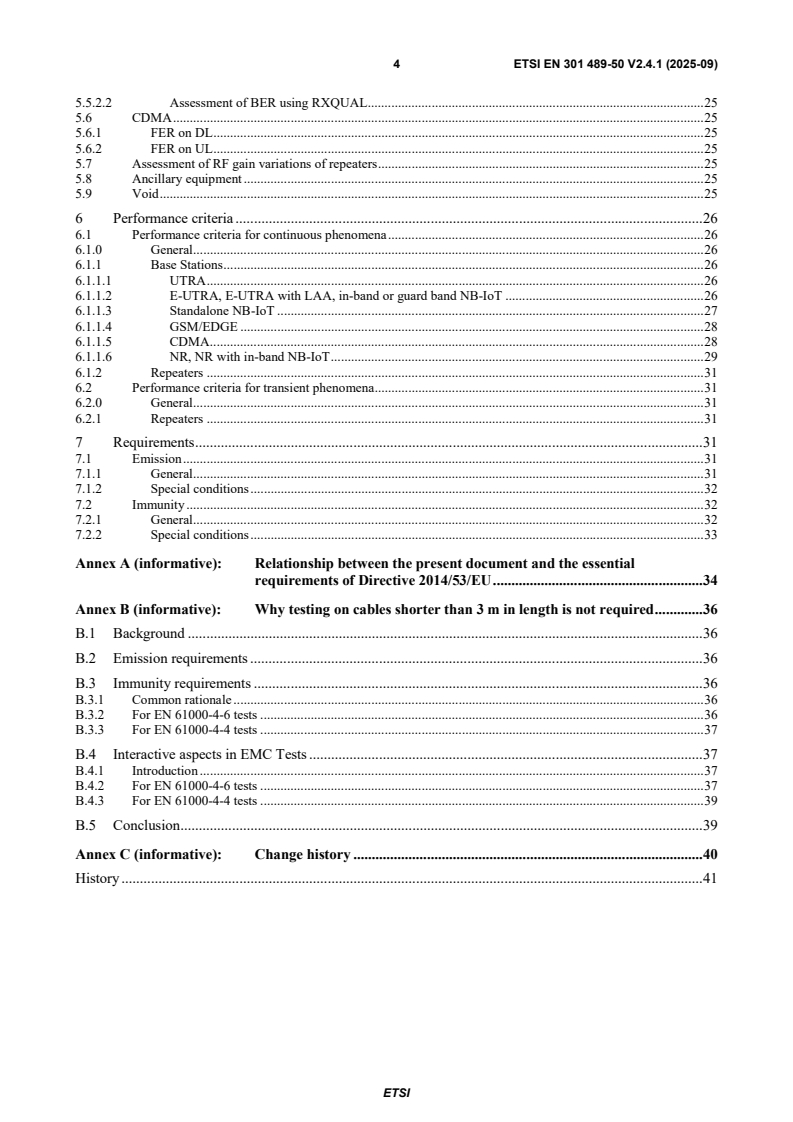
ETSI EN 301 489-50 V2.4.1 (2025-09) - ElectroMagnetic Compatibility (EMC) standard for radio equipment and services; Part 50: Specific conditions for Cellular Communication Base Station (BS), repeater and ancillary equipment; Harmonised Standard for ElectroMagnetic Compatibility

Overview
SIST EN 301 489-50 V2.4.1:2025 sets forth essential requirements for ElectroMagnetic Compatibility (EMC) in digital cellular base station equipment, repeaters, and related ancillary equipment. As a harmonised European Standard, this document helps manufacturers and stakeholders ensure their radio equipment operates within acceptable EMC limits, supporting the essential requirements of EU Directive 2014/53/EU. The standard covers 2G, 3G, 4G, and 5G cellular communication technologies, offering a unified approach to EMC compliance for an evolving radio communications environment.
Key Topics
- Scope of Application:
- Applies to digital cellular base station equipment, including those with or without antenna ports
- Includes repeaters and associated ancillary equipment used in cellular mobile networks
- Covers individual and combined use of technologies such as GSM, WCDMA, LTE, NR (5G), and WMAN (e.g., WiMAX)
- EMC Requirements:
- Specifies technical emission and immunity requirements for equipment to limit electromagnetic disturbances
- Outlines test conditions and measurement procedures to demonstrate EMC compliance
- Environmental classification and fundamental requirements reference ETSI EN 301 489-1, tailored for base station use
- Exclusions:
- Does not cover conducted emission EMC requirements below 9 kHz on AC mains ports (handled by other standards such as EN 61000-3-2 and EN 61000-3-3)
- Does not address antenna port or enclosure port emissions, which are covered by relevant product or radio spectrum standards
- Regulatory Conformance:
- Provides a route to conformity to the essential requirements of article 3.1(b) of Directive 2014/53/EU, facilitating market access within the European Union
Applications
SIST EN 301 489-50 V2.4.1:2025 is integral in the design, testing, and regulatory approval of modern radio equipment intended for deployment in public and private cellular networks. Its practical value includes:
- Product Development:
- Guides manufacturers in incorporating EMC controls during the design phase of cellular base stations, repeaters, and ancillary devices to meet legal and operational requirements
- Testing Procedures:
- Defines clear, harmonised methods for EMC measurement and performance verification, supporting third-party and self-declaration testing strategies
- Deployment Assurance:
- Ensures radio equipment deployed in live environments won’t cause or suffer from unacceptable electromagnetic interference, safeguarding network reliability and user experience
- Regulatory Compliance:
- Streamlines CE marking and regulatory approval processes within the EU, helping manufacturers avoid costly compliance pitfalls
Typical users of this standard include radio equipment manufacturers, test laboratories, certification bodies, and network operators seeking to ensure reliable, interference-free operation of 4G/5G base stations and repeaters.
Related Standards
For comprehensive EMC and radio frequency compliance, the following documents should be considered:
- ETSI EN 301 489-1: ElectroMagnetic Compatibility for radio equipment - General technical requirements
- EN 61000-3-2, EN 61000-3-3: Limits on harmonic current emissions and voltage fluctuations for mains-powered equipment
- ETSI TS 136 104, TS 138 104: LTE and 5G NR base station radio transmission/reception specifications
- EN 55032: EMC emission requirements for multimedia equipment
- EN IEC 61000-4-3: Testing and measurement techniques for radiated, RF, electromagnetic field immunity
Consulting these harmonised standards ensures a holistic approach to electromagnetic compatibility, supporting robust, legal, and high-performance radio deployments across Europe.
Keywords: EMC, radio equipment, base station, repeater, harmonised standard, Directive 2014/53/EU, 5G, LTE, GSM, WCDMA, WMAN, cellular communications, SIST EN 301 489-50, compliance, testing methods, electromagnetic compatibility.
Buy Documents
ETSI EN 301 489-50 V2.4.0 (2025-06) - ElectroMagnetic Compatibility (EMC) standard for radio equipment and services; Part 50: Specific conditions for Cellular Communication Base Station (BS), repeater and ancillary equipment; Harmonised Standard for ElectroMagnetic Compatibility
ETSI EN 301 489-50 V2.4.1 (2025-09) - ElectroMagnetic Compatibility (EMC) standard for radio equipment and services; Part 50: Specific conditions for Cellular Communication Base Station (BS), repeater and ancillary equipment; Harmonised Standard for ElectroMagnetic Compatibility
Get Certified
Connect with accredited certification bodies for this standard

ANCE
Mexican certification and testing association.

Intertek Slovenia
Intertek testing, inspection, and certification services in Slovenia.

LNE (Laboratoire National de Métrologie et d'Essais)
French national laboratory for metrology and testing.
Sponsored listings
Frequently Asked Questions
SIST EN 301 489-50 V2.4.1:2025 is a standard published by the Slovenian Institute for Standardization (SIST). Its full title is "ElectroMagnetic Compatibility (EMC) standard for radio equipment and services - Part 50: Specific conditions for Cellular Communication Base Station (BS), repeater and ancillary equipment - Harmonised Standard for ElectroMagnetic Compatibility". This standard covers: The present document specifies technical characteristics and methods of measurements in respect of ElectroMagnetic Compatibility (EMC) for the following equipment types: 1) digital cellular base station equipment, including BS with antenna ports and BS without antenna ports; 2) repeaters; 3) associated ancillary equipment. Including individual and combinations of technologies listed in table 1. Technical specifications related to conducted emission EMC requirements below 9 kHz on the AC mains port of radio equipment are not included in the present document. NOTE 1: Such technical specifications are normally found in the relevant product family standards for AC mains powered equipment (e.g. EN 61000-3-2 [i.16] and EN 61000-3-3 [i.17]). Technical specifications related to the antenna port and emissions from the enclosure port of Base Station (BS), combinations of radio and associated ancillary equipment or repeaters are not included in the present document. Such technical specifications are found in the relevant product standards for the effective use of the radio spectrum. The environmental classification and the emission and immunity requirements used in the present document are as stated in ETSI EN 301 489-1 [1], except for any special conditions included in the present document. NOTE 2: The relationship between the present document and essential requirements of article 3.1(b) of Directive 2014/53/EU [i.1] is given in Annex A.
The present document specifies technical characteristics and methods of measurements in respect of ElectroMagnetic Compatibility (EMC) for the following equipment types: 1) digital cellular base station equipment, including BS with antenna ports and BS without antenna ports; 2) repeaters; 3) associated ancillary equipment. Including individual and combinations of technologies listed in table 1. Technical specifications related to conducted emission EMC requirements below 9 kHz on the AC mains port of radio equipment are not included in the present document. NOTE 1: Such technical specifications are normally found in the relevant product family standards for AC mains powered equipment (e.g. EN 61000-3-2 [i.16] and EN 61000-3-3 [i.17]). Technical specifications related to the antenna port and emissions from the enclosure port of Base Station (BS), combinations of radio and associated ancillary equipment or repeaters are not included in the present document. Such technical specifications are found in the relevant product standards for the effective use of the radio spectrum. The environmental classification and the emission and immunity requirements used in the present document are as stated in ETSI EN 301 489-1 [1], except for any special conditions included in the present document. NOTE 2: The relationship between the present document and essential requirements of article 3.1(b) of Directive 2014/53/EU [i.1] is given in Annex A.
SIST EN 301 489-50 V2.4.1:2025 is classified under the following ICS (International Classification for Standards) categories: 33.060.01 - Radiocommunications in general; 33.100.01 - Electromagnetic compatibility in general. The ICS classification helps identify the subject area and facilitates finding related standards.
SIST EN 301 489-50 V2.4.1:2025 is associated with the following European legislation: EU Directives/Regulations: 2014/53/EU. When a standard is cited in the Official Journal of the European Union, products manufactured in conformity with it benefit from a presumption of conformity with the essential requirements of the corresponding EU directive or regulation.
SIST EN 301 489-50 V2.4.1:2025 is available in PDF format for immediate download after purchase. The document can be added to your cart and obtained through the secure checkout process. Digital delivery ensures instant access to the complete standard document.
Standards Content (Sample)
Draft ETSI EN 301 489-50 V2.4.0 (2025-06)
HARMONISED EUROPEAN STANDARD
ElectroMagnetic Compatibility (EMC)
standard for radio equipment and services;
Part 50: Specific conditions for Cellular Communication
Base Station (BS), repeater and ancillary equipment;
Harmonised Standard for ElectroMagnetic Compatibility
2 Draft ETSI EN 301 489-50 V2.4.0 (2025-06)
Reference
REN/ERM-EMC-410
Keywords
5G, EMC, GSM, harmonised standard, LTE, MSR,
NR, OFDMA, WCDMA, WMAN
ETSI
650 Route des Lucioles
F-06921 Sophia Antipolis Cedex - FRANCE
Tel.: +33 4 92 94 42 00 Fax: +33 4 93 65 47 16
Siret N° 348 623 562 00017 - APE 7112B
Association à but non lucratif enregistrée à la
Sous-Préfecture de Grasse (06) N° w061004871
Important notice
The present document can be downloaded from the
ETSI Search & Browse Standards application.
The present document may be made available in electronic versions and/or in print. The content of any electronic and/or
print versions of the present document shall not be modified without the prior written authorization of ETSI. In case of any
existing or perceived difference in contents between such versions and/or in print, the prevailing version of an ETSI
deliverable is the one made publicly available in PDF format on ETSI deliver repository.
Users should be aware that the present document may be revised or have its status changed,
this information is available in the Milestones listing.
If you find errors in the present document, please send your comments to
the relevant service listed under Committee Support Staff.
If you find a security vulnerability in the present document, please report it through our
Coordinated Vulnerability Disclosure (CVD) program.
Notice of disclaimer & limitation of liability
The information provided in the present deliverable is directed solely to professionals who have the appropriate degree of
experience to understand and interpret its content in accordance with generally accepted engineering or
other professional standard and applicable regulations.
No recommendation as to products and services or vendors is made or should be implied.
In no event shall ETSI be held liable for loss of profits or any other incidental or consequential damages.
Any software contained in this deliverable is provided "AS IS" with no warranties, express or implied, including but not
limited to, the warranties of merchantability, fitness for a particular purpose and non-infringement of intellectual property
rights and ETSI shall not be held liable in any event for any damages whatsoever (including, without limitation, damages
for loss of profits, business interruption, loss of information, or any other pecuniary loss) arising out of or related to the use
of or inability to use the software.
Copyright Notification
No part may be reproduced or utilized in any form or by any means, electronic or mechanical, including photocopying and
microfilm except as authorized by written permission of ETSI.
The content of the PDF version shall not be modified without the written authorization of ETSI.
The copyright and the foregoing restriction extend to reproduction in all media.
© ETSI 2025.
All rights reserved.
ETSI
3 Draft ETSI EN 301 489-50 V2.4.0 (2025-06)
Contents
Intellectual Property Rights . 5
Foreword . 5
Modal verbs terminology . 6
1 Scope . 7
2 References . 8
2.1 Normative references . 8
2.2 Informative references . 10
3 Definition of terms, symbols and abbreviations . 11
3.1 Terms . 11
3.2 Symbols . 14
3.3 Abbreviations . 15
4 Test conditions . 16
4.1 General . 16
4.2 Arrangements for establishing a communication link . 16
4.2.0 Specification of Channel Number . 16
4.2.1 Arrangements for test signals at the input of transmitters . 17
4.2.2 Arrangements for test signals at the output of transmitters . 17
4.2.3 Arrangements for test signals at the input of receivers . 17
4.2.4 Arrangements for test signals at the output of receivers . 18
4.2.5 Arrangements for test signals for repeaters . 18
4.3 Exclusion bands . 18
4.3.0 General . 18
4.3.1 Transmitter exclusion band . 18
4.3.2 Receiver exclusion band . 19
4.3.2.0 General . 19
4.3.3 Multi-band BS . 20
4.4 Narrow band responses of receivers . 20
4.5 Void . 21
4.6 Test configurations . 21
4.6.0 General . 21
4.6.1 Emission . 21
4.6.2 Immunity . 21
5 Performance assessment . 23
5.0 General . 23
5.1 UTRA . 23
5.1.1 BLER on DL . 23
5.1.2 BLER on UL . 23
5.2 E-UTRA, E-UTRA with LAA, in-band or guard band NB-IoT, Standalone NB-IoT. 23
5.2.1 Throughput on DL . 23
5.2.2 Throughput on UL . 23
5.3 OFDMA WMAN . 23
5.3.1 Throughput on DL . 23
5.3.2 Throughput on UL . 24
5.4 NR, NR with in-band NB-IoT . 24
5.4.1 Throughput on DL . 24
5.4.2 Throughput on UL . 24
5.5 GSM/EDGE . 24
5.5.1 BER on DL . 24
5.5.1.0 General . 24
5.5.1.1 Assessment of BER using static layer 1 functions . 24
5.5.1.2 Assessment of BER using RXQUAL . 24
5.5.2 BER on UL . 25
5.5.2.0 General . 25
5.5.2.1 Assessment of BER using reported BER . 25
ETSI
4 Draft ETSI EN 301 489-50 V2.4.0 (2025-06)
5.5.2.2 Assessment of BER using RXQUAL . 25
5.6 CDMA . 25
5.6.1 FER on DL . 25
5.6.2 FER on UL . 25
5.7 Assessment of RF gain variations of repeaters . 25
5.8 Ancillary equipment . 25
5.9 Void . 25
6 Performance criteria . 25
6.1 Performance criteria for continuous phenomena . 25
6.1.0 General . 25
6.1.1 Base Stations . 26
6.1.1.1 UTRA . 26
6.1.1.2 E-UTRA, E-UTRA with LAA, in-band or guard band NB-IoT . 26
6.1.1.3 Standalone NB-IoT . 27
6.1.1.4 GSM/EDGE . 28
6.1.1.5 CDMA . 28
6.1.1.6 NR, NR with in-band NB-IoT . 29
6.1.2 Repeaters . 31
6.2 Performance criteria for transient phenomena . 31
6.2.0 General . 31
6.2.1 Repeaters . 31
7 Requirements . 31
7.1 Emission . 31
7.1.1 General . 31
7.1.2 Special conditions . 32
7.2 Immunity . 32
7.2.1 General . 32
7.2.2 Special conditions . 33
Annex A (informative): Relationship between the present document and the essential
requirements of Directive 2014/53/EU . 34
Annex B (informative): Why testing on cables shorter than 3 m in length is not required . 36
B.1 Background . 36
B.2 Emission requirements . 36
B.3 Immunity requirements . 36
B.3.1 Common rationale . 36
B.3.2 For EN 61000-4-6 tests . 36
B.3.3 For EN 61000-4-4 tests . 37
B.4 Interactive aspects in EMC Tests . 37
B.4.1 Introduction . 37
B.4.2 For EN 61000-4-6 tests . 37
B.4.3 For EN 61000-4-4 tests . 39
B.5 Conclusion . 39
Annex C (informative): Change history . 40
History . 41
ETSI
5 Draft ETSI EN 301 489-50 V2.4.0 (2025-06)
Intellectual Property Rights
Essential patents
IPRs essential or potentially essential to normative deliverables may have been declared to ETSI. The declarations
pertaining to these essential IPRs, if any, are publicly available for ETSI members and non-members, and can be
found in ETSI SR 000 314: "Intellectual Property Rights (IPRs); Essential, or potentially Essential, IPRs notified to
ETSI in respect of ETSI standards", which is available from the ETSI Secretariat. Latest updates are available on the
ETSI IPR online database.
Pursuant to the ETSI Directives including the ETSI IPR Policy, no investigation regarding the essentiality of IPRs,
including IPR searches, has been carried out by ETSI. No guarantee can be given as to the existence of other IPRs not
referenced in ETSI SR 000 314 (or the updates on the ETSI Web server) which are, or may be, or may become,
essential to the present document.
Trademarks
The present document may include trademarks and/or tradenames which are asserted and/or registered by their owners.
ETSI claims no ownership of these except for any which are indicated as being the property of ETSI, and conveys no
right to use or reproduce any trademark and/or tradename. Mention of those trademarks in the present document does
not constitute an endorsement by ETSI of products, services or organizations associated with those trademarks.
DECT™, PLUGTESTS™, UMTS™ and the ETSI logo are trademarks of ETSI registered for the benefit of its
Members. 3GPP™, LTE™ and 5G™ logo are trademarks of ETSI registered for the benefit of its Members and of the
3GPP Organizational Partners. oneM2M™ logo is a trademark of ETSI registered for the benefit of its Members and of ®
the oneM2M Partners. GSM and the GSM logo are trademarks registered and owned by the GSM Association.
Foreword
This draft European Standard (EN) has been produced by ETSI Technical Committee Electromagnetic compatibility
and Radio spectrum Matters (ERM), and is now submitted for the combined Public Enquiry and Vote phase of the ETSI
Standardisation Request deliverable Approval Procedure (SRdAP).
The present document has been prepared under the Commission's standardisation request C(2015) 5376 final [i.15] to
provide one voluntary means of conforming to the essential requirements of Directive 2014/53/EU on the harmonisation
of the laws of the Member States relating to the making available on the market of radio equipment and repealing
Directive 1999/5/EC [i.1].
Once the present document is cited in the Official Journal of the European Union under that Directive, compliance with
the normative clauses of the present document given in table A.1 confers, within the limits of the scope of the present
document, a presumption of conformity with the corresponding essential requirements of that Directive and associated
EFTA regulations.
The present document is part 50 of a multi-part deliverable. Full details of the entire series can be found in part 1 [1].
Proposed national transposition dates
Date of latest announcement of this EN (doa): 3 months after ETSI publication
Date of latest publication of new National Standard
or endorsement of this EN (dop/e): 6 months after doa
Date of withdrawal of any conflicting National Standard (dow): 18 months after doa
ETSI
6 Draft ETSI EN 301 489-50 V2.4.0 (2025-06)
Modal verbs terminology
In the present document "shall", "shall not", "should", "should not", "may", "need not", "will", "will not", "can" and
"cannot" are to be interpreted as described in clause 3.2 of the ETSI Drafting Rules (Verbal forms for the expression of
provisions).
"must" and "must not" are NOT allowed in ETSI deliverables except when used in direct citation.
ETSI
7 Draft ETSI EN 301 489-50 V2.4.0 (2025-06)
1 Scope
The present document specifies technical characteristics and methods of measurements in respect of ElectroMagnetic
Compatibility (EMC) for the following equipment types:
1) digital cellular base station equipment, including BS with antenna ports and BS without antenna ports;
2) repeaters;
3) associated ancillary equipment.
Including individual and combinations of technologies listed in table 1.
Table 1: Cellular Mobile Communication Technologies
Technology Technology Generation Standard SET ETSI Standard
(Air technology)
GSM (GSM/EDGE)
2G/3G IMT-2000 SC ETSI EN 301 502 [i.18]
(single carrier) ETSI TS 137 104 [20]
ETSI TS 137 141 [11]
CDMA 2000 3G CDMA2000 ETSI EN 301 526 [i.2]
(IMT-MC multi carrier) ETSI EN 301 908-5 [i.7]
ETSI EN 301 908-7 [i.8]
ETSI EN 301 449 [i.11]
ETSI EN 302 426 [i.12]
UMTS (UTRA, W-CDMA) 3G IMT-2000 Direct Spread ETSI TS 125 104 [27]
ETSI TS 125 105 [28]
ETSI TS 125 106 [i.5]
LTE (E-UTRA) 4G IMT-advanced ETSI TS 136 104 [5]
(see note 1) ETSI TS 136 141[6]
ETSI TS 136 106 [i.6]
ETSI TS 136 143 [i.21]
LTE (E-UTRA), AAS 4G IMT-advanced ETSI TS 136 104 [5]
(see note 1) ETSI TS 137 145-1 [12]
ETSI TS 137 145-2 [13]
MSR
4G IMT-advanced ETSI TS 137 104 [20]
(see note 2) ETSI TS 137 141 [11]
MSR Hybrid AAS 4G IMT-advanced ETSI TS 137 105 [i.22]
(see note 3)
ETSI TS 137 145-1 [12]
ETSI TS 137 145-2 [13]
MSR OTA AAS 4G IMT-advanced ETSI TS 137 105 [i.22]
(see note 3) ETSI TS 137 145-2 [13]
WMAN (OFDMA) 3G IMT-2000 OFDMA ETSI EN 301 908-20 [i.19]
ETSI EN 301 908-22 [i.20]
NR (1-C, 1-H) 5G IMT-advanced ETSI TS 138 104 [19]
(see note 4) ETSI TS 138 141-1 [9]
ETSI TS 138 141-2 [16]
NR (1-O, 2-O)
5G IMT-advanced ETSI TS 138 104 [19]
ETSI TS 138 141-2 [16]
Standalone NB-IoT 4G IMT-2000 ETSI TS 136 104 [5]
NOTE 1: Including LAA, in-band NB-IoT or guard band NB-IoT.
NOTE 2: Combination of technologies GSM, W-CDMA, LTE and NR.
NOTE 3: Combination of technologies W-CDMA, LTE and NR.
NOTE 4: Including in-band NB-IoT.
Technical specifications related to conducted emission EMC requirements below 9 kHz on the AC mains port of radio
equipment are not included in the present document.
NOTE 1: Such technical specifications are normally found in the relevant product family standards for AC mains
powered equipment (e.g. EN 61000-3-2 [i.16] and EN 61000-3-3 [i.17]).
Technical specifications related to the antenna port and emissions from the enclosure port of Base Station (BS),
combinations of radio and associated ancillary equipment or repeaters are not included in the present document. Such
technical specifications are found in the relevant product standards for the effective use of the radio spectrum.
ETSI
8 Draft ETSI EN 301 489-50 V2.4.0 (2025-06)
The environmental classification and the emission and immunity requirements used in the present document are as
stated in ETSI EN 301 489-1 [1], except for any special conditions included in the present document.
NOTE 2: The relationship between the present document and essential requirements of article 3.1(b) of
Directive 2014/53/EU [i.1] is given in Annex A.
2 References
2.1 Normative references
References are either specific (identified by date of publication and/or edition number or version number) or
non-specific. For specific references, only the cited version applies. For non-specific references, the latest version of the
referenced document (including any amendments) applies.
Referenced documents which are not found to be publicly available in the expected location might be found in the
ETSI docbox.
NOTE: While any hyperlinks included in this clause were valid at the time of publication, ETSI cannot guarantee
their long-term validity.
The following referenced documents are necessary for the application of the present document.
[1] ETSI EN 301 489-1 (V2.2.3) (11-2019): "ElectroMagnetic Compatibility (EMC) standard for
radio equipment and services; Part 1: Common technical requirements; Harmonised Standard for
ElectroMagnetic Compatibility".
[2] ETSI TS 125 141 (V18.0.0) (05-2024): "Universal Mobile Telecommunications System (UMTS);
Base Station (BS) conformance testing (FDD) (3GPP TS 25.141 version 18.0.0 Release 18)".
[3] ETSI TS 125 142 (V18.0.0) (05-2024): "Universal Mobile Telecommunications System (UMTS);
Base Station (BS) conformance testing (TDD) (3GPP TS 25.142 version 18.0.0 Release 18)".
[4] ETSI TS 145 005 (V18.0.0) (05-2024): "Digital cellular telecommunications system (Phase 2+)
(GSM); GSM/EDGE Radio transmission and reception (3GPP TS 45.005 version 18.0.0
Release 18)".
[5] ETSI TS 136 104 (V18.5.0) (05-2024): "LTE; Evolved Universal Terrestrial Radio Access
(E-UTRA); Base Station (BS) radio transmission and reception (3GPP TS 36.104 version 18.5.0
Release 18)".
[6] ETSI TS 136 141 (V18.4.0) (05-2024): "LTE; Evolved Universal Terrestrial Radio Access
(E-UTRA); Base Station (BS) conformance testing (3GPP TS 36.141 version 18.4.0 Release 18)".
[7] Void.
[8] ETSI TS 151 021 (V18.0.0) (05-2024): "Digital cellular telecommunications system (Phase 2+)
(GSM); Base Station System (BSS) equipment specification; Radio aspects (3GPP TS 51.021
version 18.0.0 Release 18)".
[9] ETSI TS 138 141-1 (V18.5.0) (05-2024): "5G; NR; Base Station (BS) conformance testing Part 1:
Conducted conformance testing (3GPP TS 38.141-1 version 18.5.0 Release 18)".
[10] ETSI TS 138 101-4 (V17.12.0) (05-2024): "5G; NR; User Equipment (UE) radio transmission and
reception; Part 4: Performance requirements (3GPP TS 38.101-4 version 17.12.0 Release 17)".
[11] ETSI TS 137 141 (V18.5.0) (05-2024): "Digital cellular telecommunications system (Phase 2+)
(GSM); Universal Mobile Telecommunications System (UMTS); LTE; 5G; NR, E-UTRA, UTRA
and GSM/EDGE; Multi-Standard Radio (MSR) Base Station (BS) conformance testing (3GPP
TS 37.141 version 18.5.0 Release 18)".
ETSI
9 Draft ETSI EN 301 489-50 V2.4.0 (2025-06)
[12] ETSI TS 137 145-1 (V18.5.0) (05-2024): "Universal Mobile Telecommunications System
(UMTS); LTE; 5G; Active Antenna System (AAS) Base Station (BS) conformance testing; Part 1:
conducted conformance testing (3GPP TS 37.145-1 version 18.5.0 Release 18)".
[13] ETSI TS 137 145-2 (V18.5.0) (05-2024): "Universal Mobile Telecommunications
System(UMTS); LTE; 5G; Active Antenna System (AAS) Base Station (BS) conformance testing;
Part 2: radiated conformance testing (3GPP TS 37.145-2 version 18.5.0 Release 18)".
[14] Void.
[15] Void.
[16] ETSI TS 138 141-2 (V18.5.0) (05-2024): "5G; NR; Base Station (BS) conformance testing Part 2:
Radiated conformance testing (3GPP TS 38.141-2 version 18.5.0 Release 18)".
[17] Void.
[18] Void.
[19] ETSI TS 138 104 (V18.5.0) (05-2024): "5G; NR; Base Station (BS) radio transmission and
reception (3GPP TS 38.104 version 18.5.0 Release 18)".
[20] ETSI TS 137 104 (V18.5.0) (05-2024): "Digital cellular telecommunications system (Phase 2+)
(GSM); Universal Mobile Telecommunications System (UMTS); LTE; 5G; NR, E-UTRA, UTRA
and GSM/EDGE; Multi-Standard Radio (MSR) Base Station (BS) radio transmission and
reception (3GPP TS 37.104 version 18.5.0 Release 18)".
[21] ETSI TS 125 101 (V18.0.0) (05-2024): "Universal Mobile Telecommunications System (UMTS);
User Equipment (UE) radio transmission and reception (FDD) (3GPP TS 25.101 version 18.0.0
Release 18)".
[22] ETSI TS 125 102 (V18.0.0) (05-2024): "Universal Mobile Telecommunications System (UMTS);
User Equipment (UE) radio transmission and reception (TDD) (3GPP TS 25.102 version 18.0.0
Release 18)".
[23] ETSI TS 136 101 (V18.5.0) (06-2024): "LTE; Evolved Universal Terrestrial Radio Access
(E-UTRA); User Equipment (UE) radio transmission and reception (3GPP TS 36.101
version 18.5.0 Release 18)".
[24] Void.
[25] ETSI TS 151 010-1 (V13.14.0) (06-2024): "Digital cellular telecommunications system (Phase 2+)
(GSM); Mobile Station (MS) conformance specification; Part 1: Conformance specification (3GPP
TS 51.010-1 version 13.14.0 Release 13)".
[26] Void.
[27] ETSI TS 125 104 (V18.0.0) (05-2024): "Universal Mobile Telecommunications System (UMTS);
Base Station (BS) radio transmission and reception (FDD) (3GPP TS 25.104 version 18.0.0
Release 18)".
[28] ETSI TS 125 105 (V18.0.0) (05-2024): "Universal Mobile Telecommunications System (UMTS);
Base Station (BS) radio transmission and reception (TDD) (3GPP TS 25.105 version 18.0.0
Release 18)".
[29] ETSI TS 137 113 (V18.1.0) (05-2024): "Digital cellular telecommunications system (Phase 2+)
(GSM); Universal Mobile Telecommunications System (UMTS); LTE; 5G; NR, E-UTRA, UTRA
and GSM/EDGE; Multi-Standard Radio (MSR) Base Station (BS) Electromagnetic Compatibility
(EMC) (3GPP TS 37.113 version 18.1.0 Release 18)".
[30] ETSI TS 137 114 (V18.1.0) (05-2024): "Universal Mobile Telecommunications System (UMTS);
LTE; Active Antenna System (AAS) Base Station (BS) Electromagnetic Compatibility (EMC)
(3GPP TS 37.114 version 18.1.0 Release 18)".
[31] EN 55032 (2015) + Amendment A11 (2020) + Amendment A1 (2020): "Electromagnetic
compatibility of multimedia equipment - Emission Requirements" (produced by CENELEC).
ETSI
10 Draft ETSI EN 301 489-50 V2.4.0 (2025-06)
[32] EN 61000-4-3 (2020): "Electromagnetic compatibility (EMC) - Part 4-3: Testing and measurement
techniques - Radiated, radio-frequency, electromagnetic field immunity test"(produced by
CENELEC).
2.2 Informative references
References are either specific (identified by date of publication and/or edition number or version number) or
non-specific. For specific references, only the cited version applies. For non-specific references, the latest version of the
referenced document (including any amendments) applies.
NOTE: While any hyperlinks included in this clause were valid at the time of publication, ETSI cannot guarantee
their long-term validity.
The following referenced documents may be useful in implementing an ETSI deliverable or add to the reader's
understanding, but are not required for conformance to the present document.
[i.1] Directive 2014/53/EU of the European Parliament and of the Council of 16 April 2014 on the
harmonisation of the laws of the Member States relating to the making available on the market of
radio equipment and repealing Directive 1999/5/EC.
[i.2] ETSI EN 301 526 (V1.1.1) (07-2006): "Electromagnetic compatibility and Radio spectrum
Matters (ERM); Harmonized EN for CDMA spread spectrum mobile stations operating in the
450 MHz cellular band (CDMA 450) and 410, 450 and 870 MHz PAMR bands (CDMA-PAMR)
covering essential requirements of article 3.2 of the R&TTE Directive".
[i.3] Void.
[i.4] Void.
[i.5] ETSI TS 125 106 (V18.0.0) (05-2024): "Universal Mobile Telecommunications System (UMTS);
UTRA repeater radio transmission and reception (3GPP TS 25.106 version 18.0.0 Release 18)".
[i.6] ETSI TS 136 106 (V18.0.0) (05-2024): "LTE; Evolved Universal Terrestrial Radio Access
(E-UTRA); FDD repeater radio transmission and reception (3GPP TS 36.106 version 18.0.0
Release 18)".
[i.7] ETSI EN 301 908-5 (V5.2.1) (09-2011): "IMT cellular networks; Harmonized EN covering the
essential requirements of article 3.2 of the R&TTE Directive; Part 5: CDMA Multi-Carrier
(cdma2000) Base Stations (BS)".
[i.8] ETSI EN 301 908-7 (V4.2.1) (03-2010): "Electromagnetic compatibility and Radio spectrum
Matters (ERM); Base Stations (BS), Repeaters and User Equipment (UE) for IMT-2000
Third-Generation cellular networks; Part 7: Harmonized EN for IMT-2000, CDMA TDD (UTRA
TDD and E-UTRA TDD) (BS) covering the essential requirements of article 3.2 of the R&TTE
Directive".
[i.9] Void.
[i.10] Void.
[i.11] ETSI EN 301 449 (V1.1.1) (07-2006): "Electromagnetic compatibility and Radio spectrum
Matters (ERM); Harmonized EN for CDMA spread spectrum base stations operating in the
450 MHz cellular band (CDMA 450) and 410, 450 and 870 MHz PAMR bands (CDMA-PAMR)
covering essential requirements of article 3.2 of the R&TTE Directive".
[i.12] ETSI EN 302 426 (V1.1.1) (09-2006): "Electromagnetic compatibility and Radio spectrum
Matters (ERM); Harmonized EN for CDMA spread spectrum Repeaters operating in the 450 MHz
cellular band (CDMA450) and the 410 MHz, 450 MHz and 870 MHz PAMR bands
(CDMA-PAMR) covering essential requirements of article 3.2 of the R&TTE Directive".
[i.13] Void.
[i.14] Void.
ETSI
11 Draft ETSI EN 301 489-50 V2.4.0 (2025-06)
[i.15] Commission Implementing Decision C(2015) 5376 final of 4.8.2015 on a standardisation request
to the European Committee for Electrotechnical Standardisation and to the European
Telecommunications Standards Institute as regards radio equipment in support of
Directive 2014/53/EU of the European Parliament and of the Council.
[i.16] EN 61000-3-2 (2019) + A1 (2021): "Electromagnetic compatibility (EMC) - Part 3-2:
Limits - Limits for harmonic current emissions (equipment input current ≤16 A per phase)"
(produced by CENELEC).
[i.17] EN 61000-3-3 (2013) + A2 (2021): "Electromagnetic compatibility (EMC) - Part 3-3:
Limits - Limitation of voltage changes, voltage fluctuations and flicker in public low-voltage
supply systems, for equipment with rated current ≤ 16 A per phase and not subject to conditional
connection" (produced by CENELEC).
[i.18] ETSI EN 301 502 (V12.5.2) (03-2017): "Global System for Mobile communications (GSM); Base
Station (BS) equipment; Harmonised Standard covering the essential requirements of article 3.2 of
Directive 2014/53/EU".
[i.19] ETSI EN 301 908-20 (V6.3.1) (05-2016): "IMT cellular networks; Harmonised Standard covering
the essential requirements of article 3.2 of the Directive 2014/53/EU; Part 20: OFDMA TDD
TM
WMAN (Mobile WiMAX ) TDD Base Stations (BS)".
[i.20] ETSI EN 301 908-22 (V6.1.1) (07-2016): "IMT cellular networks; Harmonised Standard covering
the essential requirements of article 3.2 of the Directive 2014/53/EU; Part 22: OFDMA TDD
TM
WMAN (Mobile WiMAX ) FDD Base Stations (BS)".
[i.21] ETSI TS 136 143 (V18.0.0) (05-2024): "LTE; Evolved Universal Terrestrial Radio Access
(E-UTRA); FDD repeater conformance testing (3GPP TS 36.143 version 18.0.0 Release 18)".
[i.22] ETSI TS 137 105 (V18.4.0) (05-2024): "Universal Mobile Telecommunications System(UMTS);
LTE; 5G; Active Antenna System (AAS) Base Station (BS) transmission and reception (3GPP
TS 37.105 version 18.4.0 Release 18)".
[i.23] EN IEC 61000-6-3 (2021): "Electromagnetic compatibility (EMC) - Part 6-3: Generic standards -
Emission standard for equipment in residential environments".
[i.24] IEC TR 61000-2-5 (2017): "Electromagnetic compatibility (EMC) - Part 2-5: Environment -
Description and classification of electromagnetic environments".
[i.25] EN 55016-2-3 (2017) + A1 (2019): Specification for radio disturbance and immunity measuring
apparatus and methods - Part 2-3: Methods of measurement of disturbances and immunity
Radiated disturbance measurements" (produced by CENELEC).
[i.26] EN 61000-4-6 (2023): "Electromagnetic compatibility (EMC) - Part 4-6: Testing and measurement
techniques - Immunity to conducted disturbances, induced by radio-frequency fields"(produced by
CENELEC).
[i.27] EN 61000-4-4 (2012): "Electromagnetic compatibility (EMC) - Part 4-4: Testing and measurement
techniques - Electrical fast transient/burst immunity test"(produced by CENELEC).
[i.28] ETSI TS 145 008 (V18.0.0) (05-2024): "Digital cellular telecommunications system (Phase 2+)
(GSM); GSM/EDGE Radio subsystem link control (3GPP TS 45.008 version 18.0.0 Release 18)".
3 Definition of terms, symbols and abbreviations
3.1 Terms
For the purposes of the present document, the terms given in ETSI EN 301 489-1 [1] and the following apply:
active antenna system base station: base station system which combines an antenna array with a transceiver unit array
and a radio distribution network
ETSI
12 Draft ETSI EN 301 489-50 V2.4.0 (2025-06)
antenna array: group of radiating elements characterized by the geometry and the properties of the array elements
base station: radio equipment intended for operation at a fixed location which is not defined as portable equipment
base station type 1-C: NR base station operating at FR1 with requirements set consisting only of conducted
requirements defined at individual antenna port
base station type 1-H: NR base station operating at FR1 with a requirement set consisting of conducted requirements
defined at individual TAB connectors and OTA requirements defined at RIB
NOTE: BS type 1-H is treated as a BS type 1-C in EMC assessment. See figure 1b.
base station type 1-O: NR base station operating at FR1 with a requirement set consisting only of OTA requirements
defined at the RIB
base station type 2-O: NR base station operating at FR2 with a requirement set consisting only of OTA requirements
defined at the RIB
bearer: information transmission path of defined characteristics for transfer of user data or predefined test data
CDMA-PAMR: Public Access Mobile Radio system based on CDMA Spreading Rate 1 specifications
channel bandwidth: RF bandwidth supporting a single E-UTRA RF carrier with the transmission bandwidth
configured in the uplink or downlink of a cell
NOTE: The channel bandwidth is measured in MHz and is used as a reference for transmitter and receiver RF
requirements.
downlink: unidirectional radio link for the transmission of signals from a UTRAN access point to a UE
hybrid AAS BS: AAS BS which has both a conducted RF interface and a radiated RF interface in the far field and
conforms to a hybrid requirements set
NOTE: For NR operation in MSR, a hybrid AAS BS corresponds to NR type 1-H.
hybrid requirements set: complete set of requirements applied to a hybrid AAS BS with both conducted and radiated
requirements
International Mobile Telecommunications-2000 (IMT-2000): third generation mobile systems which provide access,
by means of one or more radio links, to a wide range of telecommunications services supported by the fixed
telecommunication networks (e.g. PSTN, ISDN or IP), and to other services which are specific to mobile users
License Assisted Access (LAA): License Assisted Access LTE based base station operating in unlicensed frequency
spectrum
maximum throughput: maximum achievable throughput for a reference measurement channel
MB Base Station: base station which is characterized by the ability of its transmitter and/or receiver to process two or
more carriers in common active RF components simultaneously, where at least one carrier is configured at a different
non-overlapping operating band than the other carrier(s)
MSR Base Station: base station which is characterized by the ability of its receiver and transmitter to process two or
more carriers in common active RF components simultaneously in a declared RF bandwidth, where at least one carrier
is of a different RAT than the other carrier(s)
multiple unit BS: radio base station consisting of separate radio digital unit and the radio unit
NOTE: See figure 1a.
NB-IoT guard band operation: operation of NB-IoT guard band utilizing the unused resource block(s) within an
E-UTRA carrier's guard-band
NB-IoT In-band operation: operation of NB-IoT in-band utilizing the resource block(s) within a normal E-UTRA
carrier
ETSI
13 Draft ETSI EN 301 489-50 V2.4.0 (2025-06)
NB-IoT standalone operation: operation of NB-IoT standalone utilizing its own spectrum, for example the spectrum
currently being used by GERAN systems as a replacement of one or more GSM carriers, as well as scattered spectrum
for potential IoT deployment
operating band: frequency range in which a wireless service operates (paired or unpaired), that is defined with a
specific set of technical requirements
OTA AAS BS: AAS BS which has ≥ 8 transceiver units for E-UTRA or MSR and ≥ 4 transceiver units for UTRA per
cell and has a radiated RF interface only and conforms to the OTA requirements set
NOTE: OTA AAS BS has no accessible antenna port. See figure 1c. For NR operation in MSR, an OTA AAS BS
corresponds to an NR type 1-O BS.
OTA requirements set: complete set of OTA requirements applied to an OTA AAS BS
Radio Configuration (RC): set of Forward Traffic Channel and Reverse Traffic Channel transmission formats that are
characterized by physical layer parameters such as transmission rates, modulation characteristics, and spreading rate
radio digital unit: equipment which contains base band and functionality for controlling Radio unit
NOTE: See figures 1a and 1b.
Radio Distribution Network (RDN): linear passive network which distributes the RF power generated by the
transceiver unit array to the antenna array, and/or distributes the radio signals collected by the antenna array to the
transceiver unit array
radio equipment: "An electrical or electronic product, which intentionally emits and/or receives radio waves for the
purpose of radio communication and/or radio determination, or an electrical or electronic product which must be
completed with an accessory, such as antenna, so as to intentionally emit and/or receive radio waves for the purpose of
radio communication and/or radio determination", definition from Directive 2014/53/EU [i.1].
NOTE 1: It can be operated with ancillary equipment but if so, is not dependent on it for basic functionality.
NOTE 2: It contains radio digital unit and radio unit.
radio unit: equipment which contains tran
...
ETSI EN 301 489-50 V2.4.1 (2025-09)
HARMONISED EUROPEAN STANDARD
ElectroMagnetic Compatibility (EMC)
standard for radio equipment and services;
Part 50: Specific conditions for Cellular Communication
Base Station (BS), repeater and ancillary equipment;
Harmonised Standard for ElectroMagnetic Compatibility
2 ETSI EN 301 489-50 V2.4.1 (2025-09)
Reference
REN/ERM-EMC-410
Keywords
5G, EMC, GSM, harmonised standard, LTE, MSR,
NR, OFDMA, WCDMA, WMAN
ETSI
650 Route des Lucioles
F-06921 Sophia Antipolis Cedex - FRANCE
Tel.: +33 4 92 94 42 00 Fax: +33 4 93 65 47 16
Siret N° 348 623 562 00017 - APE 7112B
Association à but non lucratif enregistrée à la
Sous-Préfecture de Grasse (06) N° w061004871
Important notice
The present document can be downloaded from the
ETSI Search & Browse Standards application.
The present document may be made available in electronic versions and/or in print. The content of any electronic and/or
print versions of the present document shall not be modified without the prior written authorization of ETSI. In case of any
existing or perceived difference in contents between such versions and/or in print, the prevailing version of an ETSI
deliverable is the one made publicly available in PDF format on ETSI deliver repository.
Users should be aware that the present document may be revised or have its status changed,
this information is available in the Milestones listing.
If you find errors in the present document, please send your comments to
the relevant service listed under Committee Support Staff.
If you find a security vulnerability in the present document, please report it through our
Coordinated Vulnerability Disclosure (CVD) program.
Notice of disclaimer & limitation of liability
The information provided in the present deliverable is directed solely to professionals who have the appropriate degree of
experience to understand and interpret its content in accordance with generally accepted engineering or
other professional standard and applicable regulations.
No recommendation as to products and services or vendors is made or should be implied.
In no event shall ETSI be held liable for loss of profits or any other incidental or consequential damages.
Any software contained in this deliverable is provided "AS IS" with no warranties, express or implied, including but not
limited to, the warranties of merchantability, fitness for a particular purpose and non-infringement of intellectual property
rights and ETSI shall not be held liable in any event for any damages whatsoever (including, without limitation, damages
for loss of profits, business interruption, loss of information, or any other pecuniary loss) arising out of or related to the use
of or inability to use the software.
Copyright Notification
No part may be reproduced or utilized in any form or by any means, electronic or mechanical, including photocopying and
microfilm except as authorized by written permission of ETSI.
The content of the PDF version shall not be modified without the written authorization of ETSI.
The copyright and the foregoing restriction extend to reproduction in all media.
© ETSI 2025.
All rights reserved.
ETSI
3 ETSI EN 301 489-50 V2.4.1 (2025-09)
Contents
Intellectual Property Rights . 5
Foreword . 5
Modal verbs terminology . 6
1 Scope . 7
2 References . 8
2.1 Normative references . 8
2.2 Informative references . 10
3 Definition of terms, symbols and abbreviations . 11
3.1 Terms . 11
3.2 Symbols . 15
3.3 Abbreviations . 15
4 Test conditions . 16
4.1 General . 16
4.2 Arrangements for establishing a communication link . 16
4.2.0 Specification of Channel Number . 16
4.2.1 Arrangements for test signals at the input of transmitters . 17
4.2.2 Arrangements for test signals at the output of transmitters . 17
4.2.3 Arrangements for test signals at the input of receivers . 17
4.2.4 Arrangements for test signals at the output of receivers . 18
4.2.5 Arrangements for test signals for repeaters . 18
4.3 Exclusion bands . 18
4.3.0 General . 18
4.3.1 Transmitter exclusion band . 19
4.3.2 Receiver exclusion band . 19
4.3.2.0 General . 19
4.3.3 Multi-band BS . 20
4.4 Narrow band responses of receivers . 20
4.5 Void . 21
4.6 Test configurations . 21
4.6.0 General . 21
4.6.1 Emission . 21
4.6.2 Immunity . 22
5 Performance assessment . 23
5.0 General . 23
5.1 UTRA . 23
5.1.1 BLER on DL . 23
5.1.2 BLER on UL . 23
5.2 E-UTRA, E-UTRA with LAA, in-band or guard band NB-IoT, Standalone NB-IoT. 23
5.2.1 Throughput on DL . 23
5.2.2 Throughput on UL . 24
5.3 OFDMA WMAN . 24
5.3.1 Throughput on DL . 24
5.3.2 Throughput on UL . 24
5.4 NR, NR with in-band NB-IoT . 24
5.4.1 Throughput on DL . 24
5.4.2 Throughput on UL . 24
5.5 GSM/EDGE . 24
5.5.1 BER on DL . 24
5.5.1.0 General . 24
5.5.1.1 Assessment of BER using static layer 1 functions . 24
5.5.1.2 Assessment of BER using RXQUAL . 25
5.5.2 BER on UL . 25
5.5.2.0 General . 25
5.5.2.1 Assessment of BER using reported BER . 25
ETSI
4 ETSI EN 301 489-50 V2.4.1 (2025-09)
5.5.2.2 Assessment of BER using RXQUAL . 25
5.6 CDMA . 25
5.6.1 FER on DL . 25
5.6.2 FER on UL . 25
5.7 Assessment of RF gain variations of repeaters . 25
5.8 Ancillary equipment . 25
5.9 Void . 25
6 Performance criteria . 26
6.1 Performance criteria for continuous phenomena . 26
6.1.0 General . 26
6.1.1 Base Stations . 26
6.1.1.1 UTRA . 26
6.1.1.2 E-UTRA, E-UTRA with LAA, in-band or guard band NB-IoT . 26
6.1.1.3 Standalone NB-IoT . 27
6.1.1.4 GSM/EDGE . 28
6.1.1.5 CDMA . 28
6.1.1.6 NR, NR with in-band NB-IoT . 29
6.1.2 Repeaters . 31
6.2 Performance criteria for transient phenomena . 31
6.2.0 General . 31
6.2.1 Repeaters . 31
7 Requirements . 31
7.1 Emission . 31
7.1.1 General . 31
7.1.2 Special conditions . 32
7.2 Immunity . 32
7.2.1 General . 32
7.2.2 Special conditions . 33
Annex A (informative): Relationship between the present document and the essential
requirements of Directive 2014/53/EU . 34
Annex B (informative): Why testing on cables shorter than 3 m in length is not required . 36
B.1 Background . 36
B.2 Emission requirements . 36
B.3 Immunity requirements . 36
B.3.1 Common rationale . 36
B.3.2 For EN 61000-4-6 tests . 36
B.3.3 For EN 61000-4-4 tests . 37
B.4 Interactive aspects in EMC Tests . 37
B.4.1 Introduction . 37
B.4.2 For EN 61000-4-6 tests . 37
B.4.3 For EN 61000-4-4 tests . 39
B.5 Conclusion . 39
Annex C (informative): Change history . 40
History . 41
ETSI
5 ETSI EN 301 489-50 V2.4.1 (2025-09)
Intellectual Property Rights
Essential patents
IPRs essential or potentially essential to normative deliverables may have been declared to ETSI. The declarations
pertaining to these essential IPRs, if any, are publicly available for ETSI members and non-members, and can be
found in ETSI SR 000 314: "Intellectual Property Rights (IPRs); Essential, or potentially Essential, IPRs notified to
ETSI in respect of ETSI standards", which is available from the ETSI Secretariat. Latest updates are available on the
ETSI IPR online database.
Pursuant to the ETSI Directives including the ETSI IPR Policy, no investigation regarding the essentiality of IPRs,
including IPR searches, has been carried out by ETSI. No guarantee can be given as to the existence of other IPRs not
referenced in ETSI SR 000 314 (or the updates on the ETSI Web server) which are, or may be, or may become,
essential to the present document.
Trademarks
The present document may include trademarks and/or tradenames which are asserted and/or registered by their owners.
ETSI claims no ownership of these except for any which are indicated as being the property of ETSI, and conveys no
right to use or reproduce any trademark and/or tradename. Mention of those trademarks in the present document does
not constitute an endorsement by ETSI of products, services or organizations associated with those trademarks.
DECT™, PLUGTESTS™, UMTS™ and the ETSI logo are trademarks of ETSI registered for the benefit of its
Members. 3GPP™, LTE™ and 5G™ logo are trademarks of ETSI registered for the benefit of its Members and of the
3GPP Organizational Partners. oneM2M™ logo is a trademark of ETSI registered for the benefit of its Members and of ®
the oneM2M Partners. GSM and the GSM logo are trademarks registered and owned by the GSM Association.
Foreword
This Harmonised European Standard (EN) has been produced by ETSI Technical Committee Electromagnetic
compatibility and Radio spectrum Matters (ERM).
The present document has been prepared under the Commission's standardisation request C(2015) 5376 final [i.15] to
provide one voluntary means of conforming to the essential requirements of Directive 2014/53/EU on the harmonisation
of the laws of the Member States relating to the making available on the market of radio equipment and repealing
Directive 1999/5/EC [i.1].
Once the present document is cited in the Official Journal of the European Union under that Directive, compliance with
the normative clauses of the present document given in table A.1 confers, within the limits of the scope of the present
document, a presumption of conformity with the corresponding essential requirements of that Directive and associated
EFTA regulations.
The present document is part 50 of a multi-part deliverable. Full details of the entire series can be found in part 1 [1].
National transposition dates
Date of adoption of this EN: 3 September 2025
Date of latest announcement of this EN (doa): 31 December 2025
Date of latest publication of new National Standard
or endorsement of this EN (dop/e): 30 June 2026
Date of withdrawal of any conflicting National Standard (dow): 30 June 2027
ETSI
6 ETSI EN 301 489-50 V2.4.1 (2025-09)
Modal verbs terminology
In the present document "shall", "shall not", "should", "should not", "may", "need not", "will", "will not", "can" and
"cannot" are to be interpreted as described in clause 3.2 of the ETSI Drafting Rules (Verbal forms for the expression of
provisions).
"must" and "must not" are NOT allowed in ETSI deliverables except when used in direct citation.
ETSI
7 ETSI EN 301 489-50 V2.4.1 (2025-09)
1 Scope
The present document specifies technical characteristics and methods of measurements in respect of ElectroMagnetic
Compatibility (EMC) for the following equipment types:
1) digital cellular base station equipment, including BS with antenna ports and BS without antenna ports;
2) repeaters;
3) associated ancillary equipment.
Including individual and combinations of technologies listed in table 1.
Table 1: Cellular Mobile Communication Technologies
Technology Technology Generation Standard SET ETSI Standard
(Air technology)
GSM (GSM/EDGE)
2G/3G IMT-2000 SC ETSI EN 301 502 [i.18]
(single carrier) ETSI TS 137 104 [20]
ETSI TS 137 141 [11]
CDMA 2000 3G CDMA2000 ETSI EN 301 526 [i.2]
(IMT-MC multi carrier) ETSI EN 301 908-5 [i.7]
ETSI EN 301 908-7 [i.8]
ETSI EN 301 449 [i.11]
ETSI EN 302 426 [i.12]
UMTS (UTRA, W-CDMA) 3G IMT-2000 Direct Spread ETSI TS 125 104 [27]
ETSI TS 125 105 [28]
ETSI TS 125 106 [i.5]
LTE (E-UTRA) 4G IMT-advanced ETSI TS 136 104 [5]
(see note 1) ETSI TS 136 141[6]
ETSI TS 136 106 [i.6]
ETSI TS 136 143 [i.21]
LTE (E-UTRA), AAS 4G IMT-advanced ETSI TS 136 104 [5]
(see note 1) ETSI TS 137 145-1 [12]
ETSI TS 137 145-2 [13]
MSR
4G IMT-advanced ETSI TS 137 104 [20]
(see note 2) ETSI TS 137 141 [11]
MSR Hybrid AAS 4G IMT-advanced ETSI TS 137 105 [i.22]
(see note 3)
ETSI TS 137 145-1 [12]
ETSI TS 137 145-2 [13]
MSR OTA AAS 4G IMT-advanced ETSI TS 137 105 [i.22]
(see note 3) ETSI TS 137 145-2 [13]
WMAN (OFDMA) 3G IMT-2000 OFDMA ETSI EN 301 908-20 [i.19]
ETSI EN 301 908-22 [i.20]
NR (1-C, 1-H) 5G IMT-advanced ETSI TS 138 104 [19]
(see note 4) ETSI TS 138 141-1 [9]
ETSI TS 138 141-2 [16]
NR (1-O, 2-O)
5G IMT-advanced ETSI TS 138 104 [19]
ETSI TS 138 141-2 [16]
Standalone NB-IoT 4G IMT-2000 ETSI TS 136 104 [5]
NOTE 1: Including LAA, in-band NB-IoT or guard band NB-IoT.
NOTE 2: Combination of technologies GSM, W-CDMA, LTE and NR.
NOTE 3: Combination of technologies W-CDMA, LTE and NR.
NOTE 4: Including in-band NB-IoT.
Technical specifications related to conducted emission EMC requirements below 9 kHz on the AC mains port of radio
equipment are not included in the present document.
NOTE 1: Such technical specifications are normally found in the relevant product family standards for AC mains
powered equipment (e.g. EN 61000-3-2 [i.16] and EN 61000-3-3 [i.17]).
Technical specifications related to the antenna port and emissions from the enclosure port of Base Station (BS),
combinations of radio and associated ancillary equipment or repeaters are not included in the present document. Such
technical specifications are found in the relevant product standards for the effective use of the radio spectrum.
ETSI
8 ETSI EN 301 489-50 V2.4.1 (2025-09)
The environmental classification and the emission and immunity requirements used in the present document are as
stated in ETSI EN 301 489-1 [1], except for any special conditions included in the present document.
NOTE 2: The relationship between the present document and essential requirements of article 3.1(b) of
Directive 2014/53/EU [i.1] is given in Annex A.
2 References
2.1 Normative references
References are either specific (identified by date of publication and/or edition number or version number) or
non-specific. For specific references, only the cited version applies. For non-specific references, the latest version of the
referenced document (including any amendments) applies.
Referenced documents which are not found to be publicly available in the expected location might be found in the
ETSI docbox.
NOTE: While any hyperlinks included in this clause were valid at the time of publication, ETSI cannot guarantee
their long-term validity.
The following referenced documents are necessary for the application of the present document.
[1] ETSI EN 301 489-1 (V2.2.3) (11-2019): "ElectroMagnetic Compatibility (EMC) standard for
radio equipment and services; Part 1: Common technical requirements; Harmonised Standard for
ElectroMagnetic Compatibility".
[2] ETSI TS 125 141 (V18.0.0) (05-2024): "Universal Mobile Telecommunications System (UMTS);
Base Station (BS) conformance testing (FDD) (3GPP TS 25.141 version 18.0.0 Release 18)".
[3] ETSI TS 125 142 (V18.0.0) (05-2024): "Universal Mobile Telecommunications System (UMTS);
Base Station (BS) conformance testing (TDD) (3GPP TS 25.142 version 18.0.0 Release 18)".
[4] ETSI TS 145 005 (V18.0.0) (05-2024): "Digital cellular telecommunications system (Phase 2+)
(GSM); GSM/EDGE Radio transmission and reception (3GPP TS 45.005 version 18.0.0
Release 18)".
[5] ETSI TS 136 104 (V18.5.0) (05-2024): "LTE; Evolved Universal Terrestrial Radio Access
(E-UTRA); Base Station (BS) radio transmission and reception (3GPP TS 36.104 version 18.5.0
Release 18)".
[6] ETSI TS 136 141 (V18.4.0) (05-2024): "LTE; Evolved Universal Terrestrial Radio Access
(E-UTRA); Base Station (BS) conformance testing (3GPP TS 36.141 version 18.4.0 Release 18)".
[7] Void.
[8] ETSI TS 151 021 (V18.0.0) (05-2024): "Digital cellular telecommunications system (Phase 2+)
(GSM); Base Station System (BSS) equipment specification; Radio aspects (3GPP TS 51.021
version 18.0.0 Release 18)".
[9] ETSI TS 138 141-1 (V18.5.0) (05-2024): "5G; NR; Base Station (BS) conformance testing Part 1:
Conducted conformance testing (3GPP TS 38.141-1 version 18.5.0 Release 18)".
[10] ETSI TS 138 101-4 (V17.12.0) (05-2024): "5G; NR; User Equipment (UE) radio transmission and
reception; Part 4: Performance requirements (3GPP TS 38.101-4 version 17.12.0 Release 17)".
[11] ETSI TS 137 141 (V18.5.0) (05-2024): "Digital cellular telecommunications system (Phase 2+)
(GSM); Universal Mobile Telecommunications System (UMTS); LTE; 5G; NR, E-UTRA, UTRA
and GSM/EDGE; Multi-Standard Radio (MSR) Base Station (BS) conformance testing (3GPP
TS 37.141 version 18.5.0 Release 18)".
ETSI
9 ETSI EN 301 489-50 V2.4.1 (2025-09)
[12] ETSI TS 137 145-1 (V18.5.0) (05-2024): "Universal Mobile Telecommunications System
(UMTS); LTE; 5G; Active Antenna System (AAS) Base Station (BS) conformance testing; Part 1:
conducted conformance testing (3GPP TS 37.145-1 version 18.5.0 Release 18)".
[13] ETSI TS 137 145-2 (V18.5.0) (05-2024): "Universal Mobile Telecommunications System
(UMTS); LTE; 5G; Active Antenna System (AAS) Base Station (BS) conformance testing; Part 2:
radiated conformance testing (3GPP TS 37.145-2 version 18.5.0 Release 18)".
[14] Void.
[15] Void.
[16] ETSI TS 138 141-2 (V18.5.0) (05-2024): "5G; NR; Base Station (BS) conformance testing Part 2:
Radiated conformance testing (3GPP TS 38.141-2 version 18.5.0 Release 18)".
[17] Void.
[18] Void.
[19] ETSI TS 138 104 (V18.5.0) (05-2024): "5G; NR; Base Station (BS) radio transmission and
reception (3GPP TS 38.104 version 18.5.0 Release 18)".
[20] ETSI TS 137 104 (V18.5.0) (05-2024): "Digital cellular telecommunications system (Phase 2+)
(GSM); Universal Mobile Telecommunications System (UMTS); LTE; 5G; NR, E-UTRA, UTRA
and GSM/EDGE; Multi-Standard Radio (MSR) Base Station (BS) radio transmission and
reception (3GPP TS 37.104 version 18.5.0 Release 18)".
[21] ETSI TS 125 101 (V18.0.0) (05-2024): "Universal Mobile Telecommunications System (UMTS);
User Equipment (UE) radio transmission and reception (FDD) (3GPP TS 25.101 version 18.0.0
Release 18)".
[22] ETSI TS 125 102 (V18.0.0) (05-2024): "Universal Mobile Telecommunications System (UMTS);
User Equipment (UE) radio transmission and reception (TDD) (3GPP TS 25.102 version 18.0.0
Release 18)".
[23] ETSI TS 136 101 (V18.5.0) (06-2024): "LTE; Evolved Universal Terrestrial Radio Access
(E-UTRA); User Equipment (UE) radio transmission and reception (3GPP TS 36.101
version 18.5.0 Release 18)".
[24] Void.
[25] ETSI TS 151 010-1 (V13.14.0) (06-2024): "Digital cellular telecommunications system (Phase 2+)
(GSM); Mobile Station (MS) conformance specification; Part 1: Conformance specification (3GPP
TS 51.010-1 version 13.14.0 Release 13)".
[26] Void.
[27] ETSI TS 125 104 (V18.0.0) (05-2024): "Universal Mobile Telecommunications System (UMTS);
Base Station (BS) radio transmission and reception (FDD) (3GPP TS 25.104 version 18.0.0
Release 18)".
[28] ETSI TS 125 105 (V18.0.0) (05-2024): "Universal Mobile Telecommunications System (UMTS);
Base Station (BS) radio transmission and reception (TDD) (3GPP TS 25.105 version 18.0.0
Release 18)".
[29] ETSI TS 137 113 (V18.1.0) (05-2024): "Digital cellular telecommunications system (Phase 2+)
(GSM); Universal Mobile Telecommunications System (UMTS); LTE; 5G; NR, E-UTRA, UTRA
and GSM/EDGE; Multi-Standard Radio (MSR) Base Station (BS) Electromagnetic Compatibility
(EMC) (3GPP TS 37.113 version 18.1.0 Release 18)".
[30] ETSI TS 137 114 (V18.1.0) (05-2024): "Universal Mobile Telecommunications System (UMTS);
LTE; Active Antenna System (AAS) Base Station (BS) Electromagnetic Compatibility (EMC)
(3GPP TS 37.114 version 18.1.0 Release 18)".
[31] EN 55032:2015 + Amendment A11 (2020) + Amendment A1 (2020): "Electromagnetic
compatibility of multimedia equipment - Emission Requirements", (produced by CENELEC).
ETSI
10 ETSI EN 301 489-50 V2.4.1 (2025-09)
[32] EN IEC 61000-4-3:2020: "Electromagnetic compatibility (EMC) - Part 4-3: Testing and
measurement techniques - Radiated, radio-frequency, electromagnetic field immunity test",
(produced by CENELEC).
2.2 Informative references
References are either specific (identified by date of publication and/or edition number or version number) or
non-specific. For specific references, only the cited version applies. For non-specific references, the latest version of the
referenced document (including any amendments) applies.
NOTE: While any hyperlinks included in this clause were valid at the time of publication, ETSI cannot guarantee
their long-term validity.
The following referenced documents may be useful in implementing an ETSI deliverable or add to the reader's
understanding, but are not required for conformance to the present document.
[i.1] Directive 2014/53/EU of the European Parliament and of the Council of 16 April 2014 on the
harmonisation of the laws of the Member States relating to the making available on the market of
radio equipment and repealing Directive 1999/5/EC.
[i.2] ETSI EN 301 526 (V1.1.1) (07-2006): "Electromagnetic compatibility and Radio spectrum
Matters (ERM); Harmonized EN for CDMA spread spectrum mobile stations operating in the
450 MHz cellular band (CDMA 450) and 410, 450 and 870 MHz PAMR bands (CDMA-PAMR)
covering essential requirements of article 3.2 of the R&TTE Directive".
[i.3] Void.
[i.4] Void.
[i.5] ETSI TS 125 106 (V18.0.0) (05-2024): "Universal Mobile Telecommunications System (UMTS);
UTRA repeater radio transmission and reception (3GPP TS 25.106 version 18.0.0 Release 18)".
[i.6] ETSI TS 136 106 (V18.0.0) (05-2024): "LTE; Evolved Universal Terrestrial Radio Access
(E-UTRA); FDD repeater radio transmission and reception (3GPP TS 36.106 version 18.0.0
Release 18)".
[i.7] ETSI EN 301 908-5 (V5.2.1) (09-2011): "IMT cellular networks; Harmonized EN covering the
essential requirements of article 3.2 of the R&TTE Directive; Part 5: CDMA Multi-Carrier
(cdma2000) Base Stations (BS)".
[i.8] ETSI EN 301 908-7 (V4.2.1) (03-2010): "Electromagnetic compatibility and Radio spectrum
Matters (ERM); Base Stations (BS), Repeaters and User Equipment (UE) for IMT-2000
Third-Generation cellular networks; Part 7: Harmonized EN for IMT-2000, CDMA TDD (UTRA
TDD and E-UTRA TDD) (BS) covering the essential requirements of article 3.2 of the R&TTE
Directive".
[i.9] Void.
[i.10] Void.
[i.11] ETSI EN 301 449 (V1.1.1) (07-2006): "Electromagnetic compatibility and Radio spectrum
Matters (ERM); Harmonized EN for CDMA spread spectrum base stations operating in the
450 MHz cellular band (CDMA 450) and 410, 450 and 870 MHz PAMR bands (CDMA-PAMR)
covering essential requirements of article 3.2 of the R&TTE Directive".
[i.12] ETSI EN 302 426 (V1.1.1) (09-2006): "Electromagnetic compatibility and Radio spectrum
Matters (ERM); Harmonized EN for CDMA spread spectrum Repeaters operating in the 450 MHz
cellular band (CDMA450) and the 410 MHz, 450 MHz and 870 MHz PAMR bands
(CDMA-PAMR) covering essential requirements of article 3.2 of the R&TTE Directive".
[i.13] Void.
[i.14] Void.
ETSI
11 ETSI EN 301 489-50 V2.4.1 (2025-09)
[i.15] Commission Implementing Decision C(2015) 5376 final of 4.8.2015 on a standardisation request
to the European Committee for Electrotechnical Standardisation and to the European
Telecommunications Standards Institute as regards radio equipment in support of
Directive 2014/53/EU of the European Parliament and of the Council.
[i.16] EN IEC 61000-3-2:2019/A1:2021: "Electromagnetic compatibility (EMC) - Part 3-2:
Limits - Limits for harmonic current emissions (equipment input current ≤16 A per phase)",
(produced by CENELEC).
[i.17] EN 61000-3-3:2013/A2:2021: "Electromagnetic compatibility (EMC) - Part 3-3:
Limits - Limitation of voltage changes, voltage fluctuations and flicker in public low-voltage
supply systems, for equipment with rated current ≤ 16 A per phase and not subject to conditional
connection", (produced by CENELEC).
[i.18] ETSI EN 301 502 (V12.5.2) (03-2017): "Global System for Mobile communications (GSM); Base
Station (BS) equipment; Harmonised Standard covering the essential requirements of article 3.2 of
Directive 2014/53/EU".
[i.19] ETSI EN 301 908-20 (V6.3.1) (05-2016): "IMT cellular networks; Harmonised Standard covering
the essential requirements of article 3.2 of the Directive 2014/53/EU; Part 20: OFDMA TDD
TM
WMAN (Mobile WiMAX ) TDD Base Stations (BS)".
[i.20] ETSI EN 301 908-22 (V6.1.1) (07-2016): "IMT cellular networks; Harmonised Standard covering
the essential requirements of article 3.2 of the Directive 2014/53/EU; Part 22: OFDMA TDD
TM
WMAN (Mobile WiMAX ) FDD Base Stations (BS)".
[i.21] ETSI TS 136 143 (V18.0.0) (05-2024): "LTE; Evolved Universal Terrestrial Radio Access
(E-UTRA); FDD repeater conformance testing (3GPP TS 36.143 version 18.0.0 Release 18)".
[i.22] ETSI TS 137 105 (V18.4.0) (05-2024): "Universal Mobile Telecommunications System (UMTS);
LTE; 5G; Active Antenna System (AAS) Base Station (BS) transmission and reception (3GPP
TS 37.105 version 18.4.0 Release 18)".
[i.23] EN IEC 61000-6-3 (2021): "Electromagnetic compatibility (EMC) - Part 6-3: Generic standards -
Emission standard for equipment in residential environments".
[i.24] IEC TR 61000-2-5 (2017): "Electromagnetic compatibility (EMC) - Part 2-5: Environment -
Description and classification of electromagnetic environments".
[i.25] EN 55016-2-3:2017/A1:2019: "Specification for radio disturbance and immunity measuring
apparatus and methods - Part 2-3: Methods of measurement of disturbances and immunity
Radiated disturbance measurements", (produced by CENELEC).
[i.26] EN IEC 61000-4-6:2023: "Electromagnetic compatibility (EMC) - Part 4-6: Testing and
measurement techniques - Immunity to conducted disturbances, induced by radio-frequency
fields", (produced by CENELEC).
[i.27] EN 61000-4-4:2012: "Electromagnetic compatibility (EMC) - Part 4-4: Testing and measurement
techniques - Electrical fast transient/burst immunity test", (produced by CENELEC).
[i.28] ETSI TS 145 008 (V18.0.0) (05-2024): "Digital cellular telecommunications system (Phase 2+)
(GSM); GSM/EDGE Radio subsystem link control (3GPP TS 45.008 version 18.0.0 Release 18)".
3 Definition of terms, symbols and abbreviations
3.1 Terms
For the purposes of the present document, the terms given in ETSI EN 301 489-1 [1] and the following apply:
active antenna system base station: base station system which combines an antenna array with a transceiver unit array
and a radio distribution network
ETSI
12 ETSI EN 301 489-50 V2.4.1 (2025-09)
antenna array: group of radiating elements characterized by the geometry and the properties of the array elements
base station: radio equipment intended for operation at a fixed location which is not defined as portable equipment
base station type 1-C: NR base station operating at FR1 with requirements set consisting only of conducted
requirements defined at individual antenna port
base station type 1-H: NR base station operating at FR1 with a requirement set consisting of conducted requirements
defined at individual TAB connectors and OTA requirements defined at RIB
NOTE: BS type 1-H is treated as a BS type 1-C in EMC assessment. See figure 1b.
base station type 1-O: NR base station operating at FR1 with a requirement set consisting only of OTA requirements
defined at the RIB
base station type 2-O: NR base station operating at FR2 with a requirement set consisting only of OTA requirements
defined at the RIB
bearer: information transmission path of defined characteristics for transfer of user data or predefined test data
CDMA-PAMR: Public Access Mobile Radio system based on CDMA Spreading Rate 1 specifications
channel bandwidth: RF bandwidth supporting a single E-UTRA RF carrier with the transmission bandwidth
configured in the uplink or downlink of a cell
NOTE: The channel bandwidth is measured in MHz and is used as a reference for transmitter and receiver RF
requirements.
downlink: unidirectional radio link for the transmission of signals from a UTRAN access point to a UE
hybrid AAS BS: AAS BS which has both a conducted RF interface and a radiated RF interface in the far field and
conforms to a hybrid requirements set
NOTE: For NR operation in MSR, a hybrid AAS BS corresponds to NR type 1-H.
hybrid requirements set: complete set of requirements applied to a hybrid AAS BS with both conducted and radiated
requirements
International Mobile Telecommunications-2000 (IMT-2000): third generation mobile systems which provide access,
by means of one or more radio links, to a wide range of telecommunications services supported by the fixed
telecommunication networks (e.g. PSTN, ISDN or IP), and to other services which are specific to mobile users
License Assisted Access (LAA): License Assisted Access LTE based base station operating in unlicensed frequency
spectrum
maximum throughput: maximum achievable throughput for a reference measurement channel
MB Base Station: base station which is characterized by the ability of its transmitter and/or receiver to process two or
more carriers in common active RF components simultaneously, where at least one carrier is configured at a different
non-overlapping operating band than the other carrier(s)
MSR Base Station: base station which is characterized by the ability of its receiver and transmitter to process two or
more carriers in common active RF components simultaneously in a declared RF bandwidth, where at least one carrier
is of a different RAT than the other carrier(s)
multiple unit BS: radio base station consisting of separate radio digital unit and the radio unit
NOTE: See figure 1a.
NB-IoT guard band operation: operation of NB-IoT guard band utilizing the unused resource block(s) within an
E-UTRA carrier's guard-band
NB-IoT In-band operation: operation of NB-IoT in-band utilizing the resource block(s) within a normal E-UTRA
carrier
ETSI
13 ETSI EN 301 489-50 V2.4.1 (2025-09)
NB-IoT standalone operation: operation of NB-IoT standalone utilizing its own spectrum, for example the spectrum
currently being used by GERAN systems as a replacement of one or more GSM carriers, as well as scattered spectrum
for potential IoT deployment
operating band: frequency range in which a wireless service operates (paired or unpaired), that is defined with a
specific set of technical requirements
OTA AAS BS: AAS BS which has ≥ 8 transceiver units for E-UTRA or MSR and ≥ 4 transceiver units for UTRA per
cell and has a radiated RF interface only and conforms to the OTA requirements set
NOTE: OTA AAS BS has no accessible antenna port. See figure 1c. For NR operation in MSR, an OTA AAS BS
corresponds to an NR type 1-O BS.
OTA requirements set: complete set of OTA requirements applied to an OTA AAS BS
Radio Configuration (RC): set of Forward Traffic Channel and Reverse Traffic Channel transmission formats that are
characterized by physical layer parameters such as transmission rates, modulation characteristics, and spreading rate
radio digital unit: equipment which contains base band and functionality for controlling Radio unit
NOTE: See figures 1a and 1b.
Radio Distribution Network (RDN): linear passive network which distributes the RF power generated by the
transceiver unit array to the antenna array, and/or distributes the radio signals collected by the antenna array to the
transceiver unit array
radio equipment: "An electrical or electronic product, which intentionally emits and/or receives radio waves for the
purpose of radio communication and/or radio determination, or an electrical or electronic product which must be
completed with an accessory, such as antenna, so as to intentionally emit and/or receive radio waves for the purpose of
radio communication and/or radio determination", definition from Directive 2014/53/EU [i.1].
NOTE 1: It can be operated with ancillary equipment but if so, is not dependent on it for basic functionality.
NOTE 2: It contains radio digital unit and radio unit.
radio unit: equipment which contains transmitter and receiver
NOTE: See figures 1a and 1b.
repeater: device with two RF ports, both of which are intended to be connected to antennas, which is capable of
receiving, amplifying and transmitting simultaneously in
...
SLOVENSKI STANDARD
01-november-2025
Standard elektromagnetne združljivosti (EMC) za radijsko opremo in storitve - 50.
del: Posebni pogoji za ponavljalniško (repetitorsko) in pomožno opremo celičnih
komunikacijskih baznih postaj (BS) - Harmonizirani standard za elektromagnetno
združljivost
ElectroMagnetic Compatibility (EMC) standard for radio equipment and services - Part
50: Specific conditions for Cellular Communication Base Station (BS), repeater and
ancillary equipment - Harmonised Standard for ElectroMagnetic Compatibility
Ta slovenski standard je istoveten z: ETSI EN 301 489-50 V2.4.1 (2025-09)
ICS:
33.060.01 Radijske komunikacije na Radiocommunications in
splošno general
33.100.01 Elektromagnetna združljivost Electromagnetic compatibility
na splošno in general
2003-01.Slovenski inštitut za standardizacijo. Razmnoževanje celote ali delov tega standarda ni dovoljeno.
ETSI EN 301 489-50 V2.4.1 (2025-09)
HARMONISED EUROPEAN STANDARD
ElectroMagnetic Compatibility (EMC)
standard for radio equipment and services;
Part 50: Specific conditions for Cellular Communication
Base Station (BS), repeater and ancillary equipment;
Harmonised Standard for ElectroMagnetic Compatibility
2 ETSI EN 301 489-50 V2.4.1 (2025-09)
Reference
REN/ERM-EMC-410
Keywords
5G, EMC, GSM, harmonised standard, LTE, MSR,
NR, OFDMA, WCDMA, WMAN
ETSI
650 Route des Lucioles
F-06921 Sophia Antipolis Cedex - FRANCE
Tel.: +33 4 92 94 42 00 Fax: +33 4 93 65 47 16
Siret N° 348 623 562 00017 - APE 7112B
Association à but non lucratif enregistrée à la
Sous-Préfecture de Grasse (06) N° w061004871
Important notice
The present document can be downloaded from the
ETSI Search & Browse Standards application.
The present document may be made available in electronic versions and/or in print. The content of any electronic and/or
print versions of the present document shall not be modified without the prior written authorization of ETSI. In case of any
existing or perceived difference in contents between such versions and/or in print, the prevailing version of an ETSI
deliverable is the one made publicly available in PDF format on ETSI deliver repository.
Users should be aware that the present document may be revised or have its status changed,
this information is available in the Milestones listing.
If you find errors in the present document, please send your comments to
the relevant service listed under Committee Support Staff.
If you find a security vulnerability in the present document, please report it through our
Coordinated Vulnerability Disclosure (CVD) program.
Notice of disclaimer & limitation of liability
The information provided in the present deliverable is directed solely to professionals who have the appropriate degree of
experience to understand and interpret its content in accordance with generally accepted engineering or
other professional standard and applicable regulations.
No recommendation as to products and services or vendors is made or should be implied.
In no event shall ETSI be held liable for loss of profits or any other incidental or consequential damages.
Any software contained in this deliverable is provided "AS IS" with no warranties, express or implied, including but not
limited to, the warranties of merchantability, fitness for a particular purpose and non-infringement of intellectual property
rights and ETSI shall not be held liable in any event for any damages whatsoever (including, without limitation, damages
for loss of profits, business interruption, loss of information, or any other pecuniary loss) arising out of or related to the use
of or inability to use the software.
Copyright Notification
No part may be reproduced or utilized in any form or by any means, electronic or mechanical, including photocopying and
microfilm except as authorized by written permission of ETSI.
The content of the PDF version shall not be modified without the written authorization of ETSI.
The copyright and the foregoing restriction extend to reproduction in all media.
© ETSI 2025.
All rights reserved.
ETSI
3 ETSI EN 301 489-50 V2.4.1 (2025-09)
Contents
Intellectual Property Rights . 5
Foreword . 5
Modal verbs terminology . 6
1 Scope . 7
2 References . 8
2.1 Normative references . 8
2.2 Informative references . 10
3 Definition of terms, symbols and abbreviations . 11
3.1 Terms . 11
3.2 Symbols . 15
3.3 Abbreviations . 15
4 Test conditions . 16
4.1 General . 16
4.2 Arrangements for establishing a communication link . 16
4.2.0 Specification of Channel Number . 16
4.2.1 Arrangements for test signals at the input of transmitters . 17
4.2.2 Arrangements for test signals at the output of transmitters . 17
4.2.3 Arrangements for test signals at the input of receivers . 17
4.2.4 Arrangements for test signals at the output of receivers . 18
4.2.5 Arrangements for test signals for repeaters . 18
4.3 Exclusion bands . 18
4.3.0 General . 18
4.3.1 Transmitter exclusion band . 19
4.3.2 Receiver exclusion band . 19
4.3.2.0 General . 19
4.3.3 Multi-band BS . 20
4.4 Narrow band responses of receivers . 20
4.5 Void . 21
4.6 Test configurations . 21
4.6.0 General . 21
4.6.1 Emission . 21
4.6.2 Immunity . 22
5 Performance assessment . 23
5.0 General . 23
5.1 UTRA . 23
5.1.1 BLER on DL . 23
5.1.2 BLER on UL . 23
5.2 E-UTRA, E-UTRA with LAA, in-band or guard band NB-IoT, Standalone NB-IoT. 23
5.2.1 Throughput on DL . 23
5.2.2 Throughput on UL . 24
5.3 OFDMA WMAN . 24
5.3.1 Throughput on DL . 24
5.3.2 Throughput on UL . 24
5.4 NR, NR with in-band NB-IoT . 24
5.4.1 Throughput on DL . 24
5.4.2 Throughput on UL . 24
5.5 GSM/EDGE . 24
5.5.1 BER on DL . 24
5.5.1.0 General . 24
5.5.1.1 Assessment of BER using static layer 1 functions . 24
5.5.1.2 Assessment of BER using RXQUAL . 25
5.5.2 BER on UL . 25
5.5.2.0 General . 25
5.5.2.1 Assessment of BER using reported BER . 25
ETSI
4 ETSI EN 301 489-50 V2.4.1 (2025-09)
5.5.2.2 Assessment of BER using RXQUAL . 25
5.6 CDMA . 25
5.6.1 FER on DL . 25
5.6.2 FER on UL . 25
5.7 Assessment of RF gain variations of repeaters . 25
5.8 Ancillary equipment . 25
5.9 Void . 25
6 Performance criteria . 26
6.1 Performance criteria for continuous phenomena . 26
6.1.0 General . 26
6.1.1 Base Stations . 26
6.1.1.1 UTRA . 26
6.1.1.2 E-UTRA, E-UTRA with LAA, in-band or guard band NB-IoT . 26
6.1.1.3 Standalone NB-IoT . 27
6.1.1.4 GSM/EDGE . 28
6.1.1.5 CDMA . 28
6.1.1.6 NR, NR with in-band NB-IoT . 29
6.1.2 Repeaters . 31
6.2 Performance criteria for transient phenomena . 31
6.2.0 General . 31
6.2.1 Repeaters . 31
7 Requirements . 31
7.1 Emission . 31
7.1.1 General . 31
7.1.2 Special conditions . 32
7.2 Immunity . 32
7.2.1 General . 32
7.2.2 Special conditions . 33
Annex A (informative): Relationship between the present document and the essential
requirements of Directive 2014/53/EU . 34
Annex B (informative): Why testing on cables shorter than 3 m in length is not required . 36
B.1 Background . 36
B.2 Emission requirements . 36
B.3 Immunity requirements . 36
B.3.1 Common rationale . 36
B.3.2 For EN 61000-4-6 tests . 36
B.3.3 For EN 61000-4-4 tests . 37
B.4 Interactive aspects in EMC Tests . 37
B.4.1 Introduction . 37
B.4.2 For EN 61000-4-6 tests . 37
B.4.3 For EN 61000-4-4 tests . 39
B.5 Conclusion . 39
Annex C (informative): Change history . 40
History . 41
ETSI
5 ETSI EN 301 489-50 V2.4.1 (2025-09)
Intellectual Property Rights
Essential patents
IPRs essential or potentially essential to normative deliverables may have been declared to ETSI. The declarations
pertaining to these essential IPRs, if any, are publicly available for ETSI members and non-members, and can be
found in ETSI SR 000 314: "Intellectual Property Rights (IPRs); Essential, or potentially Essential, IPRs notified to
ETSI in respect of ETSI standards", which is available from the ETSI Secretariat. Latest updates are available on the
ETSI IPR online database.
Pursuant to the ETSI Directives including the ETSI IPR Policy, no investigation regarding the essentiality of IPRs,
including IPR searches, has been carried out by ETSI. No guarantee can be given as to the existence of other IPRs not
referenced in ETSI SR 000 314 (or the updates on the ETSI Web server) which are, or may be, or may become,
essential to the present document.
Trademarks
The present document may include trademarks and/or tradenames which are asserted and/or registered by their owners.
ETSI claims no ownership of these except for any which are indicated as being the property of ETSI, and conveys no
right to use or reproduce any trademark and/or tradename. Mention of those trademarks in the present document does
not constitute an endorsement by ETSI of products, services or organizations associated with those trademarks.
DECT™, PLUGTESTS™, UMTS™ and the ETSI logo are trademarks of ETSI registered for the benefit of its
Members. 3GPP™, LTE™ and 5G™ logo are trademarks of ETSI registered for the benefit of its Members and of the
3GPP Organizational Partners. oneM2M™ logo is a trademark of ETSI registered for the benefit of its Members and of ®
the oneM2M Partners. GSM and the GSM logo are trademarks registered and owned by the GSM Association.
Foreword
This Harmonised European Standard (EN) has been produced by ETSI Technical Committee Electromagnetic
compatibility and Radio spectrum Matters (ERM).
The present document has been prepared under the Commission's standardisation request C(2015) 5376 final [i.15] to
provide one voluntary means of conforming to the essential requirements of Directive 2014/53/EU on the harmonisation
of the laws of the Member States relating to the making available on the market of radio equipment and repealing
Directive 1999/5/EC [i.1].
Once the present document is cited in the Official Journal of the European Union under that Directive, compliance with
the normative clauses of the present document given in table A.1 confers, within the limits of the scope of the present
document, a presumption of conformity with the corresponding essential requirements of that Directive and associated
EFTA regulations.
The present document is part 50 of a multi-part deliverable. Full details of the entire series can be found in part 1 [1].
National transposition dates
Date of adoption of this EN: 3 September 2025
Date of latest announcement of this EN (doa): 31 December 2025
Date of latest publication of new National Standard
or endorsement of this EN (dop/e): 30 June 2026
Date of withdrawal of any conflicting National Standard (dow): 30 June 2027
ETSI
6 ETSI EN 301 489-50 V2.4.1 (2025-09)
Modal verbs terminology
In the present document "shall", "shall not", "should", "should not", "may", "need not", "will", "will not", "can" and
"cannot" are to be interpreted as described in clause 3.2 of the ETSI Drafting Rules (Verbal forms for the expression of
provisions).
"must" and "must not" are NOT allowed in ETSI deliverables except when used in direct citation.
ETSI
7 ETSI EN 301 489-50 V2.4.1 (2025-09)
1 Scope
The present document specifies technical characteristics and methods of measurements in respect of ElectroMagnetic
Compatibility (EMC) for the following equipment types:
1) digital cellular base station equipment, including BS with antenna ports and BS without antenna ports;
2) repeaters;
3) associated ancillary equipment.
Including individual and combinations of technologies listed in table 1.
Table 1: Cellular Mobile Communication Technologies
Technology Technology Generation Standard SET ETSI Standard
(Air technology)
GSM (GSM/EDGE)
2G/3G IMT-2000 SC ETSI EN 301 502 [i.18]
(single carrier) ETSI TS 137 104 [20]
ETSI TS 137 141 [11]
CDMA 2000 3G CDMA2000 ETSI EN 301 526 [i.2]
(IMT-MC multi carrier) ETSI EN 301 908-5 [i.7]
ETSI EN 301 908-7 [i.8]
ETSI EN 301 449 [i.11]
ETSI EN 302 426 [i.12]
UMTS (UTRA, W-CDMA) 3G IMT-2000 Direct Spread ETSI TS 125 104 [27]
ETSI TS 125 105 [28]
ETSI TS 125 106 [i.5]
LTE (E-UTRA) 4G IMT-advanced ETSI TS 136 104 [5]
(see note 1) ETSI TS 136 141[6]
ETSI TS 136 106 [i.6]
ETSI TS 136 143 [i.21]
LTE (E-UTRA), AAS 4G IMT-advanced ETSI TS 136 104 [5]
(see note 1) ETSI TS 137 145-1 [12]
ETSI TS 137 145-2 [13]
MSR
4G IMT-advanced ETSI TS 137 104 [20]
(see note 2) ETSI TS 137 141 [11]
MSR Hybrid AAS 4G IMT-advanced ETSI TS 137 105 [i.22]
(see note 3)
ETSI TS 137 145-1 [12]
ETSI TS 137 145-2 [13]
MSR OTA AAS 4G IMT-advanced ETSI TS 137 105 [i.22]
(see note 3) ETSI TS 137 145-2 [13]
WMAN (OFDMA) 3G IMT-2000 OFDMA ETSI EN 301 908-20 [i.19]
ETSI EN 301 908-22 [i.20]
NR (1-C, 1-H) 5G IMT-advanced ETSI TS 138 104 [19]
(see note 4) ETSI TS 138 141-1 [9]
ETSI TS 138 141-2 [16]
NR (1-O, 2-O)
5G IMT-advanced ETSI TS 138 104 [19]
ETSI TS 138 141-2 [16]
Standalone NB-IoT 4G IMT-2000 ETSI TS 136 104 [5]
NOTE 1: Including LAA, in-band NB-IoT or guard band NB-IoT.
NOTE 2: Combination of technologies GSM, W-CDMA, LTE and NR.
NOTE 3: Combination of technologies W-CDMA, LTE and NR.
NOTE 4: Including in-band NB-IoT.
Technical specifications related to conducted emission EMC requirements below 9 kHz on the AC mains port of radio
equipment are not included in the present document.
NOTE 1: Such technical specifications are normally found in the relevant product family standards for AC mains
powered equipment (e.g. EN 61000-3-2 [i.16] and EN 61000-3-3 [i.17]).
Technical specifications related to the antenna port and emissions from the enclosure port of Base Station (BS),
combinations of radio and associated ancillary equipment or repeaters are not included in the present document. Such
technical specifications are found in the relevant product standards for the effective use of the radio spectrum.
ETSI
8 ETSI EN 301 489-50 V2.4.1 (2025-09)
The environmental classification and the emission and immunity requirements used in the present document are as
stated in ETSI EN 301 489-1 [1], except for any special conditions included in the present document.
NOTE 2: The relationship between the present document and essential requirements of article 3.1(b) of
Directive 2014/53/EU [i.1] is given in Annex A.
2 References
2.1 Normative references
References are either specific (identified by date of publication and/or edition number or version number) or
non-specific. For specific references, only the cited version applies. For non-specific references, the latest version of the
referenced document (including any amendments) applies.
Referenced documents which are not found to be publicly available in the expected location might be found in the
ETSI docbox.
NOTE: While any hyperlinks included in this clause were valid at the time of publication, ETSI cannot guarantee
their long-term validity.
The following referenced documents are necessary for the application of the present document.
[1] ETSI EN 301 489-1 (V2.2.3) (11-2019): "ElectroMagnetic Compatibility (EMC) standard for
radio equipment and services; Part 1: Common technical requirements; Harmonised Standard for
ElectroMagnetic Compatibility".
[2] ETSI TS 125 141 (V18.0.0) (05-2024): "Universal Mobile Telecommunications System (UMTS);
Base Station (BS) conformance testing (FDD) (3GPP TS 25.141 version 18.0.0 Release 18)".
[3] ETSI TS 125 142 (V18.0.0) (05-2024): "Universal Mobile Telecommunications System (UMTS);
Base Station (BS) conformance testing (TDD) (3GPP TS 25.142 version 18.0.0 Release 18)".
[4] ETSI TS 145 005 (V18.0.0) (05-2024): "Digital cellular telecommunications system (Phase 2+)
(GSM); GSM/EDGE Radio transmission and reception (3GPP TS 45.005 version 18.0.0
Release 18)".
[5] ETSI TS 136 104 (V18.5.0) (05-2024): "LTE; Evolved Universal Terrestrial Radio Access
(E-UTRA); Base Station (BS) radio transmission and reception (3GPP TS 36.104 version 18.5.0
Release 18)".
[6] ETSI TS 136 141 (V18.4.0) (05-2024): "LTE; Evolved Universal Terrestrial Radio Access
(E-UTRA); Base Station (BS) conformance testing (3GPP TS 36.141 version 18.4.0 Release 18)".
[7] Void.
[8] ETSI TS 151 021 (V18.0.0) (05-2024): "Digital cellular telecommunications system (Phase 2+)
(GSM); Base Station System (BSS) equipment specification; Radio aspects (3GPP TS 51.021
version 18.0.0 Release 18)".
[9] ETSI TS 138 141-1 (V18.5.0) (05-2024): "5G; NR; Base Station (BS) conformance testing Part 1:
Conducted conformance testing (3GPP TS 38.141-1 version 18.5.0 Release 18)".
[10] ETSI TS 138 101-4 (V17.12.0) (05-2024): "5G; NR; User Equipment (UE) radio transmission and
reception; Part 4: Performance requirements (3GPP TS 38.101-4 version 17.12.0 Release 17)".
[11] ETSI TS 137 141 (V18.5.0) (05-2024): "Digital cellular telecommunications system (Phase 2+)
(GSM); Universal Mobile Telecommunications System (UMTS); LTE; 5G; NR, E-UTRA, UTRA
and GSM/EDGE; Multi-Standard Radio (MSR) Base Station (BS) conformance testing (3GPP
TS 37.141 version 18.5.0 Release 18)".
ETSI
9 ETSI EN 301 489-50 V2.4.1 (2025-09)
[12] ETSI TS 137 145-1 (V18.5.0) (05-2024): "Universal Mobile Telecommunications System
(UMTS); LTE; 5G; Active Antenna System (AAS) Base Station (BS) conformance testing; Part 1:
conducted conformance testing (3GPP TS 37.145-1 version 18.5.0 Release 18)".
[13] ETSI TS 137 145-2 (V18.5.0) (05-2024): "Universal Mobile Telecommunications System
(UMTS); LTE; 5G; Active Antenna System (AAS) Base Station (BS) conformance testing; Part 2:
radiated conformance testing (3GPP TS 37.145-2 version 18.5.0 Release 18)".
[14] Void.
[15] Void.
[16] ETSI TS 138 141-2 (V18.5.0) (05-2024): "5G; NR; Base Station (BS) conformance testing Part 2:
Radiated conformance testing (3GPP TS 38.141-2 version 18.5.0 Release 18)".
[17] Void.
[18] Void.
[19] ETSI TS 138 104 (V18.5.0) (05-2024): "5G; NR; Base Station (BS) radio transmission and
reception (3GPP TS 38.104 version 18.5.0 Release 18)".
[20] ETSI TS 137 104 (V18.5.0) (05-2024): "Digital cellular telecommunications system (Phase 2+)
(GSM); Universal Mobile Telecommunications System (UMTS); LTE; 5G; NR, E-UTRA, UTRA
and GSM/EDGE; Multi-Standard Radio (MSR) Base Station (BS) radio transmission and
reception (3GPP TS 37.104 version 18.5.0 Release 18)".
[21] ETSI TS 125 101 (V18.0.0) (05-2024): "Universal Mobile Telecommunications System (UMTS);
User Equipment (UE) radio transmission and reception (FDD) (3GPP TS 25.101 version 18.0.0
Release 18)".
[22] ETSI TS 125 102 (V18.0.0) (05-2024): "Universal Mobile Telecommunications System (UMTS);
User Equipment (UE) radio transmission and reception (TDD) (3GPP TS 25.102 version 18.0.0
Release 18)".
[23] ETSI TS 136 101 (V18.5.0) (06-2024): "LTE; Evolved Universal Terrestrial Radio Access
(E-UTRA); User Equipment (UE) radio transmission and reception (3GPP TS 36.101
version 18.5.0 Release 18)".
[24] Void.
[25] ETSI TS 151 010-1 (V13.14.0) (06-2024): "Digital cellular telecommunications system (Phase 2+)
(GSM); Mobile Station (MS) conformance specification; Part 1: Conformance specification (3GPP
TS 51.010-1 version 13.14.0 Release 13)".
[26] Void.
[27] ETSI TS 125 104 (V18.0.0) (05-2024): "Universal Mobile Telecommunications System (UMTS);
Base Station (BS) radio transmission and reception (FDD) (3GPP TS 25.104 version 18.0.0
Release 18)".
[28] ETSI TS 125 105 (V18.0.0) (05-2024): "Universal Mobile Telecommunications System (UMTS);
Base Station (BS) radio transmission and reception (TDD) (3GPP TS 25.105 version 18.0.0
Release 18)".
[29] ETSI TS 137 113 (V18.1.0) (05-2024): "Digital cellular telecommunications system (Phase 2+)
(GSM); Universal Mobile Telecommunications System (UMTS); LTE; 5G; NR, E-UTRA, UTRA
and GSM/EDGE; Multi-Standard Radio (MSR) Base Station (BS) Electromagnetic Compatibility
(EMC) (3GPP TS 37.113 version 18.1.0 Release 18)".
[30] ETSI TS 137 114 (V18.1.0) (05-2024): "Universal Mobile Telecommunications System (UMTS);
LTE; Active Antenna System (AAS) Base Station (BS) Electromagnetic Compatibility (EMC)
(3GPP TS 37.114 version 18.1.0 Release 18)".
[31] EN 55032:2015 + Amendment A11 (2020) + Amendment A1 (2020): "Electromagnetic
compatibility of multimedia equipment - Emission Requirements", (produced by CENELEC).
ETSI
10 ETSI EN 301 489-50 V2.4.1 (2025-09)
[32] EN IEC 61000-4-3:2020: "Electromagnetic compatibility (EMC) - Part 4-3: Testing and
measurement techniques - Radiated, radio-frequency, electromagnetic field immunity test",
(produced by CENELEC).
2.2 Informative references
References are either specific (identified by date of publication and/or edition number or version number) or
non-specific. For specific references, only the cited version applies. For non-specific references, the latest version of the
referenced document (including any amendments) applies.
NOTE: While any hyperlinks included in this clause were valid at the time of publication, ETSI cannot guarantee
their long-term validity.
The following referenced documents may be useful in implementing an ETSI deliverable or add to the reader's
understanding, but are not required for conformance to the present document.
[i.1] Directive 2014/53/EU of the European Parliament and of the Council of 16 April 2014 on the
harmonisation of the laws of the Member States relating to the making available on the market of
radio equipment and repealing Directive 1999/5/EC.
[i.2] ETSI EN 301 526 (V1.1.1) (07-2006): "Electromagnetic compatibility and Radio spectrum
Matters (ERM); Harmonized EN for CDMA spread spectrum mobile stations operating in the
450 MHz cellular band (CDMA 450) and 410, 450 and 870 MHz PAMR bands (CDMA-PAMR)
covering essential requirements of article 3.2 of the R&TTE Directive".
[i.3] Void.
[i.4] Void.
[i.5] ETSI TS 125 106 (V18.0.0) (05-2024): "Universal Mobile Telecommunications System (UMTS);
UTRA repeater radio transmission and reception (3GPP TS 25.106 version 18.0.0 Release 18)".
[i.6] ETSI TS 136 106 (V18.0.0) (05-2024): "LTE; Evolved Universal Terrestrial Radio Access
(E-UTRA); FDD repeater radio transmission and reception (3GPP TS 36.106 version 18.0.0
Release 18)".
[i.7] ETSI EN 301 908-5 (V5.2.1) (09-2011): "IMT cellular networks; Harmonized EN covering the
essential requirements of article 3.2 of the R&TTE Directive; Part 5: CDMA Multi-Carrier
(cdma2000) Base Stations (BS)".
[i.8] ETSI EN 301 908-7 (V4.2.1) (03-2010): "Electromagnetic compatibility and Radio spectrum
Matters (ERM); Base Stations (BS), Repeaters and User Equipment (UE) for IMT-2000
Third-Generation cellular networks; Part 7: Harmonized EN for IMT-2000, CDMA TDD (UTRA
TDD and E-UTRA TDD) (BS) covering the essential requirements of article 3.2 of the R&TTE
Directive".
[i.9] Void.
[i.10] Void.
[i.11] ETSI EN 301 449 (V1.1.1) (07-2006): "Electromagnetic compatibility and Radio spectrum
Matters (ERM); Harmonized EN for CDMA spread spectrum base stations operating in the
450 MHz cellular band (CDMA 450) and 410, 450 and 870 MHz PAMR bands (CDMA-PAMR)
covering essential requirements of article 3.2 of the R&TTE Directive".
[i.12] ETSI EN 302 426 (V1.1.1) (09-2006): "Electromagnetic compatibility and Radio spectrum
Matters (ERM); Harmonized EN for CDMA spread spectrum Repeaters operating in the 450 MHz
cellular band (CDMA450) and the 410 MHz, 450 MHz and 870 MHz PAMR bands
(CDMA-PAMR) covering essential requirements of article 3.2 of the R&TTE Directive".
[i.13] Void.
[i.14] Void.
ETSI
11 ETSI EN 301 489-50 V2.4.1 (2025-09)
[i.15] Commission Implementing Decision C(2015) 5376 final of 4.8.2015 on a standardisation request
to the European Committee for Electrotechnical Standardisation and to the European
Telecommunications Standards Institute as regards radio equipment in support of
Directive 2014/53/EU of the European Parliament and of the Council.
[i.16] EN IEC 61000-3-2:2019/A1:2021: "Electromagnetic compatibility (EMC) - Part 3-2:
Limits - Limits for harmonic current emissions (equipment input current ≤16 A per phase)",
(produced by CENELEC).
[i.17] EN 61000-3-3:2013/A2:2021: "Electromagnetic compatibility (EMC) - Part 3-3:
Limits - Limitation of voltage changes, voltage fluctuations and flicker in public low-voltage
supply systems, for equipment with rated current ≤ 16 A per phase and not subject to conditional
connection", (produced by CENELEC).
[i.18] ETSI EN 301 502 (V12.5.2) (03-2017): "Global System for Mobile communications (GSM); Base
Station (BS) equipment; Harmonised Standard covering the essential requirements of article 3.2 of
Directive 2014/53/EU".
[i.19] ETSI EN 301 908-20 (V6.3.1) (05-2016): "IMT cellular networks; Harmonised Standard covering
the essential requirements of article 3.2 of the Directive 2014/53/EU; Part 20: OFDMA TDD
TM
WMAN (Mobile WiMAX ) TDD Base Stations (BS)".
[i.20] ETSI EN 301 908-22 (V6.1.1) (07-2016): "IMT cellular networks; Harmonised Standard covering
the essential requirements of article 3.2 of the Directive 2014/53/EU; Part 22: OFDMA TDD
TM
WMAN (Mobile WiMAX ) FDD Base Stations (BS)".
[i.21] ETSI TS 136 143 (V18.0.0) (05-2024): "LTE; Evolved Universal Terrestrial Radio Access
(E-UTRA); FDD repeater conformance testing (3GPP TS 36.143 version 18.0.0 Release 18)".
[i.22] ETSI TS 137 105 (V18.4.0) (05-2024): "Universal Mobile Telecommunications System (UMTS);
LTE; 5G; Active Antenna System (AAS) Base Station (BS) transmission and reception (3GPP
TS 37.105 version 18.4.0 Release 18)".
[i.23] EN IEC 61000-6-3 (2021): "Electromagnetic compatibility (EMC) - Part 6-3: Generic standards -
Emission standard for equipment in residential environments".
[i.24] IEC TR 61000-2-5 (2017): "Electromagnetic compatibility (EMC) - Part 2-5: Environment -
Description and classification of electromagnetic environments".
[i.25] EN 55016-2-3:2017/A1:2019: "Specification for radio disturbance and immunity measuring
apparatus and methods - Part 2-3: Methods of measurement of disturbances and immunity
Radiated disturbance measurements", (produced by CENELEC).
[i.26] EN IEC 61000-4-6:2023: "Electromagnetic compatibility (EMC) - Part 4-6: Testing and
measurement techniques - Immunity to conducted disturbances, induced by radio-frequency
fields", (produced by CENELEC).
[i.27] EN 61000-4-4:2012: "Electromagnetic compatibility (EMC) - Part 4-4: Testing and measurement
techniques - Electrical fast transient/burst immunity test", (produced by CENELEC).
[i.28] ETSI TS 145 008 (V18.0.0) (05-2024): "Digital cellular telecommunications system (Phase 2+)
(GSM); GSM/EDGE Radio subsystem link control (3GPP TS 45.008 version 18.0.0 Release 18)".
3 Definition of terms, symbols and abbreviations
3.1 Terms
For the purposes of the present document, the terms given in ETSI EN 301 489-1 [1] and the following apply:
active antenna system base station: base station system which combines an antenna array with a transceiver unit array
and a radio distribution network
ETSI
12 ETSI EN 301 489-50 V2.4.1 (2025-09)
antenna array: group of radiating elements characterized by the geometry and the properties of the array elements
base station: radio equipment intended for operation at a fixed location which is not defined as portable equipment
base station type 1-C: NR base station operating at FR1 with requirements set consisting only of conducted
requirements defined at individual antenna port
base station type 1-H: NR base station operating at FR1 with a requirement set consisting of conducted requirements
defined at individual TAB connectors and OTA requirements defined at RIB
NOTE: BS type 1-H is treated as a BS type 1-C in EMC assessment. See figure 1b.
base station type 1-O: NR base station operating at FR1 with a requirement set consisting only of OTA requirements
defined at the RIB
base station type 2-O: NR base station operating at FR2 with a requirement set consisting only of OTA requirements
defined at the RIB
bearer: information transmission path of defined characteristics for transfer of user data or predefined test data
CDMA-PAMR: Public Access Mobile Radio system based on CDMA Spreading Rate 1 specifications
channel bandwidth: RF bandwidth supporting a single E-UTRA RF carrier with the transmission bandwidth
configured in the uplink or downlink of a cell
NOTE: The channel bandwidth is measured in MHz and is used as a reference for transmitter and receiver RF
requirements.
downlink: unidirectional radio link for the transmission of signals from a UTRAN access point to a UE
hybrid AAS BS: AAS BS which has both a conducted RF interface and a radiated RF interface in the far field and
conforms to a hybrid requirements set
NOTE: For NR operation in MSR, a hybrid AAS BS corresponds to NR type 1-H.
hybrid requirements set: complete set of requirements applied to a hybrid AAS BS with both conducted and radiated
requirements
International Mobile Telecommunications-2000 (IMT-2000): third generation mobile systems which provide access,
by means of one or more radio links, to a wide range of telecommunications services supported by the fixed
telecommunication networks (e.g. PSTN, ISDN or IP), and to other services which are specific to mobile users
License Assisted Access (LAA): License Assisted Access LTE based base station operating in unlicensed frequency
spectrum
maximum throughput: maximum achievable throughput for a reference measurement channel
MB Base Station: base station which is characterized by the ability of its transmitter and/or receiver to process two or
more carriers in common active RF components simultaneously, where at least one carrier is configured at a different
non-overlapping operating band than the other carrier(s)
MSR Base Station: base station which is characterized by the ability of its receiver and transmitter to process two or
more carriers in common active RF components simultaneously in a declared RF bandwidth, where at least one carrier
is of a different RAT than the other carrier(s)
multiple unit BS: radio base station consisting of separate radio digital unit and the radio unit
NOTE: See figure 1a.
NB-IoT guard band operation: operation of NB-IoT guard band utilizing the unused resource block(s) within an
E-UTRA carrier's guard-band
NB-IoT In-band operation: operation of NB-IoT in-band utilizing the resource block(s) within a normal E-UTRA
carrier
ETSI
13 ETSI EN 301 489-50 V2.4.1 (2025-09)
NB-IoT standalone operation: operation of NB-IoT standalone utilizing its own spectrum, for example the spectrum
currently being used by GERAN systems as a replacement of one or more GSM carriers, as well as scattered spectrum
for potential IoT deployment
operating band: frequency range in which a wireless service operates (paired or unpaired), that is defined with a
specific set of technical requirements
OTA AAS BS: AAS BS which has ≥ 8 transceiver units for E-UTRA or MSR and ≥ 4 transceiver units for UTRA per
cell and has a radiated RF interface only and conforms to the OTA requirements set
NOTE: OTA AAS BS has no accessible antenna port. See figure 1c. For NR operation in MSR, an OTA AAS BS
corresponds to an NR type 1-O BS.
OTA requirements set: complete set of OTA
...