


kSIST FprEN 1996-1-1:2021
(Main)Eurocode 6 - Design of masonry structures - Part 1-1: General rules for reinforced and unreinforced masonry structures
Eurocode 6 - Design of masonry structures - Part 1-1: General rules for reinforced and unreinforced masonry structures
(1) The basis for the design of building and civil engineering works in masonry is given in this Part 1-1 of EN 1996, which deals with unreinforced masonry, reinforced masonry and confined masonry. Principles for the design of prestressed masonry are also given. This Part 1-1 of EN 1996 is not valid for masonry elements with a plan area of less than 0,04 m2.
(2) For those types of structures not covered entirely, for new structural uses for established materials, for new materials, or where actions and other influences outside normal experience have to be resisted, the provisions given in this Part 1-1 of EN 1996 may be applicable, but may need to be supplemented.
(3) Part 1-1 of EN 1996 gives detailed rules which are mainly applicable to ordinary buildings. The applicability of these rules may be limited, for practical reasons or due to simplifications; any limits of applicability are given in the text where necessary.
(4) Part 1-1 of EN 1996 does not cover:
- resistance to fire (which is dealt with in EN 1996-1-2);
- particular aspects of special types of building (for example, dynamic effects on tall buildings);
- particular aspects of special types of civil engineering works (such as masonry bridges, dams, chimneys or liquid-retaining structures);
- particular aspects of special types of structures (such as arches or domes);
- masonry where gypsum, with or without cement, mortars are used;
- masonry where the units are not laid in a regular pattern of courses (rubble masonry);
- masonry reinforced with other materials than steel.
Eurocode 6 - Bemessung und Konstruktion von Mauerwerksbauten - Teil 1-1: Allgemeine Regeln für bewehrtes und unbewehrtes Mauerwerk
(1) Dieses Dokument behandelt die allgemeinen Grundlagen für den Entwurf, die Berechnung und Bemessung von Hochbauten und Ingenieurbauwerken mit unbewehrtem und bewehrtem sowie von eingefasstem Mauerwerk. Die Grundlagen für den Entwurf, die Berechnung und Bemessung von vorgespanntem Mauerwerk werden ebenfalls bereitgestellt.
(2) Dieses Dokument gilt nicht für Mauerwerk, das eine Querschnittsfläche von weniger als 0,04 m2 aufweist.
(3) Mit Mauersteinen der Gruppe 4 hergestelltes, vorwiegend vertikal belastetes, bewehrtes und eingefasstes Mauerwerk werden nicht in diesem Dokument behandelt.
(4) Weiterhin sind in diesem Dokument detaillierte Regeln für übliche Hochbauten angegeben. Die Anwendbarkeit dieser Details kann aus praktischen Gründen oder als Folge von Vereinfachungen beschränkt sein; ihre Anwendung und die Grenzen ihrer Anwendbarkeit sind soweit nötig im Text erläutert.
(5) Die Ausführung wird nur so weit behandelt, wie dies zur Festlegung der Qualitätsanforderungen an die zu verwendenden Baustoffe und Bauprodukte und der Ausführungsqualität zur Erfüllung der Annahmen bei der Tragwerksplanung erforderlich ist.
(6) Bei Bauwerken, die durch dieses Dokument nicht vollständig erfasst sind, bei neuartiger Verwendung von bewährten Baustoffen, bei neuen Baustoffen oder wenn Einwirkungen und Einflüsse neuer Art aufgenommen werden müssen, dürfen die gleichen verbindlichen Regeln und Anwendungsregeln angewendet werden. Dabei kann es notwendig sein, diese zu ergänzen.
(7) Dieses Dokument behandelt nicht:
den Feuerwiderstand (er wird in EN 1996 1 2 behandelt);
besondere Gesichtspunkte bei speziellen Gebäudearten (z. B. der Einfluss von Schwingungen auf Hochhäuser);
besondere Gesichtspunkte bei speziellen Ingenieurbauwerken (z. B. gemauerte Brücken, Talsperren, Schornsteine oder Wasserbehälter);
besondere Gesichtspunkte bei speziellen Tragwerken (wie Bögen oder Gewölbe);
Mauerwerk, bei dem Gips mit oder ohne Zement, im Mörtel verwendet wird;
Mauerwerk, bei dem die Steine nicht in regelmäßigem Verband verlegt sind (Bruchsteinmauerwerk);
Mauerwerk, das mit Bewehrung versehen wird, die nicht aus Stahl besteht.
Eurocode 6 - Calcul des ouvrages en maçonnerie - Partie 1-1 : Règles générales pour ouvrages en maçonnerie armée et non armée
1.1 Domaine d’application de l’EN 1996 1 1
(1) Le présent document énonce les principes de base du calcul des bâtiments et des ouvrages de génie civil en maçonnerie non armée, armée et confinée. Les principes de calcul de la maçonnerie précontrainte sont également énoncés.
(2) Le présent document ne s’applique pas aux ouvrages en maçonnerie de section en plan inférieure à 0,04 m2.
(3) Les maçonneries armées et les maçonneries confinées réalisées avec des éléments du Groupe 4 et soumises principalement à un chargement vertical ne sont pas couvertes par le présent document.
(4) Le présent document donne des règles détaillées qui sont principalement applicables aux bâtiments courants. Leur mise en application peut s’avérer limitée, pour des raisons pratiques ou du fait de simplifications ; toute restriction d’application est indiquée, le cas échéant, dans le texte.
(5) L’exécution n’est traitée que dans la mesure nécessaire à la définition de la qualité des matériaux de construction et des produits à mettre en œuvre, et à la définition de la qualité de la mise en œuvre sur chantier requise pour se conformer aux hypothèses des règles de calcul.
(6) Pour les types de structure non entièrement couverts, des nouveaux usages structurels de matériaux traditionnels, des nouveaux matériaux, ou lorsqu’il faut résister à des actions et d’autres influences en dehors de l’expérience courante, les dispositions du présent document peuvent être appliquées, mais elles nécessitent éventuellement d’être complétées.
(7) Le présent document ne traite pas les sujets suivants :
— la résistance au feu (qui est traitée par l’EN 1996-1-2) ;
— les aspects particuliers de types de bâtiments spéciaux (tels que les effets dynamiques exercés sur les bâtiments élevés) ;
— les aspects particuliers de types spéciaux d’ouvrages de génie civil (tels que les ponts, barrages, cheminées ou réservoirs en maçonnerie) ;
— les aspects particuliers de types spéciaux de structure (tels que les voûtes ou les coupoles) ;
— la maçonnerie qui utilise les mortiers de plâtre avec ou sans ciment ;
— la maçonnerie pour laquelle les éléments ne sont pas posés selon un aspect régulier (maçonnerie de moellons bruts) ;
— la maçonnerie armée au moyen d’autres matériaux que l’acier.
1.2 Hypothèses
(1) Les hypothèses énoncées dans l’EN 1990 s’appliquent au présent document.
Evrokod 6 - Projektiranje zidanih konstrukcij - 1-1. del: Splošna pravila za armirano in nearmirano zidovje
(1) Ta del 1-1 standarda EN 1996, ki obravnava nearmirano, armirano in povezano zidovje, daje podlago za projektiranje stavb in gradbenih inženirskih objektov iz zidovja. Vsebuje tudi principe za projektiranje prednapetih zidov. Ta del 1-1 standarda EN 1996 se ne uporablja za elemente zidovja s tlorisno površino manj kot 0,04 m2.
(2) Za tiste tipe konstrukcij, ki jih standard ne zajema v celoti, za nove vrste uporabe konstrukcij iz uveljavljenih materialov, za konstrukcije iz novih materialov oziroma za konstrukcije, ki morajo prevzeti vplive in druge posledice, za katere ni običajnih izkušenj, se določbe v delu 1-1 standarda EN 1996 lahko uporabljajo, vendar se po potrebi dopolnijo.
(3) Del 1-1 standarda EN 1996 navaja podrobna pravila, ki so v glavnem uporabna za običajne stavbe. Zaradi praktičnih razlogov ali poenostavitev je uporabnost teh pravil lahko omejena. Kakršna koli omejitev uporabnosti je omenjena v besedilu na mestih, kjer je potrebno.
(4) Del 1-1 standarda EN 1996 ne zajema:
– požarne odpornosti (ki jo obravnava EN 1996-1-2);
– posebnih vidikov posebnih tipov stavb (na primer dinamičnih učinkov na visoke stavbe);
– posebnih vidikov posebnih tipov gradbenih inženirskih objektov (kot so zidani mostovi, pregrade, dimniki ali konstrukcije, ki zadržujejo tekočine);
– posebnih vidikov posebnih tipov konstrukcije (kot so loki ali kupole);
– zidovja, kjer se za zidanje uporabljajo malte z mavcem brez cementa ali z njim;
– zidovja, kjer zidaki niso položeni v pravilnem razporedu v vrstah (kamnito zidovje);
– zidovje, armirano z drugimi materiali kot z jeklom.
General Information
Relations

Standards Content (Sample)
SLOVENSKI STANDARD
SIST EN 1996-1-1:2022
01-junij-2022
Nadomešča:
SIST EN 1996-1-1:2006+A1:2013
Evrokod 6 - Projektiranje zidanih konstrukcij - 1-1. del: Splošna pravila za armirano
in nearmirano zidovje
Eurocode 6 - Design of masonry structures - Part 1-1: General rules for reinforced and
unreinforced masonry structures
Eurocode 6 - Bemessung und Konstruktion von Mauerwerksbauten - Teil 1-1:
Allgemeine Regeln für bewehrtes und unbewehrtes Mauerwerk
Eurocode 6 - Calcul des ouvrages en maçonnerie - Partie 1-1 : Règles générales pour
ouvrages en maçonnerie armée et non armée
Ta slovenski standard je istoveten z: EN 1996-1-1:2022
ICS:
91.010.30 Tehnični vidiki Technical aspects
91.080.30 Zidane konstrukcije Masonry
SIST EN 1996-1-1:2022 en,fr,de
2003-01.Slovenski inštitut za standardizacijo. Razmnoževanje celote ali delov tega standarda ni dovoljeno.
SIST EN 1996-1-1:2022
SIST EN 1996-1-1:2022
EN 1996-1-1
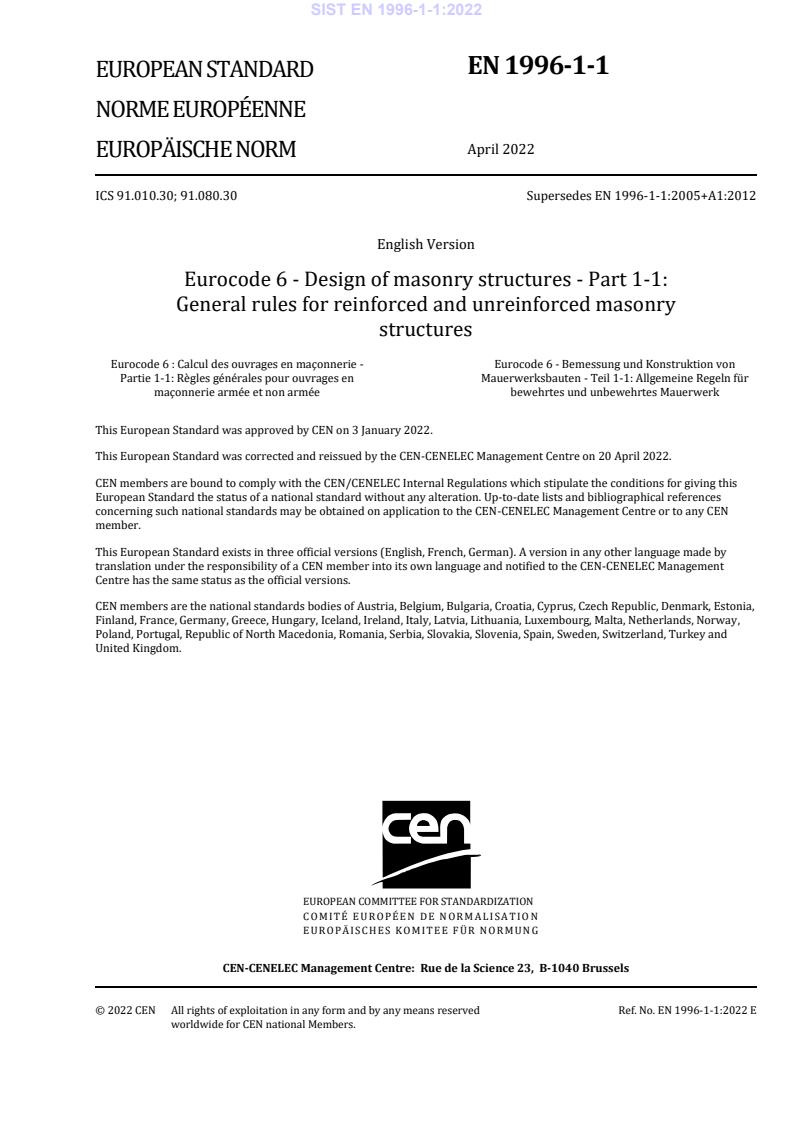
EUROPEAN STANDARD
NORME EUROPÉENNE
April 2022
EUROPÄISCHE NORM
ICS 91.010.30; 91.080.30 Supersedes EN 1996-1-1:2005+A1:2012
English Version
Eurocode 6 - Design of masonry structures - Part 1-1:
General rules for reinforced and unreinforced masonry
structures
Eurocode 6 : Calcul des ouvrages en maçonnerie - Eurocode 6 - Bemessung und Konstruktion von
Partie 1-1: Règles générales pour ouvrages en Mauerwerksbauten - Teil 1-1: Allgemeine Regeln für
maçonnerie armée et non armée bewehrtes und unbewehrtes Mauerwerk
This European Standard was approved by CEN on 3 January 2022.
This European Standard was corrected and reissued by the CEN-CENELEC Management Centre on 20 April 2022.
CEN members are bound to comply with the CEN/CENELEC Internal Regulations which stipulate the conditions for giving this
European Standard the status of a national standard without any alteration. Up-to-date lists and bibliographical references
concerning such national standards may be obtained on application to the CEN-CENELEC Management Centre or to any CEN
member.
This European Standard exists in three official versions (English, French, German). A version in any other language made by
translation under the responsibility of a CEN member into its own language and notified to the CEN-CENELEC Management
Centre has the same status as the official versions.
CEN members are the national standards bodies of Austria, Belgium, Bulgaria, Croatia, Cyprus, Czech Republic, Denmark, Estonia,
Finland, France, Germany, Greece, Hungary, Iceland, Ireland, Italy, Latvia, Lithuania, Luxembourg, Malta, Netherlands, Norway,
Poland, Portugal, Republic of North Macedonia, Romania, Serbia, Slovakia, Slovenia, Spain, Sweden, Switzerland, Turkey and
United Kingdom.
EUROPEAN COMMITTEE FOR STANDARDIZATION
C O M I T É E U R O P É E N D E N O R M A L I S A T I O N
E U R O P Ä I S C H E S K O M I T E E F Ü R N O R M U N G
CEN-CENELEC Management Centre: Rue de la Science 23, B-1040 Brussels
© 2022 CEN All rights of exploitation in any form and by any means reserved Ref. No. EN 1996-1-1:2022 E
worldwide for CEN national Members.
SIST EN 1996-1-1:2022
Contents Page
European foreword . 5
Introduction . 6
1 Scope . 8
2 Normative references . 8
3 Terms, definitions and symbols . 10
3.1 Terms and definitions . 10
3.2 Symbols . 17
4 Basis of design . 23
4.1 General rules . 23
4.2 Principles of limit state design . 23
4.3 Basic variables . 23
4.4 Verification by the partial factor method . 23
4.5 Design assisted by testing . 25
5 Materials . 25
5.1 Masonry units . 25
5.2 Mortar . 27
5.3 Concrete infill . 27
5.4 Steel reinforcement . 28
5.5 Prestressing systems . 28
5.6 Ancillary components . 29
5.7 Mechanical properties of masonry . 29
5.8 Deformation properties of masonry . 38
6 Durability . 41
6.1 General . 41
6.2 Classification of environmental conditions . 41
6.3 Durability of masonry . 41
6.4 Masonry below ground . 44
7 Structural analysis . 44
7.1 General . 44
7.2 Structural behaviour in accidental situations (other than fire) . 44
7.3 Imperfections . 45
7.4 Second order effects . 45
7.5 Analysis of structural members . 46
8 Ultimate limit states . 58
8.1 General . 58
8.2 Verification of unreinforced masonry walls subjected to mainly vertical loading . 58
8.3 Verification of unreinforced masonry walls subjected to combined vertical and
horizontal loading in the plane of the wall . 64
8.4 Verification of unreinforced masonry walls subjected to mainly lateral loading . 65
8.5 Verification of unreinforced masonry walls subjected to combined vertical and
lateral loading . 68
8.6 Ties . 69
8.7 Verification of reinforced masonry members subjected to bending, bending and
axial loading, or axial loading . 70
SIST EN 1996-1-1:2022
8.8 Verification of reinforced masonry members subjected to shear loading . 79
8.9 Prestressed masonry . 82
8.10 Confined masonry. 83
9 Serviceability limit states . 86
9.1 General . 86
9.2 Unreinforced masonry walls . 86
9.3 Reinforced masonry members . 87
9.4 Prestressed masonry members . 87
9.5 Confined masonry members . 87
9.6 Walls subjected to concentrated loads . 87
10 Detailing . 88
10.1 Masonry details . 88
10.2 Reinforcement details . 89
10.3 Prestressing details . 95
10.4 Confined masonry details . 95
10.5 Connection of walls . 95
10.6 Chases and recesses on walls . 97
10.7 Damp proof courses . 99
10.8 Thermal and long term movement . 99
11 Execution . 99
11.1 General . 99
11.2 Design of structural members. 99
11.3 Loading of masonry. 99
Annex A (informative) Consideration of partial factor for materials relating to execution . 100
A.1 Use of this Informative Annex . 100
A.2 Scope and field of application . 100
A.3 General . 100
Annex B (informative) Method for calculating the second order effect . 102
B.1 Use of this Informative Annex . 102
B.2 Scope and field of application . 102
B.3 Total moment including second order effects . 102
Annex C (informative) Simplified methods for calculating the out-of-plane eccentricity of
loading on walls. 104
C.1 Use of this Informative Annex . 104
C.2 Scope and field of application . 104
C.3 Eccentricity with reinforced concrete floors . 104
C.4 Eccentricity with timber floors . 109
Annex D (informative) Bending moment coefficients, α , in single leaf laterally loaded wall
panels . 111
D.1 Use of this Informative Annex . 111
D.2 Scope and field of application . 111
SIST EN 1996-1-1:2022
Annex E (informative) Limiting height and length to thickness ratios for unreinforced walls
and walls with only bed joint reinforcement under the serviceability limit state . 118
E.1 Use of this Informative Annex . 118
E.2 Scope and field of application . 118
E.3 Limiting height and length to thickness ratios . 118
Annex F (informative) Capacity reduction factor for slenderness and eccentricity . 121
F.1 Use of this Informative Annex . 121
F.2 Scope and field of application . 121
F.3 Reduction factor Φ for masonry walls subjected to mainly vertical loading
m
(expressed as a function of eccentricity) . 121
F.4 Reduction factor Φ for masonry walls subjected to combined vertical and lateral
M
loading (expressed as a function of normal load ratio) . 122
Annex G (informative) Adjustment of lateral load for walls supported on three or four
edges subjected to out-of-plane horizontal loading and vertical loading . 125
G.1 Use of this Informative Annex . 125
G.2 Scope and field of application . 125
G.3 Calculation of the reduction factor for the lateral load . 125
Annex H (informative) Reinforced masonry members subjected to shear loading:
enhancement of the design shear strength of masonry, f . 126
vd
H.1 Use of this Informative Annex . 126
H.2 Scope and field of application . 126
H.3 Calculation of the design shear strength of masonry, f . 126
vd
Annex I (informative) A design method for complex shaped members subjected to mainly
vertical loading . 127
I.1 Use of this Informative Annex . 127
I.2 Scope and field of application . 127
I.3 Design of complex shaped members . 128
Annex J (informative) Method for walls under combined lateral and vertical loading taking
buckling due to vertical loading and flexural strength into account . 133
J.1 Use of this Informative Annex . 133
J.2 Scope and field of application . 133
J.3 Verifications . 133
Annex K (informative) Mean material properties . 134
K.1 Use of this Informative Annex . 134
K.2 Scope and field of application . 134
K.3 Mechanical properties of masonry . 134
K.4 Deformation properties of masonry . 136
Bibliography . 137
SIST EN 1996-1-1:2022
European foreword
This document (EN 1996-1-1:2022) has been prepared by Technical Committee CEN/TC 250 “Structural
Eurocodes”, the secretariat of which is held by BSI. CEN/TC 250 is responsible for all Structural
Eurocodes and has been assigned responsibility for structural and geotechnical design matters by CEN.
This European Standard shall be given the status of a national standard, either by publication of an
identical text or by endorsement, at the latest by September 2027, and conflicting national standards shall
be withdrawn at the latest by March 2028.
Attention is drawn to the possibility that some of the elements of this document may be the subject of
patent rights. CEN shall not be held responsible for identifying any or all such patent rights.
This document supersedes EN 1996-1-1:2005+A1:2012.
The first generation of EN Eurocodes was published between 2002 and 2007. This document forms part
of the second generation of the Eurocodes, which have been prepared under a Mandate M/515 given to
CEN by the European Commission and the European Free Trade Association.
The Eurocodes have been drafted to be used in conjunction with relevant execution, material, product
and test standards, and to identify requirements for execution, materials, products and testing that are
relied upon by the Eurocodes.
The main changes compared to the previous edition are listed below:
— improvement of the verification of combined loading;
— improvement of the capacity reduction factor for slenderness and eccentricity;
— addition of the out-of-plane shear friction coefficient;
— addition of rules for confined masonry;
— addition of informative annexes for complex shapes and mean material properties.
The Eurocodes recognize the responsibility of each Member State and have safeguarded their right to
determine values related to regulatory safety matters at national level through the use of National
Annexes.
Any feedback and questions on this document should be directed to the users’ national standards body.
A complete listing of these bodies can be found on the CEN website.
According to the CEN-CENELEC Internal Regulations, the national standards organisations of the
following countries are bound to implement this European Standard: Austria, Belgium, Bulgaria, Croatia,
Cyprus, Czech Republic, Denmark, Estonia, Finland, France, Germany, Greece, Hungary, Iceland, Ireland,
Italy, Latvia, Lithuania, Luxembourg, Malta, Netherlands, Norway, Poland, Portugal, Republic of North
Macedonia, Romania, Serbia, Slovakia, Slovenia, Spain, Sweden, Switzerland, Turkey and the United
Kingdom.
SIST EN 1996-1-1:2022
0 Introduction
0.1 Introduction to the Eurocodes
The Structural Eurocodes comprise the following standards generally consisting of a number of Parts:
— EN 1990 Eurocode: Basis of structural and geotechnical design
— EN 1991 Eurocode 1: Actions on structures
— EN 1992 Eurocode 2: Design of concrete structures
— EN 1993 Eurocode 3: Design of steel structures
— EN 1994 Eurocode 4: Design of composite steel and concrete structures
— EN 1995 Eurocode 5: Design of timber structures
— EN 1996 Eurocode 6: Design of masonry structures
— EN 1997 Eurocode 7: Geotechnical design
— EN 1998 Eurocode 8: Design of structures for earthquake resistance
— EN 1999 Eurocode 9: Design of aluminium structures
The Eurocodes are intended for use by designers, clients, manufacturers, constructors, relevant
authorities (in exercising their duties in accordance with national or international regulations),
educators, soft-ware developers, and committees drafting standards for related product, testing and
execution standards.
NOTE Some aspects of design are most appropriately specified by relevant authorities or, where not specified,
can be agreed on a project-specific basis between relevant parties such as designers and clients. The Eurocodes
identify such aspects making explicit reference to relevant authorities and relevant parties.
0.2 Introduction to EN 1996 Eurocode 6
EN 1996 Eurocode 6 standards apply to the design of building and civil engineering works, or parts
thereof, in unreinforced, reinforced, prestressed and confined masonry.
EN 1996 (all parts) deal only with the requirements for resistance, serviceability and durability of
structures. Other requirements, for example, concerning thermal or sound insulation, are not considered.
EN 1996 (all parts) do not cover the specific requirements of seismic design. Provisions related to such
requirements are given in EN 1998 (all parts), which complements, and is consistent with EN 1996 (all
parts).
EN 1996 (all parts) do not cover numerical values of the actions on building and civil engineering works
to be taken into account in the design. They are provided in EN 1991(all parts).
0.3 Introduction to EN 1996-1-1
For the design of new structures, EN 1996-1-1 is intended to be used, for direct application, together with
the other Eurocodes where applicable.
SIST EN 1996-1-1:2022
0.4 Verbal forms used in the Eurocodes
The verb “shall" expresses a requirement strictly to be followed and from which no deviation is permitted
in order to comply with the Eurocodes.
The verb “should” expresses a highly recommended choice or course of action. Subject to national
regulation and/or any relevant contractual provisions, alternative approaches could be used/adopted
where technically justified.
The verb “may" expresses a course of action permissible within the limits of the Eurocodes.
The verb “can" expresses possibility and capability; it is used for statements of fact and clarification of
concepts.
0.5 National Annex for EN 1996-1-1
National choice is allowed in this standard where explicitly stated within notes. National choice includes
the selection of values for Nationally Determined Parameters (NDPs).
The national standard implementing EN 1996-1-1 can have a National Annex containing all national
choices to be used for the design of buildings and civil engineering works to be constructed in the relevant
country.
When no national choice is given, the default choice given in this standard is to be used.
When no national choice is made and no default is given in this standard, the choice can be specified by a
relevant authority or, where not specified, agreed for a specific project by appropriate parties.
National choice is allowed in EN 1996-1-1 through notes to the following:
4.4.4(2) 5.2.2(2) 5.7.1.2(1) 5.7.1.3(2)
5.7.2.1(1) 5.7.2.1(2) 5.7.2.2(4) 5.7.4(4) – 3 choices
5.8.2(3) 5.8.4(3) 6.3.3(2) 6.3.3(3)
7.5.1.4(4) 8.3.1(2) 8.10.3.1(2) 10.1.2(2)
10.5.2.2(2) 10.5.2.3(2) 10.6.2(1) 10.6.3(1)
National choice is allowed in EN 1996-1-1 on the application of the following informative annexes:
Annex A Annex B Annex C Annex D
Annex E Annex F Annex G Annex H
Annex I Annex J Annex K
The National Annex can contain, directly or by reference, non-contradictory complementary information
for ease of implementation, provided it does not alter any provisions of the Eurocodes.
SIST EN 1996-1-1:2022
1 Scope
1.1 Scope of EN 1996-1-1
(1) The basis for the design of building and civil engineering works in masonry is given in this document,
which deals with unreinforced masonry, reinforced masonry and confined masonry. Principles for the
design of prestressed masonry are also given.
(2) This document is not valid for masonry elements with a plan area of less than 0,04 m .
(3) Reinforced masonry and confined masonry built with Group 4 units and subjected to mainly vertical
loading are not covered by this document.
(4) This document gives detailed rules which are mainly applicable to ordinary buildings. The
applicability of these rules can be limited, for practical reasons or due to simplifications; any limits of
applicability are given in the text where necessary.
(5) Execution is covered to the extent that is necessary to indicate the quality of the construction
materials and products that are to be used and the standard of workmanship on site needed to comply
with the assumptions made in the design rules.
(6) For those types of structures not covered entirely, for new structural uses for established materials,
for new materials, or where actions and other influences outside normal experience have to be resisted,
the provisions given in this document can be applied, but with possible need for supplements.
(7) This document does not cover:
— resistance to fire (which is dealt with in EN 1996-1-2);
— particular aspects of special types of building (for example, dynamic effects on tall buildings);
— particular aspects of special types of civil engineering works (such as masonry bridges, dams,
chimneys or liquid-retaining structures);
— particular aspects of special types of structures (such as arches or domes);
— masonry where gypsum, with or without cement, mortars are used;
— masonry where the units are not laid in a regular pattern of courses (rubble masonry);
— masonry reinforced with other materials than steel.
1.2 Assumptions
(1) The assumptions of EN 1990 apply to this document.
2 Normative references
The following documents are referred to in the text in such a way that some or all of their content
constitutes requirements of this document. For dated references, only the edition cited applies. For
undated references, the latest edition of the referenced document (including any amendments) applies.
NOTE See the Bibliography for a list of other documents cited that are not normative references, including
those referenced as recommendations (i.e. in ‘should’ clauses), permissions (‘may’ clauses), possibilities ('can'
clauses), and in notes.
EN 206, Concrete. Specification, performance, production and conformity
EN 771-1, Specification for masonry units - Part 1: Clay masonry units
SIST EN 1996-1-1:2022
EN 771-2, Specification for masonry units - Part 2: Calcium silicate masonry units
EN 771-3, Specification for masonry units - Part 3: Aggregate concrete masonry units (Dense and
lightweight aggregates)
EN 771-4, Specification for masonry units - Part 4: Autoclaved aerated concrete masonry units
EN 771-5, Specification for masonry units - Part 5: Manufactured stone masonry units
EN 771-6, Specification for masonry units - Part 6: Natural stone masonry units
EN 845-1, Specification for ancillary components for masonry - Part 1: Ties, tension straps, hangers and
brackets
EN 845-2, Specification for ancillary components for masonry - Part 2: Lintels
EN 845-3, Specification for ancillary components for masonry - Part 3: Bed joint reinforcement of steel
meshwork
EN 998-1, Specification for mortar for masonry - Part 1: Rendering and plastering mortar
EN 998-2, Specification for mortar for masonry - Part 2: Masonry mortar
EN 1015-11, Methods of test for mortar for masonry - Part 11: Determination of flexural and compressive
strength of hardened mortar
EN 1052-1, Methods of test for masonry - Part 1: Determination of compressive strength
EN 1052-2, Methods of test for masonry - Part 2: Determination of flexural strength
EN 1052-3, Methods of test for masonry - Part 3: Determination of initial shear strength
EN 1052-4, Methods of test for masonry - Part 4: Determination of shear strength including damp proof
course
EN 1052-5, Methods of test for masonry - Part 5: Determination of bond strength by the bond wrench
method
EN 1990, Eurocode - Basis of structural and geotechnical design
EN 1991 (all parts), Eurocode 1 - Actions on structures
EN 1992-1-1, Eurocode 2: Design of concrete structures - Part 1-1: General rules - Rules for buildings,
bridges and civil engineering structures
EN 1996-2, Eurocode 6 - Design of masonry structures - Part 2: Design considerations, selection of materials
and execution of masonry
SIST EN 1996-1-1:2022
3 Terms, definitions and symbols
3.1 Terms and definitions
For the purposes of this document, the terms and definitions given in EN 1990 and the following apply.
3.1.1 Terms relating to masonry
3.1.1.1
masonry
assemblage of masonry units joined together with mortar
3.1.1.2
unreinforced masonry
masonry not containing sufficient reinforcement so as to be considered as reinforced masonry
3.1.1.3
reinforced masonry
masonry in which bars of reinforcing steel or bed joint reinforcement are embedded in mortar or
concrete so that all the materials act together in resisting action effects
3.1.1.4
prestressed masonry
masonry in which internal compressive stresses have been intentionally induced by tensioned
prestressing steel
3.1.1.5
confined masonry
masonry provided with reinforced concrete or reinforced masonry confining elements in the vertical (tie-
column) and horizontal (tie-beam) direction, so that all materials act compositely in resisting action
effects
3.1.1.6
masonry bond
disposition of units in masonry in a regular pattern to achieve common action
3.1.2 Terms relating to strength of masonry
3.1.2.1
characteristic strength of masonry
value of the strength of masonry having a prescribed probability of 5 % of not being attained in a
hypothetically unlimited test series
Note 1 to entry: This value generally corresponds to a specified fractile of the assumed statistical distribution of
the particular property of the material or product in a test series.
3.1.2.2
compressive strength of masonry
strength of masonry in compression without the effects of platen restraint, slenderness or eccentricity of
loading
3.1.2.3
shear strength of masonry
strength of masonry in shear
SIST EN 1996-1-1:2022
3.1.2.4
flexural strength of masonry
out-of-plane strength of masonry in bending
3.1.2.5
anchorage bond strength
bond strength, per unit surface area, between reinforcement and concrete or mortar, when the
reinforcement is subjected to tensile or compressive forces
3.1.2.6
adhesion
effect of mortar developing a tensile and shear resistance at the contact surface of masonry units
3.1.3 Terms relating to masonry units
3.1.3.1
masonry unit
preformed component, intended for use in masonry construction
3.1.3.2
group 1, 1S, 2, 3 and 4 masonry units
group designations for masonry units, including geometrical requirements, such as the percentage size
and orientation of holes in the units when laid
3.1.3.3
bed face
top or bottom surface of a masonry unit when laid as intended
3.1.3.4
frog
depression, formed during manufacture, in one or both bed faces of a masonry unit
3.1.3.5
hole
formed void which may or may not pass completely through a masonry unit
3.1.3.6
griphole
formed void in a masonry unit to enable it to be more readily grasped and lifted with one or both hands
or by machine
3.1.3.7
web
solid material between the holes in a masonry unit
3.1.3.8
shell
peripheral material between a hole and the face of a masonry unit
3.1.3.9
gross area
area of a cross-section through the unit without reduction for the area of holes, voids and re-entrants
SIST EN 1996-1-1:2022
3.1.3.10
compressive strength of masonry units
mean compressive strength of a specified number of masonry units
3.1.3.11
normalized compressive strength of masonry units
compressive strength of masonry units converted to the air-dried compressive strength of an equivalent
100 mm wide x 100 mm high masonry unit (see EN 771-1 to EN 771-6)
3.1.4 Terms relating to concrete infill
3.1.4.1
concrete infill
concrete used to fill pre-formed cavities or voids in masonry
3.1.5 Terms relating to reinforcement
3.1.5.1
reinforcing steel
steel reinforcement bars for use in masonry
3.1.5.2
bed joint reinforcement
reinforcing steel that is prefabricated for building into a bed joint
3.1.5.3
prestressing steel
steel wires, bars or strands for use in masonry
3.1.6 Terms relating to ancillary components
3.1.6.1
damp proof course
layer of sheeting, masonry units or other material used in masonry to resist the passage of water
3.1.6.2
wall tie
device for connecting one leaf to another leaf or to a framed structure or backing wall
3.1.6.3
strap
device for connecting masonry members to other adjacent components, such as floors and roofs
3.1.6.4
composite lintel
lintel comprising a prefabricated part and a complementary element of in-situ masonry, above, acting
together
3.1.7 Terms relating to mortar joints
3.1.7.1
bed joint
mortar layer between the bed faces of masonry units
SIST EN 1996-1-1:2022
3.1.7.2
perpend joint (head joint)
mortar joint perpendicular to the bed joint and to the face of the wall
3.1.7.3
longitudinal joint
vertical mortar joint within the thickness of a wall, parallel to the face of the wall
3.1.7.4
thin layer joint
joint made with thin layer mortar
3.1.7.5
jointing
process of finishing a mortar joint as the work proceeds
3.1.7.6
pointing
process of filling and finishing mortar joints where the surface of the joint has been raked out or left open
for pointing
3.1.8 Terms relating to mortar
3.1.8.1
masonry mortar
mixture of one or more inorganic binders, aggregates and water, and sometimes additions and/or
admixtures, for bedding, jointing and pointing of masonry
3.1.8.2
general purpose masonry mortar
masonry mortar without special characteristics
3.1.8.3
thin layer masonry mortar
designed masonry mortar with a maximum aggregate size less than or equal to a prescribed figure
3.1.8.4
lightweight masonry mortar
designed masonry mortar with a dry hardened density equal to or below 1 300 kg/m according to
EN 998-2
3.1.8.5
designed masonry mortar
mortar whose composition and manufacturing method is chosen in order to achieve specified properties
(performance concept)
3.1.8.6
prescribed masonry mortar
mortar made in predetermined proportions, the properties of which are assumed from the stated
proportions of the constituents (recipe concept)
3.1.8.7
factory made masonry mortar
mortar batched and mixed in a factory
SIST EN 1996-1-1:2022
3.1.8.8
semi-finished factory made masonry mortar
prebatched masonry mortar or a premixed lime and sand masonry mortar
3.1.8.9
prebatched masonry mortar
mortar whose constituents are wholly batched in a factory, supplied to the building site and mixed there
according to the manufacturers' specification and conditions
3.1.8.10
premixed lime sand masonry mortar
mortar whose constituents are wholly batched and mixed in a factory, supplied to the building site, where
further constituents specified or provided by the factory are added (e.g. cement) and mixed with the lime
and sand
3.1.8.11
site-made mortar
mortar composed of individual constituents batched and mixed on the building site
3.1.8.12
compressive strength of mortar
mean compressive strength of a specified number of mortar specimens after curing for 28 days (see
EN 1015-11)
3.1.9 Terms relating to wall types
3.1.9.1
loadbearing wall
wall primarily designed to carry an imposed load in addition to its own weight
3.1.9.2
single-leaf wall
wall without a cavity or continuous vertical joint in its plane
3.1.9.3
cavity wall
wall consisting of two parallel single-leaf walls, effectively tied together with wall ties or bed joint
reinforcement
Note 1 to entry: The space between the leaves is left as a continuous cavity or filled or partially filled with non-
loadbearing thermal insulating material.
Note 2 to entry: A wall consisting of two leaves separated by a cavity, where one of the leaves is not contributing
to the resistance or stiffness of the other (possibly loadbearing) leaf, is to be regarded as a veneer wall.
3.1.9.4
double-leaf wall
wall consisting of two parallel leaves with the longitudinal joint between filled solidly with mortar and
securely tied together with wall ties or bed joint reinforcement so as to result in common action under
load
SIST EN 1996-1-1:2022
3.1.9.5
collar jointed wall
wall consisting of two parallel leaves with an unfilled longitudinal joint, spaced not more than 25 mm
apart and securely tied together with wall ties or bed joint reinforcement so as to result in common action
under load
3.1.9.6
grouted cavity wall
wall consisting of two parallel leaves with the cavity filled with concrete or grout and securely tied
together with wall ties or bed joint reinforcement so as to result in common action under load
3.1.9.7
faced wall
wall with facing units bonded to backing units so as to result in common action under load
3.1.9.8
shell bedded wall
wall in which the masonry units are bedded on two or more strips of mortar two of which are at the
outside edges of the bed face of the units
3.1.9.9
veneer wall
wall used as a facing but not bonded or contributing to the resistance of the backing wall or framed
structure
3.1.9.10
shear wall
wall to resist horizontal forces in its plane
3.1.9.11
spandrel wall
the part of a wall between the top of a window and the sill of the window above, or other similar part
3.1.9.12
stiffening wall
wall set perpendicular to another wall to give it support against horizontal forces or to resist buckling
3.1.9.13
non-loadbearing wall
wall not considered to resist forces such that it can be removed without prejudicing the remaining
integrity of the structure
3.1.9.14
complex shaped section
wall with a cross-section of any shape requiring additional rules (e.g. Annex I) to design as a single section
SIST EN 1996-1-1:2022
3.1.10 Miscellaneous terms
3.1.10.1
chase
channel formed in masonry
3.1.10.2
recess
indentation formed in the face of a wall
3.1.10.3
grout
pourable mixture of cement, sand and water, and additions and/or admixtures as required, for filling
small voids or spaces
3.1.10.4
movement joint
joint permitting free movement in the plane of the wall
3.1.10.5
built-in length
length declared by the manufacturer of the prefabricated part needed to anchor the reinforcing bars,
according to EN 845-2
3.1.10.6
tie-column
reinforced concrete element, or masonry element with internal reinforcement, to act as a confining
element of a masonry wall in the vertical direction
3.1.10.7
tie-beam
reinforced concrete element, or masonry element with internal reinforcement, to act as a confining
element of a masonry wall in the horizontal direction
3.1.10.8
equivalent cross-section
rectangular section with a thickness, t , derived from the properties of a complex section
ef
3.1.10.9
deep beam
vertically loa
...
Questions, Comments and Discussion
Ask us and Technical Secretary will try to provide an answer. You can facilitate discussion about the standard in here.