


SIST EN 50131-1:2007/A3:2020
(Amendment)Alarm systems - Intrusion and hold-up systems - Part 1: System requirements
Alarm systems - Intrusion and hold-up systems - Part 1: System requirements
This European Standard specifies the requirements for Intrusion and Hold-up Alarm Systems installed in buildings using
specific or non-specific wired interconnections or wire-free interconnections. These requirements also apply to the
components of an I&HAS installed in a building which are normally mounted on the external structure of a building e.g.
ancillary control equipment or warning devices. The standard does not include requirements for exterior I&HAS.
This standard specifies performance requirements for installed I&HAS but does not include requirements for design,
planning, installation, operation or maintenance.
These requirements also apply to I&HAS sharing means of detection, triggering, interconnection, control, communication and power supplies with other applications. The functioning of an I&HAS shall not be adversely influenced by other applications.
Requirements are specified for I&HAS components where the relevant environment is classified. This classification describes the environment in which an I&HAS component may be expected to function as designed. When the requirements of the four environmental classes are inadequate, due to the extreme conditions experienced in certain geographic locations, special national conditions are given in Annex A. General environmental requirements for I&HAS components are described in Clause 7.
The requirements of this European Standard also apply to IAS and HAS when these systems are installed independently.
When an I&HAS does not include functions relating to the detection of intruders, the requirements relating to intrusion detection do not apply.
When an I&HAS does not include functions relating to hold-up, the requirements relating to hold-up do not apply.
NOTE Unless otherwise stated the abbreviation I&HAS is intended to also mean IAS and HAS.
Alarmanlagen - Einbruch- und Überfallmeldeanlagen - Teil 1: Systemanforderungen
Systèmes d'alarme - Systèmes d'alarme contre lintrusion et les hold-up - Partie 1: Exigences système
[Not available]
Alarmni sistemi - Sistemi za javljanje vloma in ropa - 1. del: Sistemske zahteve - Dopolnilo A3
General Information
- Status
- Published
- Publication Date
- 19-Jul-2020
- Technical Committee
- EAL - Alarm systems
- Current Stage
- 6060 - National Implementation/Publication (Adopted Project)
- Start Date
- 07-Jul-2020
- Due Date
- 11-Sep-2020
- Completion Date
- 20-Jul-2020
Relations
- Amends
SIST EN 50131-1:2007 - Alarm systems - Intrusion and hold-up systems -- Part 1: System requirements - Effective Date
- 07-Jun-2022
Overview
SIST EN 50131-1:2007/A3:2020 is a comprehensive European Standard specifying system requirements for Intrusion and Hold-up Alarm Systems (I&HAS) installed in buildings. Published by the Committee for Electrotechnical Standardization (CLC), this amendment updates the 2006 edition to address modern security needs, including remote access and enhanced communication protocols.
The standard applies to alarm systems utilizing specified or non-specified wired interconnections and wire-free interconnections, including components mounted on the external structure of buildings such as control equipment or warning devices. It excludes requirements for exterior I&HAS and does not cover design, planning, installation, operation, or maintenance processes. SIST EN 50131-1:2007/A3:2020 ensures that I&HAS components perform reliably under classified environmental conditions and operate independently when sharing detection, triggering, control, communication, or power supply resources with other applications.
Key Topics
System Scope
EN 50131-1 covers intrusion detection and hold-up alarm functions separately. If an I&HAS lacks a detection function, related requirements do not apply, and vice versa. The standard uses the abbreviation I&HAS to include both Intrusion Alarm Systems (IAS) and Hold-up Alarm Systems (HAS).Definitions and Power Supply
Clarifications are provided for terms like principal prime power source (PPPS), supplementary prime power source, and alternative power source - typically a battery. It outlines minimum durations and recharge requirements for power sources based on system grades.Interconnections and Communication
The standard sets strict requirements for interconnection reliability, ensuring signals or messages are transmitted without delay, modification, substitution, or loss. It requires monitoring of interconnections, with maximum permissible downtime specified for each grade to maintain system integrity. Communication systems supporting remote user access must comply with Annex B.Remote Access Security
Annex B introduces normative requirements for remote access to I&HAS, aiming to protect systems from cyber-security threats. It mandates:- Unique identification and validation for remote users.
- Integrity and confidentiality of communication paths.
- Logging of failed access attempts.
- Mechanisms to disable remote access after invalid attempts.
- Assurance that remote sessions do not interfere with alarm functions.
Fault Recognition and Event Recording
The standard prescribes timely identification of faults, including prime power source faults and interconnection failures. Event recording requirements ensure comprehensive logs, including remote access actions, enabling audit and forensic security analysis.
Applications
SIST EN 50131-1:2007/A3:2020 is essential for stakeholders involved in installing and managing security alarm systems in various environments, such as:
- Commercial buildings requiring intrusion and hold-up alarm compliance to safeguard assets and personnel.
- Residential security systems, ensuring robust detection and alarm performance.
- Facility management seeking to integrate alarm systems with other building technologies without performance degradation.
- Alarm system manufacturers and designers, ensuring product compliance with European performance and safety standards.
- Security integrators and service providers implementing remote system access with mandated cybersecurity controls.
This standard supports enhanced safety and reliable alarm operation by prescribing rigorous performance and communication requirements, ensuring intrusion and hold-up alarms function effectively in buildings under diverse environmental conditions.
Related Standards
- EN 50131-3: Specifies requirements for control and indicating equipment (CIE and ACE) within I&HAS.
- EN 50131-5-3: Covers requirements for wireless interconnections in intrusion alarm systems.
- EN 50131-6: Defines power supply categories and related terminology for alarm systems.
- CLC/TS 50131-12:2016: Details methods and requirements for setting and unsetting Intruder Alarm Systems, including the coerciveness principle used for interconnection monitoring.
- EN 50136 Series: Addresses alarm transmission systems and their integration with alarm equipment.
- TS 50131-5-1 (in development): A technical specification focusing on wired interconnection requirements, complementing EN 50131-1’s interconnection clauses.
By aligning with these related standards, SIST EN 50131-1:2007/A3:2020 provides a foundational framework for secure and resilient intrusion and hold-up alarm systems in line with European legislation and industry best practices.
Keywords: EN 50131-1, intrusion alarm systems, hold-up alarm systems, alarm system standard, remote access security, interconnection monitoring, power supply requirements, CLC standards, alarm system performance, European alarm standards.



Frequently Asked Questions
SIST EN 50131-1:2007/A3:2020 is a amendment published by the Slovenian Institute for Standardization (SIST). Its full title is "Alarm systems - Intrusion and hold-up systems - Part 1: System requirements". This standard covers: This European Standard specifies the requirements for Intrusion and Hold-up Alarm Systems installed in buildings using specific or non-specific wired interconnections or wire-free interconnections. These requirements also apply to the components of an I&HAS installed in a building which are normally mounted on the external structure of a building e.g. ancillary control equipment or warning devices. The standard does not include requirements for exterior I&HAS. This standard specifies performance requirements for installed I&HAS but does not include requirements for design, planning, installation, operation or maintenance. These requirements also apply to I&HAS sharing means of detection, triggering, interconnection, control, communication and power supplies with other applications. The functioning of an I&HAS shall not be adversely influenced by other applications. Requirements are specified for I&HAS components where the relevant environment is classified. This classification describes the environment in which an I&HAS component may be expected to function as designed. When the requirements of the four environmental classes are inadequate, due to the extreme conditions experienced in certain geographic locations, special national conditions are given in Annex A. General environmental requirements for I&HAS components are described in Clause 7. The requirements of this European Standard also apply to IAS and HAS when these systems are installed independently. When an I&HAS does not include functions relating to the detection of intruders, the requirements relating to intrusion detection do not apply. When an I&HAS does not include functions relating to hold-up, the requirements relating to hold-up do not apply. NOTE Unless otherwise stated the abbreviation I&HAS is intended to also mean IAS and HAS.
This European Standard specifies the requirements for Intrusion and Hold-up Alarm Systems installed in buildings using specific or non-specific wired interconnections or wire-free interconnections. These requirements also apply to the components of an I&HAS installed in a building which are normally mounted on the external structure of a building e.g. ancillary control equipment or warning devices. The standard does not include requirements for exterior I&HAS. This standard specifies performance requirements for installed I&HAS but does not include requirements for design, planning, installation, operation or maintenance. These requirements also apply to I&HAS sharing means of detection, triggering, interconnection, control, communication and power supplies with other applications. The functioning of an I&HAS shall not be adversely influenced by other applications. Requirements are specified for I&HAS components where the relevant environment is classified. This classification describes the environment in which an I&HAS component may be expected to function as designed. When the requirements of the four environmental classes are inadequate, due to the extreme conditions experienced in certain geographic locations, special national conditions are given in Annex A. General environmental requirements for I&HAS components are described in Clause 7. The requirements of this European Standard also apply to IAS and HAS when these systems are installed independently. When an I&HAS does not include functions relating to the detection of intruders, the requirements relating to intrusion detection do not apply. When an I&HAS does not include functions relating to hold-up, the requirements relating to hold-up do not apply. NOTE Unless otherwise stated the abbreviation I&HAS is intended to also mean IAS and HAS.
SIST EN 50131-1:2007/A3:2020 is classified under the following ICS (International Classification for Standards) categories: 13.310 - Protection against crime; 13.320 - Alarm and warning systems. The ICS classification helps identify the subject area and facilitates finding related standards.
SIST EN 50131-1:2007/A3:2020 has the following relationships with other standards: It is inter standard links to SIST EN 50131-1:2007. Understanding these relationships helps ensure you are using the most current and applicable version of the standard.
SIST EN 50131-1:2007/A3:2020 is associated with the following European legislation: EU Directives/Regulations: 2020-01-0063. When a standard is cited in the Official Journal of the European Union, products manufactured in conformity with it benefit from a presumption of conformity with the essential requirements of the corresponding EU directive or regulation.
SIST EN 50131-1:2007/A3:2020 is available in PDF format for immediate download after purchase. The document can be added to your cart and obtained through the secure checkout process. Digital delivery ensures instant access to the complete standard document.
Standards Content (Sample)
SLOVENSKI STANDARD
01-september-2020
Alarmni sistemi - Sistemi za javljanje vloma in ropa - 1. del: Sistemske zahteve -
Dopolnilo A3
Alarm systems - Intrusion and hold-up systems - Part 1: System requirements
Alarmanlagen - Einbruch- und Überfallmeldeanlagen - Teil 1: Systemanforderungen
Systèmes d'alarme - Systèmes d'alarme contre lintrusion et les hold-up - Partie 1:
Exigences système
Ta slovenski standard je istoveten z: EN 50131-1:2006/A3:2020
ICS:
13.310 Varstvo pred kriminalom Protection against crime
13.320 Alarmni in opozorilni sistemi Alarm and warning systems
2003-01.Slovenski inštitut za standardizacijo. Razmnoževanje celote ali delov tega standarda ni dovoljeno.
EUROPEAN STANDARD EN 50131-1:2006/A3
NORME EUROPÉENNE
EUROPÄISCHE NORM
June 2020
ICS 13.310
English Version
Alarm systems - Intrusion and hold-up systems - Part 1: System
requirements
Systèmes d'alarme - Systèmes d'alarme contre l'intrusion et Alarmanlagen - Einbruch- und Überfallmeldeanlagen - Teil
les hold-up - Partie 1: Exigences système 1: Systemanforderungen
This amendment A3 modifies the European Standard EN 50131-1:2006; it was approved by CENELEC on 2020-05-11. CENELEC
members are bound to comply with the CEN/CENELEC Internal Regulations which stipulate the conditions for giving this amendment the
status of a national standard without any alteration.
Up-to-date lists and bibliographical references concerning such national standards may be obtained on application to the CEN-CENELEC
Management Centre or to any CENELEC member.
This amendment exists in three official versions (English, French, German). A version in any other language made by translation under the
responsibility of a CENELEC member into its own language and notified to the CEN-CENELEC Management Centre has the same status as
the official versions.
CENELEC members are the national electrotechnical committees of Austria, Belgium, Bulgaria, Croatia, Cyprus, the Czech Republic,
Denmark, Estonia, Finland, France, Germany, Greece, Hungary, Iceland, Ireland, Italy, Latvia, Lithuania, Luxembourg, Malta, the
Netherlands, Norway, Poland, Portugal, Republic of North Macedonia, Romania, Serbia, Slovakia, Slovenia, Spain, Sweden, Switzerland,
Turkey and the United Kingdom.
European Committee for Electrotechnical Standardization
Comité Européen de Normalisation Electrotechnique
Europäisches Komitee für Elektrotechnische Normung
CEN-CENELEC Management Centre: Rue de la Science 23, B-1040 Brussels
© 2020 CENELEC All rights of exploitation in any form and by any means reserved worldwide for CENELEC Members.
Ref. No. EN 50131-1:2006/A3:2020 E
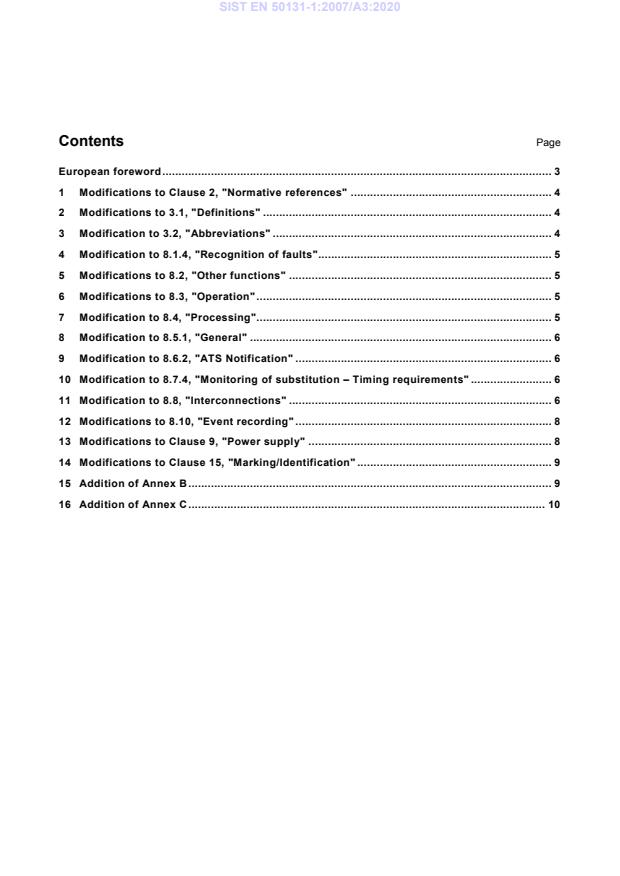
Contents Page
European foreword . 3
1 Modifications to Clause 2, "Normative references" . 4
2 Modifications to 3.1, "Definitions" . 4
3 Modification to 3.2, "Abbreviations" . 4
4 Modification to 8.1.4, "Recognition of faults" . 5
5 Modifications to 8.2, "Other functions" . 5
6 Modifications to 8.3, "Operation" . 5
7 Modification to 8.4, "Processing" . 5
8 Modification to 8.5.1, "General" . 6
9 Modification to 8.6.2, "ATS Notification" . 6
10 Modification to 8.7.4, "Monitoring of substitution – Timing requirements" . 6
11 Modification to 8.8, "Interconnections" . 6
12 Modifications to 8.10, "Event recording" . 8
13 Modifications to Clause 9, "Power supply" . 8
14 Modifications to Clause 15, "Marking/Identification" . 9
15 Addition of Annex B . 9
16 Addition of Annex C . 10
European foreword
This document (EN 50131-1:2006/A3:2020) has been prepared by CLC/TC 79 "Alarm systems".
The following dates are fixed:
• latest date by which this document has (dop) 2021-05-11
to be implemented at national level by
publication of an identical national
standard or by endorsement
• latest date by which the national (dow) 2023-05-11
standards conflicting with this document
have to be withdrawn
Attention is drawn to the possibility that some of the elements of this document may be the subject of patent
rights. CENELEC shall not be held responsible for identifying any or all such patent rights.
1 Modifications to Clause 2, "Normative references"
rd 1
Amend the 3 reference from "EN 50136-1 2012" to "EN 50136-1 2012 ".
Add the footnote to page "¹ As impacted by EN 50136-1:2012/A1:2018."
th
Delete the 4 reference (to EN 60073 2002).
Add the following reference:
"CLC/TS 50131-12 2016 Alarm systems — Intrusion and hold-up systems — Part 12: Methods and
requirements for setting and unsetting of Intruder Alarm Systems (IAS)".
2 Modifications to 3.1, "Definitions"
In definition 3.1.13 (alternative power source) add:
"Note 1 to entry: The alternative power source is typically a battery.".
Replace definition 3.1.16 (authorisation) by:
"permission for a user to gain access to the various control functions of an I&HAS".
Replace definition 3.1.55 by:
"3.1.55
prime power source
power source used to support an I&HAS under normal operating conditions
Note 1 to entry: For types A and B PS, the prime power source is equivalent to an external power source (EPS) as
defined in EN 50131-6:2017, 3.1.5; also see EN 50131-6:2017 Figure 2.
Note 2 to entry: For Type C PS the prime power source is derived from the PS storage device.".
Add the following term and definition:
"principal prime power source
energy source capable of supporting the I&HAS for extended periods
Note 1 to entry: The principal prime power source may be derived from, e.g. the public electricity (mains) supply or an
electricity supply independent of the public electricity supply.".
Delete definition 3.1.61 (significant reduction of range).
Replace definition 3.1.67 by:
"3.1.67
supplementary prime power source
energy source, independent of the PPPS, capable of supporting an I&HAS for extended periods, without
affecting the standby period of the alternate power source
Note 1 to entry: The supplementary prime power source may be derived from an electricity supply independent of the
public electricity supply, e.g. a generator.".
3 Modification to 3.2, "Abbreviations"
Add the following abbreviation:
PPPS - principal prime power source
4 Modification to 8.1.4, "Recognition of faults"
a
In Table 1, footnote :
Amend the reference from "EN 50136-1:2012" to "EN 50136-1:2012 ".
5 Modification to 8.2, "Other functions"
Delete subclause 8.2.2 (Movement detector range reduction).
6 Modifications to 8.3, "Operation"
rd
In 8.3 (Operation), add a 3 paragraph:
"The requirements of this clause apply irrespective of whether access to an I&HAS is performed directly at the
CIE/ACE or remotely."
In 8.3.1 (Access Levels), Replace NOTE by:
"NOTE 1 Access level 4 applies when changing the operating programme software without having activated a tamper
device on the CIE or ACE for example to provide cyber-security patches.".
th
Add below 4 paragraph (Access at level 4 shall be…):
"NOTE 2 This standard does not give requirements for the duration for which the permission to access the system at
access level 3 or 4 remains valid. Permitting remote access, particularly for extended periods, could result in contractual
liabilities.
Access at levels 2, 3 & 4 may be achieved remotely providing authorisation, equivalent to that specified in
Table 3, is achieved.".
th
Add below 5 paragraph (Access at levels 2, 3 & 4 may be achieved …):
"Communication systems used to support access for remote users shall comply with the requirements of
Annex B.".
In 8.3.2 (Authorisation), add below Table 3:
"At security grades 2, 3 and 4, repeated invalid authorization attempts shall be detected and/or restricted.".
In 8.3.5 (Prevention of setting), in Table 4:
Delete row 4, movement detector range reduction.
In 8.3.6 (Overriding prevention of setting), in Table 5:
Delete row 4, movement detector range reduction.
In 8.3.9 (Restoring), in Table 6:
Delete row 8, significant reduction of range.
7 Modification to 8.4, "Processing"
Delete 8.4.6 (Reduction of range signals or messages).
8 Modifications to 8.5.1, "General"
th
Replace 4 paragraph by:
"All mandatory indications required by this clause shall be located together in at least one CIE or ACE.
Duplicate indications may be provided at other locations. When access to the I&HAS is performed remotely all
mandatory indications shall be available to the remote user.".
Delete Note 3 and Note 4.
In Table 8, delete row 13, Range reduction.
9 Modification to 8.6.2, "ATS Notification"
nd
Replace 2 paragraph by:
"For PS Types A and B, notification of prime power source faults may be delayed for a maximum of 1 h.".
10 Modification to 8.7.4, "Monitoring of substitution – Timing requirements"
Replace Table 14 with:
"Table 14 — Monitoring of substitution – Timing
Monitoring requirements Grade 1 Grade 2 Grade 3 Grade 4
a
Substitution of I&HAS components – Maximum time before Op Op 100 s 10 s
detection
Key: Op = Optional.
a
When detection of substitution is included in grade of I&HAS.
".
11 Modifications to 8.8, "Interconnections"
Replace 8.8.1 by:
"8.8.1 General
Interconnections shall be suitable for the purpose and designed to provide a reliable means of communication
between I&HAS components.
Interconnections shall be designed to minimise the possibility of signals or messages being delayed, modified,
su
...
Questions, Comments and Discussion
Ask us and Technical Secretary will try to provide an answer. You can facilitate discussion about the standard in here.
Loading comments...