

SIST EN 303 659 V1.1.1:2025
(Main)Short Range Devices (SRD) in Data Networks - Radio equipment to be used in the frequency ranges 865 MHz to 868 MHz and 915 MHz to 919,4 MHz - Harmonised Standard for access to radio spectrum
General Information
- Abstract
The present document specifies technical characteristics and methods of measurements for Short Range Devices (SRD)
in data networks; radio equipment to be used in the frequency bands 865 MHz to 868 MHz and 915,0 MHz to
919,4 MHz.
The present document covers types of devices NAP, master NAP, NN and TN operating indoor and outdoor. These
types are specified in clause 4.2.2 together with related permitted e.r.p.
NOTE 1: The availability of the frequency bands in European Union and CEPT countries can be obtained from the
EFIS (https://efis.cept.org/) and is also listed in Appendices 1 and 3 of ERC/REC 70-03 [i.4].
NOTE 2: It should be noted that, in some countries, part or all of the band 915,0 MHz to 919,4 MHz may be
unavailable, for networked and/or network based short range devices. See National Radio Interfaces
(NRI) as relevant for additional guidance.
NOTE 3: For 25 mW equipment, 917,4 MHz to 919,4 MHz is the core harmonised band according to EC
DEC 2022/172 [i.5].
NOTE 4: The relationship between the present document and essential requirements of article 3.2 of Directive
2014/53/EU [i.2] is given in Annex A.
- Status
- Published
- Public Enquiry End Date
- 31-Jan-2025
- Publication Date
- 26-Feb-2025
- Technical Committee
- MOC - Mobile Communications
- Current Stage
- 6060 - National Implementation/Publication (Adopted Project)
- Start Date
- 26-Feb-2025
- Due Date
- 03-May-2025
- Completion Date
- 27-Feb-2025
- Directive
- 2014/53/EU - Directive 2014/53/EU of The European Parliament and of the Council of 16 April 2014 on the harmonisation of the laws of the Member States relating to the making available on the market of radio equipment and repealing Directive 1999/5/ECOJ Ref: 11.12.2025, L OJ Date: 11-Dec-2025
Buy Documents
ETSI EN 303 659 V1.0.0 (2024-11) - Short Range Devices (SRD) in Data Networks; Radio equipment to be used in the frequency ranges 865 MHz to 868 MHz and 915 MHz to 919,4 MHz; Harmonised Standard for access to radio spectrum
ETSI EN 303 659 V1.1.1 (2025-02) - Short Range Devices (SRD) in Data Networks; Radio equipment to be used in the frequency ranges 865 MHz to 868 MHz and 915 MHz to 919,4 MHz; Harmonised Standard for access to radio spectrum

Overview
SIST EN 303 659 V1.1.1:2025 is a harmonised European standard that specifies the technical characteristics and measurement methods for Short Range Devices (SRD) in data networks operating in the frequency ranges of 865 MHz to 868 MHz and 915 MHz to 919.4 MHz. Developed by the Slovenian Institute for Standardization (SIST), this standard aligns with European requirements for access to the radio spectrum and compliance with Directive 2014/53/EU (the Radio Equipment Directive).
This document covers various types of SRDs, including Network Access Points (NAP), master NAP, NN, and TN devices intended for both indoor and outdoor environments. It sets out the fundamental requirements for spectrum access and the permitted effective radiated power (e.r.p.) for each device type.
Key Topics
- Frequency Ranges: Defines use and technical requirements for radio equipment in 865-868 MHz and 915-919.4 MHz bands.
- Device Types: Covers operational criteria for NAP, master NAP, NN, and TN SRD devices for indoor and outdoor use.
- Spectrum Access: Establishes harmonised conditions enabling efficient use of spectrum with minimal interference.
- Technical Requirements:
- Environmental profiles and operating conditions
- Effective radiated power limits
- Unwanted emissions and spurious domain management
- Bandwidth occupation and adjacent channel power limits
- Transmitter and receiver conformance specifications
- Testing and Compliance:
- Methods of measurement for transmitter and receiver characteristics
- Specification of normal and extreme test conditions (temperature, humidity, power source)
- Presentation and selection of equipment under test (EUT)
- Legal and Market Access: Provides a basis for demonstrating compliance with Article 3.2 of Directive 2014/53/EU, key for CE marking and EU/EEA market circulation.
Applications
SIST EN 303 659 V1.1.1:2025 applies to a broad range of short range wireless devices in data networks. Primary applications include:
- IoT networks: Smart meters, environmental sensors, asset tracking, and industrial automation devices utilizing low-power, short range communication.
- Building Automation: Wireless control and monitoring systems in smart homes and smart buildings.
- Inventory and Supply Chain: SRDs for asset management, RFID applications, and logistics operations.
- Consumer Electronics: Home automation and wireless security systems that require reliable, interference-free operation.
- Health and Medical Devices: Short range communication for patient monitoring and medical telemetry.
- Outdoor and Rural Networking: Devices that utilize the specified frequencies and comply with harmonised standards for outdoor deployment.
Following this standard helps manufacturers ensure interoperability, safety, and regulatory compliance, facilitating access to European and CEPT markets.
Related Standards
- ETSI EN 303 659: The European reference standard harmonised across member states.
- Directive 2014/53/EU (RED): Essential EU legislation for radio equipment conformance and CE marking.
- ERC/REC 70-03: Recommendations for short range devices and updated information on frequency band availability.
- ETSI EN 300 220: Standard for radio equipment used in the 25 MHz to 1000 MHz range.
- EFIS (European Frequency Information System): Provides up-to-date information on frequency band allocations across the EU and CEPT countries.
Note: National Radio Interfaces (NRI) may impose additional restrictions, particularly within the 915–919.4 MHz band. Manufacturers and integrators must consult local regulations for each target market.
By adhering to SIST EN 303 659 V1.1.1:2025, organizations ensure their short range wireless equipment can be marketed and deployed efficiently across Europe, supporting robust and compliant data network solutions in critical frequency bands.
Buy Documents
ETSI EN 303 659 V1.0.0 (2024-11) - Short Range Devices (SRD) in Data Networks; Radio equipment to be used in the frequency ranges 865 MHz to 868 MHz and 915 MHz to 919,4 MHz; Harmonised Standard for access to radio spectrum
ETSI EN 303 659 V1.1.1 (2025-02) - Short Range Devices (SRD) in Data Networks; Radio equipment to be used in the frequency ranges 865 MHz to 868 MHz and 915 MHz to 919,4 MHz; Harmonised Standard for access to radio spectrum
Get Certified
Connect with accredited certification bodies for this standard

ANCE
Mexican certification and testing association.

Intertek Slovenia
Intertek testing, inspection, and certification services in Slovenia.

LNE (Laboratoire National de Métrologie et d'Essais)
French national laboratory for metrology and testing.
Sponsored listings
Frequently Asked Questions
SIST EN 303 659 V1.1.1:2025 is a standard published by the Slovenian Institute for Standardization (SIST). Its full title is "Short Range Devices (SRD) in Data Networks - Radio equipment to be used in the frequency ranges 865 MHz to 868 MHz and 915 MHz to 919,4 MHz - Harmonised Standard for access to radio spectrum". This standard covers: The present document specifies technical characteristics and methods of measurements for Short Range Devices (SRD) in data networks; radio equipment to be used in the frequency bands 865 MHz to 868 MHz and 915,0 MHz to 919,4 MHz. The present document covers types of devices NAP, master NAP, NN and TN operating indoor and outdoor. These types are specified in clause 4.2.2 together with related permitted e.r.p. NOTE 1: The availability of the frequency bands in European Union and CEPT countries can be obtained from the EFIS (https://efis.cept.org/) and is also listed in Appendices 1 and 3 of ERC/REC 70-03 [i.4]. NOTE 2: It should be noted that, in some countries, part or all of the band 915,0 MHz to 919,4 MHz may be unavailable, for networked and/or network based short range devices. See National Radio Interfaces (NRI) as relevant for additional guidance. NOTE 3: For 25 mW equipment, 917,4 MHz to 919,4 MHz is the core harmonised band according to EC DEC 2022/172 [i.5]. NOTE 4: The relationship between the present document and essential requirements of article 3.2 of Directive 2014/53/EU [i.2] is given in Annex A.
The present document specifies technical characteristics and methods of measurements for Short Range Devices (SRD) in data networks; radio equipment to be used in the frequency bands 865 MHz to 868 MHz and 915,0 MHz to 919,4 MHz. The present document covers types of devices NAP, master NAP, NN and TN operating indoor and outdoor. These types are specified in clause 4.2.2 together with related permitted e.r.p. NOTE 1: The availability of the frequency bands in European Union and CEPT countries can be obtained from the EFIS (https://efis.cept.org/) and is also listed in Appendices 1 and 3 of ERC/REC 70-03 [i.4]. NOTE 2: It should be noted that, in some countries, part or all of the band 915,0 MHz to 919,4 MHz may be unavailable, for networked and/or network based short range devices. See National Radio Interfaces (NRI) as relevant for additional guidance. NOTE 3: For 25 mW equipment, 917,4 MHz to 919,4 MHz is the core harmonised band according to EC DEC 2022/172 [i.5]. NOTE 4: The relationship between the present document and essential requirements of article 3.2 of Directive 2014/53/EU [i.2] is given in Annex A.
SIST EN 303 659 V1.1.1:2025 is classified under the following ICS (International Classification for Standards) categories: 33.060.01 - Radiocommunications in general. The ICS classification helps identify the subject area and facilitates finding related standards.
SIST EN 303 659 V1.1.1:2025 is associated with the following European legislation: EU Directives/Regulations: 2014/53/EU. When a standard is cited in the Official Journal of the European Union, products manufactured in conformity with it benefit from a presumption of conformity with the essential requirements of the corresponding EU directive or regulation.
SIST EN 303 659 V1.1.1:2025 is available in PDF format for immediate download after purchase. The document can be added to your cart and obtained through the secure checkout process. Digital delivery ensures instant access to the complete standard document.
Standards Content (Sample)
Draft ETSI EN 303 659 V1.0.0 (2024-11)
HARMONISED EUROPEAN STANDARD
Short Range Devices (SRD) in Data Networks;
Radio equipment to be used in the frequency ranges
865 MHz to 868 MHz and 915 MHz to 919,4 MHz;
Harmonised Standard for access to radio spectrum
2 Draft ETSI EN 303 659 V1.0.0 (2024-11)
Reference
DEN/ERM-TG28-561
Keywords
harmonised standard, radio, SRD
ETSI
650 Route des Lucioles
F-06921 Sophia Antipolis Cedex - FRANCE
Tel.: +33 4 92 94 42 00 Fax: +33 4 93 65 47 16
Siret N° 348 623 562 00017 - APE 7112B
Association à but non lucratif enregistrée à la
Sous-Préfecture de Grasse (06) N° w061004871
Important notice
The present document can be downloaded from the
ETSI Search & Browse Standards application.
The present document may be made available in electronic versions and/or in print. The content of any electronic and/or
print versions of the present document shall not be modified without the prior written authorization of ETSI. In case of any
existing or perceived difference in contents between such versions and/or in print, the prevailing version of an ETSI
deliverable is the one made publicly available in PDF format on ETSI deliver repository.
Users should be aware that the present document may be revised or have its status changed,
this information is available in the Milestones listing.
If you find errors in the present document, please send your comments to
the relevant service listed under Committee Support Staff.
If you find a security vulnerability in the present document, please report it through our
Coordinated Vulnerability Disclosure (CVD) program.
Notice of disclaimer & limitation of liability
The information provided in the present deliverable is directed solely to professionals who have the appropriate degree of
experience to understand and interpret its content in accordance with generally accepted engineering or
other professional standard and applicable regulations.
No recommendation as to products and services or vendors is made or should be implied.
In no event shall ETSI be held liable for loss of profits or any other incidental or consequential damages.
Any software contained in this deliverable is provided "AS IS" with no warranties, express or implied, including but not
limited to, the warranties of merchantability, fitness for a particular purpose and non-infringement of intellectual property
rights and ETSI shall not be held liable in any event for any damages whatsoever (including, without limitation, damages
for loss of profits, business interruption, loss of information, or any other pecuniary loss) arising out of or related to the use
of or inability to use the software.
Copyright Notification
No part may be reproduced or utilized in any form or by any means, electronic or mechanical, including photocopying and
microfilm except as authorized by written permission of ETSI.
The content of the PDF version shall not be modified without the written authorization of ETSI.
The copyright and the foregoing restriction extend to reproduction in all media.
© ETSI 2024.
All rights reserved.
ETSI
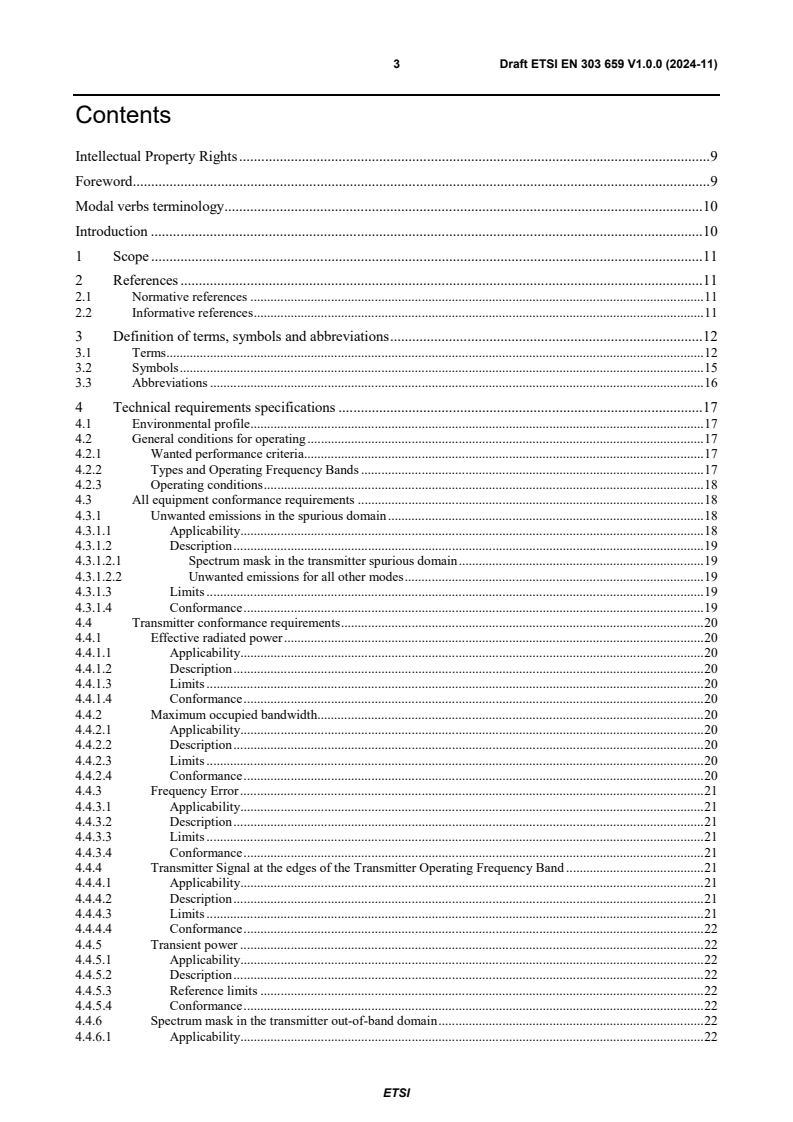
3 Draft ETSI EN 303 659 V1.0.0 (2024-11)
Contents
Intellectual Property Rights . 9
Foreword . 9
Modal verbs terminology . 10
Introduction . 10
1 Scope . 11
2 References . 11
2.1 Normative references . 11
2.2 Informative references . 11
3 Definition of terms, symbols and abbreviations . 12
3.1 Terms . 12
3.2 Symbols . 15
3.3 Abbreviations . 16
4 Technical requirements specifications . 17
4.1 Environmental profile . 17
4.2 General conditions for operating . 17
4.2.1 Wanted performance criteria. 17
4.2.2 Types and Operating Frequency Bands . 17
4.2.3 Operating conditions . 18
4.3 All equipment conformance requirements . 18
4.3.1 Unwanted emissions in the spurious domain . 18
4.3.1.1 Applicability. 18
4.3.1.2 Description . 19
4.3.1.2.1 Spectrum mask in the transmitter spurious domain . 19
4.3.1.2.2 Unwanted emissions for all other modes . 19
4.3.1.3 Limits . 19
4.3.1.4 Conformance . 19
4.4 Transmitter conformance requirements . 20
4.4.1 Effective radiated power . 20
4.4.1.1 Applicability. 20
4.4.1.2 Description . 20
4.4.1.3 Limits . 20
4.4.1.4 Conformance . 20
4.4.2 Maximum occupied bandwidth. 20
4.4.2.1 Applicability. 20
4.4.2.2 Description . 20
4.4.2.3 Limits . 20
4.4.2.4 Conformance . 20
4.4.3 Frequency Error . 21
4.4.3.1 Applicability. 21
4.4.3.2 Description . 21
4.4.3.3 Limits . 21
4.4.3.4 Conformance . 21
4.4.4 Transmitter Signal at the edges of the Transmitter Operating Frequency Band . 21
4.4.4.1 Applicability. 21
4.4.4.2 Description . 21
4.4.4.3 Limits . 21
4.4.4.4 Conformance . 22
4.4.5 Transient power . 22
4.4.5.1 Applicability. 22
4.4.5.2 Description . 22
4.4.5.3 Reference limits . 22
4.4.5.4 Conformance . 22
4.4.6 Spectrum mask in the transmitter out-of-band domain . 22
4.4.6.1 Applicability. 22
ETSI
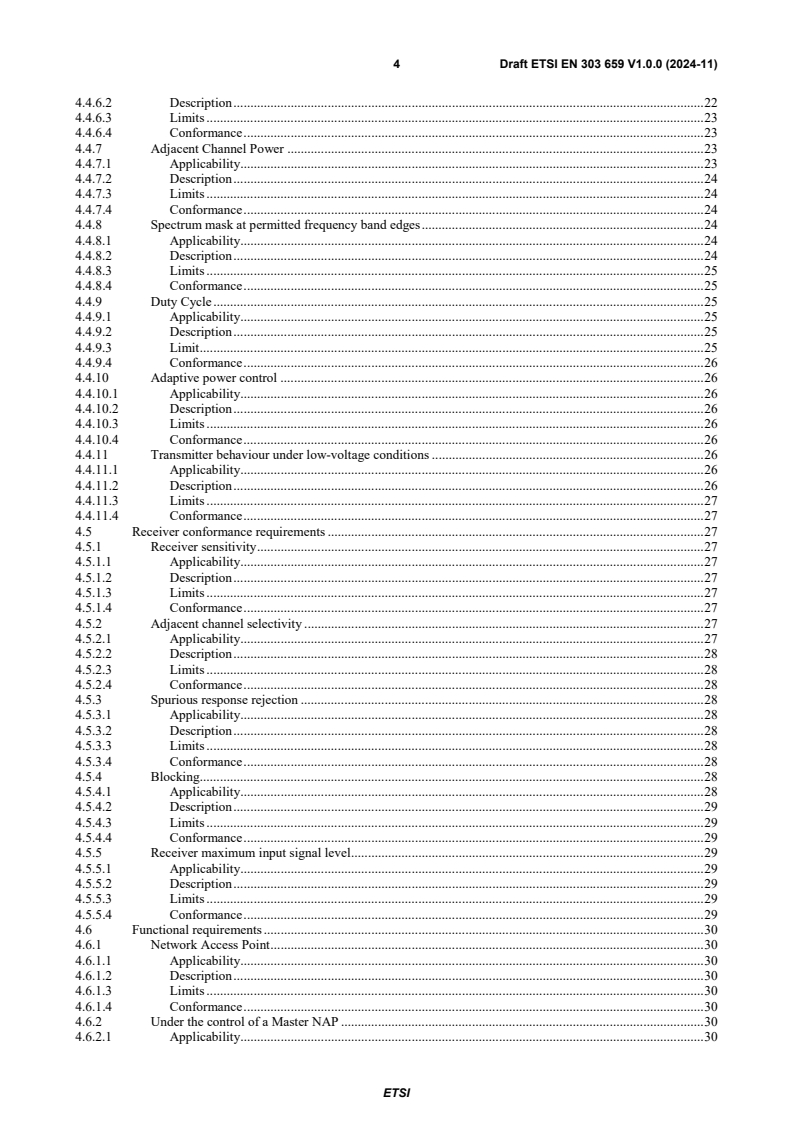
4 Draft ETSI EN 303 659 V1.0.0 (2024-11)
4.4.6.2 Description . 22
4.4.6.3 Limits . 23
4.4.6.4 Conformance . 23
4.4.7 Adjacent Channel Power . 23
4.4.7.1 Applicability. 23
4.4.7.2 Description . 24
4.4.7.3 Limits . 24
4.4.7.4 Conformance . 24
4.4.8 Spectrum mask at permitted frequency band edges . 24
4.4.8.1 Applicability. 24
4.4.8.2 Description . 24
4.4.8.3 Limits . 25
4.4.8.4 Conformance . 25
4.4.9 Duty Cycle . 25
4.4.9.1 Applicability. 25
4.4.9.2 Description . 25
4.4.9.3 Limit . 25
4.4.9.4 Conformance . 26
4.4.10 Adaptive power control . 26
4.4.10.1 Applicability. 26
4.4.10.2 Description . 26
4.4.10.3 Limits . 26
4.4.10.4 Conformance . 26
4.4.11 Transmitter behaviour under low-voltage conditions . 26
4.4.11.1 Applicability. 26
4.4.11.2 Description . 26
4.4.11.3 Limits . 27
4.4.11.4 Conformance . 27
4.5 Receiver conformance requirements . 27
4.5.1 Receiver sensitivity . 27
4.5.1.1 Applicability. 27
4.5.1.2 Description . 27
4.5.1.3 Limits . 27
4.5.1.4 Conformance . 27
4.5.2 Adjacent channel selectivity . 27
4.5.2.1 Applicability. 27
4.5.2.2 Description . 28
4.5.2.3 Limits . 28
4.5.2.4 Conformance . 28
4.5.3 Spurious response rejection . 28
4.5.3.1 Applicability. 28
4.5.3.2 Description . 28
4.5.3.3 Limits . 28
4.5.3.4 Conformance . 28
4.5.4 Blocking . 28
4.5.4.1 Applicability. 28
4.5.4.2 Description . 29
4.5.4.3 Limits . 29
4.5.4.4 Conformance . 29
4.5.5 Receiver maximum input signal level . 29
4.5.5.1 Applicability. 29
4.5.5.2 Description . 29
4.5.5.3 Limits . 29
4.5.5.4 Conformance . 29
4.6 Functional requirements . 30
4.6.1 Network Access Point . 30
4.6.1.1 Applicability. 30
4.6.1.2 Description . 30
4.6.1.3 Limits . 30
4.6.1.4 Conformance . 30
4.6.2 Under the control of a Master NAP . 30
4.6.2.1 Applicability. 30
ETSI
5 Draft ETSI EN 303 659 V1.0.0 (2024-11)
4.6.2.2 Description . 30
4.6.2.3 Limits . 30
4.6.2.4 Conformance . 31
4.6.3 Master NAP . 31
4.6.3.1 Applicability. 31
4.6.3.2 Description . 31
4.6.3.3 Limits . 31
4.6.3.4 Conformance . 31
5 Testing for compliance with technical requirements . 31
5.1 Environmental conditions for testing . 31
5.1.1 General considerations . 31
5.1.2 Normal test conditions . 31
5.1.2.1 Normal temperature and humidity for the tests . 31
5.1.2.2 Normal power source for the tests . 32
5.1.2.2.1 Mains voltage . 32
5.1.2.2.2 Battery power sources . 32
5.1.3 Extreme conditions for the tests . 32
5.1.3.1 Extreme temperatures range . 32
5.1.3.2 Extreme test source voltage. 32
5.1.3.2.1 Mains voltage . 32
5.1.3.2.2 Lead-acid battery power sources . 32
5.1.3.2.3 Other power sources . 32
5.1.3.3 Test conditions . 32
5.2 General considerations for testing . 33
5.2.0 General considerations . 33
5.2.1 Presentation of the EUT for testing purposes . 33
5.2.1.1 Choice of model for testing . 33
5.2.1.1.1 General considerations . 33
5.2.1.1.2 EUT with an external RF connector . 34
5.2.1.1.3 EUT without an external RF connector . 34
5.2.2 Test power source . 34
5.2.2.1 General considerations . 34
5.2.2.2 External test power source . 35
5.2.2.3 Internal test power source . 35
5.2.3 Thermal test conditions . 35
5.2.4 Conducted measurements . 35
5.2.5 Radiated measurements . 35
5.2.6 Applicable measurement methods . 35
5.2.7 Test signals . 36
5.2.8 Measuring receiver . 37
5.2.8.1 General considerations . 37
5.2.8.2 Reference Bandwidth . 37
5.2.9 Signal Threshold . 38
5.3 All equipment conformance requirements . 38
5.3.1 Unwanted emissions in the spurious domain . 38
5.3.1.1 Test conditions for the spectrum mask in the transmitter spurious domain . 38
5.3.1.2 Test conditions for Rx and all other modes . 39
5.3.1.3 Measurement procedure . 39
5.3.1.3.1 Radiated measurement . 39
5.3.1.3.2 Conducted measurement. 41
5.3.1.3.3 Measurement of emissions identified during the pre-scan . 42
5.4 Conformance methods of measurement for transmitters . 43
5.4.1 Effective radiated power . 43
5.4.1.1 General . 43
5.4.1.2 Radiated measurement procedure . 43
5.4.1.2.1 Test conditions . 43
5.4.1.2.2 Measurement procedure . 43
5.4.1.3 Conducted measurement procedure . 44
5.4.1.3.1 Test conditions . 44
5.4.1.3.2 Measurement procedure . 44
5.4.2 Maximum occupied bandwidth. 44
ETSI
6 Draft ETSI EN 303 659 V1.0.0 (2024-11)
5.4.2.1 Test conditions . 44
5.4.2.2 Radiated measurement . 44
5.4.2.3 Conducted measurement . 44
5.4.2.4 Measurement procedure . 45
5.4.3 Frequency error . 46
5.4.3.1 Test conditions . 46
5.4.3.2 Radiated measurement . 46
5.4.3.3 Conducted measurement . 46
5.4.3.4 Measurement procedure for D-M1 test signal . 46
5.4.3.5 Measurement procedure for other test signal . 47
5.4.4 Transmitter Signal at the edges of the TxOFB. 47
5.4.4.1 Test condition . 47
5.4.4.2 Radiated measurement . 48
5.4.4.3 Conducted measurement . 48
5.4.4.4 Measurement procedure . 48
5.4.5 Transient power . 48
5.4.5.1 General . 48
5.4.5.2 Radiated measurement . 49
5.4.5.3 Conducted measurement . 49
5.4.5.4 Measurement procedure . 49
5.4.6 Spectrum mask in the transmitter out-of-band domain . 50
5.4.6.1 Test conditions . 50
5.4.6.2 Radiated measurement . 50
5.4.6.3 Conducted measurement . 50
5.4.6.4 Measurement procedure . 50
5.4.7 Adjacent channel power . 51
5.4.7.1 Test conditions . 51
5.4.7.2 Radiated measurement . 51
5.4.7.3 Conducted measurement . 51
5.4.7.4 Measurement procedure . 51
5.4.8 Transmitter spectrum mask at permitted frequency band edges . 52
5.4.8.1 Test conditions . 52
5.4.8.2 Radiated measurement . 52
5.4.8.3 Conducted measurement . 52
5.4.8.4 Measurement procedure . 52
5.4.9 Duty cycle . 53
5.4.9.1 Test conditions . 53
5.4.9.2 Radiated measurement . 53
5.4.9.3 Conducted measurement . 53
5.4.9.4 Measurement procedure . 53
5.4.10 Adaptive power control . 54
5.4.10.1 Test conditions . 54
5.4.10.2 Radiated measurement . 54
5.4.10.3 Conducted measurement . 54
5.4.10.4 Measurement procedure . 54
5.4.11 Transmitter behaviour under low voltage conditions . 55
5.4.11.1 Test conditions . 55
5.4.11.2 Radiated measurement . 55
5.4.11.3 Conducted measurement . 55
5.4.11.4 Measurement procedure . 56
5.5 Conformance methods of measurement for receivers . 56
5.5.1 Receiver sensitivity . 56
5.5.1.1 Test conditions . 56
5.5.1.2 Radiated measurement . 56
5.5.1.3 Conducted measurement . 56
5.5.1.4 Measurement procedure . 56
5.5.2 Adjacent channel selectivity . 57
5.5.2.1 Test conditions . 57
5.5.2.2 Radiated measurement . 57
5.5.2.3 Conducted measurement . 58
5.5.2.4 Measurement procedure . 58
5.5.3 Blocking and spurious response rejection . 59
ETSI
7 Draft ETSI EN 303 659 V1.0.0 (2024-11)
5.5.3.1 Test conditions . 59
5.5.3.2 Radiated measurement . 59
5.5.3.3 Conducted measurement . 60
5.5.3.4 Measurement procedure . 60
5.5.4 Receiver maximum input signal level . 61
5.5.4.1 Test conditions . 61
5.5.4.2 Radiated measurement . 61
5.5.4.3 Conducted measurement . 61
5.5.4.4 Measurement procedure . 62
5.6 Conformance test suites for functional requirements . 62
5.6.1 General test conditions . 62
5.6.2 Network access point . 63
5.6.2.1 Test conditions . 63
5.6.2.2 Measurement Procedure . 63
5.6.3 Under the control of a Master NAP . 64
5.6.3.1 Test conditions . 64
5.6.3.2 Radiated measurement . 64
5.6.3.3 Conducted measurement . 65
5.6.3.4 Measurement procedure . 65
5.6.4 Master NAP . 66
5.6.4.1 Test conditions .
...
HARMONISED EUROPEAN STANDARD
Short Range Devices (SRD) in Data Networks;
Radio equipment to be used in the frequency ranges
865 MHz to 868 MHz and 915 MHz to 919,4 MHz;
Harmonised Standard for access to radio spectrum
2 ETSI EN 303 659 V1.1.1 (2025-02)
Reference
DEN/ERM-TG28-561
Keywords
harmonised standard, radio, SRD
ETSI
650 Route des Lucioles
F-06921 Sophia Antipolis Cedex - FRANCE
Tel.: +33 4 92 94 42 00 Fax: +33 4 93 65 47 16
Siret N° 348 623 562 00017 - APE 7112B
Association à but non lucratif enregistrée à la
Sous-Préfecture de Grasse (06) N° w061004871
Important notice
The present document can be downloaded from the
ETSI Search & Browse Standards application.
The present document may be made available in electronic versions and/or in print. The content of any electronic and/or
print versions of the present document shall not be modified without the prior written authorization of ETSI. In case of any
existing or perceived difference in contents between such versions and/or in print, the prevailing version of an ETSI
deliverable is the one made publicly available in PDF format on ETSI deliver repository.
Users should be aware that the present document may be revised or have its status changed,
this information is available in the Milestones listing.
If you find errors in the present document, please send your comments to
the relevant service listed under Committee Support Staff.
If you find a security vulnerability in the present document, please report it through our
Coordinated Vulnerability Disclosure (CVD) program.
Notice of disclaimer & limitation of liability
The information provided in the present deliverable is directed solely to professionals who have the appropriate degree of
experience to understand and interpret its content in accordance with generally accepted engineering or
other professional standard and applicable regulations.
No recommendation as to products and services or vendors is made or should be implied.
In no event shall ETSI be held liable for loss of profits or any other incidental or consequential damages.
Any software contained in this deliverable is provided "AS IS" with no warranties, express or implied, including but not
limited to, the warranties of merchantability, fitness for a particular purpose and non-infringement of intellectual property
rights and ETSI shall not be held liable in any event for any damages whatsoever (including, without limitation, damages
for loss of profits, business interruption, loss of information, or any other pecuniary loss) arising out of or related to the use
of or inability to use the software.
Copyright Notification
No part may be reproduced or utilized in any form or by any means, electronic or mechanical, including photocopying and
microfilm except as authorized by written permission of ETSI.
The content of the PDF version shall not be modified without the written authorization of ETSI.
The copyright and the foregoing restriction extend to reproduction in all media.
© ETSI 2025.
All rights reserved.
ETSI
3 ETSI EN 303 659 V1.1.1 (2025-02)
Contents
Intellectual Property Rights . 9
Foreword . 9
Modal verbs terminology . 10
Introduction . 10
1 Scope . 11
2 References . 11
2.1 Normative references . 11
2.2 Informative references . 11
3 Definition of terms, symbols and abbreviations . 12
3.1 Terms . 12
3.2 Symbols . 15
3.3 Abbreviations . 16
4 Technical requirements specifications . 17
4.1 Environmental profile . 17
4.2 General conditions for operating . 17
4.2.1 Wanted performance criteria. 17
4.2.2 Types and Operating Frequency Bands . 17
4.2.3 Operating conditions . 18
4.3 All equipment conformance requirements . 18
4.3.1 Unwanted emissions in the spurious domain . 18
4.3.1.1 Applicability. 18
4.3.1.2 Description . 19
4.3.1.2.1 Spectrum mask in the transmitter spurious domain . 19
4.3.1.2.2 Unwanted emissions for all other modes . 19
4.3.1.3 Limits . 19
4.3.1.4 Conformance . 19
4.4 Transmitter conformance requirements . 20
4.4.1 Effective radiated power . 20
4.4.1.1 Applicability. 20
4.4.1.2 Description . 20
4.4.1.3 Limits . 20
4.4.1.4 Conformance . 20
4.4.2 Maximum occupied bandwidth. 20
4.4.2.1 Applicability. 20
4.4.2.2 Description . 20
4.4.2.3 Limits . 20
4.4.2.4 Conformance . 20
4.4.3 Frequency Error . 21
4.4.3.1 Applicability. 21
4.4.3.2 Description . 21
4.4.3.3 Limits . 21
4.4.3.4 Conformance . 21
4.4.4 Transmitter Signal at the edges of the Transmitter Operating Frequency Band . 21
4.4.4.1 Applicability. 21
4.4.4.2 Description . 21
4.4.4.3 Limits . 21
4.4.4.4 Conformance . 22
4.4.5 Transient power . 22
4.4.5.1 Applicability. 22
4.4.5.2 Description . 22
4.4.5.3 Reference limits . 22
4.4.5.4 Conformance . 22
4.4.6 Spectrum mask in the transmitter out-of-band domain . 22
4.4.6.1 Applicability. 22
ETSI
4 ETSI EN 303 659 V1.1.1 (2025-02)
4.4.6.2 Description . 22
4.4.6.3 Limits . 23
4.4.6.4 Conformance . 23
4.4.7 Adjacent Channel Power . 23
4.4.7.1 Applicability. 23
4.4.7.2 Description . 24
4.4.7.3 Limits . 24
4.4.7.4 Conformance . 24
4.4.8 Spectrum mask at permitted frequency band edges . 24
4.4.8.1 Applicability. 24
4.4.8.2 Description . 24
4.4.8.3 Limits . 25
4.4.8.4 Conformance . 25
4.4.9 Duty Cycle . 25
4.4.9.1 Applicability. 25
4.4.9.2 Description . 25
4.4.9.3 Limit . 25
4.4.9.4 Conformance . 26
4.4.10 Adaptive power control . 26
4.4.10.1 Applicability. 26
4.4.10.2 Description . 26
4.4.10.3 Limits . 26
4.4.10.4 Conformance . 26
4.4.11 Transmitter behaviour under low-voltage conditions . 26
4.4.11.1 Applicability. 26
4.4.11.2 Description . 26
4.4.11.3 Limits . 27
4.4.11.4 Conformance . 27
4.5 Receiver conformance requirements . 27
4.5.1 Receiver sensitivity . 27
4.5.1.1 Applicability. 27
4.5.1.2 Description . 27
4.5.1.3 Limits . 27
4.5.1.4 Conformance . 27
4.5.2 Adjacent channel selectivity . 27
4.5.2.1 Applicability. 27
4.5.2.2 Description . 28
4.5.2.3 Limits . 28
4.5.2.4 Conformance . 28
4.5.3 Spurious response rejection . 28
4.5.3.1 Applicability. 28
4.5.3.2 Description . 28
4.5.3.3 Limits . 28
4.5.3.4 Conformance . 28
4.5.4 Blocking . 28
4.5.4.1 Applicability. 28
4.5.4.2 Description . 29
4.5.4.3 Limits . 29
4.5.4.4 Conformance . 29
4.5.5 Receiver maximum input signal level . 29
4.5.5.1 Applicability. 29
4.5.5.2 Description . 29
4.5.5.3 Limits . 29
4.5.5.4 Conformance . 29
4.6 Functional requirements . 30
4.6.1 Network Access Point . 30
4.6.1.1 Applicability. 30
4.6.1.2 Description . 30
4.6.1.3 Limits . 30
4.6.1.4 Conformance . 30
4.6.2 Under the control of a Master NAP . 30
4.6.2.1 Applicability. 30
ETSI
5 ETSI EN 303 659 V1.1.1 (2025-02)
4.6.2.2 Description . 30
4.6.2.3 Limits . 30
4.6.2.4 Conformance . 31
4.6.3 Master NAP . 31
4.6.3.1 Applicability. 31
4.6.3.2 Description . 31
4.6.3.3 Limits . 31
4.6.3.4 Conformance . 31
5 Testing for compliance with technical requirements . 31
5.1 Environmental conditions for testing . 31
5.1.1 General considerations . 31
5.1.2 Normal test conditions . 31
5.1.2.1 Normal temperature and humidity for the tests . 31
5.1.2.2 Normal power source for the tests . 32
5.1.2.2.1 Mains voltage . 32
5.1.2.2.2 Battery power sources . 32
5.1.3 Extreme conditions for the tests . 32
5.1.3.1 Extreme temperatures range . 32
5.1.3.2 Extreme test source voltage. 32
5.1.3.2.1 Mains voltage . 32
5.1.3.2.2 Lead-acid battery power sources . 32
5.1.3.2.3 Other power sources . 32
5.1.3.3 Test conditions . 32
5.2 General considerations for testing . 33
5.2.0 General considerations . 33
5.2.1 Presentation of the EUT for testing purposes . 33
5.2.1.1 Choice of model for testing . 33
5.2.1.1.1 General considerations . 33
5.2.1.1.2 EUT with an external RF connector . 34
5.2.1.1.3 EUT without an external RF connector . 34
5.2.2 Test power source . 34
5.2.2.1 General considerations . 34
5.2.2.2 External test power source . 35
5.2.2.3 Internal test power source . 35
5.2.3 Thermal test conditions . 35
5.2.4 Conducted measurements . 35
5.2.5 Radiated measurements . 35
5.2.6 Applicable measurement methods . 35
5.2.7 Test signals . 36
5.2.8 Measuring receiver . 37
5.2.8.1 General considerations . 37
5.2.8.2 Reference Bandwidth . 37
5.2.9 Signal Threshold . 38
5.3 All equipment conformance requirements . 38
5.3.1 Unwanted emissions in the spurious domain . 38
5.3.1.1 Test conditions for the spectrum mask in the transmitter spurious domain . 38
5.3.1.2 Test conditions for Rx and all other modes . 39
5.3.1.3 Measurement procedure . 39
5.3.1.3.1 Radiated measurement . 39
5.3.1.3.2 Conducted measurement. 41
5.3.1.3.3 Measurement of emissions identified during the pre-scan . 42
5.4 Conformance methods of measurement for transmitters . 43
5.4.1 Effective radiated power . 43
5.4.1.1 General . 43
5.4.1.2 Radiated measurement procedure . 43
5.4.1.2.1 Test conditions . 43
5.4.1.2.2 Measurement procedure . 43
5.4.1.3 Conducted measurement procedure . 44
5.4.1.3.1 Test conditions . 44
5.4.1.3.2 Measurement procedure . 44
5.4.2 Maximum occupied bandwidth. 44
ETSI
6 ETSI EN 303 659 V1.1.1 (2025-02)
5.4.2.1 Test conditions . 44
5.4.2.2 Radiated measurement . 44
5.4.2.3 Conducted measurement . 44
5.4.2.4 Measurement procedure . 45
5.4.3 Frequency error . 46
5.4.3.1 Test conditions . 46
5.4.3.2 Radiated measurement . 46
5.4.3.3 Conducted measurement . 46
5.4.3.4 Measurement procedure for D-M1 test signal . 46
5.4.3.5 Measurement procedure for other test signal . 47
5.4.4 Transmitter Signal at the edges of the TxOFB. 47
5.4.4.1 Test condition . 47
5.4.4.2 Radiated measurement . 48
5.4.4.3 Conducted measurement . 48
5.4.4.4 Measurement procedure . 48
5.4.5 Transient power . 48
5.4.5.1 General . 48
5.4.5.2 Radiated measurement . 49
5.4.5.3 Conducted measurement . 49
5.4.5.4 Measurement procedure . 49
5.4.6 Spectrum mask in the transmitter out-of-band domain . 50
5.4.6.1 Test conditions . 50
5.4.6.2 Radiated measurement . 50
5.4.6.3 Conducted measurement . 50
5.4.6.4 Measurement procedure . 50
5.4.7 Adjacent channel power . 51
5.4.7.1 Test conditions . 51
5.4.7.2 Radiated measurement . 51
5.4.7.3 Conducted measurement . 51
5.4.7.4 Measurement procedure . 51
5.4.8 Transmitter spectrum mask at permitted frequency band edges . 52
5.4.8.1 Test conditions . 52
5.4.8.2 Radiated measurement . 52
5.4.8.3 Conducted measurement . 52
5.4.8.4 Measurement procedure . 52
5.4.9 Duty cycle . 53
5.4.9.1 Test conditions . 53
5.4.9.2 Radiated measurement . 53
5.4.9.3 Conducted measurement . 53
5.4.9.4 Measurement procedure . 53
5.4.10 Adaptive power control . 54
5.4.10.1 Test conditions . 54
5.4.10.2 Radiated measurement . 54
5.4.10.3 Conducted measurement . 54
5.4.10.4 Measurement procedure . 54
5.4.11 Transmitter behaviour under low voltage conditions . 55
5.4.11.1 Test conditions . 55
5.4.11.2 Radiated measurement . 55
5.4.11.3 Conducted measurement . 55
5.4.11.4 Measurement procedure . 56
5.5 Conformance methods of measurement for receivers . 56
5.5.1 Receiver sensitivity . 56
5.5.1.1 Test conditions . 56
5.5.1.2 Radiated measurement . 56
5.5.1.3 Conducted measurement . 56
5.5.1.4 Measurement procedure . 56
5.5.2 Adjacent channel selectivity . 57
5.5.2.1 Test conditions . 57
5.5.2.2 Radiated measurement . 57
5.5.2.3 Conducted measurement . 58
5.5.2.4 Measurement procedure . 58
5.5.3 Blocking and spurious response rejection . 59
ETSI
7 ETSI EN 303 659 V1.1.1 (2025-02)
5.5.3.1 Test conditions . 59
5.5.3.2 Radiated measurement . 59
5.5.3.3 Conducted measurement . 60
5.5.3.4 Measurement procedure . 60
5.5.4 Receiver maximum input signal level . 61
5.5.4.1 Test conditions . 61
5.5.4.2 Radiated measurement . 61
5.5.4.3 Conducted measurement . 61
5.5.4.4 Measurement procedure . 62
5.6 Conformance test suites for functional requirements . 62
5.6.1 General test conditions . 62
5.6.2 Network access point . 63
5.6.2.1 Test conditions . 63
5.6.2.2 Measurement Procedure . 63
5.6.3 Under the control of a Master NAP . 64
5.6.3.1 Test conditions . 64
5.6.3.2 Radiated measurement . 64
5.6.3.3 Conducted measurement . 65
5.6.3.4 Measurement procedure . 65
5.6.4 Master NAP . 66
5.6.4.1 Test conditions . 66
5.6
...
SLOVENSKI STANDARD
01-april-2025
Naprave kratkega dosega (SRD) v podatkovnih omrežjih - Radijska oprema za
uporabo v frekvenčnih območjih od 865 MHz do 868 MHz in od 915 MHz do 919,4
MHz - Harmonizirani standard za dostop do radijskega spektra
Short Range Devices (SRD) in Data Networks - Radio equipment to be used in the
frequency ranges 865 MHz to 868 MHz and 915 MHz to 919,4 MHz - Harmonised
Standard for access to radio spectrum
Ta slovenski standard je istoveten z: ETSI EN 303 659 V1.1.1 (2025-02)
ICS:
33.060.01 Radijske komunikacije na Radiocommunications in
splošno general
2003-01.Slovenski inštitut za standardizacijo. Razmnoževanje celote ali delov tega standarda ni dovoljeno.
HARMONISED EUROPEAN STANDARD
Short Range Devices (SRD) in Data Networks;
Radio equipment to be used in the frequency ranges
865 MHz to 868 MHz and 915 MHz to 919,4 MHz;
Harmonised Standard for access to radio spectrum
2 ETSI EN 303 659 V1.1.1 (2025-02)
Reference
DEN/ERM-TG28-561
Keywords
harmonised standard, radio, SRD
ETSI
650 Route des Lucioles
F-06921 Sophia Antipolis Cedex - FRANCE
Tel.: +33 4 92 94 42 00 Fax: +33 4 93 65 47 16
Siret N° 348 623 562 00017 - APE 7112B
Association à but non lucratif enregistrée à la
Sous-Préfecture de Grasse (06) N° w061004871
Important notice
The present document can be downloaded from the
ETSI Search & Browse Standards application.
The present document may be made available in electronic versions and/or in print. The content of any electronic and/or
print versions of the present document shall not be modified without the prior written authorization of ETSI. In case of any
existing or perceived difference in contents between such versions and/or in print, the prevailing version of an ETSI
deliverable is the one made publicly available in PDF format on ETSI deliver repository.
Users should be aware that the present document may be revised or have its status changed,
this information is available in the Milestones listing.
If you find errors in the present document, please send your comments to
the relevant service listed under Committee Support Staff.
If you find a security vulnerability in the present document, please report it through our
Coordinated Vulnerability Disclosure (CVD) program.
Notice of disclaimer & limitation of liability
The information provided in the present deliverable is directed solely to professionals who have the appropriate degree of
experience to understand and interpret its content in accordance with generally accepted engineering or
other professional standard and applicable regulations.
No recommendation as to products and services or vendors is made or should be implied.
In no event shall ETSI be held liable for loss of profits or any other incidental or consequential damages.
Any software contained in this deliverable is provided "AS IS" with no warranties, express or implied, including but not
limited to, the warranties of merchantability, fitness for a particular purpose and non-infringement of intellectual property
rights and ETSI shall not be held liable in any event for any damages whatsoever (including, without limitation, damages
for loss of profits, business interruption, loss of information, or any other pecuniary loss) arising out of or related to the use
of or inability to use the software.
Copyright Notification
No part may be reproduced or utilized in any form or by any means, electronic or mechanical, including photocopying and
microfilm except as authorized by written permission of ETSI.
The content of the PDF version shall not be modified without the written authorization of ETSI.
The copyright and the foregoing restriction extend to reproduction in all media.
© ETSI 2025.
All rights reserved.
ETSI
3 ETSI EN 303 659 V1.1.1 (2025-02)
Contents
Intellectual Property Rights . 9
Foreword . 9
Modal verbs terminology . 10
Introduction . 10
1 Scope . 11
2 References . 11
2.1 Normative references . 11
2.2 Informative references . 11
3 Definition of terms, symbols and abbreviations . 12
3.1 Terms . 12
3.2 Symbols . 15
3.3 Abbreviations . 16
4 Technical requirements specifications . 17
4.1 Environmental profile . 17
4.2 General conditions for operating . 17
4.2.1 Wanted performance criteria. 17
4.2.2 Types and Operating Frequency Bands . 17
4.2.3 Operating conditions . 18
4.3 All equipment conformance requirements . 18
4.3.1 Unwanted emissions in the spurious domain . 18
4.3.1.1 Applicability. 18
4.3.1.2 Description . 19
4.3.1.2.1 Spectrum mask in the transmitter spurious domain . 19
4.3.1.2.2 Unwanted emissions for all other modes . 19
4.3.1.3 Limits . 19
4.3.1.4 Conformance . 19
4.4 Transmitter conformance requirements . 20
4.4.1 Effective radiated power . 20
4.4.1.1 Applicability. 20
4.4.1.2 Description . 20
4.4.1.3 Limits . 20
4.4.1.4 Conformance . 20
4.4.2 Maximum occupied bandwidth. 20
4.4.2.1 Applicability. 20
4.4.2.2 Description . 20
4.4.2.3 Limits . 20
4.4.2.4 Conformance . 20
4.4.3 Frequency Error . 21
4.4.3.1 Applicability. 21
4.4.3.2 Description . 21
4.4.3.3 Limits . 21
4.4.3.4 Conformance . 21
4.4.4 Transmitter Signal at the edges of the Transmitter Operating Frequency Band . 21
4.4.4.1 Applicability. 21
4.4.4.2 Description . 21
4.4.4.3 Limits . 21
4.4.4.4 Conformance . 22
4.4.5 Transient power . 22
4.4.5.1 Applicability. 22
4.4.5.2 Description . 22
4.4.5.3 Reference limits . 22
4.4.5.4 Conformance . 22
4.4.6 Spectrum mask in the transmitter out-of-band domain . 22
4.4.6.1 Applicability. 22
ETSI
4 ETSI EN 303 659 V1.1.1 (2025-02)
4.4.6.2 Description . 22
4.4.6.3 Limits . 23
4.4.6.4 Conformance . 23
4.4.7 Adjacent Channel Power . 23
4.4.7.1 Applicability. 23
4.4.7.2 Description . 24
4.4.7.3 Limits . 24
4.4.7.4 Conformance . 24
4.4.8 Spectrum mask at permitted frequency band edges . 24
4.4.8.1 Applicability. 24
4.4.8.2 Description . 24
4.4.8.3 Limits . 25
4.4.8.4 Conformance . 25
4.4.9 Duty Cycle . 25
4.4.9.1 Applicability. 25
4.4.9.2 Description . 25
4.4.9.3 Limit . 25
4.4.9.4 Conformance . 26
4.4.10 Adaptive power control . 26
4.4.10.1 Applicability. 26
4.4.10.2 Description . 26
4.4.10.3 Limits . 26
4.4.10.4 Conformance . 26
4.4.11 Transmitter behaviour under low-voltage conditions . 26
4.4.11.1 Applicability. 26
4.4.11.2 Description . 26
4.4.11.3 Limits . 27
4.4.11.4 Conformance . 27
4.5 Receiver conformance requirements . 27
4.5.1 Receiver sensitivity . 27
4.5.1.1 Applicability. 27
4.5.1.2 Description . 27
4.5.1.3 Limits . 27
4.5.1.4 Conformance . 27
4.5.2 Adjacent channel selectivity . 27
4.5.2.1 Applicability. 27
4.5.2.2 Description . 28
4.5.2.3 Limits . 28
4.5.2.4 Conformance . 28
4.5.3 Spurious response rejection . 28
4.5.3.1 Applicability. 28
4.5.3.2 Description . 28
4.5.3.3 Limits . 28
4.5.3.4 Conformance . 28
4.5.4 Blocking . 28
4.5.4.1 Applicability. 28
4.5.4.2 Description . 29
4.5.4.3 Limits . 29
4.5.4.4 Conformance . 29
4.5.5 Receiver maximum input signal level . 29
4.5.5.1 Applicability. 29
4.5.5.2 Description . 29
4.5.5.3 Limits . 29
4.5.5.4 Conformance . 29
4.6 Functional requirements . 30
4.6.1 Network Access Point . 30
4.6.1.1 Applicability. 30
4.6.1.2 Description . 30
4.6.1.3 Limits . 30
4.6.1.4 Conformance . 30
4.6.2 Under the control of a Master NAP . 30
4.6.2.1 Applicability. 30
ETSI
5 ETSI EN 303 659 V1.1.1 (2025-02)
4.6.2.2 Description . 30
4.6.2.3 Limits . 30
4.6.2.4 Conformance . 31
4.6.3 Master NAP . 31
4.6.3.1 Applicability. 31
4.6.3.2 Description . 31
4.6.3.3 Limits . 31
4.6.3.4 Conformance . 31
5 Testing for compliance with technical requirements . 31
5.1 Environmental conditions for testing . 31
5.1.1 General considerations . 31
5.1.2 Normal test conditions . 31
5.1.2.1 Normal temperature and humidity for the tests . 31
5.1.2.2 Normal power source for the tests . 32
5.1.2.2.1 Mains voltage . 32
5.1.2.2.2 Battery power sources . 32
5.1.3 Extreme conditions for the tests . 32
5.1.3.1 Extreme temperatures range . 32
5.1.3.2 Extreme test source voltage. 32
5.1.3.2.1 Mains voltage . 32
5.1.3.2.2 Lead-acid battery power sources . 32
5.1.3.2.3 Other power sources . 32
5.1.3.3 Test conditions . 32
5.2 General considerations for testing . 33
5.2.0 General considerations . 33
5.2.1 Presentation of the EUT for testing purposes . 33
5.2.1.1 Choice of model for testing . 33
5.2.1.1.1 General considerations . 33
5.2.1.1.2 EUT with an external RF connector . 34
5.2.1.1.3 EUT without an external RF connector . 34
5.2.2 Test power source . 34
5.2.2.1 General considerations . 34
5.2.2.2 External test power source . 35
5.2.2.3 Internal test power source . 35
5.2.3 Thermal test conditions . 35
5.2.4 Conducted measurements . 35
5.2.5 Radiated measurements . 35
5.2.6 Applicable measurement methods . 35
5.2.7 Test signals . 36
5.2.8 Measuring receiver . 37
5.2.8.1 General considerations . 37
5.2.8.2 Reference Bandwidth . 37
5.2.9 Signal Threshold . 38
5.3 All equipment conformance requirements . 38
5.3.1 Unwanted emissions in the spurious domain . 38
5.3.1.1 Test conditions for the spectrum mask in the transmitter spurious domain . 38
5.3.1.2 Test conditions for Rx and all other modes . 39
5.3.1.3 Measurement procedure . 39
5.3.1.3.1 Radiated measurement . 39
5.3.1.3.2 Conducted measurement. 41
5.3.1.3.3 Measurement of emissions identified during the pre-scan . 42
5.4 Conformance methods of measurement for transmitters . 43
5.4.1 Effective radiated power . 43
5.4.1.1 General . 43
5.4.1.2 Radiated measurement procedure . 43
5.4.1.2.1 Test conditions . 43
5.4.1.2.2 Measurement procedure . 43
5.4.1.3 Conducted measurement procedure . 44
5.4.1.3.1 Test conditions . 44
5.4.1.3.2 Measurement procedure . 44
5.4.2 Maximum occupied bandwidth. 44
ETSI
6 ETSI EN 303 659 V1.1.1 (2025-02)
5.4.2.1 Test conditions . 44
5.4.2.2 Radiated measurement . 44
5.4.2.3 Conducted measurement . 44
5.4.2.4 Measurement procedure . 45
5.4.3 Frequency error . 46
5.4.3.1 Test conditions . 46
5.4.3.2 Radiated measurement . 46
5.4.3.3 Conducted measurement . 46
5.4.3.4 Measurement procedure for D-M1 test signal . 46
5.4.3.5 Measurement procedure for other test signal . 47
5.4.4 Transmitter Signal at the edges of the TxOFB. 47
5.4.4.1 Test condition . 47
5.4.4.2 Radiated measurement . 48
5.4.4.3 Conducted measurement . 48
5.4.4.4 Measurement procedure . 48
5.4.5 Transient power . 48
5.4.5.1 General . 48
5.4.5.2 Radiated measurement . 49
5.4.5.3 Conducted measurement . 49
5.4.5.4 Measurement procedure . 49
5.4.6 Spectrum mask in the transmitter out-of-band domain . 50
5.4.6.1 Test conditions . 50
5.4.6.2 Radiated measurement . 50
5.4.6.3 Conducted measurement . 50
5.4.6.4 Measurement procedure . 50
5.4.7 Adjacent channel power . 51
5.4.7.1 Test conditions . 51
5.4.7.2 Radiated measurement . 51
5.4.7.3 Conducted measurement . 51
5.4.7.4 Measurement procedure . 51
5.4.8 Transmitter spectrum mask at permitted frequency band edges . 52
5.4.8.1 Test conditions . 52
5.4.8.2 Radiated measurement . 52
5.4.8.3 Conducted measurement . 52
5.4.8.4 Measurement procedure . 52
5.4.9 Duty cycle . 53
5.4.9.1 Test conditions . 53
5.4.9.2 Radiated measurement . 53
5.4.9.3 Conducted measurement . 53
5.4.9.4 Measurement procedure . 53
5.4.10 Adaptive power control . 54
5.4.10.1 Test conditions . 54
5.4.10.2 Radiated measurement . 54
5.4.10.3 Conducted measurement . 54
5.4.10.4 Measurement procedure . 54
5.4.11 Transmitter behaviour under low voltage conditions . 55
5.4.11.1 Test conditions . 55
5.4.11.2 Radiated measurement . 55
5.4.11.3 Conducted measurement . 55
5.4.11.4 Measurement procedure . 56
5.5 Conformance methods of measurement for receivers . 56
5.5.1 Receiver sensitivity . 56
5.5.1.1 Test conditions . 56
5.5.1.2 Radiated measurement . 56
5.5.1.3 Conducted measurement . 56
5.5.1.4 Measurement procedure . 56
5.5.2 Adjacent channel selectivity . 57
5.5.2.1 Test conditions . 57
5.5.2.2 Radiated measurement . 57
5.5.2.3 Conducted measurement . 58
5.5.2.4 Measurement procedure . 58
5.5.3 Blocking and spurious response rejection . 59
ETSI
7 ETSI EN 303 659 V1.1.1 (2025-02)
5.5.3.1 Test conditions . 59
5.5.3.2 Radiated measurement . 59
5.5.3.3 Conducted measurement . 60
5.5.3.4 Measurement procedure . 60
5.5.4 Receiver maximum input signal level . 61
5.5.4.1 Test conditions . 61
5.5.4.2 Radiated measurement . 61
5.5.4.3 Conducted measurement . 61
5.5.4.4 Measurement procedure . 62
5.6 Conformance test suites for functional requirements . 62
5.6.1 General test conditions . 62
5.6.2 Network access point . 63
5.6.2.1 Test conditions . 63
5.6.2.2 Measurement Procedure . 63
5.6
...