

SIST EN 1052-3:2004
(Main)Methods of test for masonry - Part 3: Determination of initial shear strength
General Information
- Abstract
This European Standard specifies a method for determining the in plane initial shear strength of horizontal bed joints in masonry using a specimen tested in shear.
Guidance is given on the preparation of the specimens, the conditioning required before testing, the testing machine, the method of test, the method of calculation and the contents of the test report.
- Status
- Published
- Publication Date
- 31-Dec-2003
- Technical Committee
- CAA - Mineral binders and masonry
- Current Stage
- 6060 - National Implementation/Publication (Adopted Project)
- Start Date
- 01-Jan-2004
- Due Date
- 01-Jan-2004
- Completion Date
- 01-Jan-2004

Overview
EN 1052-3:2002 - Methods of test for masonry - Part 3: Determination of initial shear strength (CEN) specifies a laboratory method to determine the in‑plane initial shear strength of horizontal bed joints in masonry. The standard covers specimen preparation, curing/conditioning, test apparatus and setup, loading procedure, calculations (including derivation of the initial shear strength by regression), and required contents of the test report. It applies where an accurate measure of bed‑joint shear behaviour is needed for design, quality control or research.
Key topics and technical requirements
- Specimens and numbers: At least nine specimens are prepared (typically three precompression levels with three replicates each). Specimen geometry is defined as Type A or Type B depending on unit height (hu ≤ 200 mm or > 200 mm).
- Preparation and curing: Units must be conditioned and laid with representative joint thickness (8–15 mm for conventional mortar or 1–3 mm for thin‑layer mortar). Specimens are cured and tested normally at 28 d ± 1 d unless otherwise specified.
- Precompression levels:
- For units with compressive strength > 10 N/mm2: approx. 0.2, 0.6 and 1.0 N/mm2.
- For units with compressive strength < 10 N/mm2: approx. 0.1, 0.3 and 0.5 N/mm2.
- Precompression must be held within ±2%.
- Loading and instrumentation:
- Shear loading by four‑point shear arrangement with roller bearings (roller diameter 12 mm).
- Shear stress increase rate: 0.1 to 0.4 N/(mm2·min).
- Testing machines must meet accuracy/repeatability requirements (repeatability and mean error ±2%, zero error ≤ 0.4% of range).
- Calculations and evaluation:
- Individual shear strength and precompression stress are calculated from measured loads and specimen cross‑sectional area.
- Plot fvoi (shear strength) vs fpi (normal stress) and determine the initial shear strength fvo as the intercept from linear regression to zero normal stress.
- Angle of internal friction is obtained from the slope; characteristic values are obtained as 0.8 × mean (fvok = 0.8 fvo).
- Reporting: The standard lists required report items: specimen details, unit/mortar descriptions and strengths, individual results, mean and characteristic shear strength, failure modes, curing, test age, remarks.
Applications and users
- Who uses it: materials and structural testing laboratories, masonry product manufacturers, research institutions, structural engineers and compliance bodies.
- Practical uses:
- Provide laboratory input data for masonry design (shear capacity of bed joints).
- Quality control of mortars, masonry units, and bonding.
- Comparative testing for new materials, thin‑joint systems, or restoration work.
- Support for structural assessments and forensic investigations where shear behaviour of joints is critical.
Related standards
Normative references used by EN 1052-3 include:
- EN 772-1, EN 772-10, EN 772-16 (masonry unit tests)
- EN 998-2 (masonry mortar specification)
- EN 1015-3, EN 1015-7, EN 1015-11 (mortar test methods)
Keywords: EN 1052-3, initial shear strength, masonry shear test, bed joint shear, masonry testing, precompression, shear strength test method.
Relations
- Refers
SIST EN 772-16:2011 - Methods of test for masonry units - Part 16: Determination of dimensions - Effective Date
- 28-Jan-2026
- Effective Date
- 28-Jan-2026
- Effective Date
- 28-Jan-2026
- Effective Date
- 28-Jan-2026
- Effective Date
- 28-Jan-2026
- Effective Date
- 28-Jan-2026
- Effective Date
- 28-Jan-2026
- Referred By
SIST EN 771-6:2011 - Specification for masonry units - Part 6: Natural stone masonry units - Effective Date
- 28-Jan-2026
- Effective Date
- 28-Jan-2026
- Effective Date
- 28-Jan-2026
- Referred By
SIST EN 771-1:2011+A1:2015 - Specification for masonry units - Part 1: Clay masonry units - Effective Date
- 28-Jan-2026
- Effective Date
- 28-Jan-2026
- Effective Date
- 28-Jan-2026
- Effective Date
- 28-Jan-2026
- Effective Date
- 28-Jan-2026
Get Certified
Connect with accredited certification bodies for this standard

DIBt (Deutsches Institut für Bautechnik)
German Institute for Building Technology.
DIN CERTCO
DIN Group product certification.

Aboma Certification B.V.
Specialized in construction, metal, and transport sectors.
Sponsored listings
Frequently Asked Questions
SIST EN 1052-3:2004 is a standard published by the Slovenian Institute for Standardization (SIST). Its full title is "Methods of test for masonry - Part 3: Determination of initial shear strength". This standard covers: This European Standard specifies a method for determining the in plane initial shear strength of horizontal bed joints in masonry using a specimen tested in shear. Guidance is given on the preparation of the specimens, the conditioning required before testing, the testing machine, the method of test, the method of calculation and the contents of the test report.
This European Standard specifies a method for determining the in plane initial shear strength of horizontal bed joints in masonry using a specimen tested in shear. Guidance is given on the preparation of the specimens, the conditioning required before testing, the testing machine, the method of test, the method of calculation and the contents of the test report.
SIST EN 1052-3:2004 is classified under the following ICS (International Classification for Standards) categories: 91.080.30 - Masonry. The ICS classification helps identify the subject area and facilitates finding related standards.
SIST EN 1052-3:2004 has the following relationships with other standards: It is inter standard links to SIST EN 772-16:2011, SIST EN 772-10:1999, SIST EN 998-2:2017, SIST EN 1015-3:2001, SIST EN 1015-7:1999, SIST EN 1015-11:2020, SIST EN 772-1:2011+A1:2015, SIST EN 771-6:2011, SIST EN 771-1:2011, SIST EN 771-3:2011, SIST EN 771-1:2011+A1:2015, SIST EN 771-3:2011+A1:2015, SIST EN 771-4:2011, SIST EN 13084-5:2005, SIST EN 771-2:2011+A1:2015. Understanding these relationships helps ensure you are using the most current and applicable version of the standard.
SIST EN 1052-3:2004 is associated with the following European legislation: EU Directives/Regulations: 305/2011, 89/106/EEC; Standardization Mandates: M/116. When a standard is cited in the Official Journal of the European Union, products manufactured in conformity with it benefit from a presumption of conformity with the essential requirements of the corresponding EU directive or regulation.
SIST EN 1052-3:2004 is available in PDF format for immediate download after purchase. The document can be added to your cart and obtained through the secure checkout process. Digital delivery ensures instant access to the complete standard document.
Standards Content (Sample)
2003-01.Slovenski inštitut za standardizacijo. Razmnoževanje celote ali delov tega standarda ni dovoljeno.Prüfverfahren für Mauerwerk - Teil 3: Bestimmung der Anfangsscherfestigkeit (Haftscherfestigkeit)Méthodes d'essai de la maçonnerie - Partie 3: Détermination de la résistance initiale au cisaillementMethods of test for masonry - Part 3: Determination of initial shear strength91.080.30Zidane konstrukcijeMasonryICS:Ta slovenski standard je istoveten z:EN 1052-3:2002SIST EN 1052-3:2004en01-januar-2004SIST EN 1052-3:2004SLOVENSKI
STANDARD
EUROPEAN STANDARDNORME EUROPÉENNEEUROPÄISCHE NORMEN 1052-3July 2002ICS 91.080.30English versionMethods of test for masonry - Part 3: Determination of initialshear strengthMéthodes d'essai de la maçonnerie - Partie 3:Détermination de la résistance initiale au cisaillementPrüfverfahren für Mauerwerk - Teil 3: Bestimmung derAnfangsscherfestigkeit (Haftscherfestigkeit)This European Standard was approved by CEN on 11 April 2002.CEN members are bound to comply with the CEN/CENELEC Internal Regulations which stipulate the conditions for giving this EuropeanStandard the status of a national standard without any alteration. Up-to-date lists and bibliographical references concerning such nationalstandards may be obtained on application to the Management Centre or to any CEN member.This European Standard exists in three official versions (English, French, German). A version in any other language made by translationunder the responsibility of a CEN member into its own language and notified to the Management Centre has the same status as the officialversions.CEN members are the national standards bodies of Austria, Belgium, Czech Republic, Denmark, Finland, France, Germany, Greece,Iceland, Ireland, Italy, Luxembourg, Malta, Netherlands, Norway, Portugal, Spain, Sweden, Switzerland and United Kingdom.EUROPEAN COMMITTEE FOR STANDARDIZATIONCOMITÉ EUROPÉEN DE NORMALISATIONEUROPÄISCHES KOMITEE FÜR NORMUNGManagement Centre: rue de Stassart, 36
B-1050 Brussels© 2002 CENAll rights of exploitation in any form and by any means reservedworldwide for CEN national Members.Ref. No. EN 1052-3:2002 ESIST EN 1052-3:2004
(informative)
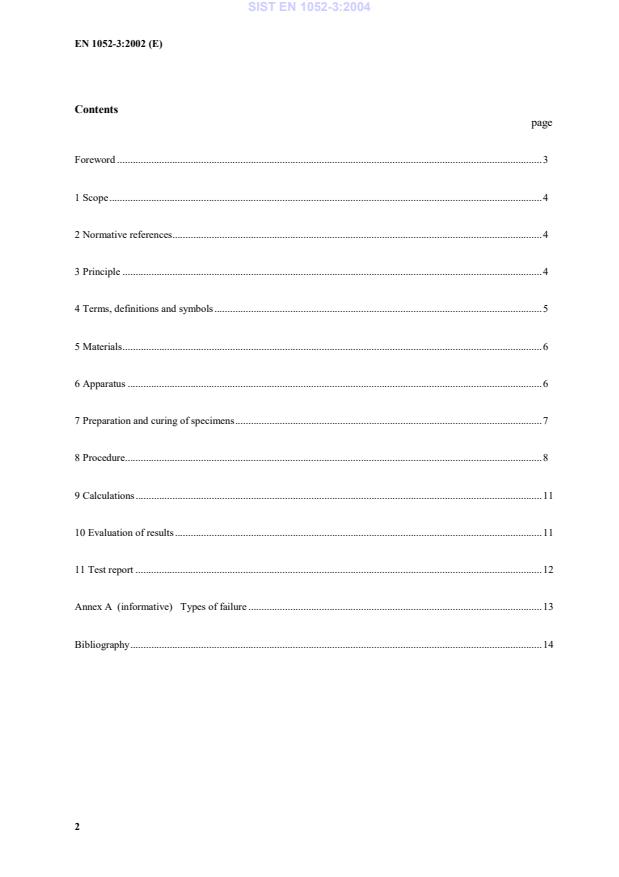
Types of failure.13Bibliography.14SIST EN 1052-3:2004
Measure the moisture content bymass of autoclaved aerated concrete and calcium silicate units in accordance with EN 772-10.
Record theage of non-autoclaved concrete units at the time of testing the masonry spe
...