

SIST EN 726-6:1998
(Main)Identification card system - Telecommunications integrated circuit(s) cards and terminals - Part 6: Telecommunication features
- Abstract
This part of EN 726 defines telecommunication features using IC cards. These telecommunication features may be used by more than one application. This part of EN 726 describes the card-terminal interface. However, when needed the system is considered as well. This part of EN 726 describes the following telecommunication features: - Abbreviated Dialling; - Last Number Dialling (stored within the card); - Fixed Number Dialling.
- Status
- Published
- Publication Date
- 31-May-1998
- Technical Committee
- BFS - Banking and related financial services
- Current Stage
- 6060 - National Implementation/Publication (Adopted Project)
- Start Date
- 01-Jun-1998
- Due Date
- 01-Jun-1998
- Completion Date
- 01-Jun-1998



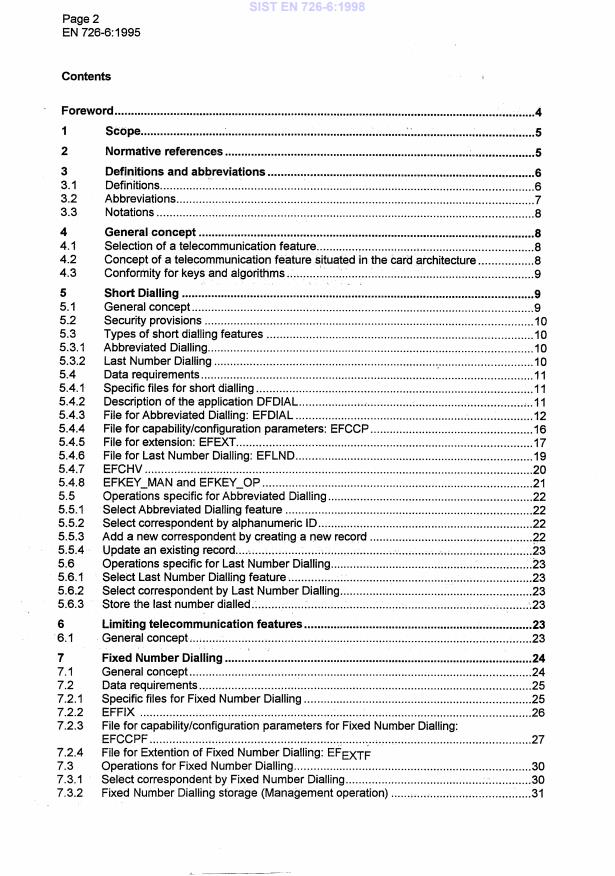
SIST EN 726-6:1998 is a Slovenian standard from SIST for identification card systems that use telecommunications integrated circuit (IC) cards and terminals. It specifies telecommunication features for card-based services - Abbreviated Dialling, Last Number Dialling stored within the card, and Fixed Number Dialling - and describes the card-terminal interface used to support them. The standard is intended for people who need to implement, integrate, or assess those features in telecommunications applications.
What does SIST EN 726-6:1998 specify?
SIST EN 726-6:1998 defines telecommunication features that use IC cards and can be used by more than one application. Its focus is the card-terminal interface, with the system also considered where that is needed to describe the feature behavior.
In practice, this means the standard is about how the card and terminal work together for specific telephone service functions. It names the feature set directly:
- Abbreviated Dialling
- Last Number Dialling, stored within the card
- Fixed Number Dialling
These are the functions a reader should look for when deciding whether the document matches a card-based telephony service design. If a project needs one of these features, the standard is the place to check the expected card-terminal behavior around that feature.
What are the key requirements of SIST EN 726-6:1998?
SIST EN 726-6:1998 is centered on the functional description of telecommunication features rather than on physical card format. The main value of the document is that it defines what the card-terminal interaction has to support for the named services.
Card-terminal interface
SIST EN 726-6:1998 describes the card-terminal interface for the telecommunication features it covers. For implementers, this is the part that matters when deciding how a terminal should query, use, or present card-based dialing functions.
In practice, the interface description helps align the card behavior with the terminal behavior so that the feature works in a predictable way.
Abbreviated Dialling
SIST EN 726-6:1998 includes Abbreviated Dialling as one of the supported telecommunication features. This is the feature a reader would use when a card or terminal must support shortened dialing behavior.
For a project team, the practical point is that the standard treats abbreviated dialing as a defined telecommunication function rather than a generic user convenience.
Last Number Dialling
SIST EN 726-6:1998 includes Last Number Dialling, and the scope states that the number is stored within the card. That detail matters because the card, not only the terminal, is part of the function.
In practice, this means designers and testers need to think about card memory and retrieval behavior when checking how the last-number feature is handled.
Fixed Number Dialling
SIST EN 726-6:1998 includes Fixed Number Dialling as a named telecommunication feature. This is the function to review when a service or card is meant to support dialing to predefined numbers.
For implementation work, the important point is that the standard identifies fixed-number behavior as a specific feature category, so it can be handled consistently across systems.
Use by more than one application
SIST EN 726-6:1998 states that these telecommunication features may be used by more than one application. That matters in multi-service environments where one card or terminal platform supports several applications.
In practice, this means the same feature description can be relevant across different telecommunication services, which helps when comparing implementations or checking interoperability expectations.
System considered where needed
SIST EN 726-6:1998 focuses on the card-terminal interface, but it also considers the wider system where needed. For readers, that means the feature description is not limited to one side of the interaction if the system context is necessary to understand the function.
This is useful when evaluating end-to-end behavior, because some telecommunication functions depend on both card and terminal roles.
What terms does SIST EN 726-6:1998 define?
IC cards - Integrated circuit cards used in the telecommunications identification card system, where card-based functions can be supported.
Card-terminal interface - The interaction boundary between the card and the terminal, including the behavior needed to use the telecommunication features.
Abbreviated Dialling - A telecommunication feature for using shortened dialing behavior instead of entering the full number each time.
Last Number Dialling - A telecommunication feature in which the most recently dialed number is stored within the card for later use.
Fixed Number Dialling - A telecommunication feature based on dialing a predefined number or set of numbers.
Telecommunication features - The service functions covered by the standard for IC cards and terminals in telecommunications use.
Who uses SIST EN 726-6:1998?
SIST EN 726-6:1998 is used by people working with identification card systems for telecommunications. That includes teams involved in card and terminal design, service implementation, integration, and functional checking.
It is relevant when a project must support card-based dialing functions such as Abbreviated Dialling, Last Number Dialling stored within the card, or Fixed Number Dialling. It is also useful for quality and acceptance work, because it gives a common reference for how the card-terminal interface should support those services.
Organizations that handle telecommunications applications with shared card features can use the standard to align behavior across implementations. That makes it a practical reference when several applications may rely on the same card feature set.
What changed in SIST EN 726-6:1998 from the previous edition?
SIST EN 726-6:1998 is identical to EN 726-6:1995.
What does the SIST EN 726-6:1998 document contain?
SIST EN 726-6:1998 contains the description of telecommunication features for IC cards and terminals, together with the card-terminal interface needed to support them. The document is organized around the named functions of Abbreviated Dialling, Last Number Dialling stored within the card, and Fixed Number Dialling.
For practical use, the document serves as a functional reference for implementation and evaluation of those telecommunication features. It is the kind of standard a project team would consult when defining how the card and terminal should behave for these service functions.
Get Certified
Connect with accredited certification bodies for this standard

BSI Group
BSI (British Standards Institution) is the business standards company that helps organizations make excellence a habit.

NYCE
Mexican standards and certification body.
Sponsored listings
Frequently Asked Questions
SIST EN 726-6:1998 is a standard published by the Slovenian Institute for Standardization (SIST). Its full title is "Identification card system - Telecommunications integrated circuit(s) cards and terminals - Part 6: Telecommunication features". This standard covers: This part of EN 726 defines telecommunication features using IC cards. These telecommunication features may be used by more than one application. This part of EN 726 describes the card-terminal interface. However, when needed the system is considered as well. This part of EN 726 describes the following telecommunication features: - Abbreviated Dialling; - Last Number Dialling (stored within the card); - Fixed Number Dialling.
This part of EN 726 defines telecommunication features using IC cards. These telecommunication features may be used by more than one application. This part of EN 726 describes the card-terminal interface. However, when needed the system is considered as well. This part of EN 726 describes the following telecommunication features: - Abbreviated Dialling; - Last Number Dialling (stored within the card); - Fixed Number Dialling.
SIST EN 726-6:1998 is classified under the following ICS (International Classification for Standards) categories: 35.240.15 - Identification cards. Chip cards. Biometrics. The ICS classification helps identify the subject area and facilitates finding related standards.
SIST EN 726-6:1998 is available in PDF format for immediate download after purchase. The document can be added to your cart and obtained through the secure checkout process. Digital delivery ensures instant access to the complete standard document.
Standards Content (Sample)
SLOVENSKI STANDARD
01-junij-1998
Identification card systems - Telecommunications integrated circuit(s) cards and
terminals - Part 6: Telecommunication features
Identification card system - Telecommunications integrated circuit(s) cards and terminals
- Part 6: Telecommunication features
Identifikationskartensysteme - Chipkarten und Endgeräte für Telekommunikationszwecke
- Teil 6: Leistungsmerkmale
Systemes de cartes d'identification - Cartes a circuit intégré et terminaux pour les
télécommunications - Partie 6: Services de télécommunications
Ta slovenski standard je istoveten z: EN 726-6:1995
ICS:
35.240.15 Identifikacijske kartice in Identification cards and
sorodne naprave related devices
2003-01.Slovenski inštitut za standardizacijo. Razmnoževanje celote ali delov tega standarda ni dovoljeno.
----
...