

SIST EN 12785:2002
(Main)Footwear - Test methods for whole shoe - Heel attachment
- Abstract
This draft standard specifies a method for the determination of the heel attachment of footwear. It applies to woman's medium and high heeled footwear. This test method measures three related wear properties: - the rigidity of the shoe backpart during normal walking - the amount of permanent deformation of the backpart caused by a fairly large force applied to the heel in a backward direction - the force required to detach the heel.
- Status
- Published
- Publication Date
- 31-Dec-2001
- Technical Committee
- SS SPL - Technical Board for the general field
- Current Stage
- 6060 - National Implementation/Publication (Adopted Project)
- Start Date
- 01-Jan-2002
- Due Date
- 01-Jan-2002
- Completion Date
- 01-Jan-2002

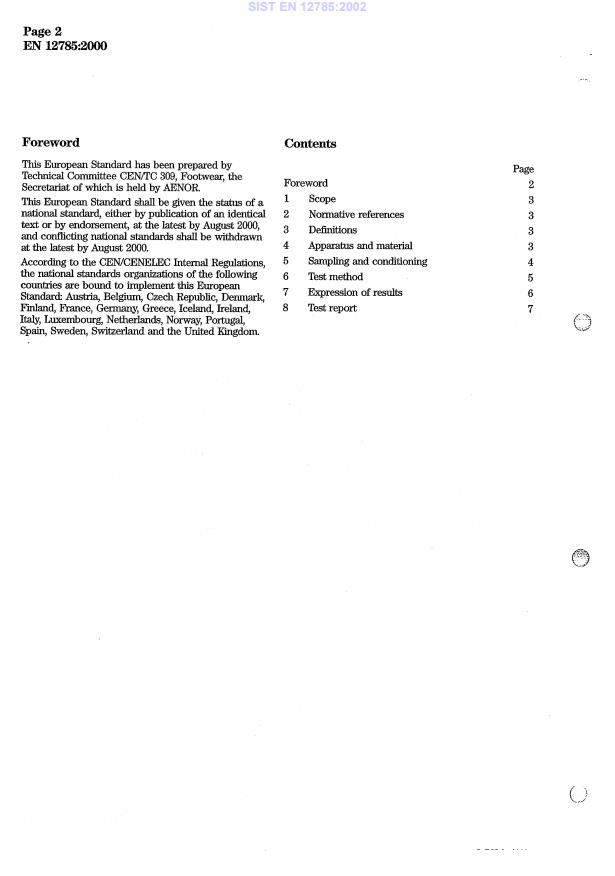
SIST EN 12785:2002 is a Slovene national standard from SIST for testing whole footwear, focused on heel attachment. It gives a test method for woman’s medium and high heeled footwear, and it is identical to EN 12785:2000. In practice, it is the reference you use when you need to measure how the heel and backpart behave under use and how much force is needed to detach the heel.
What does SIST EN 12785:2002 specify?
SIST EN 12785:2002 specifies a method for determining heel attachment on footwear. The method applies to woman’s medium and high heeled footwear, so it is aimed at styles where heel security and backpart behavior matter in wear.
The standard centers on one whole-shoe test method. It is used to assess three related properties:
- the rigidity of the shoe backpart during normal walking
- the permanent deformation of the backpart caused by a fairly large force applied to the heel in a backward direction
- the force required to detach the heel
That matters because heel attachment is not only about whether the heel comes off. It also covers how the backpart flexes and whether the shoe keeps its shape after loading, which affects wear performance and product evaluation.
What are the key requirements of SIST EN 12785:2002?
SIST EN 12785:2002 is a test-method standard, so its core value is the defined way of checking heel attachment performance on a whole shoe. For a reader in development, quality control, or purchasing, the important point is that the standard links heel attachment to measurable wear-related properties rather than a visual judgement.
The test applies to whole shoes
SIST EN 12785:2002 is for the whole shoe, not a separate component. That means the test is intended to evaluate the finished footwear as it will be worn, which is important when heel fixation depends on the interaction between heel, upper, and backpart.
It is limited to woman’s medium and high heeled footwear
SIST EN 12785:2002 applies specifically to woman’s medium and high heeled footwear. In practice, this tells the reader which product range the method is meant for and prevents using it as a general method for all footwear types.
It measures backpart rigidity during walking
SIST EN 12785:2002 includes measurement of the rigidity of the shoe backpart during normal walking. This matters because backpart stiffness affects comfort, support, and how the heel area behaves under repeated use.
It measures permanent deformation under a backward heel force
SIST EN 12785:2002 also checks the amount of permanent deformation in the backpart caused by a fairly large force applied to the heel in a backward direction. In practice, this shows whether the heel area stays shaped after loading or whether it deforms in a way that may affect appearance and performance.
It measures the force needed to detach the heel
SIST EN 12785:2002 includes the force required to detach the heel. This is the direct heel-attachment result that helps manufacturers, laboratories, and buyers compare shoes and judge whether heel retention is adequate for the intended product.
What terms does SIST EN 12785:2002 define?
Heel attachment - the part of the footwear test concerned with how securely the heel is fixed to the shoe.
Whole shoe - the finished footwear item tested as a complete product rather than as a loose component.
Backpart - the rear part of the shoe that includes the heel area and its surrounding structure.
Rigidity - how stiff the backpart is when the shoe is used in normal walking.
Permanent deformation - a lasting change in shape after force is applied to the backpart.
Woman’s medium and high heeled footwear - the footwear category to which the method applies.
Who uses SIST EN 12785:2002?
SIST EN 12785:2002 is used in the footwear industry by people who need to check heel security and rear-shoe performance on finished products. Typical users include test laboratories, product developers, quality managers, and buyers working with woman’s medium and high heeled footwear.
They use it to compare designs, verify production quality, and assess whether a shoe’s heel attachment and backpart behavior match the intended wear performance. It is also useful when technical purchasing decisions need a shared test method for supplier evaluation.
What changed in SIST EN 12785:2002 from the previous edition?
SIST EN 12785:2002 is the Slovene standard identical to EN 12785:2000.
What does the SIST EN 12785:2002 document contain?
SIST EN 12785:2002 contains the test-method framework for whole-shoe heel attachment. It describes the evaluation of backpart rigidity, permanent deformation under backward heel loading, and heel detachment force.
The document is intended for laboratory and product testing work on woman’s medium and high heeled footwear. It gives a common way to assess heel-area performance on the finished shoe, so results can be compared consistently across samples, suppliers, and production batches.
Relations
- Effective Date
- 28-Jan-2026
- Effective Date
- 28-Jan-2026
- Effective Date
- 18-Jan-2023
- Effective Date
- 01-Apr-2016
Frequently Asked Questions
SIST EN 12785:2002 is a standard published by the Slovenian Institute for Standardization (SIST). Its full title is "Footwear - Test methods for whole shoe - Heel attachment". This standard covers: This draft standard specifies a method for the determination of the heel attachment of footwear. It applies to woman's medium and high heeled footwear. This test method measures three related wear properties: - the rigidity of the shoe backpart during normal walking - the amount of permanent deformation of the backpart caused by a fairly large force applied to the heel in a backward direction - the force required to detach the heel.
This draft standard specifies a method for the determination of the heel attachment of footwear. It applies to woman's medium and high heeled footwear. This test method measures three related wear properties: - the rigidity of the shoe backpart during normal walking - the amount of permanent deformation of the backpart caused by a fairly large force applied to the heel in a backward direction - the force required to detach the heel.
SIST EN 12785:2002 is classified under the following ICS (International Classification for Standards) categories: 61.060 - Footwear. The ICS classification helps identify the subject area and facilitates finding related standards.
SIST EN 12785:2002 has the following relationships with other standards: It is inter standard links to SIST EN ISO 7500-1:2018, SIST EN 12222:2000, oSIST prEN ISO 22650:2016, oSIST prEN ISO 22650:2016. Understanding these relationships helps ensure you are using the most current and applicable version of the standard.
SIST EN 12785:2002 is available in PDF format for immediate download after purchase. The document can be added to your cart and obtained through the secure checkout process. Digital delivery ensures instant access to the complete standard document.
Standards Content (Sample)
2003-01.Slovenski inštitut za standardizacijo. Razmnoževanje celote ali delov tega standarda ni dovoljeno.Footwear - Test methods for whole shoe - Heel attachmentSchuhe - Prüfverfahren für den ganzen Schuh - AbsatzbefestigungChaussures - Méthodes d'essai applicables a la chaussure entiere - Fixation du talonFootwear - Test methods for whole
...