

SIST EN IEC 63132-1:2020
(Main)Guidance for installation procedures and tolerances of hydroelectric machines - Part 1: General aspects (IEC 63132-1:2020)
General Information
- Abstract
IEC 63132-1:2020 The purpose of this part of IEC 63132 is to establish, in a general way, suitable procedures and tolerances for the installation of hydroelectric turbines and generators. This document presents a typical assembly. There are many possible ways to assemble a unit. The size of the machines, design of the machines, layout of the powerhouse and delivery schedule of the components are some of the elements that could result in additional steps, the elimination of some steps and/or assembly sequences.
It is understood that a publication of this type will be binding only if, and to the extent that, both contracting parties have agreed upon it.
Installations for refurbishment projects or for small hydro projects are not in the scope of this document. An agreement between all parties is necessary.
This document excludes matters of purely commercial interest, except those inextricably bound up with the conduct of installation.
The tolerances in this document have been established upon best practices and experience, although it is recognized that other standards specify different tolerances.
Wherever this document specifies that documents, drawings or information is supplied by a manufacturer (or manufacturers), each individual manufacturer will furnish the appropriate information for their own supply only.
- Status
- Published
- Publication Date
- 21-Jun-2020
- Technical Committee
- IEHT - Electrotechnics - Hydraulic turbins
- Current Stage
- 6060 - National Implementation/Publication (Adopted Project)
- Start Date
- 12-Jun-2020
- Due Date
- 17-Aug-2020
- Completion Date
- 22-Jun-2020


Overview
EN IEC 63132-1:2020 (IEC 63132-1:2020) provides guidance for installation procedures and tolerances of hydroelectric machines with emphasis on general aspects of turbine and generator assembly. Published by CLC/CENELEC and aligned with IEC TC 4, this part defines a typical assembly workflow, common reference systems (axes, planes, centres), terminology and measurement concepts used during powerhouse installation. The document is intended as a practical reference for achieving correct mechanical and geometrical alignment of hydro units, while recognizing that site-specific layouts, machine designs and delivery schedules may require alternative sequences.
Key Topics and Requirements
- Scope and limits: Covers installation procedures and tolerances for new hydro turbines and generators; excludes refurbishment projects and small-hydro installations unless explicitly agreed by parties.
- Terminology and concepts: Defines reference centre, best centre, concentricity, circularity, axis of rotation, junctions, elevation, level, inclination and best-fit planes.
- Geometrical controls: Guidance on measuring and controlling concentricity, circularity, runout, shaft straightness, flatness, parallelism and orientation in plan.
- Clearances and dimensions: Descriptions of runner diameter and runner clearance, guide vane top/bottom clearances and guide vane-to-guide-vane clearance (no numerical tolerances are given here; tolerances are based on best practices and must be agreed contractually).
- Magnetic and mechanical centres: Procedures to establish stator magnetic centre, rotor magnetic centre, and checks for stator core verticality and rotor pole verticality.
- Supplier responsibilities: Manufacturers supply drawings and specific installation information relevant to their equipment; each supplier provides data only for their scope.
- Contractual binding: Recommendations are advisory and become binding only if incorporated into contractual agreements between the involved parties.
Applications
- Use during factory-to-site assembly and commissioning of medium to large hydroelectric units.
- Quality assurance and installation checklists for civil, mechanical and electrical contractors on powerhouse projects.
- Reference for site engineers and surveyors performing alignment, levelling and dimensional verification.
- Basis for writing installation contracts and acceptance criteria between owners, contractors and equipment suppliers.
Who should use this standard
- Hydro turbine and generator manufacturers
- Project owners and EPC contractors
- Site installation engineers, surveyors and commissioning teams
- Consulting engineers and technical auditors focused on hydroelectric plant installation
Related Standards
- IEC 63132 (other parts: Parts 2–4) - series continuation for detailed procedures
- IEC 60034-1, IEC 60193, IEC 62097 - referenced electromechanical and hydraulic machine standards (harmonized in context)
EN IEC 63132-1:2020 is a practical, non-prescriptive guide that helps ensure accurate mechanical alignment and consistent installation practices for hydroelectric machines when incorporated into project specifications and contracts.
Relations
- Effective Date
- 03-Feb-2026
Get Certified
Connect with accredited certification bodies for this standard

DNV
DNV is an independent assurance and risk management provider.

Lloyd's Register
Lloyd's Register is a global professional services organisation specialising in engineering and technology.
DNV Energy Systems
Energy and renewable energy certification.
Sponsored listings
Frequently Asked Questions
SIST EN IEC 63132-1:2020 is a standard published by the Slovenian Institute for Standardization (SIST). Its full title is "Guidance for installation procedures and tolerances of hydroelectric machines - Part 1: General aspects (IEC 63132-1:2020)". This standard covers: IEC 63132-1:2020 The purpose of this part of IEC 63132 is to establish, in a general way, suitable procedures and tolerances for the installation of hydroelectric turbines and generators. This document presents a typical assembly. There are many possible ways to assemble a unit. The size of the machines, design of the machines, layout of the powerhouse and delivery schedule of the components are some of the elements that could result in additional steps, the elimination of some steps and/or assembly sequences. It is understood that a publication of this type will be binding only if, and to the extent that, both contracting parties have agreed upon it. Installations for refurbishment projects or for small hydro projects are not in the scope of this document. An agreement between all parties is necessary. This document excludes matters of purely commercial interest, except those inextricably bound up with the conduct of installation. The tolerances in this document have been established upon best practices and experience, although it is recognized that other standards specify different tolerances. Wherever this document specifies that documents, drawings or information is supplied by a manufacturer (or manufacturers), each individual manufacturer will furnish the appropriate information for their own supply only.
IEC 63132-1:2020 The purpose of this part of IEC 63132 is to establish, in a general way, suitable procedures and tolerances for the installation of hydroelectric turbines and generators. This document presents a typical assembly. There are many possible ways to assemble a unit. The size of the machines, design of the machines, layout of the powerhouse and delivery schedule of the components are some of the elements that could result in additional steps, the elimination of some steps and/or assembly sequences. It is understood that a publication of this type will be binding only if, and to the extent that, both contracting parties have agreed upon it. Installations for refurbishment projects or for small hydro projects are not in the scope of this document. An agreement between all parties is necessary. This document excludes matters of purely commercial interest, except those inextricably bound up with the conduct of installation. The tolerances in this document have been established upon best practices and experience, although it is recognized that other standards specify different tolerances. Wherever this document specifies that documents, drawings or information is supplied by a manufacturer (or manufacturers), each individual manufacturer will furnish the appropriate information for their own supply only.
SIST EN IEC 63132-1:2020 is classified under the following ICS (International Classification for Standards) categories: 27.140 - Hydraulic energy engineering. The ICS classification helps identify the subject area and facilitates finding related standards.
SIST EN IEC 63132-1:2020 has the following relationships with other standards: It is inter standard links to SIST EN IEC 60034-33:2022. Understanding these relationships helps ensure you are using the most current and applicable version of the standard.
SIST EN IEC 63132-1:2020 is available in PDF format for immediate download after purchase. The document can be added to your cart and obtained through the secure checkout process. Digital delivery ensures instant access to the complete standard document.
Standards Content (Sample)
SLOVENSKI STANDARD
01-september-2020
Navodila za postopke vgradnje in tolerance hidroelektričnih strojev - 1.del: Splošni
vidiki (IEC 63132-1:2020)
Guidance for installation procedures and tolerances of hydroelectric machines - Part 1:
General aspects (IEC 63132-1:2020)
Leitfaden für Installations-Prozeduren und -Toleranzen von hydroelektrischen Maschinen
– Teil 1: Generelle Aspekte (IEC 63132-1:2020)
Lignes directrices des procédures et tolérances d'installation des machines
hydroélectriques - Partie 1: Aspects généraux (IEC 63132-1:2020)
Ta slovenski standard je istoveten z: EN IEC 63132-1:2020
ICS:
27.140 Vodna energija Hydraulic energy engineering
2003-01.Slovenski inštitut za standardizacijo. Razmnoževanje celote ali delov tega standarda ni dovoljeno.
EUROPEAN STANDARD EN IEC 63132-1
NORME EUROPÉENNE
EUROPÄISCHE NORM
June 2020
ICS 27.140
English Version
Guidance for installation procedures and tolerances of
hydroelectric machines - Part 1: General aspects
(IEC 63132-1:2020)
Lignes directrices des procédures et tolérances Leitfaden für Installations-Prozeduren und -Toleranzen von
d'installation des machines hydroélectriques - Partie 1: hydroelektrischen Maschinen - Teil 1: Generelle Aspekte
Aspects généraux (IEC 63132-1:2020)
(IEC 63132-1:2020)
This European Standard was approved by CENELEC on 2020-05-25. CENELEC members are bound to comply with the CEN/CENELEC
Internal Regulations which stipulate the conditions for giving this European Standard the status of a national standard without any alteration.
Up-to-date lists and bibliographical references concerning such national standards may be obtained on application to the CEN-CENELEC
Management Centre or to any CENELEC member.
This European Standard exists in three official versions (English, French, German). A version in any other language made by translation
under the responsibility of a CENELEC member into its own language and notified to the CEN-CENELEC Management Centre has the
same status as the official versions.
CENELEC members are the national electrotechnical committees of Austria, Belgium, Bulgaria, Croatia, Cyprus, the Czech Republic,
Denmark, Estonia, Finland, France, Germany, Greece, Hungary, Iceland, Ireland, Italy, Latvia, Lithuania, Luxembourg, Malta, the
Netherlands, Norway, Poland, Portugal, Republic of North Macedonia, Romania, Serbia, Slovakia, Slovenia, Spain, Sweden, Switzerland,
Turkey and the United Kingdom.
European Committee for Electrotechnical Standardization
Comité Européen de Normalisation Electrotechnique
Europäisches Komitee für Elektrotechnische Normung
CEN-CENELEC Management Centre: Rue de la Science 23, B-1040 Brussels
© 2020 CENELEC All rights of exploitation in any form and by any means reserved worldwide for CENELEC Members.
Ref. No. EN IEC 63132-1:2020 E
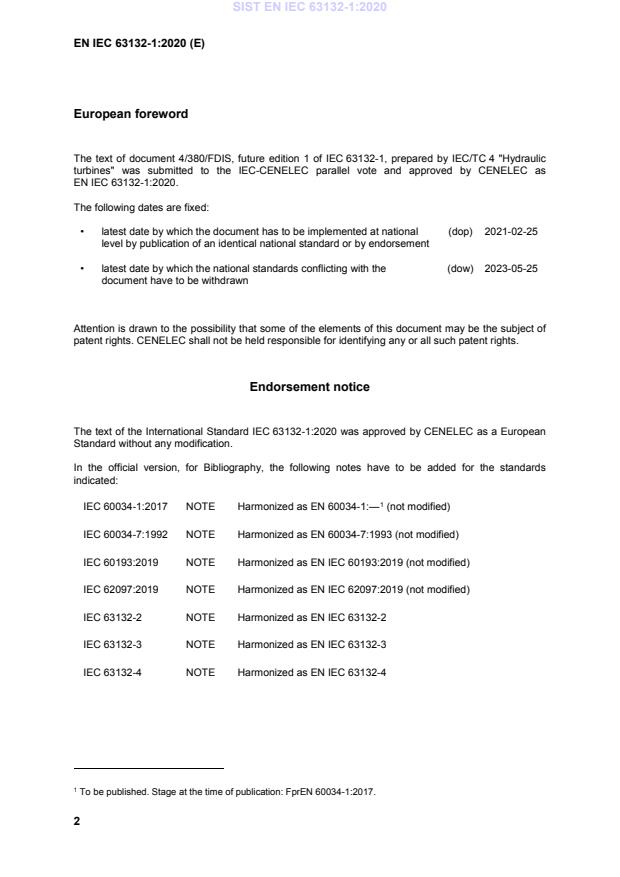
European foreword
The text of document 4/380/FDIS, future edition 1 of IEC 63132-1, prepared by IEC/TC 4 "Hydraulic
turbines" was submitted to the IEC-CENELEC parallel vote and approved by CENELEC as
The following dates are fixed:
• latest date by which the document has to be implemented at national (dop) 2021-02-25
level by publication of an identical national standard or by endorsement
• latest date by which the national standards conflicting with the (dow) 2023-05-25
document have to be withdrawn
Attention is drawn to the possibility that some of the elements of this document may be the subject of
patent rights. CENELEC shall not be held responsible for identifying any or all such patent rights.
Endorsement notice
The text of the International Standard IEC 63132-1:2020 was approved by CENELEC as a European
Standard without any modification.
In the official version, for Bibliography, the following notes have to be added for the standards
indicated:
IEC 60034-1:2017 NOTE Harmonized as EN 60034-1:— (not modified)
IEC 60034-7:1992 NOTE Harmonized as EN 60034-7:1993 (not modified)
IEC 60193:2019 NOTE Harmonized as EN IEC 60193:2019 (not modified)
IEC 62097:2019 NOTE Harmonized as EN IEC 62097:2019 (not modified)
IEC 63132-2 NOTE Harmonized as EN IEC 63132-2
IEC 63132-3 NOTE Harmonized as EN IEC 63132-3
IEC 63132-4 NOTE Harmonized as EN IEC 63132-4
To be published. Stage at the time of publication: FprEN 60034-1:2017.
IEC 63132-1 ®
Edition 1.0 2020-04
INTERNATIONAL
STANDARD
NORME
INTERNATIONALE
colour
inside
Guidance for installation procedures and tolerances of hydroelectric machines –
Part 1: General aspects
Lignes directrices des procédures et tolérances d’installation des machines
hydroélectriques –
Partie 1: Aspects généraux
INTERNATIONAL
ELECTROTECHNICAL
COMMISSION
COMMISSION
ELECTROTECHNIQUE
INTERNATIONALE
ICS 27.140 ISBN 978-2-8322-8101-7
– 2 – IEC 63132-1:2020 © IEC 2020
CONTENTS
FOREWORD . 4
1 Scope . 6
2 Normative references . 6
3 Terms and definitions . 6
4 Concept . 6
4.1 General . 6
4.2 Reference centre . 7
4.3 Best centre . 7
4.4 Concentricity . 9
4.5 Circularity . 10
4.6 Reference horizontal plane . 11
4.7 Reference vertical plane . 11
4.8 Best fit plane . 11
4.9 Axis of rotation . 11
4.10 Junction . 11
4.11 Elevation . 12
4.12 Level . 13
4.13 Inclination . 13
4.14 Flatness in line . 14
4.15 Parallelism . 15
4.16 Orientation in plan . 16
4.17 Runner diameter . 16
4.18 Runner clearance . 17
4.19 Guide vane top clearance . 18
4.20 Guide vane bottom clearance . 19
4.21 Guide vane to guide vane clearance . 19
4.22 Shaft verticality . 19
4.23 Stator core verticality . 20
4.24 Rotor pole verticality . 21
4.25 Stator magnetic centre . 22
4.26 Rotor magnetic centre . 22
4.27 Diameter of stator core (D ) . 23
SC
4.28 Runout . 23
4.29 Shaft straightness . 24
4.30 Turbine/generator supplier . 25
5 Best practices . 25
Bibliography . 26
Figure 1 – Axes definition for vertical units . 7
Figure 2 – Best centre sample calculation . 9
Figure 3 – Concentricity . 10
Figure 4 – Circularity . 11
Figure 5 – Junction . 12
Figure 6 – Elevation . 13
Figure 7 – Level . 13
IEC 63132-1:2020 © IEC 2020 – 3 –
Figure 8 – Inclination . 14
Figure 9 – Flatness in line . 15
Figure 10 – Parallelism . 15
Figure 11 – Orientation in plan . 16
Figure 12 – Cases of runner diameters . 17
Figure 13 – Runner clearance . 18
Figure 14 – Guide vane top and bottom clearances. 19
Figure 15 – Guide vane to guide vane clearance. 19
Figure 16 – Shaft verticality . 20
Figure 17 – Stator core verticality . 21
Figure 18 – Rotor pole verticality . 21
Figure 19 – Stator magnetic centre . 22
Figure 20 – Rotor magnetic centre . 23
Figure 21 – Runout . 24
Figure 22 – Shaft straightness . 25
Table 1 – Sample calculation . 8
– 4 – IEC 63132-1:2020 © IEC 2020
INTERNATIONAL ELECTROTECHNICAL COMMISSION
____________
GUIDANCE FOR INSTALLATION PROCEDURES
AND TOLERANCES OF HYDROELECTRIC MACHINES –
Part 1: General aspects
FOREWORD
1) The International Electrotechnical Commission (IEC) is a worldwide organization for standardization comprising
all national electrotechnical committees (IEC National Committees). The object of IEC is to promote international
co-operation on all questions concerning standardization in the electrical and electronic fields. To this end and
in addition to other activities, IEC publishes International Standards, Technical Specifications, Technical Reports,
Publicly Available Specifications (PAS) and Guides (hereafter referred to as “IEC Publication(s)”). Their
preparation is entrusted to technical committees; any IEC National Committee interested in the subject dealt with
may participate in this preparatory work. International, governmental and non-governmental organizations liaising
with the IEC also participate in this preparation. IEC collaborates closely with the International Organization for
Standardization (ISO) in accordance with conditions determined by agreement between the two organizations.
2) The formal decisions or agreements of IEC on technical matters express, as nearly as possible, an international
consensus of opinion on the relevant subjects since each technical committee has representation from all
interested IEC National Committees.
3) IEC Publications have the form of recommendations for international use and are accepted by IEC National
Committees in that sense. While all reasonable efforts are made to ensure that the technical content of IEC
Publications is accurate, IEC cannot be held responsible for the way in which they are used or for any
misinterpretation by any end user.
4) In order to promote international uniformity, IEC National Committees undertake to apply IEC Publications
transparently to the maximum extent possible in their national and regional publications. Any divergence between
any IEC Publication and the corresponding national or regional publication shall be clearly indicated in the latter.
5) IEC itself does not provide any attestation of conformity. Independent certification bodies provide conformity
assessment services and, in some areas, access to IEC marks of conformity. IEC is not responsible for any
services carried out by independent certification bodies.
6) All users should ensure that they have the latest edition of this publication.
7) No liability shall attach to IEC or its directors, employees, servants or agents including individual experts and
members of its technical committees and IEC National Committees for any personal injury, property damage or
o
...