

kSIST FprEN ISO 21028-1:2026
(Main)Cryogenic vessels - Toughness requirements for materials at cryogenic temperature - Part 1: Temperatures below -80 degrees C (ISO/FDIS 21028‑1:2026)
- Abstract
This document specifies the toughness requirements of metallic materials for use at a temperature below −80 °C to ensure their suitability for cryogenic vessels.
This document does not apply to unalloyed steels and cast materials.
- Status
- Not Published
- Public Enquiry End Date
- 02-Jun-2024
- Technical Committee
- TLP - Pressure vessels
- Current Stage
- 5020 - Formal vote (FV) (Adopted Project)
- Start Date
- 22-Jul-2026
- Due Date
- 09-Sep-2026
- Completion Date
- 10-Aug-2026

kSIST FprEN ISO 21028-1:2026 is a SIST standard for cryogenic vessels that sets toughness requirements for metallic materials used below -80 °C. It tells manufacturers, test laboratories and inspectors how to verify that the material, welds and heat-affected zones are suitable for cryogenic service.
What does kSIST FprEN ISO 21028-1:2026 specify?
kSIST FprEN ISO 21028-1:2026 specifies the toughness requirements for metallic materials used at temperatures below -80 °C, so they can be used in cryogenic vessels. It applies to material selection and testing for vessel parts that will see very low operating temperatures.
The scope excludes unalloyed steels and cast materials. The document is organized into scope, normative references, terms and definitions, and toughness requirements, followed by an informative Annex ZA that links the European text to the Pressure Equipment Directive.
| Annex | What it covers |
|---|---|
| ZA | Relationship between the standard and the essential requirements of Directive 2014/68/EU for pressure equipment |
What are the key requirements of kSIST FprEN ISO 21028-1:2026?
kSIST FprEN ISO 21028-1:2026 requires the toughness of the material to be guaranteed by the producer or verified by impact testing on each heat (lot). For welded vessels, impact testing is also part of welding procedure qualification and production weld testing. In practice, this means the vessel maker must control both the incoming material and the welded joint.
Material coverage
For steels, the base material, welds and heat-affected zone must meet either the minimum impact energy or lateral expansion values at the minimum working temperature. Table 1 sets the values by steel group and test condition, including ferritic alloy steels and austenitic stainless steels. Nickel alloy steels must also comply with EN 10028-4.
Cold stretched vessels follow the toughness rules in ISO 21009-1 Annex C or ISO 20421-1 Annex D. That matters because a different vessel route can bring in extra testing or qualification requirements.
Aluminium and aluminium alloys, and copper and copper alloys, are treated differently because the document considers their low-temperature toughness high enough that impact tests are not needed. For a buyer or designer, this means the standard relies on material family selection rather than a toughness test for those materials.
Test pieces and methods
The toughness limits in Clause 4.2 are linked to Charpy V-notch test pieces, normally 10 mm by 10 mm. Thinner materials use reduced-section specimens, and plates under 5 mm thick, and their welds, are not impact tested. Clause 4.5 also fixes where specimens are taken from plates, welds and heat-affected zones.
For plates, three specimens are tested transverse to the rolling direction. For welds and heat-affected zones, the number and location of specimens depend on thickness, so the laboratory has to cut samples from the correct weld zones rather than from a convenient location.
Acceptance and retest rules
For impact energy, the average of three specimens must meet the specified minimum, and one result may fall below the limit if it is still at least 70 % of that value. If the first set fails, a second set of three is tested and the combined six results must satisfy the average rule and the limit on low individual values.
For lateral expansion, each set of three specimens must meet the required value. A retest is allowed only when one result is at least two-thirds of the requirement, and the average of the original three is at least the required value. If retesting still fails, reheat-treatment and a new set of specimens are allowed.
What terms does kSIST FprEN ISO 21028-1:2026 define?
- Minimum working temperature - the lowest temperature likely to be reached by the vessel or one of its components during operation.
- Impact energy - the energy absorbed by the Charpy specimen, used here as a toughness measure.
- Lateral expansion - the deformation measured opposite the notch, used alongside impact energy for acceptance.
- Heat-affected zone - the part of the base metal changed by welding and tested separately from the weld metal.
- Charpy pendulum impact test - the impact test method referenced from ISO 148-1 for measuring toughness.
- V-notch - the notched specimen shape used for the impact test pieces in this standard.
Who uses kSIST FprEN ISO 21028-1:2026?
This standard is used by cryogenic vessel designers, manufacturers, welding coordinators, materials suppliers, test laboratories and inspectors. They use it to choose suitable metals, qualify welds, cut and test specimens, review material certificates and decide whether a batch can be accepted for cryogenic service.
It is also relevant to quality managers and buyers in the pressure equipment supply chain. They use it when checking whether a proposed material and welding route fits a vessel intended for very low temperatures.
What changed in kSIST FprEN ISO 21028-1:2026 from the previous edition?
kSIST FprEN ISO 21028-1:2026 replaces ISO 21028-1:2016 and is described as technically revised. The changes stated in the foreword are:
- expansion of Clause 2, Normative references
- addition of Table 1 in Clause 4.2 for steel impact energy and lateral expansion requirements
Which standards are used with kSIST FprEN ISO 21028-1:2026?
- ISO 148-1 - gives the Charpy pendulum impact test method used for the toughness testing.
- EN 10028-4 - gives requirements for nickel alloy steels with specified low temperature properties.
- ISO 21009-1 - supplies the Annex C route for cold stretched vessels.
- ISO 20421-1 - supplies the Annex D route for large transportable vacuum-insulated vessels.
- ISO 6361-3 and ISO 6361-4 - are cited as examples showing that aluminium and aluminium alloys have sufficient low-temperature toughness without impact testing.
- EN 1652, EN 1653, EN 1981 and EN 12163 - are cited as examples for copper and copper alloys with sufficient low-temperature toughness.
What does the kSIST FprEN ISO 21028-1:2026 document contain?
The document contains one main requirements table, Table 1, which sets toughness criteria for steels by material group, temperature and specimen type. It also contains three figures that show where to take specimens from welds and heat-affected zones at different thicknesses.
Clause 4.5 gives the specimen dimensions, the number of specimens and the cutting locations for plates, welds and heat-affected zones. Clause 4.6 gives the acceptance and retest logic for impact energy and lateral expansion.
Annex ZA maps the standard to Directive 2014/68/EU for pressure equipment, showing which clauses relate to impact strength and material characteristics. The bibliography lists related vessel standards and material standards that support design, fabrication, inspection and testing work.
Relations
- Effective Date
- 01-May-2024
Get Certified
Connect with accredited certification bodies for this standard

Institut za varilstvo d.o.o. (Welding Institute)
Slovenia's leading welding institute since 1952. ISO 3834, EN 1090, pressure equipment certification, NDT personnel, welder qualification. Only IIW Au
Sponsored listings
Frequently Asked Questions
kSIST FprEN ISO 21028-1:2026 is a draft published by the Slovenian Institute for Standardization (SIST). Its full title is "Cryogenic vessels - Toughness requirements for materials at cryogenic temperature - Part 1: Temperatures below -80 degrees C (ISO/FDIS 21028‑1:2026)". This standard covers: This document specifies the toughness requirements of metallic materials for use at a temperature below −80 °C to ensure their suitability for cryogenic vessels. This document does not apply to unalloyed steels and cast materials.
This document specifies the toughness requirements of metallic materials for use at a temperature below −80 °C to ensure their suitability for cryogenic vessels. This document does not apply to unalloyed steels and cast materials.
kSIST FprEN ISO 21028-1:2026 is classified under the following ICS (International Classification for Standards) categories: 23.020.40 - Cryogenic vessels. The ICS classification helps identify the subject area and facilitates finding related standards.
kSIST FprEN ISO 21028-1:2026 has the following relationships with other standards: It is inter standard links to SIST EN ISO 21028-1:2017. Understanding these relationships helps ensure you are using the most current and applicable version of the standard.
kSIST FprEN ISO 21028-1:2026 is associated with the following European legislation: EU Directives/Regulations: 2008/68/EC, 2014/68/EU; Standardization Mandates: M/071, M/601, M/TDG. When a standard is cited in the Official Journal of the European Union, products manufactured in conformity with it benefit from a presumption of conformity with the essential requirements of the corresponding EU directive or regulation.
kSIST FprEN ISO 21028-1:2026 is available in PDF format for immediate download after purchase. The document can be added to your cart and obtained through the secure checkout process. Digital delivery ensures instant access to the complete standard document.
Standards Content (Sample)
SLOVENSKI STANDARD
oSIST prEN ISO 21028-1:2024
01-maj-2024
Kriogene posode - Zahteve za žilavost materialov pri kriogenih temperaturah - 1.
del: Temperature pod –80 °C (ISO/DIS 21028-1:2024)
Cryogenic vessels - Toughness requirements for materials at cryogenic temperature -
Part 1: Temperatures below -80 degrees C (ISO/DIS 21028-1:2024)
Kryo-Behälter - Zähigkeitsanforderungen an Werkstoffe bei kryogenen Temperaturen -
Teil 1: Temperaturen unter −80 °C (ISO/DIS 21028-1:2024)
Récipients cryogéniques - Exigences de ténacité pour les matériaux à température
cryogénique - Partie 1: Températures inférieures à -80 degrés C (ISO/DIS 21028-
1:2024)
Ta slovenski standard je istoveten z: prEN ISO 21028-1
ICS:
23.020.40 Proti mrazu odporne posode Cryogenic vessels
(kriogenske posode)
oSIST prEN ISO 21028-1:2024 en,fr,de
2003-01.Slovenski inštitut za standardizacijo. Razmnoževanje celote ali delov tega standarda ni dovoljeno.
oSIST prEN ISO 21028-1:2024
oSIST prEN ISO 21028-1:2024
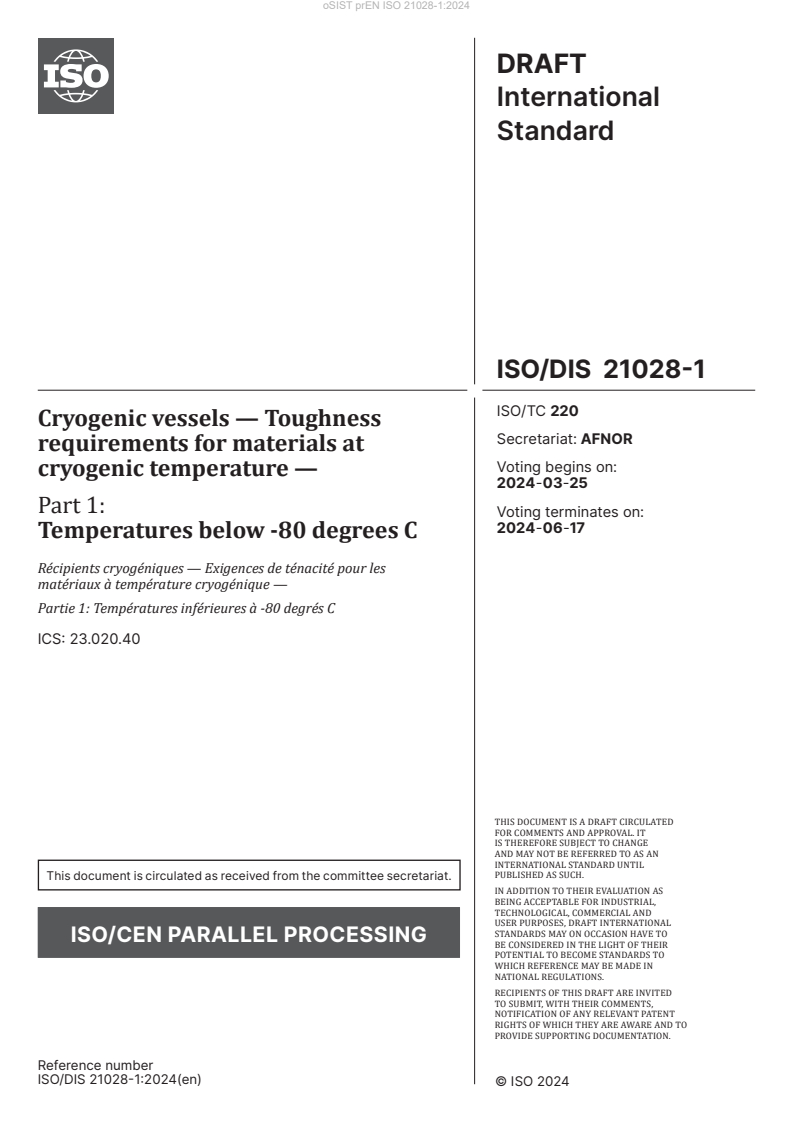
DRAFT
International
Standard
ISO/DIS 21028-1
ISO/TC 220
Cryogenic vessels — Toughness
Secretariat: AFNOR
requirements for materials at
Voting begins on:
cryogenic temperature —
2024-03-25
Part 1:
Voting terminates on:
2024-06-17
Temperatures below -80 degrees C
Récipients cryogéniques — Exigences de ténacité pour les
matériaux à température cryogénique —
Partie 1: Températures inférieures à -80 degrés C
ICS: 23.020.40
THIS DOCUMENT IS A DRAFT CIRCULATED
FOR COMMENTS AND APPROVAL. IT
IS THEREFORE SUBJECT TO CHANGE
AND MAY NOT BE REFERRED TO AS AN
INTERNATIONAL STANDARD UNTIL
PUBLISHED AS SUCH.
This document is circulated as received from the committee secretariat.
IN ADDITION TO THEIR EVALUATION AS
BEING ACCEPTABLE FOR INDUSTRIAL,
TECHNOLOGICAL, COMMERCIAL AND
USER PURPOSES, DRAFT INTERNATIONAL
STANDARDS MAY ON OCCASION HAVE TO
ISO/CEN PARALLEL PROCESSING
BE CONSIDERED IN THE LIGHT OF THEIR
POTENTIAL TO BECOME STANDARDS TO
WHICH REFERENCE MAY BE MADE IN
NATIONAL REGULATIONS.
RECIPIENTS OF THIS DRAFT ARE INVITED
TO SUBMIT, WITH THEIR COMMENTS,
NOTIFICATION OF ANY RELEVANT PATENT
RIGHTS OF WHICH THEY ARE AWARE AND TO
PROVIDE SUPPORTING DOCUMENTATION.
Reference number
ISO/DIS 21028-1:2024(en)
oSIST prEN ISO 21028-1:2024
DRAFT
ISO/DIS 21028-1:2024(en)
International
Standard
ISO/DIS 21028-1
ISO/TC 220
Cryogenic vessels — Toughness
Secretariat: AFNOR
requirements for materials at
Voting begins on:
cryogenic temperature —
Part 1:
Voting terminates on:
Temperatures below -80 degrees C
Récipients cryogéniques — Exigences de ténacité pour les
matériaux à température cryogénique —
Partie 1: Températures inférieures à -80 degrés C
ICS: 23.020.40
THIS DOCUMENT IS A DRAFT CIRCULATED
FOR COMMENTS AND APPROVAL. IT
IS THEREFORE SUBJECT TO CHANGE
AND MAY NOT BE REFERRED TO AS AN
INTERNATIONAL STANDARD UNTIL
PUBLISHED AS SUCH.
This document is circulated as received from the committee secretariat.
IN ADDITION TO THEIR EVALUATION AS
BEING ACCEPTABLE FOR INDUSTRIAL,
© ISO 2024
TECHNOLOGICAL, COMMERCIAL AND
USER PURPOSES, DRAFT INTERNATIONAL
All rights reserved. Unless otherwise specified, or required in the context of its implementation, no part of this publication may
STANDARDS MAY ON OCCASION HAVE TO
ISO/CEN PARALLEL PROCESSING
be reproduced or utilized otherwise in any form or by any means, electronic or mechanical, including photocopying, or posting on
BE CONSIDERED IN THE LIGHT OF THEIR
the internet or an intranet, without prior written permission. Permission can be requested from either ISO at the address below
POTENTIAL TO BECOME STANDARDS TO
WHICH REFERENCE MAY BE MADE IN
or ISO’s member body in the country of the requester.
NATIONAL REGULATIONS.
ISO copyright office
RECIPIENTS OF THIS DRAFT ARE INVITED
CP 401 • Ch. de Blandonnet 8
TO SUBMIT, WITH THEIR COMMENTS,
CH-1214 Vernier, Geneva
NOTIFICATION OF ANY RELEVANT PATENT
Phone: +41 22 749 01 11
RIGHTS OF WHICH THEY ARE AWARE AND TO
PROVIDE SUPPORTING DOCUMENTATION.
Email: copyright@iso.org
Website: www.iso.org
Published in Switzerland Reference number
ISO/DIS 21028-1:2024(en)
ii
oSIST prEN ISO 21028-1:2024
ISO/DIS 21028-1:2024(en)
Contents Page
Foreword .iv
Introduction .v
1 Scope . 1
2 Normative references . 1
3 Terms and definitions . 1
4 Toughness requirements . 1
4.1 General .1
4.2 Steels . . .2
4.3 Aluminium or aluminium alloys .2
4.4 Copper or copper alloys .2
4.5 Test methods .2
4.5.1 General .2
4.5.2 Test piece locations for plates .3
4.5.3 Test piece locations for welds and heat-affected zones .3
4.6 Acceptance criteria .5
4.6.1 For impact energy.5
4.6.2 For lateral expansion .5
Annex ZA (informative) Relationship between this European Standard and the essential
requirements of Directive 2014/68/EU (Pressure Equipment Directive) aimed to be
covered . 7
Bibliography . 8
iii
oSIST prEN ISO 21028-1:2024
ISO/DIS 21028-1:2024(en)
Foreword
ISO (the International Organization for Standardization) is a worldwide federation of national standards
bodies (ISO member bodies). The work of preparing International Standards is normally carried out through
ISO technical committees. Each member body interested in a subject for which a technical committee
has been established has the right to be represented on that committee. International organizations,
governmental and non-governmental, in liaison with ISO, also take part in the work. ISO collaborates closely
with the International Electrotechnical Commission (IEC) on all matters of electrotechnical standardization.
The procedures used to develop this document and those intended for its further maintenance are described
in the ISO/IEC Directives, Part 1. In particular the different approval criteria needed for the different types
of ISO documents should be noted. This document was drafted in accordance with the editorial rules of the
ISO/IEC Directives, Part 2 (see www.iso.org/directives).
ISO draws attention to the possibility that the implementation of this document may involve the use of (a)
patent(s). ISO takes no position concerning the evidence, validity or applicability of any claimed patent
rights in respect thereof. As of the date of publication of this document, ISO had not received notice of (a)
patent(s) which may be required to implement this document. However, implementers are cautioned that
this may not represent the latest information, which may be obtained from the patent database available at
www.iso.org/patents. ISO shall not be held responsible for identifying any or all such patent rights.
Any trade name used in this document is information given for the convenience of users and does not
constitute an endorsement.
For an explanation of the voluntary nature of standards, the meaning of ISO specific terms and expressions
related to conformity assessment, as well as information about ISO's adherence to the World Trade
Organization (WTO) principles in the Technical Barriers to Trade (TBT), see www.iso.org/iso/foreword.html.
This document was prepared by Technical Committee ISO/TC 220 Cryogenic vessels.
This third edition cancels and replaces the second edition (ISO 21028-1:2016), which has been technically
revised.
The main changes are as follows:
— Expansion of the Section 2: Normative references;
— Addition of Table 1 – Impact Energy and Lateral Expansion Requirements for Steels in Section 4.2: Steels.
A list of all parts in the ISO 21028 series can be found on the ISO website.
Any feedback or questions on this document should be directed to the user’s national standards body. A
complete listing of these bodies can be found at www.iso.org/members.html.
iv
oSIST prEN ISO 21028-1:2024
ISO/DIS 21028-1:2024(en)
Introduction
The use of materials at low temperatures entails special problems which are to be addressed. Consideration
is to be given, in particular, to changes in mechanical characteristics, expansion and contraction phenomena
and the thermal conduction of the various materials. Austenitic stainless steel can transform from the
austenitic to the martensitic phase when cooled down, leading to dimensional change that needs to be
considered during design.
However, the most important property to be considered is material to
...