

SIST ISO 1110:1975:2023
(Main)Plastics - Polyamide 66, 610 and 6 - Accelerated conditioning of test specimens
General Information
- Abstract
- Status
- Not Published
- Technical Committee
- IPMA - Polimer materials and products
- Current Stage
- 98 - Abandoned project (Adopted Project)
- Start Date
- 04-Jun-2024
- Due Date
- 09-Jun-2024
- Completion Date
- 04-Jun-2024
Buy Documents

ISO 1110:1975 - Plastics — Polyamide 66, 610 and 6 — Accelerated conditioning of test specimens Released:6/1/1975

ISO 1110:1975 - Matieres plastiques — Polyamides 66, 610 et 6 — Conditionnement accéléré d'éprouvettes Released:6/1/1975
Overview
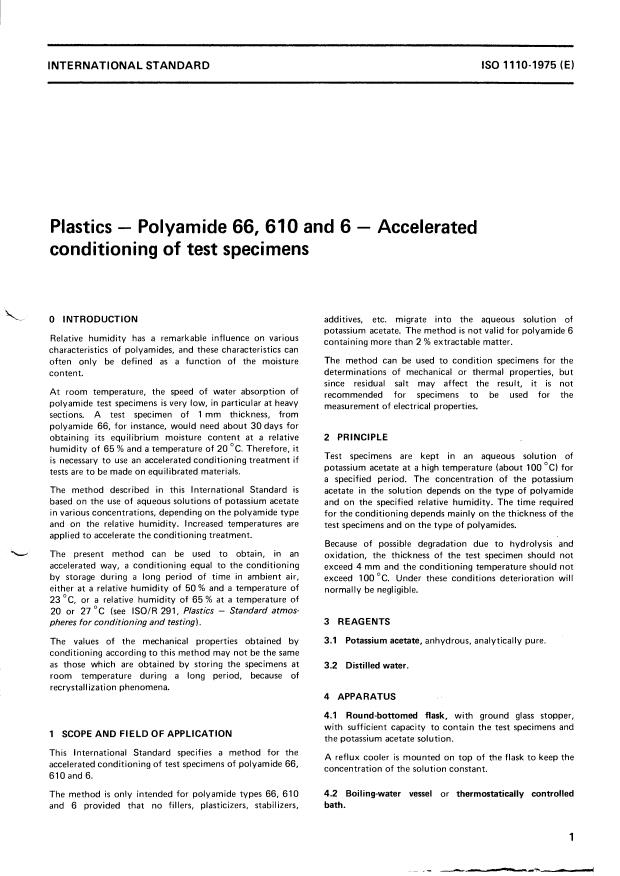
SIST ISO 1110:1975:2023 specifies a standardized method for the accelerated conditioning of test specimens made from polyamide 66, 610, and 6 plastics. Developed by the International Organization for Standardization (ISO), and adopted by SIST, this standard streamlines the preparation of polyamide test samples, ensuring consistency when measuring material properties. Moisture content significantly affects polyamide properties, making controlled and repeatable conditioning critical in product development, quality control, and international trade compliance.
Key Topics
- Accelerated Conditioning Method:
The standard details a laboratory procedure using heated aqueous potassium acetate solutions to simulate the long-term environmental conditioning of polyamide 66, 610, and 6 specimens. This approach drastically reduces preparation time compared to ambient storage methods. - Scope and Limitations:
- Applicable only to polyamide 66, 610, and 6, provided they contain negligible fillers, plasticizers, or stabilizers.
- Not suitable for polyamide 6 with over 2% extractable matter or for samples intended for electrical property testing, as residual salts may interfere.
- Testing Parameters:
- Conditioning is performed at 95 to 100°C using solutions with concentrations tailored to the specific polyamide grade and target relative humidity.
- The standard advises a maximum test specimen thickness of 4mm to prevent degradation.
- Reporting Requirements:
Standardized test reports must include specimen identification, conditioning solution concentration, temperature and time, achieved moisture content, and the test date.
Applications
SIST ISO 1110:1975:2023 is essential in various fields utilizing polyamide materials, such as automotive, electrical, construction, and manufacturing sectors. Key practical uses include:
- Quality Assurance:
Ensures that physical and mechanical property tests-like tensile strength, impact resistance, and thermal behavior-are based on specimens with a uniform moisture history. - Material Comparison:
Allows material engineers and product developers to meaningfully compare polyamide formulations and manufacturing lots by using standardized conditioning protocols. - Research and Development:
Speeds up laboratory testing cycles by enabling rapid equilibration of test samples, helping R&D teams optimize formulations or process conditions more efficiently. - Regulatory and Standards Compliance:
Supports compliance with international specifications for testing procedures, aiding in market access and certification processes.
Related Standards
For holistic material testing and quality control, consider referencing the following associated standards:
- ISO 291 - Plastics – Standard atmospheres for conditioning and testing:
Outlines standard ambient conditions for plastic testing, often used in conjunction with accelerated conditioning protocols. - ISO 527 - Plastics – Determination of tensile properties:
Specifies tensile testing methods for plastic specimens, frequently utilizing conditioned samples per ISO 1110. - ISO 62 - Plastics – Determination of water absorption:
Provides general procedures for measuring water uptake-a key property influenced by pre-test conditioning. - ISO/TC 61 - Plastics:
The technical committee responsible for standardization in the field of plastics, including polyamides.
By following SIST ISO 1110:1975:2023, organizations ensure that polyamide test specimens are conditioned rapidly and consistently, leading to reliable, comparable test results vital for product quality, innovation, and international trade.
Buy Documents
ISO 1110:1975 - Plastics — Polyamide 66, 610 and 6 — Accelerated conditioning of test specimens Released:6/1/1975
ISO 1110:1975 - Matieres plastiques — Polyamides 66, 610 et 6 — Conditionnement accéléré d'éprouvettes Released:6/1/1975
Get Certified
Connect with accredited certification bodies for this standard

DIN CERTCO
DIN Group product certification.

Smithers Quality Assessments
US management systems and product certification.
Sponsored listings
Frequently Asked Questions
SIST ISO 1110:1975:2023 is a standard published by the Slovenian Institute for Standardization (SIST). Its full title is "Plastics - Polyamide 66, 610 and 6 - Accelerated conditioning of test specimens". This standard covers: Plastics - Polyamide 66, 610 and 6 - Accelerated conditioning of test specimens
Plastics - Polyamide 66, 610 and 6 - Accelerated conditioning of test specimens
SIST ISO 1110:1975:2023 is classified under the following ICS (International Classification for Standards) categories: 83.080.20 - Thermoplastic materials. The ICS classification helps identify the subject area and facilitates finding related standards.
SIST ISO 1110:1975:2023 is available in PDF format for immediate download after purchase. The document can be added to your cart and obtained through the secure checkout process. Digital delivery ensures instant access to the complete standard document.
Standards Content (Sample)
INTERNATIONAL STANDARD
INTERNATIONAL ORGANIZATION FOR STANDARDIZATION *MEYilYHAPOLlHAS OPrAHMJAUMR il0 CTAHLIAPTMJAUMM .ORGANISATION INTERNATIONALE DE NORMALISATION
\
Plastics - Polyamide 66, 610 and 6 - Accelerated
conditioning of test specimens
Matières plastiques - Polyamides 66, 610 et 6 - Conditionnement accéléré d'éprouvettes
First edition - 1975-06-15
L
UDC 678.675 : 620.199 Ref. No. IS0 1110-1975 (E)
Descriptors : plastics, thermoplastic resins, polyamide resins, test Specimens, test specimen conditioning.
c
c
Price based on 2 pages
FOR E WORD
IS0 (the International -'rganization for Standardization) is a worldwide federation
of national standards institutes (IS0 Member Bodies). The work of developing
International Standards is carried out through IS0 Technical Committees. Every
Member Body interested in a subject for which a Technical Committee has been set
up has the right to be represented on that Committee. International organizations,
Y
governmental and non-governmental, in liaison with ISO, also take part in the work.
Draft International Standards adopted by the Technical Committees are circulated
to the Member Bodies for approval before their acceptance as International
Standards by the IS0 Council.
Prior to 1972, the results of the work of the Technical Committees were published
as IS0 Recommendations; these documents are now in the process of being
transformed into International Standards. As part of this process, Technical
Committee ISO/TC 61 has reviewed IS0 Recommendation R 11 10 and found it
technically suitable for transformation. International Standard IS0 11 10 therefore
replaces IS0 Recommendation R 11 10-1969 to which it is technically identical.
I
Member Bodies of the
IS0 Recommendation R 1110 was approved by the
following countries :
Austria Hungary Poland
Belgium India Romania
Bulgaria Iran South Africa, Rep. of
Czechoslovakia Israel Spain
Sweden
Egypt, Arab Rep. of Japan
Switzerland
France Korea, Dem. P. Rep. of
Germany Korea, Rep. of Turkey
Greece Netherlands U.S.A.
The Member Bodies of the following countries expressed disapproval of the
Recommendation on technical grounds :
Canada
Italy
United Kingdom
The Member Bodies of the following countries disapproved the transformation of
ISO/R 11 10 into an International Standard :
Canada
United Kingdom
d International Organization for Standardization, 1975
Printed in Switzerland
INTERNATIONAL STANDARD IS0 11 10-1975 (E)
Plastics - Polyamide 66, 610 and 6 - Accelerated
conditioning of test specimens
q- O INTRODUCTION additives, etc. migrate into the aqueous solution of
potassium acetate. The method is not valid for polyamide 6
Relative humidity has a remarkable influence on various
containing more than 2 % extractable matter.
characteristics of polyamides, and these characteristics can
The method can be used to condition specimens for the
often only be defined as a function of the moisture
determinations of mechanical or thermal properties, but
content.
since residual salt may affect the result, it is not
At room temperature, the speed of water absorption of
recommended for specimens to be used for the
polyamide test specimens is very low, in particular at heavy
measurement of electrical properties.
sections. A test specimen of 1 mm thickness, from
polyamide 66, for instance, would need about 30 days for
obtaining its equilibrium moisture content at a relative 2 PRINCIPLE
humidity of 65 % and a temperature of 20 OC. Therefore, it
Test specimens are kept in an aqueous solution of
is necessary to use an accelerated conditioning treatment if
potassium acetate at a high temperature (about 100 OC) for
tests are to be made on equilibrated materials.
a specified period. The concentration of the potassium
The method described in this International Standard is acetate in the solution depends on the type of polyamide
based on the use of aqueous solutions of potassium acetate
and on the specified relative humidity. The time required
in various concentrations, depending on the polyamide type
for the conditioning depends mainly on the thickness of the
and on the relativ
...
NORME INTERNATIONALE 111 O
INTERNATIONAL ORGANIZATION FOR STANDARDIZATION aMEXnYHAPOnHAR OPrAHH3AUHR II0 CTAHDAPTH3AUHH -ORGANISATION INTERNATIONALE DE NORMALISATION
~1
Matières plastiques - Polyamides 66, 610 et 6 -
Condition nemen t accéléré d'éprouvettes
Plastics - Polyamide 66, 610 and 6 - Accelerated conditioning of test specimens
Première édition - 1975-06-15
Réf. no : IS0 1110-1975 (FI
- U. CDU 678.675 : 620.199
m
?
Descripteurs : matière plastique, résine thermoplastique, résine polyamide, spécimen d'essai, conditionnement des éprouvettes.
O
c
U
Prix basé sur 2 pages
v)
r.
AVANT-PROPOS
L’ISO (Organisation Internationale de Normalisation) est une fédération mondiale
d‘organismes nationaux de normalisation (Comités Membres ISO). L’élaboration de
Normes Internationales est confiée aux Comités Techniques ISO. Chaque Comité
Membre intéressé par une étude a le droit de faire partie du Comité Technique
correspondant. Les organisations internationales, gouvernementales et non
gouvernementales, en liaison avec I‘ISO, participent également aux travaux.
Les Projets de Normes Internationales adoptés par les Comités Techniques sont
soumis aux Comités Membres pour approbation, avant leur acceptation comme
Normes Internationales par le Conseil de I‘ISO.
Avant 1972, les résultats des travaux des Comités Techniques étaient publiés
comme Recommandations ISO; maintenant, ces documents sont en cours de
transformation en Normes Internationales. Compte tenu de cette procédure, le
Comité Technique ISO/TC 61 a examiné la Recommandation ISO/R 1110 et est
d’avis qu’elle peut, du point de vue technique, être transformée en Norme
Internationale. La présente Norme Internationale remplace donc la
Recommandation ISO/R 11 10-1969 a laquelle elle est techniquement identique.
La Recommandation ISO/R 11 1 O avait été approuvée par les Comités Membres des
pays suivants :
Afrique du Sud, Rép. d’ Espagne Pays-Bas
Allemagne France Pologne
Autriche Grèce Roumanie
Belgique Hongrie Suède
Bulgarie Inde Suisse
Corée, Rép. de Iran Tchécoslovaquie
Israël Turquie
Corée, Rép. dém. p. de
Egypte, Rép. arabe d’ Japon U.S.A.
Les Comités Membres des pays suivants avaient désapprouvé la Recommandation
pour des raisons techniques :
Canada
Italie
Royaume-Uni
Les Comités Membres des pays suivants ont désapprouvé la transformation de la
Recommandation ISO/R 11 10 en Norme Internationale :
Canada
Royaume-Uni
O Organisation Internationale de Normalisation, 1975 0
Imprimé en Suisse
NORME INTERNATIONALE IS0 1110-1975 (F)
Matières plastiques - Polyamides 66, 610 et 6 -
Conditionnement accéléré d'éprouvettes
O INTRODUCTION Cette méthode ne traite que du conditionnement des
polyamides des types 66, 610 et 6, exempts de charges, de
L'état hygrométrique a une influence très importante sur
\.,
plastifiants, de stabilisants, d'adjuvants, etc., susceptibles de
les différentes Caractéristiques des polyamides,
migrer dans la solution d'acétate de potassium. La méthode
caractéristiques qui ne peuvent être définies qu'en fonction
n'est pas applicable au polyamide 6 dont la teneur en
de leur humidité.
matières extractibles est supérieure à 2 %.
À la température ambiante, la vitesse de reprise d'humidité
Cette méthode peut être utilisée pour conditionner des
par des éprouvettes en polyamide est extrêmement lente, et
éprouvettes dans le but de déterminer des propriétés
cela d'autant plus que leur épaisseur est importante. Par
mécaniques ou thermiques mais, étant donné que du sel
exemple, une éprouvette de 1 mm d'épaisseur en polyamide
résiduel affecte les résultats, elle n'est pas recommandée
de type 66 n'atteint une teneur en eau constante qu'au
pour des éprouvettes destinées à des mesurages électriques.
bout de 30 jours environ dans une atmosphère d'humidité
relative 65 % et de température 20 OC. II est donc nécessaire
d'utiliser une méthode de conditionnement accéléré si des 2 PRINCIPE
à l'état
essais doivent être effectués sur des éprouvettes
Les éprouvettes sont mises dans une solution aqueuse
d'équilibre hygrométrique.
d'acétate de potassiu
...