

SIST EN 24883:2000
(Main)Hardmetals - Determination of contents of metallic elements by X-ray fluorescence - Solution method (ISO 4883:1978)
- Abstract
The solution method determines cobalt, iron, manganese, molybdenum, nickel, niobium, tantalum, titanium, tungsten, vanadium and zirconium. Is applicable to carbides of niobium, tantalum, titanium, vanadium, tungsten and zirconium, mixtures of these carbides and binder metals, all grades of presintered or sintered hardmetals, produce from these carbides, with the minimum element contents shown in table 1.
- Status
- Published
- Publication Date
- 30-Nov-2000
- Technical Committee
- SS SPL - Technical Board for the general field
- Current Stage
- 6060 - National Implementation/Publication (Adopted Project)
- Start Date
- 01-Dec-2000
- Due Date
- 01-Dec-2000
- Completion Date
- 01-Dec-2000


SIST EN 24883:2000 is a Slovenian standard published by SIST that adopts EN 24883:1993 and carries the title Hardmetals - Determination of contents of metallic elements by X-ray fluorescence - Solution method (ISO 4883:1978). It specifies a solution method for determining cobalt, iron, manganese, molybdenum, nickel, niobium, tantalum, titanium, tungsten, vanadium and zirconium in hardmetals and related carbide materials. In practice, it is the document to use when a dissolved-sample X-ray fluorescence measurement is needed for these metallic elements.
What does SIST EN 24883:2000 specify?
SIST EN 24883:2000 specifies a solution method based on X-ray fluorescence for carbide materials and hardmetals. It applies to carbides of niobium, tantalum, titanium, vanadium, tungsten and zirconium, to mixtures of these carbides with binder metals, and to presintered or sintered hardmetals made from them, provided the element contents meet the minimum values in Table 1.
The document is organized into clauses covering scope, principle, interfering elements, reagents, apparatus, sampling, procedure, X-ray fluorescence analysis, calibration curves, expression of results, and test report. The tables support the method by setting applicability limits, analytical lines, repeatability tolerances, and rounding rules.
What are the key requirements of SIST EN 24883:2000?
Scope, principle, and interference
- Clauses 1 to 4 define the analytical target and the method principle. SIST EN 24883:2000 measures the intensity of characteristic X-ray radiation after the test portion is dissolved in hydrofluoric and nitric acids. This matters because dissolving the material reduces particle-size effects and helps make the measurement comparable from sample to sample.
- Clause 4 says to take interfering elements into account, including line interference of titanium and tungsten on vanadium. In practice, the analyst must check whether the chosen measurement line is affected by another element in the same sample.
Reagents, apparatus, and sampling
- Clause 5 requires analytical-grade reagents and distilled or equivalent-purity water. The method uses hydrofluoric acid, nitric acid, a solvent solution, and tartaric acid solution. This means the laboratory has to control reagent quality because the result depends on clean dissolution chemistry.
- Clause 6 calls for ordinary laboratory apparatus, an X-ray spectrometer suitable for solution analysis, and acid-resistant sample cells with a 6 µm polyethylene terephthalate film window. This matters because the sample solution is chemically aggressive and the cell must not contaminate or leak.
- Clause 7 requires the sample to be crushed in a mortar that does not alter its composition, then passed through a 2 mm sieve. The analysis is carried out on two or three test portions, which helps check representativeness.
Procedure, calibration, and result treatment
- Clause 8 gives the dissolution and preparation sequence: weigh 2 g of test sample, add the solvent solution, heat on a water bath, transfer to a volumetric flask with tartaric acid solution, make up to volume, filter, fill the cell, and measure. In practice, this is the core bench procedure the analyst follows step by step.
- Clauses 9 and 10 cover measurement and calibration. The spectrometer settings are chosen to obtain the best counting statistics, the analytical lines are specified in Table 2, background corrections are made when needed, and calibration uses at least five samples prepared from known amounts of pure metals or suitable compounds. Separate calibration curves are required for different types of hardmetals, so the lab cannot assume one curve fits every product family.
- Clause 11 gives the acceptance limits for agreement between independent determinations and the rounding rules for the final result in Tables 3 and 4. This tells the user how to decide whether repeated measurements are close enough and how to report the number.
- Clause 12 defines the test report contents, including the standard reference, sample identification, result, any optional or non-standard operations, and any occurrence that may have affected the result. This is the information a buyer, customer, or auditor will expect to see.
What terms does SIST EN 24883:2000 define?
- Hardmetals - carbide-based materials covered by the method, including presintered and sintered grades.
- Binder metals - the metallic part mixed with the carbides in the material.
- Test portion - the weighed part of the sample that is dissolved and measured.
- External standard - a calibration sample of approximately the same composition as the test sample, used as the reference in the count-rate ratio.
- Calibration sample - a sample made from accurately known amounts of pure metals or suitable compounds for building calibration curves.
- Analytical line - the selected X-ray line used for each element, as listed in Table 2.
- Background correction - an adjustment applied when needed to remove non-element signal from the measurement.
Who uses SIST EN 24883:2000?
SIST EN 24883:2000 is used by laboratory analysts, quality control staff, and technical buyers working with hardmetals, carbide mixtures, and sintered powder-metallurgy products. It is relevant in production laboratories, incoming inspection, and contract test laboratories that need a repeatable chemical method for metallic element content. It also helps quality managers review whether reported results were obtained and documented in the prescribed way.
What does the SIST EN 24883:2000 document contain?
The document contains the full analytical workflow rather than only a result statement. It gives the applicability limits in Table 1, the selected analytical lines in Table 2, the acceptance tolerances in Table 3, and the rounding rules in Table 4. It also describes reagent preparation, sample crushing, dissolution, filtration, spectrometer measurement, calibration-curve construction, and the required contents of the test report.
Get Certified
Connect with accredited certification bodies for this standard

Element Materials Technology
Materials testing and product certification.

Inštitut za kovinske materiale in tehnologije
Institute of Metals and Technology. Materials testing, metallurgical analysis, NDT.
Sponsored listings
Frequently Asked Questions
SIST EN 24883:2000 is a standard published by the Slovenian Institute for Standardization (SIST). Its full title is "Hardmetals - Determination of contents of metallic elements by X-ray fluorescence - Solution method (ISO 4883:1978)". This standard covers: The solution method determines cobalt, iron, manganese, molybdenum, nickel, niobium, tantalum, titanium, tungsten, vanadium and zirconium. Is applicable to carbides of niobium, tantalum, titanium, vanadium, tungsten and zirconium, mixtures of these carbides and binder metals, all grades of presintered or sintered hardmetals, produce from these carbides, with the minimum element contents shown in table 1.
The solution method determines cobalt, iron, manganese, molybdenum, nickel, niobium, tantalum, titanium, tungsten, vanadium and zirconium. Is applicable to carbides of niobium, tantalum, titanium, vanadium, tungsten and zirconium, mixtures of these carbides and binder metals, all grades of presintered or sintered hardmetals, produce from these carbides, with the minimum element contents shown in table 1.
SIST EN 24883:2000 is classified under the following ICS (International Classification for Standards) categories: 77.160 - Powder metallurgy. The ICS classification helps identify the subject area and facilitates finding related standards.
SIST EN 24883:2000 is available in PDF format for immediate download after purchase. The document can be added to your cart and obtained through the secure checkout process. Digital delivery ensures instant access to the complete standard document.
Standards Content (Sample)
SLOVENSKI STANDARD
01-december-2000
Hardmetals - Determination of contents of metallic elements by X-ray fluorescence
- Solution method (ISO 4883:1978)
Hardmetals - Determination of contents of metallic elements by X-ray fluorescence -
Solution method (ISO 4883:1978)
Hartmetalle - Bestimmung des Gehaltes metallischer Elemente durch
Röntgenfluoreszenz - Lösungsverfahren (ISO 4883:1978)
Métaux-durs - Dosage des éléments métalliques par fluorescence de rayons X -
Méthode par solution (ISO 4883:1978)
Ta slovenski standard je istoveten z: EN 24883:1993
ICS:
77.160 Metalurgija prahov Powder metallurgy
2003-01.Slovenski inštitut za standardizacijo. Razmnoževanje celote ali delov tega standarda ni dovoljeno.
INTERNATIONAL ‘STANDARD
INTERNATIONAL ORGANIZATION FOR STANDARDIZATION*MEWYHAPO,llHAR OPI-AHM3ALWlR fl0 CTAH~APTM3ALWWl.ORGANISATlON INTERNATIONALE DE NORMALISATION
. ,
:
Hardmetals - Determination ‘of contents of metallic elements
by X-ray fluorescence - Solution method
Mb taux-durs - Dosage des bfkmen ts metalliques par fluorescence de rayons X - Mthode par Solution
First edition - 1978-06-15
Ref. No. ISO 4883-1978 (E)
UDC 621.762 : 661.665.2 : 546.3 : 543.422.8
determination of content, metals, Cobalt, ironj manganke, molybdenum; nickel,
Descriptors : hardmetals, carbides, Chemical analysis,
X -ray fluorescence spectrometry
niobium, tantalum, titanium, tungsten, vanadium, zirconium, spectrophotometric analysis,
Price based on 2 pages
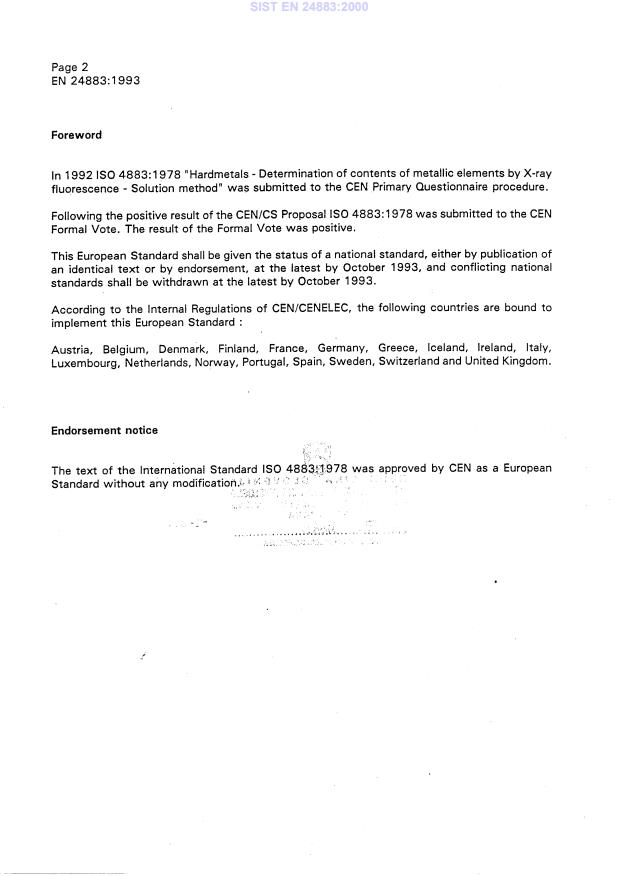
FOREWORD
ISO (the International Organization for Standardization) is a worldwide federation
of national Standards institutes (ISO member bodies). The work of developing
International Standards is carried out through ISO technical committees. Every
member body interested in a subject for which a technical committee has been set
up has the right to be represented on that committee. International organizations,
governmental and non-governmental, in liaison with ISO, also take part in the work.
Draft International Standards adopted by the technical committees are circulated
to the member bodies for approval before their acceptance as International
Standards by the ISO Council.
International Standard ISO 4883 was developed by Technical Committee
ISO/TC 119, Powder metallurgical materials and products, and was circulated
to the member bodies in December 1977.
lt has been approved by the member bodies of the following countries :
Germany South Africa, Rep. of
Australia
Austria I reland Spain
Bulgaria I taly Sweden
Canada Japan Turkey
Chile Korea, Rep. of United Kingdom
Mexico U.S.A
Czechoslovakia
Poland U.S.S. R
Egypt, Arab Rep. of
Romania
France
No member body expressed disapproval of the document.
@ International Organkation for Standardkation, 1978 l
Printed in Switzerland
INTERNATIONAL STANDARD
ISO 4883-1978 (El
Determination of contents of metallic elements
Hardmetals -
by X-ray fluorescence - Solution method
5 REAGENTS
1 SCOPE
During the analysis, use only reagents of recognized ana-
This International Standard specifies an X-ray f luorescence
lytical grade, and only distilled water or water of eouivalent
Solution method for the determination of Cobalt, iron,
nickel, niobium, tantalum, purity.
manganese, molybdenum,
vanadium and zirconium contents
titanium, tungsten,
of carbides and hardmetals.
5.1 Hydrofluoric acid, p 1 ,12 g/ml.
5.2 Nitrit acid, p 1,42 g/ml.
2 FIELD OF APPLICATION
The method is applicable to
5.3 Solvent Solution.
-
carbides of niobium, tantalum, titanium, vanadium,
Mix 2 Parts of the hydrofluoric acid (5.1), 1 part of the
tungsten and zirconium,
nitric acid (5.2) and 2 Parts of distilled water.
-
mixtures of these carbides and binder metals,
5.4 Tartaric acid Solution, 2
...