

SIST EN 301 549 V1.1.1:2014
(Main)Accessibility requirements for public procurement of ICT products and services in Europe
General Information
- Abstract
The present document specifies the functional accessibility requirements applicable to ICT products and services, together with a description of the test procedures and evaluation methodology for each accessibility requirement in a form that is suitable for use in public procurement within Europe. The present document might be useful for other purposes such as procurement in the private sector. The present document is intended to be used as the basis for an accessible ICT procurement toolkit. The present document will primarily be useful for public procurers to identify the requirements for their purchases, and also for manufacturers to employ it within their design, build and quality control procedures. The present document contains the necessary functional requirements and provides a reference document such that if procedures are followed by different actors, the results of testing are similar and the interpretation of those results is clear. The test descriptions and evaluation methodology included in the present document are elaborated to a level of detail compliant with ISO/IEC 17007:2009 [i.14], so that conformance testing can give conclusive results. The inherent nature of certain situations makes it impossible to make reliable and definitive statements that accessibility requirements have been met. In those situations therefore, the requirements in the present document are not applicable:
• when the product is in a failure, repair or maintenance state where the ordinary set of input or output functions are not available;
• during those parts of start-up, shutdown, and other state transitions that can be completed without user interaction.
NOTE 1: Even in the above situations, it is best practice to apply requirements in the present document wherever it is feasible and safe to do so.
NOTE 2: Compliance issues are covered in normative clause C.1.
- Status
- Published
- Public Enquiry End Date
- 31-May-2013
- Publication Date
- 06-Apr-2014
- Technical Committee
- SPN - Services and Protocols for Networks
- Current Stage
- 6060 - National Implementation/Publication (Adopted Project)
- Start Date
- 17-Mar-2014
- Due Date
- 22-May-2014
- Completion Date
- 07-Apr-2014
- Mandate
- M/376
Buy Documents
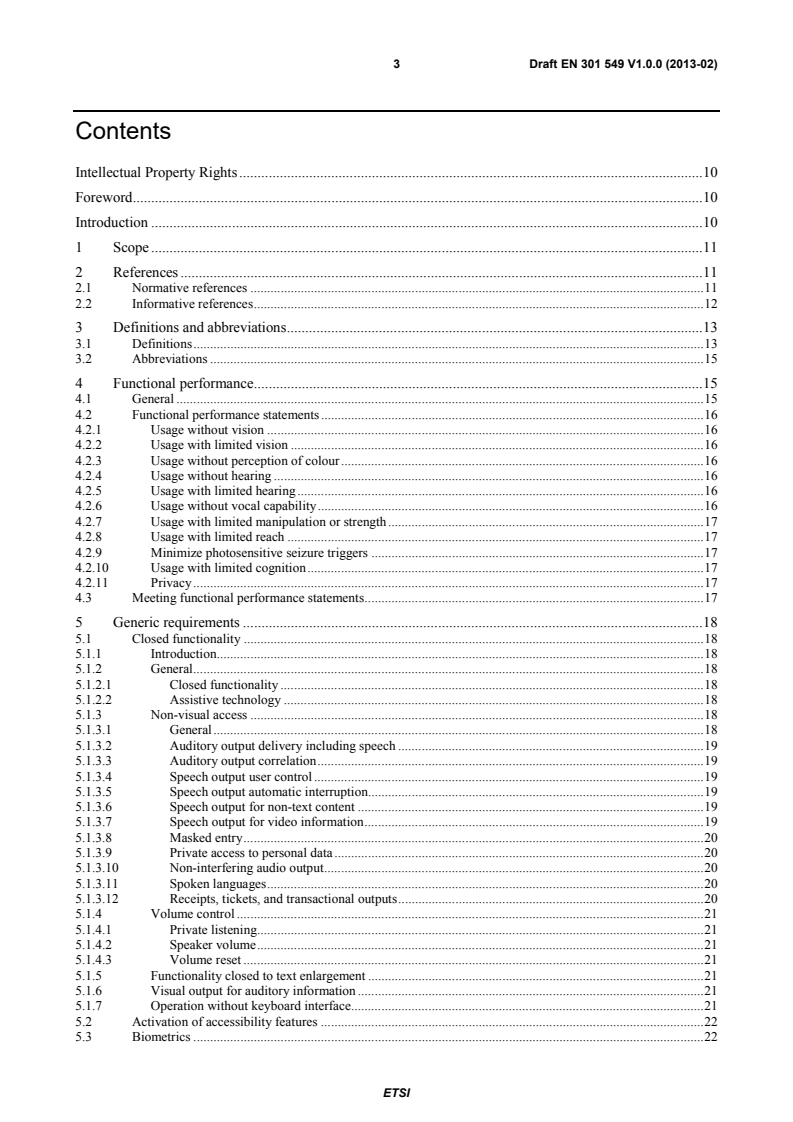
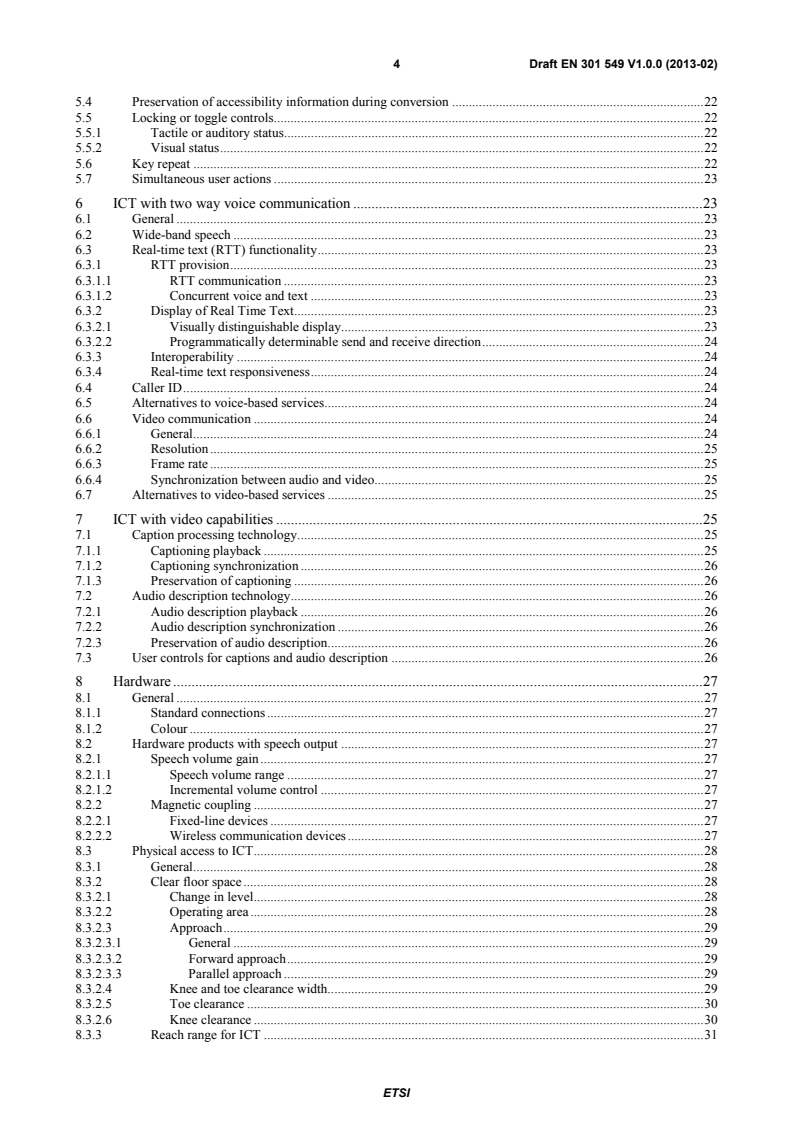
ETSI EN 301 549 V1.0.0 (2013-02) - Accessibility requirements for public procurement of ICT products and services in Europe
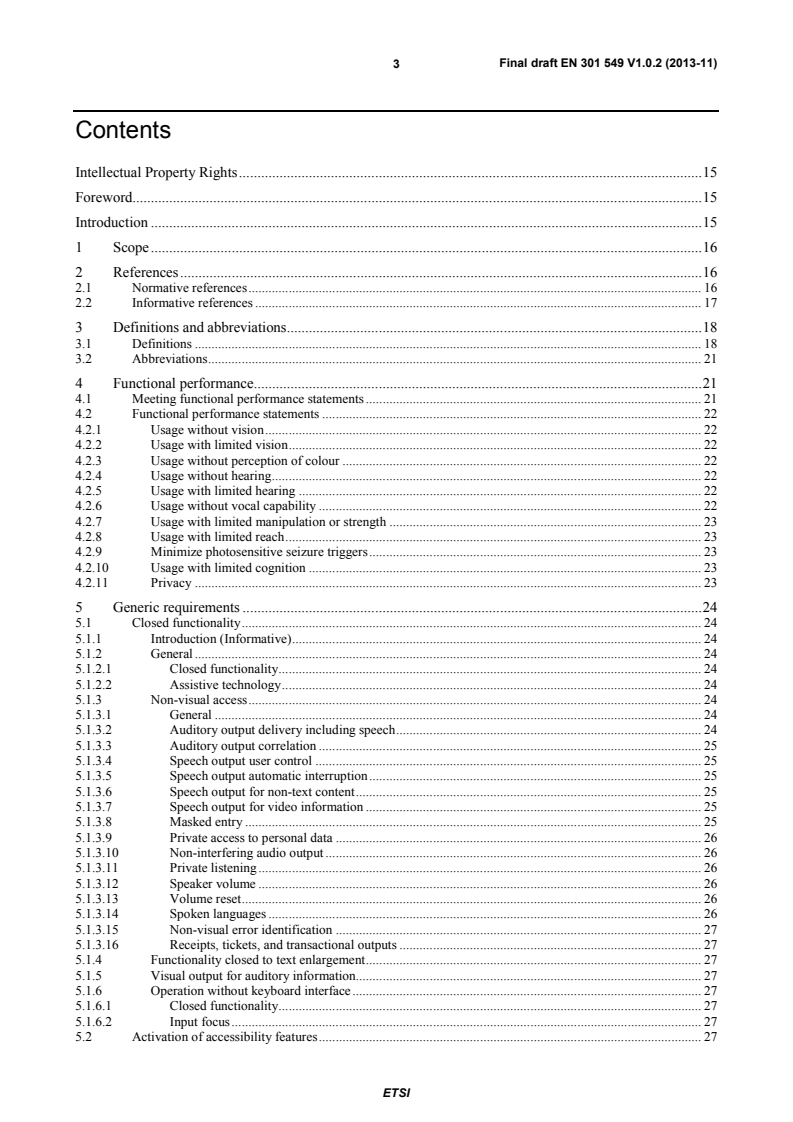
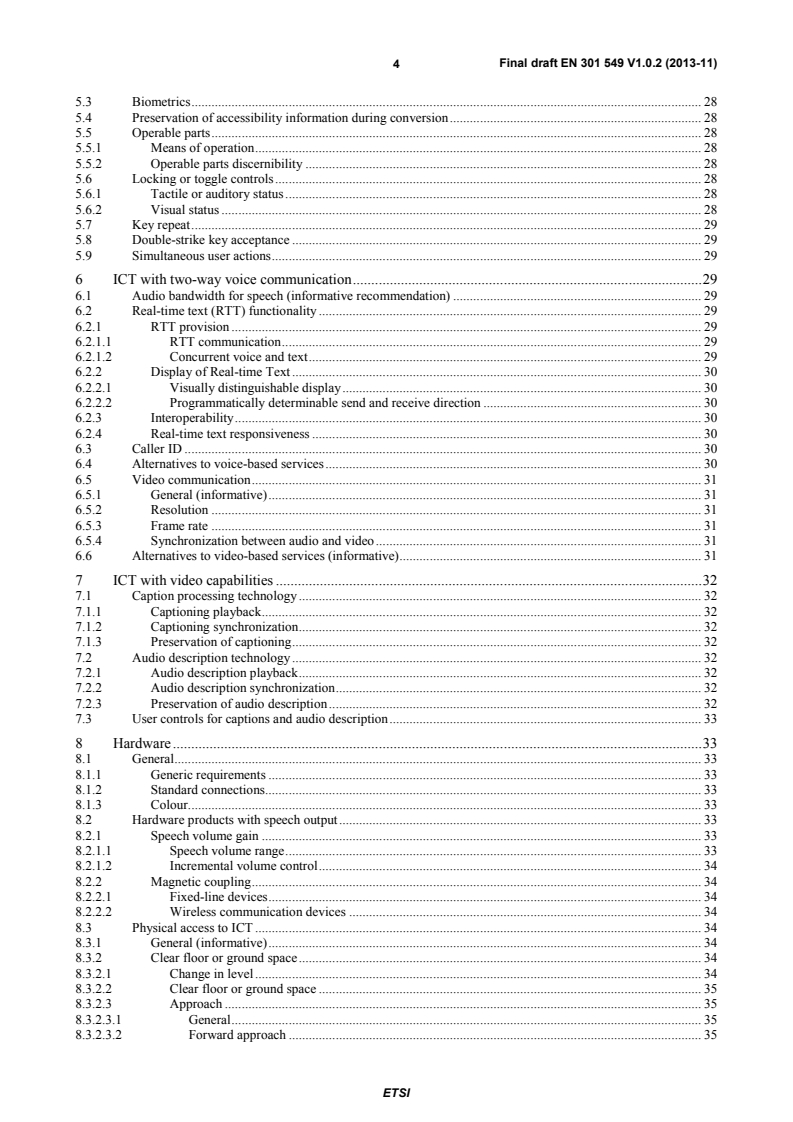
ETSI EN 301 549 V1.0.2 (2013-11) - Accessibility requirements suitable for public procurement of ICT products and services in Europe
ETSI EN 301 549 V1.1.1 (2014-02) - Accessibility requirements suitable for public procurement of ICT products and services in Europe

Overview
SIST EN 301 549 V1.1.1:2014 - EN 301 549 - defines accessibility requirements for public procurement of ICT products and services in Europe. It specifies functional accessibility requirements, associated test procedures and an evaluation methodology suitable for use in public procurement. The document is produced by ETSI/CEN/CENELEC and is intended as the basis for an accessible ICT procurement toolkit. Test descriptions are elaborated to a level compliant with ISO/IEC 17007:2009 so that conformance testing can give conclusive results.
Key topics and technical requirements
The standard covers a broad set of functional and technical accessibility topics for ICT, including:
- Functional performance statements for users with differing needs:
- Usage without vision or with limited vision
- Usage without or with limited hearing
- Usage with limited manipulation, reach, dexterity or strength
- Usage with limited cognition and color perception
- Privacy and photosensitive seizure minimization
- Generic requirements:
- Handling of closed functionality and activation of accessibility features
- Support for assistive technology and retention of accessibility information during format conversion
- Operable parts, tactile/auditory status of controls, locks/toggles, key repeat and simultaneous actions
- Biometrics and related accessibility considerations
- Real-time communication and media:
- Two-way voice communication: recommendations for real-time text (RTT), caller ID, and alternatives to voice
- Video capabilities: caption processing, audio description, synchronization and preservation of captions/descriptions
- Hardware-specific requirements:
- Speech output devices (volume control, incremental adjustments)
- Magnetic coupling for hearing devices (fixed-line and wireless)
- Physical access considerations (clear floor space, operable parts)
- Conformance & testing:
- Detailed test procedures and evaluation methodology to ensure consistent, repeatable conformance testing across actors
Note: requirements are not applicable during product failure/repair states or during start-up/shutdown transitions where ordinary I/O are unavailable, though applying accessibility where feasible is recommended.
Practical applications & who uses this standard
- Public procurers: to define accessibility clauses in ICT procurement (software, websites, hardware, communication services).
- Manufacturers and vendors: to design, build and verify products/services that meet procurement accessibility requirements.
- Test labs and QA teams: to perform conformance testing using the provided procedures and evaluation methodology.
- Procurement consultants and policy makers: to develop accessible ICT procurement toolkits and tender templates.
Related standards
- ISO/IEC 17007:2009 (conformance test method guidance) - referenced directly.
- Complementary accessibility guidance typically includes web/content standards such as WCAG for web content and other regional accessibility regulations.
Keywords: EN 301 549, SIST EN 301 549, ICT accessibility, public procurement, accessibility requirements, assistive technology, conformance testing, captions, real-time text, audio description.
Buy Documents
ETSI EN 301 549 V1.0.0 (2013-02) - Accessibility requirements for public procurement of ICT products and services in Europe
ETSI EN 301 549 V1.0.2 (2013-11) - Accessibility requirements suitable for public procurement of ICT products and services in Europe
ETSI EN 301 549 V1.1.1 (2014-02) - Accessibility requirements suitable for public procurement of ICT products and services in Europe
Get Certified
Connect with accredited certification bodies for this standard

ANCE
Mexican certification and testing association.

Intertek Slovenia
Intertek testing, inspection, and certification services in Slovenia.

LNE (Laboratoire National de Métrologie et d'Essais)
French national laboratory for metrology and testing.
Sponsored listings
Frequently Asked Questions
SIST EN 301 549 V1.1.1:2014 is a standard published by the Slovenian Institute for Standardization (SIST). Its full title is "Accessibility requirements for public procurement of ICT products and services in Europe". This standard covers: The present document specifies the functional accessibility requirements applicable to ICT products and services, together with a description of the test procedures and evaluation methodology for each accessibility requirement in a form that is suitable for use in public procurement within Europe. The present document might be useful for other purposes such as procurement in the private sector. The present document is intended to be used as the basis for an accessible ICT procurement toolkit. The present document will primarily be useful for public procurers to identify the requirements for their purchases, and also for manufacturers to employ it within their design, build and quality control procedures. The present document contains the necessary functional requirements and provides a reference document such that if procedures are followed by different actors, the results of testing are similar and the interpretation of those results is clear. The test descriptions and evaluation methodology included in the present document are elaborated to a level of detail compliant with ISO/IEC 17007:2009 [i.14], so that conformance testing can give conclusive results. The inherent nature of certain situations makes it impossible to make reliable and definitive statements that accessibility requirements have been met. In those situations therefore, the requirements in the present document are not applicable: • when the product is in a failure, repair or maintenance state where the ordinary set of input or output functions are not available; • during those parts of start-up, shutdown, and other state transitions that can be completed without user interaction. NOTE 1: Even in the above situations, it is best practice to apply requirements in the present document wherever it is feasible and safe to do so. NOTE 2: Compliance issues are covered in normative clause C.1.
The present document specifies the functional accessibility requirements applicable to ICT products and services, together with a description of the test procedures and evaluation methodology for each accessibility requirement in a form that is suitable for use in public procurement within Europe. The present document might be useful for other purposes such as procurement in the private sector. The present document is intended to be used as the basis for an accessible ICT procurement toolkit. The present document will primarily be useful for public procurers to identify the requirements for their purchases, and also for manufacturers to employ it within their design, build and quality control procedures. The present document contains the necessary functional requirements and provides a reference document such that if procedures are followed by different actors, the results of testing are similar and the interpretation of those results is clear. The test descriptions and evaluation methodology included in the present document are elaborated to a level of detail compliant with ISO/IEC 17007:2009 [i.14], so that conformance testing can give conclusive results. The inherent nature of certain situations makes it impossible to make reliable and definitive statements that accessibility requirements have been met. In those situations therefore, the requirements in the present document are not applicable: • when the product is in a failure, repair or maintenance state where the ordinary set of input or output functions are not available; • during those parts of start-up, shutdown, and other state transitions that can be completed without user interaction. NOTE 1: Even in the above situations, it is best practice to apply requirements in the present document wherever it is feasible and safe to do so. NOTE 2: Compliance issues are covered in normative clause C.1.
SIST EN 301 549 V1.1.1:2014 is classified under the following ICS (International Classification for Standards) categories: 33.030 - Telecommunication services. Applications. The ICS classification helps identify the subject area and facilitates finding related standards.
SIST EN 301 549 V1.1.1:2014 is associated with the following European legislation: Standardization Mandates: M/376. When a standard is cited in the Official Journal of the European Union, products manufactured in conformity with it benefit from a presumption of conformity with the essential requirements of the corresponding EU directive or regulation.
SIST EN 301 549 V1.1.1:2014 is available in PDF format for immediate download after purchase. The document can be added to your cart and obtained through the secure checkout process. Digital delivery ensures instant access to the complete standard document.
Standards Content (Sample)
Draft EN 301 549 V1.0.0 (2013-02)
European Standard
Accessibility requirements for public procurement of ICT
products and services in Europe
�
2 Draft EN 301 549 V1.0.0 (2013-02)
Reference
DEN/HF-00125
Keywords
accessibility, HF, ICT, procurement
CEN CENELEC ETSI
Avenue Marnix 17 Avenue Marnix 17 650 Route des Lucioles
B-1000 Brussels - BELGIUM B-1000 Brussels - BELGIUM F-06921 Sophia Antipolis Cedex - FRANCE
Tel: + 32 2 550 08 11 Tel.: +32 2 519 68 71 Tel.: +33 4 92 94 42 00
Fax: + 32 2 550 08 19 Fax: +32 2 519 69 19 Fax: +33 4 93 65 47 16
Siret N° 348 623 562 00017 - NAF 742 C
Association à but non lucratif enregistrée à la
Sous-Préfecture de Grasse (06) N° 7803/88
Important notice
Individual copies of the present document can be downloaded from:
http://www.etsi.org
The present document may be made available in more than one electronic version or in print. In any case of existing or
perceived difference in contents between such versions, the reference version is the Portable Document Format (PDF).
In case of dispute, the reference shall be the printing on ETSI printers of the PDF version kept on a specific network drive
within ETSI Secretariat.
Users of the present document should be aware that the document may be subject to revision or change of status.
Information on the current status of this and other ETSI documents is available at
http://portal.etsi.org/tb/status/status.asp
If you find errors in the present document, please send your comment to one of the following services:
http://portal.etsi.org/chaircor/ETSI_support.asp
Copyright Notification
No part may be reproduced except as authorized by written permission.
The copyright and the foregoing restriction extend to reproduction in all media.
© European Telecommunications Standards Institute 2013.
© Comité Européen de Normalisation 2013.
© Comité Européen de Normalisation Electrotechnique 2013.
All rights reserved.
TM TM TM
DECT , PLUGTESTS , UMTS and the ETSI logo are Trade Marks of ETSI registered for the benefit of its Members.
TM
3GPP and LTE™ are Trade Marks of ETSI registered for the benefit of its Members and
of the 3GPP Organizational Partners.
GSM® and the GSM logo are Trade Marks registered and owned by the GSM Association.
ETSI
3 Draft EN 301 549 V1.0.0 (2013-02)
Contents
Intellectual Property Rights . 10
Foreword . 10
Introduction . 10
1 Scope . 11
2 References . 11
2.1 Normative references . 11
2.2 Informative references . 12
3 Definitions and abbreviations . 13
3.1 Definitions . 13
3.2 Abbreviations . 15
4 Functional performance . 15
4.1 General . 15
4.2 Functional performance statements . 16
4.2.1 Usage without vision . 16
4.2.2 Usage with limited vision . 16
4.2.3 Usage without perception of colour . 16
4.2.4 Usage without hearing . 16
4.2.5 Usage with limited hearing . 16
4.2.6 Usage without vocal capability . 16
4.2.7 Usage with limited manipulation or strength . 17
4.2.8 Usage with limited reach . 17
4.2.9 Minimize photosensitive seizure triggers . 17
4.2.10 Usage with limited cognition . 17
4.2.11 Privacy . 17
4.3 Meeting functional performance statements . 17
5 Generic requirements . 18
5.1 Closed functionality . 18
5.1.1 Introduction. 18
5.1.2 General . 18
5.1.2.1 Closed functionality . 18
5.1.2.2 Assistive technology . 18
5.1.3 Non-visual access . 18
5.1.3.1 General . 18
5.1.3.2 Auditory output delivery including speech . 19
5.1.3.3 Auditory output correlation . 19
5.1.3.4 Speech output user control . 19
5.1.3.5 Speech output automatic interruption. 19
5.1.3.6 Speech output for non-text content . 19
5.1.3.7 Speech output for video information . 19
5.1.3.8 Masked entry . 20
5.1.3.9 Private access to personal data . 20
5.1.3.10 Non-interfering audio output . 20
5.1.3.11 Spoken languages . 20
5.1.3.12 Receipts, tickets, and transactional outputs . 20
5.1.4 Volume control . 21
5.1.4.1 Private listening . 21
5.1.4.2 Speaker volume . 21
5.1.4.3 Volume reset . 21
5.1.5 Functionality closed to text enlargement . 21
5.1.6 Visual output for auditory information . 21
5.1.7 Operation without keyboard interface. 21
5.2 Activation of accessibility features . 22
5.3 Biometrics . 22
ETSI
4 Draft EN 301 549 V1.0.0 (2013-02)
5.4 Preservation of accessibility information during conversion . 22
5.5 Locking or toggle controls. 22
5.5.1 Tactile or auditory status . 22
5.5.2 Visual status . 22
5.6 Key repeat . 22
5.7 Simultaneous user actions . 23
6 ICT with two way voice communication . 23
6.1 General . 23
6.2 Wide-band speech . 23
6.3 Real-time text (RTT) functionality . 23
6.3.1 RTT provision . 23
6.3.1.1 RTT communication . 23
6.3.1.2 Concurrent voice and text . 23
6.3.2 Display of Real Time Text . 23
6.3.2.1 Visually distinguishable display. 23
6.3.2.2 Programmatically determinable send and receive direction . 24
6.3.3 Interoperability . 24
6.3.4 Real-time text responsiveness . 24
6.4 Caller ID . 24
6.5 Alternatives to voice-based services. 24
6.6 Video communication . 24
6.6.1 General . 24
6.6.2 Resolution . 25
6.6.3 Frame rate . 25
6.6.4 Synchronization between audio and video . 25
6.7 Alternatives to video-based services . 25
7 ICT with video capabilities . 25
7.1 Caption processing technology. 25
7.1.1 Captioning playback . 25
7.1.2 Captioning synchronization . 26
7.1.3 Preservation of captioning . 26
7.2 Audio description technology. 26
7.2.1 Audio description playback . 26
7.2.2 Audio description synchronization . 26
7.2.3 Preservation of audio description . 26
7.3 User controls for captions and audio description . 26
8 Hardware . 27
8.1 General . 27
8.1.1 Standard connections . 27
8.1.2 Colour . 27
8.2 Hardware products with speech output . 27
8.2.1 Speech volume gain . 27
8.2.1.1 Speech volume range . 27
8.2.1.2 Incremental volume control . 27
8.2.2 Magnetic coupling . 27
8.2.2.1 Fixed-line devices . 27
8.2.2.2 Wireless communication devices . 27
8.3 Physical access to ICT . 28
8.3.1 General . 28
8.3.2 Clear floor space . 28
8.3.2.1 Change in level . 28
8.3.2.2 Operating area . 28
8.3.2.3 Approach . 29
8.3.2.3.1 General . 29
8.3.2.3.2 Forward approach . 29
8.3.2.3.3 Parallel approach . 29
8.3.2.4 Knee and toe clearance width. 29
8.3.2.5 Toe clearance . 30
8.3.2.6 Knee clearance . 30
8.3.3 Reach range for ICT . 31
ETSI
5 Draft EN 301 549 V1.0.0 (2013-02)
8.3.3.1 Forward reach . 31
8.3.3.1.1 Unobstructed high forward reach . 31
8.3.3.1.2 Unobstructed low forward reach . 31
8.3.3.1.3 Obstructed reach . 31
8.3.3.2 Side reach . 32
8.3.3.2.1 Unobstructed high side reach . 32
8.3.3.2.2 Unobstructed low side reach . 32
8.3.3.2.3 Obstructed side reach . 32
8.3.4 Visibility . 33
8.3.5 Installation instructions . 33
8.4 Operable parts . 33
8.4.1 Operable part discernibility. 33
8.4.2 Numeric keys . 33
8.4.3 Operation . 33
8.4.4 Keys, tickets and fare cards . 33
8.5 Tactile indication of speech mode . 33
9 Web content . 34
10 Documents . 34
10.1 General . 34
10.2 Document success criteria . 34
11 Non-Web software . 44
11.1 General . 44
11.2 Software success criteria . 45
11.3 Interoperability with assistive technology . 55
11.3.1 Closed functionality . 55
11.3.2 Accessibility services . 55
11.3.2.1 Platform accessibility service support for software that provides a user interface . 55
11.3.2.2 Platform accessibility service support for assistive technologies . 56
11.3.2.3 Use of accessibility services . 56
11.3.2.4 Assistive technology . 56
11.3.2.5 Object information . 56
11.3.2.6 Row, column, and headers . 56
11.3.2.7 Values . 56
11.3.2.8 Label relationships . 56
11.3.2.9 Parent-child relationships . 57
11.3.2.10 Text . 57
11.3.2.11 List of available actions . 57
11.3.2.12 Execution of available actions. 57
11.3.2.13 Tracking of focus and selection attributes . 57
11.3.2.14 Modification of focus and selection attributes . 57
11.3.2.15 Change notification . 57
11.3.2.16 Modifications of states and properties. 58
11.3.2.17 Modifications of values and text . 58
11.4 Documented accessibility usage . 58
11.4.1 User control of accessibility features . 58
11.4.2 No disruption of accessibility features . 58
11.5 User preferences . 58
11.6 Authoring tools . 58
11.6.1 Content technology . 58
11.6.2 Accessible content creation. 59
11.6.3 Preservation of accessibility information in transformations . 59
11.6.4 Repair assistance . 59
11.6.5 Templates . 59
12 Documentation and support services . 59
12.1 Product documentation . 59
12.1.1 Accessibility and compatibility features . 59
12.1.2 Accessible documentation . 59
12.2 Support services . 60
12.2.1 General . 60
ETSI
6 Draft EN 301 549 V1.0.0 (2013-02)
12.2.2 Information on accessibility and compatibility features . 60
12.2.3 Effective communication . 60
12.2.4 Accessible documentation . 60
13 Relay and emergency services . 60
13.1 Relay services requirements . 60
13.1.1 Text relay services . 60
13.1.2 Sign relay services . 60
13.1.3 Lip-reading relay services . 61
13.1.4 Captioned telephony services . 61
13.1.5 Speech to speech relay services . 61
13.2 Access to relay services . 61
13.3 Access to emergency services . 61
Annex A (informative): WCAG 2.0 . . 62
A.1 Electronic attachment . 62
Annex B (informative): Relationships between requirements and functional performance
statements . 63
B.1 Relationships with WCAG 2.0 Success Criteria . 63
B.2 Relationships with the requirements in clauses 5 to 13 . 66
Annex C (normative): Determination of compliance . 70
C.1 Introduction . 70
C.2 Blank clause . 70
C.3 Blank clause . 70
C.4 Functional performance . 70
C.5 Generic requirements . 70
C.5.1 Closed functionality . 70
C.5.1.1 Introduction. 70
C.5.1.2 General . 70
C.5.1.2.1 Closed functionality . 70
C.5.1.2.2 Assistive technology . 70
C.5.1.3 Non-visual access . 71
C.5.1.3.1 General . 71
C.5.1.3.2 Auditory output delivery including speech . 71
C.5.1.3.3 Auditory output correlation . 71
C.5.1.3.4 Speech output user control . 71
C.5.1.3.5 Speech output automatic interruption. 71
C.5.1.3.6 Speech output for non-text content . 72
C.5.1.3.7 Speech output for video information . 72
C.5.1.3.8 Masked entry . 72
C.5.1.3.9 Private access to personal data . 72
C.5.1.3.10 Non-interfering audio output . 72
C.5.1.3.11 Spoken languages . 73
C.5.1.3.12 Receipts, tickets, and transactional outputs . 73
C.5.1.4 Volume control . 73
C.5.1.4.1 Private listening . 73
C.5.1.4.2 Speaker volume . 73
C.5.1.4.3 Volume reset . 74
C.5.1.5 Functionality closed to text enlargement . 74
C.5.1.6 Visual output for auditory information . 74
C.5.1.7 Operation without keyboard interface. 74
C.5.2 Activation of accessibility features . 74
C.5.3 Biometrics . 75
C.5.4 Preservation of accessibility information during conversion . 75
C.5.5 Locking or toggle controls. 75
ETSI
7 Draft EN 301 549 V1.0.0 (2013-02)
C.5.5.1 Tactile or auditory status . 75
C.5.5.2 Visual status . 76
C.5.6 Key repeat . 76
C.5.7 Simultaneous user actions . 76
C.6 ICT with two way voice communication . 76
C.6.1 General . 76
C.6.2 Wide-band speech . 76
C.6.3 Real Time Text (RTT) functionality . 77
C.6.3.1 RTT provision . 77
C.6.3.1.1 RTT communication . 77
C.6.3.1.2 Concurrent voice and text . 77
C.6.3.2 Display of Real Time Text . 77
C.6.3.2.1 Visually distinguishable display. 77
C.6.3.2.2 Programmatically determinable send and receive direction . 78
C.6.3.3 Interoperability . 78
C.6.3.4 Real Time Text responsiveness . 79
C.6.4 Caller ID . 79
C.6.5 Alternatives to voice-based services. 79
C.6.6 Video communication . 79
C.6.6.1 General . 79
C.6.6.2 Minimum Resolution . 79
C.6.6.3 Frame rate . 80
C.6.6.4 Synchronization between audio and video . 80
C.6.7 Alternatives to video-based services . 80
C.7 ICT with video capabilities . 80
C.7.1 Caption processing technology. 80
C.7.1.1 Captioning playback . 80
C.7.1.2 Captioning synchronization . 81
C.7.1.3 Preservation of captioning . 81
C.7.2 Audio description technology. 81
C.7.2.1 Audio description playback . 81
C.7.2.2 Audio description synchronization . 81
C.7.2.3 Preservation of audio description . 81
C.7.3 User controls for captions and audio description . 82
C.8 Hardware . 82
C.8.1 General . 82
C.8.1.1 Standard connections . 82
C.8.1.2 Colour . 82
C.8.2 Hardware products with speech output . 82
C.8.2.
...
Final draft EN 301 549 V1.0.2 (2013-11)
European Standard
Accessibility requirements suitable for public procurement of
ICT products and services in Europe
2 Final draft EN 301 549 V1.0.2 (2013-11)
Reference
DEN/HF-00125
Keywords
accessibility, HF, ICT, procurement
CEN CENELEC ETSI
Avenue Marnix 17 Avenue Marnix 17 650 Route des Lucioles
B-1000 Brussels - BELGIUM B-1000 Brussels - BELGIUM F-06921 Sophia Antipolis Cedex - FRANCE
Tel: + 32 2 550 08 11 Tel.: +32 2 519 68 71 Tel.: +33 4 92 94 42 00
Fax: + 32 2 550 08 19 Fax: +32 2 519 69 19 Fax: +33 4 93 65 47 16
Siret N° 348 623 562 00017 - NAF 742 C
Association à but non lucratif enregistrée à la
Sous-Préfecture de Grasse (06) N° 7803/88
Important notice
Individual copies of the present document can be downloaded from:
http://www.etsi.org
The present document may be made available in more than one electronic version or in print. In any case of existing or
perceived difference in contents between such versions, the reference version is the Portable Document Format (PDF).
In case of dispute, the reference shall be the printing on ETSI printers of the PDF version kept on a specific network drive
within ETSI Secretariat.
Users of the present document should be aware that the document may be subject to revision or change of status.
Information on the current status of this and other ETSI documents is available at
http://portal.etsi.org/tb/status/status.asp
If you find errors in the present document, please send your comment to one of the following services:
http://portal.etsi.org/chaircor/ETSI_support.asp
Copyright Notification
No part may be reproduced except as authorized by written permission.
The copyright and the foregoing restriction extend to reproduction in all media.
© European Telecommunications Standards Institute 2013.
© Comité Européen de Normalisation 2013.
© Comité Européen de Normalisation Electrotechnique 2013.
All rights reserved.
TM TM TM
DECT , PLUGTESTS , UMTS and the ETSI logo are Trade Marks of ETSI registered for the benefit of its Members.
TM
3GPP and LTE™ are Trade Marks of ETSI registered for the benefit of its Members and
of the 3GPP Organizational Partners.
GSM® and the GSM logo are Trade Marks registered and owned by the GSM Association.
ETSI
3 Final draft EN 301 549 V1.0.2 (2013-11)
Contents
Intellectual Property Rights . 15
Foreword. 15
Introduction . 15
1 Scope . 16
2 References . 16
2.1 Normative references . 16
2.2 Informative references . 17
3 Definitions and abbreviations . 18
3.1 Definitions . 18
3.2 Abbreviations . 21
4 Functional performance . 21
4.1 Meeting functional performance statements . 21
4.2 Functional performance statements . 22
4.2.1 Usage without vision . 22
4.2.2 Usage with limited vision . 22
4.2.3 Usage without perception of colour . 22
4.2.4 Usage without hearing . 22
4.2.5 Usage with limited hearing . 22
4.2.6 Usage without vocal capability . 22
4.2.7 Usage with limited manipulation or strength . 23
4.2.8 Usage with limited reach . 23
4.2.9 Minimize photosensitive seizure triggers . 23
4.2.10 Usage with limited cognition . 23
4.2.11 Privacy . 23
5 Generic requirements . 24
5.1 Closed functionality . 24
5.1.1 Introduction (Informative) . 24
5.1.2 General . 24
5.1.2.1 Closed functionality . 24
5.1.2.2 Assistive technology . 24
5.1.3 Non-visual access . 24
5.1.3.1 General . 24
5.1.3.2 Auditory output delivery including speech . 24
5.1.3.3 Auditory output correlation . 25
5.1.3.4 Speech output user control . 25
5.1.3.5 Speech output automatic interruption . 25
5.1.3.6 Speech output for non-text content . 25
5.1.3.7 Speech output for video information . 25
5.1.3.8 Masked entry . 25
5.1.3.9 Private access to personal data . 26
5.1.3.10 Non-interfering audio output . 26
5.1.3.11 Private listening . 26
5.1.3.12 Speaker volume . 26
5.1.3.13 Volume reset . 26
5.1.3.14 Spoken languages . 26
5.1.3.15 Non-visual error identification . 27
5.1.3.16 Receipts, tickets, and transactional outputs . 27
5.1.4 Functionality closed to text enlargement . 27
5.1.5 Visual output for auditory information. 27
5.1.6 Operation without keyboard interface . 27
5.1.6.1 Closed functionality . 27
5.1.6.2 Input focus . 27
5.2 Activation of accessibility features . 27
ETSI
4 Final draft EN 301 549 V1.0.2 (2013-11)
5.3 Biometrics . 28
5.4 Preservation of accessibility information during conversion . 28
5.5 Operable parts . 28
5.5.1 Means of operation . 28
5.5.2 Operable parts discernibility . 28
5.6 Locking or toggle controls . 28
5.6.1 Tactile or auditory status . 28
5.6.2 Visual status . 28
5.7 Key repeat . 29
5.8 Double-strike key acceptance . 29
5.9 Simultaneous user actions . 29
6 ICT with two-way voice communication . 29
6.1 Audio bandwidth for speech (informative recommendation) . 29
6.2 Real-time text (RTT) functionality . 29
6.2.1 RTT provision . 29
6.2.1.1 RTT communication . 29
6.2.1.2 Concurrent voice and text . 29
6.2.2 Display of Real-time Text . 30
6.2.2.1 Visually distinguishable display . 30
6.2.2.2 Programmatically determinable send and receive direction . 30
6.2.3 Interoperability . 30
6.2.4 Real-time text responsiveness . 30
6.3 Caller ID . 30
6.4 Alternatives to voice-based services . 30
6.5 Video communication . 31
6.5.1 General (informative) . 31
6.5.2 Resolution . 31
6.5.3 Frame rate . 31
6.5.4 Synchronization between audio and video . 31
6.6 Alternatives to video-based services (informative) . 31
7 ICT with video capabilities . 32
7.1 Caption processing technology . 32
7.1.1 Captioning playback . 32
7.1.2 Captioning synchronization . 32
7.1.3 Preservation of captioning . 32
7.2 Audio description technology . 32
7.2.1 Audio description playback . 32
7.2.2 Audio description synchronization . 32
7.2.3 Preservation of audio description . 32
7.3 User controls for captions and audio description . 33
8 Hardware . 33
8.1 General . 33
8.1.1 Generic requirements . 33
8.1.2 Standard connections. 33
8.1.3 Colour. 33
8.2 Hardware products with speech output . 33
8.2.1 Speech volume gain . 33
8.2.1.1 Speech volume range . 33
8.2.1.2 Incremental volume control . 34
8.2.2 Magnetic coupling . 34
8.2.2.1 Fixed-line devices . 34
8.2.2.2 Wireless communication devices . 34
8.3 Physical access to ICT . 34
8.3.1 General (informative) . 34
8.3.2 Clear floor or ground space . 34
8.3.2.1 Change in level . 34
8.3.2.2 Clear floor or ground space . 35
8.3.2.3 Approach . 35
8.3.2.3.1 General . 35
8.3.2.3.2 Forward approach . 35
ETSI
5 Final draft EN 301 549 V1.0.2 (2013-11)
8.3.2.3.3 Parallel approach . 36
8.3.2.4 Knee and toe clearance width . 36
8.3.2.5 Toe clearance . 36
8.3.2.6 Knee clearance . 37
8.3.3 Reach range for ICT . 37
8.3.3.1 Forward reach . 37
8.3.3.1.1 Unobstructed high forward reach . 37
8.3.3.1.2 Unobstructed low forward reach . 38
8.3.3.1.3 Obstructed reach . 38
8.3.3.2 Side reach . 38
8.3.3.2.1 Unobstructed high side reach . 38
8.3.3.2.2 Unobstructed low side reach . 39
8.3.3.2.3 Obstructed side reach . 39
8.3.4 Visibility . 39
8.3.5 Installation instructions . 40
8.4 Mechanically Operable parts . 40
8.4.1 Numeric keys . 40
8.4.2 Operation of mechanical parts . 40
8.4.2.1 Means of Operation of mechanical parts . 40
8.4.2.2 Force of operation of mechanical parts. 40
8.4.3 Keys, tickets and fare cards . 40
8.5 Tactile indication of speech mode . 40
9 Web . 40
9.1 General (informative) . 40
9.2 Web content requirements . 41
9.2.1 Non-text content . 41
9.2.2 Audio-only and video-only (pre-recorded) . 41
9.2.3 Captions (pre-recorded) . 41
9.2.4 Audio description or media alternative (pre-recorded) . 41
9.2.5 Captions (live) . 41
9.2.6 Audio description (pre-recorded) . 41
9.2.7 Info and relationships . 42
9.2.8 Meaningful sequence. 42
9.2.9 Sensory characteristics . 42
9.2.10 Use of colour . 42
9.2.11 Audio control . 42
9.2.12 Contrast (minimum) . 42
9.2.13 Resize text . 42
9.2.14 Images of text . 42
9.2.15 Keyboard . 42
9.2.16 No keyboard trap . 42
9.2.17 Timing adjustable . 42
9.2.18 Pause, stop, hide . 42
9.2.19 Three flashes or below threshold . 42
9.2.20 Bypass blocks . 42
9.2.21 Page titled . 43
9.2.22 Focus Order . 43
9.2.23 Link purpose (in context) . 43
9.2.24 Multiple ways . 43
9.2.25 Headings and labels . 43
9.2.26 Focus visible. 43
9.2.27 Language of page . 43
9.2.28 Language of parts . 43
9.2.29 On focus . 43
9.2.30 On input . 43
9.2.31 Consistent navigation . 43
9.2.32 Consistent identification . 43
9.2.33 Error identification . 43
9.2.34 Labels or instructions . 43
9.2.35 Error suggestion . 44
9.2.36 Error prevention (legal, financial, data) . 44
ETSI
6 Final draft EN 301 549 V1.0.2 (2013-11)
9.2.37 Parsing . 44
9.2.38 Name, role, value . 44
9.3 WCAG 2.0 conformance requirements . 44
10 Non-web documents . 44
10.1 General (informative) . 44
10.2 Document success criteria . 45
10.2.1 Non-text content . 45
10.2.2 Audio-only and video-only (pre-recorded) . 45
10.2.3 Captions (pre-recorded) . 45
10.2.4 Audio description or media alternative (pre-recorded) . 46
10.2.5 Captions (live) . 46
10.2.6 Audio description (pre-recorded) . 46
10.2.7 Info and relationships . 46
10.2.8 Meaningful sequence. 47
10.2.9 Sensory characteristics . 47
10.2.10 Use of colour . 47
10.2.11 Audio control . 47
10.2.12 Contrast (minimum) . 48
10.2.13 Resize text . 48
10.2.14 Images of text . 48
10.2.15 Keyboard . 48
10.2.16 No keyboard trap . 49
10.2.17 Timing adjustable . 49
10.2.18 Pause, stop, hide . 49
10.2.19 Three flashes or below threshold . 50
10.2.20 Empty clause . 50
10.2.21 Document titled . 50
10.2.22 Focus order . 51
10.2.23 Link purpose (in context) . 51
10.2.24 Empty clause . 51
10.2.25 Headings and labels . 51
10.2.26 Focus visible. 51
10.2.27 Language of page . 51
10.2.28 Language of parts . 52
10.2.29 On focus . 52
10.2.30 On input . 52
10.2.31 Empty clause . 52
10.2.32 Empty clause . 52
10.2.33 Error identification . 53
10.2.34 Labels or instructions . 53
10.2.35 Error suggestion . 53
10.2.36 Error prevention (legal, financial, data) . 53
10.2.37 Parsing . 54
10.2.38 Name, role, value . 54
10.2.39 Caption positioning . 54
10.2.40 Audio description timing . 54
11 Non-Web software . 55
11.1 General (informative) . 55
11.2 Software success criteria . 55
11.2.1 Software success criteria (excluding closed functionality) . 55
11.2.1.1 Non-text content (screen reading supported) . 55
11.2.1.2 Audio-only and video-only (pre-recorded) . 56
11.2.1.3 Captions (pre-recorded) . 56
11.2.1.4 Audio description or media alternative (pre-recorded) . 57
11.2.1.5 Captions (live) . 57
11.2.1.6 Audio description (pre-recorded) . 57
11.2.1.7 Info and relationships . 57
11.2.1.8 Meaningful sequence . 58
11.2.1.9 Sensory characteristics . 58
11.2.1.10 Use of colour . 58
ETSI
7 Final draft EN 301 549 V1.0.2 (2013-11)
11.2.1.11 Audio control . 58
11.2.1.12 Contrast (minimum) . 59
11.2.1.13 Resize text . 59
11.2.1.14 Images of text . 59
11.2.1.15 Keyboard . 60
11.2.1.16 No keyboard trap . 60
11.2.1.17 Timing adjustable . 60
11.2.1.18 Pause, stop, hide . 61
11.2.1.19 Three flashes or below threshold . 61
11.2.1.20 Empty clause . 62
11.2.1.21 Empty clause . 62
11.2.1.22 Focus order . 62
11.2.1.23 Link purpose (in context) . 62
11.2.1.24 Empty clause . 62
11.2.1.25 Headings and labels . 62
11.2.1.26 Focus visible . 63
11.2.1.27 Language of software . 63
11.2.1.28 Empty clause . 63
11.2.1.29 On focus . 63
11.2.1.30 On input . 63
11.2.1.31 Empty clause . 64
11.2.1.32 Empty clause . 64
11.2.1.33 Error identification . 64
11.2.1.34 Labels or instructions. 64
11.2.1.35 Error suggestion . 64
11.2.1.36 Error prevention (legal, financial, data) . 64
11.2.1.37 Parsing . 65
11.2.1.38 Name, role, value .
...
EN 301 549 V1.1.1 (2014-02)
European Standard
Accessibility requirements suitable for public procurement of
ICT products and services in Europe
2 EN 301 549 V1.1.1 (2014-02)
Reference
DEN/HF-00125
Keywords
accessibility, HF, ICT, procurement
CEN CENELEC ETSI
Avenue Marnix 17 Avenue Marnix 17 650 Route des Lucioles
B-1000 Brussels - BELGIUM B-1000 Brussels - BELGIUM F-06921 Sophia Antipolis Cedex - FRANCE
Tel: + 32 2 550 08 11 Tel.: +32 2 519 68 71 Tel.: +33 4 92 94 42 00
Fax: + 32 2 550 08 19 Fax: +32 2 519 69 19 Fax: +33 4 93 65 47 16
Siret N° 348 623 562 00017 - NAF 742 C
Association à but non lucratif enregistrée à la
Sous-Préfecture de Grasse (06) N° 7803/88
Important notice
Individual copies of the present document can be downloaded from:
http://www.etsi.org
The present document may be made available in more than one electronic version or in print. In any case of existing or
perceived difference in contents between such versions, the reference version is the Portable Document Format (PDF).
In case of dispute, the reference shall be the printing on ETSI printers of the PDF version kept on a specific network drive
within ETSI Secretariat.
Users of the present document should be aware that the document may be subject to revision or change of status.
Information on the current status of this and other ETSI documents is available at
http://portal.etsi.org/tb/status/status.asp
If you find errors in the present document, please send your comment to one of the following services:
http://portal.etsi.org/chaircor/ETSI_support.asp
Copyright Notification
No part may be reproduced except as authorized by written permission.
The copyright and the foregoing restriction extend to reproduction in all media.
© European Telecommunications Standards Institute 2014.
© Comité Européen de Normalisation 2014.
© Comité Européen de Normalisation Electrotechnique 2014.
All rights reserved.
TM TM TM
DECT , PLUGTESTS , UMTS and the ETSI logo are Trade Marks of ETSI registered for the benefit of its Members.
TM
3GPP and LTE™ are Trade Marks of ETSI registered for the benefit of its Members and
of the 3GPP Organizational Partners.
GSM® and the GSM logo are Trade Marks registered and owned by the GSM Association.
ETSI
3 EN 301 549 V1.1.1 (2014-02)
Contents
Contents . 3
Intellectual Property Rights . 15
Foreword. 15
Introduction . 15
1 Scope . 16
2 References . 16
2.1 Normative references . 16
2.2 Informative references . 17
3 Definitions and abbreviations . 18
3.1 Definitions . 18
3.2 Abbreviations . 21
4 Functional performance . 21
4.1 Meeting functional performance statements . 21
4.2 Functional performance statements . 22
4.2.1 Usage without vision . 22
4.2.2 Usage with limited vision . 22
4.2.3 Usage without perception of colour . 22
4.2.4 Usage without hearing . 22
4.2.5 Usage with limited hearing . 22
4.2.6 Usage without vocal capability . 23
4.2.7 Usage with limited manipulation or strength . 23
4.2.8 Usage with limited reach . 23
4.2.9 Minimize photosensitive seizure triggers . 23
4.2.10 Usage with limited cognition . 23
4.2.11 Privacy . 23
5 Generic requirements . 24
5.1 Closed functionality . 24
5.1.1 Introduction (Informative) . 24
5.1.2 General . 24
5.1.2.1 Closed functionality . 24
5.1.2.2 Assistive technology . 24
5.1.3 Non-visual access . 24
5.1.3.1 General . 24
5.1.3.2 Auditory output delivery including speech . 24
5.1.3.3 Auditory output correlation . 25
5.1.3.4 Speech output user control . 25
5.1.3.5 Speech output automatic interruption . 25
5.1.3.6 Speech output for non-text content . 25
5.1.3.7 Speech output for video information . 25
5.1.3.8 Masked entry . 25
5.1.3.9 Private access to personal data . 26
5.1.3.10 Non-interfering audio output . 26
5.1.3.11 Private listening volume . 26
5.1.3.12 Speaker volume . 26
5.1.3.13 Volume reset . 26
5.1.3.14 Spoken languages . 26
5.1.3.15 Non-visual error identification . 27
5.1.3.16 Receipts, tickets, and transactional outputs . 27
5.1.4 Functionality closed to text enlargement . 27
5.1.5 Visual output for auditory information. 27
5.1.6 Operation without keyboard interface . 27
5.1.6.1 Closed functionality . 27
ETSI
4 EN 301 549 V1.1.1 (2014-02)
5.1.6.2 Input focus . 27
5.2 Activation of accessibility features . 28
5.3 Biometrics . 28
5.4 Preservation of accessibility information during conversion . 28
5.5 Operable parts . 28
5.5.1 Means of operation . 28
5.5.2 Operable parts discernibility . 28
5.6 Locking or toggle controls . 28
5.6.1 Tactile or auditory status . 28
5.6.2 Visual status . 28
5.7 Key repeat . 29
5.8 Double-strike key acceptance . 29
5.9 Simultaneous user actions . 29
6 ICT with two-way voice communication . 29
6.1 Audio bandwidth for speech (informative recommendation) . 29
6.2 Real-time text (RTT) functionality . 29
6.2.1 RTT provision . 29
6.2.1.1 RTT communication . 29
6.2.1.2 Concurrent voice and text . 30
6.2.2 Display of Real-time Text . 30
6.2.2.1 Visually distinguishable display . 30
6.2.2.2 Programmatically determinable send and receive direction . 30
6.2.3 Interoperability . 30
6.2.4 Real-time text responsiveness . 30
6.3 Caller ID . 30
6.4 Alternatives to voice-based services . 31
6.5 Video communication . 31
6.5.1 General (informative) . 31
6.5.2 Resolution . 31
6.5.3 Frame rate . 31
6.5.4 Synchronization between audio and video . 31
6.6 Alternatives to video-based services . 31
7 ICT with video capabilities . 32
7.1 Caption processing technology . 32
7.1.1 Captioning playback . 32
7.1.2 Captioning synchronization . 32
7.1.3 Preservation of captioning . 32
7.2 Audio description technology . 32
7.2.1 Audio description playback . 32
7.2.2 Audio description synchronization . 32
7.2.3 Preservation of audio description . 33
7.3 User controls for captions and audio description . 33
8 Hardware . 33
8.1 General . 33
8.1.1 Generic requirements . 33
8.1.2 Standard connections. 33
8.1.3 Colour. 33
8.2 Hardware products with speech output . 33
8.2.1 Speech volume gain . 33
8.2.1.1 Speech volume range . 33
8.2.1.2 Incremental volume control . 34
8.2.2 Magnetic coupling . 34
8.2.2.1 Fixed-line devices . 34
8.2.2.2 Wireless communication devices . 34
8.3 Physical access to ICT . 34
8.3.1 General (informative) . 34
8.3.2 Clear floor or ground space . 34
8.3.2.1 Change in level . 34
8.3.2.2 Clear floor or ground space . 35
8.3.2.3 Approach . 35
ETSI
5 EN 301 549 V1.1.1 (2014-02)
8.3.2.3.1 General . 35
8.3.2.3.2 Forward approach . 35
8.3.2.3.3 Parallel approach . 36
8.3.2.4 Knee and toe clearance width . 36
8.3.2.5 Toe clearance . 36
8.3.2.6 Knee clearance . 37
8.3.3 Reach range for ICT . 37
8.3.3.1 Forward reach . 37
8.3.3.1.1 Unobstructed high forward reach . 37
8.3.3.1.2 Unobstructed low forward reach . 38
8.3.3.1.3 Obstructed reach . 38
8.3.3.2 Side reach . 38
8.3.3.2.1 Unobstructed high side reach . 38
8.3.3.2.2 Unobstructed low side reach . 39
8.3.3.2.3 Obstructed side reach . 39
8.3.4 Visibility . 39
8.3.5 Installation instructions . 40
8.4 Mechanically Operable parts . 40
8.4.1 Numeric keys . 40
8.4.2 Operation of mechanical parts . 40
8.4.2.1 Means of Operation of mechanical parts . 40
8.4.2.2 Force of operation of mechanical parts. 40
8.4.3 Keys, tickets and fare cards . 40
8.5 Tactile indication of speech mode . 40
9 Web . 40
9.1 General (informative) . 40
9.2 Web content requirements . 41
9.2.1 Non-text content . 41
9.2.2 Audio-only and video-only (pre-recorded) . 41
9.2.3 Captions (pre-recorded) . 41
9.2.4 Audio description or media alternative (pre-recorded) . 41
9.2.5 Captions (live) . 41
9.2.6 Audio description (pre-recorded) . 41
9.2.7 Info and relationships . 42
9.2.8 Meaningful sequence. 42
9.2.9 Sensory characteristics . 42
9.2.10 Use of colour . 42
9.2.11 Audio control . 42
9.2.12 Contrast (minimum) . 42
9.2.13 Resize text . 42
9.2.14 Images of text . 42
9.2.15 Keyboard . 42
9.2.16 No keyboard trap . 42
9.2.17 Timing adjustable . 42
9.2.18 Pause, stop, hide . 42
9.2.19 Three flashes or below threshold . 42
9.2.20 Bypass blocks . 42
9.2.21 Page titled . 43
9.2.22 Focus Order . 43
9.2.23 Link purpose (in context) . 43
9.2.24 Multiple ways . 43
9.2.25 Headings and labels . 43
9.2.26 Focus visible. 43
9.2.27 Language of page . 43
9.2.28 Language of parts . 43
9.2.29 On focus . 43
9.2.30 On input . 43
9.2.31 Consistent navigation . 43
9.2.32 Consistent identification . 43
9.2.33 Error identification . 43
9.2.34 Labels or instructions . 43
ETSI
6 EN 301 549 V1.1.1 (2014-02)
9.2.35 Error suggestion . 44
9.2.36 Error prevention (legal, financial, data) . 44
9.2.37 Parsing . 44
9.2.38 Name, role, value . 44
9.3 WCAG 2.0 conformance requirements . 44
10 Non-web documents . 44
10.1 General (informative) . 44
10.2 Document success criteria . 45
10.2.1 Non-text content . 45
10.2.2 Audio-only and video-only (pre-recorded) . 45
10.2.3 Captions (pre-recorded) . 46
10.2.4 Audio description or media alternative (pre-recorded) . 46
10.2.5 Captions (live) . 46
10.2.6 Audio description (pre-recorded) . 46
10.2.7 Info and relationships . 47
10.2.8 Meaningful sequence. 47
10.2.9 Sensory characteristics . 47
10.2.10 Use of colour . 47
10.2.11 Audio control . 47
10.2.12 Contrast (minimum) . 48
10.2.13 Resize text . 48
10.2.14 Images of text . 48
10.2.15 Keyboard . 49
10.2.16 No keyboard trap . 49
10.2.17 Timing adjustable . 49
10.2.18 Pause, stop, hide . 50
10.2.19 Three flashes or below threshold . 50
10.2.20 Empty clause . 50
10.2.21 Document titled . 51
10.2.22 Focus order . 51
10.2.23 Link purpose (in context) . 51
10.2.24 Empty clause . 51
10.2.25 Headings and labels . 51
10.2.26 Focus visible. 51
10.2.27 Language of page . 52
10.2.28 Language of parts . 52
10.2.29 On focus . 52
10.2.30 On input . 52
10.2.31 Empty clause . 53
10.2.32 Empty clause . 53
10.2.33 Error identification . 53
10.2.34 Labels or instructions . 53
10.2.35 Error suggestion . 53
10.2.36 Error prevention (legal, financial, data) . 53
10.2.37 Parsing . 54
10.2.38 Name, role, value . 54
10.2.39 Caption positioning . 54
10.2.40 Audio description timing . 54
11 Software . 55
11.1 General (informative) . 55
11.2 Non-Web software success criteria . 55
11.2.1 Non-Web software success criteria (excluding closed functionality) . 55
11.2.1.1 Non-text content (screen reading supported) . 55
11.2.1.2 Audio-only and video-only (pre-recorded) . 56
11.2.1.3 Captions (pre-recorded) . 56
11.2.1.4 Audio description or media alternative (pre-recorded) . 57
11.2.1.5 Captions (live) . 57
11.2.1.6 Audio description (pre-recorded) . 57
11.2.1.7 Info and relationships . 57
11.2.1.8 Meaningful sequence . 58
ETSI
7 EN 301 549 V1.1.1 (2014-02)
11.2.1.9 Sensory characteristics . 58
11.2.1.10 Use of colour . 58
11.2.1.11 Audio control . 58
11.2.1.12 Contrast (minimum) . 59
11.2.1.13 Resize text . 59
11.2.1.14 Images of text . 59
11.2.1.15 Keyboard . 60
11.2.1.16 No keyboard trap . 60
11.2.1.17 Timing adjustable . 60
11.2.1.18 Pause, stop, hide . 61
11.2.1.19 Three flashes or below threshold . 61
11.2.1.20 Empty clause . 62
11.2.1.21 Empty clause . 62
11.2.1.22 Focus order . 62
11.2.1.23 Link purpose (in context) . 62
11.2.1.24 Empty clause . 62
11.2.1.25 Headings and labels . 62
11.2.1.26 Focus visible . 63
11.2.1.27 Language of software . 63
11.2.1.28 Empty clause . 63
11.2.1.29 On focus . 63
11.2.1.30 On input . 63
11.2.1.31 Empty clause . 64
11.2.1.32 Empty clause . 64
11.2.1.33 Error identification . 64
11.2.1.34 Labels or instructions. 64
11.2.1.35 Error suggestion . 64
11.2.1.36 Error prevention (legal, financial, data) . 64
11.2.1.37 Parsing . 65
11.2.1.38 Name, role, value
...
2003-01.Slovenski inštitut za standardizacijo. Razmnoževanje celote ali delov tega standarda ni dovoljeno.Accessibility requirements for public procurement of ICT products and services in Europe33.030Telekomunikacijske uporabniške rešitveTelecommunication services. ApplicationsICS:Ta slovenski standard je istoveten z:EN 301 549 Version 1.1.1SIST EN 301 549 V1.1.1:2014en01-maj-2014SIST EN 301 549 V1.1.1:2014SLOVENSKI
STANDARD
EN 301 549 V1.1.1 (2014-02) European Standard Accessibility requirements suitable for public procurement of ICT products and services in Europe
EN 301 549 V1.1.1 (2014-02) ETSI 2
Reference DEN/HF-00125 Keywords accessibility, HF, ICT, procurement
CEN Avenue Marnix 17 B-1000 Brussels - BELGIUM Tel: + 32 2 550 08 11 Fax: + 32 2 550 08 19 CENELEC Avenue Marnix 17
B-1000 Brussels - BELGIUM Tel.: +32 2 519 68 71 Fax: +32 2 519 69 19 ETSI 650 Route des Lucioles F-06921 Sophia Antipolis Cedex - FRANCE Tel.: +33 4 92 94 42 00 Fax: +33 4 93 65 47 16 Siret N° 348 623 562 00017 - NAF 742 C
Association à but non lucratif enregistrée à la
Sous-Préfecture de Grasse (06) N° 7803/88
Important notice Individual copies of the present document can be downloaded from: http://www.etsi.org The present document may be made available in more than one electronic version or in print. In any case of existing or perceived difference in contents between such versions, the reference version is the Portable Document Format (PDF). In case of dispute, the reference shall be the printing on ETSI printers of the PDF version kept on a specific network drive within ETSI Secretariat. Users of the present document should be aware that the document may be subject to revision or change of status. Information on the current status of this and other ETSI documents is available at http://portal.etsi.org/tb/status/status.asp If you find errors in the present document, please send your comment to one of the following services: http://portal.etsi.org/chaircor/ETSI_support.asp Copyright Notification No part may be reproduced except as authorized by written permission. The copyright and the foregoing restriction extend to reproduction in all media.
© European Telecommunications Standards Institute 2014. © Comité Européen de Normalisation 2014. © Comité Européen de Normalisation Electrotechnique 2014. All rights reserved.
DECTTM, PLUGTESTSTM, UMTSTM and the ETSI logo are Trade Marks of ETSI registered for the benefit of its Members. 3GPPTM and LTE™ are Trade Marks of ETSI registered for the benefit of its Members and of the 3GPP Organizational Partners. GSM® and the GSM logo are Trade Marks registered and owned by the GSM Association. SIST EN 301 549 V1.1.1:2014
EN 301 549 V1.1.1 (2014-02) ETSI 3
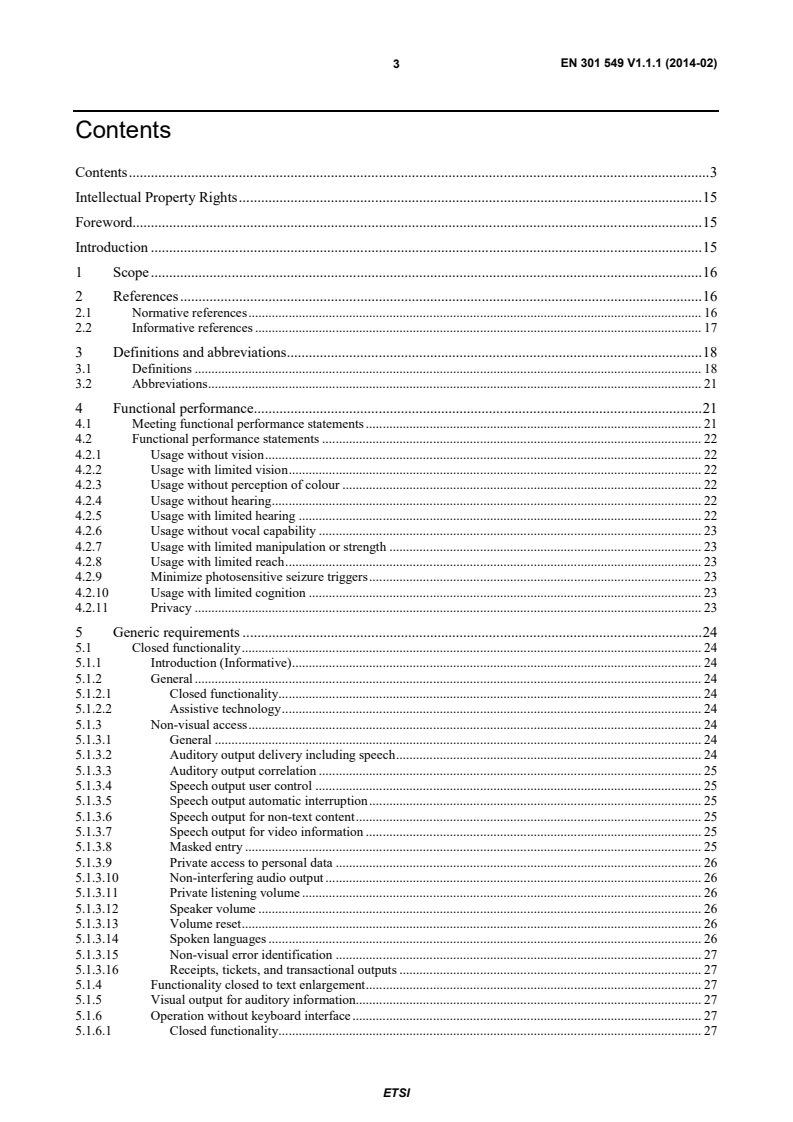
Contents Contents . 3 Intellectual Property Rights . 15 Foreword. 15 Introduction . 15 1 Scope . 16 2 References . 16 2.1 Normative references . 16 2.2 Informative references . 17 3 Definitions and abbreviations . 18 3.1 Definitions . 18 3.2 Abbreviations . 21 4 Functional performance . 21 4.1 Meeting functional performance statements . 21 4.2 Functional performance statements . 22 4.2.1 Usage without vision . 22 4.2.2 Usage with limited vision . 22 4.2.3 Usage without perception of colour . 22 4.2.4 Usage without hearing . 22 4.2.5 Usage with limited hearing . 22 4.2.6 Usage without vocal capability . 23 4.2.7 Usage with limited manipulation or strength . 23 4.2.8 Usage with limited reach . 23 4.2.9 Minimize photosensitive seizure triggers . 23 4.2.10 Usage with limited cognition . 23 4.2.11 Privacy . 23 5 Generic requirements . 24 5.1 Closed functionality . 24 5.1.1 Introduction (Informative) . 24 5.1.2 General . 24 5.1.2.1 Closed functionality . 24 5.1.2.2 Assistive technology . 24 5.1.3 Non-visual access . 24 5.1.3.1 General . 24 5.1.3.2 Auditory output delivery including speech . 24 5.1.3.3 Auditory output correlation . 25 5.1.3.4 Speech output user control . 25 5.1.3.5 Speech output automatic interruption . 25 5.1.3.6 Speech output for non-text content . 25 5.1.3.7 Speech output for video information . 25 5.1.3.8 Masked entry . 25 5.1.3.9 Private access to personal data . 26 5.1.3.10 Non-interfering audio output . 26 5.1.3.11 Private listening volume . 26 5.1.3.12 Speaker volume . 26 5.1.3.13 Volume reset . 26 5.1.3.14 Spoken languages . 26 5.1.3.15 Non-visual error identification . 27 5.1.3.16 Receipts, tickets, and transactional outputs . 27 5.1.4 Functionality closed to text enlargement . 27 5.1.5 Visual output for auditory information. 27 5.1.6 Operation without keyboard interface . 27 5.1.6.1 Closed functionality . 27 SIST EN 301 549 V1.1.1:2014
EN 301 549 V1.1.1 (2014-02) ETSI 4
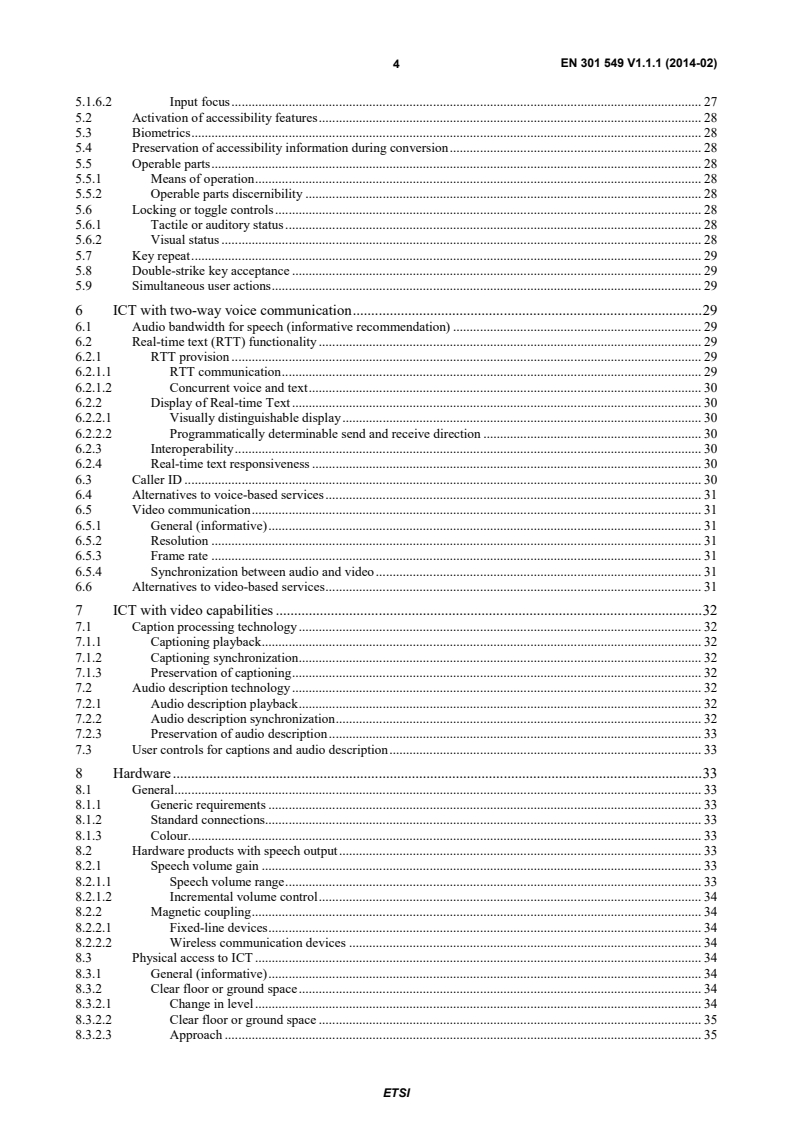
5.1.6.2 Input focus . 27 5.2 Activation of accessibility features . 28 5.3 Biometrics . 28 5.4 Preservation of accessibility information during conversion . 28 5.5 Operable parts . 28 5.5.1 Means of operation . 28 5.5.2 Operable parts discernibility . 28 5.6 Locking or toggle controls . 28 5.6.1 Tactile or auditory status . 28 5.6.2 Visual status . 28 5.7 Key repeat . 29 5.8 Double-strike key acceptance . 29 5.9 Simultaneous user actions . 29 6 ICT with two-way voice communication . 29 6.1 Audio bandwidth for speech (informative recommendation) . 29 6.2 Real-time text (RTT) functionality . 29 6.2.1 RTT provision . 29 6.2.1.1 RTT communication . 29 6.2.1.2 Concurrent voice and text . 30 6.2.2 Display of Real-time Text . 30 6.2.2.1 Visually distinguishable display . 30 6.2.2.2 Programmatically determinable send and receive direction . 30 6.2.3 Interoperability . 30 6.2.4 Real-time text responsiveness . 30 6.3 Caller ID . 30 6.4 Alternatives to voice-based services . 31 6.5 Video communication . 31 6.5.1 General (informative) . 31 6.5.2 Resolution . 31 6.5.3 Frame rate . 31 6.5.4 Synchronization between audio and video . 31 6.6 Alternatives to video-based services . 31 7 ICT with video capabilities . 32 7.1 Caption processing technology . 32 7.1.1 Captioning playback . 32 7.1.2 Captioning synchronization . 32 7.1.3 Preservation of captioning . 32 7.2 Audio description technology . 32 7.2.1 Audio description playback . 32 7.2.2 Audio description synchronization . 32 7.2.3 Preservation of audio description . 33 7.3 User controls for captions and audio description . 33 8 Hardware . 33 8.1 General . 33 8.1.1 Generic requirements . 33 8.1.2 Standard connections. 33 8.1.3 Colour. 33 8.2 Hardware products with speech output . 33 8.2.1 Speech volume gain . 33 8.2.1.1 Speech volume range . 33 8.2.1.2 Incremental volume control . 34 8.2.2 Magnetic coupling . 34 8.2.2.1 Fixed-line devices . 34 8.2.2.2 Wireless communication devices . 34 8.3 Physical access to ICT . 34 8.3.1 General (informative) . 34 8.3.2 Clear floor or ground space . 34 8.3.2.1 Change in level . 34 8.3.2.2 Clear floor or ground space . 35 8.3.2.3 Approach . 35 SIST EN 301 549 V1.1.1:2014
EN 301 549 V1.1.1 (2014-02) ETSI 5
8.3.2.3.1 General . 35 8.3.2.3.2 Forward approach . 35 8.3.2.3.3 Parallel approach . 36 8.3.2.4 Knee and toe clearance width . 36 8.3.2.5 Toe clearance . 36 8.3.2.6 Knee clearance . 37 8.3.3 Reach range for ICT . 37 8.3.3.1 Forward reach . 37 8.3.3.1.1 Unobstructed high forward reach . 37 8.3.3.1.2 Unobstructed low forward reach . 38 8.3.3.1.3 Obstructed reach . 38 8.3.3.2 Side reach . 38 8.3.3.2.1 Unobstructed high side reach . 38 8.3.3.2.2 Unobstructed low side reach . 39 8.3.3.2.3 Obstructed side reach . 39 8.3.4 Visibility . 39 8.3.5 Installation instructions . 40 8.4 Mechanically Operable parts . 40 8.4.1 Numeric keys . 40 8.4.2 Operation of mechanical parts . 40 8.4.2.1
Means of Operation of mechanical parts . 40 8.4.2.2 Force of operation of mechanical parts. 40 8.4.3 Keys, tickets and fare cards . 40 8.5 Tactile indication of speech mode . 40 9 Web . 40 9.1 General (informative) . 40 9.2 Web content requirements . 41 9.2.1 Non-text content . 41 9.2.2 Audio-only and video-only (pre-recorded) . 41 9.2.3 Captions (pre-recorded) . 41 9.2.4 Audio description or media alternative (pre-recorded) . 41 9.2.5 Captions (live) . 41 9.2.6 Audio description (pre-recorded) . 41 9.2.7 Info and relationships . 42 9.2.8 Meaningful sequence. 42 9.2.9 Sensory characteristics . 42 9.2.10 Use of colour . 42 9.2.11 Audio control . 42 9.2.12 Contrast (minimum) . 42 9.2.13 Resize text . 42 9.2.14 Images of text . 42 9.2.15 Keyboard . 42 9.2.16 No keyboard trap . 42 9.2.17 Timing adjustable . 42 9.2.18 Pause, stop, hide . 42 9.2.19 Three flashes or below threshold . 42 9.2.20 Bypass blocks . 42 9.2.21 Page titled . 43 9.2.22 Focus Order . 43 9.2.23 Link purpose (in context) . 43 9.2.24 Multiple ways . 43 9.2.25 Headings and labels . 43 9.2.26 Focus visible. 43 9.2.27 Language of page . 43 9.2.28 Language of parts . 43 9.2.29 On focus . 43 9.2.30 On input . 43 9.2.31 Consistent navigation . 43 9.2.32 Consistent identification . 43 9.2.33 Error identification . 43 9.2.34 Labels or instructions . 43 SIST EN 301 549 V1.1.1:2014
EN 301 549 V1.1.1 (2014-02) ETSI 6
9.2.35 Error suggestion . 44 9.2.36 Error prevention (legal, financial, data) . 44 9.2.37 Parsing . 44 9.2.38 Name, role, value . 44 9.3 WCAG 2.0 conformance requirements . 44 10 Non-web documents . 44 10.1 General (informative) . 44 10.2 Document success criteria . 45 10.2.1 Non-text content . 45 10.2.2 Audio-only and video-only (pre-recorded) . 45 10.2.3 Captions (pre-recorded) . 46 10.2.4 Audio description or media alternative (pre-recorded) . 46 10.2.5 Captions (live) . 46 10.2.6 Audio description (pre-recorded) . 46 10.2.7 Info and relationships . 47 10.2.8 Meaningful sequence. 47 10.2.9 Sensory characteristics . 47 10.2.10 Use of colour . 47 10.2.11 Audio control . 47 10.2.12 Contrast (minimum) . 48 10.2.13 Resize text . 48 10.2.14 Images of text . 48 10.2.15 Keyboard . 49 10.2.16 No keyboard trap . 49 10.2.17 Timing adjustable . 49 10.2.18 Pause, stop, hide . 50 10.2.19 Three flashes or below threshold . 50 10.2.20 Empty clause . 50 10.2.21 Document titled . 51 10.2.22 Focus order . 51 10.2.23 Link purpose (in context) . 51 10.2.24 Empty clause . 51 10.2.25 Headings and labels . 51 10.2.26 Focus visible. 51 10.2.27 Language of page . 52 10.2.28 Language of parts . 52 10.2.29 On focus . 52 10.2.30 On input . 52 10.2.31 Empty clause . 53 10.2.32 Empty clause . 53 10.2.33 Error identification . 53 10.2.34 Labels or instructions . 53 10.2.35 Error suggestion . 53 10.2.36 Error prevention (legal, financial, data) . 53 10.2.37 Parsing . 54 10.2.38 Name, role, value . 54 10.2.39 Caption positioning . 54 10.2.40 Audio description timing . 54 11 Software . 55 11.1 General (informative) . 55 11.2 Non-Web software success criteria . 55 11.2.1 Non-Web software success criteria (excluding closed functionality) . 55 11.2.1.1 Non-text content (screen reading supported) . 55 11.2.1.2 Audio-only and video-only (pre-recorded) . 56 11.2.1.3 Captions (pre-recorded) . 56 11.2.1.4 Audio description or media alternative (pre-recorded) . 57 11.2.1.5 Captions (live) . 57 11.2.1.6 Audio description (pre-recorded) . 57 11.2.1.7 Info and relationships . 57 11.2.1.8 Meaningful sequence . 58 SIST EN 301 549 V1.1.1:2014
EN 301 549 V1.1.1 (2014-02) ETSI 7
11.2.1.9 Sensory characteristics . 58 11.2.1.10 Use of colour . 58 11.2.1.11 Audio control . 58 11.2.1.12 Contrast (minimum) . 59 11.2.1.13 Resize text . 59 11.2.1.14 Images of text . 59 11.2.1.15 Keyboard . 60 11.2.1.16 No keyboard trap . 60 11.2.1.17 Timing adjustable . 60 11.2.1.18 Pause, stop, hide . 61 11.2.1.19 Three flashes or below threshold . 61 11.2.1.20 Empty clause . 62 11.2.1.21 Empty clause . 62 11.2.1.22 Focus order . 62 11.2.1.23 Link purpose (in context) . 62 11.2.1.24 Empty clause . 62 11.2.1.25 Headings and labels . 62 11.2.1.26 Focus visible . 63 11.2.1.27 Language of software . 63 11.2.1.28 Empty clause . 63 11.2.1.29 On focus . 63 11.2.1.30 On input . 63 11.2.1.31 Empty clause . 64 11.2.1.32 Empty clause . 64 11.2.1.33 Error identification . 64 11.2.1.34 Labels or instructions. 64 11.2.1.35 Error suggestion . 64 11.2.1.36 Error prevention (legal, financial, data) . 64 11.2.1.37 Parsing . 65 11.2.1.38 Name, role, value .
...