


SIST EN 13630-9:2004
(Main)Explosives for civil uses - Detonating cords and safety fuses - Part 9: Determination of transmission of detonation from detonating cord to detonating cord
Explosives for civil uses - Detonating cords and safety fuses - Part 9: Determination of transmission of detonation from detonating cord to detonating cord
This European Standard specifies a method of verifying whether a flexible plastics-coated detonating cord or a flexible fibrous-overbraided detonating cord, for civil uses, can be initiated by a flexible plastics-coated detonating cord or a flexible fibrous-overbraided detonating cord.
NOTE The initiating capability of a donor cord is defined by the equivalent initiating capability as described in EN 13630-10.
Explosivstoffe für zivile Zwecke - Sprengschnüre und Sicherheitsanzündschnüre - Teil 9: Bestimmung der Detonationsübertragung von Sprengschnur zu Sprengschnur
Diese Europäische Norm legt ein Verfahren zur Bestimmung der Detonationsübertragung mit flexiblen, kunststoffummantelten Sprengschnüren und flexiblen faserumsponnenen Sprengschnüren für zivile Zwecke fest. Diese Norm schließt die Fähigkeit der Sprengschnur ein, in Abhängigkeit von den Festlegungen des Herstellers, als eine Empfängerschnur zu funktionieren.
ANMERKUNG Die Fähigkeit der Sprengschnur als Empfängerschnur zu arbeiten ist durch die Zündfähigkeit nach EN 13630-10 festgelegt.
Explosifs a usage civil - Poudres propulsives et propergols pour autopropulsion - Partie 9: Détermination de la transmission de la détonation de cordeau détonant a cordeau détonant
La présente Norme européenne prescrit une méthode permettant de vérifier si un cordeau détonant souple
sous revêtement plastique ou un cordeau détonant à fibres tressées souples, à usage civil peut être amorcé
par un cordeau détonant souple sous revêtement plastique ou par un cordeau détonant à fibres tressées
souples.
NOTE La capacité d’amorçage du cordeau donneur est définie par la capacité d’amorçage équivalente décrite dans
le prEN 13630-10.
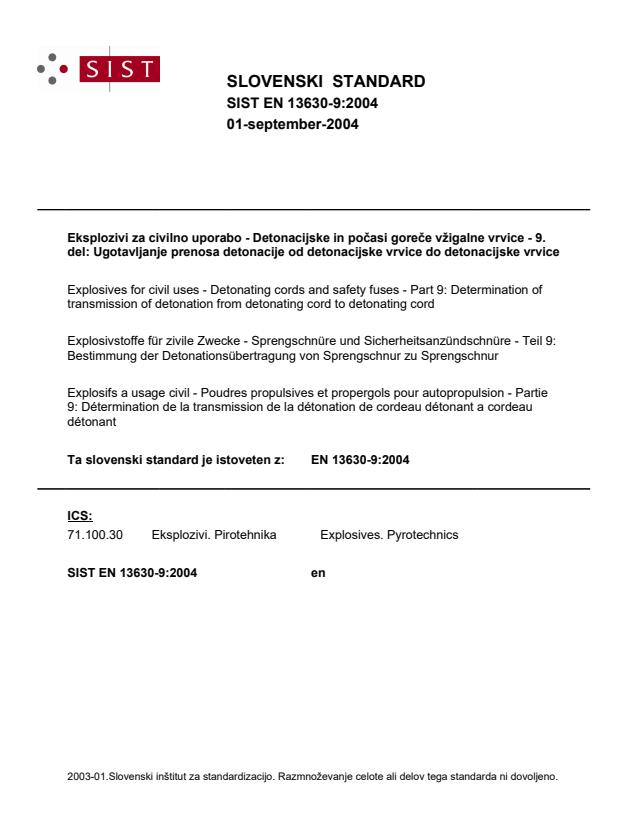
Eksplozivi za civilno uporabo - Detonacijske in počasi goreče vžigalne vrvice - 9. del: Ugotavljanje prenosa detonacije od detonacijske vrvice do detonacijske vrvice
General Information
- Status
- Withdrawn
- Publication Date
- 31-Aug-2004
- Withdrawal Date
- 08-Oct-2025
- Technical Committee
- IEKS - Explosives
- Current Stage
- 9900 - Withdrawal (Adopted Project)
- Start Date
- 09-Oct-2025
- Due Date
- 01-Nov-2025
- Completion Date
- 09-Oct-2025
Relations
- Effective Date
- 18-Jan-2023


Frequently Asked Questions
SIST EN 13630-9:2004 is a standard published by the Slovenian Institute for Standardization (SIST). Its full title is "Explosives for civil uses - Detonating cords and safety fuses - Part 9: Determination of transmission of detonation from detonating cord to detonating cord". This standard covers: This European Standard specifies a method of verifying whether a flexible plastics-coated detonating cord or a flexible fibrous-overbraided detonating cord, for civil uses, can be initiated by a flexible plastics-coated detonating cord or a flexible fibrous-overbraided detonating cord. NOTE The initiating capability of a donor cord is defined by the equivalent initiating capability as described in EN 13630-10.
This European Standard specifies a method of verifying whether a flexible plastics-coated detonating cord or a flexible fibrous-overbraided detonating cord, for civil uses, can be initiated by a flexible plastics-coated detonating cord or a flexible fibrous-overbraided detonating cord. NOTE The initiating capability of a donor cord is defined by the equivalent initiating capability as described in EN 13630-10.
SIST EN 13630-9:2004 is classified under the following ICS (International Classification for Standards) categories: 71.100.30 - Explosives. Pyrotechnics and fireworks. The ICS classification helps identify the subject area and facilitates finding related standards.
SIST EN 13630-9:2004 has the following relationships with other standards: It is inter standard links to SIST EN 13630-9:2025. Understanding these relationships helps ensure you are using the most current and applicable version of the standard.
SIST EN 13630-9:2004 is associated with the following European legislation: EU Directives/Regulations: 2014/28/EU, 93/15/EEC; Standardization Mandates: M/055. When a standard is cited in the Official Journal of the European Union, products manufactured in conformity with it benefit from a presumption of conformity with the essential requirements of the corresponding EU directive or regulation.
SIST EN 13630-9:2004 is available in PDF format for immediate download after purchase. The document can be added to your cart and obtained through the secure checkout process. Digital delivery ensures instant access to the complete standard document.
Standards Content (Sample)
2003-01.Slovenski inštitut za standardizacijo. Razmnoževanje celote ali delov tega standarda ni dovoljeno.Explosives for civil uses - Detonating cords and safety fuses - Part 9: Determination of transmission of detonation from detonating cord to detonating cordExplosifs a usage civil - Poudres propulsives et propergols pour autopropulsion - Partie 9: Détermination de la transmission de la détonation de cordeau détonant a cordeau détonantExplosivstoffe für zivile Zwecke - Sprengschnüre und Sicherheitsanzündschnüre - Teil 9: Bestimmung der Detonationsübertragung von Sprengschnur zu SprengschnurTa slovenski standard je istoveten z:EN 13630-9:2004SIST EN 13630-9:2004en71.100.30Eksplozivi. PirotehnikaExplosives. PyrotechnicsICS:SLOVENSKI
STANDARDSIST EN 13630-9:200401-september-2004
EUROPEAN STANDARDNORME EUROPÉENNEEUROPÄISCHE NORMEN 13630-9May 2004ICS 71.100.30English versionExplosives for civil uses - Detonating cords and safety fuses -Part 9: Determination of transmission of detonation fromdetonating cord to detonating cordExplosifs à usage civil - Poudres propulsives et propergolspour autopropulsion - Partie 9: Détermination de latransmission de la détonation de cordeau détonant àcordeau détonantExplosivstoffe für zivile Zwecke - Sprengschnüre undSicherheitsanzündschnüre - Teil 9: Bestimmung derDetonationsübertragung von Sprengschnur zuSprengschnurThis European Standard was approved by CEN on 2 January 2004.CEN members are bound to comply with the CEN/CENELEC Internal Regulations which stipulate the conditions for giving this EuropeanStandard the status of a national standard without any alteration. Up-to-date lists and bibliographical references concerning such nationalstandards may be obtained on application to the Central Secretariat or to any CEN member.This European Standard exists in three official versions (English, French, German). A version in any other language made by translationunder the responsibility of a CEN member into its own language and notified to the Central Secretariat has the same status as the officialversions.CEN members are the national standards bodies of Austria, Belgium, Cyprus, Czech Republic, Denmark, Estonia, Finland, France,Germany, Greece, Hungary, Iceland, Ireland, Italy, Latvia, Lithuania, Luxembourg, Malta, Netherlands, Norway, Poland, Portugal, Slovakia,Slovenia, Spain, Sweden, Switzerland and United Kingdom.EUROPEAN COMMITTEE FOR STANDARDIZATIONCOMITÉ EUROPÉEN DE NORMALISATIONEUROPÄISCHES KOMITEE FÜR NORMUNGManagement Centre: rue de Stassart, 36
B-1050 Brussels© 2004 CENAll rights of exploitation in any form and by any means reservedworldwide for CEN national Members.Ref. No. EN 13630-9:2004: E
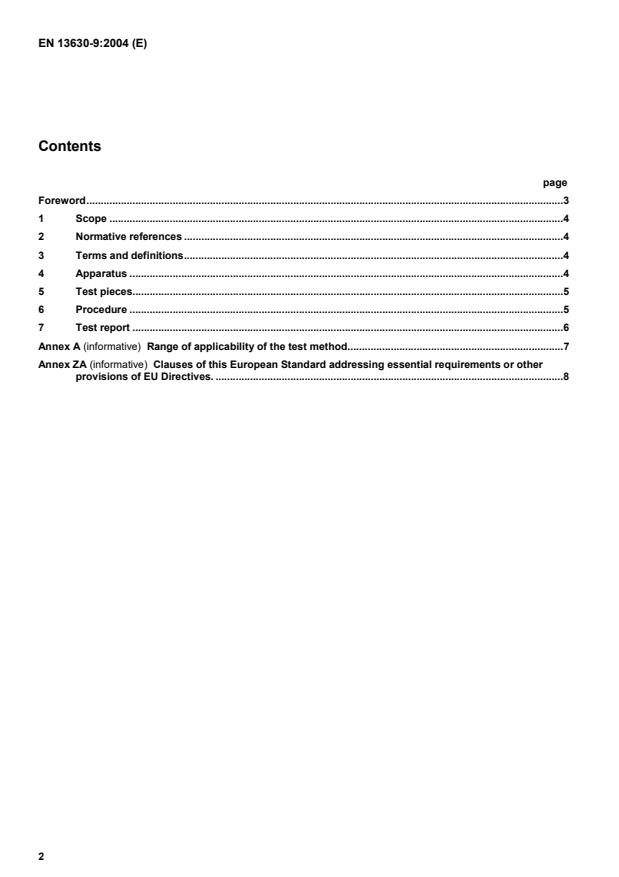
Range of applicability of the test method.7Annex ZA (informative)
Clauses of this European Standard addressing essential requirements or otherprovisions of EU Directives.8
...
Questions, Comments and Discussion
Ask us and Technical Secretary will try to provide an answer. You can facilitate discussion about the standard in here.
Loading comments...