

SIST EN 1516:2002
(Main)Surfaces for sports areas - Determination of resistance to indentation
- Abstract
This European Standard specifies a method of test for the determination of resistance to indentation of artificial sports surfaces, other than synthetic turf.
- Status
- Published
- Publication Date
- 31-Aug-2002
- Technical Committee
- SPO - Sports
- Current Stage
- 6060 - National Implementation/Publication (Adopted Project)
- Start Date
- 01-Sep-2002
- Due Date
- 01-Sep-2002
- Completion Date
- 01-Sep-2002
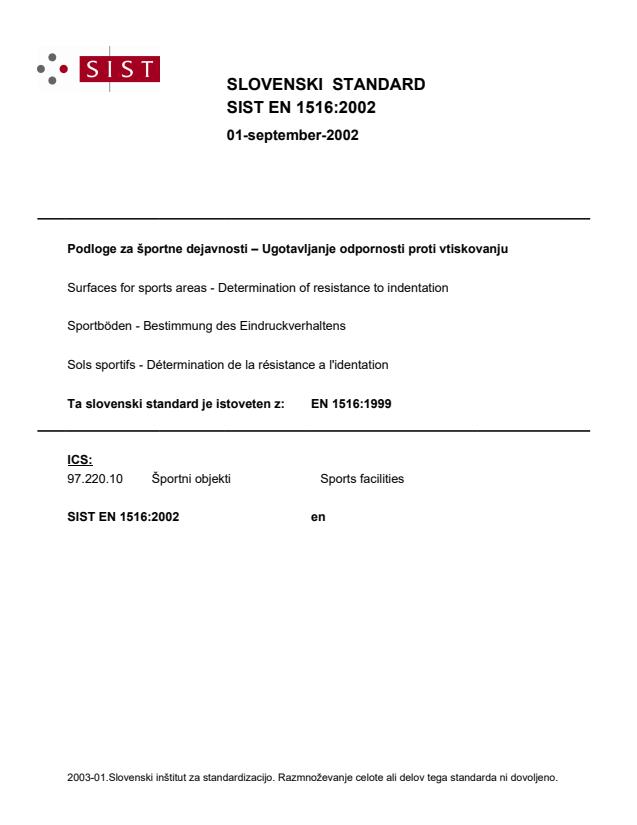

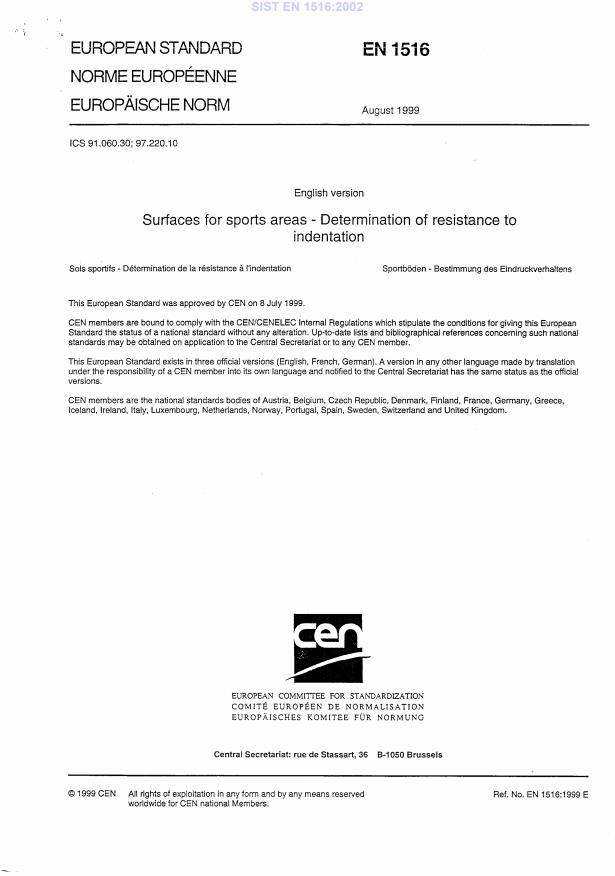

SIST EN 1516:2002 is the Slovenian version of EN 1516:1999 for testing the resistance to indentation of artificial sports surfaces other than synthetic turf. It gives a standardized way to measure how these surfaces deform under load, so manufacturers, laboratories, specifiers, and buyers can compare products on the same basis. The standard is relevant wherever the firmness or local deformation of a sports surface needs to be checked in a repeatable way.
What does SIST EN 1516:2002 specify?
SIST EN 1516:2002 specifies a method of test for determining the resistance to indentation of artificial sports surfaces, other than synthetic turf. In practice, it is the reference to use when you need a common way to check how a sports surface responds when it is pressed or loaded.
The scope is narrow on purpose. It covers artificial sports surfaces used in sports facilities, but it excludes synthetic turf, so the user first needs to confirm the surface type before applying the method. The document is classified under ICS 97.220.10, Sports facilities, which matches its practical use in sports-surface work.
What are the key requirements of SIST EN 1516:2002?
The main point of SIST EN 1516:2002 is that indentation resistance must be determined by the standard test method in the document. That matters because the result is only useful for comparison if the same approach is used every time.
The standard focuses on one performance characteristic:
- Resistance to indentation - how much the surface deforms under applied pressure. This is the property that tells users whether a surface feels firm or yields locally under load.
The method applies only to artificial sports surfaces other than synthetic turf. For a buyer or specifier, that means the product description must be checked before using the standard. Using the wrong method on the wrong surface type would make the result hard to compare.
Because it is a test-method standard, its practical value is consistency. The same method can be used by different parties to assess the same kind of surface in a comparable way, which supports product evaluation, acceptance checks, and technical specification work.
The document is intended for surfaces used in sports areas, so its results are relevant to fitness for use in sports facilities. In practice, this helps users judge whether a surface has the expected indentation response for the intended activity.
What terms does SIST EN 1516:2002 define?
SIST - Slovenski inštitut za standardizacijo, the Slovenian standards body that publishes the standard.
EN - European Standard, showing that this Slovenian standard is aligned with the European document EN 1516:1999.
ICS - International Classification for Standards, the classification system used here to place the document under sports facilities.
Artificial sports surfaces - manufactured sports-area surfaces that are covered by the test method in this standard.
Synthetic turf - a turf-like sports surface that is excluded from the scope of this test method.
Who uses SIST EN 1516:2002?
SIST EN 1516:2002 is used by organisations that specify, test, supply, or buy artificial sports surfaces. Typical users include manufacturers, test laboratories, quality managers, buyers, and specifiers working on sports facilities.
They use it when comparing surface products, checking whether a surface meets a required indentation performance, or documenting technical acceptance of a sports floor or similar surface.
What changed in SIST EN 1516:2002 from the previous edition?
SIST EN 1516:2002 is identical to EN 1516:1999.
What does the SIST EN 1516:2002 document contain?
SIST EN 1516:2002 is a test-method standard for measuring indentation resistance in artificial sports surfaces. Its content is aimed at giving users a common procedure so that the surface response can be checked and reported in a consistent way.
The document also carries the standard publication details and multilingual titles shown for the Slovenian, German, French, and English versions. For technical work, the important part is the method for evaluating indentation resistance, which supports design checks, product testing, and specification review for sports facilities.
Relations
- Effective Date
- 28-Jan-2026
Frequently Asked Questions
SIST EN 1516:2002 is a standard published by the Slovenian Institute for Standardization (SIST). Its full title is "Surfaces for sports areas - Determination of resistance to indentation". This standard covers: This European Standard specifies a method of test for the determination of resistance to indentation of artificial sports surfaces, other than synthetic turf.
This European Standard specifies a method of test for the determination of resistance to indentation of artificial sports surfaces, other than synthetic turf.
SIST EN 1516:2002 is classified under the following ICS (International Classification for Standards) categories: 97.220.10 - Sports facilities. The ICS classification helps identify the subject area and facilitates finding related standards.
SIST EN 1516:2002 has the following relationships with other standards: It is inter standard links to SIST EN 14904:2006. Understanding these relationships helps ensure you are using the most current and applicable version of the standard.
SIST EN 1516:2002 is available in PDF format for immediate download after purchase. The document can be added to your cart and obtained through the secure checkout process. Digital delivery ensures instant access to the complete standard document.
Standards Content (Sample)
2003-01.Slovenski inštitut za standardizacijo. Razmnoževanje celote ali delov tega standarda ni dovoljeno.Podloge za športne dejavnosti – Ugotavljanje odpornosti proti vtiskovanjuSportböden - Bestimmung des EindruckverhaltensSols sportifs - Détermination de la résistance a l'identationSurfaces for sports areas - Determin
...