

SIST EN ISO 9054:2000
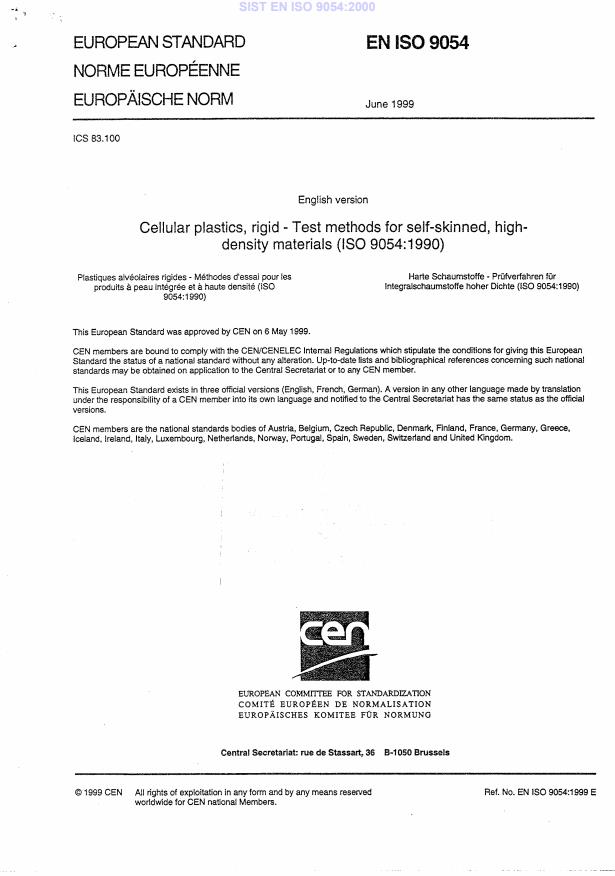
(Main)Cellular plastics, rigid - Test methods for self-skinned, high-density materials (ISO 9054:1990)
General Information
- Abstract
Contains the basic test procedures for the determination of the physical properties of these plastics. Also specifies the primary methods to be used for comparison of materials similar to materials as defined in clause 3. Likewise permits the use of the same test methods, when found to be suitable for the assessment of the properties of products of different thickness, when agreed upon by the supplier and the purchaser.
- Status
- Published
- Publication Date
- 30-Apr-2000
- Technical Committee
- IPMA - Polimer materials and products
- Current Stage
- 6060 - National Implementation/Publication (Adopted Project)
- Start Date
- 01-May-2000
- Due Date
- 01-May-2000
- Completion Date
- 01-May-2000

Overview
SIST EN ISO 9054:2000 - Cellular Plastics, Rigid - Test Methods for Self-Skinned, High-Density Materials defines standard test procedures for evaluating the key physical properties of self-skinned, high-density rigid cellular plastics. Developed by CEN and based on ISO 9054:1990, this standard establishes primary testing methods to assess material properties and enable direct comparison between different types of cellular plastics, or products of varying thicknesses, when agreed upon by supplier and purchaser.
By setting out detailed procedures for sample preparation, conditioning, and physical testing, SIST EN ISO 9054:2000 ensures consistency and comparability in the assessment of self-skinned rigid foam plastics commonly used in industries requiring high structural performance and surface durability.
Key Topics
Scope and Purpose
- Outlines procedures for determining physical properties-applicable to self-skinned, high-density rigid cellular plastics.
- Supports material comparison and quality assessment across similar and dissimilar products, subject to mutual agreement.
Sample Preparation
- Specifies requirements for specimen selection, dimensions, skin integrity, and post-manufacture handling.
- Recommends conditioning specimens according to standardized environments.
Physical Test Methods
- Procedures cover measurements such as:
- Apparent (bulk) density
- Bending and tensile strength
- Impact resistance (falling dart/instrumented puncture)
- Shear strength
- Screw retention capability (including direct withdrawal tests)
- Surface hardness
- Linear thermal expansion and thermal conductivity
- Deflection under load and at increasing temperatures
- Dielectric strength
- Procedures cover measurements such as:
Reporting Requirements
- Each test result must include complete material identification, production parameters, specimen details, conditioning settings, test results, deviations, and any anomalies noted during testing.
Applications
SIST EN ISO 9054:2000 is highly valuable for:
Manufacturers of Rigid Cellular Plastics
- Ensures consistent production quality and facilitates internal quality control processes.
- Enables direct, standardized comparison of materials for product improvement and customer assurance.
Purchasers and Specifiers
- Provides reliable test data for material selection in applications requiring structural strength and high surface quality (e.g., automotive interiors, structural panels, insulation systems).
Laboratories and Testing Facilities
- Uses standardized sample preparation and testing protocols to generate accurate, repeatable data.
- Supports certification, compliance, and R&D efforts with internationally recognized procedures.
Industry Sectors
- Automotive, construction, appliance manufacturing, and other sectors requiring high-performance rigid foams with integral skins benefit from comparable, validated materials data.
Related Standards
SIST EN ISO 9054:2000 references several key international standards relevant to the testing of cellular plastics:
- ISO 845: Determination of apparent (bulk) density for cellular plastics and rubbers
- ISO 868: Shore hardness measurement for plastics and ebonite
- ISO 178: Bending properties of rigid plastics
- ISO 291: Standard atmospheres for plastics conditioning and testing
- ISO 1922, 1923, 1926: Shear strength, linear dimensions, and tensile property testing of cellular plastics
- ISO 4897: Linear thermal expansion
- ISO 8301, ISO 8302: Steady-state thermal resistance (thermal conductivity)
- ISO 6603-1, 6603-2: Multi-axial impact behavior and instrumented puncture testing
- ISO 75: Deflection temperature under load
- IEC 243: Electric strength for solid insulating materials
These references ensure broad compatibility with modern testing practices, making SIST EN ISO 9054:2000 a cornerstone standard for reliable evaluation of self-skinned, high-density rigid plastics.
By following these standardized test methods, companies and laboratories can achieve consistent quality, dependable product performance, and clear communication across the plastics industry.
Relations
- Effective Date
- 03-Jun-2026
- Effective Date
- 03-Jun-2026
- Refers
SIST ISO 1926:1996 - Cellular plastics -- Determination of tensile properties of rigid materials - Effective Date
- 03-Jun-2026
- Effective Date
- 03-Jun-2026
- Effective Date
- 03-Jun-2026
- Effective Date
- 03-Jun-2026
- Effective Date
- 03-Jun-2026
- Effective Date
- 09-Feb-2026
- Effective Date
- 09-Feb-2026
- Effective Date
- 09-Feb-2026
- Effective Date
- 28-Jan-2026
- Refers
SIST EN 12945:2003 - Liming materials - Determination of neutralizing value - Titrimetric methods - Effective Date
- 28-Jan-2026
- Effective Date
- 28-Jan-2026
- Effective Date
- 28-Jan-2026
- Effective Date
- 28-Jan-2026
Get Certified
Connect with accredited certification bodies for this standard

DIN CERTCO
DIN Group product certification.

Smithers Quality Assessments
US management systems and product certification.
Sponsored listings
Frequently Asked Questions
SIST EN ISO 9054:2000 is a standard published by the Slovenian Institute for Standardization (SIST). Its full title is "Cellular plastics, rigid - Test methods for self-skinned, high-density materials (ISO 9054:1990)". This standard covers: Contains the basic test procedures for the determination of the physical properties of these plastics. Also specifies the primary methods to be used for comparison of materials similar to materials as defined in clause 3. Likewise permits the use of the same test methods, when found to be suitable for the assessment of the properties of products of different thickness, when agreed upon by the supplier and the purchaser.
Contains the basic test procedures for the determination of the physical properties of these plastics. Also specifies the primary methods to be used for comparison of materials similar to materials as defined in clause 3. Likewise permits the use of the same test methods, when found to be suitable for the assessment of the properties of products of different thickness, when agreed upon by the supplier and the purchaser.
SIST EN ISO 9054:2000 is classified under the following ICS (International Classification for Standards) categories: 83.100 - Cellular materials. The ICS classification helps identify the subject area and facilitates finding related standards.
SIST EN ISO 9054:2000 has the following relationships with other standards: It is inter standard links to SIST ISO 6603-1:1996, SIST ISO 8302:1997, SIST ISO 1926:1996, SIST ISO 178:1996, SIST ISO 8301:1997, SIST ISO 6603-2:1996, SIST ISO 1923:1996, SIST ISO 868:1996, SIST ISO 845:1996, SIST ISO 1922:1996, SIST EN 14081-3:2006, SIST EN 12945:2003, SIST EN 12259-1:2000 + A1:2001/A3:2006, SIST EN 539-2:1998, SIST EN 13763-18:2004. Understanding these relationships helps ensure you are using the most current and applicable version of the standard.
SIST EN ISO 9054:2000 is available in PDF format for immediate download after purchase. The document can be added to your cart and obtained through the secure checkout process. Digital delivery ensures instant access to the complete standard document.
Standards Content (Sample)
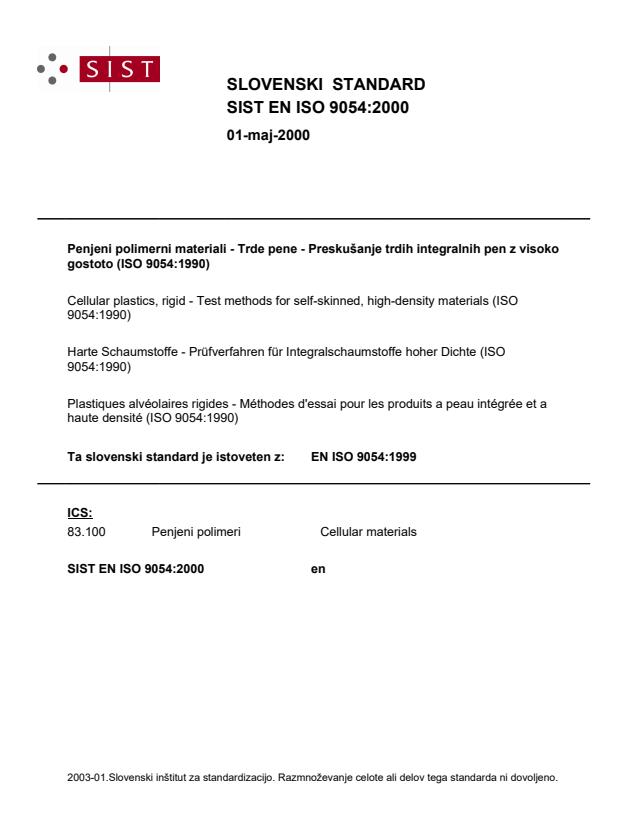
SLOVENSKI STANDARD
01-maj-2000
Penjeni polimerni materiali - Trde pene - Preskušanje trdih integralnih pen z visoko
gostoto (ISO 9054:1990)
Cellular plastics, rigid - Test methods for self-skinned, high-density materials (ISO
9054:1990)
Harte Schaumstoffe - Prüfverfahren für Integralschaumstoffe hoher Dichte (ISO
9054:1990)
Plastiques alvéolaires rigides - Méthodes d'essai pour les produits a peau intégrée et a
haute densité (ISO 9054:1990)
Ta slovenski standard je istoveten z: EN ISO 9054:1999
ICS:
83.100 Penjeni polimeri Cellular materials
2003-01.Slovenski inštitut za standardizacijo. Razmnoževanje celote ali delov tega standarda ni dovoljeno.
INTERNATIONAL
STANDARD
First edition
1990-l 2-15
---
Cellular plastics, rigid - Test methods for
self-skinned, high-density materials
Plasfiques ahkolaires rigides - Methodes d’essai pour les produits 5
peau intkgr6e et 5 haufe densit
Reference number
IS0 9054: 1990(E)
---
IS0 9054:1990(E)
Foreword
IS0 (the International Organization for Standardization) is a worldwide
federation of national standards bodies (IS0 member bodies). The work
of preparing International Standards is normally carried out through IS0
technical committees. Each member body interested in a subject for
which a technical committee has been established has the right to be
represented on that committee. International organizations, govern-
mental and non-governmental, in liaison with ISO, also take part in the
work. IS0 collaborates closely with the International Electrotechnical
Commission (IEC) on all matters of electrotechnical standardization.
Draft International Standards adopted by the technical committees are
circulated to the member bodies for voting. Publication as an Interna-
tional Standard requires approval by at least 75 % of the member bodies
casting a vote.
International Standard IS0 9054 was prepared by Technical Committee
ISO/TC 61, Plastics.
Annex A forms an integral part of this International Standard.
0 IS0 1990
All rights reserved. No part of this publication may be reproduced or utilized in any form
or by any means, electronic or mechanical, including photocopying and microfilm, without
permission in writing from the publisher.
International Organization for Standardization
Case Postale 56 l CH-1211 Genkve 20 + Switzerland
Printed in Switzerland
ii
INTERNATIONAL STANDARD
IS0 9054:1990(E)
Cellular plastics, rigid - Test methods for self-skinned,
high-density materials
IS0 845:1988, Cellular plastics and rubbers - Deter-
I Scope
mination of apparent (bulk) density.
This International Standard specifies the basic test
IS0 868:1985, Plastics and ebonite - Determination
procedures for the determination of the physical
of indentation hardness by means of a durometer
properties of self-skinned, high-density (typically
(Shore hardness).
having an overall density in excess of 100 kg/m3)
rigid cellular plastic materials.
IS0 1922:1981, Cellular plastics - Determination of
shear strength of rigid materials.
This standard also specifies the primary methods to
be used for comparison of materials similar to self-
IS0 1923:1981, Cellular plastics and rubbers - De-
skinned, high-density materials as defined in clause
termination of linear dimensions.
3, based upon IS0 test methods and using a stan-
dard test specimen thickness. It likewise permits the
IS0 1926:1979, Cellular plastics - Determination of
use of the same test methods, when found to be
suitable, for the assessment of the properties of tensile properties of rigid materials.
products of different thickness, when agreed upon
IS0 4897:1985, Cellular plastics - Determination of
by the supplier and the purchaser.
the coefficient of linear thermal expansion of rigid
materials at sub-ambient temperatures.
2 Normative references
IS0 6603-1:1985, Plastics - Determination of multi-
The following standards contain provisions which,
axial impact behaviour of rigid plastics - Part I:
through reference in this text, constitute provisions
Falling dart method.
of this International Standard. At the time of publi-
cation, the editions indicated were valid. All stan-
IS0 6603-2: 1989, Plastics - Determination of multi-
dards are subject to revision, and parties to
axial impact behaviour of rigid plastics - Part 2: In-
agreements based on this International Standard
strumented puncture test.
are encouraged to investigate the possibility of ap-
plying the most recent editions of the standards in-
IS0 8301: -l), Thermal insulation - Determination of
dicated below. Members of IEC and IS0 maintain
steady-state thermal resistance and related proper-
registers of currently valid International Standards.
ties - Heat flow meter apparatus.
IS0 75:1987, Plastics and ebonite - Determination
IS0 8302: -I), Thermal insulation - Determination of
of temperature of deflection under load.
steady-state thermal resistance and related proper-
ties - Guarded hot plate apparatus.
IS0 178: 1975, Plastics - Determination of flexural
properfies of rigid p/as tics.
IEC 24311967, Recommended methods of test for
electric strength of solid insulating materials at
IS0 291:1977, Plastics - Standard atmospheres for
power frequencies.
conditioning and testing.
1) To be published.
5.2 Testing
3 Definition
The testing of the specimens shall be performed
urposes
For the of this International Standard, the
P
under the same conditions as used for conditioning
definitio n applies.
followin
g
the test specimens.
self-skinned, high-density material; integral-skin
foam; structural foam: A rigid cellular material, with
an integral surface skin formed during manufacture,
6 Test methods
which has either:
All tests for material properties shall be as agreed
a) one or more surface zones with an apparent
upon between purchaser and supplier. These tests
density substantially greater than that of the core
will vary from material to material depending upon
material;
the ultimate use of the finished material. It should
be recognized that properties are influenced by the
variation of the density in the direction of the thick-
ness.
b) a relatively uniform density.
Where IS0 test methods are unavailable or cannot
be used for determining the property values as set
forth in these clauses, national practice shall be the
4 Test specimens
guiding factor.
Where the form and thickness of the finished product
are known, the thickness of the specimen shall be
6.1 Apparent density
“as produced”. In those instances where the final
form and shape of the product are unknown, or
See IS0 845.
where the thickness of the part is variable, the test
thickness shall be as agreed upon by the purchaser
The linear dimensions shall be measured with an
and supplier. When a test specimen is moulded ex-
accuracy of 0,Ol mm (in accordance with IS0 1923)
pressly for test purposes, the identical conditions,
and the mass to an accuracy of 0,l g.
as specified by the material supplier for use in the
production of the finished product, shall be used in-
sofar as is practical.
6.2 Bending strength
When test specimens are cut from a finished part or
See IS0 178, which determines the bending stress
a part moulded expressly for test purposes, no
and deflectio
...