

SIST EN 71-7:2014+A2:2018/oprA3:2019
(Amendment)Safety of toys - Part 7: Finger paints - Requirements and test methods
General Information
- Abstract
2019-12-09: HAS assessment missing at ENQ. Request submitted to HAS Livelink platform with deadline: 2020-01-29.
- Status
- Not Published
- Public Enquiry End Date
- 03-Nov-2019
- Technical Committee
- OTR - Child use and care article
- Current Stage
- 98 - Abandoned project (Adopted Project)
- Start Date
- 11-Nov-2020
- Due Date
- 16-Nov-2020
- Completion Date
- 11-Nov-2020

Overview
The SIST EN 71-7:2014+A2:2018/oprA3:2019 standard, prepared by the European Committee for Standardization (CEN), focuses on the safety of toys, specifically addressing finger paints. This standard outlines the requirements and test methods to ensure finger paints used in toys are safe for children. It updates and amends previous versions to reflect the latest safety regulations, chemical limits, and testing protocols. Ensuring compliance with EN 71-7 helps manufacturers meet European safety directives and protects consumers from hazardous substances in finger paints.
Key Topics
Chemical Safety Requirements
The standard specifies limits for impurities such as Benzo(a)pyrene, which must not exceed 0.05 mg/kg, reflecting the latest achievable analytical quantitation limits. It also addresses permissible preservatives, including updated compositional limits for substances like Climbazole.Colorants Compliance
Annex A lists colorants commonly used in finger paints, detailing which must comply with both general and purity-specific requirements. Colorants referenced adhere to the Commission Regulation (EU) No 231/2012, ensuring they meet the current food additive and safety standards.Taste and Smell Testing
The standard includes requirements to control the taste and smell of finger paints, aiming to prevent the use of substances with unpleasant or harmful sensory properties, such as the standardization of the correct spelling for Denatonium benzoate in regulations.Analytical Methods
Updates detail the analytical testing methods for hazardous substances, including PCB (polychlorinated biphenyls) analysis and procedures to ensure homogenous sample incorporation in viscous finger paint matrices.General Amendments and Clarifications
This amendment clarifies nomenclature, modifies footnotes, and updates references in the bibliography to reflect current regulations and guidelines to maintain relevance and accuracy.
Applications
Toy Manufacturing
This standard is essential for companies producing finger paints as a component of toys to ensure their products are safe for children and comply with EU safety requirements.Quality Control and Testing Laboratories
Laboratories performing safety assessments utilize this standard to conduct precise and standardized chemical analysis and sensory testing.Regulatory Bodies and Compliance Auditors
Enforcement agencies rely on EN 71-7 to verify that finger paints on the market meet stringent safety criteria, safeguarding children against toxic substances.Retailers and Importers
By requiring compliance with EN 71-7, retailers ensure they sell only safe finger paint products within the European market, maintaining brand reputation and consumer trust.
Related Standards
EN 71 Series
EN 71 encompasses multiple parts covering different toy safety aspects, such as mechanical properties (Part 1), flammability (Part 2), and chemical properties (Part 3). Part 7 fits within this series as the dedicated regulation for finger paints.Commission Regulation (EU) No 231/2012
This regulation sets out specifications for food additives referenced in EN 71-7, reflecting necessary compliance for colorants used in finger paints.ISO Standards on Toy Safety
While EN 71 is specific to Europe, complementary ISO standards provide international guidelines for toy safety, reinforcing the harmonization of safety practices globally.
Keywords: EN 71-7, finger paints safety, toy safety standard, finger paint requirements, chemical impurities in toys, Benzo(a)pyrene limit, preservative regulations, colorants in finger paints, CEN standard for toys, European toy safety compliance, toy testing methods.
Relations
- Consolidated By
SIST EN 71-7:2014+A3:2020 - Safety of toys - Part 7: Finger paints - Requirements and test methods - Effective Date
- 01-Jun-2020
- Revised
SIST EN 71-7:2014+A2:2018 - Safety of toys - Part 7: Finger paints - Requirements and test methods - Effective Date
- 01-Oct-2019
Frequently Asked Questions
SIST EN 71-7:2014+A2:2018/oprA3:2019 is a draft published by the Slovenian Institute for Standardization (SIST). Its full title is "Safety of toys - Part 7: Finger paints - Requirements and test methods". This standard covers: 2019-12-09: HAS assessment missing at ENQ. Request submitted to HAS Livelink platform with deadline: 2020-01-29.
2019-12-09: HAS assessment missing at ENQ. Request submitted to HAS Livelink platform with deadline: 2020-01-29.
SIST EN 71-7:2014+A2:2018/oprA3:2019 is classified under the following ICS (International Classification for Standards) categories: 97.200.50 - Toys. The ICS classification helps identify the subject area and facilitates finding related standards.
SIST EN 71-7:2014+A2:2018/oprA3:2019 has the following relationships with other standards: It is inter standard links to SIST EN 71-7:2014+A3:2020, SIST EN 71-7:2014+A2:2018. Understanding these relationships helps ensure you are using the most current and applicable version of the standard.
SIST EN 71-7:2014+A2:2018/oprA3:2019 is associated with the following European legislation: EU Directives/Regulations: 2009/48/EC; Standardization Mandates: M/445. When a standard is cited in the Official Journal of the European Union, products manufactured in conformity with it benefit from a presumption of conformity with the essential requirements of the corresponding EU directive or regulation.
SIST EN 71-7:2014+A2:2018/oprA3:2019 is available in PDF format for immediate download after purchase. The document can be added to your cart and obtained through the secure checkout process. Digital delivery ensures instant access to the complete standard document.
Standards Content (Sample)
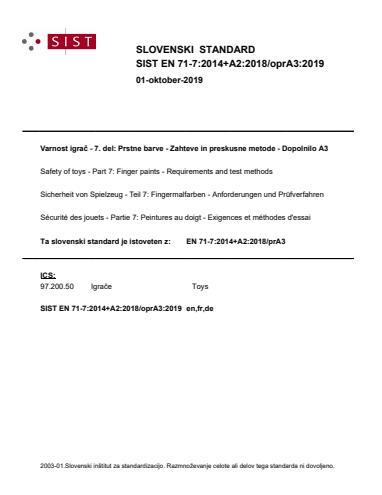
SLOVENSKI STANDARD
01-oktober-2019
Varnost igrač - 7. del: Prstne barve - Zahteve in preskusne metode - Dopolnilo A3
Safety of toys - Part 7: Finger paints - Requirements and test methods
Sicherheit von Spielzeug - Teil 7: Fingermalfarben - Anforderungen und Prüfverfahren
Sécurité des jouets - Partie 7: Peintures au doigt - Exigences et méthodes d'essai
Ta slovenski standard je istoveten z: EN 71-7:2014+A2:2018/prA3
ICS:
97.200.50 Igrače Toys
2003-01.Slovenski inštitut za standardizacijo. Razmnoževanje celote ali delov tega standarda ni dovoljeno.
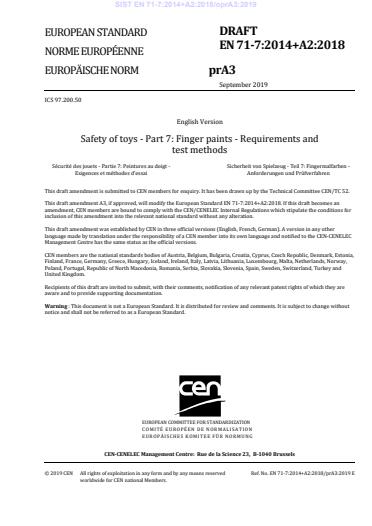
DRAFT
EUROPEAN STANDARD
EN 71-7:2014+A2:2018
NORME EUROPÉENNE
EUROPÄISCHE NORM
prA3
September 2019
ICS 97.200.50
English Version
Safety of toys - Part 7: Finger paints - Requirements and
test methods
Sécurité des jouets - Partie 7: Peintures au doigt - Sicherheit von Spielzeug - Teil 7: Fingermalfarben -
Exigences et méthodes d'essai Anforderungen und Prüfverfahren
This draft amendment is submitted to CEN members for enquiry. It has been drawn up by the Technical Committee CEN/TC 52.
This draft amendment A3, if approved, will modify the European Standard EN 71-7:2014+A2:2018. If this draft becomes an
amendment, CEN members are bound to comply with the CEN/CENELEC Internal Regulations which stipulate the conditions for
inclusion of this amendment into the relevant national standard without any alteration.
This draft amendment was established by CEN in three official versions (English, French, German). A version in any other
language made by translation under the responsibility of a CEN member into its own language and notified to the CEN-CENELEC
Management Centre has the same status as the official versions.
CEN members are the national standards bodies of Austria, Belgium, Bulgaria, Croatia, Cyprus, Czech Republic, Denmark, Estonia,
Finland, France, Germany, Greece, Hungary, Iceland, Ireland, Italy, Latvia, Lithuania, Luxembourg, Malta, Netherlands, Norway,
Poland, Portugal, Republic of North Macedonia, Romania, Serbia, Slovakia, Slovenia, Spain, Sweden, Switzerland, Turkey and
United Kingdom.
Recipients of this draft are invited to submit, with their comments, notification of any relevant patent rights of which they are
aware and to provide supporting documentation.
Warning : This document is not a European Standard. It is distributed for review and comments. It is subject to change without
notice and shall not be referred to as a European Standard.
EUROPEAN COMMITTEE FOR STANDARDIZATION
COMITÉ EUROPÉEN DE NORMALISATION
EUROPÄISCHES KOMITEE FÜR NORMUNG
CEN-CENELEC Management Centre: Rue de la Science 23, B-1040 Brussels
© 2019 CEN All rights of exploitation in any form and by any means reserved Ref. No. EN 71-7:2014+A2:2018/prA3:2019 E
worldwide for CEN national Members.
EN 71-7:2014/prA3:2019 (E)
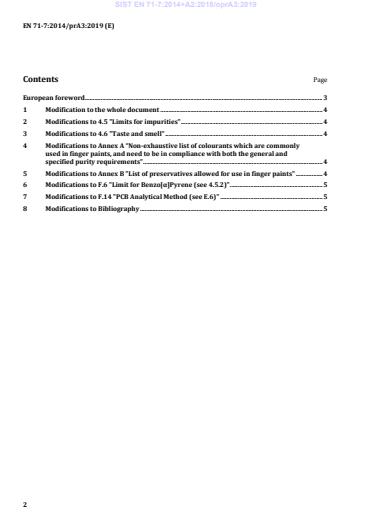
Contents Page
European foreword . 3
1 Modification to the whole document . 4
2 Modifications to 4.5 "Limits for impurities" . 4
3 Modifications to 4.6 "Taste and smell" .
...