

SIST EN ISO 23547:2023
(Main)Measurement of radioactivity - Gamma emitting radionuclides - Reference measurement standard specifications for the calibration of gamma-ray spectrometers (ISO 23547:2022)
General Information
- Abstract
This document specifies the characteristics of solid, liquid or gas sources of gamma emitting
radionuclides used as reference measurement standards for the calibration of gamma-ray spectrometers.
These reference measurement standards are traceable to national measurement standards.
This document does not describe the procedures involved in the use of these reference measurement
standards for the calibration of gamma-ray spectrometers. Such procedures are specified in ISO 20042
and other documents.
This document specifies recommended reference radiations for the calibration of gamma-ray
spectrometers. This document covers, but is not restricted to, gamma emitters which emit photons in
the energy range of 60 keV to 1 836 keV. These reference radiations are realized in the form of point
sources or adequately extended sources specified in terms of activity which are traceable to national
standards.
- Status
- Published
- Public Enquiry End Date
- 13-Jun-2023
- Publication Date
- 20-Aug-2023
- Technical Committee
- I13 - Imaginarni 13
- Current Stage
- 6060 - National Implementation/Publication (Adopted Project)
- Start Date
- 26-Jul-2023
- Due Date
- 30-Sep-2023
- Completion Date
- 21-Aug-2023

Overview
SIST EN ISO 23547:2023 is a European and International Standard focused on the measurement of radioactivity, specifically addressing the specifications for reference measurement standards needed for the calibration of gamma-ray spectrometers. Published by CEN and identical to ISO 23547:2022, this standard outlines the required properties of solid, liquid, or gaseous sources of gamma-emitting radionuclides that serve as reference measurement standards. These sources are essential for ensuring the traceability of gamma-ray spectrometer calibrations to national or international measurement standards. The document covers recommended reference radiations for spectrometer calibration, with photon energies ranging from 60 keV to 1,836 keV.
Key Topics
- Reference Measurement Standards (RMS): The standard specifies characteristics and traceability requirements for RMS in solid, liquid, or gas form. These RMSs provide the basis for accurate calibration of gamma-ray spectrometers.
- Traceability: Emphasizes the need for RMSs to be traceable to national or international standards, ensuring global comparability and reliability of radioactivity measurements.
- Source Types: Details the use of point sources, extended sources, and liquid sources for calibration activities. It also clarifies that reference materials produced under ISO 17034 are outside its scope.
- Activity and Homogeneity: Specifies performance parameters like activity (with defined uncertainty), homogeneity requirements for solid standards, and reporting of radioactive impurities.
- Energy Range: Focus on gamma emitters emitting photons between 60 keV and 1,836 keV, suitable for most environmental, health physics, and research applications.
- Documentation: RMSs must be accompanied by certificates with critical information such as identification number, manufacturer, composition, activity, homogeneity, impurities, and compliance with relevant measurement procedures.
Applications
SIST EN ISO 23547:2023 is essential for organizations involved in radiation measurement and calibration, including:
- Testing Laboratories: Maintains high data quality and measurement traceability for regulatory and accreditation purposes.
- National Metrology Institutes and Calibration Laboratories: Provides a framework for certifying and maintaining national measurement standards related to gamma-ray spectrometry.
- Health, Environmental, and Industrial Monitoring: Supports the precise calibration of instrumentation used in assessing occupational, environmental, and public radiation exposures.
- Nuclear Industry: Ensures that measurements related to waste management, effluent releases, and workplace monitoring are reliable and defensible.
- Research and Quality Assurance: Facilitates robust comparison of results across laboratories, supporting inter-laboratory comparisons and proficiency testing for technical competence.
The standard is particularly relevant for calibration activities in settings where reliable detection and quantification of gamma-emitting radionuclides are critical, such as nuclear power plants, environmental monitoring agencies, medical facilities, and safety regulatory bodies.
Related Standards
Several international standards complement and support the implementation of SIST EN ISO 23547:2023:
- ISO 20042: Specifies procedures for calibration and usage of gamma-ray spectrometers with reference measurement standards.
- ISO 2919: Outlines general requirements for sealed radioactive sources.
- ISO 9978: Defines test methods for leakage of sealed radioactive sources.
- ISO 12749-2: Provides vocabulary for nuclear energy and radiological protection.
- ISO/IEC Guide 99: Offers definitions and concepts for metrology.
- IEC 60050-395: Supplies terminology for nuclear instrumentation.
These related standards ensure a comprehensive and harmonized approach to the calibration, measurement, and quality assurance of radioactivity using gamma-ray spectrometry.
Keywords: SIST EN ISO 23547:2023, ISO 23547:2022, gamma-ray spectrometer calibration, gamma emitting radionuclides, reference measurement standard, radioactivity measurement, traceability, radiation detection standards, CEN, national measurement standards.
Relations
- Effective Date
- 09-Feb-2026
- Effective Date
- 28-Jan-2026
- Referred By
SIST EN ISO 9466:2025 - Railway Applications - Coating of passenger rail vehicle (ISO 9466:2025) - Effective Date
- 28-Jan-2026
- Effective Date
- 28-Jan-2026
- Effective Date
- 28-Jan-2026
- Effective Date
- 28-Jan-2026
- Effective Date
- 28-Jan-2026
- Effective Date
- 28-Jan-2026
- Effective Date
- 28-Jan-2026
- Effective Date
- 28-Jan-2026
Get Certified
Connect with accredited certification bodies for this standard

BSMI (Bureau of Standards, Metrology and Inspection)
Taiwan's standards and inspection authority.
Sponsored listings
Frequently Asked Questions
SIST EN ISO 23547:2023 is a standard published by the Slovenian Institute for Standardization (SIST). Its full title is "Measurement of radioactivity - Gamma emitting radionuclides - Reference measurement standard specifications for the calibration of gamma-ray spectrometers (ISO 23547:2022)". This standard covers: This document specifies the characteristics of solid, liquid or gas sources of gamma emitting radionuclides used as reference measurement standards for the calibration of gamma-ray spectrometers. These reference measurement standards are traceable to national measurement standards. This document does not describe the procedures involved in the use of these reference measurement standards for the calibration of gamma-ray spectrometers. Such procedures are specified in ISO 20042 and other documents. This document specifies recommended reference radiations for the calibration of gamma-ray spectrometers. This document covers, but is not restricted to, gamma emitters which emit photons in the energy range of 60 keV to 1 836 keV. These reference radiations are realized in the form of point sources or adequately extended sources specified in terms of activity which are traceable to national standards.
This document specifies the characteristics of solid, liquid or gas sources of gamma emitting radionuclides used as reference measurement standards for the calibration of gamma-ray spectrometers. These reference measurement standards are traceable to national measurement standards. This document does not describe the procedures involved in the use of these reference measurement standards for the calibration of gamma-ray spectrometers. Such procedures are specified in ISO 20042 and other documents. This document specifies recommended reference radiations for the calibration of gamma-ray spectrometers. This document covers, but is not restricted to, gamma emitters which emit photons in the energy range of 60 keV to 1 836 keV. These reference radiations are realized in the form of point sources or adequately extended sources specified in terms of activity which are traceable to national standards.
SIST EN ISO 23547:2023 is classified under the following ICS (International Classification for Standards) categories: 17.240 - Radiation measurements. The ICS classification helps identify the subject area and facilitates finding related standards.
SIST EN ISO 23547:2023 has the following relationships with other standards: It is inter standard links to SIST-V ISO/IEC Vodilo 99:2012, SIST EN 13721:2023, SIST EN ISO 9466:2025, SIST EN ISO/CIE 11664-5:2024, SIST EN ISO 12625-16:2024, SIST EN ISO 25980:2023, SIST EN ISO 18314-4:2021, SIST EN 13245-3:2026, SIST EN ISO 18314-4:2024, SIST EN 13245-1:2026. Understanding these relationships helps ensure you are using the most current and applicable version of the standard.
SIST EN ISO 23547:2023 is available in PDF format for immediate download after purchase. The document can be added to your cart and obtained through the secure checkout process. Digital delivery ensures instant access to the complete standard document.
Standards Content (Sample)
SLOVENSKI STANDARD
01-september-2023
Merjenje radioaktivnosti - Radionuklidi, ki sevajo gama žarke - Specifikacije
referenčnega merilnega standarda za kalibracijo spektrometrov žarkov gama (ISO
23547:2022)
Measurement of radioactivity - Gamma emitting radionuclides - Reference measurement
standard specifications for the calibration of gamma-ray spectrometers (ISO 23547:2022)
Mesurage de la radioactivité - Radionucléides émetteurs gamma - Caractéristiques des
étalons de mesure pour l’étalonnage de spectromètres gamma (ISO 23547:2022)
Ta slovenski standard je istoveten z: EN ISO 23547:2023
ICS:
17.240 Merjenje sevanja Radiation measurements
2003-01.Slovenski inštitut za standardizacijo. Razmnoževanje celote ali delov tega standarda ni dovoljeno.
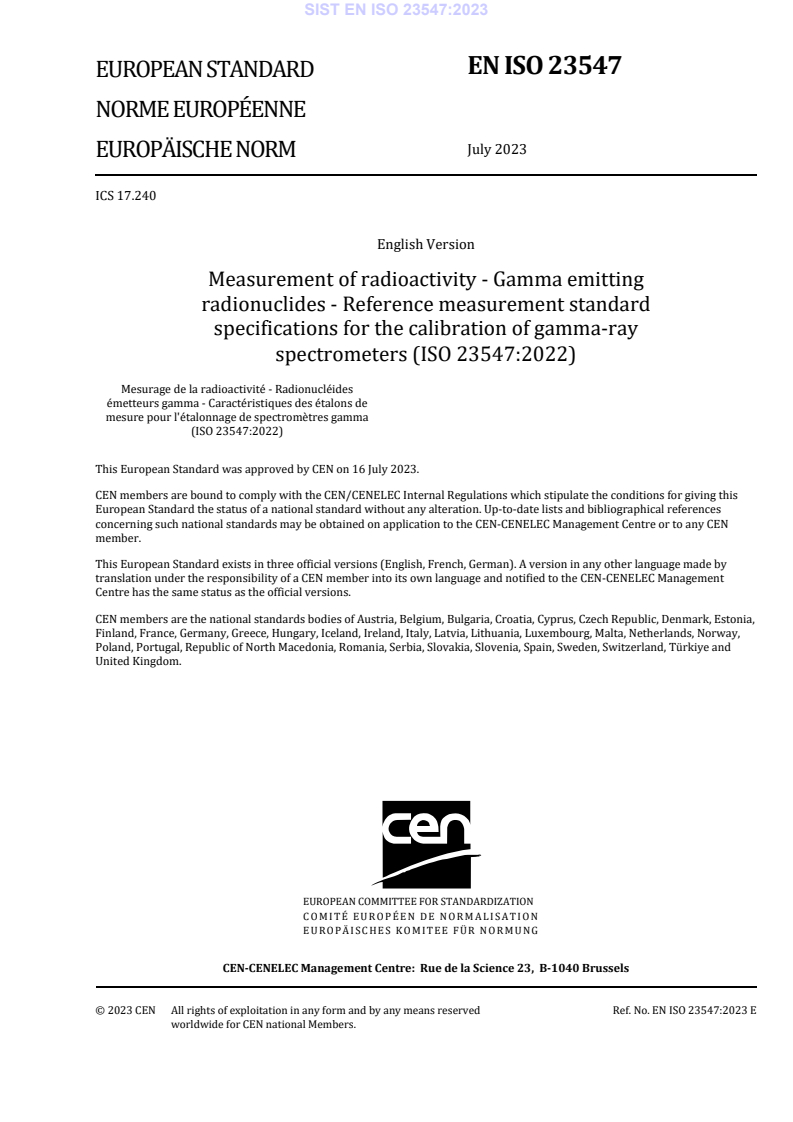
EN ISO 23547
EUROPEAN STANDARD
NORME EUROPÉENNE
July 2023
EUROPÄISCHE NORM
ICS 17.240
English Version
Measurement of radioactivity - Gamma emitting
radionuclides - Reference measurement standard
specifications for the calibration of gamma-ray
spectrometers (ISO 23547:2022)
Mesurage de la radioactivité - Radionucléides
émetteurs gamma - Caractéristiques des étalons de
mesure pour l'étalonnage de spectromètres gamma
(ISO 23547:2022)
This European Standard was approved by CEN on 16 July 2023.
CEN members are bound to comply with the CEN/CENELEC Internal Regulations which stipulate the conditions for giving this
European Standard the status of a national standard without any alteration. Up-to-date lists and bibliographical references
concerning such national standards may be obtained on application to the CEN-CENELEC Management Centre or to any CEN
member.
This European Standard exists in three official versions (English, French, German). A version in any other language made by
translation under the responsibility of a CEN member into its own language and notified to the CEN-CENELEC Management
Centre has the same status as the official versions.
CEN members are the national standards bodies of Austria, Belgium, Bulgaria, Croatia, Cyprus, Czech Republic, Denmark, Estonia,
Finland, France, Germany, Greece, Hungary, Iceland, Ireland, Italy, Latvia, Lithuania, Luxembourg, Malta, Netherlands, Norway,
Poland, Portugal, Republic of North Macedonia, Romania, Serbia, Slovakia, Slovenia, Spain, Sweden, Switzerland, Türkiye and
United Kingdom.
EUROPEAN COMMITTEE FOR STANDARDIZATION
COMITÉ EUROPÉEN DE NORMALISATION
EUROPÄISCHES KOMITEE FÜR NORMUNG
CEN-CENELEC Management Centre: Rue de la Science 23, B-1040 Brussels
© 2023 CEN All rights of exploitation in any form and by any means reserved Ref. No. EN ISO 23547:2023 E
worldwide for CEN national Members.
Contents Page
European foreword . 3
European foreword
The text of ISO 23547:2022 has been prepared by Technical Committee ISO/TC 85 "Nuclear energy,
nuclear technologies, and radiological protection” of the International Organization for Standardization
(ISO) and has been taken over as EN ISO 23547:2023 by Technical Committee CEN/TC 430 “Nuclear
energy, nuclear technologies, and radiological protection” the secretariat of which is held by AFNOR.
This European Standard shall be given the status of a national standard, either by publication of an
identical text or by endorsement, at the latest by January 2024, and conflicting national standards shall
be withdrawn at the latest by January 2024.
Attention is drawn to the possibility that some of the elements of this document may be the subject of
patent rights. CEN shall not be held responsible for identifying any or all such patent rights.
Any feedback and questions on this document should be directed to the users’ national standards body.
A complete listing of these bodies can be found on the CEN website.
According to the CEN-CENELEC Internal Regulations, the national standards organizations of the
following countries are bound to implement this European Standard: Austria, Belgium, Bulgaria,
Croatia, Cyprus, Czech Republic, Denmark, Estonia, Finland, France, Germany, Greece, Hungary, Iceland,
Ireland, Italy, Latvia, Lithuania, Luxembourg, Malta, Netherlands, Norway, Poland, Portugal, Republic of
North Macedonia, Romania, Serbia, Slovakia, Slovenia, Spain, Sweden, Switzerland, Türkiye and the
United Kingdom.
Endorsement notice
The text of ISO 23547:2022 has been approved by CEN as EN ISO 23547:2023 without any modification.
INTERNATIONAL ISO
STANDARD 23547
First edition
2022-05
Measurement of radioactivity —
Gamma emitting radionuclides —
Reference measurement standard
specifications for the calibration of
gamma-ray spectrometers
Mesurage de la radioactivité — Radionucléides émetteurs gamma —
Caractéristiques des étalons de mesure de référence pour l’étalonnage
de spectromètres gamma
Reference number
ISO 23547:2022(E)
ISO 23547:2022(E)
© ISO 2022
All rights reserved. Unless otherwise specified, or required in the context of its implementation, no part of this publication may
be reproduced or utilized otherwise in any form or by any means, electronic or mechanical, including photocopying, or posting on
the internet or an intranet, without prior written permission. Permission can be requested from either ISO at the address below
or ISO’s member body in the country of the requester.
ISO copyright office
CP 401 • Ch. de Blandonnet 8
CH-1214 Vernier, Geneva
Phone: +41 22 749 01 11
Email: copyright@iso.org
Website: www.iso.org
Published in Switzerland
ii
ISO 23547:2022(E)
Contents Page
Foreword .iv
Introduction .v
1 Scope . 1
2 Normative references . 1
3 Terms and definitions . 1
4 Metrological traceability of reference measurement standards (RMSs) .3
5 Specification of measurement standards . 4
5.1 General . 4
5.2 Reference measurement standard . 5
5.2.1 General requirements . 5
5.2.2 Container and matrix of the solid reference standards . . 6
5.2.3 Activity . 6
5.2.4 Homogeneity of radioactivity in the solid reference measurement standard . 7
5.2.5 Radionuclides . 7
5.3 Working measurement standards (WMSs) . 8
5.3.1 General requirements . 8
5.3.2 Activity . 9
5.3.3 Homogeneity . 9
5.3.4 Radionuclides . 9
6 Transfer devices . 9
6.1 Transfer measurement device . 9
6.2 Calibration . 9
Annex A (informative) Procedures for preparation of working measurement standards
from liquid source reference measurement standard .10
Bibliography .12
iii
ISO 23547:2022(E)
Foreword
ISO (the International Organization for Standardization) is a worldwide federation of national standards
bodies (ISO member bodies). The work of preparing International Standards is normally carried out
through ISO technical committees. Each member body interested in a subject for which a technical
committee has been established has the right to be represented on that committee. International
organizations, governmental and non-governmental, in liaison with ISO, also take part in the work.
ISO collaborates closely with the International Electrotechnical Commission (IEC) on all matters of
electrotechnical standardization.
The procedures used to develop this document and those intended for its further maintenance are
described in the ISO/IEC Directives, Part 1. In particular the different approval criteria needed for the
different types of ISO documents should be noted. This document was drafted in accordance with the
editorial rules of the ISO/IEC Directives, Part 2 (see www.iso.org/directives).
Attention is drawn to the possibility that some of the elements of this document may be the subject of
patent rights. ISO shall not be held responsible for identifying any or all such patent rights. Details of
any patent rights identified during the development of the document will be in the Introduction and/or
on the ISO list of patent declarations received (see www.iso.org/patents).
Any trade name used in this document is information given for the convenience of users and does not
constitute an endorsement.
For an explanation on the voluntary nature of standards, the meaning of ISO specific terms and
expressions related to conformity assessment, as well as information about ISO's adherence to the
World Trade Organization (WTO) principles in the Technical Barriers to Trade (TBT) see the following
URL: www.iso.org/iso/foreword.html.
This document was prepared by Technical Committee ISO/TC 85, Nuclear energy, nuclear technologies,
and radiological protection, Subcommittee SC 2, Radiological protection.
Any feedback or questions on this document should be directed to the user’s national standards body. A
complete listing of these bodies can be found at www.iso.org/members.html.
iv
ISO 23547:2022(E)
Introduction
Everyone is exposed to natural radiation. The natural sources of radiation are cosmic rays and
naturally occurring radioactive substances existing in the Earth itself and inside the human body.
Human activities involving the use of radiation and radioactive substances cause radiation exposure in
addition to the natural exposure. Some individual activities, such as the mining, use of ores containing
naturally radioactive substances and the production of energy by burning coal that contains such
substances, can simply enhance the exposure from natural radiation sources. Nuclear installations
use radioactive materials and produce radioactive effluent and waste during operations. The use of
radioactive materials in industry, medicine, agriculture and research is expanding around the globe.
All these human activities generally also give rise to radiation exposures that are only a small fraction
of the global average level of natural exposure. The medical use of radiation is the largest and a growing
man-made source of radiation exposure in developed countries. It includes diagnostic radiology,
radiotherapy, nuclear medicine and interventional radiology.
Radiation exposure also occurs as a result of occupational activities. It is incurred by workers in
industry, medicine and research using radiation or radioactive substances, as well as by passengers and
crew during air travel and space travel. The average level of occupational exposures is generally similar
[10]
to the global average level of natural radiation exposure .
As the uses of radiation increase, the potential health risk and the public’s concerns may increase. Thus,
ionizing radiation exposures are regularly assessed in order to improve the understanding of regional
levels and temporal trends of public and worker exposure, to evaluate the components of exposure to
provide a measure of their relative importance, and to identify emerging issues that may warrant more
attention and scrutiny. While doses to workers are usually directly measured, doses to the public are
usually assessed by indirect methods using radioactivity measurements results performed on various
sources, including waste, liquid or air effluent, and environmental samples. Environmental samples
may include ambient air, soil, surface water, ground water, treated water, vegetation, livestock and
game or other biota.
Surveillance programs require financial and technical resources. The program should be designed to
acquire data to adequately monitor potential risks. To ensure that the data obtained from radioactivity
monitoring programs support their intended use, it is essential in the dose assessment process that
stakeholders (the operators, the regulatory bodies, the local information committee and associations,
etc.) agree on appropriate data quality objectives, methods and procedures for
— the acquisition, handling, transport, storage and preparation of test samples;
— the test analytical method, and
— for calculating measurement uncertainty.
As reliable, comparable and ‘fit for purpose’ data are an essential requirement for any public health
decision based on radioactivity measurements, international standards of tested and validated
radionuclide test methods are an important tool for the production of such measurement results.
The application of standards serves also to guarantee comparability over time of the test results
and between different testing laboratories. Laboratories apply them to demonstrate their technical
qualifications with successful completion of proficiency tests during laboratory intercomparison,
two prerequisites to obtain national accreditation. Today, over a hundred international standards,
prepared by Technical Committees of the International Organization for Standardization, including
those produced by ISO/TC 85, and the International Electrotechnical Commission, are available for
application by testing laboratories to measure the main radionuclides.
A reliable determination of the activity concentration of gamma-emitting radionuclides in various
matrices is necessary for the assessment of any potential human exposure (public and workers) to the
radioactivity of these sources.
Gamma-ray spectrometry is commonly used to determine the activity of gamma-emitting
radionuclides. ISO 20042 describes the generic requirements and instrumentation to quantify the
v
ISO 23547:2022(E)
activity concentration of gamma-emitting radionuclides in samples after proper sampling, sample
handling and test sample preparation in a testing laboratory or directly on site. ISO 20042 also helps
testing laboratories to manage the measurement process by setting out the general requirements and
methods to calibrate and validate techniques. It forms the basis for measurement tasks using gamma-
ray spectrometry, such as those set out in ISO 18589-3, ISO 18589-7, ISO 10703, ISO 13164-2 and
ISO 13165-3.
According to ISO 20042 and the above-mentioned ISO standards, reference measurement standards
that are traceable to International Standards or national standards are required to calibrate gamma-
ray spectrometry systems. The necessity for developing this document originated from the need
for standardized specifications for radioactive reference measurement standards used to calibrate
gamma-ray spectrometers, as mentioned in those International Standards. Accordingly, traceability
of measurement standards to International Standards or national standards is established by use of
sources of reference measurement standards that comply with this document.
vi
INTERNATIONAL STANDARD ISO 23547:2022(E)
Measurement of radioactivity — Gamma emitting
radionuclides — Reference measurement standard
specifications for the calibration of gamma-ray
spectrometers
1 Scope
This document specifies the characteristics of solid, liquid or gas sources of gamma emitting
radionuclides used as reference measurement standards for the calibration of gamma-ray spectrometers.
These reference measurement standards are traceable to national measurement standards.
This document does not describe the procedures involved in the use of these reference measurement
standards for the calibration of gamma-ray spectrometers. Such procedures are specified in ISO 20042
and other documents.
This document specifies recommended reference radiations for the calibration of gamma-ray
spectrometers. This document covers, but is not restricted to, gamma emitters which emit photons in
the energy range of 60 keV to 1 836 keV. These reference radiations are realized in the form of point
sources or adequately extended sources specified in terms of activity which are traceable to national
standards.
Liquid standards that are intended to be used for preparing extended standards by the laboratories
are also within the scope of this document. Reference materials (RMs) produced in accordance with
ISO 17034 are out of scope of this document.
2 Normative references
The following documents are referred to in the text in such a way that some or all of their content
constitutes requirements of this document. For dated references, only the edition cited applies. For
undated references, the latest edition of the referenced document (including any amendments) applies.
ISO 2919, Radiological protection — Sealed radioactive sources — General requirements and classification
ISO 9978, Radiation protection — Sealed sources — Leakage test methods
ISO 12749-2, Nuclear energy, nuclear technologies, and radiological protection — Vocabulary — Part 2:
Radiological protection
ISO/IEC Guide 99, International vocabulary of metrology — Basic and general concepts and associated
terms (VIM)
IEC 60050-395, International Electrotechnical Vocabulary — Part 395: Nuclear instrumentation: Physical
phenomena, basic concepts, instruments, systems, equipment and detectors
3 Terms and definitions
For the purposes of this document, the terms and definitions given in ISO 12749-2, IEC 60050-395,
ISO/IEC Guide 99 and the following apply.
ISO and IEC maintain terminology databases for use in standardization at the following addresses:
— ISO Online browsing platform: available at https:// www .iso .org/ obp
— IEC Electropedia: available at https:// www .electropedia .org/
ISO 23547:2022(E)
3.1
activity
quantitative indication of the radioactivity of an amount of each radionuclide in a source
of reference measurement standard, at reference date
Note 1 to entry: It is expressed as A = −dN/dt where dN is the mean change in the number of nuclei in that energy
state due to spontaneous nuclear transformations in the time interval dt.
−1
Note 2 to entry: The special name for the unit of activity is becquerel (Bq), where 1 Bq = 1 s and
1 Ci = 3,7 × 10 Bq.
3.2
reference measurement standard
RMS
measurement standard designated for the calibration of other measurement standards
for quantities of a given kind in a given organization or at a given location
Note 1 to entry: Reference measurement standard (RMS) for activity of a quantity of radionuclide(s) is provided
as radioactive material sealed in a container or associated with a material to which it is closely bonded, this
capsule or bonding material being strong enough to maintain leak-tightness of the sealed source under the
conditions of use and wear for which it was designed.
3.3
working measurement standard
WMS
measurement standard used routinely to calibrate or verify measuring instruments or
measuring systems
Note 1 to entry: A working measurement standard (WMS) is usually calibrated with respect to a reference
measurement standard.
Note 2 to entry: In relation to verification, the terms “check standard” or “control standard” are also sometimes
used.
3.4
transfer measurement device
device used as an intermediary to compare measurement standards
3.5
cascade summing
simultaneous detection of two or more photons originating from a single nuclear disintegration that
results in only one observed (summed) pulse
3.6
detection efficiency
ratio of the count rate of detected photons to the photon emission rate of the same energy E from a RMS
(3.2) at actual measurement geometry
3.7
self-absorption
absorption of radiation which occurs within the material of the source itself
3.8
uncertainty
standard uncertainty (k = 1) unless otherwise stated
Note 1 to entry: The treatment of uncertainties is in accordance with ISO/IEC Guide 98-3.
3.9
homogeneity
indication of the lack variation of that property over the
radioactive region in a volume standard
ISO 23547:2022(E)
3.10
instrument check source
single or mixed radionuclide source which have been developed to check the correct functioning of
radiation measurement equipment involving gamma-ray spectrometers
Note 1 to entry: Instrument check sources are not used for the calibration of gamma-ray spectrometers.
3.11
metrological traceability
property of a measurement result whereby the result can be related to a reference through a
documented unbroken chain of calibrations, each contributing to the measurement uncertainty (3.8)
3.12
bulk density
-3
value in g cm obtained by the mass of radioactive matrix material filling a container divided by the
volume of the container
4 Metrological traceability of reference measurement standards (RMSs)
National metrology institutes (NMIs) or calibration laboratories should, at their discretion, provide the
means whereby reference measurement standards of a specified range of radionuclides may be certified
by them. In other words, the NMIs or calibration laboratory should be able to provide traceability
documentation for RMSs that they create, use, or measure. NMIs and calibration laboratories that
provide measurement standards should be accredited in accordance with ISO/IEC 17025 requirements
for calibration of measurement standards.
For those countries signatory to the Mutual Recognition Arrangement (MRA), a certificate of calibration
from another participating institute in a second country is recognized as valid in the first country for
the quantities, ranges, and measurement uncertainties specified in Annex C of Reference [11].
The RMS provided as a solid sealed source should be fabricated using liquid standards of radionuclides.
The activity concentration of such a solution named “standardized solution” is determined by absolute
activity measurement (e.g. 4πβ − γ coincidence counting technique) by NMIs.
Pressurized ionization chambers or germanium semiconductor detectors, which were previously
calibrated by use of standardized solutions of several kinds of nuclides are also commonly used to
determine the activity concentration of the liquid standard by secondary calibration laboratories.
For a point source RMS [see 5.1 a)], the well-mixed liquid standard shall be gravimetrically deposited
onto an infinitesimal small substrate (e.g. ion-exchange resin) and the radioactive material is sealed in
the source capsule in accordance with ISO 2919.
The well-mixed liquid standard can also be gravimetrically deposited into the capsule and after the
drying process, it is covered to avoid leakage of radioactive material.
The activity of the point source can be determined from the activity concentration of the solution
source and deposited mass of the liquid standard expressed in grams. Such sources are also used as the
RMS to determine the activity of other point sources of the same nuclide by the comparative measure in
the secondary calibration laboratory.
In case of the RMS of wide area sources [see 5.1 b)], the well-mixed
...