


SIST EN 50470-3:2022
(Main)Electricity metering equipment - Part 3: Particular requirements - Static meters for AC active energy (class indexes A, B and C)
Electricity metering equipment - Part 3: Particular requirements - Static meters for AC active energy (class indexes A, B and C)
This document applies only to static watt-hour meters of accuracy classes A, B and C for the measurement of alternating current electrical active energy in 50 Hz or 60 Hz networks and it applies to their type tests.
NOTE 1 For general requirements, such as construction, EMC, safety, dependability etc., see the relevant EN 62052 series or EN 62059 series.
This document applies to electricity metering equipment designed to:
- measure and control electrical energy on electrical networks (mains) with voltage up to 1 000 V AC;
NOTE 2 For AC electricity meters, the voltage mentioned above is the line-to-neutral voltage derived from nominal voltages. See EN 62052-31:2016, Table 7. EN 62052 31:2016 covers AC voltages only up to 600 V and Ed. 2 of EN IEC 62052 31 will cover AC voltages up to 1000 V.
- have all functional elements, including add-on modules, enclosed in, or forming a single meter case with exception of indicating displays;
- operate with integrated or detached indicating displays;
- be installed in specified matching sockets or racks;
- optionally, provide additional functions other than those for measurement of electrical energy.
Meters designed for operation with low power instrument transformers (LPITs as defined in the EN 61869 series) can be tested for compliance with this document only if such meters and their LPITs are tested together and meet the requirements for directly connected meters.
NOTE 3 Modern electricity meters typically contain additional functions such as measurement of voltage magnitude, current magnitude, power, frequency, power factor, etc.; measurement of power quality parameters; load control functions; delivery, time, test, accounting, recording functions; data communication interfaces and associated data security functions. The relevant standards for these functions could apply in addition to the requirements of this document. However, the requirements for such functions are outside the scope of this document.
NOTE 4 Product requirements for power metering and monitoring devices (PMDs) and measurement functions such as voltage magnitude, current magnitude, power, frequency, etc., are covered in EN 61557-12:2008. However, devices compliant with EN 61557-12:2008 are not intended to be used as billing meters unless they are also compliant with the EN IEC 62052-11:2021/A11:2022 and EN 50470-3:2022 standards.
NOTE 5 Product requirements for power quality instruments (PQIs) are covered in EN 62586-1:2017. Requirements for power quality measurement techniques (functions) are covered in EN 61000-4-30:2015. Requirements for testing of the power quality measurement functions are covered in EN 62586-2:2017.
This document does not apply to:
- meters for which the line-to-neutral voltage derived from nominal voltages exceeds 1 000 V AC;
- meters intended for connection with low power instrument transformers (LPITs as defined in the EN 61869 series) when tested without such transformers;
- metering systems comprising multiple devices (except of LPITs) physically remote from one another;
- portable meters;
NOTE 6 Portable meters are meters that are not permanently connected.
- meters used in rolling stock, vehicles, ships and airplanes;
- laboratory and meter test equipment;
- reference standard meters;
- data interfaces to the register of the meter;
- matching sockets or racks used for installation of electricity metering equipment;
- any additional functions provided in electrical energy meters.
This document does not cover measures for the detection and prevention of fraudulent attempts to compromise meter’s performance (tampering).
[...]
Elektrizitätszähler - Teil 3: Besondere Anforderungen - Elektronische Wechselstrom Wirkverbrauchszähler der Genauigkeitsklassen A, B und C
Equipement de comptage d'électricité - Partie 3: Exigences particulières - Compteurs statiques d'énergie active en courant alternatif (indices de classe A, B et C)
Le présent document s’applique uniquement aux compteurs statiques d’énergie active de classes de précision A, B et C, destinés à la mesure de l’énergie électrique active en courant alternatif sur les réseaux électriques en 50 Hz et 60 Hz, et à leurs essais de type.
NOTE 1 Pour les exigences générales, notamment en matière de construction, de CEM, de sécurité, de sûreté de fonctionnement, etc., voir la série EN 62052 ou la série EN 62059 correspondante.
Le présent document s’applique aux équipements de comptage de l’électricité conçus pour:
- mesurer et piloter l’énergie électrique sur les réseaux électriques (secteur) avec une tension allant jusqu’à 1 000 V en courant alternatif;
NOTE 2 Pour les compteurs en courant alternatif, la tension mentionnée ci-dessus est la tension phase-neutre dérivée des tensions nominales. Voir l’EN 62052-31:2016, Tableau 7. L’EN 62052 31:2016 couvre des tensions en courant alternatif allant uniquement jusqu’à 600 V et l’édition 2 de l’EN IEC 62052 31 couvrira des tensions en courant alternatif jusqu’à 1 000 V.
- avoir tous les éléments fonctionnels, y compris les modules complémentaires, incorporés dans ou formant un boîtier de compteur unique, à l’exception des afficheurs;
- fonctionner avec des afficheurs intégrés ou séparés;
- être installés en racks ou embases spécifiés;
- assurer, en option, des fonctions supplémentaires, autres que celles relatives au comptage de l’énergie électrique.
Les compteurs conçus pour être alimentés par des transformateurs de mesure de faible puissance (LPIT, Low Power Instrument Transformers, définis dans la série EN 61869) peuvent uniquement être soumis à des essais de conformité au présent document si ces compteurs et leurs LPIT sont soumis à l’essai ensemble et satisfont aux exigences relatives aux compteurs à branchement direct.
NOTE 3 Les compteurs d’électricité modernes présentent généralement des fonctions supplémentaires, telles que la mesure de l’amplitude de tension, de l’amplitude de courant, de la puissance, de la fréquence, du facteur de puissance, etc.; la mesure des paramètres de qualité de l’alimentation; des fonctions de commande des charges; des fonctions de distribution, de temporisation, d’essai, de gestion, d’enregistrement; des fonctions relatives aux interfaces de communication de données et à la sécurité des données associées. Les normes pertinentes pour ces fonctions peuvent s’appliquer en plus des exigences du présent document. Toutefois, les exigences relatives à ces fonctions ne relèvent pas du domaine d’application du présent document.
NOTE 4 Les exigences de produits concernant les dispositifs de mesure et de surveillance des performances (PMD, Power Metering and Monitoring Devices) et des fonctions de mesure telles que l’amplitude de tension, l’amplitude de courant, la puissance, la fréquence, etc. sont traitées dans l’EN 61557-12:2008. Toutefois, les dispositifs conformes à l’EN 61557-12:2008 ne sont pas destinés à être utilisés en tant que compteurs de facturation, sauf s’ils sont également conformes aux normes EN IEC 62052-11:2021/A11:2022 et EN 50470-3:2022.
NOTE 5 Les exigences de produits concernant les instruments de mesure de la qualité de l’alimentation (PQI, Power Quality Instrument) sont traitées dans l’EN 62586-1:2017. Les exigences relatives aux techniques (fonctions) de mesure de la qualité de l’alimentation sont traitées dans l’EN 61000-4-30:2015. Les exigences relatives aux essais des fonctions de mesure de la qualité de l’alimentation sont traitées dans l’EN 62586-2:2017.
Le présent document ne s’applique pas:
[...]
Oprema za merjenje električne energije - 3. del: Posebne zahteve - Statični števci za izmenično delovno energijo (razredni indeksi A, B in C)
Ta dokument se uporablja za statične števce delovne energije razredov natančnosti A, B in C za merjenje delovne električne energije pri izmeničnem toku v omrežju 50 Hz ali 60 Hz ter se uporablja le za tipsko preskušanje teh števcev.
OPOMBA 1: Splošne zahteve, na primer za izdelavo, elektromagnetno združljivost (EMC), varnost, zanesljivost itd. so podane v ustreznih skupinah standardov EN 62052 ali EN 62059.
Ta dokument se uporablja za opremo za merjenje električne energije, zasnovano:
– za merjenje in nadzor električne energije v električnih omrežjih z napetostjo 1000 V pri izmeničnem toku;
OPOMBA 2: Za merilnike električne energije za izmenični tok je zgoraj omenjena napetost napetost med linijskim in nevtralnim vodnikom, izpeljana iz nazivnih napetosti. Glej EN 62052-31:2016, preglednica 7. Standard EN 62052-31:2016 zajema napetosti pri izmeničnem toku le do 600 V, 2. izdaja standarda EN IEC 62052-31 pa bo zajemala napetosti pri izmeničnem toku do 1000 V;
– z vsemi funkcionalnimi elementi, vključno z dodatnimi moduli, v enotnem ohišju, razen prikazovalnikov;
– za delovanje z integriranimi ali ločenimi prikazovalniki;
– za namestitev v določeno ustrezno vtičnico ali stojalo;
– za zagotavljanje dodatnih funkcij po izbiri poleg tistih, ki so namenjene merjenju električne energije.
Merilnike, zasnovane za delovanje z instrumentnimi transformatorji majhne moči (LPIT, kot so opredeljeni v skupini standardov EN 61869), je mogoče preskusiti glede skladnosti s tem dokumentom le, če se takšni merilniki in njihovi instrumentni transformatorji majhne moči preskusijo skupaj in izpolnjujejo zahteve za neposredno povezane merilnike.
OPOMBA 3: Sodobni števci električne energije običajno vsebujejo dodatne funkcije, kot so merjenje velikosti napetosti, velikosti toka, moči, frekvence, faktorja moči itd.; merjenje parametrov kakovosti električne energije; funkcije krmiljenja obremenitve; funkcije dobave, časa, preskušanja, vodenja evidence, beleženja; podatkovni komunikacijski vmesniki in povezane funkcije za varnost podatkov.
Poleg zahtev iz tega dokumenta lahko veljajo ustrezni standardi za te funkcije. Vendar zahteve za te funkcije ne spadajo na področje uporabe tega dokumenta.
OPOMBA 4: Zahteve glede izdelkov za naprave za merjenje in nadzorovanje moči (PMD) in merilne funkcije, kot so velikost napetosti, velikost toka, moč, frekvenca itd., so zajete v standardu EN 61557-12:2008. Vendar naprave, ki so skladne s standardom EN 61557-12:2008, niso namenjene uporabi kot merilniki za obračunavanje, razen če so skladne tudi s standardoma EN IEC 62052-11:2021/A11:2022 in EN 50470-3:2022.
OPOMBA 5: Zahteve glede izdelkov za instrumente za kakovost napajanja (PQI) so obravnavane v standardu EN 62586-1:2017. Zahteve za tehnike (funkcije) merjenja kakovosti napajanja so zajete v standardu EN 61000-4-30:2015. Zahteve za preskušanje funkcij merjenja kakovosti napajanja so opisane v standardu EN 62586-2:2017.
Ta dokument se ne uporablja za:
– merilnike, pri katerih napetost med linijskim in nevtralnim vodnikom, izpeljana iz nazivnih napetosti, presega 1000 V pri izmeničnem toku;
– merilnike, namenjene za povezavo z instrumentnimi transformatorji majhne moči (LPIT, kot so opredeljeni v skupini standardov EN 61869), kadar se preskušajo brez takih transformatorjev;
– merilne sisteme, sestavljene iz več naprav (razen LPIT), ki so medsebojno fizično oddaljene;
– prenosne merilnike;
OPOMBA 6: Prenosni merilniki so merilniki, ki niso trajno priključeni.
– merilnike, ki se uporabljajo v tirnih vozilih, vozilih, ladjah in letalih;
– laboratorijsko in preskusno opremo za merilnike;
standardne referenčne merilnike;
– podatkovne vmesnike, povezane v register števca;
– ustrezne vtičnice ali stojala, ki se uporabljajo za namestitev opreme za merjenje električne energije;
– vse dodatne funkcije, ki jih zagotavljajo merilniki električne energije.
Ta dokument ne zajema ukrepov za odkrivanje in preprečevanje poskusov goljufije z vplivanjem na
General Information
- Status
- Published
- Public Enquiry End Date
- 29-Jul-2021
- Publication Date
- 23-Aug-2022
- Technical Committee
- MEE - Equipment for electrical energy measurement and load control
- Current Stage
- 6060 - National Implementation/Publication (Adopted Project)
- Start Date
- 01-Aug-2022
- Due Date
- 06-Oct-2022
- Completion Date
- 24-Aug-2022
Relations
- Effective Date
- 01-Sep-2022
- Effective Date
- 01-Sep-2022
Overview
EN 50470-3:2022 (CLC) specifies the particular requirements and type-test procedures for static watt-hour meters that measure AC active energy in accuracy class indexes A, B and C. It applies to meters for 50 Hz or 60 Hz networks and equipment intended for use on electrical mains with line‑to‑neutral voltages up to 1 000 V AC. This standard is focused on metrological performance and type testing of static electricity meters (billing meters) and complements general requirements in the EN 62052 / EN 62059 series.
Key topics and technical requirements
- Scope and applicability: Static meters only; excludes portable meters, meters for rolling stock/vehicles/ships/airplanes, reference standard meters and distributed metering systems.
- Accuracy and tests: Requirements for accuracy verification, measurement uncertainty, starting current, minimum/maximum current, repeatability, and accuracy tests at reference conditions.
- Electrical ratings: Standardized nominal voltages, currents and frequencies (50 Hz / 60 Hz) and transitional/current ranges relevant to classes A, B and C.
- Construction & marking: Meter construction requirements, labeling and documentation needed for type approval and field use.
- Environmental & reliability tests: Climatic conditions, effects of external influences, durability and reliability (type test regimes).
- Software and data protection: Identification/protection of metrologically relevant software and parameters, protection against corruption and unauthorized parameter changes.
- Exclusions & limitations: Does not define tampering/fraud prevention measures; LPIT‑operated meters must be tested together with their LPITs to be compliant.
Practical applications and users
- Meter manufacturers - design, development and type-testing of static electricity meters for billing.
- Test laboratories and conformity assessment bodies - perform the type tests and verification required for market access.
- Utilities and metering procurement teams - specify meter requirements that ensure compliance with European metrology requirements.
- Regulators and notified bodies - evaluate device compliance with the Measuring Instruments Directive (MID) and national regulations.
Related standards (select)
- EN IEC 62052-11:2021/A11:2022 - General requirements, tests and test conditions for metering equipment
- EN 62052-31 - Voltages/ratings guidance for AC meters
- EN 61869 series - Low power instrument transformers (LPITs)
- EN 61557-12 - Power metering & monitoring devices (non-billing)
- EN 62586 / EN 61000-4-30 - Power quality instruments and measurement techniques
EN 50470-3:2022 supersedes earlier editions and aligns with EU Directive 2014/32/EU (MID) for billing meters. Use this standard when specifying, testing or approving static AC active energy meters (classes A, B, C). Keywords: electricity metering, static meters, AC active energy, accuracy classes A B C, EN 50470-3, type tests, meter testing, metrological requirements.



Frequently Asked Questions
SIST EN 50470-3:2022 is a standard published by the Slovenian Institute for Standardization (SIST). Its full title is "Electricity metering equipment - Part 3: Particular requirements - Static meters for AC active energy (class indexes A, B and C)". This standard covers: This document applies only to static watt-hour meters of accuracy classes A, B and C for the measurement of alternating current electrical active energy in 50 Hz or 60 Hz networks and it applies to their type tests. NOTE 1 For general requirements, such as construction, EMC, safety, dependability etc., see the relevant EN 62052 series or EN 62059 series. This document applies to electricity metering equipment designed to: - measure and control electrical energy on electrical networks (mains) with voltage up to 1 000 V AC; NOTE 2 For AC electricity meters, the voltage mentioned above is the line-to-neutral voltage derived from nominal voltages. See EN 62052-31:2016, Table 7. EN 62052 31:2016 covers AC voltages only up to 600 V and Ed. 2 of EN IEC 62052 31 will cover AC voltages up to 1000 V. - have all functional elements, including add-on modules, enclosed in, or forming a single meter case with exception of indicating displays; - operate with integrated or detached indicating displays; - be installed in specified matching sockets or racks; - optionally, provide additional functions other than those for measurement of electrical energy. Meters designed for operation with low power instrument transformers (LPITs as defined in the EN 61869 series) can be tested for compliance with this document only if such meters and their LPITs are tested together and meet the requirements for directly connected meters. NOTE 3 Modern electricity meters typically contain additional functions such as measurement of voltage magnitude, current magnitude, power, frequency, power factor, etc.; measurement of power quality parameters; load control functions; delivery, time, test, accounting, recording functions; data communication interfaces and associated data security functions. The relevant standards for these functions could apply in addition to the requirements of this document. However, the requirements for such functions are outside the scope of this document. NOTE 4 Product requirements for power metering and monitoring devices (PMDs) and measurement functions such as voltage magnitude, current magnitude, power, frequency, etc., are covered in EN 61557-12:2008. However, devices compliant with EN 61557-12:2008 are not intended to be used as billing meters unless they are also compliant with the EN IEC 62052-11:2021/A11:2022 and EN 50470-3:2022 standards. NOTE 5 Product requirements for power quality instruments (PQIs) are covered in EN 62586-1:2017. Requirements for power quality measurement techniques (functions) are covered in EN 61000-4-30:2015. Requirements for testing of the power quality measurement functions are covered in EN 62586-2:2017. This document does not apply to: - meters for which the line-to-neutral voltage derived from nominal voltages exceeds 1 000 V AC; - meters intended for connection with low power instrument transformers (LPITs as defined in the EN 61869 series) when tested without such transformers; - metering systems comprising multiple devices (except of LPITs) physically remote from one another; - portable meters; NOTE 6 Portable meters are meters that are not permanently connected. - meters used in rolling stock, vehicles, ships and airplanes; - laboratory and meter test equipment; - reference standard meters; - data interfaces to the register of the meter; - matching sockets or racks used for installation of electricity metering equipment; - any additional functions provided in electrical energy meters. This document does not cover measures for the detection and prevention of fraudulent attempts to compromise meter’s performance (tampering). [...]
This document applies only to static watt-hour meters of accuracy classes A, B and C for the measurement of alternating current electrical active energy in 50 Hz or 60 Hz networks and it applies to their type tests. NOTE 1 For general requirements, such as construction, EMC, safety, dependability etc., see the relevant EN 62052 series or EN 62059 series. This document applies to electricity metering equipment designed to: - measure and control electrical energy on electrical networks (mains) with voltage up to 1 000 V AC; NOTE 2 For AC electricity meters, the voltage mentioned above is the line-to-neutral voltage derived from nominal voltages. See EN 62052-31:2016, Table 7. EN 62052 31:2016 covers AC voltages only up to 600 V and Ed. 2 of EN IEC 62052 31 will cover AC voltages up to 1000 V. - have all functional elements, including add-on modules, enclosed in, or forming a single meter case with exception of indicating displays; - operate with integrated or detached indicating displays; - be installed in specified matching sockets or racks; - optionally, provide additional functions other than those for measurement of electrical energy. Meters designed for operation with low power instrument transformers (LPITs as defined in the EN 61869 series) can be tested for compliance with this document only if such meters and their LPITs are tested together and meet the requirements for directly connected meters. NOTE 3 Modern electricity meters typically contain additional functions such as measurement of voltage magnitude, current magnitude, power, frequency, power factor, etc.; measurement of power quality parameters; load control functions; delivery, time, test, accounting, recording functions; data communication interfaces and associated data security functions. The relevant standards for these functions could apply in addition to the requirements of this document. However, the requirements for such functions are outside the scope of this document. NOTE 4 Product requirements for power metering and monitoring devices (PMDs) and measurement functions such as voltage magnitude, current magnitude, power, frequency, etc., are covered in EN 61557-12:2008. However, devices compliant with EN 61557-12:2008 are not intended to be used as billing meters unless they are also compliant with the EN IEC 62052-11:2021/A11:2022 and EN 50470-3:2022 standards. NOTE 5 Product requirements for power quality instruments (PQIs) are covered in EN 62586-1:2017. Requirements for power quality measurement techniques (functions) are covered in EN 61000-4-30:2015. Requirements for testing of the power quality measurement functions are covered in EN 62586-2:2017. This document does not apply to: - meters for which the line-to-neutral voltage derived from nominal voltages exceeds 1 000 V AC; - meters intended for connection with low power instrument transformers (LPITs as defined in the EN 61869 series) when tested without such transformers; - metering systems comprising multiple devices (except of LPITs) physically remote from one another; - portable meters; NOTE 6 Portable meters are meters that are not permanently connected. - meters used in rolling stock, vehicles, ships and airplanes; - laboratory and meter test equipment; - reference standard meters; - data interfaces to the register of the meter; - matching sockets or racks used for installation of electricity metering equipment; - any additional functions provided in electrical energy meters. This document does not cover measures for the detection and prevention of fraudulent attempts to compromise meter’s performance (tampering). [...]
SIST EN 50470-3:2022 is classified under the following ICS (International Classification for Standards) categories: 17.220.20 - Measurement of electrical and magnetic quantities; 91.140.50 - Electricity supply systems. The ICS classification helps identify the subject area and facilitates finding related standards.
SIST EN 50470-3:2022 has the following relationships with other standards: It is inter standard links to SIST EN 50470-3:2007/A1:2019, SIST EN 50470-3:2007. Understanding these relationships helps ensure you are using the most current and applicable version of the standard.
SIST EN 50470-3:2022 is associated with the following European legislation: EU Directives/Regulations: 2013-01-0613, 2014/30/EU, 2014/32/EU; Standardization Mandates: M/541, M/552. When a standard is cited in the Official Journal of the European Union, products manufactured in conformity with it benefit from a presumption of conformity with the essential requirements of the corresponding EU directive or regulation.
SIST EN 50470-3:2022 is available in PDF format for immediate download after purchase. The document can be added to your cart and obtained through the secure checkout process. Digital delivery ensures instant access to the complete standard document.
Standards Content (Sample)
SLOVENSKI STANDARD
01-september-2022
Nadomešča:
SIST EN 50470-3:2007
SIST EN 50470-3:2007/A1:2019
Oprema za merjenje električne energije - 3. del: Posebne zahteve - Statični števci
za izmenično delovno energijo (razredni indeksi A, B in C)
Electricity metering equipment - Part 3: Particular requirements - Static meters for AC
active energy (class indexes A, B and C)
Elektrizitätszähler - Teil 3: Besondere Anforderungen - Elektronische Wechselstrom
Wirkverbrauchszähler der Genauigkeitsklassen A, B und C
Equipement de comptage d'électricité - Partie 3: Exigences particulières - Compteurs
statiques d'énergie active en courant alternatif (indices de classe A, B et C)
Ta slovenski standard je istoveten z: EN 50470-3:2022
ICS:
17.220.20 Merjenje električnih in Measurement of electrical
magnetnih veličin and magnetic quantities
91.140.50 Sistemi za oskrbo z elektriko Electricity supply systems
2003-01.Slovenski inštitut za standardizacijo. Razmnoževanje celote ali delov tega standarda ni dovoljeno.
EUROPEAN STANDARD EN 50470-3
NORME EUROPÉENNE
EUROPÄISCHE NORM June 2022
ICS 91.140.50 Supersedes EN 50470-3:2006 + A1:2018
English Version
Electricity metering equipment - Part 3: Particular requirements -
Static meters for AC active energy (class indexes A, B and C)
Equipement de comptage d'électricité - Partie 3: Exigences Elektrizitätszähler - Teil 3: Besondere Anforderungen -
particulières - Compteurs statiques d'énergie active en Elektronische Wechselstrom Wirkverbrauchszähler der
courant alternatif (indices de classe A, B et C) Genauigkeitsklassen A, B und C
This European Standard was approved by CENELEC on 2022-04-11. CENELEC members are bound to comply with the CEN/CENELEC
Internal Regulations which stipulate the conditions for giving this European Standard the status of a national standard without any alteration.
Up-to-date lists and bibliographical references concerning such national standards may be obtained on application to the CEN-CENELEC
Management Centre or to any CENELEC member.
This European Standard exists in three official versions (English, French, German). A version in any other language made by translation
under the responsibility of a CENELEC member into its own language and notified to the CEN-CENELEC Management Centre has the
same status as the official versions.
CENELEC members are the national electrotechnical committees of Austria, Belgium, Bulgaria, Croatia, Cyprus, the Czech Republic,
Denmark, Estonia, Finland, France, Germany, Greece, Hungary, Iceland, Ireland, Italy, Latvia, Lithuania, Luxembourg, Malta, the
Netherlands, Norway, Poland, Portugal, Republic of North Macedonia, Romania, Serbia, Slovakia, Slovenia, Spain, Sweden, Switzerland,
Turkey and the United Kingdom.
European Committee for Electrotechnical Standardization
Comité Européen de Normalisation Electrotechnique
Europäisches Komitee für Elektrotechnische Normung
CEN-CENELEC Management Centre: Rue de la Science 23, B-1040 Brussels
© 2022 CENELEC All rights of exploitation in any form and by any means reserved worldwide for CENELEC Members.
Ref. No. EN 50470-3:2022 E
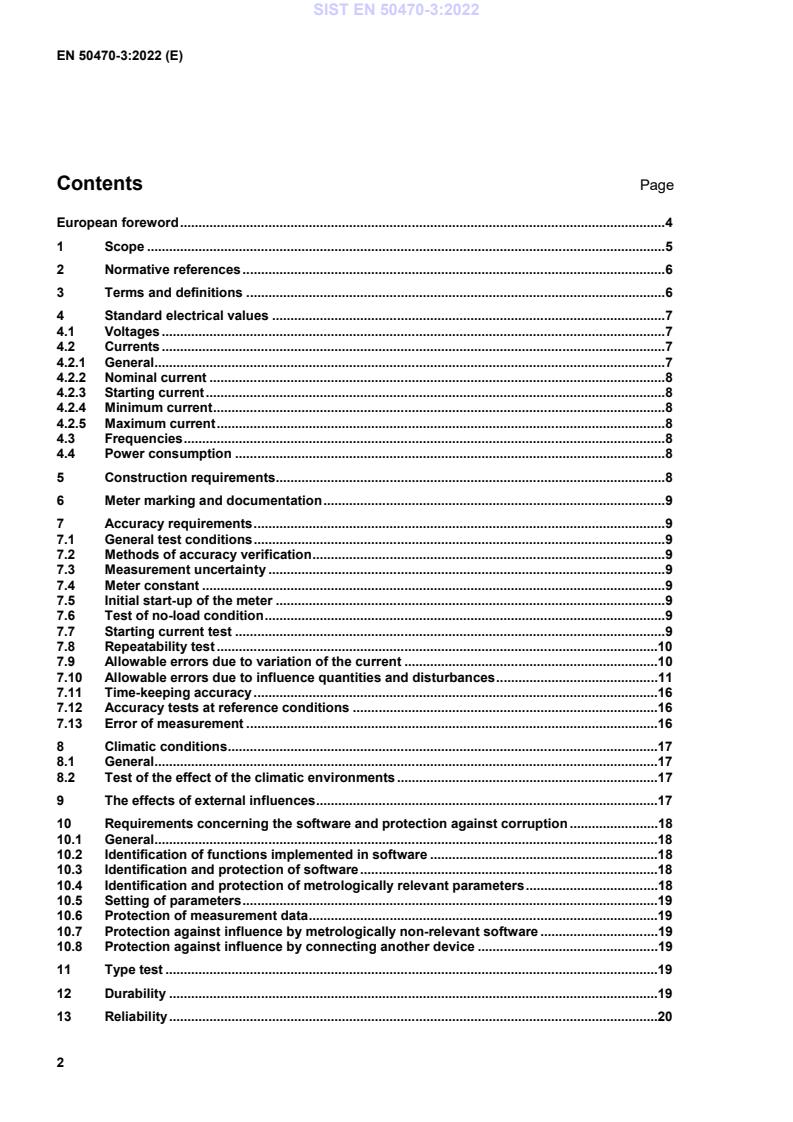
Contents Page
European foreword . 4
1 Scope . 5
2 Normative references . 6
3 Terms and definitions . 6
4 Standard electrical values . 7
4.1 Voltages . 7
4.2 Currents . 7
4.2.1 General . 7
4.2.2 Nominal current . 8
4.2.3 Starting current . 8
4.2.4 Minimum current . 8
4.2.5 Maximum current . 8
4.3 Frequencies . 8
4.4 Power consumption . 8
5 Construction requirements . 8
6 Meter marking and documentation . 9
7 Accuracy requirements . 9
7.1 General test conditions . 9
7.2 Methods of accuracy verification . 9
7.3 Measurement uncertainty . 9
7.4 Meter constant . 9
7.5 Initial start-up of the meter . 9
7.6 Test of no-load condition . 9
7.7 Starting current test . 9
7.8 Repeatability test .10
7.9 Allowable errors due to variation of the current .10
7.10 Allowable errors due to influence quantities and disturbances .11
7.11 Time-keeping accuracy .16
7.12 Accuracy tests at reference conditions .16
7.13 Error of measurement .16
8 Climatic conditions .17
8.1 General .17
8.2 Test of the effect of the climatic environments .17
9 The effects of external influences .17
10 Requirements concerning the software and protection against corruption .18
10.1 General .18
10.2 Identification of functions implemented in software .18
10.3 Identification and protection of software .18
10.4 Identification and protection of metrologically relevant parameters .18
10.5 Setting of parameters .19
10.6 Protection of measurement data .19
10.7 Protection against influence by metrologically non-relevant software .19
10.8 Protection against influence by connecting another device .19
11 Type test .19
12 Durability .19
13 Reliability .20
Annex A (informative) Calculation of the error of measurement . 21
Annex B (informative) Differences between IEC and Directive 2014/32/EU . 22
Annex C (informative) Accuracy classes . 25
C.1 General . 25
C.2 Accuracy classes . 25
Annex ZZ (informative) Relationship between this European Standard and the essential
requirements of Directive 2014/32/EU aimed to be covered . 26
Bibliography . 29
European foreword
This document (EN 50470-3:2022) has been prepared by CLC/TC 13 “Electrical energy measurement and
control”.
The following dates are fixed:
• latest date by which this document has to be (dop) 2023-04-11
implemented at national level by publication of
an identical national standard or by
endorsement
• latest date by which the national standards (dow) 2025-04-11
conflicting with this document have to be
withdrawn
This document supersedes EN 50470-3:2006 and all of its amendments and corrigenda.
based on EN IEC 62052-11:2021/A11:2022 instead of EN 50470-1:2006.
Attention is drawn to the possibility that some of the elements of this document may be the subject of patent
rights. CENELEC shall not be held responsible for identifying any or all such patent rights.
This document has been prepared under a Standardization Request given to CENELEC by the European
Commission and the European Free Trade Association, and supports essential requirements of EU Directive(s)
/ Regulation(s).
For the relationship with EU Directive(s) / Regulation(s), see informative Annex ZZ, which is an integral part of
this document.
This document is related to:
— EN IEC 62053-21:2021/A11:2021, Electricity metering equipment – Particular requirements – Part 21:
Static meters for AC active energy (classes 0,5, 1 and 2)
— EN IEC 62053-22:2021/A11:2021, Electricity metering equipment – Particular requirements – Part 22:
Static meters for AC active energy (classes 0,1 S, 0,2 S and 0,5 S).
NOTE Terms differences for accuracy classes in related standards (EN IEC 62053-21:2021/A11:2021 and
EN IEC 62053-22:2021/A11:2021) and Directive 2014/32/EU are listed in Annex C.
The structure of the standards is similar; modifications in this document are provided in the perspective of
compliance with the Essential Requirements of Directive 2014/32/EU on Measuring Instruments (MID).
Any feedback and questions on this document should be directed to the users’ national committee. A complete
listing of these bodies can be found on the CENELEC website.
1 Scope
This document applies only to static watt-hour meters of accuracy classes A, B and C for the measurement of
alternating current electrical active energy in 50 Hz or 60 Hz networks and it applies to their type tests.
NOTE 1 For general requirements, such as construction, EMC, safety, dependability etc., see the relevant EN 62052
series or EN 62059 series.
This document applies to electricity metering equipment designed to:
— measure and control electrical energy on electrical networks (mains) with voltage up to 1 000 V AC;
NOTE 2 For AC electricity meters, the voltage mentioned above is the line-to-neutral voltage derived from nominal
voltages. See EN 62052-31:2016, Table 7. EN 62052-31:2016 covers AC voltages only up to 600 V and Ed. 2 of
EN IEC 62052-31 will cover AC voltages up to 1000 V.
— have all functional elements, including add-on modules, enclosed in, or forming a single meter case with
exception of indicating displays;
— operate with integrated or detached indicating displays;
— be installed in specified matching sockets or racks;
— optionally, provide additional functions other than those for measurement of electrical energy.
Meters designed for operation with low power instrument transformers (LPITs as defined in the EN 61869
series) can be tested for compliance with this document only if such meters and their LPITs are tested together
and meet the requirements for directly connected meters.
NOTE 3 Modern electricity meters typically contain additional functions such as measurement of voltage magnitude,
current magnitude, power, frequency, power factor, etc.; measurement of power quality parameters; load control functions;
delivery, time, test, accounting, recording functions; data communication interfaces and associated data security functions.
The relevant standards for these functions could apply in addition to the requirements of this document. However, the
requirements for such functions are outside the scope of this document.
NOTE 4 Product requirements for power metering and monitoring devices (PMDs) and measurement functions such as
voltage magnitude, current magnitude, power, frequency, etc., are covered in EN 61557-12:2008. However, devices
compliant with EN 61557-12:2008 are not intended to be used as billing meters unless they are also compliant with the
EN IEC 62052-11:2021/A11:2022 and EN 50470-3:2022 standards.
NOTE 5 Product requirements for power quality instruments (PQIs) are covered in EN 62586-1:2017. Requirements for
power quality measurement techniques (functions) are covered in EN 61000-4-30:2015. Requirements for testing of the
power quality measurement functions are covered in EN 62586-2:2017.
This document does not apply to:
— meters for which the line-to-neutral voltage derived from nominal voltages exceeds 1 000 V AC;
— meters intended for connection with low power instrument transformers (LPITs as defined in the EN 61869
series) when tested without such transformers;
— metering systems comprising multiple devices (except of LPITs) physically remote from one another;
— portable meters;
NOTE 6 Portable meters are meters that are not permanently connected.
— meters used in rolling stock, vehicles, ships and airplanes;
— laboratory and meter test equipment;
— reference standard meters;
— data interfaces to the register of the meter;
— matching sockets or racks used for installation of electricity metering equipment;
— any additional functions provided in electrical energy meters.
This document does not cover measures for the detection and prevention of fraudulent attempts to compromise
meter’s performance (tampering).
NOTE 7 Nevertheless, specific tampering detection and prevention requirements, and test methods, as relevant for a
particular market are subject to the agreement between the manufacturer and the purchaser.
NOTE 8 Specifying requirements and test methods for fraud detection and prevention would be counterproductive, as
such specifications would provide guidance for potential fraudsters.
NOTE 9 There are many types of meter tampering reported from various markets; therefore, designing meters to detect
and prevent all types of tampering could lead to unjustified increase in costs of meter design, verification and validation.
NOTE 10 Billing systems, such as smart metering systems, are capable of detecting irregular consumption patterns and
irregular network losses which enable discovery of suspected meter tampering.
NOTE 11 For transformer operated meters paired with current transformers (CTs) according to EN 61869-2: the standard
CT measuring range is specified from 0,05 I to I for accuracy classes 0,1, 0,2, 0,5 and 1 and these CTs are used for
n max
meters of class C, B and A according to this document.
NOTE 12 This document does not specify emission requirements, these are specified in
EN IEC 62052-11:2021/A11:2022, 9.3.14.
2 Normative references
The following documents are referred to in the text in such a way that some or all of their content constitutes
requirements of this document. For dated references, only the edition cited applies. For undated references, the
latest edition of the referenced document (including any amendments) applies.
EN IEC 62052-11:2021/A11:2022, Electricity metering equipment – General requirements, tests and test
conditions - Part 11: Metering equipment
3 Terms and definitions
For the purposes of this document, the terms and definitions given in EN IEC 62052-11:2021/A11:2022 and the
following apply.
ISO and IEC maintain terminological databases for use in standardization at the following addresses:
— ISO Online browsing platform: available at https://www.iso.org/obp
— IEC Electropedia: available at https://www.electropedia.org/
NOTE The definitions listed here take precedence over those in EN IEC 62052-11:2021/A11:2022.
3.1
transitional current
I
tr
value of the current at, and above which, up to I full accuracy requirements of this document apply
max
3.2
influence quantity
quantity that is not the measurand but that affects the result of measurement
3.3
disturbance
influence quantity having a value within the limits specified in the appropriate requirement but outside the
specified rated operating conditions of the measuring instrument
Note 1 to entry: An influence quantity is a disturbance if for that influence quantity the rated operating conditions are not
specified.
3.4
critical change value
value at which the change in the measurement result is considered undesirable
Note 1 to entry: The critical change value specifies here the maximum change in the measurement results for all
disturbances. This definition is the same definition as in the Directive 2014/32/EU. In EN IEC 62052-11:2021/A11:2022, the
critical change value has another definition and meaning and applies only for tests without any current.
3.5
rated operating condition
value for the measurand and influence quantities making up the normal working conditions of an instrument
3.6
maximum permissible error
MPE
maximum allowable error under rated operating conditions and in the absence of a disturbance
4 Standard electrical values
4.1 Voltages
The values in EN IEC 62052-11:2021/A11:2022, 4.1 apply.
4.2 Currents
4.2.1 General
Table 1 — Preferred values of I and I
tr n
Meters Current Value of current
A
0,1–0,2–0,5–1–1,5–2–3–4–
I
tr
5–6,3–8–10–12,5
For direct connection
I 1–2–5–10–15–20–30–40–
n
50–63–80–100–125
I 0,05–0,1–0,25
tr
Transformer operated
I 1–2–5
n
For meters intended for operation with LPITs, the values in Table 1 for direct connection apply to the primary
ratings of the LPITs used with the meter.
NOTE 1 The values for I are from EN IEC 62052-11:2021/A11:2022, Table 3.
n
NOTE 2 Meters operating with external LPITs are sometimes specified for nominal current values greater than the values
in Table 1, e.g. common values to be considered are 160 A, 200 A, 250 A, 400 A, 500 A, 600 A, 630 A.
4.2.2 Nominal current
The nominal current I for direct connected meters shall be 10 I .
n tr
The nominal current I for transformer operated meters shall be 20 I .
n tr
4.2.3 Starting current
Starting current I relation to I is shown in Table 2 below.
st
tr
Table 2 — Starting current
Meters Meters of class index Power
factor
A B C
For direct connection ≤ 0,05 I ≤ 0,04 I ≤ 0,04 I 1
tr tr tr
Transformer operated ≤ 0,06 I ≤ 0,04 I ≤ 0,02 I 1
tr tr tr
4.2.4 Minimum current
Minimum current I relation to I is shown in Table 3 below.
min tr
Table 3 — Minimum current
Meters Meters of class index
A B C
For direct connection ≤ 0,5 I ≤ 0,5 I ≤ 0,3 I
tr tr tr
Transformer operated ≤ 0,4 I ≤ 0,2 I ≤ 0,2 I
tr tr tr
4.2.5 Maximum current
Maximum current I relation to I is shown in Table 4 below.
max tr
Table 4 — Maximum current
Meters Meters of class index
A B C
For direct connection ≥ 50 I ≥ 50 I ≥ 50 I
tr tr tr
Transformer operated ≥ 24 I ≥ 24 I ≥ 24 I
tr tr tr
4.3 Frequencies
The values given in EN IEC 62052-11:2021/A11:2022, 4.3 apply.
4.4 Power consumption
The values given in EN IEC 62052-11:2021/A11:2022, 4.4 apply.
5 Construction requirements
The requirements given in EN IEC 62052-11:2021/A11:2022, Clause 5 apply.
In addition to the requirements in EN IEC 62052-11:2021/A11:2022, 5.6, these requirements apply:
n n n
a) The scale interval for a measured value shall be in the form 1 × 10 , 2 × 10 , or 5 × 10 , where n is any
integer or zero. The unit of measurement or its symbol shall be shown close to the numerical value.
b) The indication of any result shall be clear and unambiguous and accompanied by such marks and
inscriptions necessary to inform the user of the significance of the result. Easy reading of the presented
result shall be permitted under normal conditions of use. Additional indications may be shown provided
they cannot be confused with the metrologically controlled indications.
NOTE 1 Metrologically relevant information on the display requires an unambiguous identification of the way it is defined.
The user manual could provide additional details.
NOTE 2 The mechanical tests specified in EN IEC 62052-11:2021/A11:2022 are deemed to provide evidence for
compliance with the M1 and M2 requirements (see 2014/32/EU, Measuring Instruments Directive), if the meter after the
tests shows no damage or change of the information and operates correctly in accordance with the requirements of
EN IEC 62052-11:2021/A11:2022. As static meters have no moving parts, it is sufficient to perform metrological tests after
the mechanical tests only.
6 Meter marking and documentation
The requirements of EN IEC 62052-11:2021/A11:2022, Clause 6 apply.
7 Accuracy requirements
7.1 General test conditions
Tests and test conditions given in EN IEC 62052-11:2021/A11:2022, 7.1 apply.
7.2 Methods of accuracy verification
Tests and test conditions given in EN IEC 62052-11:2021/A11:2022, 7.2 apply.
7.3 Measurement uncertainty
The requirements, test conditions and procedures, and acceptance criteria of
EN IEC 62052-11:2021/A11:2022, 7.3 apply.
7.4 Meter constant
The requirements, test conditions and procedures, and acceptance criteria of
EN IEC 62052-11:2021/A11:2022, 7.4 apply.
7.5 Initial start-up of the meter
The requirements, test conditions and procedures, and acceptance criteria of
EN IEC 62052-11:2021/A11:2022, 7.5 apply.
7.6 Test of no-load condition
The requirements, test conditions and procedures, and acceptance criteria of
EN IEC 62052-11:2021/A11:2022, 7.6 apply. In addition to the test at 1,1 U , the test shall be executed at
n
0,8 U .
n
7.7 Starting current test
The requirements, test conditions and procedures, and acceptance criteria of
EN IEC 62052-11:2021/A11:2022, 7.7 apply.
7.8 Repeatability test
The requirements, test conditions and procedures, and acceptance criteria of
EN IEC 62052-11:2021/A11:2022, 7.8 apply.
NOTE For static meters the results of the repeatability test are deemed to be sufficient for the reproducibility
requirement as stated in Annex I, Clause 2 of Directive 2014/32/EU.
7.9 Allowable errors due to variation of the current
When the meter is operated under reference conditions as specified in 7.1 of EN IEC 62052-11:2021/A11:2022,
Table 10, and the current and the power factor are varied, the percentage errors shall not exceed the limits
specified for the relevant class indexes in Table 5.
If the meter is designed for the measurement of energy in both directions, the values in Table 5 shall apply for
each direction.
If the meter is rated for multiple connection modes, the accuracy testing results are valid only for the connection
modes tested and cannot be used to claim accuracy for other untested connection modes.
Table 5 — Acceptable percentage error limits at reference conditions
(single-phase meters and poly-phase meters with balanced loads or single-phase loads)
Value of current Acceptable percentage error limits
for directly connected or for meters of class index
Power factor
transformer operated meters
A B C
I ≤ I < I 1 ±2,5 ±1,5 ±1,0
min tr
I ≤ I ≤ I 0,5 ind…1…cap 0,8 ±2,0 ±1,0 ±0,5
tr max
NOTE 1 The requirements for poly-phase meters operating with single-phase loads are exceeding requirements of
Directive 2014/32/EU, and non-compliance with Table 5 requirements does not necessarily imply non-compliance with
Directive 2014/32/EU for this specific test.
Additionally, for currents outside of the controlled current range (i.e. for currents below I or above I ),
min max
unduly biasing shall not occur. The percentage errors shall not exceed the limits specified for the relevant class
indexes in Table 6.
Table 6 — Acceptable percentage error limits at reference conditions
(single-phase meters and poly-phase meters with balanced loads or single-phase loads)
Value of current Acceptable percentage error limits
Power
for directly connected or for meters of class index
factor
transformer operated meters
A B C
I I I
min min min
I ≤ I < I
±2,5 · ±1,5 · ±1,0 ·
st min
I I I
NOTE 2 The limits between I ≤ I < I are from OIML R 46-1/-2:2012, section 3.3.3.
st min
NOTE 3 Values above I are not expected to occur in installations for longer durations normally (i.e. more than a few
max
hours in a year). However, error limits above I can be specified in an agreement between the manufacturer and the
max
purchaser or according to national regulatory requirements.
NOTE 4 Alternative approaches could be acceptable to demonstrate the requirement of no unduly biasing. The
specifications provided in this document represent the view of CLC/TC 13, WG 01 as the best practice to be followed.
7.10 Allowable errors due to influence quantities and disturbances
Reference conditions as specified in 7.1 of EN IEC 62052-11:2021/A11:2022, Table 10 apply.
NOTE 1 Differences exist between terminologies in IEC standards and Directive 2014/32/EU. They are detailed in
Table B.1 of Annex B.
If the meter is rated for multiple connection modes, the accuracy requirements apply for each of the connection
modes. All tests of effects of influence quantities shall be performed in one connection mode selected to exercise
the complete metrological capability of the meter.
When the current and the phase displacement (power factor) are held constant as specified in 7.1 of
EN IEC 62052-11:2021/A11:2022, Table 10, and any single influence quantity is applied one at a time, with the
meter otherwise operated at reference conditions as specified in 7.1 of EN IEC 62052-11:2021/A11:2022,
Table 10, the variation in percentage error relative to the intrinsic error shall not exceed the limits specified for
the relevant class indexes given in Table 7 and Table 8.
The variation in percentage error due to temperature variation shall be determined for each sub-range within
the full temperature range selected by the manufacturer.
NOTE 2 For example, if the manufacturer specifies that the meter is intended for the temperature range −10 °C to 40 °C,
then the requirements for the sub-ranges 5 °C to 30 °C, −10 °C to 5 °C and 30 °C to 40 °C apply.
Table 7 — Acceptable limits of variation in percentage error due to influence quantities
(single-phase meters and poly-phase meters with balanced loads)
Value of current for Acceptable limits of variation
directly connected or in percentage error for meters of
Influence quantity Power factor
transformer operated class index
meters
A B C
Temperature
variation
I ≤ I ≤ I
1 ±1,8 ±0,9 ±0,5
min max
5 °C to 30 °C
I ≤ I ≤ I
0,5 ind, 0,8 cap ±2,7 ±1,3 ±0,9
tr max
I ≤ I ≤ I
−10 °C to 5 °C 1 ±3,3 ±1,6 ±1,0
min max
I ≤ I ≤ I
0,5 ind, 0,8 cap ±4,9 ±2,3 ±1,6
tr max
30 °C to 40 °C
I ≤ I ≤ I
−25 °C to −10 °C 1 ±4,8 ±2,4 ±1,4
min max
I ≤ I ≤ I
0,5 ind, 0,8 cap ±7,2 ±3,4 ±2,4
tr max
40 °C to 55 °C
I ≤ I ≤ I
−40 °C to −25 °C 1 ±6,3 ±3,1 ±1,9
min max
I ≤ I ≤ I
0,5 ind, 0,8 cap ±9,4 ±4,4 ±3,1
tr max
55 °C to 70 °C
I ≤ I ≤ I
1 ±1,0 ±0,7 ±0,2
min max
Voltage
variation ±10 %
I ≤ I ≤ I
0,5 ind, 0,8 cap ±1,5 ±1,0 ±0,4
tr max
I ≤ I ≤ I
1 ±0,8 ±0,5 ±0,2
min max
Frequency
variation ±2 %
I ≤ I ≤ I
0,5 ind, 0,8 cap ±1,0 ±0,7 ±0,2
tr max
NOTE For the relationships I / I and I / I see Tables 3 and 4.
min tr max tr
Table 8 — Acceptable limits of variation in percentage error due to influence quantities
(poly-phase meters carrying a single-phase load, but with balanced poly-phase voltages applied to voltage
circuits)
Value of current for Acceptable limits of variation
directly connected or in percentage error for meters of
Influence quantity Power factor
transformer operated class index
meters
A B C
Temperature
variation
1 ±1,8 ±0,9 ±0,5
I ≤ I ≤ I
5 °C to 30 °C
tr max
0,5 ind, 0,8 cap ±2,7 ±1,3 ±0,9
−10 °C to 5 °C 1 ±3,3 ±1,6 ±1,0
I ≤ I ≤ I
tr max
0,5 ind, 0
...
Questions, Comments and Discussion
Ask us and Technical Secretary will try to provide an answer. You can facilitate discussion about the standard in here.
Loading comments...