

oSIST prEN 14579:2026
(Main)Natural stone test methods - Determination of sound speed propagation
- Abstract
This document specifies a method for the determination of the velocity of propagation of pulses of ultrasonic longitudinal waves in natural stone, both in laboratory and in situ.
- Status
- Not Published
- Public Enquiry End Date
- 09-Oct-2026
- Technical Committee
- IKER - Ceramics
- Current Stage
- 4020 - Public enquire (PE) (Adopted Project)
- Start Date
- 12-Aug-2026
- Due Date
- 30-Dec-2026

oSIST prEN 14579:2026 is the Slovenian publication of the CEN draft European Standard prEN 14579:2026 for natural stone test methods. It specifies how to determine the velocity of propagation of ultrasonic longitudinal pulses in natural stone, both in the laboratory and in situ. The document is written for testing laboratories, stone producers, and engineers who need a repeatable way to measure pulse velocity on stone specimens or installed stone.
What does oSIST prEN 14579:2026 specify?
oSIST prEN 14579:2026 specifies a test method for measuring sound speed propagation in natural stone by ultrasonic pulse velocity. The standard is organized into clauses on scope, principle, apparatus, specimen preparation, test procedure, result expression, and the test report.
| Annex | What it covers |
|---|---|
| Annex A | Determination of pulse velocity for indirect transmission, including the line-plot method and fixed-distance devices |
| Annex B | Factors that influence the measurement of the velocity of sound, including water content, path length, specimen size, and fissures |
What are the key requirements of oSIST prEN 14579:2026?
Principle and measuring arrangements
Clause 4 uses an electro-acoustical transducer to send a pulse through the stone and a transponder to receive it after a known path length. Clause 8 allows direct, semi-direct, and indirect or surface transmission. In practice, this tells the user where to place the probes and how much of the stone body the reading represents.
Indirect transmission is the least sensitive and is mainly for in situ work when only one face is available, or when the near-surface zone matters more than the full section. Semi-direct transmission is used when direct placement cannot be made. That matters because the access available on the stone controls which arrangement gives a usable result.
Specimens and conditioning
Clause 7 requires specimens selected from a homogeneous batch, with at least 6 specimens when sampling is carried out for the test. The faces are sawn or honed, the specimen is a prism of at least 180 mm length, and the long axis should be set relative to any anisotropy planes when those planes exist. This keeps measurements comparable from one specimen to another.
The specimens are dried at (70 ± 5) °C to constant mass, with mass checks at 24-hour intervals. A weighing instrument and a ventilated oven are specified in Clause 6.5. In practice, moisture control matters because water content can change the measured velocity.
Apparatus and measurement quality
Clause 6 requires a pulse generator, transducer, compatible transponder, amplifier, and electronic timing device. The timing system shall measure transit times in the calibration bar to within ±0.1 µs, give a sharp pulse onset, and avoid interference from reverberations. The transducer frequency shall be within 20 kHz to 150 kHz.
Clause 8 also addresses coupling and path length. Good acoustic coupling is needed, often with a couplant such as petroleum jelly or grease, and rough surfaces may need grinding or epoxy preparation. For direct transmission the path length is measured, for semi-direct transmission it is estimated center-to-center, and indirect transmission may use repeated readings at different distances or a fixed-distance device.
Results and reporting
Clause 9 calculates pulse velocity from the path length and transit time, with indirect transmission treated in Annex A. The result is expressed to the nearest 0.01 km/s. Clause 10 then requires a report that identifies the laboratory, client, specimen details, apparatus, probe arrangement, path lengths, transit times, calculated velocities, uncertainty, deviations, and signatures.
What terms does oSIST prEN 14579:2026 use?
- Pulse velocity (V) - the speed of the ultrasonic pulse through the stone, given in km/s.
- Path length (L) - the distance the pulse travels through the stone, given in mm.
- Transit time (T) - the time taken by the pulse to cross the path, given in µs.
- Transducer - the device that sends the ultrasonic pulse into the stone.
- Transponder - the receiving device that converts the arriving pulse back into an electrical signal.
- Direct transmission - probe placement on opposite faces of the stone.
- Indirect or surface transmission - probe placement on the same face of the stone.
- In situ - measurement on the stone element in place.
Who uses oSIST prEN 14579:2026?
Testing laboratories use this standard to measure pulse velocity on stone specimens and in place. Quarry operators, stone processors, and quality managers use it to compare batches, check specimen preparation, and control the effect of moisture or anisotropy. Engineers and inspectors use it when they need a non-destructive field measurement on natural stone already built into a structure.
What changed in oSIST prEN 14579:2026 from the previous edition?
oSIST prEN 14579:2026 supersedes EN 14579:2004. The significant technical change listed in the foreword is the inclusion of measurement with apparatus that uses a fixed distance between the transducer and transponder.
Which standards are used with oSIST prEN 14579:2026?
- The foreword places this document in the natural stone test methods series, alongside parts on salt crystallization, flexural strength, petrographic examination, breaking load at dowel hole, geometric characteristics, water absorption, thermal shock, slip resistance, abrasion resistance, rupture energy, static elastic modulus, and linear thermal expansion coefficient.
- EN 12504-4 is cited in a note for correlating test results with compressive strength.
- EN 12670 is cited in a note for the geological definition of marble.
- ASTM D2845:2008 is listed in the bibliography as a related method for pulse velocities and ultrasonic elastic constants of rocks.
What does the oSIST prEN 14579:2026 document contain?
The document contains a principle section, apparatus requirements, specimen preparation rules, and a step-by-step test procedure for direct, semi-direct, and indirect transmission. It also includes Figure 1 for probe arrangements and Annex A with a graph-based method for indirect transmission. Annex B explains the main influences on measured velocity and includes Table B.1 on specimen size versus transducer frequency. The test report clause provides the checklist of information that must be recorded for traceability.
Relations
- Effective Date
- 31-Jul-2024
Get Certified
Connect with accredited certification bodies for this standard

DIBt (Deutsches Institut für Bautechnik)
German Institute for Building Technology.
DIN CERTCO
DIN Group product certification.

Aboma Certification B.V.
Specialized in construction, metal, and transport sectors.
Sponsored listings
Frequently Asked Questions
oSIST prEN 14579:2026 is a draft published by the Slovenian Institute for Standardization (SIST). Its full title is "Natural stone test methods - Determination of sound speed propagation". This standard covers: This document specifies a method for the determination of the velocity of propagation of pulses of ultrasonic longitudinal waves in natural stone, both in laboratory and in situ.
This document specifies a method for the determination of the velocity of propagation of pulses of ultrasonic longitudinal waves in natural stone, both in laboratory and in situ.
oSIST prEN 14579:2026 is classified under the following ICS (International Classification for Standards) categories: 73.020 - Mining and quarrying; 91.100.15 - Mineral materials and products. The ICS classification helps identify the subject area and facilitates finding related standards.
oSIST prEN 14579:2026 has the following relationships with other standards: It is inter standard links to SIST EN 14579:2004. Understanding these relationships helps ensure you are using the most current and applicable version of the standard.
oSIST prEN 14579:2026 is available in PDF format for immediate download after purchase. The document can be added to your cart and obtained through the secure checkout process. Digital delivery ensures instant access to the complete standard document.
Standards Content (Sample)
SLOVENSKI STANDARD
01-oktober-2026
Preskušanje naravnega kamna - Ugotavljanje hitrosti širjenja zvoka
Natural stone test methods - Determination of sound speed propagation
Prüfverfahren für Naturstein - Bestimmung der Geschwindigkeit der Schallausbreitung
Méthodes d'essai pour pierres naturelles - Détermination de la vitesse et propagation du
son
Ta slovenski standard je istoveten z: prEN 14579
ICS:
73.020 Rudarstvo in kamnolomsko Mining and quarrying
izkopavanje
91.100.15 Mineralni materiali in izdelki Mineral materials and
products
2003-01.Slovenski inštitut za standardizacijo. Razmnoževanje celote ali delov tega standarda ni dovoljeno.
DRAFT
EUROPEAN STANDARD
NORME EUROPÉENNE
EUROPÄISCHE NORM
July 2026
ICS 73.020; 91.100.15 Will supersede EN 14579:2004
English Version
Natural stone test methods - Determination of sound
speed propagation
Méthodes d'essai pour pierres naturelles - Prüfverfahren für Naturstein - Bestimmung der
Détermination de la vitesse et propagation du son Geschwindigkeit der Schallausbreitung
This draft European Standard is submitted to CEN members for enquiry. It has been drawn up by the Technical Committee
CEN/TC 246.
If this draft becomes a European Standard, CEN members are bound to comply with the CEN/CENELEC Internal Regulations
which stipulate the conditions for giving this European Standard the status of a national standard without any alteration.
This draft European Standard was established by CEN in three official versions (English, French, German). A version in any other
language made by translation under the responsibility of a CEN member into its own language and notified to the CEN-CENELEC
Management Centre has the same status as the official versions.
CEN members are the national standards bodies of Austria, Belgium, Bulgaria, Croatia, Cyprus, Czech Republic, Denmark, Estonia,
Finland, France, Germany, Greece, Hungary, Iceland, Ireland, Italy, Latvia, Lithuania, Luxembourg, Malta, Netherlands, Norway,
Poland, Portugal, Republic of North Macedonia, Romania, Serbia, Slovakia, Slovenia, Spain, Sweden, Switzerland, Türkiye and
United Kingdom.
Recipients of this draft are invited to submit, with their comments, notification of any relevant patent rights of which they are
aware and to provide supporting documentation.
Warning : This document is not a European Standard. It is distributed for review and comments. It is subject to change without
notice and shall not be referred to as a European Standard.
EUROPEAN COMMITTEE FOR STANDARDIZATION
COMITÉ EUROPÉEN DE NORMALISATION
EUROPÄISCHES KOMITEE FÜR NORMUNG
CEN-CENELEC Management Centre: Rue de la Science 23, B-1040 Brussels
© 2026 CEN All rights of exploitation in any form and by any means reserved Ref. No. prEN 14579:2026 E
worldwide for CEN national Members.
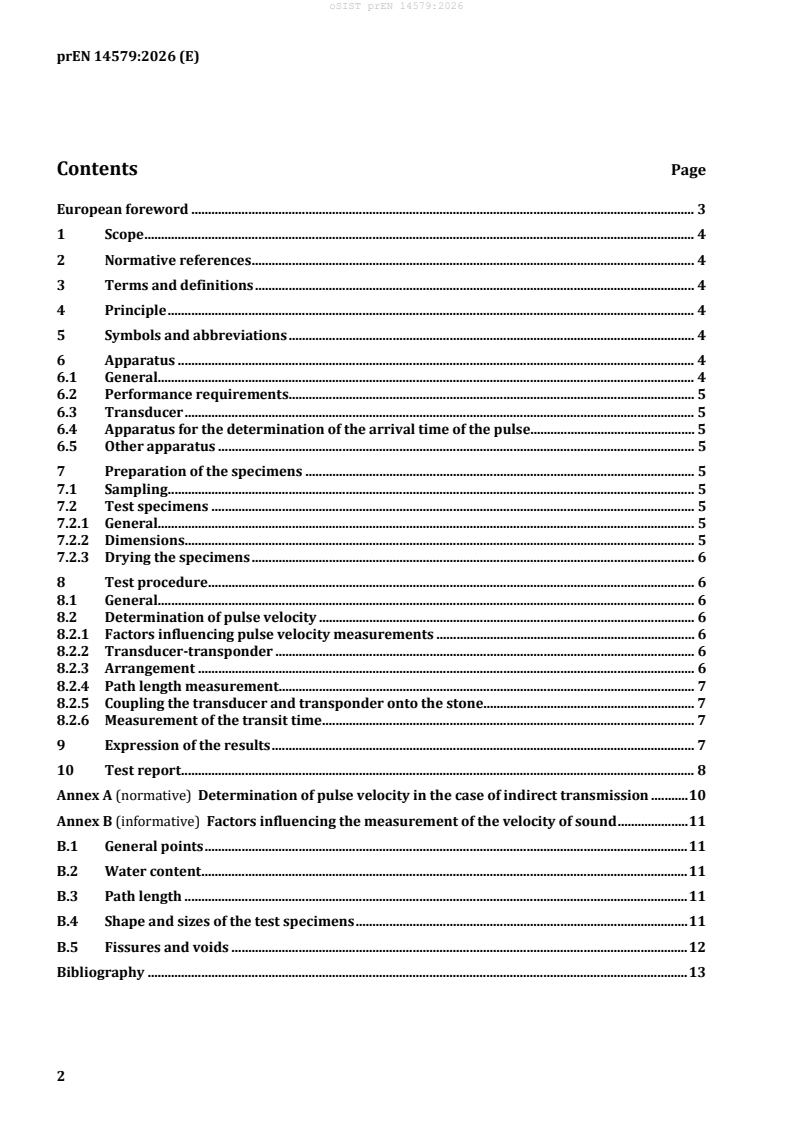
Contents Page
European foreword . 3
1 Scope . 4
2 Normative references . 4
3 Terms and definitions . 4
4 Principle . 4
5 Symbols and abbreviations . 4
6 Apparatus . 4
6.1 General. 4
6.2 Performance requirements . 5
6.3 Transducer . 5
6.4 Apparatus for the determination of the arrival time of the pulse. 5
6.5 Other apparatus . 5
7 Preparation of the specimens . 5
7.1 Sampling . 5
7.2 Test specimens . 5
7.2.1 General. 5
7.2.2 Dimensions. 5
7.2.3 Drying the specimens . 6
8 Test procedure . 6
8.1 General. 6
8.2 Determination of pulse velocity . 6
8.2.1 Factors influencing pulse velocity measurements . 6
8.2.2 Transducer-transponder . 6
8.2.3 Arrangement . 6
8.2.4 Path length measurement. 7
8.2.5 Coupling the transducer and transponder onto the stone. 7
8.2.6 Measurement of the transit time . 7
9 Expression of the results . 7
10 Test report . 8
Annex A (normative) Determination of pulse velocity in the case of indirect transmission . 10
Annex B (informative) Factors influencing the measurement of the velocity of sound . 11
B.1 General points . 11
B.2 Water content . 11
B.3 Path length . 11
B.4 Shape and sizes of the test specimens . 11
B.5 Fissures and voids . 12
Bibliography . 13
European foreword
This document (prEN 14579:2026) has been prepared by Technical Committee CEN/TC 246 “Natural
stones”, the secretariat of which is held by UNI.
This document is currently submitted to the CEN Enquiry.
This document will supersede EN 14579:2004.
EN 14579:2026 includes the following significant technical changes with respect to EN 14579:2004:
— inclusion of the possibility to measure the sound speed propagation with an apparatus using a fixed
distance between the transducer and transponder.
This standard is one of the series for tests on natural stone.
Test methods for natural stone consist of the following parts:
— EN 12370, Natural stone test methods — Determination of resistance to salt crystallization
— EN 12372, Natural stone test methods — Determination of flexural strength under concentrated load
— EN 12407, Natural stone test methods — Petrographic examination
— EN 13161, Natural stone test methods — Determination of flexural strength under constant moment
— EN 13364, Natural stone test methods — Determination of the breaking load at dowel hole
— EN 13373, Natural stone test methods — Determination of geometric characteristics on units
— EN 13755, Natural stone test methods — Determination of water absorption at atmospheric pressure
— EN 14066, Natural stone test methods — Determination of resistance to ageing by thermal shock
— EN 14231, Natural stone test methods — Determination of the slip resistance by means of the
pendulum tester
— EN 14157, Natural stone test methods — Determination of abrasion resistance
— EN 14158, Natural stone test methods — Determination of rupture energy
— EN 14580, Natural stone test methods — Determination of the static elastic modulus
— EN 14581, Natural stone test methods — Determination of linear thermal expansion coefficient
1 Scope
This document specifies a method for the determination of the velocity of propagation of pulses of
ultrasonic longitudinal waves in natural stone, both in laboratory and in situ.
2 Normative references
There are no normative references in this document.
3 Terms and definitions
No terms and definitions are listed in this document.
4 Principle
A pulse of longitudinal vibrations is produced by an electro-acoustical transducer held in contact with
one surface of the stone under test. After traversing a known path length in the stone, the pulse is received
converted into an electrical signal by a transponder and electronic timing circuits enable the transit time
of the pulse to be measured.
5 Symbols and abbreviations
V pulse velocity, in km/s
L path length, in mm
T time taken by the pulse to transverse the length, in µs
6 Apparatus
6.1 General
The apparatus consists essentially of an electrical pulse generator, a transducer (transmitting a pulse at
a defined frequency), a compatible transponder (receiving the pulse), an amplifier and an electronic
timing device for measuring the time interval elapsing between the onset of a pulse generated at the
transmitting transducer and the onset of its arrival at the receiving transponder.
Three forms of electronic timing apparatus are available:
a) an oscilloscope on which the first front of the pulse is displayed in relation to a suitable time scale;
b) an interval timer with a direct reading digital display;
c) an apparatus for indirect or surface transmission with a direct reading digital display, having fixed
distance between transmitting and transponder thus providing a reading computed from frequency,
time and path length.
NOTE 1 An oscilloscope provides the facility for examining the wave form, which can be advantageous in
complex situations.
NOTE 2 A graphic representation of the various forms of transducer-transponder arrangement is reported in
Figure 1.
6.2 Performance requirements
The apparatus shall comply with the following performance requirements:
— to measure transit times in the calibration bar to an accuracy of ±0,1 µs;
— to ensure a sharp pulse onset, that is the electronic excitation pulse applied to the transducer shall
have a rise time of not greater than one-quarter of its natural period;
— the pulse repetition frequency shall be low enough to ensure that the onset of the received signal is
free from interference by reverberations.
6.3 Transducer
The natural frequency of the transducer shall be within the range 20 kHz to 150 kHz.
NOTE Frequencies as low as 10 kHz and as high as 200 kHz is sometimes used. High frequency pulses have a
well-defined onset, but, as they pass through the natural stone, they become attenuated more rapidly than pulses
of lower frequency. It is therefore preferable to use high frequency transducers (82 kHz to 200 kHz) for short path
lengths (down to 50 mm) and low frequency transducers (10 kHz to 40 kHz) for long path lengths (up to a maximum
of 15 m). Transducers with a frequency of 40 kHz to 82 kHz are found to be useful for most applications.
6.4 Apparatus for the determination of the arrival time of the pulse
The apparatus receives the signal from the transponder and shall be capable of determining the time of
arrival of the first front of the pulse, even though this may be of small amplitude compared with that of
the first half wave of the pulse.
6.5 Other apparatus
A weighing instrument with an accuracy of 0,01 % of the mass to be weighed.
A ventilated oven capable of maintaining a temperature of (70 ± 5) °C.
7 Preparation of the specimens
7.1 Sampling
Sampling is not the responsibility of the test laboratory except where specially requested.
At least 6 specimens shall be selected from a homogeneous batch (see also 7.2.2).
7.2 Test specimens
7.2.1 General
As a standard reference the surface finish of the faces o
...