

SIST EN ISO 9202:2026
(Main)Jewellery and precious metals - Fineness of precious metal alloys (ISO 9202:2026)
- Abstract
This document specifies a range of fineness of precious metal alloys recommended for use in the field of jewellery.
NOTE There is a possibility that national legal requirements for the designation, marking and stamping of finished articles exist in the respective countries.
- Status
- Published
- Public Enquiry End Date
- 30-Mar-2025
- Publication Date
- 18-Jun-2026
- Technical Committee
- I13 - Imaginarni 13
- Current Stage
- 6060 - National Implementation/Publication (Adopted Project)
- Start Date
- 10-Jun-2026
- Due Date
- 15-Aug-2026
- Completion Date
- 19-Jun-2026

SIST EN ISO 9202:2026 is the Slovenian adoption of EN ISO 9202:2026, based on ISO 9202:2026, published by SIST. It specifies recommended fineness ranges for precious metal alloys used in jewellery and names the analytical methods used to determine fineness. The document is for people who specify, test, mark, or buy jewellery alloys.
What does SIST EN ISO 9202:2026 specify?
SIST EN ISO 9202:2026 specifies a range of fineness of precious metal alloys recommended for use in jewellery. It also points readers to the analytical methods used to determine fineness.
The document is organized into five clauses:
- Clause 1 - Scope
- Clause 2 - Normative references
- Clause 3 - Terms and definitions
- Clause 4 - Analytical methods for determining fineness
- Clause 5 - Range of fineness, with Table 1
A note in the scope reminds users that national legal requirements for designation, marking, and stamping of finished articles may apply in individual countries.
What are the key requirements of SIST EN ISO 9202:2026?
SIST EN ISO 9202:2026 is built around two practical rules: use one of the listed test methods to determine fineness, and state fineness as a minimum value with no minus tolerance. In practice, a declared fineness must not be shown below the stated level.
Fineness is a mass-based minimum
Clause 3 defines fineness as the content of the named metal, expressed as parts per thousand (‰) by mass. Clause 5 then says fineness is stated as a minimum value.
That matters because the standard treats the stated number as a floor, not a target with room below it. If a jewellery alloy is marked with a fineness from this document, the measured value must meet or exceed that stated level.
The test method must come from Clause 4
Clause 4 requires one of these methods for determining fineness:
- ISO 11210
- ISO 11426
- ISO 11427
- ISO 11490
- ISO 11494
- ISO 11495
- ISO 13756
- ISO 15093
- ISO 15096
- ISO 18214
This matters for laboratories and suppliers because the fineness claim has to be supported by an accepted analytical method, not by an informal estimate.
Table 1 links metals, fineness levels, and methods
Table 1 gives the fineness levels for the precious metals covered by the document and pairs them with recommended methods. It includes:
- Gold - 585 and 995
- Platinum - 900, 950, and 999
- Palladium - 999
- Silver - 925, 958, and 999
For users, Table 1 is the main lookup point when selecting an alloy grade or choosing how to verify it. The table also shows that some fineness levels can be checked by more than one method.
National marking rules may still apply
The scope note warns that national legal requirements can govern designation, marking, and stamping of finished articles. In practice, this means the standard supports technical specification and testing, but local law may add further obligations for finished jewellery.
What terms does SIST EN ISO 9202:2026 define?
- Fineness - The content of the named metal, expressed as parts per thousand (‰) by mass.
- Parts per thousand (‰) by mass - The unit used in the document to state fineness values.
- Minimum value - The stated fineness is the lowest acceptable value.
- Minus tolerance - No allowance below the stated fineness is permitted.
- Recommended method - The analytical method Table 1 assigns to a given fineness level.
- Precious metal alloys - The alloy products covered here for jewellery use.
- Analytical methods for determining fineness - The test procedures named in Clause 4 for verifying fineness.
Who uses SIST EN ISO 9202:2026?
SIST EN ISO 9202:2026 is used by jewellery manufacturers, precious metal suppliers, assay and test laboratories, quality managers, and buyers who need to specify or verify alloy fineness. It is also relevant to organizations involved in marking or stamping finished articles, because the document connects technical fineness levels with legal and commercial identification of jewellery.
What changed in SIST EN ISO 9202:2026 from the previous edition?
SIST EN ISO 9202:2026 supersedes EN ISO 9202:2019 and ISO 9202:2019. The foreword states that this fourth edition is technically revised, with two named changes:
- updated normative references
- addition of gold 995 ‰
Which standards are used with SIST EN ISO 9202:2026?
The normative references are listed below, together with what each contributes.
| Standard | Contribution |
|---|---|
| ISO 11210 | Determination of platinum by gravimetry using ammonium chloride |
| ISO 11426 | Determination of gold by cupellation method (fire assay) |
| ISO 11427 | Determination of silver by potentiometry using potassium bromide |
| ISO 11490 | Determination of palladium by gravimetry using dimethylglyoxime |
| ISO 11494 | Determination of platinum in platinum alloys by ICP-OES with an internal standard element |
| ISO 11495 | Determination of palladium in palladium alloys by ICP-OES with an internal standard element |
| ISO 13756 | Determination of silver by potentiometry using sodium chloride or potassium chloride |
| ISO 15093 | Determination of high purity gold, platinum and palladium by difference method using ICP-OES |
| ISO 15096 | Determination of high purity silver by difference method using ICP-OES |
| ISO 18214 | Determination of high purity gold, silver, platinum and palladium by difference method using SPARK-OES |
| ISO 19376-1 | Vocabulary for precious metals and units, including fineness |
What does the SIST EN ISO 9202:2026 document contain?
The document contains the scope, normative references, terms and definitions, a clause on analytical methods, and a clause on the range of fineness. Its core technical content is Table 1 in Clause 5, which links precious metal and fineness level to the recommended test method. Clause 4 gives the accepted method families, while the forewords explain the relationship to ISO and CEN publication status.
Relations
- Effective Date
- 06-Nov-2024
Frequently Asked Questions
SIST EN ISO 9202:2026 is a standard published by the Slovenian Institute for Standardization (SIST). Its full title is "Jewellery and precious metals - Fineness of precious metal alloys (ISO 9202:2026)". This standard covers: This document specifies a range of fineness of precious metal alloys recommended for use in the field of jewellery. NOTE There is a possibility that national legal requirements for the designation, marking and stamping of finished articles exist in the respective countries.
This document specifies a range of fineness of precious metal alloys recommended for use in the field of jewellery. NOTE There is a possibility that national legal requirements for the designation, marking and stamping of finished articles exist in the respective countries.
SIST EN ISO 9202:2026 is classified under the following ICS (International Classification for Standards) categories: 39.060 - Jewellery. The ICS classification helps identify the subject area and facilitates finding related standards.
SIST EN ISO 9202:2026 has the following relationships with other standards: It is inter standard links to SIST EN ISO 9202:2019. Understanding these relationships helps ensure you are using the most current and applicable version of the standard.
SIST EN ISO 9202:2026 is available in PDF format for immediate download after purchase. The document can be added to your cart and obtained through the secure checkout process. Digital delivery ensures instant access to the complete standard document.
Standards Content (Sample)
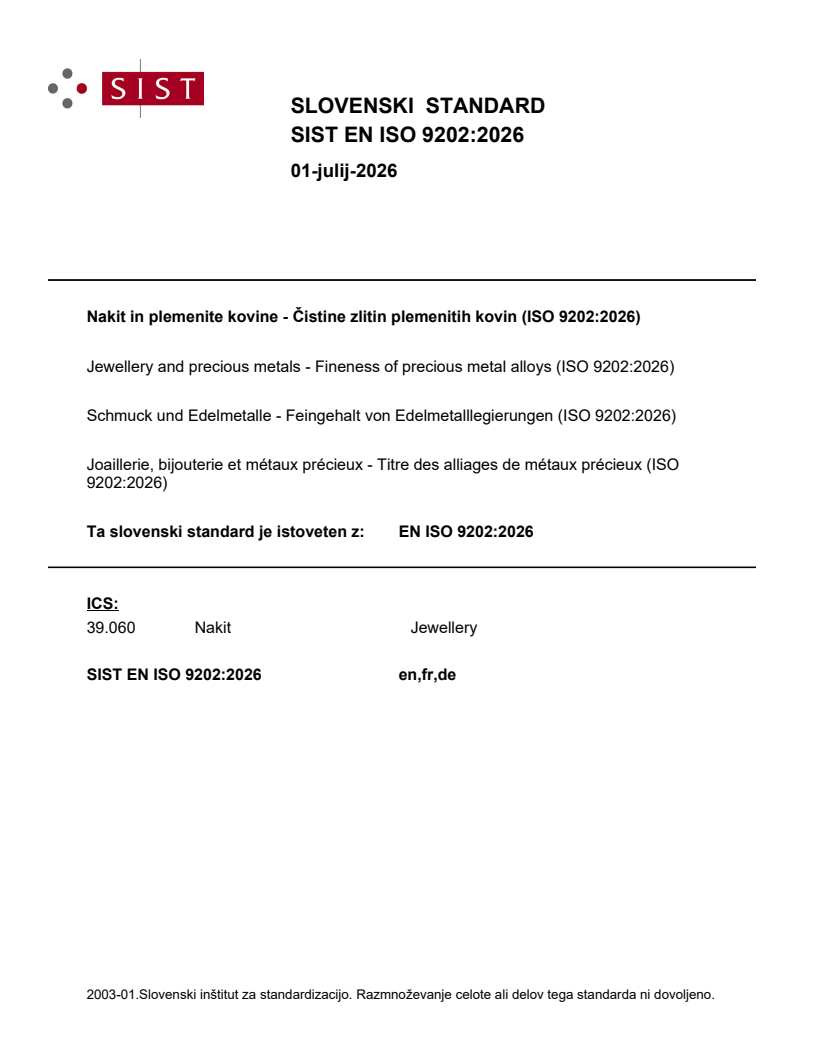
SLOVENSKI STANDARD
01-julij-2026
Nakit in plemenite kovine - Čistine zlitin plemenitih kovin (ISO 9202:2026)
Jewellery and precious metals - Fineness of precious metal alloys (ISO 9202:2026)
Schmuck und Edelmetalle - Feingehalt von Edelmetalllegierungen (ISO 9202:2026)
Joaillerie, bijouterie et métaux précieux - Titre des alliages de métaux précieux (ISO
9202:2026)
Ta slovenski standard je istoveten z: EN ISO 9202:2026
ICS:
39.060 Nakit Jewellery
2003-01.Slovenski inštitut za standardizacijo. Razmnoževanje celote ali delov tega standarda ni dovoljeno.
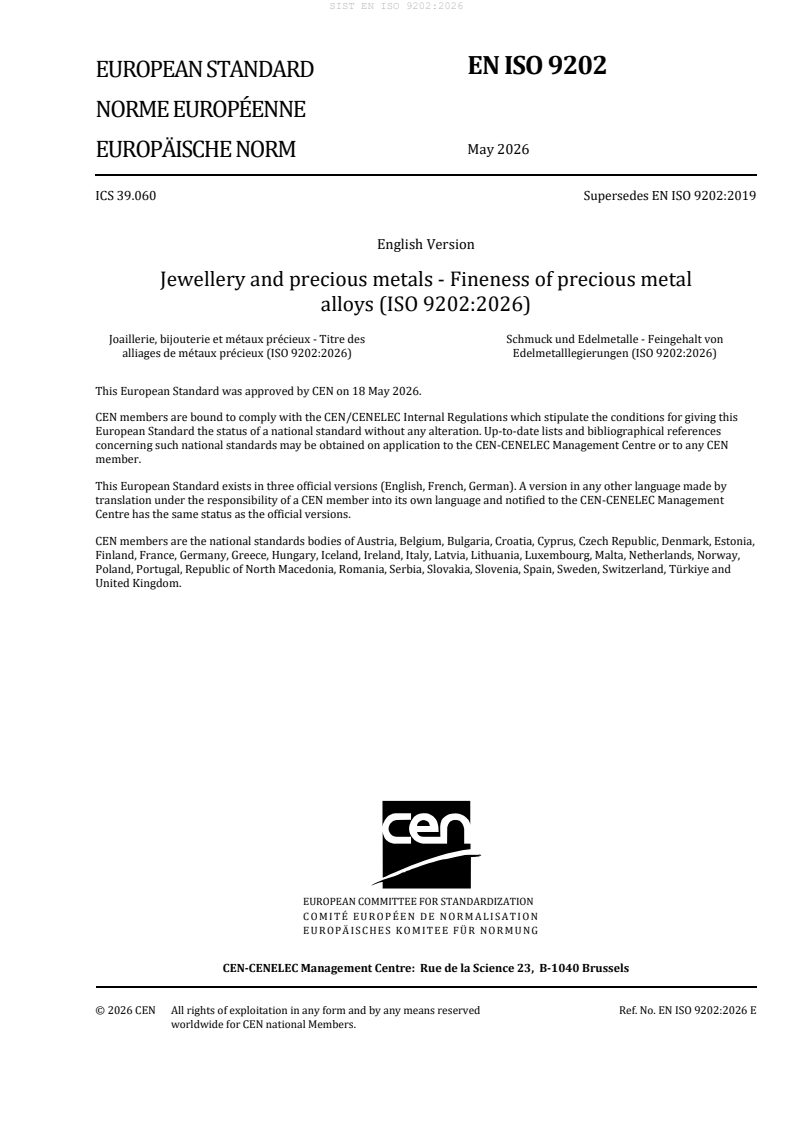
EN ISO 9202
EUROPEAN STANDARD
NORME EUROPÉENNE
May 2026
EUROPÄISCHE NORM
ICS 39.060 Supersedes EN ISO 9202:2019
English Version
Jewellery and precious metals - Fineness of precious metal
alloys (ISO 9202:2026)
Joaillerie, bijouterie et métaux précieux - Titre des Schmuck und Edelmetalle - Feingehalt von
alliages de métaux précieux (ISO 9202:2026) Edelmetalllegierungen (ISO 9202:2026)
This European Standard was approved by CEN on 18 May 2026.
CEN members are bound to comply with the CEN/CENELEC Internal Regulations which stipulate the conditions for giving this
European Standard the status of a national standard without any alteration. Up-to-date lists and bibliographical references
concerning such national standards may be obtained on application to the CEN-CENELEC Management Centre or to any CEN
member.
This European Standard exists in three official versions (English, French, German). A version in any other language made by
translation under the responsibility of a CEN member into its own language and notified to the CEN-CENELEC Management
Centre has the same status as the official versions.
CEN members are the national standards bodies of Austria, Belgium, Bulgaria, Croatia, Cyprus, Czech Republic, Denmark, Estonia,
Finland, France, Germany, Greece, Hungary, Iceland, Ireland, Italy, Latvia, Lithuania, Luxembourg, Malta, Netherlands, Norway,
Poland, Portugal, Republic of North Macedonia, Romania, Serbia, Slovakia, Slovenia, Spain, Sweden, Switzerland, Türkiye and
United Kingdom.
EUROPEAN COMMITTEE FOR STANDARDIZATION
COMITÉ EUROPÉEN DE NORMALISATION
EUROPÄISCHES KOMITEE FÜR NORMUNG
CEN-CENELEC Management Centre: Rue de la Science 23, B-1040 Brussels
© 2026 CEN All rights of exploitation in any form and by any means reserved Ref. No. EN ISO 9202:2026 E
worldwide for CEN national Members.
Contents Page
European foreword . 3
European foreword
This document (EN ISO 9202:2026) has been prepared by Technical Committee ISO/TC 174 "Jewellery
and precious metals" in collaboration with CCMC.
This European Standard shall be given the status of a national standard, either by publication of an
identical text or by endorsement, at the latest by November 2026, and conflicting national standards
shall be withdrawn at the latest by November 2026.
Attention is drawn to the possibility that some of the elements of this document may be the subject of
patent rights. CEN shall not be held responsible for identifying any or all such patent rights.
This document supersedes EN ISO 9202:2019.
Any feedback and questions on this document should be directed to the users’ national standards
body/national committee. A complete listing of these bodies can be found on the CEN website.
According to the CEN-CENELEC Internal Regulations, the national standards organizations of the
following countries are bound to implement this European Standard: Austria, Belgium, Bulgaria,
Croatia, Cyprus, Czech Republic, Denmark, Estonia, Finland, France, Germany, Greece, Hungary, Iceland,
Ireland, Italy, Latvia, Lithuania, Luxembourg, Malta, Netherlands, Norway, Poland, Portugal, Republic of
North Macedonia, Romania, Serbia, Slovakia, Slovenia, Spain, Sweden, Switzerland, Türkiye and the
United Kingdom.
Endorsement notice
The text of ISO 9202:2026 has been approved by CEN as EN ISO 9202:2026 without any modification.
International
Standard
ISO 9202
Fourth edition
Jewellery and precious metals —
2026-05
Fineness of precious metal alloys
Joaillerie, bijouterie et métaux précieux — Titre des alliages de
métaux précieux
Reference number
ISO 9202:2026(en) © ISO 2026
ISO 9202:2026(en)
© ISO 2026
All rights reserved. Unless otherwise specified, or required in the context of its implementation, no part of this publication may
be reproduced or utilized otherwise in any form or by any means, electronic or mechanical, including photocopying, or posting on
the internet or an intranet, without prior written permission. Permission can be requested from either ISO at the address below
or ISO’s member body in the country of the requester.
ISO copyright office
CP 401 • Ch. de Blandonnet 8
CH-1214 Vernier, Geneva
Phone: +41 22 749 01 11
Email: copyright@iso.org
Website: www.iso.org
Published in Switzerland
ii
ISO 9202:2026(en)
Contents Page
Foreword .iv
1 Scope . 1
2 Normative references . 1
3 Terms and definitions . 1
4 Analytical methods for determining fineness .
...