

SIST EN 13274-7:2019
(Main)Respiratory protective devices - Methods of test - Part 7: Determination of particle filter penetration
General Information
- Abstract
This European Standard specifies the procedure for testing particle filter penetration for respiratory protective devices.
- Status
- Published
- Public Enquiry End Date
- 24-May-2018
- Publication Date
- 09-Sep-2019
- Technical Committee
- OVP - Personal protecting equipment
- Current Stage
- 6060 - National Implementation/Publication (Adopted Project)
- Start Date
- 11-Jul-2019
- Due Date
- 15-Sep-2019
- Completion Date
- 10-Sep-2019

Overview
SIST EN 13274-7:2019 is a European Standard established by CEN that defines the test methods for determining particle filter penetration in respiratory protective devices. This standard is critical for ensuring the effectiveness and safety of respirators in filtering airborne particles. It supersedes the 2008 version, introducing refined procedures for testing with sodium chloride and paraffin oil aerosols, as well as streamlined methods for evaluating filter penetration and exposure.
The document covers detailed test requirements, equipment specifications, procedures, and calculations necessary to assess the filtration performance of respiratory protection filters against particle penetration. It applies across CEN member countries, establishing harmonized practices for manufacturers and testing laboratories.
Key Topics
Scope and Purpose
SIST EN 13274-7:2019 specifies the procedures for testing particle filter penetration for respiratory protective devices, ensuring reliable measurement of filter efficiency.Test Aerosols
Two main aerosols are used for testing:- Sodium Chloride (NaCl) aerosol, generated by atomizing an aqueous salt solution.
- Paraffin oil aerosol, produced via atomization of paraffin oil (CAS 8012-95-1).
Test Equipment and Setup
- Sodium chloride aerosol test equipment includes an aerosol generator, flow control modules, a filter test chamber, and a flame photometer to measure aerosol concentration before and after the filter.
- Paraffin oil test equipment consists of an aerosol generator, flow control, a test chamber, and a scattered light aerosol detector.
Test Procedures
- Aerosol is fed through the filter at a specified flow rate. The aerosol concentrations upstream and downstream of the filter are measured.
- Penetration is calculated as the ratio of downstream aerosol concentration relative to upstream, accounting for clean air background values.
- Tests include penetration measurement, exposure testing over specified aerosol load, and storage tests for reusable filters.
Environmental Conditions and Tolerances
- Ambient test conditions should be controlled within 16°C to 32°C and 50% ±30% relative humidity.
- Nominal values tolerate ±5% variance unless otherwise specified.
- Accurate reporting of measurement uncertainty is encouraged to evaluate result reliability.
Updates from Previous Version
Changes from EN 13274-7:2008 include revised test procedures, clarified test equipment specifications, and updated calculation methods, ensuring contemporary relevance and improved standardization.
Applications
SIST EN 13274-7:2019 is vital for multiple stakeholders involved in respiratory protection:
Manufacturers of respiratory protective devices
Use this standard to develop, validate, and certify particle filters for respirators, ensuring compliance with European regulations.Testing laboratories
Implement the detailed measurement methods for filter penetration to provide objective performance data for product certification and quality control.Regulators and certification bodies
Apply the standard to harmonize approval processes for respiratory protection equipment intended for occupational or public health use.End users and safety professionals
Rely on certified devices tested under SIST EN 13274-7:2019 for effective filtration against harmful airborne particles in industrial, healthcare, or environmental settings.Research and development
Support innovation by providing standardized testing frameworks useful in evaluating new filter materials and designs.
Related Standards
EN 132: Respiratory Protective Devices - Definitions of terms and pictograms
Provides essential terminologies that underpin SIST EN 13274-7:2019, ensuring consistent understanding across standards.EN 13274-5: Respiratory Protective Devices - Methods of Test - Part 5:
Although reference to EN 13274-5 in storage tests has been deleted in this version, it remains relevant for complementary testing methods.ISO 15900: Aerosol measurement standards
Gives additional guidance on particle size distribution measurements used in sodium chloride aerosol characterization.Other Parts of EN 13274 Series
Cover various test methods for respiratory protective devices, complementing filter penetration tests for comprehensive assessment.
Summary
SIST EN 13274-7:2019 is the authoritative European standard for evaluating particle filter penetration in respiratory protective devices. It specifies rigorous, repeatable test methods using sodium chloride and paraffin oil aerosols to ensure filter efficacy. This standard supports product development, regulatory compliance, and safety assurance, playing a crucial role in respiratory health protection across industrial and healthcare environments.
Keywords: SIST EN 13274-7:2019, respiratory protective devices, particle filter penetration, sodium chloride test, paraffin oil test, filter performance testing, CEN standard, aerosol filtration, respiratory mask testing, European respiratory standards.
Relations
- Effective Date
- 01-Oct-2019
- Effective Date
- 28-Jan-2026
- Effective Date
- 28-Jan-2026
- Effective Date
- 28-Jan-2026
- Effective Date
- 28-Jan-2026
- Effective Date
- 28-Jan-2026
- Effective Date
- 28-Jan-2026
- Effective Date
- 28-Jan-2026
- Effective Date
- 28-Jan-2026
- Effective Date
- 28-Jan-2026
Get Certified
Connect with accredited certification bodies for this standard

CIS Institut d.o.o.
Personal Protective Equipment (PPE) certification body. Notified Body NB-2890 for EU Regulation 2016/425 PPE.

Kiwa BDA Testing
Building and construction product certification.
Kmetijski inštitut Slovenije
Agricultural Institute of Slovenia. Soil testing, plant health, agricultural product analysis.
Sponsored listings
Frequently Asked Questions
SIST EN 13274-7:2019 is a standard published by the Slovenian Institute for Standardization (SIST). Its full title is "Respiratory protective devices - Methods of test - Part 7: Determination of particle filter penetration". This standard covers: This European Standard specifies the procedure for testing particle filter penetration for respiratory protective devices.
This European Standard specifies the procedure for testing particle filter penetration for respiratory protective devices.
SIST EN 13274-7:2019 is classified under the following ICS (International Classification for Standards) categories: 13.340.30 - Respiratory protective devices. The ICS classification helps identify the subject area and facilitates finding related standards.
SIST EN 13274-7:2019 has the following relationships with other standards: It is inter standard links to SIST EN 13274-7:2008, SIST EN ISO 16972:2020, SIST EN 12941:1999, SIST EN 405:2002+A1:2009, SIST EN 149:2001+A1:2009, SIST EN 143:2021, SIST EN 12941:2024, SIST EN 12942:1999, SIST EN 12942:2024, SIST EN 14387:2021. Understanding these relationships helps ensure you are using the most current and applicable version of the standard.
SIST EN 13274-7:2019 is associated with the following European legislation: EU Directives/Regulations: 2016/425, 89/686/EEC; Standardization Mandates: M/031. When a standard is cited in the Official Journal of the European Union, products manufactured in conformity with it benefit from a presumption of conformity with the essential requirements of the corresponding EU directive or regulation.
SIST EN 13274-7:2019 is available in PDF format for immediate download after purchase. The document can be added to your cart and obtained through the secure checkout process. Digital delivery ensures instant access to the complete standard document.
Standards Content (Sample)
SLOVENSKI STANDARD
01-oktober-2019
Nadomešča:
SIST EN 13274-7:2008
Oprema za varovanje dihal - Metode preskušanja - 7. del: Ugotavljanje penetracije
delcev skozi filter
Respiratory protective devices - Methods of test - Part 7: Determination of particle filter
penetration
Atemschutzgeräte - Prüfverfahren - Teil 7: Bestimmung des Durchlasses von
Partikelfiltern
Appareils de protection respiratoire - Méthodes d'essai - Partie 7: Détermination de la
pénétration des filtres à particules
Ta slovenski standard je istoveten z: EN 13274-7:2019
ICS:
13.340.30 Varovalne dihalne naprave Respiratory protective
devices
2003-01.Slovenski inštitut za standardizacijo. Razmnoževanje celote ali delov tega standarda ni dovoljeno.
EN 13274-7
EUROPEAN STANDARD
NORME EUROPÉENNE
June 2019
EUROPÄISCHE NORM
ICS 13.340.30 Supersedes EN 13274-7:2008
English Version
Respiratory protective devices - Methods of test - Part 7:
Determination of particle filter penetration
Appareils de protection respiratoire - Méthodes d'essai Atemschutzgeräte - Prüfverfahren - Teil 7:
- Partie 7: Détermination de la pénétration des filtres à Bestimmung des Durchlasses von Partikelfiltern
particules
This European Standard was approved by CEN on 5 May 2019.
CEN members are bound to comply with the CEN/CENELEC Internal Regulations which stipulate the conditions for giving this
European Standard the status of a national standard without any alteration. Up-to-date lists and bibliographical references
concerning such national standards may be obtained on application to the CEN-CENELEC Management Centre or to any CEN
member.
This European Standard exists in three official versions (English, French, German). A version in any other language made by
translation under the responsibility of a CEN member into its own language and notified to the CEN-CENELEC Management
Centre has the same status as the official versions.
CEN members are the national standards bodies of Austria, Belgium, Bulgaria, Croatia, Cyprus, Czech Republic, Denmark, Estonia,
Finland, France, Germany, Greece, Hungary, Iceland, Ireland, Italy, Latvia, Lithuania, Luxembourg, Malta, Netherlands, Norway,
Poland, Portugal, Republic of North Macedonia, Romania, Serbia, Slovakia, Slovenia, Spain, Sweden, Switzerland, Turkey and
United Kingdom.
EUROPEAN COMMITTEE FOR STANDARDIZATION
COMITÉ EUROPÉEN DE NORMALISATION
EUROPÄISCHES KOMITEE FÜR NORMUNG
CEN-CENELEC Management Centre: Rue de la Science 23, B-1040 Brussels
© 2019 CEN All rights of exploitation in any form and by any means reserved Ref. No. EN 13274-7:2019 E
worldwide for CEN national Members.
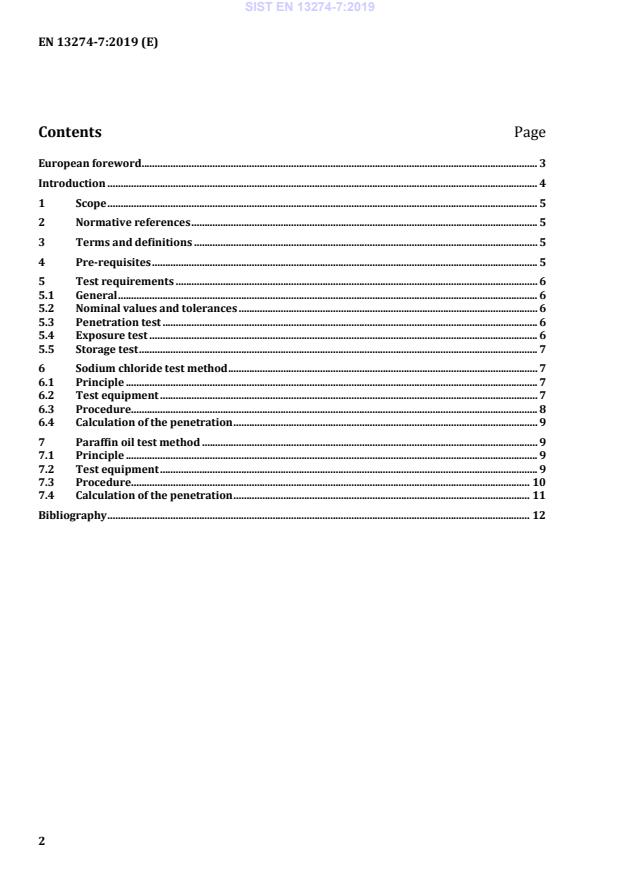
Contents Page
European foreword . 3
Introduction . 4
1 Scope . 5
2 Normative references . 5
3 Terms and definitions . 5
4 Pre-requisites . 5
5 Test requirements . 6
5.1 General . 6
5.2 Nominal values and tolerances . 6
5.3 Penetration test . 6
5.4 Exposure test . 6
5.5 Storage test . 7
6 Sodium chloride test method . 7
6.1 Principle . 7
6.2 Test equipment . 7
6.3 Procedure. 8
6.4 Calculation of the penetration . 9
7 Paraffin oil test method . 9
7.1 Principle . 9
7.2 Test equipment . 9
7.3 Procedure. 10
7.4 Calculation of the penetration . 11
Bibliography . 12
European foreword
This document (EN 13274-7:2019) has been prepared by Technical Committee CEN/TC 79 “Respiratory
protection devices”, the secretariat of which is held by DIN.
This European Standard shall be given the status of a national standard, either by publication of an
identical text or by endorsement, at the latest by month year of December 2019, and conflicting national
standards shall be withdrawn at the latest by month year of December 2019.
Attention is drawn to the possibility that some of the elements of this document may be the subject of
patent rights. CEN shall not be held responsible for identifying any or all such patent rights.
This document supersedes EN 13274-7:2008.
The following main technical changes have been made compared to EN 13274-7:2008:
a) reference to EN 13274-5 in storage test (5.5) deleted;
b) test equipment for sodium chloride test and test conditions clarified and summarized in one
subclause;
c) procedure for sodium chloride test revised;
d) calculation of the penetration for sodium chloride revised;
e) test equipment for paraffin oil test and test conditions clarified and summarized in one subclause:
f) procedure for paraffin oil test revised;
g) figures adapted to the changes made in the test procedures, where appropriate.
According to the CEN-CENELEC Internal Regulations, the national standards organisations of the
following countries are bound to implement this European Standard: Austria, Belgium, Bulgaria,
Croatia, Cyprus, Czech Republic, Denmark, Estonia, Finland, France, Germany, Greece, Hungary, Iceland,
Ireland, Italy, Latvia, Lithuania, Luxembourg, Malta, Netherlands, Norway, Poland, Portugal, Republic of
North Macedonia, Romania, Serbia, Slovakia, Slovenia, Spain, Sweden, Switzerland, Turkey and the
United Kingdom.
Introduction
This document is intended as a supplement to the specific device standards for respiratory protective
devices. Test methods are specified for complete or parts of devices. If deviations from the test method
given in this document are necessary, these deviations will be specified in the relevant device standard.
1 Scope
This document specifies the procedure for testing particle filter penetration for respiratory protective
devices.
2 Normative references
The following documents are referred to in the text in such a way that some or all of their content
constitutes requirements of this document. For dated references, only the edition cited applies. For
undated references, the latest edition of the referenced document (including any amendments) applies.
EN 132, Respiratory protective devices - Definitions of terms and pictograms
3 Terms and definitions
For the purposes of this document, the terms and definitions given in EN 132 apply.
ISO and IEC maintain terminological databases for use in standardization at the following addresses:
• IEC Electropedia: available at http://www.electropedia.org/
• ISO Online browsing platform: available at http://www.iso.org/obp
4 Pre-requisites
In order to implement this document, at least the following parameters need to be specified in the
appropriate device standard:
— items to be tested;
— number of samples;
— test method(s);
— flow rate through the filter;
— sequence of conditioning phases, where more than one is required;
— specification of any observations to be carried out;
— sample preparation and orientation;
— sample holding;
— in the case of the exposure test, the specified mass of test aerosol;
— pass/fail criteria;
— any deviations from this method.
5 Test requirements
5.1 General
Two test aerosols are used for measurement of filter penetration:
a) Sodium Chloride, using the equipment specified in Clause 6;
b) Paraffin Oil, using the equipment specified in Clause 7.
The test aerosol is fed into the test chamber, where the particle filtering device under test is mounted in
a leaktight manner on a suitable adaptor. Aerosol is passed through the device and the aerosol
concentration is measured immediately before and after the particle filtering device by the photometer.
Laboratories should give consideration to the following factors.
— Test chamber should be designed to minimize air velocity variations across the surface of the filter
under test.
— Localized high air velocity (“jets”) can result in arti
...