

SIST EN 304 113 V1.1.1:2026
(Main)Maritime satellite Emergency Position Indicating Radio Beacons (EPIRBs) for non-SOLAS vessels - Technical characteristics and methods of measurement
- Abstract
The present document sets out the minimum performance requirements and technical characteristics for non-SOLAS satellite Emergency Position-Indicating Radio Beacons (EPIRBs), operating in the COSPAS-SARSAT satellite system (406,0 MHz to 406,1 MHz) and ancillary transmissions on 121,5 MHz and also AIS1 (169,975 MHz) and AIS2 (162,025 MHz). The present document covers both first and second generation EPIRBs defined by the COSPAS-SARSAT standards C/S T.001 [1] and C/S T.018 [3]. The present document covers only category 2 EPIRBs in class 2 (-20 °C to +55 °C). The present document only covers battery powered portable EPIRB. Category 1 (float free) EPIRBs are not covered by the present document.
- Status
- Published
- Publication Date
- 21-Jul-2026
- Technical Committee
- MOC - Mobile Communications
- Current Stage
- 6060 - National Implementation/Publication (Adopted Project)
- Start Date
- 06-Jul-2026
- Due Date
- 10-Sep-2026
- Completion Date
- 22-Jul-2026
Buy Documents
ETSI EN 304 113 V1.0.0 (2025-12) - Maritime satellite Emergency Position Indicating Radio Beacons (EPIRBs) for non-SOLAS vessels; Technical characteristics and methods of measurement
ETSI EN 304 113 V1.1.0 (2026-04) - Maritime satellite Emergency Position Indicating Radio Beacons (EPIRBs) for non-SOLAS vessels; Technical characteristics and methods of measurement
ETSI EN 304 113 V1.1.1 (2026-07) - Maritime satellite Emergency Position Indicating Radio Beacons (EPIRBs) for non-SOLAS vessels; Technical characteristics and methods of measurement

SIST EN 304 113 V1.1.1:2026 is the Slovenian adoption of ETSI EN 304 113 V1.1.1 (2026-07), published by SIST. It specifies minimum performance requirements, technical characteristics, and methods of measurement for non-SOLAS Maritime satellite Emergency Position Indicating Radio Beacons (EPIRBs) used in the COSPAS-SARSAT system, with ancillary 121,5 MHz transmission and optional Automatic Identification System (AIS) transmissions. The document is aimed at manufacturers, test laboratories, quality teams, and conformity assessors working with battery-powered portable category 2 EPIRBs in class 2 (-20 °C to +55 °C).
What does SIST EN 304 113 V1.1.1:2026 specify?
SIST EN 304 113 V1.1.1:2026 defines the technical and test requirements for non-SOLAS EPIRBs that transmit on 406,0 MHz to 406,1 MHz and may also transmit on 121,5 MHz and AIS channels. It applies to both first- and second-generation beacons and focuses on portable, battery-powered, category 2 EPIRBs.
The document is organized so that the operational requirements come first, then the measurement conditions and the test methods. Clause 4 covers general requirements, clause 5 gives technical background, clauses 6 to 14 contain the measurement conditions and tests, and the annexes add uncertainty values, test support, AIS message examples, grey-box testing guidance, and change history.
| Annex | What it covers |
|---|---|
| Annex A | Maximum measurement uncertainty and how to report it |
| Annex B | EPIRB test support, including the circular support disk |
| Annex C | AIS message bursts and default message field values |
| Annex D | Grey-box testing of EPIRBs, test interface, and special test modes |
| Annex E | Change history |
What are the key requirements of SIST EN 304 113 V1.1.1:2026?
SIST EN 304 113 V1.1.1:2026 combines construction, operating, radio, environmental, and information requirements so that a beacon can be deployed, tested, and located reliably in distress use.
Portable, integral construction - Clause 4.2 requires the EPIRB to be a single portable unit with a permanently attached antenna, no tool-free detachable parts, no sharp edges likely to injure people or damage equipment, and a highly visible yellow or orange exterior. In practice, this helps stowage, handling, and visual detection on deck or in the water.
Visual detection aids - Clause 4.2 requires retro-reflective material above the waterline, and clause 14 covers the visible strobe light and optional night vision indicator. That means the beacon must support both daytime and low-light recovery, not only radio location.
Operating position and activation - Clause 4.3 expects the EPIRB to work floating in the sea, on a ship’s deck, and in a survival craft when manually activated. Clause 7.13 checks automatic activation and upright floating behavior, while clause 7.14 checks watertightness. In practice, the beacon must still function after immersion and rough handling.
COSPAS-SARSAT and function priority - Clause 4.4 requires compliance with the COSPAS-SARSAT type approval standards for first- and second-generation beacons, and clause 5.5 sets the function priority order. The 406 MHz distress transmission has highest priority, so optional functions such as RLS, AIS, 121,5 MHz homing, and other RF features cannot interfere with it.
Lanyard and tethering - Clause 4.5 requires a buoyant, visible lanyard that is permanently attached and properly stowed, and clause 13 tests its strength. This matters because the beacon may need to stay tied to a craft or life-saving appliance during use.
Controls, indicators, IDs, and manuals - Clauses 4.6 to 4.13 cover controls usable with gloves, operational indicators, self-test behavior, Hex ID and AIS self ID handling, labels, battery precautions, and user manuals. For users, this means the beacon must be understandable, testable, and traceable, with clear instructions on registration, maintenance, false alerts, and end-of-life disposal.
Measurement and test discipline - Clause 6 sets the test conditions, identifiers, artificial antenna arrangements, timing signals, and reference bandwidths, while clause 7 covers environmental tests such as drop, temperature, vibration, saltwater spray, thermal shock, bump, compass-safe distance, solar radiation, oil resistance, automatic activation, and watertightness. In practice, laboratories must use the same setup and sequence so results are comparable.
Radio performance and message content - Clauses 8 to 11 test the 121,5 MHz homing transmitter, the AIS transmitter, spurious emissions, AIS VDL link-layer behavior, and AIS message content in active mode and GNSS self-test mode. Clause 12 then checks the GNSS receiver performance and its protection from interference. These clauses matter because location, identification, and signaling all have to stay within their intended channels and message formats.
What terms does SIST EN 304 113 V1.1.1:2026 define?
SIST EN 304 113 V1.1.1:2026 defines the terms used to classify EPIRBs and describe their operating state and identification.
- activated - An EPIRB that has been set off and is flashing and transmitting in active mode.
- category 2 EPIRB - An EPIRB that must be manually deployed and activated.
- class 2 - An EPIRB intended to operate over the temperature range -20 °C to +55 °C.
- non-SOLAS - Equipment not intended to be used under SOLAS carriage requirements or covered by the Marine Equipment Directive 2014/90/EU.
- Automatic Identification System (AIS) - The VHF maritime system used here for transmitting locating information alongside the distress beacon.
- First Generation Beacon (FGB) - A COSPAS-SARSAT beacon covered by the first-generation specifications and test standard.
- Second Generation Beacon (SGB) - A COSPAS-SARSAT beacon covered by the second-generation specifications and test standard.
- Hex ID - The unique beacon identity programmed into the EPIRB and used in testing and AIS message handling.
Who uses SIST EN 304 113 V1.1.1:2026?
SIST EN 304 113 V1.1.1:2026 is used by EPIRB manufacturers, test houses, certification bodies, and market surveillance teams. It is also relevant to quality managers, technical buyers, and marine equipment engineers who need to specify, verify, or inspect non-SOLAS EPIRBs.
In practice, these users apply it to design checks, conformance testing, radio measurements, environmental testing, labeling review, GNSS validation, AIS message verification, and user-manual review. Annex D is especially relevant when a tester needs access to special test modes or timing signals.
Which standards are used with SIST EN 304 113 V1.1.1:2026?
| Reference | What it contributes |
|---|---|
| C/S T.001 | Core COSPAS-SARSAT requirements for first-generation 406 MHz distress beacons |
| C/S T.007 | Type approval test standard for first-generation beacons |
| C/S T.018 | Core COSPAS-SARSAT requirements for second-generation 406 MHz distress beacons |
| C/S T.021 | Type approval test standard for second-generation beacons |
| Recommendation ITU-R M.585-9 | Maritime mobile service identity assignment and use |
| IEC 61108-1 / -2 / -3 / -5 | GNSS receiver performance and testing for GPS, GLONASS, Galileo, and BDS |
| Recommendation ITU-R M.1371-5 | AIS technical characteristics |
| Recommendation ITU-R M.690-3 | 121,5 MHz and 243 MHz EPIRB technical characteristics |
| ETSI TS 103 052 | Radiated measurement methods and test-site arrangements |
| IMO Resolution MSC.481(102) | Retro-reflective material performance for life-saving appliances |
| ITU-T O.153 | Basic timing and error-performance measurement parameters |
| EN 55016-2-3 / EN IEC 55016-1-1 | EMC measurement methods and measuring apparatus |
| IEC 60068-2-6 | Sinusoidal vibration test method |
| IMO Resolution MSC.81(70) | Life-saving appliance test procedures, including optical measurement basis |
What does the SIST EN 304 113 V1.1.1:2026 document contain?
The document contains functional and test-oriented material rather than product marketing or procurement guidance. It includes a block diagram of a typical EPIRB, AIS parameter settings, reference bandwidth tables, spectrum masks, timing diagrams, and detailed measurement arrangements for RF, environmental, GNSS, and optical testing.
It also provides support and calibration information, including the EPIRB test support in Annex B, AIS message burst examples in Annex C, and grey-box test access in Annex D. Several clauses use formulas and worked measurement methods, such as chamber calibration, EIRP/EIRPEP determination, and location-error calculation, so that laboratories can repeat the tests consistently.
Buy Documents
ETSI EN 304 113 V1.0.0 (2025-12) - Maritime satellite Emergency Position Indicating Radio Beacons (EPIRBs) for non-SOLAS vessels; Technical characteristics and methods of measurement
ETSI EN 304 113 V1.1.0 (2026-04) - Maritime satellite Emergency Position Indicating Radio Beacons (EPIRBs) for non-SOLAS vessels; Technical characteristics and methods of measurement
ETSI EN 304 113 V1.1.1 (2026-07) - Maritime satellite Emergency Position Indicating Radio Beacons (EPIRBs) for non-SOLAS vessels; Technical characteristics and methods of measurement
Get Certified
Connect with accredited certification bodies for this standard

DNV
DNV is an independent assurance and risk management provider.

Lloyd's Register
Lloyd's Register is a global professional services organisation specialising in engineering and technology.

FSC International
Forest Stewardship Council certification.
Sponsored listings
Frequently Asked Questions
SIST EN 304 113 V1.1.1:2026 is a standard published by the Slovenian Institute for Standardization (SIST). Its full title is "Maritime satellite Emergency Position Indicating Radio Beacons (EPIRBs) for non-SOLAS vessels - Technical characteristics and methods of measurement". This standard covers: The present document sets out the minimum performance requirements and technical characteristics for non-SOLAS satellite Emergency Position-Indicating Radio Beacons (EPIRBs), operating in the COSPAS-SARSAT satellite system (406,0 MHz to 406,1 MHz) and ancillary transmissions on 121,5 MHz and also AIS1 (169,975 MHz) and AIS2 (162,025 MHz). The present document covers both first and second generation EPIRBs defined by the COSPAS-SARSAT standards C/S T.001 [1] and C/S T.018 [3]. The present document covers only category 2 EPIRBs in class 2 (-20 °C to +55 °C). The present document only covers battery powered portable EPIRB. Category 1 (float free) EPIRBs are not covered by the present document.
The present document sets out the minimum performance requirements and technical characteristics for non-SOLAS satellite Emergency Position-Indicating Radio Beacons (EPIRBs), operating in the COSPAS-SARSAT satellite system (406,0 MHz to 406,1 MHz) and ancillary transmissions on 121,5 MHz and also AIS1 (169,975 MHz) and AIS2 (162,025 MHz). The present document covers both first and second generation EPIRBs defined by the COSPAS-SARSAT standards C/S T.001 [1] and C/S T.018 [3]. The present document covers only category 2 EPIRBs in class 2 (-20 °C to +55 °C). The present document only covers battery powered portable EPIRB. Category 1 (float free) EPIRBs are not covered by the present document.
SIST EN 304 113 V1.1.1:2026 is classified under the following ICS (International Classification for Standards) categories: 33.060.20 - Receiving and transmitting equipment; 47.020.70 - Navigation and control equipment. The ICS classification helps identify the subject area and facilitates finding related standards.
SIST EN 304 113 V1.1.1:2026 is available in PDF format for immediate download after purchase. The document can be added to your cart and obtained through the secure checkout process. Digital delivery ensures instant access to the complete standard document.
Standards Content (Sample)
Draft ETSI EN 304 113 V1.0.0 (2025-12)
EUROPEAN STANDARD
Maritime satellite Emergency Position Indicating
Radio Beacons (EPIRBs) for non-SOLAS vessels;
Technical characteristics and methods of measurement
2 Draft ETSI EN 304 113 V1.0.0 (2025-12)
Reference
DEN/ERM-TGMAR-636
Keywords
EPIRB, maritime, radio, SAR, testing
ETSI
650 Route des Lucioles
F-06921 Sophia Antipolis Cedex - FRANCE
Tel.: +33 4 92 94 42 00 Fax: +33 4 93 65 47 16
Siret N° 348 623 562 00017 - APE 7112B
Association à but non lucratif enregistrée à la
Sous-Préfecture de Grasse (06) N° w061004871
Important notice
The present document can be downloaded from the
ETSI Search & Browse Standards application.
The present document may be made available in electronic versions and/or in print. The content of any electronic and/or print
versions of the present document shall not be modified without the prior written authorization of ETSI. In case of any existing or
perceived difference in contents between such versions and/or in print, the prevailing version of an ETSI deliverable is the one
made publicly available in PDF format on ETSI deliver repository.
Users should be aware that the present document may be revised or have its status changed,
this information is available in the Milestones listing.
If you find errors in the present document, please send your comments to
the relevant service listed under Committee Support Staff.
If you find a security vulnerability in the present document, please report it through our
Coordinated Vulnerability Disclosure (CVD) program.
Notice of disclaimer & limitation of liability
The information provided in the present deliverable is directed solely to professionals who have the appropriate degree of
experience to understand and interpret its content in accordance with generally accepted engineering or
other professional standard and applicable regulations.
No recommendation as to products and services or vendors is made or should be implied.
In no event shall ETSI be held liable for loss of profits or any other incidental or consequential damages.
Any software contained in this deliverable is provided "AS IS" with no warranties, express or implied, including but not limited to,
the warranties of merchantability, fitness for a particular purpose and non-infringement of intellectual property rights and ETSI
shall not be held liable in any event for any damages whatsoever (including, without limitation, damages for loss of profits,
business interruption, loss of information, or any other pecuniary loss) arising out of or related to the use of or inability to use the
software.
Copyright Notification
No part may be reproduced or utilized in any form or by any means, electronic or mechanical, including photocopying and
microfilm except as authorized by written permission of ETSI.
The content of the PDF version shall not be modified without the written authorization of ETSI.
The copyright and the foregoing restriction extend to reproduction in all media.
© ETSI 2025.
All rights reserved.
ETSI
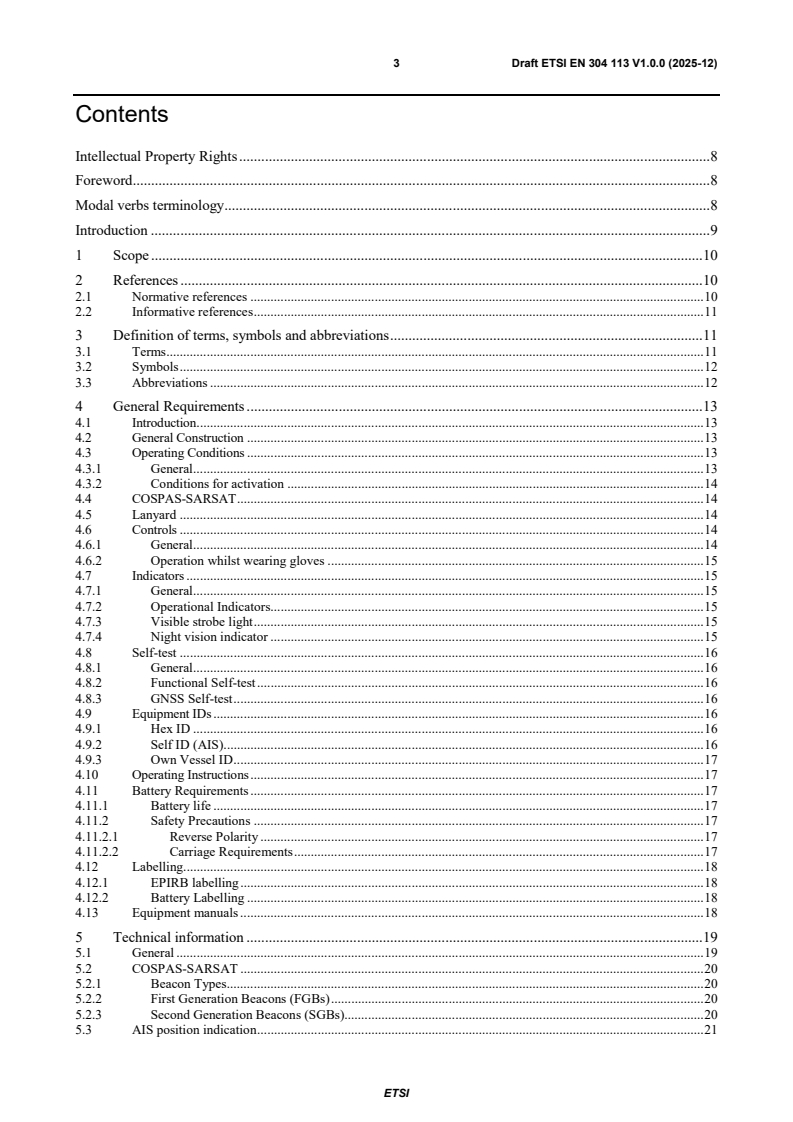
3 Draft ETSI EN 304 113 V1.0.0 (2025-12)
Contents
Intellectual Property Rights . 8
Foreword . 8
Modal verbs terminology . 8
Introduction . 9
1 Scope . 10
2 References . 10
2.1 Normative references . 10
2.2 Informative references . 11
3 Definition of terms, symbols and abbreviations . 11
3.1 Terms . 11
3.2 Symbols . 12
3.3 Abbreviations . 12
4 General Requirements . 13
4.1 Introduction . 13
4.2 General Construction . 13
4.3 Operating Conditions . 13
4.3.1 General . 13
4.3.2 Conditions for activation . 14
4.4 COSPAS-SARSAT . 14
4.5 Lanyard . 14
4.6 Controls . 14
4.6.1 General . 14
4.6.2 Operation whilst wearing gloves . 15
4.7 Indicators . 15
4.7.1 General . 15
4.7.2 Operational Indicators . 15
4.7.3 Visible strobe light . 15
4.7.4 Night vision indicator . 15
4.8 Self-test . 16
4.8.1 General . 16
4.8.2 Functional Self-test . 16
4.8.3 GNSS Self-test . 16
4.9 Equipment IDs . 16
4.9.1 Hex ID . 16
4.9.2 Self ID (AIS). 16
4.9.3 Own Vessel ID . 17
4.10 Operating Instructions . 17
4.11 Battery Requirements . 17
4.11.1 Battery life . 17
4.11.2 Safety Precautions . 17
4.11.2.1 Reverse Polarity . 17
4.11.2.2 Carriage Requirements . 17
4.12 Labelling. 18
4.12.1 EPIRB labelling . 18
4.12.2 Battery Labelling . 18
4.13 Equipment manuals . 18
5 Technical information . 19
5.1 General . 19
5.2 COSPAS-SARSAT . 20
5.2.1 Beacon Types . 20
5.2.2 First Generation Beacons (FGBs) . 20
5.2.3 Second Generation Beacons (SGBs). 20
5.3 AIS position indication . 21
ETSI
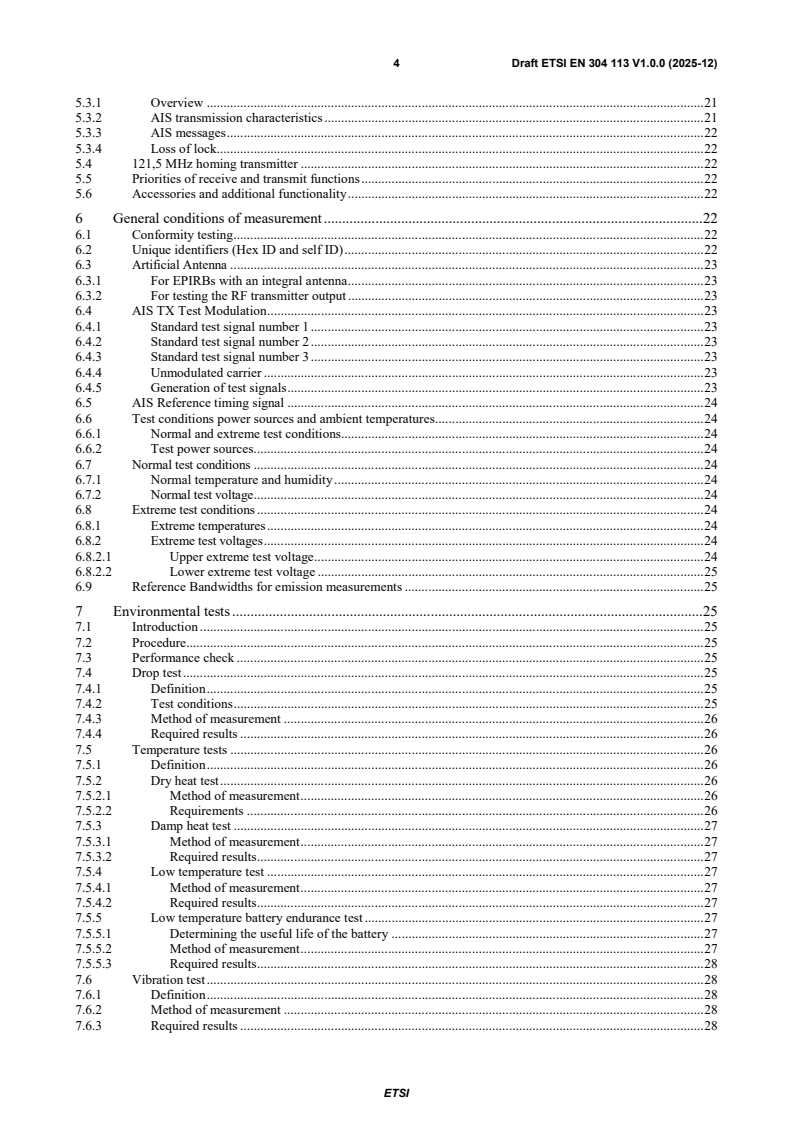
4 Draft ETSI EN 304 113 V1.0.0 (2025-12)
5.3.1 Overview . 21
5.3.2 AIS transmission characteristics . 21
5.3.3 AIS messages . 22
5.3.4 Loss of lock. 22
5.4 121,5 MHz homing transmitter . 22
5.5 Priorities of receive and transmit functions . 22
5.6 Accessories and additional functionality . 22
6 General conditions of measurement . 22
6.1 Conformity testing . 22
6.2 Unique identifiers (Hex ID and self ID) . 22
6.3 Artificial Antenna . 23
6.3.1 For EPIRBs with an integral antenna . 23
6.3.2 For testing the RF transmitter output . 23
6.4 AIS TX Test Modulation . 23
6.4.1 Standard test signal number 1 . 23
6.4.2 Standard test signal number 2 . 23
6.4.3 Standard test signal number 3 . 23
6.4.4 Unmodulated carrier . 23
6.4.5 Generation of test signals . 23
6.5 AIS Reference timing signal . 24
6.6 Test conditions power sources and ambient te mperature s . 24
6.6.1 Normal and extreme test conditions. 24
6.6.2 Test power sources. 24
6.7 Normal test conditions . 24
6.7.1 Normal temperature and humidity . 24
6.7.2 Normal test voltage . 24
6.8 Extreme test conditions . 24
6.8.1 Extreme temperatures . 24
6.8.2 Extreme test voltages . 24
6.8.2.1 Upper extreme test voltage . 24
6.8.2.2 Lower extreme test voltage . 25
6.9 Reference Bandwidths for emission measurements . 25
7 Environmental tests . 25
7.1 Introduction . 25
7.2 Procedure . 25
7.3 Performance check . 25
7.4 Drop test . 25
7.4.1 Definition . 25
7.4.2 Test conditions . 25
7.4.3 Method of measurement . 26
7.4.4 Required results . 26
7.5 Temperature tests . 26
7.5.1 Definition . 26
7.5.2 Dry heat test . 26
7.5.2.1 Method of measurement . 26
7.5.2.2 Requirements . 26
7.5.3 Damp heat test . 27
7.5.3.1 Method of measurement . 27
7.5.3.2 Required results . 27
7.5.4 Low temperature test . 27
7.5.4.1 Method of measurement . 27
7.5.4.2 Required results . 27
7.5.5 Low temperature battery endurance test . 27
7.5.5.1 Determining the useful life of the battery . 27
7.5.5.2 Method of measurement . 27
7.5.5.3 Required results . 28
7.6 Vibration test . 28
7.6.1 Definition . 28
7.6.2 Method of measurement . 28
7.6.3 Required results . 28
ETSI
5 Draft ETSI EN 304 113 V1.0.0 (2025-12)
7.7 Saltwater spray test . 29
7.7.1 Definition . 29
7.7.2 Method of measurement . 29
7.7.2.1 The spraying apparatus . 29
7.7.2.2 Preparation of EUT . 29
7.7.2.3 Test cycles . 29
7.7.2.4 Conclusion of testing. 30
7.7.3 Required results . 30
7.8 Thermal shock test. 30
7.8.1 Definition . 30
7.8.2 Method of measurement . 30
7.8.3 Required results . 30
7.9 Bump test. 30
7.9.1 Definition . 30
7.9.2 Method of measurement . 30
7.9.3 Required results . 31
7.10 Compass safe distance test . 31
7.10.1 Definition . 31
7.10.2 Method of measurement . 31
7.10.3 Requirements . 32
7.11 Solar radiation test . 32
7.11.0 Applicability . 32
7.11.1 Definition . 32
7.11.2 Method of measurement . 32
7.11.3 Requirements . 32
7.12 Oil resistance test. 32
7.12.0 Applicability . 32
7.12.1 Definition . 33
7.12.2 Method of measurement . 33
7.12.3 Requirements . 33
7.13 Automatic activation and float upright test . 33
7.13.1 Definition . 33
7.13.2 Method of measurement . 33
7.13.3 Requirements . 33
7.14 Watertightness test . 34
7.14.1 Definition . 34
7.14.2 Method of measurement . 34
7.14.3 Required results . 34
8 Tests on the 121,5 MHz homing transmitter . 34
8.1 Frequency error . 34
8.1.1 Definition . 34
8.1.2 Method of measurement . 34
8.1.3 Limit . 34
8.2 Audio modulation characteristics . 35
8.2.1 Definition . 35
8.2.2 Method of measurement . 36
8.2.3 Limits . 36
8.3 DST sweep rate and duty cycle . 36
8.3.1 Definition . 36
8.3.2 Method of measurement . 37
8.3.3 Limits . 37
8.4 Spectral carrier power ratio . 37
8.4.1 Definition . 37
8.4.2 Method of measurement . 37
8.4.3 Limit . 38
8.5 Maximum Effective Isotropic Radiated Peak Envelope Power (EIRPEP) . 38
8.5.1 Definition . 38
8.5.2 Method of measurement under normal test conditions . 38
8.5.3 Limit . 39
8.6 Transmitter spectrum mask . 39
8.6.1 Definition . 39
ETSI
6 Draft ETSI EN 304 113 V1.0.0 (2025-12)
8.6.2 Method of measurement . 39
8.6.3 Limit . 40
8.7 Radiation produced by operation of the test function . 40
8.7.1 Definition . 40
8.7.2 Method of measurement . 40
8.7.2.0 General . 40
8.7.2.1 Mandatory full-power test transmission . 41
8.7.2.2 Optional low-power test transmission . 41
8.7.3 Limits . 41
9 Tests on the AIS transmitter . 41
9.1 AIS Frequency error . 41
9.1.1 Definition . 41
9.1.2 Method of measurement . 41
9.1.3 Limit . 41
9.2 AIS Conducted power variation . 41
9.2.1 Purpose . 41
9.2.2 Definition . 42
9.2.3 Method of measurement . 42
9.2.4 Limit . 42
9.3 AIS Transmitter spectrum mask . 42
9.3.1 Definition . 42
9.3.2 Method of measurement . 42
9.3.3 Limit . 43
9.4 AIS Transmitter transient behaviour (output power) . 43
9.4.1 Definition . 43
9.4.2 Method of measurement . 44
9.4.3 Limit . 45
9.5 AIS Transmitter Transient Behaviour (frequency deviation) . 45
9.5.1 Definition . 45
9.5.2 Method of measurement . 45
9.5.3 Limit . 46
9.6 AIS Synchronization accuracy . 46
9.6.1 Definition . 46
9.6.2 Method of measurement . 46
9.6.3 Limit . 47
9.7 AIS Effective Isotropic Radiated Power (EIRP) . 47
9.7.1 Definition . 47
9.7.2 Method of measurement . 48
9.7.3 Limits . 48
10 Spurious emissions . 49
10.1 Definition . 49
10.2 Method of measurement . 49
10.2.1 Modes of operation . 49
10.2.2 Test method . 49
10.2.3 Exclusion bands . 49
10.2.3.1 Active mode . 49
10.2.3.2 Standby or off . 50
10.3 Limit . 50
10.3.1 Activated mode . 50
10.3.2 Standby or off . 50
11 AIS VDL Link layer tests . 50
11.1 Active mode tests . 50
11.1.1 Method of measurement . 50
11.1.2 Initialization period - Required results. 50
11.1.3 Message content of Message 1 - Required results . 50
11.1.4 Message content of first Message 14 - Required results . 51
11.1.5 Message content of second Message 14 - Required results . 51
11.1.6 Transmission schedule for Message 1 - Required results . 51
11.1.7 Communication state of Message 1 - Required results . 52
11.1.8 Transmission schedule of Message 14 - Required results. 52
ETSI
7 Draft ETSI EN 304 113 V1.0.0 (2025-12)
11.1.9 Transmission with lost GNSS - Required results . 52
11.2 GNSS self-test . 52
11.2.0 General . 52
11.2.1 Method of measurement . 53
11.2.2 Required results . 53
11.3 Functional self-test . 53
11.3.0 General . 53
11.3.1 Method of measurement . 53
11.3.2 Required results . 53
12 GNSS receiver . 54
12.1 General . 54
12.2 Protection from specific interfering signals . 54
12.3 Protection from internally generated interfering signals . 54
12.3.1 Definition . 54
12.3.2 Method of measurement . 54
12.3.2.1 Test setup . 54
12.3.2.2 Calibration of the test setup . 55
12.3.2.3 Making the measurement . 57
12.3.3 Required results . 58
13 Lanyard Strength test.
...
Final draft ETSI EN 304 113 V1.1.0 (2026-04)
EUROPEAN STANDARD
Maritime satellite Emergency Position Indicating
Radio Beacons (EPIRBs) for non-SOLAS vessels;
Technical characteristics and methods of measurement
2 Final draft ETSI EN 304 113 V1.1.0 (2026-04)
Reference
DEN/ERM-TGMAR-636
Keywords
EPIRB, maritime, radio, SAR, testing
ETSI
650 Route des Lucioles
F-06921 Sophia Antipolis Cedex - FRANCE
Tel.: +33 4 92 94 42 00 Fax: +33 4 93 65 47 16
Siret N° 348 623 562 00017 - APE 7112B
Association à but non lucratif enregistrée à la
Sous-Préfecture de Grasse (06) N° w061004871
Important notice
The present document can be downloaded from the
ETSI Search & Browse Standards application.
The present document may be made available in electronic versions and/or in print. The content of any electronic and/or
print versions of the present document shall not be modified without the prior written authorization of ETSI. In case of any
existing or perceived difference in contents between such versions and/or in print, the prevailing version of an ETSI
deliverable is the one made publicly available in PDF format on ETSI deliver repository.
Users should be aware that the present document may be revised or have its status changed,
this information is available in the Milestones listing.
If you find errors in the present document, please send your comments to
the relevant service listed under Committee Support Staff.
If you find a security vulnerability in the present document, please report it through our
Coordinated Vulnerability Disclosure (CVD) program.
Notice of disclaimer & limitation of liability
The information provided in the present deliverable is directed solely to professionals who have the appropriate degree of
experience to understand and interpret its content in accordance with generally accepted engineering or
other professional standard and applicable regulations.
No recommendation as to products and services or vendors is made or should be implied.
In no event shall ETSI be held liable for loss of profits or any other incidental or consequential damages.
Any software contained in this deliverable is provided "AS IS" with no warranties, express or implied, including but not
limited to, the warranties of merchantability, fitness for a particular purpose and non-infringement of intellectual property
rights and ETSI shall not be held liable in any event for any damages whatsoever (including, without limitation, damages
for loss of profits, business interruption, loss of information, or any other pecuniary loss) arising out of or related to the use
of or inability to use the software.
Copyright Notification
No part may be reproduced or utilized in any form or by any means, electronic or mechanical, including photocopying and
microfilm except as authorized by written permission of ETSI.
The content of the PDF version shall not be modified without the written authorization of ETSI.
The copyright and the foregoing restriction extend to reproduction in all media.
© ETSI 2026.
All rights reserved.
ETSI
3 Final draft ETSI EN 304 113 V1.1.0 (2026-04)
Contents
Intellectual Property Rights . 8
Foreword . 8
Modal verbs terminology . 8
Introduction . 9
1 Scope . 10
2 References . 10
2.1 Normative references . 10
2.2 Informative references . 11
3 Definition of terms, symbols and abbreviations . 11
3.1 Terms . 11
3.2 Symbols . 12
3.3 Abbreviations . 12
4 General Requirements . 13
4.1 Introduction . 13
4.2 General Construction . 13
4.3 Operating Conditions . 13
4.3.1 General . 13
4.3.2 Conditions for activation . 14
4.4 COSPAS-SARSAT . 14
4.5 Lanyard . 14
4.6 Controls . 15
4.6.1 General . 15
4.6.2 Operation whilst wearing gloves . 15
4.7 Indicators . 15
4.7.1 General . 15
4.7.2 Operational Indicators . 15
4.7.3 Visible strobe light . 16
4.7.4 Night vision indicator . 16
4.8 Self-test . 16
4.8.1 General . 16
4.8.2 Functional Self-test . 16
4.8.3 GNSS Self-test . 16
4.9 Equipment IDs . 17
4.9.1 Hex ID . 17
4.9.2 Self ID (AIS). 17
4.9.3 Own Vessel ID . 17
4.10 Operating Instructions . 17
4.11 Battery Requirements . 17
4.11.1 Battery life . 17
4.11.2 Safety Precautions . 18
4.11.2.1 Reverse Polarity . 18
4.11.2.2 Carriage Requirements . 18
4.12 Labelling. 18
4.12.1 EPIRB labelling . 18
4.12.2 Battery Labelling . 19
4.13 Equipment manuals . 19
5 Technical information . 20
5.1 General . 20
5.2 COSPAS-SARSAT . 20
5.2.1 Beacon Types . 20
5.2.2 First Generation Beacons (FGBs) . 20
5.2.3 Second Generation Beacons (SGBs). 21
ETSI
4 Final draft ETSI EN 304 113 V1.1.0 (2026-04)
5.3 AIS position indication . 22
5.3.1 Overview . 22
5.3.2 AIS transmission characteristics . 22
5.3.3 AIS messages . 22
5.3.4 Loss of lock. 22
5.4 121,5 MHz homing transmitter . 22
5.5 Priorities of receive and transmit functions . 22
5.6 Accessories and additional functionality . 23
6 General conditions of measurement . 23
6.1 Conformity testing . 23
6.2 Unique identifiers (Hex ID and self ID) . 23
6.3 Artificial Antenna . 23
6.3.1 For EPIRBs with an integral antenna . 23
6.3.2 For testing the RF transmitter output . 23
6.4 AIS TX Test Modulation . 24
6.4.1 Standard test signal number 1 . 24
6.4.2 Standard test signal number 2 . 24
6.4.3 Standard test signal number 3 . 24
6.4.4 Unmodulated carrier . 24
6.4.5 Generation of test signals . 24
6.5 AIS Reference timing signal . 24
6.6 Test conditions power sources and ambient te mperature s . 24
6.6.1 Normal and extreme test conditions. 24
6.6.2 Test power sources. 24
6.7 Normal test conditions . 25
6.7.1 Normal temperature and humidity . 25
6.7.2 Normal test voltage . 25
6.8 Extreme test conditions . 25
6.8.1 Extreme temperatures . 25
6.8.2 Extreme test voltages . 25
6.8.2.1 Upper extreme test voltage . 25
6.8.2.2 Lower extreme test voltage . 25
6.9 Reference Bandwidths for emission measurements . 25
7 Environmental tests . 26
7.1 Introduction . 26
7.2 Procedure . 26
7.3 Performance check . 26
7.4 Drop test . 26
7.4.1 Definition . 26
7.4.2 Test conditions . 26
7.4.3 Method of measurement . 26
7.4.4 Required results . 27
7.5 Temperature tests . 27
7.5.1 Definition . 27
7.5.2 Dry heat test . 27
7.5.2.1 Method of measurement . 27
7.5.2.2 Requirements . 27
7.5.3 Damp heat test . 27
7.5.3.1 Method of measurement . 27
7.5.3.2 Required results . 28
7.5.4 Low temperature test . 28
7.5.4.1 Method of measurement . 28
7.5.4.2 Required results . 28
7.5.5 Low temperature battery endurance test . 28
7.5.5.1 Determining the useful life of the battery . 28
7.5.5.2 Method of measurement . 28
7.5.5.3 Required results . 28
7.6 Vibration test . 29
7.6.1 Definition . 29
7.6.2 Method of measurement . 29
ETSI
5 Final draft ETSI EN 304 113 V1.1.0 (2026-04)
7.6.3 Required results . 29
7.7 Saltwater spray test . 29
7.7.1 Definition . 29
7.7.2 Method of measurement . 30
7.7.2.1 The spraying apparatus . 30
7.7.2.2 Preparation of EUT . 30
7.7.2.3 Test cycles . 30
7.7.2.4 Conclusion of testing. 30
7.7.3 Required results . 30
7.8 Thermal shock test. 31
7.8.1 Definition . 31
7.8.2 Method of measurement . 31
7.8.3 Required results . 31
7.9 Bump test. 31
7.9.1 Definition . 31
7.9.2 Method of measurement . 31
7.9.3 Required results . 32
7.10 Compass safe distance test . 32
7.10.1 Definition . 32
7.10.2 Method of measurement . 32
7.10.3 Requirements . 33
7.11 Solar radiation test . 33
7.11.0 Applicability . 33
7.11.1 Definition . 33
7.11.2 Method of measurement . 33
7.11.3 Requirements . 33
7.12 Oil resistance test. 33
7.12.0 Applicability . 33
7.12.1 Definition . 34
7.12.2 Method of measurement . 34
7.12.3 Requirements . 34
7.13 Automatic activation and float upright test . 34
7.13.1 Definition . 34
7.13.2 Method of measurement . 34
7.13.3 Requirements . 34
7.14 Watertightness test . 35
7.14.1 Definition . 35
7.14.2 Method of measurement . 35
7.14.3 Required results . 35
8 Tests on the 121,5 MHz homing transmitter . 35
8.1 Frequency error . 35
8.1.1 Definition . 35
8.1.2 Method of measurement . 35
8.1.3 Limit . 35
8.2 Audio modulation characteristics . 36
8.2.1 Definition . 36
8.2.2 Method of measurement . 37
8.2.3 Limits . 37
8.3 DST sweep rate and duty cycle . 37
8.3.1 Definition . 37
8.3.2 Method of measurement . 38
8.3.3 Limits . 38
8.4 Spectral carrier power ratio . 38
8.4.1 Definition . 38
8.4.2 Method of measurement . 38
8.4.3 Limit . 39
8.5 Maximum Effective Isotropic Radiated Peak Envelope Power (EIRPEP) . 39
8.5.1 Definition . 39
8.5.2 Method of measurement under normal test conditions . 39
8.5.3 Limit . 40
8.6 Transmitter spectrum mask . 40
ETSI
6 Final draft ETSI EN 304 113 V1.1.0 (2026-04)
8.6.1 Definition . 40
8.6.2 Method of measurement . 40
8.6.3 Limit . 41
8.7 Radiation produced by operation of the test function . 41
8.7.1 Definition . 41
8.7.2 Method of measurement . 41
8.7.2.0 General . 41
8.7.2.1 Mandatory full-power test transmission . 42
8.7.2.2 Optional low-power test transmission . 42
8.7.3 Limits . 42
9 Tests on the AIS transmitter . 42
9.1 AIS Frequency error . 42
9.1.1 Definition . 42
9.1.2 Method of measurement . 42
9.1.3 Limit . 42
9.2 AIS Conducted power variation . 43
9.2.1 Purpose . 43
9.2.2 Definition . 43
9.2.3 Method of measurement . 43
9.2.4 Limit . 43
9.3 AIS Transmitter spectrum mask . 43
9.3.1 Definition . 43
9.3.2 Method of measurement . 43
9.3.3 Limit . 44
9.4 AIS Transmitter transient behaviour (output power) . 44
9.4.1 Definition . 44
9.4.2 Method of measurement . 45
9.4.3 Limit . 46
9.5 AIS Transmitter Transient Behaviour (frequency deviation) . 46
9.5.1 Definition . 46
9.5.2 Method of measurement . 46
9.5.3 Limit . 47
9.6 AIS Synchronization accuracy . 47
9.6.1 Definition . 47
9.6.2 Method of measurement . 47
9.6.3 Limit . 48
9.7 AIS Effective Isotropic Radiated Power (EIRP) . 48
9.7.1 Definition . 48
9.7.2 Method of measurement . 48
9.7.3 Limits . 49
10 Spurious emissions . 50
10.1 Definition . 50
10.2 Method of measurement . 50
10.2.1 Modes of operation . 50
10.2.2 Test method . 50
10.2.3 Exclusion bands . 50
10.2.3.1 Active mode . 50
10.2.3.2 Standby or off . 51
10.3 Limit . 51
10.3.1 Activated mode . 51
10.3.2 Standby or off . 51
11 AIS VDL Link layer tests . 51
11.1 Active mode tests . 51
11.1.1 Method of measurement . 51
11.1.2 Initialization period - Required results. 51
11.1.3 Message content of Message 1 - Required results . 51
11.1.4 Message content of first Message 14 - Required results . 52
11.1.5 Message content of second Message 14 - Required results . 52
11.1.6 Transmission schedule for Message 1 - Required results . 52
11.1.7 Communication state of Message 1 - Required results . 53
ETSI
7 Final draft ETSI EN 304 113 V1.1.0 (2026-04)
11.1.8 Transmission schedule of Message 14 - Required results. 53
11.1.9 Transmission with lost GNSS - Required results . 53
11.2 GNSS self-test . 53
11.2.0 General . 53
11.2.1 Method of measurement . 54
11.2.2 Required results . 54
11.3 Functional self-test . 54
11.3.0 General . 54
11.3.1 Method of measurement . 54
11.3.2 Required results . 54
12 GNSS receiver . 55
12.1 General . 55
12.2 Protection from specific interfering signals . 55
12.3 Protection from internally generated interfering signals . 55
12.3.1 Definition . 55
12.3.2 Method of measurement . 55
12.3.2.1 Test setup . 55
12.3.2.2 Calibration of the test setup . 56
12.3.2.3 Making the measurement . 58
12.3.3 Required results . 59
13 Lanyard Strength test.
...
EUROPEAN STANDARD
Maritime satellite Emergency Position Indicating
Radio Beacons (EPIRBs) for non-SOLAS vessels;
Technical characteristics and methods of measurement
2 ETSI EN 304 113 V1.1.1 (2026-07)
Reference
DEN/ERM-TGMAR-636
Keywords
EPIRB, maritime, radio, SAR, testing
ETSI
650 Route des Lucioles
F-06921 Sophia Antipolis Cedex - FRANCE
Tel.: +33 4 92 94 42 00 Fax: +33 4 93 65 47 16
Siret N° 348 623 562 00017 - APE 7112B
Association à but non lucratif enregistrée à la
Sous-Préfecture de Grasse (06) N° w061004871
Important notice
The present document can be downloaded from the
ETSI Search & Browse Standards application.
The present document may be made available in electronic versions and/or in print. The content of any electronic and/or
print versions of the present document shall not be modified without the prior written authorization of ETSI. In case of any
existing or perceived difference in contents between such versions and/or in print, the prevailing version of an ETSI
deliverable is the one made publicly available in PDF format on ETSI deliver repository.
Users should be aware that the present document may be revised or have its status changed,
this information is available in the Milestones listing.
If you find errors in the present document, please send your comments to
the relevant service listed under Committee Support Staff.
If you find a security vulnerability in the present document, please report it through our
Coordinated Vulnerability Disclosure (CVD) program.
Notice of disclaimer & limitation of liability
The information provided in the present deliverable is directed solely to professionals who have the appropriate degree of
experience to understand and interpret its content in accordance with generally accepted engineering or
other professional standard and applicable regulations.
No recommendation as to products and services or vendors is made or should be implied.
In no event shall ETSI be held liable for loss of profits or any other incidental or consequential damages.
Any software contained in this deliverable is provided "AS IS" with no warranties, express or implied, including but not
limited to, the warranties of merchantability, fitness for a particular purpose and non-infringement of intellectual property
rights and ETSI shall not be held liable in any event for any damages whatsoever (including, without limitation, damages
for loss of profits, business interruption, loss of information, or any other pecuniary loss) arising out of or related to the use
of or inability to use the software.
Copyright Notification
No part of this document may be reproduced in any form, by any means and in any media, without the prior written
authorization of ETSI and except as expressly permitted below.
By way of exception and when the document is a normative deliverable (European Standard (EN),
Technical Specification (TS), Group Specification (GS) or ETSI Standard (ES)), ETSI authorizes to reproduce
and incorporate into products, services and technical documentation only those extracts (e.g. templates) that are strictly
necessary for the technical implementation of the normative deliverable, to ensure compliance with the latter.
Nothing in this notice shall be construed as limiting any mandatory exceptions to copyright provided by applicable law.
© ETSI 2026.
All rights reserved.
ETSI
3 ETSI EN 304 113 V1.1.1 (2026-07)
Contents
Intellectual Property Rights . 8
Foreword . 8
Modal verbs terminology . 9
Introduction . 9
1 Scope . 10
2 References . 10
2.1 Normative references . 10
2.2 Informative references . 11
3 Definition of terms, symbols and abbreviations . 11
3.1 Terms . 11
3.2 Symbols . 12
3.3 Abbreviations . 12
4 General Requirements . 13
4.1 Introduction . 13
4.2 General Construction . 13
4.3 Operating Conditions . 13
4.3.1 General . 13
4.3.2 Conditions for activation . 14
4.4 COSPAS-SARSAT . 14
4.5 Lanyard . 14
4.6 Controls . 15
4.6.1 General . 15
4.6.2 Operation whilst wearing gloves . 15
4.7 Indicators . 15
4.7.1 General . 15
4.7.2 Operational Indicators . 15
4.7.3 Visible strobe light . 16
4.7.4 Night vision indicator . 16
4.8 Self-test . 16
4.8.1 General . 16
4.8.2 Functional Self-test . 16
4.8.3 GNSS Self-test . 16
4.9 Equipment IDs . 17
4.9.1 Hex ID . 17
4.9.2 Self ID (AIS). 17
4.9.3 Own Vessel ID . 17
4.10 Operating Instructions . 17
4.11 Battery Requirements . 17
4.11.1 Battery life . 17
4.11.2 Safety Precautions . 18
4.11.2.1 Reverse Polarity . 18
4.11.2.2 Carriage Requirements . 18
4.12 Labelling. 18
4.12.1 EPIRB labelling . 18
4.12.2 Battery Labelling . 19
4.13 Equipment manuals . 19
5 Technical information . 20
5.1 General . 20
5.2 COSPAS-SARSAT . 20
5.2.1 Beacon Types . 20
5.2.2 First Generation Beacons (FGBs) . 20
5.2.3 Second Generation Beacons (SGBs). 21
5.3 AIS position indication . 22
ETSI
4 ETSI EN 304 113 V1.1.1 (2026-07)
5.3.1 Overview . 22
5.3.2 AIS transmission characteristics . 22
5.3.3 AIS messages . 22
5.3.4 Loss of lock. 22
5.4 121,5 MHz homing transmitter . 22
5.5 Priorities of receive and transmit functions . 22
5.6 Accessories and additional functionality . 23
6 General conditions of measurement . 23
6.1 Conformity testing . 23
6.2 Unique identifiers (Hex ID and self ID) . 23
6.3 Artificial Antenna . 23
6.3.1 For EPIRBs with an integral antenna . 23
6.3.2 For testing the RF transmitter output . 23
6.4 AIS TX Test Modulation . 24
6.4.1 Standard test signal number 1 . 24
6.4.2 Standard test signal number 2 . 24
6.4.3 Standard test signal number 3 . 24
6.4.4 Unmodulated carrier . 24
6.4.5 Generation of test signals . 24
6.5 AIS Reference timing signal . 24
6.6 Test conditions power sources and ambient te mperature s . 24
6.6.1 Normal and extreme test conditions. 24
6.6.2 Test power sources. 24
6.7 Normal test conditions . 25
6.7.1 Normal temperature and humidity . 25
6.7.2 Normal test voltage . 25
6.8 Extreme test conditions . 25
6.8.1 Extreme temperatures . 25
6.8.2 Extreme test voltages . 25
6.8.2.1 Upper extreme test voltage . 25
6.8.2.2 Lower extreme test voltage . 25
6.9 Reference Bandwidths for emission measurements . 25
7 Environmental tests . 26
7.1 Introduction . 26
7.2 Procedure . 26
7.3 Performance check . 26
7.4 Drop test . 26
7.4.1 Definition . 26
7.4.2 Test conditions . 26
7.4.3 Method of measurement . 26
7.4.4 Required results . 27
7.5 Temperature tests . 27
7.5.1 Definition . 27
7.5.2 Dry heat test . 27
7.5.2.1 Method of measurement . 27
7.5.2.2 Requirements . 27
7.5.3 Damp heat test . 27
7.5.3.1 Method of measurement . 27
7.5.3.2 Required results . 28
7.5.4 Low temperature test . 28
7.5.4.1 Method of measurement . 28
7.5.4.2 Required results . 28
7.5.5 Low temperature battery endurance test . 28
7.5.5.1 Determining the useful life of the battery . 28
7.5.5.2 Method of measurement . 28
7.5.5.3 Required results . 28
7.6 Vibration test . 29
7.6.1 Definition . 29
7.6.2 Method of measurement . 29
7.6.3 Required results . 29
ETSI
5 ETSI EN 304 113 V1.1.1 (2026-07)
7.7 Saltwater spray test . 29
7.7.1 Definition . 29
7.7.2 Method of measurement . 30
7.7.2.1 The spraying apparatus . 30
7.7.2.2 Preparation of EUT . 30
7.7.2.3 Test cycles . 30
7.7.2.4 Conclusion of testing. 30
7.7.3 Required results . 30
7.8 Thermal shock test. 31
7.8.1 Definition . 31
7.8.2 Method of measurement . 31
7.8.3 Required results . 31
7.9 Bump test. 31
7.9.1 Definition . 31
7.9.2 Method of measurement . 31
7.9.3 Required results . 32
7.10 Compass safe distance test . 32
7.10.1 Definition . 32
7.10.2 Method of measurement . 32
7.10.3 Requirements . 33
7.11 Solar radiation test . 33
7.11.0 Applicability . 33
7.11.1 Definition . 33
7.11.2 Method of measurement . 33
7.11.3 Requirements . 33
7.12 Oil resistance test. 33
7.12.0 Applicability . 33
7.12.1 Definition . 34
7.12.2 Method of measurement . 34
7.12.3 Requirements . 34
7.13 Automatic activation and float upright test . 34
7.13.1 Definition . 34
7.13.2 Method of measurement . 34
7.13.3 Requirements . 34
7.14 Watertightness test . 35
7.14.1 Definition . 35
7.14.2 Method of measurement . 35
7.14.3 Required results . 35
8 Tests on the 121,5 MHz homing transmitter . 35
8.1 Frequency error . 35
8.1.1 Definition . 35
8.1.2 Method of measurement . 35
8.1.3 Limit . 35
8.2 Audio modulation characteristics . 36
8.2.1 Definition . 36
8.2.2 Method of measurement . 37
8.2.3 Limits . 37
8.3 DST sweep rate and duty cycle . 37
8.3.1 Definition . 37
8.3.2 Method of measurement . 38
8.3.3 Limits . 38
8.4 Spectral carrier power ratio . 38
8.4.1 Definition . 38
8.4.2 Method of measurement . 38
8.4.3 Limit . 39
8.5 Maximum Effective Isotropic Radiated Peak Envelope Power (EIRPEP) . 39
8.5.1 Definition . 39
8.5.2 Method of measurement under normal test conditions . 39
8.5.3 Limit . 40
8.6 Transmitter spectrum mask . 40
8.6.1 Definition . 40
ETSI
6 ETSI EN 304 113 V1.1.1 (2026-07)
8.6.2 Method of measurement . 40
8.6.3 Limit . 41
8.7 Radiation produced by operation of the test function . 41
8.7.1 Definition . 41
8.7.2 Method of measurement . 41
8.7.2.0 General . 41
8.7.2.1 Mandatory full-power test transmission . 42
8.7.2.2 Optional low-power test transmission . 42
8.7.3 Limits . 42
9 Tests on the AIS transmitter . 42
9.1 AIS Frequency error . 42
9.1.1 Definition . 42
9.1.2 Method of measurement . 42
9.1.3 Limit . 42
9.2 AIS Conducted power variation . 43
9.2.1 Purpose . 43
9.2.2 Definition . 43
9.2.3 Method of measurement . 43
9.2.4 Limit . 43
9.3 AIS Transmitter spectrum mask . 43
9.3.1 Definition . 43
9.3.2 Method of measurement . 43
9.3.3 Limit . 44
9.4 AIS Transmitter transient behaviour (output power) . 44
9.4.1 Definition . 44
9.4.2 Method of measurement . 45
9.4.3 Limit . 46
9.5 AIS Transmitter Transient Behaviour (frequency deviation) . 46
9.5.1 Definition . 46
9.5.2 Method of measurement . 46
9.5.3 Limit . 47
9.6 AIS Synchronization accuracy . 47
9.6.1 Definition . 47
9.6.2 Method of measurement . 47
9.6.3 Limit . 48
9.7 AIS Effective Isotropic Radiated Power (EIRP) . 48
9.7.1 Definition . 48
9.7.2 Method of measurement . 48
9.7.3 Limits . 49
10 Spurious emissions . 50
10.1 Definition . 50
10.2 Method of measurement . 50
10.2.1 Modes of operation . 50
10.2.2 Test method . 50
10.2.3 Exclusion bands . 50
10.2.3.1 Active mode . 50
10.2.3.2 Standby or off . 51
10.3 Limit . 51
10.3.1 Activated mode . 51
10.3.2 Standby or off . 51
11 AIS VDL Link layer tests . 51
11.1 Active mode tests . 51
11.1.1 Method of measurement . 51
11.1.2 Initialization period - Required results. 51
11.1.3 Message content of Message 1 - Required results . 51
11.1.4 Message content of first Message 14 - Required results . 52
11.1.5 Message content of second Message 14 - Required results . 52
11.1.6 Transmission schedule for Message 1 - Required results . 52
11.1.7 Communication state of Message 1 - Required results . 53
11.1.8 Transmission schedule of Message 14 - Required results. 53
ETSI
7 ETSI EN 304 113 V1.1.1 (2026-07)
11.1.9 Transmission with lost GNSS - Required results . 53
11.2 GNSS self-test . 53
11.2.0 General . 53
11.2.1 Method of measurement . 54
11.2.2 Required results . 54
11.3 Functional self-test . 54
11.3.0 General . 54
11.3.1 Method of measurement . 54
11.3.2 Required results . 54
12 GNSS receiver . 55
12.1 General . 55
12.2 Protection from specific interfering signals . 55
12.3 Protection from internally generated interfering signals . 55
12.3.1 Definition . 55
12.3.2 Method of measurement . 55
12.3.2.1 Test setup . 55
12.3.2.2 Calibration of the test setup . 56
12.3.2.3 Making the measurement .
...
SLOVENSKI STANDARD
01-september-2026
Pomorski satelitski radijski javljalniki kraja nuje (EPIRB) na plovilih brez opreme
SOLAS - Tehnične karakteristike in merilne metode
Maritime satellite Emergency Position Indicating Radio Beacons (EPIRBs) for non-
SOLAS vessels - Technical characteristics and methods of measurement
Ta slovenski standard je istoveten z: ETSI EN 304 113 V1.1.1 (2026-07)
ICS:
33.060.20 Sprejemna in oddajna Receiving and transmitting
oprema equipment
47.020.70 Navigacijska in krmilna Navigation and control
oprema equipment
2003-01.Slovenski inštitut za standardizacijo. Razmnoževanje celote ali delov tega standarda ni dovoljeno.
EUROPEAN STANDARD
Maritime satellite Emergency Position Indicating
Radio Beacons (EPIRBs) for non-SOLAS vessels;
Technical characteristics and methods of measurement
2 ETSI EN 304 113 V1.1.1 (2026-07)
Reference
DEN/ERM-TGMAR-636
Keywords
EPIRB, maritime, radio, SAR, testing
ETSI
650 Route des Lucioles
F-06921 Sophia Antipolis Cedex - FRANCE
Tel.: +33 4 92 94 42 00 Fax: +33 4 93 65 47 16
Siret N° 348 623 562 00017 - APE 7112B
Association à but non lucratif enregistrée à la
Sous-Préfecture de Grasse (06) N° w061004871
Important notice
The present document can be downloaded from the
ETSI Search & Browse Standards application.
The present document may be made available in electronic versions and/or in print. The content of any electronic and/or
print versions of the present document shall not be modified without the prior written authorization of ETSI. In case of any
existing or perceived difference in contents between such versions and/or in print, the prevailing version of an ETSI
deliverable is the one made publicly available in PDF format on ETSI deliver repository.
Users should be aware that the present document may be revised or have its status changed,
this information is available in the Milestones listing.
If you find errors in the present document, please send your comments to
the relevant service listed under Committee Support Staff.
If you find a security vulnerability in the present document, please report it through our
Coordinated Vulnerability Disclosure (CVD) program.
Notice of disclaimer & limitation of liability
The information provided in the present deliverable is directed solely to professionals who have the appropriate degree of
experience to understand and interpret its content in accordance with generally accepted engineering or
other professional standard and applicable regulations.
No recommendation as to products and services or vendors is made or should be implied.
In no event shall ETSI be held liable for loss of profits or any other incidental or consequential damages.
Any software contained in this deliverable is provided "AS IS" with no warranties, express or implied, including but not
limited to, the warranties of merchantability, fitness for a particular purpose and non-infringement of intellectual property
rights and ETSI shall not be held liable in any event for any damages whatsoever (including, without limitation, damages
for loss of profits, business interruption, loss of information, or any other pecuniary loss) arising out of or related to the use
of or inability to use the software.
Copyright Notification
No part of this document may be reproduced in any form, by any means and in any media, without the prior written
authorization of ETSI and except as expressly permitted below.
By way of exception and when the document is a normative deliverable (European Standard (EN),
Technical Specification (TS), Group Specification (GS) or ETSI Standard (ES)), ETSI authorizes to reproduce
and incorporate into products, services and technical documentation only those extracts (e.g. templates) that are strictly
necessary for the technical implementation of the normative deliverable, to ensure compliance with the latter.
Nothing in this notice shall be construed as limiting any mandatory exceptions to copyright provided by applicable law.
© ETSI 2026.
All rights reserved.
ETSI
3 ETSI EN 304 113 V1.1.1 (2026-07)
Contents
Intellectual Property Rights . 8
Foreword . 8
Modal verbs terminology . 9
Introduction . 9
1 Scope . 10
2 References . 10
2.1 Normative references . 10
2.2 Informative references . 11
3 Definition of terms, symbols and abbreviations . 11
3.1 Terms . 11
3.2 Symbols . 12
3.3 Abbreviations . 12
4 General Requirements . 13
4.1 Introduction . 13
4.2 General Construction . 13
4.3 Operating Conditions . 13
4.3.1 General . 13
4.3.2 Conditions for activation . 14
4.4 COSPAS-SARSAT . 14
4.5 Lanyard . 14
4.6 Controls . 15
4.6.1 General . 15
4.6.2 Operation whilst wearing gloves . 15
4.7 Indicators . 15
4.7.1 General . 15
4.7.2 Operational Indicators . 15
4.7.3 Visible strobe light . 16
4.7.4 Night vision indicator . 16
4.8 Self-test . 16
4.8.1 General . 16
4.8.2 Functional Self-test . 16
4.8.3 GNSS Self-test . 16
4.9 Equipment IDs . 17
4.9.1 Hex ID . 17
4.9.2 Self ID (AIS). 17
4.9.3 Own Vessel ID . 17
4.10 Operating Instructions . 17
4.11 Battery Requirements . 17
4.11.1 Battery life . 17
4.11.2 Safety Precautions . 18
4.11.2.1 Reverse Polarity . 18
4.11.2.2 Carriage Requirements . 18
4.12 Labelling. 18
4.12.1 EPIRB labelling . 18
4.12.2 Battery Labelling . 19
4.13 Equipment manuals . 19
5 Technical information . 20
5.1 General . 20
5.2 COSPAS-SARSAT . 20
5.2.1 Beacon Types . 20
5.2.2 First Generation Beacons (FGBs) . 20
5.2.3 Second Generation Beacons (SGBs). 21
5.3 AIS position indication . 22
ETSI
4 ETSI EN 304 113 V1.1.1 (2026-07)
5.3.1 Overview . 22
5.3.2 AIS transmission characteristics . 22
5.3.3 AIS messages . 22
5.3.4 Loss of lock. 22
5.4 121,5 MHz homing transmitter . 22
5.5 Priorities of receive and transmit functions . 22
5.6 Accessories and additional functionality . 23
6 General conditions of measurement . 23
6.1 Conformity testing . 23
6.2 Unique identifiers (Hex ID and self ID) . 23
6.3 Artificial Antenna . 23
6.3.1 For EPIRBs with an integral antenna . 23
6.3.2 For testing the RF transmitter output . 23
6.4 AIS TX Test Modulation . 24
6.4.1 Standard test signal number 1 . 24
6.4.2 Standard test signal number 2 . 24
6.4.3 Standard test signal number 3 . 24
6.4.4 Unmodulated carrier . 24
6.4.5 Generation of test signals . 24
6.5 AIS Reference timing signal . 24
6.6 Test conditions power sources and ambient te mperature s . 24
6.6.1 Normal and extreme test conditions. 24
6.6.2 Test power sources. 24
6.7 Normal test conditions . 25
6.7.1 Normal temperature and humidity . 25
6.7.2 Normal test voltage . 25
6.8 Extreme test conditions . 25
6.8.1 Extreme temperatures . 25
6.8.2 Extreme test voltages . 25
6.8.2.1 Upper extreme test voltage . 25
6.8.2.2 Lower extreme test voltage . 25
6.9 Reference Bandwidths for emission measurements . 25
7 Environmental tests . 26
7.1 Introduction . 26
7.2 Procedure . 26
7.3 Performance check . 26
7.4 Drop test . 26
7.4.1 Definition . 26
7.4.2 Test conditions . 26
7.4.3 Method of measurement . 26
7.4.4 Required results . 27
7.5 Temperature tests . 27
7.5.1 Definition . 27
7.5.2 Dry heat test . 27
7.5.2.1 Method of measurement . 27
7.5.2.2 Requirements . 27
7.5.3 Damp heat test . 27
7.5.3.1 Method of measurement . 27
7.5.3.2 Required results . 28
7.5.4 Low temperature test . 28
7.5.4.1 Method of measurement . 28
7.5.4.2 Required results . 28
7.5.5 Low temperature battery endurance test . 28
7.5.5.1 Determining the useful life of the battery . 28
7.5.5.2 Method of measurement . 28
7.5.5.3 Required results . 28
7.6 Vibration test . 29
7.6.1 Definition . 29
7.6.2 Method of measurement . 29
7.6.3 Required results . 29
ETSI
5 ETSI EN 304 113 V1.1.1 (2026-07)
7.7 Saltwater spray test . 29
7.7.1 Definition . 29
7.7.2 Method of measurement . 30
7.7.2.1 The spraying apparatus . 30
7.7.2.2 Preparation of EUT . 30
7.7.2.3 Test cycles . 30
7.7.2.4 Conclusion of testing. 30
7.7.3 Required results . 30
7.8 Thermal shock test. 31
7.8.1 Definition . 31
7.8.2 Method of measurement . 31
7.8.3 Required results . 31
7.9 Bump test. 31
7.9.1 Definition . 31
7.9.2 Method of measurement . 31
7.9.3 Required results . 32
7.10 Compass safe distance test . 32
7.10.1 Definition . 32
7.10.2 Method of measurement . 32
7.10.3 Requirements . 33
7.11 Solar radiation test . 33
7.11.0 Applicability . 33
7.11.1 Definition . 33
7.11.2 Method of measurement . 33
7.11.3 Requirements . 33
7.12 Oil resistance test. 33
7.12.0 Applicability . 33
7.12.1 Definition . 34
7.12.2 Method of measurement . 34
7.12.3 Requirements . 34
7.13 Automatic activation and float upright test . 34
7.13.1 Definition . 34
7.13.2 Method of measurement . 34
7.13.3 Requirements . 34
7.14 Watertightness test . 35
7.14.1 Definition . 35
7.14.2 Method of measurement . 35
7.14.3 Required results . 35
8 Tests on the 121,5 MHz homing transmitter . 35
8.1 Frequency error . 35
8.1.1 Definition . 35
8.1.2 Method of measurement . 35
8.1.3 Limit . 35
8.2 Audio modulation characteristics . 36
8.2.1 Definition . 36
8.2.2 Method of measurement . 37
8.2.3 Limits . 37
8.3 DST sweep rate and duty cycle . 37
8.3.1 Definition . 37
8.3.2 Method of measurement . 38
8.3.3 Limits . 38
8.4 Spectral carrier power ratio . 38
8.4.1 Definition . 38
8.4.2 Method of measurement . 38
8.4.3 Limit . 39
8.5 Maximum Effective Isotropic Radiated Peak Envelope Power (EIRPEP) . 39
8.5.1 Definition . 39
8.5.2 Method of measurement under normal test conditions . 39
8.5.3 Limit . 40
8.6 Transmitter spectrum mask . 40
8.6.1 Definition . 40
ETSI
6 ETSI EN 304 113 V1.1.1 (2026-07)
8.6.2 Method of measurement . 40
8.6.3 Limit . 41
8.7 Radiation produced by operation of the test function . 41
8.7.1 Definition . 41
8.7.2 Method of measurement . 41
8.7.2.0 General . 41
8.7.2.1 Mandatory full-power test transmission . 42
8.7.2.2 Optional low-power test transmission . 42
8.7.3 Limits . 42
9 Tests on the AIS transmitter . 42
9.1 AIS Frequency error . 42
9.1.1 Definition . 42
9.1.2 Method of measurement . 42
9.1.3 Limit . 42
9.2 AIS Conducted power variation . 43
9.2.1 Purpose . 43
9.2.2 Definition . 43
9.2.3 Method of measurement . 43
9.2.4 Limit . 43
9.3 AIS Transmitter spectrum mask . 43
9.3.1 Definition . 43
9.3.2 Method of measurement . 43
9.3.3 Limit . 44
9.4 AIS Transmitter transient behaviour (output power) . 44
9.4.1 Definition . 44
9.4.2 Method of measurement . 45
9.4.3 Limit . 46
9.5 AIS Transmitter Transient Behaviour (frequency deviation) . 46
9.5.1 Definition . 46
9.5.2 Method of measurement . 46
9.5.3 Limit . 47
9.6 AIS Synchronization accuracy . 47
9.6.1 Definition . 47
9.6.2 Method of measurement . 47
9.6.3 Limit . 48
9.7 AIS Effective Isotropic Radiated Power (EIRP) . 48
9.7.1 Definition . 48
9.7.2 Method of measurement . 48
9.7.3 Limits . 49
10 Spurious emissions . 50
10.1 Definition . 50
10.2 Method of measurement . 50
10.2.1 Modes of operation . 50
10.2.2 Test method . 50
10.2.3 Exclusion bands . 50
10.2.3.1 Active mode . 50
10.2.3.2 Standby or off . 51
10.3 Limit . 51
10.3.1 Activated mode . 51
10.3.2 Standby or off . 51
11 AIS VDL Link layer tests . 51
11.1 Active mode tests . 51
11.1.1 Method of measurement . 51
11.1.2 Initialization period - Required results. 51
11.1.3 Message content of Message 1 - Required results . 51
11.1.4 Message content of first Message 14 - Required results . 52
11.1.5 Message content of second Message 14 - Required results . 52
11.1.6 Transmission schedule for Message 1 - Required results . 52
11.1.7 Communication state of Message 1 - Required results . 53
11.1.8 Transmission schedule of Message 14 - Required results. 53
ETSI
7 ETSI EN 304 113 V1.1.1 (2026-07)
11.1.9 Transmission with lost GNSS - Required results . 53
11.2 GNSS self-test . 53
11.2.0 General . 53
11.2.1 Method of measurement . 54
11.2.2 Required results . 54
11.3 Functional self-test . 54
11.3.0 General . 54
11.3.1 Method of measurement . 54
11.3.2 Required results . 54
12 GNSS receiver . 55
12.1 General .
...