

SIST EN 16986:2024
(Main)Electronic fee collection - Interoperable application profiles for information exchange between service provision and toll charging
General Information
- Abstract
This document defines an application interface definition by selecting suitable options from the base standard EN ISO 12855:2021. Furthermore, it defines transfer mechanisms and supporting functions to ensure the interoperability between Toll Chargers and Toll Service Providers.
This document covers:
— exchange of information between the central equipment associated with the two roles service provision and toll charging, e.g.:
o charging related data (exception lists, toll declarations, billing details, payment claims);
o administrative data (trust objects, EFC context data, contact details for enforcement, etc.);
o confirmation data.
— transfer mechanisms and supporting functions;
— semantics of data elements;
— restrictions on parameters and their values
— implementation conformance statement proforma, in an Annex, as a basis for assessment of conformity to this document;
— an Interoperability statement proforma, in an Annex, as a basis for assessment of transactional interoperability of two technical implementations;
— a web service definition, in an Annex, for the use of web services as communication technology.
The implementation of the underlying back office systems and their business processes is not covered.
- Status
- Published
- Public Enquiry End Date
- 14-May-2023
- Publication Date
- 15-Sep-2024
- Technical Committee
- ITC - Information technology
- Current Stage
- 6060 - National Implementation/Publication (Adopted Project)
- Start Date
- 21-Aug-2024
- Due Date
- 26-Oct-2024
- Completion Date
- 16-Sep-2024

Overview
EN 16986:2024 - published by CEN - specifies interoperable application profiles for electronic fee collection (EFC) information exchange between Toll Service Providers (TSPs) and Toll Chargers (TCs). It selects options from the base standard EN ISO 12855:2021, and defines transfer mechanisms, supporting functions, data semantics and parameter restrictions to ensure transactional interoperability of tolling back-office systems. The document includes proforma conformance and interoperability statements and an annexed web service definition. Implementation of underlying back-office business processes is explicitly out of scope.
Key Topics and Technical Requirements
- Application interface definition: IAPs (Interoperable Application Profiles) derived from EN ISO 12855:2021 to standardize message content and behavior.
- Information exchange scope:
- Charging-related data (exception lists, toll declarations, billing details, payment claims)
- Administrative data (trust objects, EFC context data, enforcement contact details)
- Confirmation and quality/complaint messages
- Transfer mechanisms & APDU:
- Defines APDU transfer mechanisms and encoding options (including ASN.1 where applicable)
- Alternative transfer options for specific transaction types (e.g., trust objects)
- Data semantics & restrictions:
- Precise semantics of data elements and restrictions on coded values, ranges and extended data types
- Transaction-specific syntax and semantics (e.g., USERDETAILS, BILLINGDETAILS, PAYMENTCLAIM, EXCEPTIONLIST, TRUSTOBJECTS)
- Conformance and interoperability:
- Implementation Conformance Statement proforma for conformity assessment
- Interoperability Statement proforma to assess transactional interoperability between two implementations
- Web services:
- Annex provides a web service definition for using web services as the communication technology
Applications
- Enables standardized, interoperable communication between toll chargers and third-party service providers across jurisdictions.
- Useful for:
- Cross-border tolling initiatives and national toll operators
- Toll system integrators and software vendors building back-office interfaces
- Certification bodies assessing conformance and interoperability
- Enforcement agencies requiring standardized exchange of administrative and trust data
Who should use this standard
- Toll Chargers (TCs) and Toll Service Providers (TSPs)
- System architects and developers of EFC back-office systems
- Integrators, testing laboratories, and regulatory bodies involved in toll interoperability
Related Standards
- EN ISO 12855:2021 (base standard referenced for option selection)
- Supersedes CEN/TS 16986:2016 (previous technical specification)
Keywords: EN 16986:2024, electronic fee collection, toll charging, interoperability, toll service providers, toll chargers, application profiles, web service, conformance, ASN.1, APDU.
Relations
- Effective Date
- 01-Oct-2024
- Effective Date
- 01-Oct-2024
- Effective Date
- 28-Jan-2026
- Effective Date
- 28-Jan-2026
- Effective Date
- 28-Jan-2026
- Effective Date
- 28-Jan-2026
- Effective Date
- 28-Jan-2026
- Effective Date
- 28-Aug-2024
Get Certified
Connect with accredited certification bodies for this standard

BSI Group
BSI (British Standards Institution) is the business standards company that helps organizations make excellence a habit.

NYCE
Mexican standards and certification body.
Sponsored listings
Frequently Asked Questions
SIST EN 16986:2024 is a standard published by the Slovenian Institute for Standardization (SIST). Its full title is "Electronic fee collection - Interoperable application profiles for information exchange between service provision and toll charging". This standard covers: This document defines an application interface definition by selecting suitable options from the base standard EN ISO 12855:2021. Furthermore, it defines transfer mechanisms and supporting functions to ensure the interoperability between Toll Chargers and Toll Service Providers. This document covers: — exchange of information between the central equipment associated with the two roles service provision and toll charging, e.g.: o charging related data (exception lists, toll declarations, billing details, payment claims); o administrative data (trust objects, EFC context data, contact details for enforcement, etc.); o confirmation data. — transfer mechanisms and supporting functions; — semantics of data elements; — restrictions on parameters and their values — implementation conformance statement proforma, in an Annex, as a basis for assessment of conformity to this document; — an Interoperability statement proforma, in an Annex, as a basis for assessment of transactional interoperability of two technical implementations; — a web service definition, in an Annex, for the use of web services as communication technology. The implementation of the underlying back office systems and their business processes is not covered.
This document defines an application interface definition by selecting suitable options from the base standard EN ISO 12855:2021. Furthermore, it defines transfer mechanisms and supporting functions to ensure the interoperability between Toll Chargers and Toll Service Providers. This document covers: — exchange of information between the central equipment associated with the two roles service provision and toll charging, e.g.: o charging related data (exception lists, toll declarations, billing details, payment claims); o administrative data (trust objects, EFC context data, contact details for enforcement, etc.); o confirmation data. — transfer mechanisms and supporting functions; — semantics of data elements; — restrictions on parameters and their values — implementation conformance statement proforma, in an Annex, as a basis for assessment of conformity to this document; — an Interoperability statement proforma, in an Annex, as a basis for assessment of transactional interoperability of two technical implementations; — a web service definition, in an Annex, for the use of web services as communication technology. The implementation of the underlying back office systems and their business processes is not covered.
SIST EN 16986:2024 is classified under the following ICS (International Classification for Standards) categories: 35.240.60 - IT applications in transport. The ICS classification helps identify the subject area and facilitates finding related standards.
SIST EN 16986:2024 has the following relationships with other standards: It is inter standard links to SIST-TS CEN/TS 16986:2017/AC:2017, SIST-TS CEN/TS 16986:2017, SIST EN ISO 14906:2023, SIST EN ISO 17573-3:2023, SIST EN ISO 13141:2024, SIST EN ISO 12813:2024, SIST EN ISO 12855:2022, oSIST prEN 16986:2026. Understanding these relationships helps ensure you are using the most current and applicable version of the standard.
SIST EN 16986:2024 is associated with the following European legislation: EU Directives/Regulations: 2019/520; Standardization Mandates: M/338. When a standard is cited in the Official Journal of the European Union, products manufactured in conformity with it benefit from a presumption of conformity with the essential requirements of the corresponding EU directive or regulation.
SIST EN 16986:2024 is available in PDF format for immediate download after purchase. The document can be added to your cart and obtained through the secure checkout process. Digital delivery ensures instant access to the complete standard document.
Standards Content (Sample)
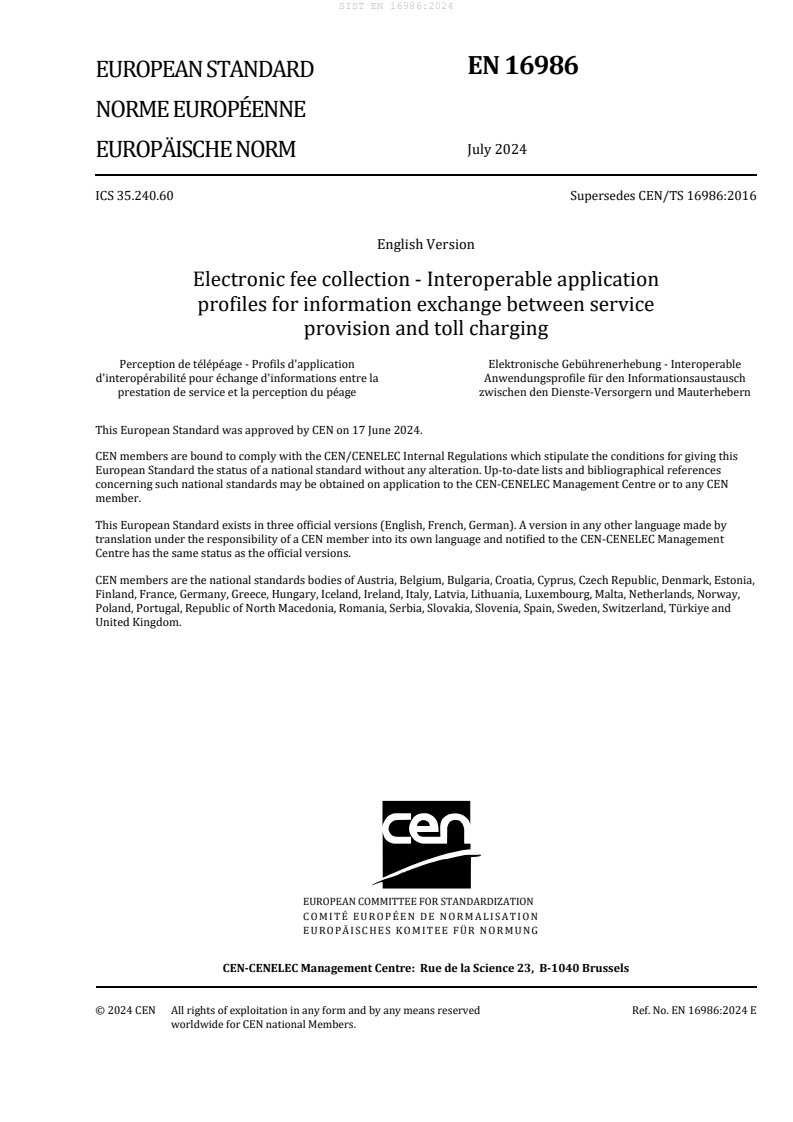
SLOVENSKI STANDARD
01-oktober-2024
Nadomešča:
SIST-TS CEN/TS 16986:2017
SIST-TS CEN/TS 16986:2017/AC:2017
Elektronsko pobiranje pristojbin - Interoperabilni profili aplikacije za informativno
izmenjavo med ponudnikom storitve in operaterjem cestninjenja
Electronic fee collection - Interoperable application profiles for information exchange
between service provision and toll charging
Elektronische Gebührenerhebung - Interoperable Anwendungsprofile für den
Informationsaustausch zwischen den Dienste-Versorgern und Mauterhebern
Perception de télépéage - Profils d’application d’interopérabilité pour échange
d’informations entre la prestation de service et la perception du péage
Ta slovenski standard je istoveten z: EN 16986:2024
ICS:
35.240.60 Uporabniške rešitve IT v IT applications in transport
prometu
2003-01.Slovenski inštitut za standardizacijo. Razmnoževanje celote ali delov tega standarda ni dovoljeno.
EN 16986
EUROPEAN STANDARD
NORME EUROPÉENNE
July 2024
EUROPÄISCHE NORM
ICS 35.240.60 Supersedes CEN/TS 16986:2016
English Version
Electronic fee collection - Interoperable application
profiles for information exchange between service
provision and toll charging
Perception de télépéage - Profils d'application Elektronische Gebührenerhebung - Interoperable
d'interopérabilité pour échange d'informations entre la Anwendungsprofile für den Informationsaustausch
prestation de service et la perception du péage zwischen den Dienste-Versorgern und Mauterhebern
This European Standard was approved by CEN on 17 June 2024.
CEN members are bound to comply with the CEN/CENELEC Internal Regulations which stipulate the conditions for giving this
European Standard the status of a national standard without any alteration. Up-to-date lists and bibliographical references
concerning such national standards may be obtained on application to the CEN-CENELEC Management Centre or to any CEN
member.
This European Standard exists in three official versions (English, French, German). A version in any other language made by
translation under the responsibility of a CEN member into its own language and notified to the CEN-CENELEC Management
Centre has the same status as the official versions.
CEN members are the national standards bodies of Austria, Belgium, Bulgaria, Croatia, Cyprus, Czech Republic, Denmark, Estonia,
Finland, France, Germany, Greece, Hungary, Iceland, Ireland, Italy, Latvia, Lithuania, Luxembourg, Malta, Netherlands, Norway,
Poland, Portugal, Republic of North Macedonia, Romania, Serbia, Slovakia, Slovenia, Spain, Sweden, Switzerland, Türkiye and
United Kingdom.
EUROPEAN COMMITTEE FOR STANDARDIZATION
COMITÉ EUROPÉEN DE NORMALISATION
EUROPÄISCHES KOMITEE FÜR NORMUNG
CEN-CENELEC Management Centre: Rue de la Science 23, B-1040 Brussels
© 2024 CEN All rights of exploitation in any form and by any means reserved Ref. No. EN 16986:2024 E
worldwide for CEN national Members.
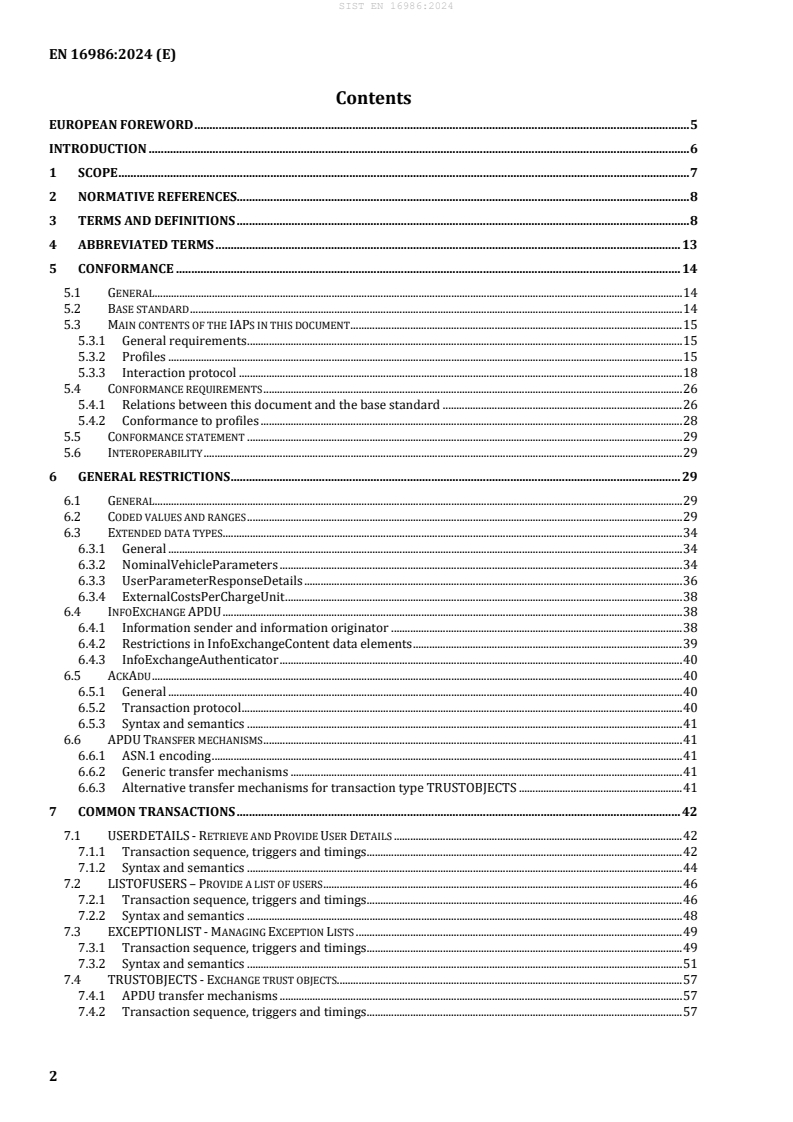
Contents
EUROPEAN FOREWORD . 5
INTRODUCTION . 6
1 SCOPE . 7
2 NORMATIVE REFERENCES. 8
3 TERMS AND DEFINITIONS . 8
4 ABBREVIATED TERMS . 13
5 CONFORMANCE . 14
5.1 GENERAL . 14
5.2 BASE STANDARD . 14
5.3 MAIN CONTENTS OF THE IAPS IN THIS DOCUMENT . 15
5.3.1 General requirements . 15
5.3.2 Profiles . 15
5.3.3 Interaction protocol . 18
5.4 CONFORMANCE REQUIREMENTS . 26
5.4.1 Relations between this document and the base standard . 26
5.4.2 Conformance to profiles . 28
5.5 CONFORMANCE STATEMENT . 29
5.6 INTEROPERABILITY . 29
6 GENERAL RESTRICTIONS . 29
6.1 GENERAL . 29
6.2 CODED VALUES AND RANGES . 29
6.3 EXTENDED DATA TYPES . 34
6.3.1 General . 34
6.3.2 NominalVehicleParameters . 34
6.3.3 UserParameterResponseDetails . 36
6.3.4 ExternalCostsPerChargeUnit . 38
6.4 INFOEXCHANGE APDU . 38
6.4.1 Information sender and information originator . 38
6.4.2 Restrictions in InfoExchangeContent data elements . 39
6.4.3 InfoExchangeAuthenticator . 40
6.5 ACKADU . 40
6.5.1 General . 40
6.5.2 Transaction protocol . 40
6.5.3 Syntax and semantics . 41
6.6 APDU TRANSFER MECHANISMS . 41
6.6.1 ASN.1 encoding . 41
6.6.2 Generic transfer mechanisms . 41
6.6.3 Alternative transfer mechanisms for transaction type TRUSTOBJECTS . 41
7 COMMON TRANSACTIONS . 42
7.1 USERDETAILS - RETRIEVE AND PROVIDE USER DETAILS . 42
7.1.1 Transaction sequence, triggers and timings. 42
7.1.2 Syntax and semantics . 44
7.2 LISTOFUSERS – PROVIDE A LIST OF USERS . 46
7.2.1 Transaction sequence, triggers and timings. 46
7.2.2 Syntax and semantics . 48
7.3 EXCEPTIONLIST - MANAGING EXCEPTION LISTS . 49
7.3.1 Transaction sequence, triggers and timings. 49
7.3.2 Syntax and semantics . 51
7.4 TRUSTOBJECTS - EXCHANGE TRUST OBJECTS. 57
7.4.1 APDU transfer mechanisms . 57
7.4.2 Transaction sequence, triggers and timings. 57
7.4.3 Syntax and semantics .6 1
7.5 CONTRACTISSUERLIST – TRANSFER OBE CONTRACTUAL INFORMATION .6 2
7.5.1 Transaction sequence, triggers and timings .6 2
7.5.2 Syntax and semantics .6 4
7.6 EFCCONTEXTDATA – TRANSFER TOLL CONTEXT DATA INFORMATION .6 4
7.6.1 Transaction sequence, triggers and timings .6 4
7.6.2 Syntax and semantics .6 6
7.7 BILLINGDETAILS_TC – TRANSFER BILLING DETAILS FROM TC .6 6
7.7.1 Transaction sequence, triggers and timings .6 6
7.7.2 Syntax and semantics .6 8
7.8 BILLINGDETAILS_TSP .6 9
7.8.1 Transaction sequence, triggers and timings .6 9
7.8.2 Syntax and semantics .7 1
7.9 PAYMENTCLAIM – ISSUE A PAYMENT CLAIM .7 2
7.9.1 Transaction sequence, triggers and timings .7 2
7.9.2 Syntax and semantics .7 5
7.10 REPORTABNORMALOBE – REPORT DETECTION OF OBE MISBEHAVIOUR .7 5
7.10.1 Transaction sequence, triggers and timings .7 5
7.10.2 Syntax and semantics .7 7
7.11 USERCOMPLAINT – REPORT A USER COMPLAINT .7 8
7.11.1 Transaction sequence, triggers and timings .7 8
7.11.2 Syntax and semantics .8 0
7.12 QAINFO – EXCHANGE OF QUALITY RELATED INFORMATION .8 1
7.12.1 Transaction sequence, triggers and timings .8 1
7.12.2 Syntax and semantics .8 4
8 SECTIONDISCRETE PROFILE. 85
8.1 DESCRIPTION .8 5
8.2 COMMON TRANSACTIONS USED BY THE PROFILE.8 5
8.3 ADDITIONAL PROFILE RESTRICTIONS .8 5
8.3.1 Apci restrictions .8 5
8.3.2 EXCEPTIONLIST restrictions .8 6
8.3.3 TRUSTOBJECTS restrictions.8 7
8.3.4 EFCCONTEXTDATA restrictions .8 7
8.3.5 BILLINGDETAILS_TC restrictions .9 4
8.3.6 PAYMENTCLAIM restrictions .9 7
8.4 SPECIFIC PROFILE TRANSACTIONS .9 8
9 SECTIONAUTONOMOUS PROFILE . 98
9.1 DESCRIPTION .9 8
9.2 COMMON TRANSACTIONS USED BY THE PROFILE.9 8
9.3 ADDITIONAL PROFILE RESTRICTIONS .9 9
9.3.1 Apci restrictions .9 9
9.3.2 EXCEPTIONLIST restrictions .9 9
9.3.3 BILLINGDETAILS transactions restrictions . 100
9.3.4 EFCCONTEXTDATA restrictions . 101
9.4 SPECIFIC PROFILE TRANSACTIONS . 101
9.4.1 General . 101
9.4.2 TOLLDECLARATIONS_SECT . 102
9.4.3 PAYMENTANNOUNCEMENT transaction . 107
10 MESHEDDISCRETE PROFILE . 110
10.1 DESCRIPTION . 110
10.2 COMMON TRANSACTIONS USED BY THE PROFILE. 110
10.3 ADDITIONAL PROFILE RESTRICTIONS . 111
10.3.1 Apci restrictions . 111
10.3.2 EXCEPTIONLIST restrictions . 111
10.3.3 TRUSTOBJECTS restrictions . 112
10.3.4 EFCCONTEXTDATA restrictions . 112
10.3.5 BILLINGDETAILS_TC restrictions . 115
10.3.6 BILLINGDETAILS_TSP_restrictions . 117
10.3.7 PAYMENTCLAIM restrictions . 117
10.4 SPECIFIC PROFILE TRANSACTIONS . 117
11 AREADISTANCEAUTONOMOUS PROFILE .118
11.1 DESCRIPTION . 118
11.2 COMMON TRANSACTIONS USED BY THE PROFILE . 118
11.3 FURTHER PROFILE RESTRICTIONS ON USED TRANSACTIONS . 118
11.3.1 EXCEPTIONLIST restrictions . 118
11.3.2 EFCCONTEXTDATA restrictions . 118
11.3.3 BILLINGDETAILS_TSP restrictions . 119
11.3.4 REPORTABNORMALOBE restrictions . 120
11.4 SPECIFIC PROFILE TRANSACTIONS . 121
11.4.1 TOLLDECLARATIONS_AREA . 121
ANNEX A (NORMATIVE) FORMAL RESTRICTIONS ON DATA TYPES .127
ANNEX B (NORMATIVE) ICS PROFORMA .129
ANNEX C (NORMATIVE) INTEROPERABILITY STATEMENT PROFORMA .213
ANNEX D (NORMATIVE) WEB SERVICE DEFINITION (WSDL) .222
ANNEX E (INFORMATIVE) USE OF THIS DOCUMENT FOR THE EETS .223
BIBLIOGRAPHY .224
European foreword
This document (EN 16986:2024) has been prepared by Technical Committee CEN/TC 278 “Intelligent
transport systems”, the secretariat of which is held by NEN.
This European Standard shall be given the status of a national standard, either by publication of an
identical text or by endorsement, at the latest by January 2025, and conflicting national standards shall
be withdrawn at the latest by January 2025.
Attention is drawn to the possibility that some of the elements of this document may be the subject of
patent rights. CEN shall not be held responsible for identifying any or all such patent rights.
This document supersedes CEN/TS 16986:2016.
This document features the following main changes compared to CEN/TS 16986:2016:
— updated interoperability application profiles tailored according to electronic fee collection (EFC)
charging policies and primary used technologies;
— updated data definitions to reflect changes made to the underlying base standard, i.e.,
EN ISO 12855:2022;
— addition of a second level of the version identifier (i.e. minor version) of the abstract syntax notation
one (ASN.1) module to provide enhanced support to standards that import data types from this
document;
— introduction of use of imported ASN.1 types with successors (i.e. including all future minor versions);
— updated terms and definitions, including reference to ISO/TS 17573-2 as the primary source;
— inserted a normative formal specification of profiles’ restrictions on data, both as ASN.1 data types,
and as XSD specifications as Annex A and renumbered other annexes consequently;
— updated informative Annex E on the “Use of this document for the European electronic toll service”
[16]
(EETS), so as to reflect the recast of the EETS legislation (i.e. Directive (EU) 2019/520 and the
[16]
corresponding Commission Implementing Regulation ).
This document is intended to provide support for the technical specification of the recast of the EETS
legislation as laid down in the European Directive (EU) 2019/520 and in its Commission Delegated
Regulation (EU) 2020/203 and Commission Implementing Regulation (EU) 2020/204. See Annex E on
the “Use of this document for the EETS legislation”.
Any feedback and questions on this document should be directed to the users’ national standards body.
A complete listing of these bodies can be found on the CEN website.
According to the CEN-CENELEC Internal Regulations, the national standards organisations of the
following countries are bound to implement this European Standard: Austria, Belgium, Bulgaria, Croatia,
Cyprus, Czech Republic, Denmark, Estonia, Finland, France, Germany, Greece, Hungary, Iceland, Ireland,
Italy, Latvia, Lithuania, Luxembourg, Malta, Netherlands, Norway, Poland, Portugal, Republic of North
Macedonia, Romania, Serbia, Slovakia, Slovenia, Spain, Sweden, Switzerland, Türkiye and the United
Kingdom.
Introduction
The CEN ISO Standard on Electronic fee collection - Information exchange between service provision and
toll charging (i.e. EN ISO 12855) is a so-called toolbox standard. That means that it provides a large
number of options that can be used to support various needs of toll chargers (TCs) and toll service
providers (TSPs). As such, it provides useful but not sufficient support to ensure technical
interoperability.
The aim of this document is to produce a profile specification that provides technical interoperability to
support the EFC information exchange between TSPs and TCs according to the following tolling policies:
— based on traversing sections of roads;
— based on travelling within areas of territory;
— based on traversing meshed networks of roads.
This document covers the definition of interoperable application profiles (IAP) applicable for the use of
EN ISO 12855:2022. These profiles define a specific coherent set of transactions, triggers, conditions, data
elements, transfer mechanisms and supporting functions for an interoperable exchange of data between
the back end systems of TCs and TSPs (in Europe).
This document defines profiles using the concept of “International Standardized Profiles (ISP)”, as
defined in ISO/IEC TR 10000-1. The ISP concept is specifically suited for defining interoperability
specifications where a set of base standards can be used in different ways. This is exactly the case for
EN ISO 12855:2022, where the base standard allows for different choices that are not interoperable.
The principles of the ISP-concept can be summarized as follows:
— an ISP will make references only to base standards or other ISPs;
— the profile will restrict the choice of base standard options to the extent necessary to maximize
the probability of interoperability (e.g. chosen classes, conforming subsets, options and
parameter values of base standards);
— the ISP will not copy content of the base standards (in order to avoid consistency problems with
the base standards);
— the profile will not specify any requirements that would contradict or cause non-conformance to
the base standards;
— the profile may contain conformance requirements that are more specific and limited in scope
than those of the base standards;
— conformance to a profile implies by definition conformance to a set of base standards, whereas
conformance to that set of base standards does not necessarily imply conformance to the profile.
This document will be complemented by standard EN 17154 that will specify how to evaluate
implementations of EN 16986 (this document).
1 Scope
This document specifies interoperable application profiles for information exchanges between toll
chargers (TCs) and toll service providers (TSPs), by selecting suitable options from the base standard
EN ISO 12855:2022.
This document covers:
— exchange of information between back end systems of TCs and TSPs, e.g.:
— charging related data (toll declarations, billing details, payment claims, payment
announcements);
— administrative data (trust objects, EFC context data, contact details for enforcement, etc.);
— user related data (exception lists, user details, abnormal OBE information, CCC event data,
user complaints);
— confirmation data.
— transfer mechanisms and supporting functions;
— semantics of data elements;
— formal definitions (Annex A) of restrictions on data types w.r.t. the ASN.1 definitions in the base
standard EN ISO 12855:2022 by introducing an XML Schema Definition (XSD) for each specified
profile;
— implementation conformance statement proforma (Annex B), as a basis for evaluation of
implementation for conformity to this document;
— an interoperability statement proforma (Annex C), as a basis for assessment of transactional
interoperability of two technical implementations;
— a web service definition (Annex D) for the use of web services as communication technology.
The implementation of the underlying back end systems and their business processes is not covered.
Therefore, the following aspects are outside the scope of this document:
— details about how back end systems use the authenticator data elements of the base standard to
implement security;
— how to operate compliance checking and the enforcement process;
— commercial aspects;
— definition of non-functional features such as performance indicators, acceptable fault levels,
availability of interfaces of TC and TSP, and reporting requirements.
This document further explains the correspondence between the European electronic toll service (EETS)
legislation and this document (Annex E).
2 Normative references
The following documents are referred to in the text in such a way that some or all of their content
constitutes requirements of this document. For dated references, only the edition cited applies. For
undated references, the latest edition of the referenced document (including any amendments) applies.
EN ISO 12855:2022, Electronic fee collection — Information exchange between service provision and toll
charging (ISO 12855:2022)
EN ISO 17573-3:2023, Electronic fee collection — System architecture for vehicle related tolling — Part 3:
Data dictionary (ISO 17573-3:2023)
EN ISO 14906:2023, Electronic fee collection — Application interface definition for dedicated short-range
communication (ISO 14906:2022)
EN ISO 12813:2024, Electronic fee collection — Compliance check communication for autonomous systems
(ISO 12813:2024)
EN ISO 13141:2024, Electronic fee collection — Localization augmentation communication for
autonomous systems (ISO 13141:2024)
IETF RC 959, File Transfer Protocol [Oct 1985]
IETF RFC 4217, Securing FTP with TLS [Oct 2015]
WSDL 1.1, Web Services Description Language (WSDL) 1.1
3 Terms and definitions
For the purposes of this document, the following terms and definitions apply.
ISO and IEC maintain terminology databases for use in standardization at the following addresses:
— ISO Online browsing platform: available at https://www.iso.org/obp
— IEC Electropedia: available at https://www.electropedia.org
3.1
attribute
addressable package of data consisting of a single data element (3.13) or structured sequences of data
elements
[SOURCE: ISO/TS 17575-2:2020, 3.2]
3.2
authentication
security mechanism allowing verification of the provided identity
[SOURCE: ISO/TS 17573-2:2020, 3.15]
1 http://www.w3.org/TR/2001/NOTE-wsdl-20010315 [15.03.2001]
3.3
authenticator
data, possibly encrypted, that is used for authentication (3.2)
[SOURCE: ISO/TS 17573-2:2020, 3.16]
3.4
availability
property of being accessible and useable upon demand by an authorized entity
[SOURCE: ISO/TS 17575-2:2020, 3.20]
3.5
base standard
approved international standard, technical specification or ITU-T Recommendation
[SOURCE: ISO/TS 17573-2:2020, 3.23]
3.6
billing detail
information needed to determine or verify the amount due for the usage of a given service
[SOURCE: ISO/TS 17573-2:2020, 3.25]
3.7
channel
information transfer path
[SOURCE: ISO 7498-2:1989, 3.3.13]
3.8
charge object
geographic or road related object for the use of which a charge is applied
[SOURCE: ISO/TS 17573-2:2020, 3.31]
3.9
charge report
information containing road usage and related information originated at the front end
[SOURCE: ISO/TS 17573-2:2020, 3.35]
3.10
charging data
relevant data on the usage of a certain service
[SOURCE: ISO/TS 17573-2:2020, 3.36]
3.11
conformance testing
assessment to determine whether an implementation complies with the requirements
[SOURCE: ISO/TS 17573-2:2020, 3.45]
3.12
context data
information defined by the responsible toll charger necessary to establish the toll due for using a vehicle
on a particular toll context and to conclude the toll transaction
3.13
data element
coded information, which might itself consist of lower level information structures
[SOURCE: ISO/TS 17573-2:2020, 3.54]
3.14
electronic fee collection
fee collection by electronic means
[SOURCE: ISO/TS 17573-2:2020, 3.70]
3.15
enforcement
measures or actions performed to achieve compliance with laws, regulations or rules
[SOURCE: ISO/TS 17573-2:2020, 3.73]
3.16
evaluation
systematic process of determining how individuals, procedures, systems or programs have met formally
agreed objectives and requirements
[SOURCE: ISO/TS 17573-2:2020, 3.75]
3.17
front end
part of an EFC system which consists of on-board equipment and possibly of a proxy where road tolling
information and usage data are collected and processed for delivery to the back end
[SOURCE: ISO/TS 17573-2:2020, 3.85]
3.18
implementation conformance statement
statement of capabilities and options that have been implemented defining to what extent the
implementation is compliant with a given specification
[SOURCE: ISO/TS 17573-2:2020, 3.90]
3.19
implementation under test
implementation of one or more open systems interconnection (OSI) protocols in an adjacent
user/provider relationship, being part of a real system, which is to be studied by testing
[SOURCE: ISO/TS 17573-2:2020, 3.94]
3.20
international standardized profile
internationally agreed-to, harmonized document which describes one or more profiles
[SOURCE: ISO/TS 17573-2:2020, 3.102]
3.21
interoperability
ability of systems to exchange information and to make mutual use of the information that has been
exchanged
[SOURCE: ISO/TS 17573-2:2020, 3.103]
3.22
issuer
entity responsible for issuing the payment means to the user
[SOURCE: ISO/TS 16785:2014, 3.9]
3.23
on-board equipment
all required equipment on-board a vehicle for performing required EFC functions and communication
services
[SOURCE: ISO/TS 17573-2:2020, 3.126]
3.24
payment claim
statement made available to the payer by the payee to justify the amount due
[SOURCE: ISO/TS 17573-2:2020, 3.133]
3.25
profile
set of requirements and selected options from base standards or international standardized profiles used
to provide a specific functionality
[SOURCE: ISO/TS 17573-2:2020, 3.146]
3.26
role
set of responsibilities
[SOURCE: ISO/TS 17573-2:2020, 3.163]
3.27
system under test
real system in which the implementation under test resides
[SOURCE: ISO/TS 17573-2:2020, 3.178]
3.28
test
procedure designed to measure characteristics of a component or system in specified conditions
[SOURCE: ISO/TS 17573-2:2020, 3.182]
3.29
toll
charge, tax or duty levied in connection to using a vehicle in a toll domain
[SOURCE: ISO 17573-2:2020, 3.193]
3.30
toll charger
entity which levies toll for the use of vehicles in a toll domain
[SOURCE: ISO/TS 17573-2:2020, 3.194]
3.31
toll context
logical view as defined by attributes and functions of the basic elements of a toll scheme consisting of a
single basic tolling principle, a spatial distribution of the charge objects and a single behaviour of the
related front end
[SOURCE: ISO/TS 17573-2:2020, 3.196]
3.32
toll declaration
statement to declare the usage of a given toll service to a toll charger
[SOURCE: ISO/TS 17573-2:2020, 3.199]
3.33
toll domain
area or a part of a road network where a certain toll regime is applied
[SOURCE: ISO 17573-2:2020, 3.201]
3.34
toll regime
set of rules, including enforcement rules, governing the collection of toll in a toll domain
[SOURCE: ISO/TS 17573-2:2020, 3.203]
3.35
toll scheme
organizational view of a toll regime, including the actors and their relationships
[SOURCE: ISO/TS 17573-2:2020, 3.204]
3.36
toll service provider
entity providing toll services in one or more toll domains
[SOURCE: ISO/TS 17573-2:2020, 3.206]
3.37
transaction
whole of the exchange of information between two physically separated communication facilities
[SOURCE: ISO/TS 17573-2:2020, 3.211]
3.38
transaction type
identifier of a set of transactions that adhere to the same rules for the exchanged application protocol
data units in terms of triggers, timings, content and sequence
[SOURCE: ISO/TS 17573-2:2020, 3.214]
3.39
trigger
event that allows a transaction to start
3.40
trust object
information object that is exchanged between entities to ensure mutual trust
[SOURCE: ISO/TS 17573-2:2020, 3.221]
3.41
XML schema definition
formal definition of the interrelationship between the attributes and elements of an XML object
[SOURCE: W3C Recommendation 28 October 2004, XML Schema Part 0: Primer Second Edition]
4 Abbreviated terms
For the purposes of this document, the following abbreviations apply throughout the document unless
otherwise specified.
ADU Application Data Unit
ANPR Automatic Number Plate Recognition
APCI Application Protocol Control Information
APDU Application Protocol Data Unit
CCC Compliance Check Communication
CN Cellular Network
CRL Certificate Revocation List
DSRC Dedicated Short-Range Communication
EETS European Electronic Toll Service
EFC Electronic Fee Collection
FE Front End
FTP File Transfer Protocol
GNSS Global Navigation Satellite System
IAP Interoperability Application Profile
IP Internet Protocol
IUT Implementation Under Test
MAC Message Authentication Code
LAC Localisation Augmentation Communication
LPN Licence Plate Number
OBE On-Board Equipment
OSI Open Systems Interconnection
PAN Personal Account Number
PICS Protocol Implementation Conformance Statement
RSE Roadside Equipment
SOAP Simple Object Access Protocol
SU Service User
SUT System Under Test
TC Toll Charger
TCP Transmission Control Protocol
TSP Toll Service Provider
UML Unified Modelling Language
VPN Virtual Private Network
XER XML Encoding Rules
XML eXtensible Markup Language
XSD XML schema definition
5 Conformance
5.1 General
This clause describes the profiles that are specified by this document and the respective conformance
requirements for TCs and TSPs. Profiles are fully specified in Clauses 8 to 11.
5.2 Base standard
This document relies on EN ISO 12855:2022 as its base standard. It limits or restricts options and ranges
of data types defined in the base standard. In some cases, it limits the range of data types imported into
the base standard from other standards. These limitations are specified in the clauses for the common
transactions (Clauses 6 and 6.6) and the specified profiles (Clauses 8 to 11), and are formally defined in
Annex A.
The syntax of an InfoExchange application protocol data unit (APDU) shall be according to the ASN.1
definitions of the ASN.1 code in EN ISO 12855:2022 with the limitations and semantics relevant for the
profile(s) to which conformance is claimed.
---------------------- Page
...