


SIST-TS CEN/TS 17973:2024
(Main)Safety of toys - Categorization of slime type materials
Safety of toys - Categorization of slime type materials
This document specifies a test method for categorization of slime-type products to support users of EN 71-3 in the categorization of products with slime-like behaviour into material categories 1 (dry, brittle, powder-like or pliable toy material) or 2 (liquid or sticky toy material).
Sicherheit von Spielzeug - Einstufung von schleimartigen Materialien
Dieses Dokument legt ein Prüfverfahren für die Kategorisierung von schleimartigen Produkten fest, um die Anwender der EN 71 3 bei der Einstufung von Produkten mit einem schleimartigen Verhalten in Kategorie 1 (trockenes, brüchiges, staubförmiges oder geschmeidiges Spielzeugmaterial) oder Kategorie 2 (flüssiges oder klebriges Spielzeugmaterial) zu unterstützen.
Sécurité des jouets - Catégorisation des matériaux de type slime
Le présent document spécifie une méthode d’essai pour la catégorisation des produits de type slime, afin d’aider les utilisateurs de l’EN 71 3 à classer les produits ayant un comportement similaire à celui du slime dans la catégorie de matériaux 1 (matériau-jouet sec, friable, poudreux ou souple) ou 2 (matériau jouet liquide ou collant).
Varnost igrač - Razvrstitev materialov, podobnih sluzi
Ta dokument določa preskusno metodo za razvrstitev materialov, podobnih sluzi, v pomoč uporabnikom standarda EN 71-3 pri razvrščanju izdelkov z lastnostmi sluzi v kategorijo materiala 1 (suh, krhek, prahu podoben ali upogljiv material za igrače) ali kategorijo materiala 2 (tekoč ali lepljiv material za igrače).
General Information
- Status
- Published
- Public Enquiry End Date
- 02-Jul-2023
- Publication Date
- 11-Apr-2024
- Technical Committee
- OTR - Child use and care article
- Current Stage
- 6060 - National Implementation/Publication (Adopted Project)
- Start Date
- 22-Mar-2024
- Due Date
- 27-May-2024
- Completion Date
- 12-Apr-2024
Overview - CEN/TS 17973:2023 (Safety of toys - Categorization of slime type materials)
CEN/TS 17973:2023 provides a pragmatic, laboratory test method to categorize slime-type toy materials for correct application of EN 71-3 chemical migration limits. It addresses the long-standing difficulty of deciding whether a slime-like product behaves as category 1 (dry, brittle, powder-like or pliable) or category 2 (liquid or sticky) material for toy safety and migration testing, supporting conformity assessment under the Toy Safety Directive (2009/48/EC).
Key topics and technical requirements
- Purpose: support users of EN 71-3 in categorizing slime-type products so the correct migration limits (notably for boron) are applied.
- Definitions: slime, liquid, modelling clay/putty, creeping - and the recognition of non-Newtonian behaviours (thixotropy, rheopexy).
- New “rod test” (preferred method):
- Principle: a POM rod is placed on the slime surface and the time to sink a set distance is recorded.
- Key equipment specs (as given in the Technical Specification):
- POM rod: length 100 mm, diameter (12.5 ± 0.1) mm, contact area ≈ 123 mm², weight (10.0 ± 0.2) g (including indicator ring).
- Guiding tube: inner diameter (12.8 + 0.1) mm, height 20–25 mm.
- Base plate: diameter 100 mm (or square 70 × 70 mm).
- Indicator ring: height 20 mm to set measuring distance (10 mm).
- Test container: 50 ml beaker (≈40 mm inner diameter), min sample height 30 mm, minimum test amount ≈30 g.
- Stopwatch resolution at least 0.1 s.
- Sample preparation: test at (21 ± 2) °C with at least 4 h equilibration; container kept closed to avoid humidity loss; surface leveled prior to testing.
- Advantages: minimal pre-test mechanical manipulation, better repeatability, and the sample remains available for EN 71-3 migration testing after categorization.
- Historical alternatives (documented disadvantages): tube test and shape (ball) test - both vulnerable to handling effects and limited reproducibility.
Applications - who uses this standard
- Toy manufacturers: categorize slime products early in design to select the correct EN 71-3 limits and formulation choices (e.g., boron content).
- Independent testing laboratories: apply a repeatable rod test procedure for conformity assessment and reporting.
- Market surveillance authorities and regulators: harmonise enforcement decisions and reduce inconsistent conservative categorizations.
- Product safety and compliance teams: justify category decisions for import, CE marking and technical documentation.
Related standards and context
- EN 71‑3 (Safety of toys - Migration of certain elements) - CEN/TS 17973 is explicitly intended to support EN 71‑3 categorization.
- Toy Safety Directive 2009/48/EC - material categories and associated ingestion assumptions underpin the classification rationale.
- The specification is provisional (initially limited to three years) and may be considered for conversion into an EN.
Keywords: CEN/TS 17973:2023, safety of toys, slime categorization, EN 71-3, rod test, boron migration, non-Newtonian, toy compliance.

Frequently Asked Questions
SIST-TS CEN/TS 17973:2024 is a technical specification published by the Slovenian Institute for Standardization (SIST). Its full title is "Safety of toys - Categorization of slime type materials". This standard covers: This document specifies a test method for categorization of slime-type products to support users of EN 71-3 in the categorization of products with slime-like behaviour into material categories 1 (dry, brittle, powder-like or pliable toy material) or 2 (liquid or sticky toy material).
This document specifies a test method for categorization of slime-type products to support users of EN 71-3 in the categorization of products with slime-like behaviour into material categories 1 (dry, brittle, powder-like or pliable toy material) or 2 (liquid or sticky toy material).
SIST-TS CEN/TS 17973:2024 is classified under the following ICS (International Classification for Standards) categories: 97.200.50 - Toys. The ICS classification helps identify the subject area and facilitates finding related standards.
SIST-TS CEN/TS 17973:2024 is available in PDF format for immediate download after purchase. The document can be added to your cart and obtained through the secure checkout process. Digital delivery ensures instant access to the complete standard document.
Standards Content (Sample)
SLOVENSKI STANDARD
01-maj-2024
Varnost igrač - Razvrstitev materialov, podobnih sluzi
Safety of toys - Categorization of slime type materials
Sicherheit von Spielzeug - Einstufung von schleimartigen Materialien
Sécurité des jouets - Catégorisation des matériaux de type slime
Ta slovenski standard je istoveten z: CEN/TS 17973:2023
ICS:
97.200.50 Igrače Toys
2003-01.Slovenski inštitut za standardizacijo. Razmnoževanje celote ali delov tega standarda ni dovoljeno.
CEN/TS 17973
TECHNICAL SPECIFICATION
SPÉCIFICATION TECHNIQUE
October 2023
TECHNISCHE SPEZIFIKATION
ICS 97.200.50
English Version
Safety of toys - Categorization of slime type materials
Sécurité des jouets - Catégorisation des matériaux de Sicherheit von Spielzeug - Einstufung von
type slime schleimartigen Materialien
This Technical Specification (CEN/TS) was approved by CEN on 28 August 2023 for provisional application.
The period of validity of this CEN/TS is limited initially to three years. After two years the members of CEN will be requested to
submit their comments, particularly on the question whether the CEN/TS can be converted into a European Standard.
CEN members are required to announce the existence of this CEN/TS in the same way as for an EN and to make the CEN/TS
available promptly at national level in an appropriate form. It is permissible to keep conflicting national standards in force (in
parallel to the CEN/TS) until the final decision about the possible conversion of the CEN/TS into an EN is reached.
CEN members are the national standards bodies of Austria, Belgium, Bulgaria, Croatia, Cyprus, Czech Republic, Denmark, Estonia,
Finland, France, Germany, Greece, Hungary, Iceland, Ireland, Italy, Latvia, Lithuania, Luxembourg, Malta, Netherlands, Norway,
Poland, Portugal, Republic of North Macedonia, Romania, Serbia, Slovakia, Slovenia, Spain, Sweden, Switzerland, Türkiye and
United Kingdom.
EUROPEAN COMMITTEE FOR STANDARDIZATION
COMITÉ EUROPÉEN DE NORMALISATION
EUROPÄISCHES KOMITEE FÜR NORMUNG
CEN-CENELEC Management Centre: Rue de la Science 23, B-1040 Brussels
© 2023 CEN All rights of exploitation in any form and by any means reserved Ref. No. CEN/TS 17973:2023 E
worldwide for CEN national Members.
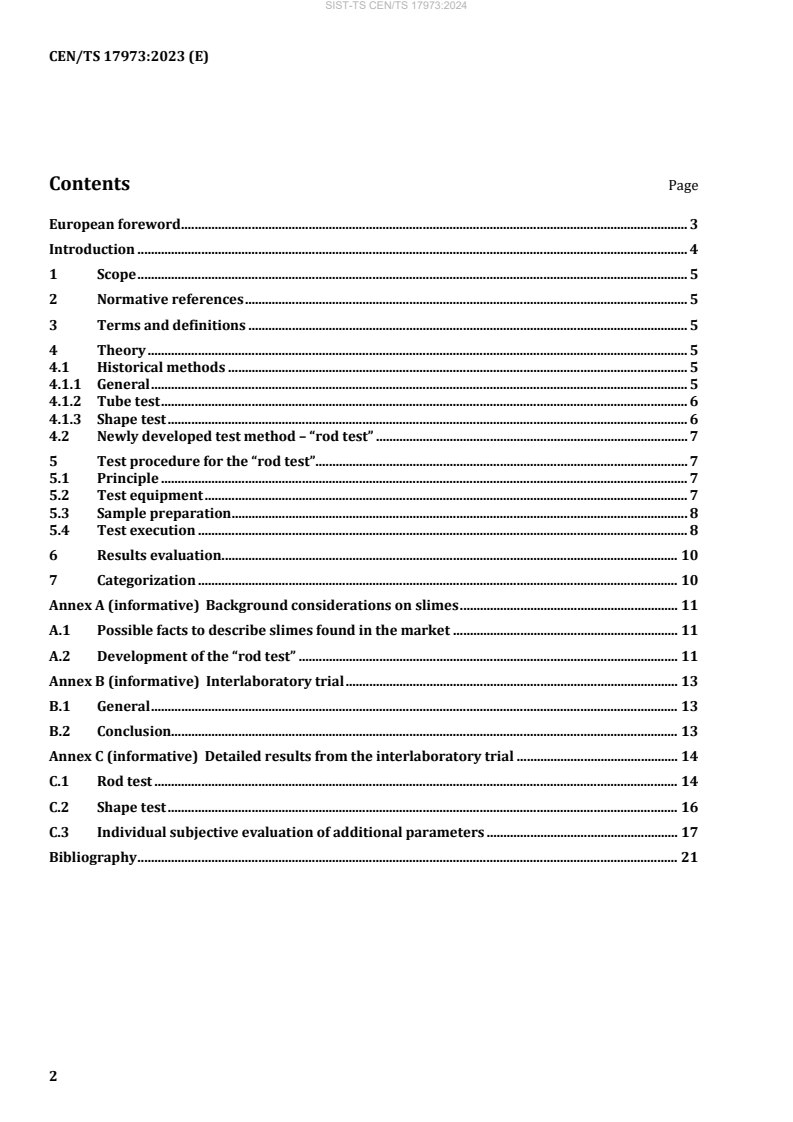
Contents Page
European foreword . 3
Introduction . 4
1 Scope . 5
2 Normative references . 5
3 Terms and definitions . 5
4 Theory . 5
4.1 Historical methods . 5
4.1.1 General . 5
4.1.2 Tube test . 6
4.1.3 Shape test . 6
4.2 Newly developed test method – “rod test” . 7
5 Test procedure for the “rod test”. 7
5.1 Principle . 7
5.2 Test equipment . 7
5.3 Sample preparation . 8
5.4 Test execution . 8
6 Results evaluation . 10
7 Categorization . 10
Annex A (informative) Background considerations on slimes . 11
A.1 Possible facts to describe slimes found in the market . 11
A.2 Development of the “rod test” . 11
Annex B (informative) Interlaboratory trial . 13
B.1 General . 13
B.2 Conclusion. 13
Annex C (informative) Detailed results from the interlaboratory trial . 14
C.1 Rod test . 14
C.2 Shape test . 16
C.3 Individual subjective evaluation of additional parameters . 17
Bibliography . 21
European foreword
This document (CEN/TS 17973:2023) has been prepared by Technical Committee CEN/TC 52 “Safety of
toys”, the secretariat of which is held by DS.
Attention is drawn to the possibility that some of the elements of this document may be the subject of
patent rights. CEN shall not be held responsible for identifying any or all such patent rights.
Any feedback and questions on this document should be directed to the users’ national standards body.
A complete listing of these bodies can be found on the CEN website.
According to the CEN-CENELEC Internal Regulations, the national standards organizations of the
following countries are bound to announce this Technical Specification: Austria, Belgium, Bulgaria,
Croatia, Cyprus, Czech Republic, Denmark, Estonia, Finland, France, Germany, Greece, Hungary, Iceland,
Ireland, Italy, Latvia, Lithuania, Luxembourg, Malta, Netherlands, Norway, Poland, Portugal, Republic of
North Macedonia, Romania, Serbia, Slovakia, Slovenia, Spain, Sweden, Switzerland, Türkiye and the
United Kingdom.
Introduction
There have been long lasting discussions on the correct categorization of slime type products in
conjunction with testing those products according to EN 71-3 and the applicability of the correct limit
value.
Due to their complex behaviour, in many cases a clear distinction cannot be made easily to come to a
reliable conclusion on category 1 (pliable) or category 2 (liquid).
As they often present non-Newtonian behaviour on the one hand and/or are creeping rather than free
flowing on the other hand the determination of the status appears complex. The stickiness of some
compositions needs to be evaluated in a specific way and presents a further challenge.
According to Annex II, Chapter 3, Paragraph (13), the Toy Safety Directive 2009/48/EC differentiates 3
material categories, which are derived on a risk basis from, besides other facts, (inter alia RIVM report
320003001/2008 [incl. erratum]) an assumption of daily values for ingestion: category 1 - 100 mg toy
material per day/category 2 - 400 mg toy material per day. This was confirmed by SCHER - Final Opinion
on Estimates of the amount of toy materials ingested by children as of 8 April 2016, ISBN 978-92-79-ND.
Hand-to-mouth contact (addressing residues on the hands/fingers) is yet addressed within the
mentioned RIVM report and therefore addressed by the given limit values. In this conjunction sticky
should mean “visible product residues” on fingers and hands (wet feeling does not necessarily reflect the
intake of toy material).
For slime-like products, such as toy slime (free-flowing), effect slime (creeping slime masses) and
kneading slime (quasi-stable pliable compounds), 2 possible categories come into consideration:
— Category 2: liquid or sticky toy material;
— Category 1: dry, brittle, powder-like or pliable toy material.
Some test institutes as well as market surveillance authorities tend to categorize more conservative into
category 2 because of a potentially higher level of protection which leads to different evaluations. This
may be not proportionate from the TSD perspective.
The purpose of this document is to give some clarification on slimes and their behaviour, methodology
for the characterization as well as an approach for a suitable categorization.
Besides various elements, the element boron is of particular interest for slime-like products which
usually obtain their special (non-Newtonian) properties (such as rheopectic or thixotropic behaviour)
through the cross-linking of organic components (binders) with the element boron.
For category 1, the migration limit for boron is 1 200 mg/kg toy mass, for category 2 the migration limit
is set to 300 mg/kg.
In the context of conformity assessment, it is of particular importance to categorize the slime-type
materials correctly for a well-founded evaluation of the test results on the applicable limit value.
Request for a test method proposal
The test method should be easy to use and show acceptable precision for decision making. It must also
be pragmatic and may be based on a convention.
1 Scope
This document specifies a test method for categorization of slime-type products to support users of
EN 71-3 in the categorization of products with slime-like behaviour into material categories 1 (dry,
brittle, powder-like or pliable toy material) or 2 (liquid or sticky toy material).
2 Normative references
There are no normative references in this document.
3 Terms and definitions
For the purposes of this document, the following terms and definitions apply.
ISO and IEC maintain terminology databases for use in standardization at the following addresses:
— ISO Online browsing platform: available at https://www.iso.org/obp/
— IEC Electropedia: available at https://www.electropedia.org/
3.1
slime
liquid, semi-liquid or firm material exhibiting free flowing, viscous, paste-like up to creeping behaviour
presenting non-Newtonian properties (like rheopexy or thixotropy) and changing the shape over a
certain time when left alone
3.2
liquid
free flowing fluid presenting Newtonian behaviour, not keeping any defined shape when not kept in a
container
3.3
modelling clay
putty
pliable material exhibiting kneadable behaviour (soft to firm) keeping the shape after manipulation
3.4
creeping
slow steady flow of a viscous material under low stress conditions commonly understood as a specific
viscoelastic property
4 Theory
4.1 Historical methods
4.1.1 General
Due to the non-Newtonian behaviour of slime-type products, the standard measurement methods for
viscosity are not suitable to obtain reliable results for the categorization.
Furthermore, there is no clear range or point for decision making.
Known provisional methods need mechanical manipulation of the material in preparing the sample for
measurement.
4.1.2 Tube test
Cylindrical test tube
Tube dimensions Diameter 30 mm
Height min. 60 mm
Procedure Slime is pressed into the tube and the slime surface is cut flat
Tube inclination: 90°/45°/0° (different approaches)
The time for the protrusion of 10 mm of the slime material is taken
Results evaluation ≥ 90 s → category 1
< 90 s → category 2
Disadvantages of the tube test
— Sample material handling needs some effort to fill the tube properly (e.g. without air bubbles).
— Sample material can be influenced by sweat/fat from the hands and loss of humidity, hand
temperature or mechanical forces which may trigger non-Newtonian behaviour.
— The test material needs to be cut at the upper edge of the test tube to have an exact starting point.
— The material cannot be used for further testing.
— No data on reproducibility is available.
— Time taking is not exact because there is no means of a defined end point.
— The test tube material and inclination are not defined and agreed anywhere.
4.1.3 Shape test
A sphere (ball) is shaped from the slime-type toy material with a diameter of 30 mm (as far as it is
feasible).
The sphere is placed on a flat horizontal glass, metal or plastic surface and the initial height is determined
(H0). The sphere is left for 5 min ((300 ± 5) s). Subsequently the height (H5) is taken.
Results evaluation If H5 is less than H0/2 or equal to H0/2 → category 2.
If H5 is more than H0/2→ category 1.
Disadvantages of the shape test
— Sample material handling needs some effort to shape an acceptable sphere (especially with creeping
and flexible material or within the transition range of the categories).
— Sample material can be influenced by sweat/fat from the hands and loss of humidity, hand
temperature or mechanical forces which may trigger non-Newtonian behaviour.
— Placing the sphere onto a flat surface and measuring the initial height is accompanied by continuous
change of the sphere’s shape which results in an uncertainty of the starting point (no equilibration is
possible prior to measurement).
— The material cannot be used for further testing.
— The optimum sphere diameter is not described nor agreed anywhere.
— No data on reproducibility is available.
— Height determination is variable in its precision depending on the means of measurement (like
vernier calliper, which needs to touch the upper surface).
4.2 Newly developed test method – “rod test”
The proposed test method describes an easy-to-use procedure exhibiting an acceptable accuracy for
decision making. It is also pragmatic and represents a conventional method.
An advantage of the described method is that the material to be categorized is not subjected to any
mechanical influences prior to measurement, e.g. by kneading or moulding or loss of humidity or other
effects which enables a uniform and repeatable starting point (see Annex A).
The material can directly be used for migration purposes according to EN 71-3 after categorization.
5 Test procedure for the “rod test”
5.1 Principle
A rod made of polymeric material, preferably POM (polyoxymethylene), is placed onto the surface of a
slime-type product and the time of sinking into the material for a certain distance is taken.
5.2 Test equipment
POM rod Length 100 mm (drilled hollow from the top for adjusting the
weight)
Diameter (12,5 ± 0,1) mm
2 2
Contact area
123 mm /(= 1,23 cm )
Weight (10,0 + 0,2) g (including indicator ring)
Guiding tube (POM, PC, ABS) Inner diameter (12,8 + 0,1) mm
Height 20 mm to 25 mm from the base
Base plate (PC, PMMA) Diameter 100 mm (not less than 70 mm)
or Square 70 mm × 70 mm
Indicator ring Height 20 mm
Inner diameter about 12 mm (vertically slotted, slidable on the rod,
fixed and positioned by friction)
Adjustment clamp Height 10 mm (for adjusting the indicator ring to the
measuring distance)
Test container Glass beaker 50 ml (standard laboratory glass ware)
Inner diameter approx. 40 mm
Height approx. 60 mm
or original product container (meeting at least the above
defined container size specifications as a minimum)
Minimum sample height 30 mm
Maximum sample height 80 % of the height of the container
...
Questions, Comments and Discussion
Ask us and Technical Secretary will try to provide an answer. You can facilitate discussion about the standard in here.
Loading comments...