


SIST EN 15372:2024
(Main)Furniture - Strength, durability and safety - Requirements for non-domestic tables
Furniture - Strength, durability and safety - Requirements for non-domestic tables
This document specifies requirements for the safety, strength and durability of all types of non-domestic tables including those with glass in their construction.
It does not apply to office work tables or desks, tables for educational institutions, laboratory workbenches for educational institutions and outdoor tables for which EN standards exist.
It does not apply to laboratory workbenches for professional use and industrial workbenches.
It does not apply to tables where the table top is not fixed to the understructure, i.e. when applying test 6, Table 2, the top becomes detached from the understructure.
With exception of the stability tests, this document does not provide assessment of the suitability of any storage features included in non-domestic tables.
It does not include requirements for electrical safety.
It does not include requirements for the resistance to ageing, degradation.
This document has three annexes:
- Annex A (normative) Test methods for finger entrapment;
- Annex B (informative) Additional test requirements;
- Annex C (informative) Test severity in relation to application.
Möbel - Festigkeit, Dauerhaltbarkeit und Sicherheit - Anforderungen an Tische für den Nicht-Wohnbereich
Dieses Dokument legt Anforderungen an die Sicherheit, Festigkeit und Dauerhaltbarkeit von allen Arten von Tischen für den Nicht-Wohnbereich fest, einschließlich von Tischen mit Bauteilen aus Glas.
Es ist nicht anwendbar für Büroarbeitstische oder Schreibtische, Tische für Bildungseinrichtungen, Arbeitstische für Laboratorien in Bildungseinrichtungen und Außentische, für die eigene EN-Normen vorhanden sind.
Es ist nicht anwendbar für Arbeitstische für Laboratorien für den gewerblichen Gebrauch und industrielle Werkbänke.
Es ist nicht anwendbar für Tische, bei denen die Tischplatte nicht fest mit der Unterkonstruktion verbunden ist, d. h. bei Anwendung der Prüfung 6, Tabelle 2, löst sich die Platte von der Unterkonstruktion.
Mit Ausnahme der Standsicherheitsprüfungen enthält dieses Dokument keine Bewertung hinsichtlich der Eignung von Aufbewahrungsvorrichtungen in Tischen für den Nicht-Wohnbereich.
Es enthält keine Anforderungen an elektrische Sicherheit.
Es enthält keine Anforderungen an die Alterungsbeständigkeit, Verwitterung.
Dieses Dokument enthält drei Anhänge:
Anhang A (normativ) Prüfverfahren für Fingerfangstellen;
Anhang B (informativ) Zusätzliche Prüfanforderungen;
Anhang C (informativ) Prüfstufe in Bezug auf den Anwendungsbereich.
Ameublement - Résistance, durabilité et sécurité - Exigences applicables aux tables à usage non domestique
Le présent document spécifie les exigences de sécurité, de résistance et de durabilité s’appliquant à tous les types de tables à usage non domestique, y compris celles comportant du verre.
Il ne s’applique pas aux tables et bureaux de mobilier de bureau, ni aux tables pour les établissements d’enseignement, ni aux plans de travail de laboratoire pour les établissements d’enseignement, ni aux tables d’extérieur, qui font l’objet de normes européennes spécifiques.
Il ne s’applique pas aux plans de travail de laboratoire pour une utilisation professionnelle ou industrielle.
Il ne s’applique pas aux tables dont le plateau n’est pas fixé au piètement, c’est-à-dire aux tables dont le plateau se désolidarise du piètement lorsqu’elles sont soumises à l’essai 6 (Tableau 2).
À l’exception des essais de stabilité, le présent document n’a pas pour objet d’évaluer l’aptitude à l’emploi des rangements éventuellement présents dans les tables à usage non domestique.
Il ne prescrit pas d’exigences relatives à la sécurité électrique.
Il ne prescrit pas non plus d’exigences relatives à la résistance au vieillissement et à la dégradation.
Le présent document contient trois annexes :
— l’Annexe A (normative) relative aux méthodes d’essai pour le coincement des doigts ;
— l’Annexe B (informative) relative aux exigences d’essai additionnelles ;
— l’Annexe C (informative) relative aux niveaux d’essai en fonction de l’application.
Pohištvo - Trdnost, trajnost in varnost - Zahteve za mize za javno uporabo
Ta dokument določa zahteve za varnost, trdnost in trajnost vseh vrst miz za javno uporabo, vključno takšnih s steklom.
Ne uporablja se za pisarniške mize, mize za izobraževalne ustanove, laboratorijske delovne pulte za izobraževalne ustanove in zunanje mize, za katere obstajajo standardi EN.
Ne uporablja se za laboratorijske delovne pulte za profesionalno uporabo in za industrijske delovne pulte.
Z izjemo preskušanja stabilnosti ta standard ne zagotavlja ocene primernosti za nobeno funkcijo shranjevanja, vključeno v mize za javno uporabo.
Ne vključuje zahtev za električno varnost.
Ne vključuje zahtev za odpornost proti staranju in razgradnji.
Standard ima tri dodatke:
Dodatek A (normativni) Preskusne metode za ukleščenje prstov;
Dodatek B (informativni) Dodatne zahteve za preskus;
Dodatek C (informativni) Preskusna zahtevnost v zvezi z uporabo.
General Information
- Status
- Published
- Public Enquiry End Date
- 01-Oct-2021
- Publication Date
- 15-Jan-2024
- Technical Committee
- POH - Furniture
- Current Stage
- 6060 - National Implementation/Publication (Adopted Project)
- Start Date
- 11-Jan-2024
- Due Date
- 17-Mar-2024
- Completion Date
- 16-Jan-2024
Relations
- Effective Date
- 01-Feb-2024
Overview
EN 15372:2023 is the CEN European standard that specifies requirements for the strength, durability and safety of non‑domestic tables. It covers all types of contract and public‑use tables, including those incorporating glass, and sets out test methods and performance criteria to minimise injury and ensure long‑term function. The standard replaces EN 15372:2016 and is intended for manufacturers, test laboratories, specifiers and procurers of non‑domestic furniture.
Key topics and technical requirements
- Scope and exclusions: Applies to non‑domestic tables (e.g., hospitality, catering, communal areas) but excludes office worktables/desks, tables for educational institutions, outdoor tables covered by other EN standards, professional/industrial laboratory workbenches, and tables where the top is not fixed to the understructure.
- Safety design: Requirements to minimise injury risk - rounded or chamfered user‑contact edges, no burrs/sharp edges, protected lubricated parts, and secure load‑bearing connections.
- Finger entrapment, shear and compression: Normative test methods (Annex A) for finger entrapment and for shear/compression points created during setup, by non‑electrically powered mechanisms (e.g., springs, gas lifts), and during normal use. Specific clearances are required (for example, no accessible holes 8–18 mm deep unless safe; moving gaps limits described in the standard).
- Stability: Stability tests follow EN 1730 and include requirements for tables set at heights ≤950 mm and >950 mm and for tables with extension elements. Tables must not overturn under specified test loads.
- Strength and durability: Durability and strength tests are defined (to be executed in the order given in Table 2). The standard distinguishes table types and gives guidance on test severity relative to application (Annex C).
- Glass requirements: Defines “safety glass” criteria and vertical‑impact test requirements (references EN 12150‑1 and EN 12600).
- Additional content: Annex B offers informative test recommendations (e.g., tabletop deflection, castor durability). The standard does not cover electrical safety or ageing/resistance to degradation.
Practical applications - who uses EN 15372:2023
- Manufacturers and designers of contract furniture for product development, specifying construction details, and ensuring compliance with safety and durability expectations.
- Testing laboratories to perform the normative tests (finger entrapment, stability, impact, durability) and issue test reports.
- Procurement officers and specifiers (hotels, restaurants, public buildings, contract furnishers) to set performance requirements in tenders and buy‑off criteria.
- Regulatory and standards professionals for harmonising national rules with CEN requirements.
Related standards
- EN 1730:2012 - Tables - Test methods for stability, strength and durability
- EN 12150‑1:2015+A1:2019 and EN 12600:2002 - Safety glass and impact/fragmentation tests
- CEN/TR 17202 - Guidance on accessible parts and finger entrapment
- prEN 17684 (under development) - future requirements for electrically operated furniture
Keywords: EN 15372:2023, non‑domestic tables, furniture standard, strength durability safety, test methods, safety glass, finger entrapment, stability tests, CEN.

Frequently Asked Questions
SIST EN 15372:2024 is a standard published by the Slovenian Institute for Standardization (SIST). Its full title is "Furniture - Strength, durability and safety - Requirements for non-domestic tables". This standard covers: This document specifies requirements for the safety, strength and durability of all types of non-domestic tables including those with glass in their construction. It does not apply to office work tables or desks, tables for educational institutions, laboratory workbenches for educational institutions and outdoor tables for which EN standards exist. It does not apply to laboratory workbenches for professional use and industrial workbenches. It does not apply to tables where the table top is not fixed to the understructure, i.e. when applying test 6, Table 2, the top becomes detached from the understructure. With exception of the stability tests, this document does not provide assessment of the suitability of any storage features included in non-domestic tables. It does not include requirements for electrical safety. It does not include requirements for the resistance to ageing, degradation. This document has three annexes: - Annex A (normative) Test methods for finger entrapment; - Annex B (informative) Additional test requirements; - Annex C (informative) Test severity in relation to application.
This document specifies requirements for the safety, strength and durability of all types of non-domestic tables including those with glass in their construction. It does not apply to office work tables or desks, tables for educational institutions, laboratory workbenches for educational institutions and outdoor tables for which EN standards exist. It does not apply to laboratory workbenches for professional use and industrial workbenches. It does not apply to tables where the table top is not fixed to the understructure, i.e. when applying test 6, Table 2, the top becomes detached from the understructure. With exception of the stability tests, this document does not provide assessment of the suitability of any storage features included in non-domestic tables. It does not include requirements for electrical safety. It does not include requirements for the resistance to ageing, degradation. This document has three annexes: - Annex A (normative) Test methods for finger entrapment; - Annex B (informative) Additional test requirements; - Annex C (informative) Test severity in relation to application.
SIST EN 15372:2024 is classified under the following ICS (International Classification for Standards) categories: 97.140 - Furniture. The ICS classification helps identify the subject area and facilitates finding related standards.
SIST EN 15372:2024 has the following relationships with other standards: It is inter standard links to SIST EN 15372:2017. Understanding these relationships helps ensure you are using the most current and applicable version of the standard.
You can purchase SIST EN 15372:2024 directly from iTeh Standards. The document is available in PDF format and is delivered instantly after payment. Add the standard to your cart and complete the secure checkout process. iTeh Standards is an authorized distributor of SIST standards.
Standards Content (Sample)
SLOVENSKI STANDARD
01-februar-2024
Nadomešča:
SIST EN 15372:2017
Pohištvo - Trdnost, trajnost in varnost - Zahteve za mize za javno uporabo
Furniture - Strength, durability and safety - Requirements for non-domestic tables
Möbel - Festigkeit, Dauerhaltbarkeit und Sicherheit - Anforderungen an Tische für den
Nicht-Wohnbereich
Ameublement - Résistance, durabilité et sécurité - Exigences applicables aux tables à
usage non domestique
Ta slovenski standard je istoveten z: EN 15372:2023
ICS:
97.140 Pohištvo Furniture
2003-01.Slovenski inštitut za standardizacijo. Razmnoževanje celote ali delov tega standarda ni dovoljeno.
EN 15372
EUROPEAN STANDARD
NORME EUROPÉENNE
December 2023
EUROPÄISCHE NORM
ICS 97.140 Supersedes EN 15372:2016
English Version
Furniture - Strength, durability and safety - Requirements
for non-domestic tables
Ameublement - Résistance, durabilité et sécurité - Möbel - Festigkeit, Dauerhaltbarkeit und Sicherheit -
Exigences applicables aux tables à usage non Anforderungen an Tische für den Nicht-Wohnbereich
domestique
This European Standard was approved by CEN on 27 November 2023.
CEN members are bound to comply with the CEN/CENELEC Internal Regulations which stipulate the conditions for giving this
European Standard the status of a national standard without any alteration. Up-to-date lists and bibliographical references
concerning such national standards may be obtained on application to the CEN-CENELEC Management Centre or to any CEN
member.
This European Standard exists in three official versions (English, French, German). A version in any other language made by
translation under the responsibility of a CEN member into its own language and notified to the CEN-CENELEC Management
Centre has the same status as the official versions.
CEN members are the national standards bodies of Austria, Belgium, Bulgaria, Croatia, Cyprus, Czech Republic, Denmark, Estonia,
Finland, France, Germany, Greece, Hungary, Iceland, Ireland, Italy, Latvia, Lithuania, Luxembourg, Malta, Netherlands, Norway,
Poland, Portugal, Republic of North Macedonia, Romania, Serbia, Slovakia, Slovenia, Spain, Sweden, Switzerland, Türkiye and
United Kingdom.
EUROPEAN COMMITTEE FOR STANDARDIZATION
COMITÉ EUROPÉEN DE NORMALISATION
EUROPÄISCHES KOMITEE FÜR NORMUNG
CEN-CENELEC Management Centre: Rue de la Science 23, B-1040 Brussels
© 2023 CEN All rights of exploitation in any form and by any means reserved Ref. No. EN 15372:2023 E
worldwide for CEN national Members.
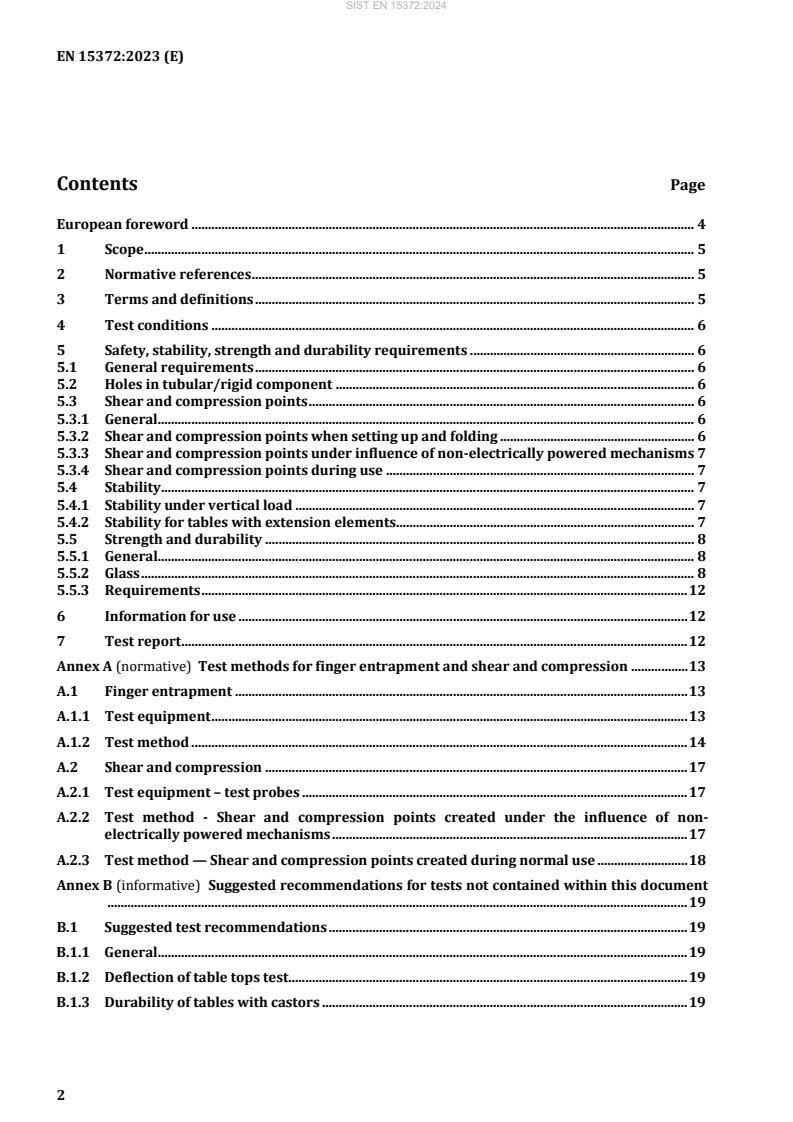
Contents Page
European foreword . 4
1 Scope . 5
2 Normative references . 5
3 Terms and definitions . 5
4 Test conditions . 6
5 Safety, stability, strength and durability requirements . 6
5.1 General requirements . 6
5.2 Holes in tubular/rigid component . 6
5.3 Shear and compression points . 6
5.3.1 General. 6
5.3.2 Shear and compression points when setting up and folding . 6
5.3.3 Shear and compression points under influence of non-electrically powered mechanisms 7
5.3.4 Shear and compression points during use . 7
5.4 Stability . 7
5.4.1 Stability under vertical load . 7
5.4.2 Stability for tables with extension elements. 7
5.5 Strength and durability . 8
5.5.1 General. 8
5.5.2 Glass . 8
5.5.3 Requirements . 12
6 Information for use . 12
7 Test report . 12
Annex A (normative) Test methods for finger entrapment and shear and compression . 13
A.1 Finger entrapment . 13
A.1.1 Test equipment . 13
A.1.2 Test method . 14
A.2 Shear and compression . 17
A.2.1 Test equipment – test probes . 17
A.2.2 Test method - Shear and compression points created under the influence of non-
electrically powered mechanisms . 17
A.2.3 Test method — Shear and compression points created during normal use . 18
Annex B (informative) Suggested recommendations for tests not contained within this document
............................................................................................................................................................................. 19
B.1 Suggested test recommendations . 19
B.1.1 General. 19
B.1.2 Deflection of table tops test . 19
B.1.3 Durability of tables with castors . 19
Annex C (informative) Test severity in relation to application - Test severity . 21
Bibliography . 22
European foreword
This document (EN 15372:2023) has been prepared by Technical Committee CEN/TC 207 “Furniture”,
the secretariat of which is held by UNI.
This European Standard shall be given the status of a national standard, either by publication of an
identical text or by endorsement, at the latest by June 2024, and conflicting national standards shall be
withdrawn at the latest by June 2024.
Attention is drawn to the possibility that some of the elements of this document may be the subject of
patent rights. CEN shall not be held responsible for identifying any or all such patent rights.
This document supersedes EN 15372:2016.
In comparison with the previous edition EN 15372:2016, the following technical modifications have been
made:
— update on the requirements for finger entrapment reflecting CEN/TR 17202:2018 including an
annex containing test methods;
— improved definition of safety glass;
— addition of a requirement for the durability of height adjustment mechanisms;
— addition of recommendations for table top deflection.
Any feedback and questions on this document should be directed to the users’ national standards body.
A complete listing of these bodies can be found on the CEN website.
According to the CEN-CENELEC Internal Regulations, the national standards organisations of the
following countries are bound to implement this European Standard: Austria, Belgium, Bulgaria, Croatia,
Cyprus, Czech Republic, Denmark, Estonia, Finland, France, Germany, Greece, Hungary, Iceland, Ireland,
Italy, Latvia, Lithuania, Luxembourg, Malta, Netherlands, Norway, Poland, Portugal, Republic of North
Macedonia, Romania, Serbia, Slovakia, Slovenia, Spain, Sweden, Switzerland, Türkiye and the United
Kingdom.
1 Scope
This document specifies requirements for the safety, strength and durability of all types of non-domestic
tables including those with glass in their construction.
It does not apply to office work tables or desks, tables for educational institutions, laboratory
workbenches for educational institutions and outdoor tables for which EN standards exist.
It does not apply to laboratory workbenches for professional use and industrial workbenches.
It does not apply to tables where the table top is not fixed to the understructure, i.e. when applying test
6, Table 2, the top becomes detached from the understructure.
With exception of the stability tests, this document does not provide assessment of the suitability of any
storage features included in non-domestic tables.
It does not include requirements for electrical safety.
It does not include requirements for the resistance to ageing, degradation.
This document has three annexes:
— Annex A (normative) Test methods for finger entrapment;
— Annex B (informative) Additional test requirements;
— Annex C (informative) Test severity in relation to application.
2 Normative references
The following documents are referred to in the text in such a way that some or all of their content
constitutes requirements of this document. For dated references, only the edition cited applies. For
undated references, the latest edition of the referenced document (including any amendments) applies.
EN 1730:2012, Furniture — Tables — Test methods for the determination of stability, strength and
durability
EN 12150-1:2015+A1:2019, Glass in building — Thermally toughened soda lime silicate safety glass — Part
1: Definition and description
EN 12600:2002, Glass in building — Pendulum test — Impact test method and classification for flat glass
3 Terms and definitions
For the purposes of this document, the following terms and definitions apply.
ISO and IEC maintain terminology databases for use in standardization at the following addresses:
— ISO Online browsing platform: available at https://www.iso.org/obp/
— IEC Electropedia: available at https://www.electropedia.org/
3.1
accessible part
part to which access can easily be gained by the user when the table is in its intended configuration of use
and for which the probability of unintentional user contact is high, including all parts 500 mm in from the
edges users are likely to sit at and 200 mm from all other edges
3.2
extension element
component that can be pulled out and pushed in
Note 1 to entry: Examples of extension elements include drawers, suspended pocket files and keyboard trays.
4 Test conditions
General test conditions shall be in accordance with EN 1730:2012, Clause 4.
The tests shall be carried out on the same sample, in the order in which they are listed in Table 2.
5 Safety, stability, strength and durability requirements
5.1 General requirements
The table shall be designed so as to minimize the risk of injury to the user.
All parts of the table with which the user comes into contact during intended use and, when the table is
positioned in its intended configuration of use shall be designed so that physical injury and damage are
avoided.
This requirement is met when:
a) edges and corners of table tops which are directly in contact with the user are rounded or chamfered,
b) all other edges and corners accessible during intended use are free from burrs and/or sharp edge.
Movable and adjustable parts shall be designed so that injuries and inadvertent operation are avoided.
It shall not be possible for any load bearing part of the table to come loose unintentionally.
All parts which are lubricated to assist sliding shall be designed to protect users from lubricant stains
when in normal use.
5.2 Holes in tubular/rigid component
There shall be no holes in the ends of tubular components or holes in rigid components in accessible parts
between 8 mm and 18 mm, unless the depth of penetration is less than 10 mm. This requirement is
fulfilled if there is no hazard present when tested in accordance with A.1, Finger entrapment.
5.3 Shear and compression points
5.3.1 General
The requirements contained within 5.3.2, 5.3.3 and 5.3.4 do not apply to electrically operated furniture.
NOTE The requirements for electrically operated furniture will be provided in EN 17684:— .
5.3.2 Shear and compression points when setting up and folding
Unless 5.3.3 or 5.3.4 are applicable, shear and compression points that are created only during setting up
and folding are acceptable, because the user can be assumed to be in control of his/her movements and
to be able to cease applying the force immediately upon experiencing pain.
The edges of parts moving relative to each other and creating shear and compression points shall be as
specified in 5.1.
Under preparation. Stage at time of publication: prEN 17684:2022.
5.3.3 Shear and compression points under influence of non-electrically powered mechanisms
With the exception of operation of doors, flaps and extension elements, there shall be no areas where the
distance between two accessible parts moving relative to each other can be less than 25 mm, and more
than 8 mm in any position during movement that could present a risk of injury to the user, created by
parts of the furniture operated by powered mechanisms, e.g. mechanical springs and gas lifts.
This requirement is fulfilled if there is no hazard present when tested in accordance with A.2.2.
NOTE Further guidance on the accessible parts is given in CEN/TR 17202.
5.3.4 Shear and compression points during use
With the exception of operation of doors, flaps and extension elements, there shall be no areas where the
distance between two accessible parts moving relative to each other can be less than 18 mm, and more
than 8 mm in any position that could present a risk of injury to the user, created by forces applied during
normal use.
The vertical and horizontal forces specified for durability tests within Table 2 are considered
representative of normal use. The vertical force specified in Test 7 of Table 2 shall be applied for all types
of table construction.
This requirement is fulfilled if there is no hazard present when tested in accordance with A.2.3.
5.4 Stability
5.4.1 Stability under vertical load
5.4.1.1 General
When assessing the stability of a table, reference shall be made to EN 1730:2012, 7.1.
Tables that can be set to heights both above and below 950 mm shall be tested to both 5.4.1.2 and 5.4.1.3.
5.4.1.2 Test for tables that are or can be set to a height ≤ 950 mm
The table shall be set to the height most likely to cause overturning, but not more than 950 mm. The table
shall not overturn when tested according to EN 1730:2012, 7.2.2 using the forces specified within
Table 2.
5.4.1.3 Test for tables that are or can be set to a height > 950 mm
The table shall be set to the height most likely
...
Die SIST EN 15372:2024 legt spezifische Anforderungen an die Sicherheit, Festigkeit und Haltbarkeit aller Arten von nicht-haushaltlichen Tischen fest, einschließlich solcher, die Glas in ihrer Konstruktion enthalten. Der Rahmen dieser Norm ist besonders relevant für Hersteller und Anbieter von Tischen, die in verschiedenen gewerblichen Umgebungen eingesetzt werden, da sie die erforderlichen Kriterien für die Produktsicherheit und -zuverlässigkeit definiert. Ein herausragendes Merkmal der Norm ist ihre umfassende Abdeckung der Anforderungen an die Festigkeit und Haltbarkeit, was für nicht-domestische Anwendungen von entscheidender Bedeutung ist. Die Norm bietet klare Kriterien für die Evaluierung, die es Herstellern ermöglicht, Produkte zu entwerfen, die den strengen Anforderungen des Marktes standhalten. Insbesondere die Berücksichtigung von Tischen mit Glas zeigt die Fortschrittlichkeit der Norm und deren Anpassungsfähigkeit an moderne Materialien. Die Exklusion bestimmter Tischarten, wie beispielsweise Bürotische, Tische für Bildungseinrichtungen und professionelle Laborarbeitsplätze, sorgt dafür, dass die Norm gezielt auf das relevante Anwendungsfeld fokussiert bleibt. Dies stellt sicher, dass die Anforderungen nicht nur theoretisch, sondern auch praxisnah sind. Darüber hinaus sind die Normen zu Stabilitätstests besonders wichtig, um die sichere Nutzung von nicht-haushaltlichen Tischen in öffentlichen und kommerziellen Umgebungen zu garantieren. Die drei Anhänge der Norm bieten wertvolle Zusatzinformationen: Annex A behandelt Prüfmethoden zur Finger-Einfanggefahr, während Annex B zusätzliche Testanforderungen und Annex C die Testschwere in Relation zur Anwendung erläutert. Diese Anhänge tragen erheblich zur praktischen Umsetzbarkeit der Norm bei und ermöglichen eine detaillierte Analyse der Sicherheit und Nutzerfreundlichkeit. Zusammenfassend lässt sich sagen, dass die SIST EN 15372:2024 mit ihrer klaren Fokussierung auf nicht-domestische Tische und den spezifischen Anforderungen, die sie an Sicherheit, Festigkeit und Haltbarkeit stellt, eine bedeutende Ressource für die Branche darstellt. Die Norm sichert nicht nur die Qualität der Produkte, sondern unterstützt auch Unternehmen dabei, die Regulierungsstandards zu erfüllen und gleichzeitig ein hohes Maß an Sicherheit zu gewährleisten.
La norme SIST EN 15372:2024 présente une portée essentielle dans le domaine des meubles, en se concentrant spécifiquement sur les exigences de sécurité, de résistance et de durabilité pour les tables non domestiques, y compris celles intégrant du verre dans leur construction. L'importance de cette standardisation réside dans sa capacité à garantir que les tables utilisées dans des environnements publics et commerciaux répondent à des critères rigoureux, ce qui favorise la confiance des utilisateurs et des consommateurs. Parmi les points forts de cette norme, on note l'exclusion explicite des meubles de bureau, des tables pour établissements éducatifs et autres catégories bien définies. Cela permet une concentration ciblée sur les tables non domestiques, offrant une clarté et une précision dans les exigences qui ne s'appliquent pas aux autres types de mobilier. Cette délimitation aide les fabricants à mieux comprendre les spécifications qui les concernent et à s'assurer qu'ils produisent des articles conformes aux attentes de sécurité. La norme inclut également des annexes pertinentes qui enrichissent son contenu. L'Annexe A, qui traite des méthodes d'essai pour l'attrapement des doigts, est particulièrement significative car elle aborde un aspect de sécurité souvent négligé dans le design des meubles. De plus, l'Annexe B propose des exigences d'essai supplémentaires, ce qui témoigne de l'engagement de la norme à offrir une évaluation globale des produits. L'Annexe C complète la norme en abordant la gravité des tests en relation avec l'application, ajoutant ainsi une nuance essentielle à l'interprétation des résultats d'essai. En ce qui concerne la pertinence de cette norme, le document reconnaît certaines limites, notamment en ce qui concerne les tests de stabilité et l'absence de critères liés à la sécurité électrique ou à la résistance au vieillissement. Ces exclusions peuvent être interprétées comme une opportunité pour les fabricants d'adopter des standards complémentaires, tout en soulignant l'importance de ces considérations dans le développement de produits de qualité supérieure. En résumé, la norme SIST EN 15372:2024 est un document crucial pour les fabricants de tables non domestiques, fournissant une structure solide pour la sécurité, la durabilité et la résistance. Son approche ciblée, accompagnée de méthodes d'essai normatives et informatives, en fait une référence incontournable pour le secteur.
SIST EN 15372:2024は、非家庭用テーブルに関する強度、耐久性、及び安全性の要求事項を規定した重要な文書です。この標準は、ガラスを使用した構造のテーブルを含む全てのタイプの非家庭用テーブルに適用されますが、オフィスのワークテーブルや教育機関用のデスク、教育機関の実験用作業台、及び既存のEN規格がある屋外テーブルには適用されません。また、プロフェッショナル用の実験用作業台や工業用作業台にも適用外です。 この標準の強みは、非家庭用テーブルの安全性と耐久性に関する具体的な要求事項を提供する点にあります。特に、テーブルの天板が下構造に固定されていない場合は検討から外れるなど、細かな条件設定がなされています。安定性テストを除くと、家具に搭載されている収納機能の適合性を評価しない点も明記されています。これにより、ユーザーは標準の範囲内で明確な理解を得ることができます。 さらに、この文書は三つの附属書を含んでおり、指の挟まれを防ぐためのテスト方法(附属書A)、追加のテスト要求(附属書B)、及びテストの厳しさをアプリケーションに関連づける情報(附属書C)を提供することで、具体的な評価基準を示しています。これにより、設計者や製造者は、より安全設計を考慮した製品開発が可能になります。 このように、SIST EN 15372:2024は非家庭用テーブルに関する非常に重要な標準であり、その要求事項や範囲は、この種の家具の安全性と耐久性を保証する上で大きな意義を持っています。
SIST EN 15372:2024 표준은 비주거용 테이블의 안전성, 강도 및 내구성에 대한 요구 사항을 명확히 규정한 문서입니다. 이 표준은 유리 구조를 포함한 모든 유형의 비주거용 테이블에 적용되며, 사무용 작업 테이블, 교육 기관용 테이블, 실험실 작업대, 그리고 EN 표준이 존재하는 야외 테이블에는 적용되지 않습니다. 이러한 명확한 적용 범위는 표준의 신뢰성을 높이며, 사용자가 필요한 정보를 쉽게 이해하고 적용할 수 있게 합니다. 이 표준의 강점 중 하나는 비주거용 테이블의 강도와 내구성에 대한 엄격한 요구 사항을 제시함으로써, 사용자와 제조업체 모두가 안전하게 사용할 수 있는 지침을 제공한다는 점입니다. 각 부속서에서 제시되는 테스트 방법 및 추가 테스트 요구 사항은 비주거용 테이블의 안전성을 더욱 강화합니다. 특히 부록 A의 손가락 고착 테스트 방법은 실제 사용에서 발생할 수 있는 사고를 예방하도록 설계되어 있습니다. 그러나 이 표준은 사무 작업 테이블이나 실험실 작업대에 대한 요구 사항은 배제하고 있는 점은 관점에 따라 제한으로 볼 수 있습니다. 또한, 전기 안전, 노화 저항성 및 열화 저항성에 대한 요구 사항이 포함되어 있지 않지만, 이는 비주거용 테이블의 특정 특성을 반영한 결정으로 해석됩니다. 결론적으로, SIST EN 15372:2024 표준은 비주거용 테이블의 안전성, 강도 및 내구성을 증진시키기 위한 중요한 기준을 제공하며, 사용자와 제조업체에게 매우 유용한 지침이 될 것입니다. 이를 통해 비주거용 테이블의 품질과 안전성을 높이는 데 기여할 것으로 기대됩니다.
The SIST EN 15372:2024 standard is a significant contribution to the field of furniture safety and performance, specifically targeting non-domestic tables. With its focused scope, it lays out the essential requirements for the safety, strength, and durability of a wide range of tables that may include glass in their construction. This makes the standard particularly relevant in environments where safety and durability of furniture are paramount, such as hospitality and commercial sectors. One of the core strengths of this standard is its comprehensive approach to specifying the necessary criteria for non-domestic tables. By addressing various aspects such as strength and durability, SIST EN 15372:2024 provides manufacturers with clear guidelines that help ensure their products meet essential safety requirements. The inclusion of different test methods in its normative annex-specifically for finger entrapment-highlights the standard's commitment to comprehensive safety assessments, which are crucial in protecting users against potential hazards. Furthermore, the standard distinguishes itself by clearly defining its scope and exclusions, which helps prevent the misapplication of its requirements. By specifying what is not covered-such as office work tables, educational institution tables, and those designed for outdoor use-the document helps manufacturers and stakeholders understand the relevant context for compliance. This clarity enhances its usability in a variety of settings and prevents confusion regarding the applicability of the standard's requirements. The annexes also add a layer of depth to the standard. Annex B provides additional test requirements, offering further insights into specific testing that may be beneficial for certain non-domestic tables. Meanwhile, Annex C gives context to the severity of tests relative to their applications, ensuring that users are informed about the specific performance metrics that are essential depending on the intended use. Overall, SIST EN 15372:2024 is a robust framework that addresses the important aspects of safety, strength, and durability for non-domestic tables. Its clear scope, comprehensive guidelines, and thoughtful inclusion of annexes make it a vital reference for manufacturers in the furniture industry aiming for high standards of performance and safety in their products.
Questions, Comments and Discussion
Ask us and Technical Secretary will try to provide an answer. You can facilitate discussion about the standard in here.
Loading comments...