

EN 15372:2023
(Main)Furniture - Strength, durability and safety - Requirements for non-domestic tables
- Abstract
This document specifies requirements for the safety, strength and durability of all types of non-domestic tables including those with glass in their construction.
It does not apply to office work tables or desks, tables for educational institutions, laboratory workbenches for educational institutions and outdoor tables for which EN standards exist.
It does not apply to laboratory workbenches for professional use and industrial workbenches.
It does not apply to tables where the table top is not fixed to the understructure, i.e. when applying test 6, Table 2, the top becomes detached from the understructure.
With exception of the stability tests, this document does not provide assessment of the suitability of any storage features included in non-domestic tables.
It does not include requirements for electrical safety.
It does not include requirements for the resistance to ageing, degradation.
This document has three annexes:
- Annex A (normative) Test methods for finger entrapment;
- Annex B (informative) Additional test requirements;
- Annex C (informative) Test severity in relation to application.
- Status
- Published
- Publication Date
- 19-Dec-2023
- Technical Committee
- CEN/TC 207 - Furniture
- Drafting Committee
- CEN/TC 207/WG 5 - Contract and educational furniture
- Current Stage
- 6060 - Definitive text made available (DAV) - Publishing
- Start Date
- 20-Dec-2023
- Due Date
- 20-Feb-2023
- Completion Date
- 20-Dec-2023

Overview
EN 15372:2023 is the CEN European standard that specifies requirements for the strength, durability and safety of non‑domestic tables. It covers all types of contract and public‑use tables, including those incorporating glass, and sets out test methods and performance criteria to minimise injury and ensure long‑term function. The standard replaces EN 15372:2016 and is intended for manufacturers, test laboratories, specifiers and procurers of non‑domestic furniture.
Key topics and technical requirements
- Scope and exclusions: Applies to non‑domestic tables (e.g., hospitality, catering, communal areas) but excludes office worktables/desks, tables for educational institutions, outdoor tables covered by other EN standards, professional/industrial laboratory workbenches, and tables where the top is not fixed to the understructure.
- Safety design: Requirements to minimise injury risk - rounded or chamfered user‑contact edges, no burrs/sharp edges, protected lubricated parts, and secure load‑bearing connections.
- Finger entrapment, shear and compression: Normative test methods (Annex A) for finger entrapment and for shear/compression points created during setup, by non‑electrically powered mechanisms (e.g., springs, gas lifts), and during normal use. Specific clearances are required (for example, no accessible holes 8–18 mm deep unless safe; moving gaps limits described in the standard).
- Stability: Stability tests follow EN 1730 and include requirements for tables set at heights ≤950 mm and >950 mm and for tables with extension elements. Tables must not overturn under specified test loads.
- Strength and durability: Durability and strength tests are defined (to be executed in the order given in Table 2). The standard distinguishes table types and gives guidance on test severity relative to application (Annex C).
- Glass requirements: Defines “safety glass” criteria and vertical‑impact test requirements (references EN 12150‑1 and EN 12600).
- Additional content: Annex B offers informative test recommendations (e.g., tabletop deflection, castor durability). The standard does not cover electrical safety or ageing/resistance to degradation.
Practical applications - who uses EN 15372:2023
- Manufacturers and designers of contract furniture for product development, specifying construction details, and ensuring compliance with safety and durability expectations.
- Testing laboratories to perform the normative tests (finger entrapment, stability, impact, durability) and issue test reports.
- Procurement officers and specifiers (hotels, restaurants, public buildings, contract furnishers) to set performance requirements in tenders and buy‑off criteria.
- Regulatory and standards professionals for harmonising national rules with CEN requirements.
Related standards
- EN 1730:2012 - Tables - Test methods for stability, strength and durability
- EN 12150‑1:2015+A1:2019 and EN 12600:2002 - Safety glass and impact/fragmentation tests
- CEN/TR 17202 - Guidance on accessible parts and finger entrapment
- prEN 17684 (under development) - future requirements for electrically operated furniture
Keywords: EN 15372:2023, non‑domestic tables, furniture standard, strength durability safety, test methods, safety glass, finger entrapment, stability tests, CEN.
Relations
- Replaces
EN 15372:2016 - Furniture - Strength, durability and safety - Requirements for non-domestic tables - Effective Date
- 09-Dec-2020
- Effective Date
- 28-Jan-2026
- Effective Date
- 28-Jan-2026
- Effective Date
- 28-Jan-2026
- Effective Date
- 28-Jan-2026
- Effective Date
- 28-Jan-2026
- Effective Date
- 28-Jan-2026
- Effective Date
- 28-Jan-2026
Frequently Asked Questions
EN 15372:2023 is a standard published by the European Committee for Standardization (CEN). Its full title is "Furniture - Strength, durability and safety - Requirements for non-domestic tables". This standard covers: This document specifies requirements for the safety, strength and durability of all types of non-domestic tables including those with glass in their construction. It does not apply to office work tables or desks, tables for educational institutions, laboratory workbenches for educational institutions and outdoor tables for which EN standards exist. It does not apply to laboratory workbenches for professional use and industrial workbenches. It does not apply to tables where the table top is not fixed to the understructure, i.e. when applying test 6, Table 2, the top becomes detached from the understructure. With exception of the stability tests, this document does not provide assessment of the suitability of any storage features included in non-domestic tables. It does not include requirements for electrical safety. It does not include requirements for the resistance to ageing, degradation. This document has three annexes: - Annex A (normative) Test methods for finger entrapment; - Annex B (informative) Additional test requirements; - Annex C (informative) Test severity in relation to application.
This document specifies requirements for the safety, strength and durability of all types of non-domestic tables including those with glass in their construction. It does not apply to office work tables or desks, tables for educational institutions, laboratory workbenches for educational institutions and outdoor tables for which EN standards exist. It does not apply to laboratory workbenches for professional use and industrial workbenches. It does not apply to tables where the table top is not fixed to the understructure, i.e. when applying test 6, Table 2, the top becomes detached from the understructure. With exception of the stability tests, this document does not provide assessment of the suitability of any storage features included in non-domestic tables. It does not include requirements for electrical safety. It does not include requirements for the resistance to ageing, degradation. This document has three annexes: - Annex A (normative) Test methods for finger entrapment; - Annex B (informative) Additional test requirements; - Annex C (informative) Test severity in relation to application.
EN 15372:2023 is classified under the following ICS (International Classification for Standards) categories: 97.140 - Furniture. The ICS classification helps identify the subject area and facilitates finding related standards.
EN 15372:2023 has the following relationships with other standards: It is inter standard links to EN 15372:2016, EN 12150-1:2015+A1:2019, EN 12600:2002, EN 1730:2012, EN ISO 5840-1:2021, EN ISO 25539-2:2020, EN ISO 14630:2024, EN 1729-2:2023. Understanding these relationships helps ensure you are using the most current and applicable version of the standard.
EN 15372:2023 is available in PDF format for immediate download after purchase. The document can be added to your cart and obtained through the secure checkout process. Digital delivery ensures instant access to the complete standard document.
Standards Content (Sample)
SLOVENSKI STANDARD
01-februar-2024
Nadomešča:
SIST EN 15372:2017
Pohištvo - Trdnost, trajnost in varnost - Zahteve za mize za javno uporabo
Furniture - Strength, durability and safety - Requirements for non-domestic tables
Möbel - Festigkeit, Dauerhaltbarkeit und Sicherheit - Anforderungen an Tische für den
Nicht-Wohnbereich
Ameublement - Résistance, durabilité et sécurité - Exigences applicables aux tables à
usage non domestique
Ta slovenski standard je istoveten z: EN 15372:2023
ICS:
97.140 Pohištvo Furniture
2003-01.Slovenski inštitut za standardizacijo. Razmnoževanje celote ali delov tega standarda ni dovoljeno.
EN 15372
EUROPEAN STANDARD
NORME EUROPÉENNE
December 2023
EUROPÄISCHE NORM
ICS 97.140 Supersedes EN 15372:2016
English Version
Furniture - Strength, durability and safety - Requirements
for non-domestic tables
Ameublement - Résistance, durabilité et sécurité - Möbel - Festigkeit, Dauerhaltbarkeit und Sicherheit -
Exigences applicables aux tables à usage non Anforderungen an Tische für den Nicht-Wohnbereich
domestique
This European Standard was approved by CEN on 27 November 2023.
CEN members are bound to comply with the CEN/CENELEC Internal Regulations which stipulate the conditions for giving this
European Standard the status of a national standard without any alteration. Up-to-date lists and bibliographical references
concerning such national standards may be obtained on application to the CEN-CENELEC Management Centre or to any CEN
member.
This European Standard exists in three official versions (English, French, German). A version in any other language made by
translation under the responsibility of a CEN member into its own language and notified to the CEN-CENELEC Management
Centre has the same status as the official versions.
CEN members are the national standards bodies of Austria, Belgium, Bulgaria, Croatia, Cyprus, Czech Republic, Denmark, Estonia,
Finland, France, Germany, Greece, Hungary, Iceland, Ireland, Italy, Latvia, Lithuania, Luxembourg, Malta, Netherlands, Norway,
Poland, Portugal, Republic of North Macedonia, Romania, Serbia, Slovakia, Slovenia, Spain, Sweden, Switzerland, Türkiye and
United Kingdom.
EUROPEAN COMMITTEE FOR STANDARDIZATION
COMITÉ EUROPÉEN DE NORMALISATION
EUROPÄISCHES KOMITEE FÜR NORMUNG
CEN-CENELEC Management Centre: Rue de la Science 23, B-1040 Brussels
© 2023 CEN All rights of exploitation in any form and by any means reserved Ref. No. EN 15372:2023 E
worldwide for CEN national Members.
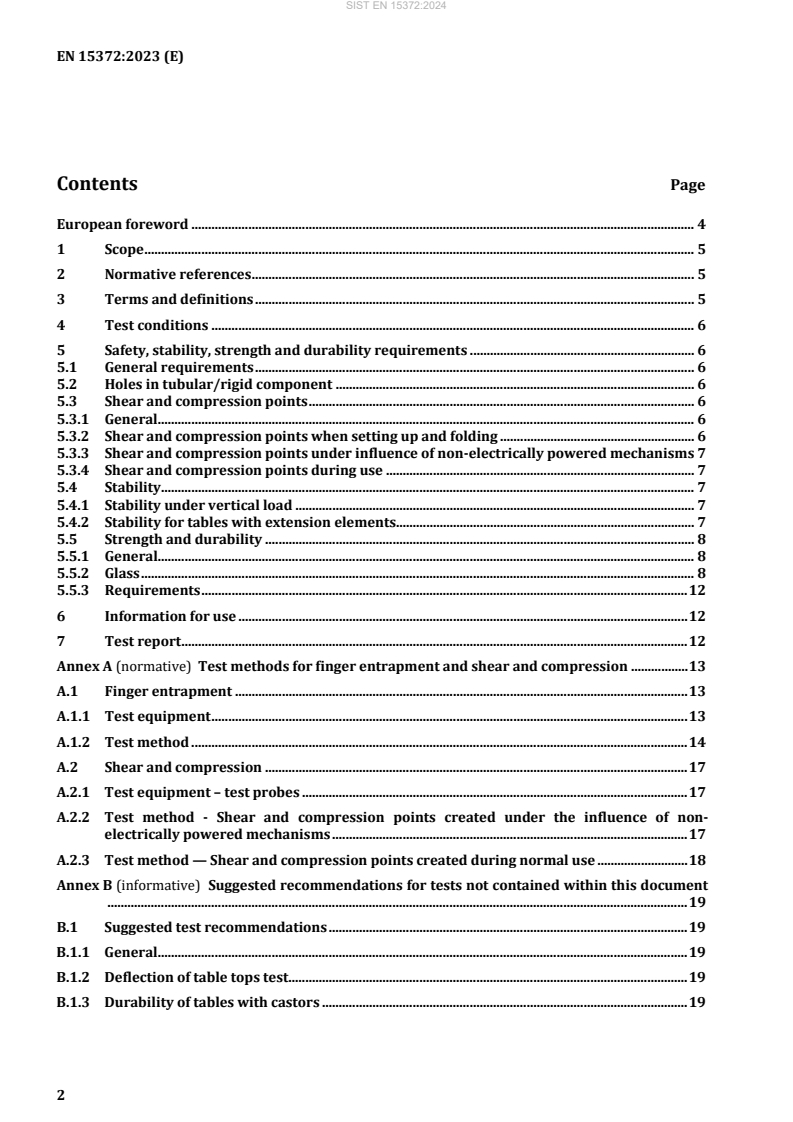
Contents Page
European foreword . 4
1 Scope . 5
2 Normative references . 5
3 Terms and definitions . 5
4 Test conditions . 6
5 Safety, stability, strength and durability requirements . 6
5.1 General requirements . 6
5.2 Holes in tubular/rigid component . 6
5.3 Shear and compression points . 6
5.3.1 General. 6
5.3.2 Shear and compression points when setting up and folding . 6
5.3.3 Shear and compression points under influence of non-electrically powered mechanisms 7
5.3.4 Shear and compression points during use . 7
5.4 Stability . 7
5.4.1 Stability under vertical load . 7
5.4.2 Stability for tables with extension elements. 7
5.5 Strength and durability . 8
5.5.1 General. 8
5.5.2 Glass . 8
5.5.3 Requirements . 12
6 Information for use . 12
7 Test report . 12
Annex A (normative) Test methods for finger entrapment and shear and compression . 13
A.1 Finger entrapment . 13
A.1.1 Test equipment . 13
A.1.2 Test method . 14
A.2 Shear and compression . 17
A.2.1 Test equipment – test probes . 17
A.2.2 Test method - Shear and compression points created under the influence of non-
electrically powered mechanisms . 17
A.2.3 Test method — Shear and compression points created during normal use . 18
Annex B (informative) Suggested recommendations for tests not contained within this document
............................................................................................................................................................................. 19
B.1 Suggested test recommendations . 19
B.1.1 General. 19
B.1.2 Deflection of table tops test . 19
B.1.3 Durability of tables with castors . 19
Annex C (informative) Test severity in relation to application - Test severity . 21
Bibliography . 22
European foreword
This document (EN 15372:2023) has been prepared by Technical Committee CEN/TC 207 “Furniture”,
the secretariat of which is held by UNI.
This European Standard shall be given the status of a national standard, either by publication of an
identical text or by endorsement, at the latest by June 2024, and conflicting national standards shall be
withdrawn at the latest by June 2024.
Attention is drawn to the possibility that some of the elements of this document may be the subject of
patent rights. CEN shall not be held responsible for identifying any or all such patent rights.
This document supersedes EN 15372:2016.
In comparison with the previous edition EN 15372:2016, the following technical modifications have been
made:
— update on the requirements for finger entrapment reflecting CEN/TR 17202:2018 including an
annex containing test methods;
— improved definition of safety glass;
— addition of a requirement for the durability of height adjustment mechanisms;
— addition of recommendations for table top deflection.
Any feedback and questions on this document should be directed to the users’ national standards body.
A complete listing of these bodies can be found on the CEN website.
According to the CEN-CENELEC Internal Regulations, the national standards organisations of the
following countries are bound to implement this European Standard: Austria, Belgium, Bulgaria, Croatia,
Cyprus, Czech Republic, Denmark, Estonia, Finland, France, Germany, Greece, Hungary, Iceland, Ireland,
Italy, Latvia, Lithuania, Luxembourg, Malta, Netherlands, Norway, Poland, Portugal, Republic of North
Macedonia, Romania, Serbia, Slovakia, Slovenia, Spain, Sweden, Switzerland, Türkiye and the United
Kingdom.
1 Scope
This document specifies requirements for the safety, strength and durability of all types of non-domestic
tables including those with glass in their construction.
It does not apply to office work tables or desks, tables for educational institutions, laboratory
workbenches for educational institutions and outdoor tables for which EN standards exist.
It does not apply to laboratory workbenches for professional use and industrial workbenches.
It does not apply to tables where the table top is not fixed to the understructure, i.e. when applying test
6, Table 2, the top becomes detached from the understructure.
With exception of the stability tests, this document does not provide assessment of the suitability of any
storage features included in non-domestic tables.
It does not include requirements for electrical safety.
It does not include requirements for the resistance to ageing, degradation.
This document has three annexes:
— Annex A (normative) Test methods for finger entrapment;
— Annex B (informative) Additional test requirements;
— Annex C (informative) Test severity in relation to application.
2 Normative references
The following documents are referred to in the text in such a way that some or all of their content
constitutes requirements of this document. For dated references, only the edition cited applies. For
undated references, the latest edition of the referenced document (including any amendments) applies.
EN 1730:2012, Furniture — Tables — Test methods for the determination of stability, strength and
durability
EN 12150-1:2015+A1:2019, Glass in building — Thermally toughened soda lime silicate safety glass — Part
1: Definition and description
EN 12600:2002, Glass in building — Pendulum test — Impact test method and classification for flat glass
3 Terms and definitions
For the purposes of this document, the following terms and definitions apply.
ISO and IEC maintain terminology databases for use in standardization at the following addresses:
— ISO Online browsing platform: available at https://www.iso.org/obp/
— IEC Electropedia: available at https://www.electropedia.org/
3.1
accessible part
part to which access can easily be gained by the user when the table is in its intended configuration of use
and for which the probability of unintentional user contact is high, including all parts 500 mm in from the
edges users are likely to sit at and 200 mm from all other edges
3.2
extension element
component that can be pulled out and pushed in
Note 1 to entry: Examples of extension elements include drawers, suspended pocket files and keyboard trays.
4 Test conditions
General test conditions shall be in accordance with EN 1730:2012, Clause 4.
The tests shall be carried out on the same sample, in the order in which they are listed in Table 2.
5 Safety, stability, strength and durability requirements
5.1 General requirements
The table shall be designed so as to minimize the risk of injury to the user.
All parts of the table with which the user comes into contact during intended use and, when the table is
positioned in its intended configuration of use shall be designed so that physical injury and damage are
avoided.
This requirement is met when:
a) edges and corners of table tops which are directly in contact with the user are rounded or chamfered,
b) all other edges and corners accessible during intended use are free from burrs and/or sharp edge.
Movable and adjustable parts shall be designed so that injuries and inadvertent operation are avoided.
It shall not be possible for any load bearing part of the table to come loose unintentionally.
All parts which are lubricated to assist sliding shall be designed to protect users from lubricant stains
when in normal use.
5.2 Holes in tubular/rigid component
There shall be no holes in the ends of tubular components or holes in rigid components in accessible parts
between 8 mm and 18 mm, unless the depth of penetration is less than 10 mm. This requirement is
fulfilled if there is no hazard present when tested in accordance with A.1, Finger entrapment.
5.3 Shear and compression points
5.3.1 General
The requirements contained within 5.3.2, 5.3.3 and 5.3.4 do not apply to electrically operated furniture.
NOTE The requirements for electrically operated furniture will be provided in EN 17684:— .
5.3.2 Shear and compression points when setting up and folding
Unless 5.3.3 or 5.3.4 are applicable, shear and compression points that are created only during setting up
and folding are acceptable, because the user can be assumed to be in control of his/her movements and
to be able to cease applying the force immediately upon experiencing pain.
The edges of parts moving relative to each other and creating shear and compression points shall be as
specified in 5.1.
Under preparation. Stage at time of publication: prEN 17684:2022.
5.3.3 Shear and compression points under influence of non-electrically powered mechanisms
With the exception of operation of doors, flaps and extension elements, there shall be no areas where the
distance between two accessible parts moving relative to each other can be less than 25 mm, and more
than 8 mm in any position during movement that could present a risk of injury to the user, created by
parts of the furniture operated by powered mechanisms, e.g. mechanical springs and gas lifts.
This requirement is fulfilled if there is no hazard present when tested in accordance with A.2.2.
NOTE Further guidance on the accessible parts is given in CEN/TR 17202.
5.3.4 Shear and compression points during use
With the exception of operation of doors, flaps and extension elements, there shall be no areas where the
distance between two accessible parts moving relative to each other can be less than 18 mm, and more
than 8 mm in any position that could present a risk of injury to the user, created by forces applied during
normal use.
The vertical and horizontal forces specified for durability tests within Table 2 are considered
representative of normal use. The vertical force specified in Test 7 of Table 2 shall be applied for all types
of table construction.
This requirement is fulfilled if there is no hazard present when tested in accordance with A.2.3.
5.4 Stability
5.4.1 Stability under vertical load
5.4.1.1 General
When assessing the stability of a table, reference shall be made to EN 1730:2012, 7.1.
Tables that can be set to heights both above and below 950 mm shall be tested to both 5.4.1.2 and 5.4.1.3.
5.4.1.2 Test for tables that are or can be set to a height ≤ 950 mm
The table shall be set to the height most likely to cause overturning, but not more than 950 mm. The table
shall not overturn when tested according to EN 1730:2012, 7.2.2 using the forces specified within
Table 2.
5.4.1.3 Test for tables that are or can be set to a height > 950 mm
The table shall be set to the height most likely
...