

SIST EN 303 446-1 V1.2.1:2019
(Main)ElectroMagnetic Compatibility (EMC) standard for combined and/or integrated radio and non-radio equipment - Part 1: Requirements for equipment intended to be used in residential, commercial and light industry locations
General Information
- Abstract
The present document defines requirements in respect of ElectroMagnetic Compatibility (EMC) for combined and/or
integrated equipment intended to be used within residential, commercial and light industry locations.
The present document is only applicable to combined and/or integrated equipment where the radio function is within the
scope of one or more of the standards listed in clause 2.1.2 (covering references [1] to [7]) and where the non-radio
function is within the scope of one or more of the standards listed in clause 2.1.3 (covering references [8] to [39]).
Requirements applicable to the antenna port specifically related to the efficient use of radio spectrum are not included in
the present document.
NOTE: These requirements are generally found in the applicable product standard(s) for the effective use of the
radio spectrum.
- Status
- Published
- Public Enquiry End Date
- 31-May-2019
- Publication Date
- 09-Oct-2019
- Technical Committee
- MOC - Mobile Communications
- Current Stage
- 6060 - National Implementation/Publication (Adopted Project)
- Start Date
- 07-Oct-2019
- Due Date
- 12-Dec-2019
- Completion Date
- 10-Oct-2019
Buy Documents
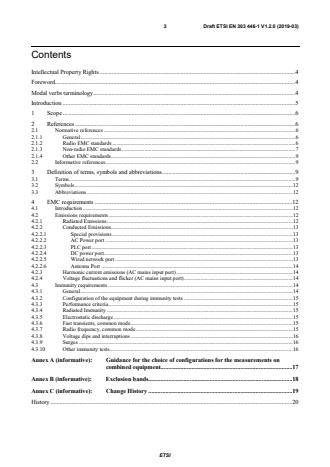
ETSI EN 303 446-1 V1.2.0 (2019-03) - ElectroMagnetic Compatibility (EMC) standard for combined and/or integrated radio and non-radio equipment; Part 1: Requirements for equipment intended to be used in residential, commercial and light industry locations
ETSI EN 303 446-1 V1.2.1 (2019-07) - ElectroMagnetic Compatibility (EMC) standard for combined and/or integrated radio and non-radio equipment; Part 1: Requirements for equipment intended to be used in residential, commercial and light industry locations
ETSI EN 303 446-1 V1.2.1 (2019-10) - ElectroMagnetic Compatibility (EMC) standard for combined and/or integrated radio and non-radio equipment; Part 1: Requirements for equipment intended to be used in residential, commercial and light industry locations

Overview
SIST EN 303 446-1 V1.2.1:2019 defines the requirements for ElectroMagnetic Compatibility (EMC) of combined and/or integrated radio and non-radio equipment for use in residential, commercial, and light industry locations. Developed by SIST in collaboration with ETSI, this standard ensures that equipment combining both radio and non-radio functions operates reliably and does not create electromagnetic interference within its intended environment.
This EMC standard specifically applies to equipment where the radio functionality is covered by established radio EMC standards and the non-radio functionality is within the scope of applicable non-radio EMC standards. While the document provides comprehensive requirements for emission and immunity, requirements regarding efficient radio spectrum use via the antenna port are addressed by relevant product-specific standards.
Key Topics
Scope of Application:
Covers combined and integrated equipment for residential, commercial, and light industry sites, ensuring compatibility regardless of the mixture of radio and non-radio elements.Referenced Standards:
Applies where radio functions align with recognized radio EMC standards (e.g., ETSI EN 301 489 series) and non-radio functions comply with CENELEC and ETSI EMC standards for various equipment categories (e.g., appliances, IT equipment, lighting, telecommunication devices).EMC Emissions Requirements:
- Radiated emissions must be assessed, with consideration for radio function states (standby, receive, or transmit).
- Conducted emissions tested at all relevant ports (AC, DC, PLC, network), following specified limits and methodologies.
- Exclusion bands for radio operation are recognized, avoiding simultaneous assessment where not technically meaningful.
Immunity Requirements:
- Testing ensures that equipment can withstand electromagnetic disturbances typical in homes, offices, and light industry contexts.
- Performance criteria and test setups follow referenced standards, with results recorded for consistency and traceability.
Test Configuration and Reporting:
- Equipment under test (EUT) should be configured to maximize emissions and susceptibility, aligned with typical use-cases.
- Test arrangements and reasons for omissions or specific choices must be documented.
Applications
Manufacturers of Combined Equipment:
Developers producing devices that include both radio (e.g., Wi-Fi, Bluetooth) and non-radio (e.g., control circuitry, sensors) modules, such as smart home appliances, must ensure compliance to facilitate CE marking and market access.Testing & Certification Laboratories:
Laboratories use this standard as the definitive basis for EMC assessment procedures when testing integrated equipment, ensuring objective and uniform evaluation aligned with European Union EMC and radio equipment directives.Product Integrators:
Businesses assembling or customizing devices with mixed radio/non-radio components must confirm that their configurations meet the integrated EMC requirements.Residential, Commercial & Light Industry Deployments:
The standard supports the reliable operation of devices in environments like offices, shops, educational institutions, entertainment venues, and light industrial spaces, minimizing risk of electromagnetic disturbances affecting technology infrastructure.
Related Standards
Radio EMC Standards:
- ETSI EN 301 489-1 (Common requirements)
- ETSI EN 301 489-3, -5, -6, -17, -19, -33 (Specific technologies and environments)
Non-Radio EMC Standards:
- CENELEC EN 50065, EN 55011, EN 55014, EN 55032/55035, EN 61547, EN 61000-6 series (Generic and product-specific EMC requirements)
- ETSI EN 300 386 (Telecommunications network equipment)
Harmonised Directives and Guides:
- Directive 2014/53/EU (RED)
- Directive 2014/30/EU (EMC Directive)
- ETSI EG 203 367 (Application of harmonised standards for combined radio and non-radio equipment)
SIST EN 303 446-1 is a key resource for ensuring electromagnetic compatibility in today's interconnected environments. Adoption of this standard helps manufacturers, integrators, and testing organizations assure equipment quality, compliance, and reliability in residential, commercial, and light-industrial applications.
Buy Documents
ETSI EN 303 446-1 V1.2.0 (2019-03) - ElectroMagnetic Compatibility (EMC) standard for combined and/or integrated radio and non-radio equipment; Part 1: Requirements for equipment intended to be used in residential, commercial and light industry locations
ETSI EN 303 446-1 V1.2.1 (2019-07) - ElectroMagnetic Compatibility (EMC) standard for combined and/or integrated radio and non-radio equipment; Part 1: Requirements for equipment intended to be used in residential, commercial and light industry locations
ETSI EN 303 446-1 V1.2.1 (2019-10) - ElectroMagnetic Compatibility (EMC) standard for combined and/or integrated radio and non-radio equipment; Part 1: Requirements for equipment intended to be used in residential, commercial and light industry locations
Get Certified
Connect with accredited certification bodies for this standard

ANCE
Mexican certification and testing association.

Intertek Slovenia
Intertek testing, inspection, and certification services in Slovenia.

LNE (Laboratoire National de Métrologie et d'Essais)
French national laboratory for metrology and testing.
Sponsored listings
Frequently Asked Questions
SIST EN 303 446-1 V1.2.1:2019 is a standard published by the Slovenian Institute for Standardization (SIST). Its full title is "ElectroMagnetic Compatibility (EMC) standard for combined and/or integrated radio and non-radio equipment - Part 1: Requirements for equipment intended to be used in residential, commercial and light industry locations". This standard covers: The present document defines requirements in respect of ElectroMagnetic Compatibility (EMC) for combined and/or integrated equipment intended to be used within residential, commercial and light industry locations. The present document is only applicable to combined and/or integrated equipment where the radio function is within the scope of one or more of the standards listed in clause 2.1.2 (covering references [1] to [7]) and where the non-radio function is within the scope of one or more of the standards listed in clause 2.1.3 (covering references [8] to [39]). Requirements applicable to the antenna port specifically related to the efficient use of radio spectrum are not included in the present document. NOTE: These requirements are generally found in the applicable product standard(s) for the effective use of the radio spectrum.
The present document defines requirements in respect of ElectroMagnetic Compatibility (EMC) for combined and/or integrated equipment intended to be used within residential, commercial and light industry locations. The present document is only applicable to combined and/or integrated equipment where the radio function is within the scope of one or more of the standards listed in clause 2.1.2 (covering references [1] to [7]) and where the non-radio function is within the scope of one or more of the standards listed in clause 2.1.3 (covering references [8] to [39]). Requirements applicable to the antenna port specifically related to the efficient use of radio spectrum are not included in the present document. NOTE: These requirements are generally found in the applicable product standard(s) for the effective use of the radio spectrum.
SIST EN 303 446-1 V1.2.1:2019 is classified under the following ICS (International Classification for Standards) categories: 33.060.01 - Radiocommunications in general; 33.100.01 - Electromagnetic compatibility in general. The ICS classification helps identify the subject area and facilitates finding related standards.
SIST EN 303 446-1 V1.2.1:2019 is available in PDF format for immediate download after purchase. The document can be added to your cart and obtained through the secure checkout process. Digital delivery ensures instant access to the complete standard document.
Standards Content (Sample)
Draft ETSI EN 303 446-1 V1.2.0 (2019-03)
EUROPEAN STANDARD
ElectroMagnetic Compatibility (EMC)
standard for combined and/or integrated
radio and non-radio equipment;
Part 1: Requirements for equipment intended to be used
in residential, commercial and light industry locations
2 Draft ETSI EN 303 446-1 V1.2.0 (2019-03)
Reference
REN/ERM-EMC-398
Keywords
EMC, emission, immunity
ETSI
650 Route des Lucioles
F-06921 Sophia Antipolis Cedex - FRANCE
Tel.: +33 4 92 94 42 00 Fax: +33 4 93 65 47 16
Siret N° 348 623 562 00017 - NAF 742 C
Association à but non lucratif enregistrée à la
Sous-Préfecture de Grasse (06) N° 7803/88
Important notice
The present document can be downloaded from:
http://www.etsi.org/standards-search
The present document may be made available in electronic versions and/or in print. The content of any electronic and/or
print versions of the present document shall not be modified without the prior written authorization of ETSI. In case of any
existing or perceived difference in contents between such versions and/or in print, the prevailing version of an ETSI
deliverable is the one made publicly available in PDF format at www.etsi.org/deliver.
Users of the present document should be aware that the document may be subject to revision or change of status.
Information on the current status of this and other ETSI documents is available at
https://portal.etsi.org/TB/ETSIDeliverableStatus.aspx
If you find errors in the present document, please send your comment to one of the following services:
https://portal.etsi.org/People/CommiteeSupportStaff.aspx
Copyright Notification
No part may be reproduced or utilized in any form or by any means, electronic or mechanical, including photocopying
and microfilm except as authorized by written permission of ETSI.
The content of the PDF version shall not be modified without the written authorization of ETSI.
The copyright and the foregoing restriction extend to reproduction in all media.
© ETSI 2019.
All rights reserved.
TM TM TM
DECT , PLUGTESTS , UMTS and the ETSI logo are trademarks of ETSI registered for the benefit of its Members.
TM TM
3GPP and LTE are trademarks of ETSI registered for the benefit of its Members and
of the 3GPP Organizational Partners.
oneM2M™ logo is a trademark of ETSI registered for the benefit of its Members and
of the oneM2M Partners. ®
GSM and the GSM logo are trademarks registered and owned by the GSM Association.
ETSI
3 Draft ETSI EN 303 446-1 V1.2.0 (2019-03)
Contents
Intellectual Property Rights . 4
Foreword . 4
Modal verbs terminology . 4
Introduction . 5
1 Scope . 6
2 References . 6
2.1 Normative references . 6
2.1.1 General . 6
2.1.2 Radio EMC standards . 6
2.1.3 Non-radio EMC standards . 7
2.1.4 Other EMC standards. 9
2.2 Informative references . 9
3 Definition of terms, symbols and abbreviations . 9
3.1 Terms . 9
3.2 Symbols . 12
3.3 Abbreviations . 12
4 EMC requirements . 12
4.1 Introduction . 12
4.2 Emissions requirements . 12
4.2.1 Radiated Emissions . 12
4.2.2 Conducted Emissions . 13
4.2.2.1 Special provisions . 13
4.2.2.2 AC Power port . 13
4.2.2.3 PLC port . 13
4.2.2.4 DC power port . 13
4.2.2.5 Wired network port . 13
4.2.2.6 Antenna Port . 14
4.2.3 Harmonic current emissions (AC mains input port) . 14
4.2.4 Voltage fluctuations and flicker (AC mains input port) . 14
4.3 Immunity requirements . 14
4.3.1 General . 14
4.3.2 Configuration of the equipment during immunity tests . 15
4.3.3 Performance criteria . 15
4.3.4 Radiated Immunity . 15
4.3.5 Electrostatic discharge . 15
4.3.6 Fast transients, common mode . 15
4.3.7 Radio frequency, common mode . 15
4.3.8 Voltage dips and interruptions . 16
4.3.9 Surges . 16
4.3.10 Other immunity tests . 16
Annex A (informative): Guidance for the choice of configurations for the measurements on
combined equipment. 17
Annex B (informative): Exclusion bands. 18
Annex C (informative): Change History . 19
History . 20
ETSI
4 Draft ETSI EN 303 446-1 V1.2.0 (2019-03)
Intellectual Property Rights
Essential patents
IPRs essential or potentially essential to normative deliverables may have been declared to ETSI. The information
pertaining to these essential IPRs, if any, is publicly available for ETSI members and non-members, and can be found
in ETSI SR 000 314: "Intellectual Property Rights (IPRs); Essential, or potentially Essential, IPRs notified to ETSI in
respect of ETSI standards", which is available from the ETSI Secretariat. Latest updates are available on the ETSI Web
server (https://ipr.etsi.org/).
Pursuant to the ETSI IPR Policy, no investigation, including IPR searches, has been carried out by ETSI. No guarantee
can be given as to the existence of other IPRs not referenced in ETSI SR 000 314 (or the updates on the ETSI Web
server) which are, or may be, or may become, essential to the present document.
Trademarks
The present document may include trademarks and/or tradenames which are asserted and/or registered by their owners.
ETSI claims no ownership of these except for any which are indicated as being the property of ETSI, and conveys no
right to use or reproduce any trademark and/or tradename. Mention of those trademarks in the present document does
not constitute an endorsement by ETSI of products, services or organizations associated with those trademarks.
Foreword
This draft European Standard (EN) has been produced by ETSI Technical Committee Electromagnetic compatibility
and Radio spectrum Matters (ERM), and is now submitted for the combined Public Enquiry and Vote phase of the ETSI
standards EN Approval Procedure.
The present document is part 1 of a multi-part deliverable covering ElectroMagnetic Compatibility (EMC) for
combined and/or integrated equipment, as identified below:
Part 1: "Requirements for equipment intended to be used in residential, commercial and light industry
locations";
Part 2: "Requirements for equipment intended to be used in industrial locations".
Proposed national transposition dates
Date of latest announcement of this EN (doa): 3 months after ETSI publication
Date of latest publication of new National Standard
or endorsement of this EN (dop/e): 6 months after doa
Date of withdrawal of any conflicting National Standard (dow): 6 months after doa
Modal verbs terminology
In the present document "shall", "shall not", "should", "should not", "may", "need not", "will", "will not", "can" and
"cannot" are to be interpreted as described in clause 3.2 of the ETSI Drafting Rules (Verbal forms for the expression of
provisions).
"must" and "must not" are NOT allowed in ETSI deliverables except when used in direct citation.
ETSI
5 Draft ETSI EN 303 446-1 V1.2.0 (2019-03)
Introduction
The present document is not intended for citation under any new approach Directive.
The present document is based on the principles given in ETSI EG 203 367 [i.3] "Guide to the application of
harmonised standards covering articles 3.1(b) and 3.2 of the Directive 2014/53/EU (RED) to multi-radio and combined
radio and non-radio equipment".
The present document contains the measurements, emission limits and performance criteria that are necessary for the
Δ" in ETSI EG 203 367 [i.3]).
assessment of a combination of a non-radio and a radio product (which is called "
ETSI
6 Draft ETSI EN 303 446-1 V1.2.0 (2019-03)
1 Scope
The present document defines requirements in respect of ElectroMagnetic Compatibility (EMC) for combined and/or
integrated equipment intended to be used within residential, commercial and light industry locations.
The present document is only applicable to combined and/or integrated equipment where the radio function is within the
scope of one or more of the standards listed in clause 2.1.2 (covering references [1] to [7]) and where the non-radio
function is within the scope of one or more of the standards listed in clause 2.1.3 (covering references [8] to [39]).
Requirements applicable to the antenna port specifically related to the efficient use of radio spectrum are not included in
the present document.
NOTE: These requirements are generally found in the applicable product standard(s) for the effective use of the
radio spectrum.
2 References
2.1 Normative references
2.1.1 General
References are either specific (identified by date of publication and/or edition number or version number) or
non-specific. For specific references, only the cited version applies. For non-specific references, the latest version of the
referenced document (including any amendments) applies.
Referenced documents which are not found to be publicly available in the expected location might be found at
https://docbox.etsi.org/Reference/.
NOTE 1: While any hyperlinks included in this clause were valid at the time of publication, ETSI cannot guarantee
their long term validity.
The following referenced documents are necessary for the application of the present document.
In addition, within the present document, some references are non-specific. The applicable version listed in the OJEU
under the Directives 2014/53/EU [i.1] or 2014/30/EU [i.2] may be used.
NOTE 2: Before the date of withdrawal, a preceding version may be used (see clause 2.4 of the Technical Working
Procedures in the ETSI Directives).
2.1.2 Radio EMC standards
[1] ETSI EN 301 489-1: "ElectroMagnetic Compatibility (EMC) standard for radio equipment and
services; Part 1: Common technical requirements; Harmonised Standard covering the essential
requirements of article 3.1(b) of Directive 2014/53/EU and the essential requirements of article 6
of Directive 2014/30/EU".
[2] ETSI EN 301 489-3: "Electromagnetic compatibility and Radio spectrum Matters (ERM);
ElectroMagnetic Compatibility (EMC) standard for radio equipment and services; Part 3: Specific
conditions for Short-Range Devices (SRD) operating on frequencies between 9 kHz and 40 GHz".
[3] ETSI EN 301 489-5: "ElectroMagnetic Compatibility (EMC) standard for radio equipment and
services; Part 5: Specific conditions for Private land Mobile Radio (PMR) and ancillary equipment
(speech and non-speech) and Terrestrial Trunked Radio (TETRA) Harmonised Standard covering
the essential requirements of article 3.1(b) of the Directive 2014/53/EU".
[4] ETSI EN 301 489-6: "ElectroMagnetic Compatibility (EMC) standard for radio equipment and
services; Part 6: Specific conditions for Digital Enhanced Cordless Telecommunications (DECT)
equipment; Harmonised Standard covering the essential requirements of article 3.1(b) of the
Directive 2014/53/EU".
ETSI
7 Draft ETSI EN 303 446-1 V1.2.0 (2019-03)
[5] ETSI EN 301 489-17: "ElectroMagnetic Compatibility (EMC) standard for radio equipment and
services; Part 17: Specific conditions for Broadband Data Transmission Systems; Harmonised
Standard covering the essential requirements of article 3.1(b) of Directive 2014/53/EU".
[6] ETSI EN 301 489-19: "Electromagnetic compatibility and Radio spectrum Matters (ERM);
ElectroMagnetic Compatibility (EMC) standard for radio equipment and services; Part 19:
Specific conditions for Receive Only Mobile Earth Stations (ROMES) operating in the 1,5 GHz
band providing data communications".
[7] ETSI EN 301 489-33: "ElectroMagnetic Compatibility (EMC) standard for radio equipment and
services; Part 33: Specific conditions for Ultra-WideBand (UWB) devices; Harmonised Standard
covering the essential requirements of article 3.1(b) of Directive 2014/53/EU".
2.1.3 Non-radio EMC standards
[8] CENELEC EN 50065-1: "Signalling on low-voltage electrical installations in the frequency range
3 kHz to 148,5 kHz - Part 1: General requirements, frequency bands and electromagnetic
disturbances".
[9] CENELEC EN 50065-2-1: "Signalling on low-voltage electrical installations in the frequency
range 3 kHz to 148,5 kHz - Part 2-1: Immunity requirements for mains communications
equipment and systems operating in the range of frequencies 95 kHz to 148,5 kHz and intended for
use in residential, commercial and light industrial environments".
[10] CENELEC EN 50065-2-3: "Signalling on low-voltage electrical installations in the frequency
range 3 kHz to 148,5 kHz - Part 2-3: Immunity requirements for mains communications
equipment and systems operating in the range of frequencies 3 kHz to 95 kHz and intended for use
by electricity suppliers and distributors".
[11] CENELEC EN 50130-4: "Alarm systems - Part 4: Electromagnetic compatibility - Product family
standard: Immunity requirements for components of fire, intruder, hold up, CCTV, access control
and social alarm systems".
[12] CENELEC EN 50412-2-1: "Power line communication apparatus and systems used in low-voltage
installations in the frequency range 1,6 MHz to 30 MHz - Part 2-1: Residential, commercial and
industrial environment - Immunity requirements".
[13] CENELEC EN 50491-5-1: "General requirements for Home and Building Electronic Systems
(HBES) and Building Automation and Control Systems (BACS) - Part 5-1: EMC requirements,
conditions and test set-up".
[14] CENELEC EN 50491-5-2: "General requirements for Home and Building Electronic Systems
(HBES) and Building Automation and Control Systems (BACS) - Part 5-2: EMC requirements for
HBES/BACS used in residential, commercial and light industry environment".
[15] CENELEC EN 50561-1: "Power line communication apparatus used in low-voltage installations -
Radio disturbance characteristics - Limits and methods of measurement - Part 1: Apparatus for in-
home use".
[16] CENELEC EN 50561-3: "Power line communication apparatus used in low-voltage installations -
Radio disturbance characteristics - Limits and methods of measurement - Part 3: Apparatus
operating above 30 MHz".
[17] CENELEC EN 55011: "Industrial, scientific and medical equipment. Radio-frequency disturbance
characteristics. Limits and methods of measurement".
[18] CENELEC EN 55014-1: "Electromagnetic compatibility - Requirements for household appliances,
electric tools and similar apparatus - Part 1: Emission".
[19] CENELEC EN 55014-2: "Electromagnetic compatibility - Requirements for household appliances,
electric tools and similar apparatus - Part 2: Immunity - Product family standard".
[20] CENELEC EN 55015: "Limits and methods of measurement of radio disturbance characteristics of
electrical lighting and similar equipment".
ETSI
8 Draft ETSI EN 303 446-1 V1.2.0 (2019-03)
[21] CENELEC EN 55020: "Sound and television broadcast receivers and associated equipment -
Immunity characteristics - Limits and methods of measurement".
[22] CENELEC EN 55024: "Information technology equipment - Immunity characteristics - Limits and
methods of measurement".
[23] CENELEC EN 55032: "Electromagnetic compatibility of multimedia equipment - Emission
Requirements".
NOTE: CENELEC EN 55032 also covers broadcast receivers.
[24] CENELEC EN 55035: "Electromagnetic compatibility of multimedia equipment - Immunity
requirements".
[25] CENELEC EN 55103-2: "Electromagnetic compatibility - Product family standard for audio,
video, audio-visual and entertainment lighting control apparatus for professional use -
Part 2: Immunity".
[26] CENELEC EN 50270: "Electromagnetic compatibility. Electrical apparatus for the detection and
measurement of combustible gases, toxic gases or oxygen".
[27] CENELEC EN 60730-1: "Automatic electrical controls - Part 1: General requirements".
[28] CENELEC EN 60974-10: "Arc welding equipment - Part 10: Electromagnetic compatibility
(EMC) requirements".
[29] CENELEC EN 61000-6-1: "Electromagnetic compatibility (EMC) - Part 6-1: Generic standards -
Immunity for residential, commercial and light-industrial environments".
[30] CENELEC EN 61000-6-3: "Electromagnetic compatibility (EMC) - Part 6-3: Generic standards -
Emission standard for residential, commercial and light-industrial environments".
[31] CENELEC EN 61326-1: "Electrical equipment for measurement, control and laboratory use -
EMC requirements - Part 1: General requirements".
[32] CENELEC EN 61326-2-2: "Electrical equipment for measurement, control and laboratory use -
EMC requirements - Part 2-2: Particular requirements - Test configurations, operational conditions
and performance criteria for portable test, measuring and monitoring equipment used in low-
voltage distribution systems".
[33] CENELEC EN 61326-2-3: "Electrical equipment for measurement, control and laboratory use -
EMC requirements - Part 2-3: Particular requirements - Test configuration, operational conditions
and performance criteria for transducers with integrated or remote signal conditioning".
[34] CENELEC EN 61326-2-4 (2013): "Electrical equipment for measurement, control and laboratory
use - EMC requirements - Part 2-4: Particular requirements - Test configurations, operational
conditions and performance criteria for insulation monitoring devices according to IEC 61557-8
and for equipment for insulation fault location according to IEC 61557-9".
[35] CENELEC EN 61326-2-5: "Electrical equipment for measurement, control and laboratory use -
EMC requirements - Part 2-5: Particular requirements - Test configurations, operational conditions
and performance criteria for devices with field bus interfaces according to IEC 61784-1".
[36] CENELEC EN 61547: "Equipment for general lighting purposes - EMC immunity requirements".
[37] CENELEC EN 61800-3: "Adjustable speed electrical power drive systems - Part 3: EMC
requirements and specific test methods".
[38] CENELEC EN 62135-2: "Resistance welding equipment - Part 2: Electromagnetic compatibility
(EMC) requirements".
[39] ETSI EN 300 386: "Telecommunication network equipment; ElectroMagnetic Compatibility
(EMC) requirements; Harmonised Standard covering the essential requirements of the Directive
2014/30/EU".
ETSI
9 Draft ETSI EN 303 446-1 V1.2.0 (2019-03)
2.1.4 Other EMC standards
[40] CENELEC EN 61000-3-2 (2014): "Electromagnetic compatibility (EMC) - Part 3-2: Limits -
Limits for harmonic current emissions (equipment input current ≤ 16 A per phase)".
[41] CENELEC EN 61000-3-3 (2013): "Electromagnetic compatibility (EMC) - Part 3-3: Limits -
Limitation of voltage changes, voltage fluctuations and flicker in public low-voltage supply
systems, for equipment with rated current <= 16 A per phase and not subject to conditional
connection".
[42] CENELEC EN 61000-3-11 (2000): "Electromagnetic compatibility (EMC) - Part 3-11: Limits -
Limitation of voltage changes, voltage fluctuations and flicker in public low-voltage supply
systems - Equipment with rated current <= 75 A and subject to conditional connection".
[43] CENELEC EN 61000-3-12 (2011): "Electromagnetic compatibility (EMC) - Part 3-12: Limits -
Limits for harmonic currents produced by equipment connected to public low-voltage systems
with input current > 16 A and <= 75 A per phase".
[44] CENELEC EN 61000-6-3 (2007) and A1 (2011): "Electromagnetic compatibility (EMC) -
Part 6-3: Generic standards - Emission standard for residential, commercial and light-industrial
environments".
[45] CENELEC EN 55032 (2015) and AC (2016): "Electromagnetic compatibility of multimedia
equipment - Emission requirements".
NOTE: The standards referenced in clause 2.1.4 do not define the scope of the present document. They are only
referenced in the sense of a basic standard for a specific measurement.
2.2 Informative references
References are either specific (identified by date of publication and/or edition number or version number) or
non-specific. For specific references, only the cited version applies. For non-specific references, the latest version of the
referenced document (including any amendments) applies.
NOTE: While any hyperlinks included in this clause were valid at the time of publication, ETSI cannot guarantee
their long term validity.
The following referenced documents are not necessary for the application of the present document but they assist the
user with regard to a particular subject area.
[i.1] Directive 2014/53/EU of the European Parliament and of the council of 16 April 2014 on the
harmonisation of the
...
Final draft ETSI EN 303 446-1 V1.2.1 (2019-07)
EUROPEAN STANDARD
ElectroMagnetic Compatibility (EMC)
standard for combined and/or integrated
radio and non-radio equipment;
Part 1: Requirements for equipment intended to be used
in residential, commercial and light industry locations
2 Final draft ETSI EN 303 446-1 V1.2.1 (2019-07)
Reference
REN/ERM-EMC-398
Keywords
EMC, emission, immunity
ETSI
650 Route des Lucioles
F-06921 Sophia Antipolis Cedex - FRANCE
Tel.: +33 4 92 94 42 00 Fax: +33 4 93 65 47 16
Siret N° 348 623 562 00017 - NAF 742 C
Association à but non lucratif enregistrée à la
Sous-Préfecture de Grasse (06) N° 7803/88
Important notice
The present document can be downloaded from:
http://www.etsi.org/standards-search
The present document may be made available in electronic versions and/or in print. The content of any electronic and/or
print versions of the present document shall not be modified without the prior written authorization of ETSI. In case of any
existing or perceived difference in contents between such versions and/or in print, the prevailing version of an ETSI
deliverable is the one made publicly available in PDF format at www.etsi.org/deliver.
Users of the present document should be aware that the document may be subject to revision or change of status.
Information on the current status of this and other ETSI documents is available at
https://portal.etsi.org/TB/ETSIDeliverableStatus.aspx
If you find errors in the present document, please send your comment to one of the following services:
https://portal.etsi.org/People/CommiteeSupportStaff.aspx
Copyright Notification
No part may be reproduced or utilized in any form or by any means, electronic or mechanical, including photocopying
and microfilm except as authorized by written permission of ETSI.
The content of the PDF version shall not be modified without the written authorization of ETSI.
The copyright and the foregoing restriction extend to reproduction in all media.
© ETSI 2019.
All rights reserved.
DECT™, PLUGTESTS™, UMTS™ and the ETSI logo are trademarks of ETSI registered for the benefit of its Members.
3GPP™ and LTE™ are trademarks of ETSI registered for the benefit of its Members and
of the 3GPP Organizational Partners.
oneM2M™ logo is a trademark of ETSI registered for the benefit of its Members and
of the oneM2M Partners. ®
GSM and the GSM logo are trademarks registered and owned by the GSM Association.
ETSI
3 Final draft ETSI EN 303 446-1 V1.2.1 (2019-07)
Contents
Intellectual Property Rights . 4
Foreword . 4
Modal verbs terminology . 4
Introduction . 5
1 Scope . 6
2 References . 6
2.1 Normative references . 6
2.1.1 General . 6
2.1.2 Radio EMC standards . 6
2.1.3 Non-radio EMC standards . 7
2.1.4 Other EMC standards. 9
2.2 Informative references . 9
3 Definition of terms, symbols and abbreviations . 10
3.1 Terms . 10
3.2 Symbols . 12
3.3 Abbreviations . 12
4 EMC requirements . 12
4.1 Introduction . 12
4.2 Emissions requirements . 13
4.2.1 Radiated Emissions . 13
4.2.2 Conducted Emissions . 13
4.2.2.1 Special provisions . 13
4.2.2.2 AC Power port . 13
4.2.2.3 PLC port . 13
4.2.2.4 DC power port . 13
4.2.2.5 Wired network port . 14
4.2.2.6 Antenna Port . 14
4.2.3 Harmonic current emissions (AC mains input port) . 14
4.2.4 Voltage fluctuations and flicker (AC mains input port) . 14
4.3 Immunity requirements . 14
4.3.1 General . 14
4.3.2 Configuration of the equipment during immunity tests . 15
4.3.3 Performance criteria . 15
4.3.4 Radiated Immunity . 15
4.3.5 Electrostatic discharge . 15
4.3.6 Fast transients, common mode . 15
4.3.7 Radio frequency, common mode . 15
4.3.8 Voltage dips and interruptions . 16
4.3.9 Surges . 16
4.3.10 Other immunity tests . 16
Annex A (informative): Change History . 17
History . 18
ETSI
4 Final draft ETSI EN 303 446-1 V1.2.1 (2019-07)
Intellectual Property Rights
Essential patents
IPRs essential or potentially essential to normative deliverables may have been declared to ETSI. The information
pertaining to these essential IPRs, if any, is publicly available for ETSI members and non-members, and can be found
in ETSI SR 000 314: "Intellectual Property Rights (IPRs); Essential, or potentially Essential, IPRs notified to ETSI in
respect of ETSI standards", which is available from the ETSI Secretariat. Latest updates are available on the ETSI Web
server (https://ipr.etsi.org/).
Pursuant to the ETSI IPR Policy, no investigation, including IPR searches, has been carried out by ETSI. No guarantee
can be given as to the existence of other IPRs not referenced in ETSI SR 000 314 (or the updates on the ETSI Web
server) which are, or may be, or may become, essential to the present document.
Trademarks
The present document may include trademarks and/or tradenames which are asserted and/or registered by their owners.
ETSI claims no ownership of these except for any which are indicated as being the property of ETSI, and conveys no
right to use or reproduce any trademark and/or tradename. Mention of those trademarks in the present document does
not constitute an endorsement by ETSI of products, services or organizations associated with those trademarks.
Foreword
This final draft European Standard (EN) has been produced by ETSI Technical Committee Electromagnetic
compatibility and Radio spectrum Matters (ERM), and is now submitted for the Vote phase of the ETSI standards EN
Approval Procedure.
The present document is part 1 of a multi-part deliverable covering ElectroMagnetic Compatibility (EMC) for
combined and/or integrated equipment, as identified below:
Part 1: "Requirements for equipment intended to be used in residential, commercial and light industry
locations";
Part 2: "Requirements for equipment intended to be used in industrial locations".
Proposed national transposition dates
Date of latest announcement of this EN (doa): 3 months after ETSI publication
Date of latest publication of new National Standard
or endorsement of this EN (dop/e): 6 months after doa
Date of withdrawal of any conflicting National Standard (dow): 6 months after doa
Modal verbs terminology
In the present document "shall", "shall not", "should", "should not", "may", "need not", "will", "will not", "can" and
"cannot" are to be interpreted as described in clause 3.2 of the ETSI Drafting Rules (Verbal forms for the expression of
provisions).
"must" and "must not" are NOT allowed in ETSI deliverables except when used in direct citation.
ETSI
5 Final draft ETSI EN 303 446-1 V1.2.1 (2019-07)
Introduction
The present document is not intended for citation under any new approach Directive.
The present document is based on the principles given in ETSI EG 203 367 [i.3] "Guide to the application of
harmonised standards covering articles 3.1(b) and 3.2 of the Directive 2014/53/EU (RED) to multi-radio and combined
radio and non-radio equipment".
The present document contains the measurements, emission limits, immunity test levels and performance criteria that
are necessary for the assessment of a combination of a non-radio and a radio product in accordance with ETSI
EG 203 367 [i.3].
ETSI
6 Final draft ETSI EN 303 446-1 V1.2.1 (2019-07)
1 Scope
The present document defines requirements in respect of ElectroMagnetic Compatibility (EMC) for combined and/or
integrated equipment intended to be used within residential, commercial and light industry locations.
The present document is only applicable to combined and/or integrated equipment where the radio function is within the
scope of one or more of the standards listed in clause 2.1.2 (covering references [1] to [7]) and where the non-radio
function is within the scope of one or more of the standards listed in clause 2.1.3 (covering references [8] to [39]).
Requirements applicable to the antenna port specifically related to the efficient use of radio spectrum are not included in
the present document.
NOTE: These requirements are generally found in the applicable product standard(s) for the effective use of the
radio spectrum.
2 References
2.1 Normative references
2.1.1 General
References are either specific (identified by date of publication and/or edition number or version number) or
non-specific. For specific references, only the cited version applies. For non-specific references, the latest version of the
referenced document (including any amendments) applies.
Referenced documents which are not found to be publicly available in the expected location might be found at
https://docbox.etsi.org/Reference/.
NOTE 1: While any hyperlinks included in this clause were valid at the time of publication, ETSI cannot guarantee
their long term validity.
The following referenced documents are necessary for the application of the present document.
In addition, within the present document, some references are non-specific. The applicable version listed in the OJEU
under the Directives 2014/53/EU [i.1] or 2014/30/EU [i.2] may be used.
NOTE 2: Before the date of withdrawal, a preceding version may be used (see clause 2.4 of the Technical Working
Procedures in the ETSI Directives).
2.1.2 Radio EMC standards
[1] ETSI EN 301 489-1: "ElectroMagnetic Compatibility (EMC) standard for radio equipment and
services; Part 1: Common technical requirements; Harmonised Standard for Electromagnetic
Compatibility".
[2] ETSI EN 301 489-3: "ElectroMagnetic Compatibility (EMC) standard for radio equipment and
services; Part 3: Specific conditions for Short-Range Devices (SRD) operating on frequencies
between 9 kHz and 246 GHz; Harmonised Standard covering the essential requirements of article
3.1(b) of Directive 2014/53/EU".
[3] ETSI EN 301 489-5: "ElectroMagnetic Compatibility (EMC) standard for radio equipment and
services; Part 5: Specific conditions for Private land Mobile Radio (PMR) and ancillary equipment
(speech and non-speech) and Terrestrial Trunked Radio (TETRA); Harmonised Standard covering
the essential requirements of article 3.1(b) of Directive 2014/53/EU".
[4] ETSI EN 301 489-6: "ElectroMagnetic Compatibility (EMC) standard for radio equipment and
services; Part 6: Specific conditions for Digital Enhanced Cordless Telecommunications (DECT)
equipment; Harmonised Standard covering the essential requirements of article 3.1(b) of Directive
2014/53/EU".
ETSI
7 Final draft ETSI EN 303 446-1 V1.2.1 (2019-07)
[5] ETSI EN 301 489-17: "ElectroMagnetic Compatibility (EMC) standard for radio equipment and
services; Part 17: Specific conditions for Broadband Data Transmission Systems; Harmonised
Standard covering the essential requirements of article 3.1(b) of Directive 2014/53/EU".
[6] ETSI EN 301 489-19: "ElectroMagnetic Compatibility (EMC) standard for radio equipment and
services; Part 19: Specific conditions for Receive Only Mobile Earth Stations (ROMES) operating
in the 1,5 GHz band providing data communications and GNSS receivers operating in the RNSS
band (ROGNSS) providing positioning, navigation, and timing data; Harmonised Standard
covering the essential requirements of article 3.1(b) of Directive 2014/53/EU".
[7] ETSI EN 301 489-33: "ElectroMagnetic Compatibility (EMC) standard for radio equipment and
services; Part 33: Specific conditions for Ultra-WideBand (UWB) devices; Harmonised Standard
covering the essential requirements of article 3.1(b) of Directive 2014/53/EU".
2.1.3 Non-radio EMC standards
[8] CENELEC EN 50065-1: "Signalling on low-voltage electrical installations in the frequency range
3 kHz to 148,5 kHz - Part 1: General requirements, frequency bands and electromagnetic
disturbances".
[9] CENELEC EN 50065-2-1: "Signalling on low-voltage electrical installations in the frequency
range 3 kHz to 148,5 kHz - Part 2-1: Immunity requirements for mains communications
equipment and systems operating in the range of frequencies 95 kHz to 148,5 kHz and intended for
use in residential, commercial and light industrial environments".
[10] CENELEC EN 50065-2-3: "Signalling on low-voltage electrical installations in the frequency
range 3 kHz to 148,5 kHz - Part 2-3: Immunity requirements for mains communications
equipment and systems operating in the range of frequencies 3 kHz to 95 kHz and intended for use
by electricity suppliers and distributors".
[11] CENELEC EN 50130-4: "Alarm systems - Part 4: Electromagnetic compatibility - Product family
standard: Immunity requirements for components of fire, intruder, hold up, CCTV, access control
and social alarm systems".
[12] CENELEC EN 50412-2-1: "Power line communication apparatus and systems used in low-voltage
installations in the frequency range 1,6 MHz to 30 MHz - Part 2-1: Residential, commercial and
industrial environment - Immunity requirements".
[13] CENELEC EN 50491-5-1: "General requirements for Home and Building Electronic Systems
(HBES) and Building Automation and Control Systems (BACS) - Part 5-1: EMC requirements,
conditions and test set-up".
[14] CENELEC EN 50491-5-2: "General requirements for Home and Building Electronic Systems
(HBES) and Building Automation and Control Systems (BACS) - Part 5-2: EMC requirements for
HBES/BACS used in residential, commercial and light industry environment".
[15] CENELEC EN 50561-1: "Power line communication apparatus used in low-voltage installations -
Radio disturbance characteristics - Limits and methods of measurement - Part 1: Apparatus for
in-home use".
[16] CENELEC EN 50561-3: "Power line communication apparatus used in low-voltage installations -
Radio disturbance characteristics - Limits and methods of measurement - Part 3: Apparatus
operating above 30 MHz".
[17] CENELEC EN 55011: "Industrial, scientific and medical equipment - Radio-frequency
disturbance characteristics - Limits and methods of measurement".
[18] CENELEC EN 55014-1: "Electromagnetic compatibility - Requirements for household appliances,
electric tools and similar apparatus - Part 1: Emission".
[19] CENELEC EN 55014-2: "Electromagnetic compatibility - Requirements for household appliances,
electric tools and similar apparatus - Part 2: Immunity - Product family standard".
ETSI
8 Final draft ETSI EN 303 446-1 V1.2.1 (2019-07)
[20] CENELEC EN 55015: "Limits and methods of measurement of radio disturbance characteristics of
electrical lighting and similar equipment".
[21] CENELEC EN 55020: "Sound and television broadcast receivers and associated equipment -
Immunity characteristics - Limits and methods of measurement".
[22] CENELEC EN 55024: "Information technology equipment - Immunity characteristics - Limits and
methods of measurement".
[23] CENELEC EN 55032: "Electromagnetic compatibility of multimedia equipment - Emission
Requirements".
NOTE: CENELEC EN 55032 also covers broadcast receivers.
[24] CENELEC EN 55035: "Electromagnetic compatibility of multimedia equipment - Immunity
requirements".
NOTE: CENELEC EN 55035 also covers broadcast receivers.
[25] CENELEC EN 55103-2: "Electromagnetic compatibility - Product family standard for audio,
video, audio-visual and entertainment lighting control apparatus for professional use - Part 2:
Immunity".
[26] CENELEC EN 50270: "Electromagnetic compatibility - Electrical apparatus for the detection and
measurement of combustible gases, toxic gases or oxygen".
[27] CENELEC EN 60730-1: "Automatic electrical controls - Part 1: General requirements".
[28] CENELEC EN 60974-10: "Arc welding equipment - Part 10: Electromagnetic compatibility
(EMC) requirements".
[29] CENELEC EN 61000-6-1: "Electromagnetic compatibility (EMC) - Part 6-1: Generic standards -
Immunity for residential, commercial and light-industrial environments".
[30] CENELEC EN 61000-6-3: "Electromagnetic compatibility (EMC) - Part 6-3: Generic standards -
Emission standard for residential, commercial and light-industrial environments".
[31] CENELEC EN 61326-1: "Electrical equipment for measurement, control and laboratory use -
EMC requirements - Part 1: General requirements".
[32] CENELEC EN 61326-2-2: "Electrical equipment for measurement, control and laboratory use -
EMC requirements - Part 2-2: Particular requirements - Test configurations, operational conditions
and performance criteria for portable test, measuring and monitoring equipment used in low-
voltage distribution systems".
[33] CENELEC EN 61326-2-3: "Electrical equipment for measurement, control and laboratory use -
EMC requirements - Part 2-3: Particular requirements - Test configuration, operational conditions
and performance criteria for transducers with integrated or remote signal conditioning".
[34] CENELEC EN 61326-2-4 (2013): "Electrical equipment for measurement, control and laboratory
use - EMC requirements - Part 2-4: Particular requirements - Test configurations, operational
conditions and performance criteria for insulation monitoring devices according to IEC 61557-8
and for equipment for insulation fault location according to IEC 61557-9".
[35] CENELEC EN 61326-2-5: "Electrical equipment for measurement, control and laboratory use -
EMC requirements - Part 2-5: Particular requirements - Test configurations, operational conditions
and performance criteria for devices with field bus interfaces according to IEC 61784-1".
[36] CENELEC EN 61547: "Equipment for general lighting purposes - EMC immunity requirements".
[37] CENELEC EN 61800-3: "Adjustable speed electrical power drive systems - Part 3: EMC
requirements and specific test methods".
[38] CENELEC EN 62135-2: "Resistance welding equipment - Part 2: Electromagnetic compatibility
(EMC) requirements".
ETSI
9 Final draft ETSI EN 303 446-1 V1.2.1 (2019-07)
[39] ETSI EN 300 386: "Telecommunication network equipment; ElectroMagnetic Compatibility
(EMC) requirements; Harmonised Standard covering the essential requirements of the Directive
2014/30/EU".
2.1.4 Other EMC standards
[40] CENELEC EN 61000-3-2 (2014): "Electromagnetic compatibility (EMC) - Part 3-2: Limits -
Limits for harmonic current emissions (equipment input current ≤ 16 A per phase)".
[41] CENELEC EN 61000-3-3 (2013): "Electromagnetic compatibility (EMC) - Part 3-3: Limits -
Limitation of voltage changes, voltage fluctuations and flicker in public low-voltage supply
systems, for equipment with rated current <= 16 A per phase and not subject to conditional
connection".
[42] CENELEC EN 61000-3-11 (2000): "Electromagnetic compatibility (EMC) - Part 3-11: Limits -
Limitation of voltage changes
...
EUROPEAN STANDARD
ElectroMagnetic Compatibility (EMC)
standard for combined and/or integrated
radio and non-radio equipment;
Part 1: Requirements for equipment intended to be used
in residential, commercial and light industry locations
2 ETSI EN 303 446-1 V1.2.1 (2019-10)
Reference
REN/ERM-EMC-398
Keywords
EMC, emission, immunity
ETSI
650 Route des Lucioles
F-06921 Sophia Antipolis Cedex - FRANCE
Tel.: +33 4 92 94 42 00 Fax: +33 4 93 65 47 16
Siret N° 348 623 562 00017 - NAF 742 C
Association à but non lucratif enregistrée à la
Sous-Préfecture de Grasse (06) N° 7803/88
Important notice
The present document can be downloaded from:
http://www.etsi.org/standards-search
The present document may be made available in electronic versions and/or in print. The content of any electronic and/or
print versions of the present document shall not be modified without the prior written authorization of ETSI. In case of any
existing or perceived difference in contents between such versions and/or in print, the prevailing version of an ETSI
deliverable is the one made publicly available in PDF format at www.etsi.org/deliver.
Users of the present document should be aware that the document may be subject to revision or change of status.
Information on the current status of this and other ETSI documents is available at
https://portal.etsi.org/TB/ETSIDeliverableStatus.aspx
If you find errors in the present document, please send your comment to one of the following services:
https://portal.etsi.org/People/CommiteeSupportStaff.aspx
Copyright Notification
No part may be reproduced or utilized in any form or by any means, electronic or mechanical, including photocopying
and microfilm except as authorized by written permission of ETSI.
The content of the PDF version shall not be modified without the written authorization of ETSI.
The copyright and the foregoing restriction extend to reproduction in all media.
© ETSI 2019.
All rights reserved.
DECT™, PLUGTESTS™, UMTS™ and the ETSI logo are trademarks of ETSI registered for the benefit of its Members.
3GPP™ and LTE™ are trademarks of ETSI registered for the benefit of its Members and
of the 3GPP Organizational Partners.
oneM2M™ logo is a trademark of ETSI registered for the benefit of its Members and
of the oneM2M Partners. ®
GSM and the GSM logo are trademarks registered and owned by the GSM Association.
ETSI
3 ETSI EN 303 446-1 V1.2.1 (2019-10)
Contents
Intellectual Property Rights . 4
Foreword . 4
Modal verbs terminology . 4
Introduction . 5
1 Scope . 6
2 References . 6
2.1 Normative references . 6
2.1.1 General . 6
2.1.2 Radio EMC standards . 6
2.1.3 Non-radio EMC standards . 7
2.1.4 Other EMC standards. 9
2.2 Informative references . 9
3 Definition of terms, symbols and abbreviations . 10
3.1 Terms . 10
3.2 Symbols . 12
3.3 Abbreviations . 12
4 EMC requirements . 12
4.1 Introduction . 12
4.2 Emissions requirements . 13
4.2.1 Radiated Emissions . 13
4.2.2 Conducted Emissions . 13
4.2.2.1 Special provisions . 13
4.2.2.2 AC Power port . 13
4.2.2.3 PLC port . 13
4.2.2.4 DC power port . 13
4.2.2.5 Wired network port . 14
4.2.2.6 Antenna Port . 14
4.2.3 Harmonic current emissions (AC mains input port) . 14
4.2.4 Voltage fluctuations and flicker (AC mains input port) . 14
4.3 Immunity requirements . 14
4.3.1 General . 14
4.3.2 Configuration of the equipment during immunity tests . 15
4.3.3 Performance criteria . 15
4.3.4 Radiated Immunity . 15
4.3.5 Electrostatic discharge . 15
4.3.6 Fast transients, common mode . 15
4.3.7 Radio frequency, common mode . 15
4.3.8 Voltage dips and interruptions . 16
4.3.9 Surges . 16
4.3.10 Other immunity tests . 16
Annex A (informative): Change History . 17
History . 18
ETSI
4 ETSI EN 303 446-1 V1.2.1 (2019-10)
Intellectual Property Rights
Essential patents
IPRs essential or potentially essential to normative deliverables may have been declared to ETSI. The information
pertaining to these essential IPRs, if any, is publicly available for ETSI members and non-members, and can be found
in ETSI SR 000 314: "Intellectual Property Rights (IPRs); Essential, or potentially Essential, IPRs notified to ETSI in
respect of ETSI standards", which is available from the ETSI Secretariat. Latest updates are available on the ETSI Web
server (https://ipr.etsi.org/).
Pursuant to the ETSI IPR Policy, no investigation, including IPR searches, has been carried out by ETSI. No guarantee
can be given as to the existence of other IPRs not referenced in ETSI SR 000 314 (or the updates on the ETSI Web
server) which are, or may be, or may become, essential to the present document.
Trademarks
The present document may include trademarks and/or tradenames which are asserted and/or registered by their owners.
ETSI claims no ownership of these except for any which are indicated as being the property of ETSI, and conveys no
right to use or reproduce any trademark and/or tradename. Mention of those trademarks in the present document does
not constitute an endorsement by ETSI of products, services or organizations associated with those trademarks.
Foreword
This European Standard (EN) has been produced by ETSI Technical Committee Electromagnetic compatibility and
Radio spectrum Matters (ERM).
The present document is part 1 of a multi-part deliverable covering ElectroMagnetic Compatibility (EMC) for
combined and/or integrated equipment, as identified below:
Part 1: "Requirements for equipment intended to be used in residential, commercial and light industry
locations";
Part 2: "Requirements for equipment intended to be used in industrial locations".
National transposition dates
Date of adoption of this EN: 20 September 2019
Date of latest announcement of this EN (doa): 31 December 2019
Date of latest publication of new National Standard
or endorsement of this EN (dop/e): 30 June 2020
Date of withdrawal of any conflicting National Standard (dow): 30 June 2020
Modal verbs terminology
In the present document "shall", "shall not", "should", "should not", "may", "need not", "will", "will not", "can" and
"cannot" are to be interpreted as described in clause 3.2 of the ETSI Drafting Rules (Verbal forms for the expression of
provisions).
"must" and "must not" are NOT allowed in ETSI deliverables except when used in direct citation.
ETSI
5 ETSI EN 303 446-1 V1.2.1 (2019-10)
Introduction
The present document is not intended for citation under any new approach Directive.
The present document is based on the principles given in ETSI EG 203 367 [i.3] "Guide to the application of
harmonised standards covering articles 3.1(b) and 3.2 of the Directive 2014/53/EU (RED) to multi-radio and combined
radio and non-radio equipment".
The present document contains the measurements, emission limits, immunity test levels and performance criteria that
are necessary for the assessment of a combination of a non-radio and a radio product in accordance with ETSI
EG 203 367 [i.3].
ETSI
6 ETSI EN 303 446-1 V1.2.1 (2019-10)
1 Scope
The present document defines requirements in respect of ElectroMagnetic Compatibility (EMC) for combined and/or
integrated equipment intended to be used within residential, commercial and light industry locations.
The present document is only applicable to combined and/or integrated equipment where the radio function is within the
scope of one or more of the standards listed in clause 2.1.2 (covering references [1] to [7]) and where the non-radio
function is within the scope of one or more of the standards listed in clause 2.1.3 (covering references [8] to [39]).
Requirements applicable to the antenna port specifically related to the efficient use of radio spectrum are not included in
the present document.
NOTE: These requirements are generally found in the applicable product standard(s) for the effective use of the
radio spectrum.
2 References
2.1 Normative references
2.1.1 General
References are either specific (identified by date of publication and/or edition number or version number) or
non-specific. For specific references, only the cited version applies. For non-specific references, the latest version of the
referenced document (including any amendments) applies.
Referenced documents which are not found to be publicly available in the expected location might be found at
https://docbox.etsi.org/Reference/.
NOTE 1: While any hyperlinks included in this clause were valid at the time of publication, ETSI cannot guarantee
their long term validity.
The following referenced documents are necessary for the application of the present document.
In addition, within the present document, some references are non-specific. The applicable version listed in the OJEU
under the Directives 2014/53/EU [i.1] or 2014/30/EU [i.2] may be used.
NOTE 2: Before the date of withdrawal, a preceding version may be used (see clause 2.4 of the Technical Working
Procedures in the ETSI Directives).
2.1.2 Radio EMC standards
[1] ETSI EN 301 489-1: "ElectroMagnetic Compatibility (EMC) standard for radio equipment and
services; Part 1: Common technical requirements; Harmonised Standard for Electromagnetic
Compatibility".
[2] ETSI EN 301 489-3: "ElectroMagnetic Compatibility (EMC) standard for radio equipment and
services; Part 3: Specific conditions for Short-Range Devices (SRD) operating on frequencies
between 9 kHz and 246 GHz; Harmonised Standard covering the essential requirements of
article 3.1(b) of Directive 2014/53/EU".
[3] ETSI EN 301 489-5: "ElectroMagnetic Compatibility (EMC) standard for radio equipment and
services; Part 5: Specific conditions for Private land Mobile Radio (PMR) and ancillary equipment
(speech and non-speech) and Terrestrial Trunked Radio (TETRA); Harmonised Standard covering
the essential requirements of article 3.1(b) of Directive 2014/53/EU".
[4] ETSI EN 301 489-6: "ElectroMagnetic Compatibility (EMC) standard for radio equipment and
services; Part 6: Specific conditions for Digital Enhanced Cordless Telecommunications (DECT)
equipment; Harmonised Standard covering the essential requirements of article 3.1(b) of Directive
2014/53/EU".
ETSI
7 ETSI EN 303 446-1 V1.2.1 (2019-10)
[5] ETSI EN 301 489-17: "ElectroMagnetic Compatibility (EMC) standard for radio equipment and
services; Part 17: Specific conditions for Broadband Data Transmission Systems; Harmonised
Standard covering the essential requirements of article 3.1(b) of Directive 2014/53/EU".
[6] ETSI EN 301 489-19: "ElectroMagnetic Compatibility (EMC) standard for radio equipment and
services; Part 19: Specific conditions for Receive Only Mobile Earth Stations (ROMES) operating
in the 1,5 GHz band providing data communications and GNSS receivers operating in the RNSS
band (ROGNSS) providing positioning, navigation, and timing data; Harmonised Standard
covering the essential requirements of article 3.1(b) of Directive 2014/53/EU".
[7] ETSI EN 301 489-33: "ElectroMagnetic Compatibility (EMC) standard for radio equipment and
services; Part 33: Specific conditions for Ultra-WideBand (UWB) devices; Harmonised Standard
covering the essential requirements of article 3.1(b) of Directive 2014/53/EU".
2.1.3 Non-radio EMC standards
[8] CENELEC EN 50065-1: "Signalling on low-voltage electrical installations in the frequency range
3 kHz to 148,5 kHz - Part 1: General requirements, frequency bands and electromagnetic
disturbances".
[9] CENELEC EN 50065-2-1: "Signalling on low-voltage electrical installations in the frequency
range 3 kHz to 148,5 kHz - Part 2-1: Immunity requirements for mains communications
equipment and systems operating in the range of frequencies 95 kHz to 148,5 kHz and intended for
use in residential, commercial and light industrial environments".
[10] CENELEC EN 50065-2-3: "Signalling on low-voltage electrical installations in the frequency
range 3 kHz to 148,5 kHz - Part 2-3: Immunity requirements for mains communications
equipment and systems operating in the range of frequencies 3 kHz to 95 kHz and intended for use
by electricity suppliers and distributors".
[11] CENELEC EN 50130-4: "Alarm systems - Part 4: Electromagnetic compatibility - Product family
standard: Immunity requirements for components of fire, intruder, hold up, CCTV, access control
and social alarm systems".
[12] CENELEC EN 50412-2-1: "Power line communication apparatus and systems used in low-voltage
installations in the frequency range 1,6 MHz to 30 MHz - Part 2-1: Residential, commercial and
industrial environment - Immunity requirements".
[13] CENELEC EN 50491-5-1: "General requirements for Home and Building Electronic Systems
(HBES) and Building Automation and Control Systems (BACS) - Part 5-1: EMC requirements,
conditions and test set-up".
[14] CENELEC EN 50491-5-2: "General requirements for Home and Building Electronic Systems
(HBES) and Building Automation and Control Systems (BACS) - Part 5-2: EMC requirements for
HBES/BACS used in residential, commercial and light industry environment".
[15] CENELEC EN 50561-1: "Power line communication apparatus used in low-voltage installations -
Radio disturbance characteristics - Limits and methods of measurement - Part 1: Apparatus for
in-home use".
[16] CENELEC EN 50561-3: "Power line communication apparatus used in low-voltage installations -
Radio disturbance characteristics - Limits and methods of measurement - Part 3: Apparatus
operating above 30 MHz".
[17] CENELEC EN 55011: "Industrial, scientific and medical equipment - Radio-frequency
disturbance characteristics - Limits and methods of measurement".
[18] CENELEC EN 55014-1: "Electromagnetic compatibility - Requirements for household appliances,
electric tools and similar apparatus - Part 1: Emission".
[19] CENELEC EN 55014-2: "Electromagnetic compatibility - Requirements for household appliances,
electric tools and similar apparatus - Part 2: Immunity - Product family standard".
ETSI
8 ETSI EN 303 446-1 V1.2.1 (2019-10)
[20] CENELEC EN 55015: "Limits and methods of measurement of radio disturbance characteristics of
electrical lighting and similar equipment".
[21] CENELEC EN 55020: "Sound and television broadcast receivers and associated equipment -
Immunity characteristics - Limits and methods of measurement".
[22] CENELEC EN 55024: "Information technology equipment - Immunity characteristics - Limits and
methods of measurement".
[23] CENELEC EN 55032: "Electromagnetic compatibility of multimedia equipment - Emission
Requirements".
NOTE: CENELEC EN 55032 also covers broadcast receivers.
[24] CENELEC EN 55035: "Electromagnetic compatibility of multimedia equipment - Immunity
requirements".
NOTE: CENELEC EN 55035 also covers broadcast receivers.
[25] CENELEC EN 55103-2: "Electromagnetic compatibility - Product family standard for audio,
video, audio-visual and entertainment lighting control apparatus for professional use - Part 2:
Immunity".
[26] CENELEC EN 50270: "Electromagnetic compatibility - Electrical apparatus for the detection and
measurement of combustible gases, toxic gases or oxygen".
[27] CENELEC EN 60730-1: "Automatic electrical controls - Part 1: General requirements".
[28] CENELEC EN 60974-10: "Arc welding equipment - Part 10: Electromagnetic compatibility
(EMC) requirements".
[29] CENELEC EN 61000-6-1: "Electromagnetic compatibility (EMC) - Part 6-1: Generic standards -
Immunity for residential, commercial and light-industrial environments".
[30] CENELEC EN 61000-6-3: "Electromagnetic compatibility (EMC) - Part 6-3: Generic standards -
Emission standard for residential, commercial and light-industrial environments".
[31] CENELEC EN 61326-1: "Electrical equipment for measurement, control and laboratory use -
EMC requirements - Part 1: General requirements".
[32] CENELEC EN 61326-2-2: "Electrical equipment for measurement, control and laboratory use -
EMC requirements - Part 2-2: Particular requirements - Test configurations, operational conditions
and performance criteria for portable test, measuring and monitoring equipment used in low-
voltage distribution systems".
[33] CENELEC EN 61326-2-3: "Electrical equipment for measurement, control and laboratory use -
EMC requirements - Part 2-3: Particular requirements - Test configuration, operational conditions
and performance criteria for transducers with integrated or remote signal conditioning".
[34] CENELEC EN 61326-2-4 (2013): "Electrical equipment for measurement, control and laboratory
use - EMC requirements - Part 2-4: Particular requirements - Test configurations, operational
conditions and performance criteria for insulation monitoring devices according to IEC 61557-8
and for equipment for insulation fault location according to IEC 61557-9".
[35] CENELEC EN 61326-2-5: "Electrical equipment for measurement, control and laboratory use -
EMC requirements - Part 2-5: Particular requirements - Test configurations, operational conditions
and performance criteria for devices with field bus interfaces according to IEC 61784-1".
[36] CENELEC EN 61547: "Equipment for general lighting purposes - EMC immunity requirements".
[37] CENELEC EN 61800-3: "Adjustable speed electrical power drive systems - Part 3: EMC
requirements and specific test methods".
[38] CENELEC EN 62135-2: "Resistance welding equipment - Part 2: Electromagnetic compatibility
(EMC) requirements".
ETSI
9 ETSI EN 303 446-1 V1.2.1 (2019-10)
[39] ETSI EN 300 386: "Telecommunication network equipment; ElectroMagnetic Compatibility
(EMC) requirements; Harmonised Standard covering the essential requirements of the Directive
2014/30/EU".
2.1.4 Other EMC standards
[40] CENELEC EN 61000-3-2 (2014): "Electromagnetic compatibility (EMC) - Part 3-2: Limits -
Limits for harmonic current emissions (equipment input current ≤ 16 A per phase)".
[41] CENELEC EN 61000-3-3 (2013): "Electromagnetic compatibility (EMC) - Part 3-3: Limits -
Limitation of voltage changes, voltage fluctuations and flicker in public low-voltage supply
systems, for equipment with rated current <= 16 A per phase and not subject to conditional
connection".
[42] CENELEC EN 61000-3-11 (2000): "Electromagnetic compatibility (EMC) - Part 3-11: Limits -
Limitation of voltage changes, voltage fluctuations and flicker in public low-voltage supply
sy
...
SLOVENSKI STANDARD
01-december-2019
Standard elektromagnetne združljivosti (EMC) za kombinirano in/ali integrirano
radijsko in neradijsko opremo - 1. del: Zahteve za opremo, ki je namenjena za
uporabo v stanovanjskih in poslovnih prostorih ter v prostorih lahke industrije
ElectroMagnetic Compatibility (EMC) standard for combined and/or integrated radio and
non-radio equipment - Part 1: Requirements for equipment intended to be used in
residential, commercial and light industry locations
Ta slovenski standard je istoveten z: ETSI EN 303 446-1 V1.2.1 (2019-10)
ICS:
33.060.01 Radijske komunikacije na Radiocommunications in
splošno general
33.100.01 Elektromagnetna združljivost Electromagnetic compatibility
na splošno in general
2003-01.Slovenski inštitut za standardizacijo. Razmnoževanje celote ali delov tega standarda ni dovoljeno.
EUROPEAN STANDARD
ElectroMagnetic Compatibility (EMC)
standard for combined and/or integrated
radio and non-radio equipment;
Part 1: Requirements for equipment intended to be used
in residential, commercial and light industry locations
2 ETSI EN 303 446-1 V1.2.1 (2019-10)
Reference
REN/ERM-EMC-398
Keywords
EMC, emission, immunity
ETSI
650 Route des Lucioles
F-06921 Sophia Antipolis Cedex - FRANCE
Tel.: +33 4 92 94 42 00 Fax: +33 4 93 65 47 16
Siret N° 348 623 562 00017 - NAF 742 C
Association à but non lucratif enregistrée à la
Sous-Préfecture de Grasse (06) N° 7803/88
Important notice
The present document can be downloaded from:
http://www.etsi.org/standards-search
The present document may be made available in electronic versions and/or in print. The content of any electronic and/or
print versions of the present document shall not be modified without the prior written authorization of ETSI. In case of any
existing or perceived difference in contents between such versions and/or in print, the prevailing version of an ETSI
deliverable is the one made publicly available in PDF format at www.etsi.org/deliver.
Users of the present document should be aware that the document may be subject to revision or change of status.
Information on the current status of this and other ETSI documents is available at
https://portal.etsi.org/TB/ETSIDeliverableStatus.aspx
If you find errors in the present document, please send your comment to one of the following services:
https://portal.etsi.org/People/CommiteeSupportStaff.aspx
Copyright Notification
No part may be reproduced or utilized in any form or by any means, electronic or mechanical, including photocopying
and microfilm except as authorized by written permission of ETSI.
The content of the PDF version shall not be modified without the written authorization of ETSI.
The copyright and the foregoing restriction extend to reproduction in all media.
© ETSI 2019.
All rights reserved.
DECT™, PLUGTESTS™, UMTS™ and the ETSI logo are trademarks of ETSI registered for the benefit of its Members.
3GPP™ and LTE™ are trademarks of ETSI registered for the benefit of its Members and
of the 3GPP Organizational Partners.
oneM2M™ logo is a trademark of ETSI registered for the benefit of its Members and
of the oneM2M Partners. ®
GSM and the GSM logo are trademarks registered and owned by the GSM Association.
ETSI
3 ETSI EN 303 446-1 V1.2.1 (2019-10)
Contents
Intellectual Property Rights . 4
Foreword . 4
Modal verbs terminology . 4
Introduction . 5
1 Scope . 6
2 References . 6
2.1 Normative references . 6
2.1.1 General . 6
2.1.2 Radio EMC standards . 6
2.1.3 Non-radio EMC standards . 7
2.1.4 Other EMC standards. 9
2.2 Informative references . 9
3 Definition of terms, symbols and abbreviations . 10
3.1 Terms . 10
3.2 Symbols . 12
3.3 Abbreviations . 12
4 EMC requirements . 12
4.1 Introduction . 12
4.2 Emissions requirements . 13
4.2.1 Radiated Emissions . 13
4.2.2 Conducted Emissions . 13
4.2.2.1 Special provisions . 13
4.2.2.2 AC Power port . 13
4.2.2.3 PLC port . 13
4.2.2.4 DC power port . 13
4.2.2.5 Wired network port . 14
4.2.2.6 Antenna Port . 14
4.2.3 Harmonic current emissions (AC mains input port) . 14
4.2.4 Voltage fluctuations and flicker (AC mains input port) . 14
4.3 Immunity requirements . 14
4.3.1 General . 14
4.3.2 Configuration of the equipment during immunity tests . 15
4.3.3 Performance criteria . 15
4.3.4 Radiated Immunity . 15
4.3.5 Electrostatic discharge . 15
4.3.6 Fast transients, common mode . 15
4.3.7 Radio frequency, common mode . 15
4.3.8 Voltage dips and interruptions . 16
4.3.9 Surges . 16
4.3.10 Other immunity tests . 16
Annex A (informative): Change History . 17
History . 18
ETSI
4 ETSI EN 303 446-1 V1.2.1 (2019-10)
Intellectual Property Rights
Essential patents
IPRs essential or potentially essential to normative deliverables may have been declared to ETSI. The information
pertaining to these essential IPRs, if any, is publicly available for ETSI members and non-members, and can be found
in ETSI SR 000 314: "Intellectual Property Rights (IPRs); Essential, or potentially Essential, IPRs notified to ETSI in
respect of ETSI standards", which is available from the ETSI Secretariat. Latest updates are available on the ETSI Web
server (https://ipr.etsi.org/).
Pursuant to the ETSI IPR Policy, no investigation, including IPR searches, has been carried out by ETSI. No guarantee
can be given as to the existence of other IPRs not referenced in ETSI SR 000 314 (or the updates on the ETSI Web
server) which are, or may be, or may become, essential to the present document.
Trademarks
The present document may include trademarks and/or tradenames which are asserted and/or registered by their owners.
ETSI claims no ownership of these except for any which are indicated as being the property of ETSI, and conveys no
right to use or reproduce any trademark and/or tradename. Mention of those trademarks in the present document does
not constitute an endorsement by ETSI of products, services or organizations associated with those trademarks.
Foreword
This European Standard (EN) has been produced by ETSI Technical Committee Electromagnetic compatibility and
Radio spectrum Matters (ERM).
The present document is part 1 of a multi-part deliverable covering ElectroMagnetic Compatibility (EMC) for
combined and/or integrated equipment, as identified below:
Part 1: "Requirements for equipment intended to be used in residential, commercial and light industry
locations";
Part 2: "Requirements for equipment intended to be used in industrial locations".
National transposition dates
Date of adoption of this EN: 20 September 2019
Date of latest announcement of this EN (doa): 31 December 2019
Date of latest publication of new National Standard
or endorsement of this EN (dop/e): 30 June 2020
Date of withdrawal of any conflicting National Standard (dow): 30 June 2020
Modal verbs terminology
In the present document "shall", "shall not", "should", "should not", "may", "need not", "will", "will not", "can" and
"cannot" are to be interpreted as described in clause 3.2 of the ETSI Drafting Rules (Verbal forms for the expression of
provisions).
"must" and "must not" are NOT allowed in ETSI deliverables except when used in direct citation.
ETSI
5 ETSI EN 303 446-1 V1.2.1 (2019-10)
Introduction
The present document is not intended for citation under any new approach Directive.
The present document is based on the principles given in ETSI EG 203 367 [i.3] "Guide to the application of
harmonised standards covering articles 3.1(b) and 3.2 of the Directive 2014/53/EU (RED) to multi-radio and combined
radio and non-radio equipment".
The present document contains the measurements, emission limits, immunity test levels and performance criteria that
are necessary for the assessment of a combination of a non-radio and a radio product in accordance with ETSI
EG 203 367 [i.3].
ETSI
6 ETSI EN 303 446-1 V1.2.1 (2019-10)
1 Scope
The present document defines requirements in respect of ElectroMagnetic Compatibility (EMC) for combined and/or
integrated equipment intended to be used within residential, commercial and light industry locations.
The present document is only applicable to combined and/or integrated equipment where the radio function is within the
scope of one or more of the standards listed in clause 2.1.2 (covering references [1] to [7]) and where the non-radio
function is within the scope of one or more of the standards listed in clause 2.1.3 (covering references [8] to [39]).
Requirements applicable to the antenna port specifically related to the efficient use of radio spectrum are not included in
the present document.
NOTE: These requirements are generally found in the applicable product standard(s) for the effective use of the
radio spectrum.
2 References
2.1 Normative references
2.1.1 General
References are either specific (identified by date of publication and/or edition number or version number) or
non-specific. For specific references, only the cited version applies. For non-specific references, the latest version of the
referenced document (including any amendments) applies.
Referenced documents which are not found to be publicly available in the expected location might be found at
https://docbox.etsi.org/Reference/.
NOTE 1: While any hyperlinks included in this clause were valid at the time of publication, ETSI cannot guarantee
their long term validity.
The following referenced documents are necessary for the application of the present document.
In addition, within the present document, some references are non-specific. The applicable version listed in the OJEU
under the Directives 2014/53/EU [i.1] or 2014/30/EU [i.2] may be used.
NOTE 2: Before the date of withdrawal, a preceding version may be used (see clause 2.4 of the Technical Working
Procedures in the ETSI Directives).
2.1.2 Radio EMC standards
[1] ETSI EN 301 489-1: "ElectroMagnetic Compatibility (EMC) standard for radio equipment and
services; Part 1: Common technical requirements; Harmonised Standard for Electromagnetic
Compatibility".
[2] ETSI EN 301 489-3: "ElectroMagnetic Compatibility (EMC) standard for radio equipment and
services; Part 3: Specific conditions for Short-Range Devices (SRD) operating on frequencies
between 9 kHz and 246 GHz; Harmonised Standard covering the essential requirements of
article 3.1(b) of Directive 2014/53/EU".
[3] ETSI EN 301 489-5: "ElectroMagnetic Compatibility (EMC) standard for radio equipment and
services; Part 5: Specific conditions for Private land Mobile Radio (PMR) and ancillary equipment
(speech and non-speech) and Terrestrial Trunked Radio (TETRA); Harmonised Standard covering
the essential requirements of article 3.1(b) of Directive 2014/53/EU".
[4] ETSI EN 301 489-6: "ElectroMagnetic Compatibility (EMC) standard for radio equipment and
services; Part 6: Specific conditions for Digital Enhanced Cordless Telecommunications (DECT)
equipment; Harmonised Standard covering the essential requirements of article 3.1(b) of Directive
2014/53/EU".
ETSI
7 ETSI EN 303 446-1 V1.2.1 (2019-10)
[5] ETSI EN 301 489-17: "ElectroMagnetic Compatibility (EMC) standard for radio equipment and
services; Part 17: Specific conditions for Broadband Data Transmission Systems; Harmonised
Standard covering the essential requirements of article 3.1(b) of Directive 2014/53/EU".
[6] ETSI EN 301 489-19: "ElectroMagnetic Compatibility (EMC) standard for radio equipment and
services; Part 19: Specific conditions for Receive Only Mobile Earth Stations (ROMES) operating
in the 1,5 GHz band providing data communications and GNSS receivers operating in the RNSS
band (ROGNSS) providing positioning, navigation, and timing data; Harmonised Standard
covering the essential requirements of article 3.1(b) of Directive 2014/53/EU".
[7] ETSI EN 301 489-33: "ElectroMagnetic Compatibility (EMC) standard for radio equipment and
services; Part 33: Specific conditions for Ultra-WideBand (UWB) devices; Harmonised Standard
covering the essential requirements of article 3.1(b) of Directive 2014/53/EU".
2.1.3 Non-radio EMC standards
[8] CENELEC EN 50065-1: "Signalling on low-voltage electrical installations in the frequency range
3 kHz to 148,5 kHz - Part 1: General requirements, frequency bands and electromagnetic
disturbances".
[9] CENELEC EN 50065-2-1: "Signalling on low-voltage electrical installations in the frequency
range 3 kHz to 148,5 kHz - Part 2-1: Immunity requirements for mains communications
equipment and systems operating in the range of frequencies 95 kHz to 148,5 kHz and intended for
use in residential, commercial and light industrial environments".
[10] CENELEC EN 50065-2-3: "Signalling on low-voltage electrical installations in the frequency
range 3 kHz to 148,5 kHz - Part 2-3: Immunity requirements for mains communications
equipment and systems operating in the range of frequencies 3 kHz to 95 kHz and intended for use
by electricity suppliers and distributors".
[11] CENELEC EN 50130-4: "Alarm systems - Part 4: Electromagnetic compatibility - Product family
standard: Immunity requirements for components of fire, intruder, hold up, CCTV, access control
and social alarm systems".
[12] CENELEC EN 50412-2-1: "Power line communication apparatus and systems used in low-voltage
installations in the frequency range 1,6 MHz to 30 MHz - Part 2-1: Residential, commercial and
industrial environment - Immunity requirements".
[13] CENELEC EN 50491-5-1: "General requirements for Home and Building Electronic Systems
(HBES) and Building Automation and Control Systems (BACS) - Part 5-1: EMC requirements,
conditions and test set-up".
[14] CENELEC EN 50491-5-2: "General requirements for Home and Building Electronic Systems
(HBES) and Building Automation and Control Systems (BACS) - Part 5-2: EMC requirements for
HBES/BACS used in residential, commercial and light industry environment".
[15] CENELEC EN 50561-1: "Power line communication apparatus used in low-voltage installations -
Radio disturbance characteristics - Limits and methods of measurement - Part 1: Apparatus for
in-home use".
[16] CENELEC EN 50561-3: "Power line communication apparatus used in low-voltage installations -
Radio disturbance characteristics - Limits and methods of measurement - Part 3: Apparatus
operating above 30 MHz".
[17] CENELEC EN 55011: "Industrial, scientific and medical equipment - Radio-frequency
disturbance characteristics - Limits and methods of measurement".
[18] CENELEC EN 55014-1: "Electromagnetic compatibility - Requirements for household appliances,
electric tools and similar apparatus - Part 1: Emission".
[19] CENELEC EN 55014-2: "Electromagnetic compatibility - Requirements for household appliances,
electric tools and similar apparatus - Part 2: Immunity - Product family standard".
ETSI
8 ETSI EN 303 446-1 V1.2.1 (2019-10)
[20] CENELEC EN 55015: "Limits and methods of measurement of radio disturbance characteristics of
electrical lighting and similar equipment".
[21] CENELEC EN 55020: "Sound and television broadcast receivers and associated equipment -
Immunity characteristics - Limits and methods of measurement".
[22] CENELEC EN 55024: "Information technology equipment - Immunity characteristics - Limits and
methods of measurement".
[23] CENELEC EN 55032: "Electromagnetic compatibility of multimedia equipment - Emission
Requirements".
NOTE: CENELEC EN 55032 also covers broadcast receivers.
[24] CENELEC EN 55035: "Electromagnetic compatibility of multimedia equipment - Immunity
requirements".
NOTE: CENELEC EN 55035 also covers broadcast receivers.
[25] CENELEC EN 55103-2: "Electromagnetic compatibility - Product family standard for audio,
video, audio-visual and entertainment lighting control apparatus for professional use - Part 2:
Immunity".
[26] CENELEC EN 50270: "Electromagnetic compatibility - Electrical apparatus for the detection and
measurement of combustible gases, toxic gases or oxygen".
[27] CENELEC EN 60730-1: "Automatic electrical controls - Part 1: General requirements".
[28] CENELEC EN 60974-10: "Arc welding equipment - Part 10: Electromagnetic compatibility
(EMC) requirements".
[29] CENELEC EN 61000-6-1: "Electromagnetic compatibility (EMC) - Part 6-1: Generic standards -
Immunity for residential, commercial and light-industrial environments".
[30] CENELEC EN 61000-6-3: "Electromagnetic compatibility (EMC) - Part 6-3: Generic standards -
Emission standard for residential, commercial and light-industrial environments".
[31] CENELEC EN 61326-1: "Electrical equipment for measurement, control and laboratory use -
EMC requirements - Part 1: General requirements".
[32] CENELEC EN 61326-2-2: "Electrical equipment for measurement, control and laboratory use -
EMC requirements - Part 2-2: Particular requirements - Test configurations, operational conditions
and performance criteria for portable test, measuring and monitoring equipment used in low-
voltage distribution systems".
[33] CENELEC EN 61326-2-3: "Electrical equipment for measurement, control and laboratory use -
EMC requirements - Part 2-3: Particular requirements - Test configuration, operational conditions
and performance criteria for transducers with integrated or remote signal conditioning".
[34] CENELEC EN 61326-2-4 (2013): "Electrical equipment for measurement, control and laboratory
use - EMC requirements - Part 2-4: Particular requirements - Test configurations, operational
conditions and performance criteria for insulation monitoring devices according to IEC 61557-8
and for equipment for insulation fault location according to IEC 61557-9".
[35] CENELEC EN 61326-2-5: "Electrical equipment for measurement, control and laboratory use -
EMC requirements - Part 2-5: Particular requirements - Test configurations, operational conditions
and performance criteria for devices with field bus interfaces according to IEC 61784-1".
[36] CENELEC EN 61547: "Equipment for general lighting purposes - EMC immunity requirements".
[37] CENELEC EN 61800-3: "Adjustable speed electrical power drive systems - Part 3: EMC
requirements and specific test methods".
[38] CENELEC EN 62135-2: "Resistance welding equipment - Part 2: Electromagnetic compatibility
(EMC) requirements".
ETSI
9 ETSI EN 303 446-1 V1.2.1 (2019-10)
[39] ETSI EN 300 386: "Telecommunication network equipment; ElectroMagnetic Compatibility
(EMC) requirements; Harmonised Standard covering the essential requirements of the Directive
2014/30/EU".
2.1.4 Other EMC standards
[40] CENELEC EN 61000-3-2 (2014): "Electromagnetic compatibility (EMC) - Part 3-2: Limits -
Limits for harmonic current emissions (e
...