

SIST-TS CEN/TS 17831:2023
(Main)Cycles - Electrically power assisted cycles - Anti-tampering measures
General Information
- Abstract
This document is intended to cover anti-tampering requirements of EN 15194:2017, 4.2.17. It provides reproducible test methods recognized by the market aiming at protecting safety and fighting tampering of electric power assisted cycles.
- Status
- Published
- Public Enquiry End Date
- 29-Nov-2022
- Publication Date
- 11-Apr-2023
- Technical Committee
- SPO - Sports
- Current Stage
- 6060 - National Implementation/Publication (Adopted Project)
- Start Date
- 06-Apr-2023
- Due Date
- 11-Jun-2023
- Completion Date
- 12-Apr-2023

Overview
SIST-TS CEN/TS 17831:2023 is a technical specification developed by the European Committee for Standardization (CEN) focused on anti-tampering measures for electrically power assisted cycles (EPACs). It supplements the requirements of EN 15194:2017 by providing standardized, reproducible test methods that help protect the safety and regulatory compliance of EPACs from unauthorized tampering. This specification supports manufacturers, regulators, and market stakeholders in maintaining the integrity of electric power-assisted cycles through clearly defined anti-tampering protocols.
Key Topics
Anti-tampering Requirements
EPACs must integrate technical safeguards against tampering with critical powertrain parameters, including maximum motor-assisted speed, motor power output, and operational conditions such as pedal-assist behavior.Powertrain Focus
The specification emphasizes protection of all components that store, manage, or transmit power assistance-such as motors, motor management systems, sensors (e.g., wheel speed sensors), and transmission parts-to prevent unauthorized modifications that might affect safety or regulatory status.Parameter Protection
Key parameters susceptible to tampering include:- Maximum speed with motor assistance
- Maximum motor power
- Maximum startup assistance speed
- Motor assistance activation only during forward pedaling, except in startup mode
Access Control and Security Measures
Electronic modifications of these parameters require proprietary programming tools with user authentication, ensuring only authorized personnel may adjust settings. The use of tamper-evident seals and design elements that indicate unauthorized opening of components is mandated.Prohibited User Access
Adjustments through user-facing interfaces like keypads, displays, or smartphone apps, even if password-protected, are strongly discouraged to reduce the risk of unauthorized tampering through widely available access codes or instructions.Test Procedures and Compliance
Manufacturers must provide documentation or formal statements confirming compliance with anti-tampering requirements. Test methods focus on reproducibility and industry recognition to ensure valid verification across the market.
Applications
Manufacturers of EPACs
To design and certify electric power-assisted cycles with robust anti-tampering mechanisms that comply with European regulations and safety standards.Regulatory Authorities and Testing Laboratories
To evaluate EPACs for conformity against anti-tampering measures, ensuring products in the market meet safety and legal requirements.Aftermarket Service and Repair Providers
To understand permitted modifications for servicing while maintaining anti-tampering integrity and avoiding unauthorized changes that compromise safety or compliance.Market Surveillance and Consumer Protection
To prevent and detect unauthorized modifications that could increase speeds or power beyond legal limits, enhancing rider safety and adherence to traffic laws.
Related Standards
EN 15194:2017 – Cycles – Electrically Power Assisted Cycles (EPAC Bicycles)
The foundational standard that defines safety, performance, and operational requirements for EPACs, which SIST-TS CEN/TS 17831:2023 specifically supports in its anti-tampering provisions.ISO and IEC Terminology Standards
Utilize standardized definitions for terms related to anti-tampering and electric cycles, helping harmonize terminology across global electric cycle standards.
By adhering to SIST-TS CEN/TS 17831:2023, stakeholders ensure that electrically power assisted cycles incorporate effective, market-recognized anti-tampering measures that safeguard riders' safety and regulatory compliance. This promotes trust, reduces illegal modifications, and supports a safer cycling environment throughout Europe.
Relations
- Effective Date
- 28-Jan-2026
- Effective Date
- 28-Jan-2026
Get Certified
Connect with accredited certification bodies for this standard

TÜV Rheinland
TÜV Rheinland is a leading international provider of technical services.

TÜV SÜD
TÜV SÜD is a trusted partner of choice for safety, security and sustainability solutions.

DEKRA Certification Inc.
DEKRA US certification services.
Sponsored listings
Frequently Asked Questions
SIST-TS CEN/TS 17831:2023 is a technical specification published by the Slovenian Institute for Standardization (SIST). Its full title is "Cycles - Electrically power assisted cycles - Anti-tampering measures". This standard covers: This document is intended to cover anti-tampering requirements of EN 15194:2017, 4.2.17. It provides reproducible test methods recognized by the market aiming at protecting safety and fighting tampering of electric power assisted cycles.
This document is intended to cover anti-tampering requirements of EN 15194:2017, 4.2.17. It provides reproducible test methods recognized by the market aiming at protecting safety and fighting tampering of electric power assisted cycles.
SIST-TS CEN/TS 17831:2023 is classified under the following ICS (International Classification for Standards) categories: 43.150 - Cycles. The ICS classification helps identify the subject area and facilitates finding related standards.
SIST-TS CEN/TS 17831:2023 has the following relationships with other standards: It is inter standard links to SIST EN 15194:2017, SIST EN 17860-5:2025. Understanding these relationships helps ensure you are using the most current and applicable version of the standard.
SIST-TS CEN/TS 17831:2023 is available in PDF format for immediate download after purchase. The document can be added to your cart and obtained through the secure checkout process. Digital delivery ensures instant access to the complete standard document.
Standards Content (Sample)
SLOVENSKI STANDARD
01-maj-2023
Kolesa - Kolesa z električnim pomožnim pogonom - Ukrepi proti nedovoljenim
posegom
Cycles - Electrically power assisted cycles - Anti-tampering measures
Fahrräder - Elektromotorisch unterstützte Räder - Maßnahmen zum Schutz vor
Manipulationen - Reproduzierbare Tests zur Fälschungsbekämpfung
Cycles - Cycles à assistance électrique - Mesures anti-débridage
Ta slovenski standard je istoveten z: CEN/TS 17831:2023
ICS:
43.150 Kolesa Cycles
2003-01.Slovenski inštitut za standardizacijo. Razmnoževanje celote ali delov tega standarda ni dovoljeno.
CEN/TS 17831
TECHNICAL SPECIFICATION
SPÉCIFICATION TECHNIQUE
March 2023
TECHNISCHE SPEZIFIKATION
ICS 43.150
English Version
Cycles - Electrically power assisted cycles - Anti-tampering
measures
Cycles - Cycles à assistance électrique - Mesures anti- Fahrräder - Elektromotorisch unterstützte Räder -
débridage Maßnahmen zum Schutz vor Manipulationen -
Reproduzierbare Tests zur Fälschungsbekämpfung
This Technical Specification (CEN/TS) was approved by CEN on 23 January 2023 for provisional application.
The period of validity of this CEN/TS is limited initially to three years. After two years the members of CEN will be requested to
submit their comments, particularly on the question whether the CEN/TS can be converted into a European Standard.
CEN members are required to announce the existence of this CEN/TS in the same way as for an EN and to make the CEN/TS
available promptly at national level in an appropriate form. It is permissible to keep conflicting national standards in force (in
parallel to the CEN/TS) until the final decision about the possible conversion of the CEN/TS into an EN is reached.
CEN members are the national standards bodies of Austria, Belgium, Bulgaria, Croatia, Cyprus, Czech Republic, Denmark, Estonia,
Finland, France, Germany, Greece, Hungary, Iceland, Ireland, Italy, Latvia, Lithuania, Luxembourg, Malta, Netherlands, Norway,
Poland, Portugal, Republic of North Macedonia, Romania, Serbia, Slovakia, Slovenia, Spain, Sweden, Switzerland, Türkiye and
United Kingdom.
EUROPEAN COMMITTEE FOR STANDARDIZATION
COMITÉ EUROPÉEN DE NORMALISATION
EUROPÄISCHES KOMITEE FÜR NORMUNG
CEN-CENELEC Management Centre: Rue de la Science 23, B-1040 Brussels
© 2023 CEN All rights of exploitation in any form and by any means reserved Ref. No. CEN/TS 17831:2023 E
worldwide for CEN national Members.
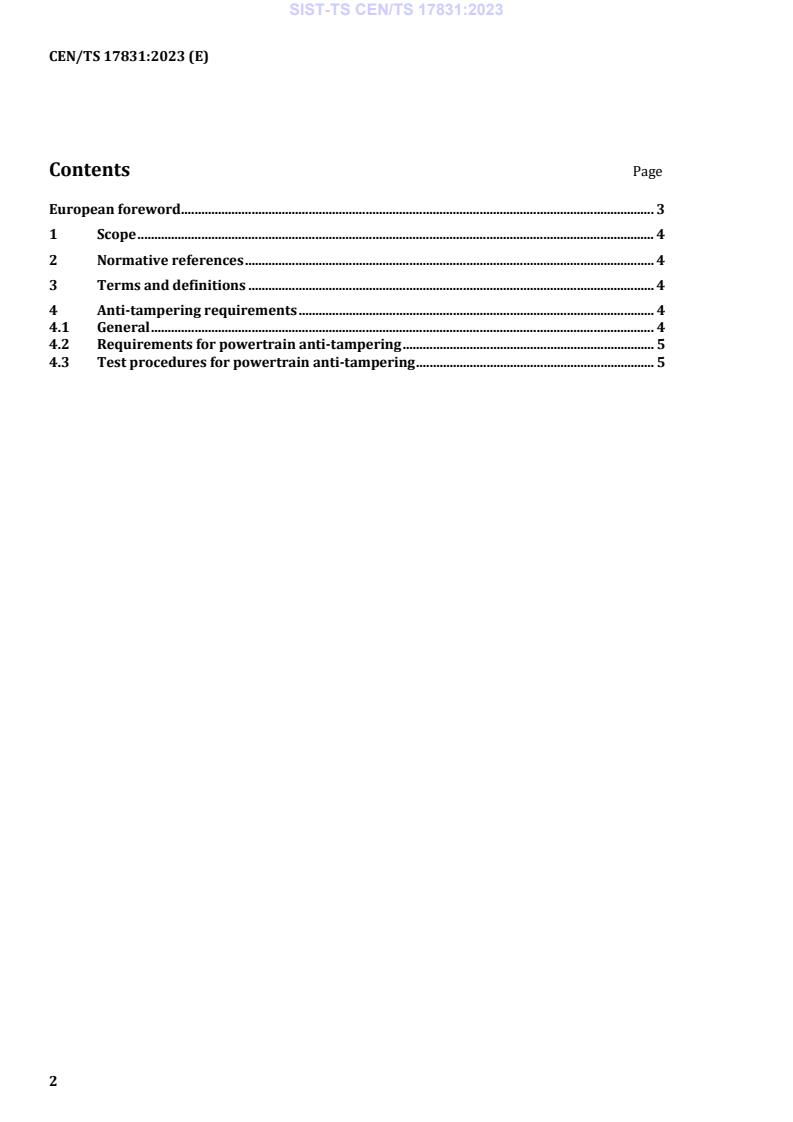
Contents Page
European foreword . 3
1 Scope . 4
2 Normative references . 4
3 Terms and definitions . 4
4 Anti-tampering requirements . 4
4.1 General . 4
4.2 Requirements for powertrain anti-tampering . 5
4.3 Test procedures for powertrain anti-tampering . 5
European foreword
This document (CEN/TS 17831:2023) has been prepared by Technical Committee CEN/TC 333 “Cycles”,
the secretariat of which is held by UNI.
Attention is drawn to the possibility that some of the elements of this document may be the subject of
patent rights. CEN shall not be held responsible for identifying any or all such patent rights.
Any feedback and questions on this document should be directed to the users’ national standards body.
A complete listing of these bodies can be found on the CEN website.
According to the CEN/CENELEC Internal Regulations, the national standards organisations of the
following countries are bound to announce
...