

ASTM D3910-21
(Practice)Standard Practices for Design, Testing, and Construction of Slurry Seal
General Information
- Abstract
SIGNIFICANCE AND USE
4.1 These slurry seal practices are written as a guide and should not be construed as specifications.
4.2 End-use specifications should be adopted to conform to job and user requirements.
Note 1: The quality of the results produced by this standard are dependent on the competence of the personnel performing the procedure and the capability, calibration, and maintenance of the equipment used. Agencies that meet the criteria of Specification D3666 are generally considered capable of competent and objective testing, sampling, inspection, etc. Users of this standard are cautioned that compliance with Specification D3666 alone does not completely ensure reliable results. Reliable results depend on many factors; following the suggestions of Specification D3666 or some similar acceptable guideline provides a means of evaluating and controlling some of those factors.
SCOPE
1.1 These practices cover the design, testing, and construction of mixtures for surface treatment of pavements. It is written as a guide and should be used as such. End-use specifications should be adapted to conform to job and user requirements.
1.2 The values stated in SI units are to be regarded as the standard. The non-SI units used in this standard are allowed by the subcommittee for clarification in the use of the standard.
1.3 The text of this standard references notes and footnotes that provide explanatory material. These notes and footnotes (excluding those in tables and figures) shall not be considered as requirements of the standard.
1.4 This standard does not purport to address all of the safety concerns, if any, associated with its use. It is the responsibility of the user of this standard to establish appropriate safety, health, and environmental practices and determine the applicability of regulatory limitations prior to use.
1.5 This international standard was developed in accordance with internationally recognized principles on standardization established in the Decision on Principles for the Development of International Standards, Guides and Recommendations issued by the World Trade Organization Technical Barriers to Trade (TBT) Committee.
- Status
- Published
- Publication Date
- 31-Oct-2021
- Technical Committee
- D04 - Road and Paving Materials
- Drafting Committee
- D04.24 - Asphalt Surface Treatments
Overview
ASTM D3910-21: Standard Practices for Design, Testing, and Construction of Slurry Seal presents established guidelines for the design, testing, and field construction of slurry seal surface treatments for pavements. Issued by ASTM International, this standard is intended as a practical reference to ensure effective and consistent slurry seal applications. It is widely adopted in road maintenance, airfield, and parking lot surface treatments where a cost-effective preservation and rejuvenation of pavement surfaces is required.
These practices are intended as a guide and should be adapted to meet specific project and user requirements. Compliance with this standard helps organizations achieve robust, long-lasting pavement surfaces, extend pavement service life, and improve safety and surface performance.
Key Topics
Slurry Seal Mix Design
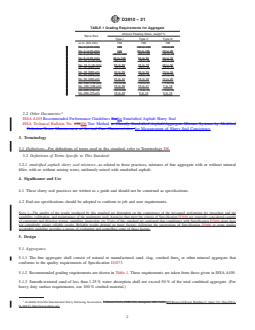
Guidance on selecting appropriate aggregates, mineral fillers, emulsified asphalt, and water to produce a workable and durable slurry seal mixture. The standard specifies different aggregate gradations for Types I, II, and III slurry seals, addressing varying surface needs.Testing Methods
Procedures to assess the consistency, set time, cure time, and abrasion resistance of the slurry seal mixture. These include specific laboratory and field test protocols to ensure the desired performance before and after placement.Construction Practices
Recommendations for equipment, surface preparation, weather limitations, application methods, and post-application procedures. Details are provided to ensure that proper construction practices result in uniform application and reliable service performance.Equipment Requirements
Specifications for mixing machines, spreader boxes, and auxiliary tools necessary for creating and applying slurry seal. This ensures that the right equipment is employed for efficient and quality slurry seal construction.Quality Control
Emphasis on the need for competent personnel, well-maintained and calibrated equipment, and adherence to recognized quality management systems, such as those detailed in ASTM D3666.
Applications
ASTM D3910 is essential in guiding the use of slurry seals for preventive maintenance and surface restoration on a wide variety of pavement types, including:
Highways and Roads
Used to fill cracks, correct minor surface distress, seal surfaces, and restore skid resistance while protecting against further deterioration.Airport Runways and Taxiways
Applied to maintain smoothness, seal surfaces, and enhance safety through improved friction.Parking Lots and Urban Streets
Suitable for rejuvenating high-traffic and low-traffic surfaces, providing a new wearing surface, sealing, and extending pavement life.Bituminous Base Courses and Soil-Cement Bases
Acts as a sealer or wearing course to protect the underlying structure and enhance durability.
Adhering to these practices ensures the application of slurry seal treatments that meet project performance demands and environmental conditions.
Related Standards
Practitioners should reference related ASTM and industry standards to complement the application of ASTM D3910, including:
- ASTM D1073: Standard Specification for Fine Aggregate for Asphalt Paving Mixtures
- ASTM D977: Standard Specification for Emulsified Asphalt
- ASTM D2397: Specification for Cationic Emulsified Asphalt
- ASTM D242: Specification for Mineral Filler for Asphalt Mixtures
- ASTM D3666: Specification for Minimum Requirements for Agencies Testing and Inspecting Road and Paving Materials
- ISSA A105: Recommended Performance Guidelines for Emulsified Asphalt Slurry Seal
- ISSA Technical Bulletin 106: Test Method for Measurement of Slurry Seal Consistency
Practical Value
Implementing ASTM D3910-21 as a guide delivers significant practical value:
- Promotes consistent and reliable slurry seal performance
- Extends pavement longevity and reduces lifecycle maintenance costs
- Enhances surface safety and appearance
- Provides a structured approach for quality assurance in pavement surface treatment projects
By following this standard, agencies, engineers, and contractors can achieve high-quality, sustainable slurry seal installations that meet the evolving needs of pavements and road users.
Relations
- Effective Date
- 01-Nov-2019
- Effective Date
- 01-Nov-2019
- Effective Date
- 01-Nov-2019
- Effective Date
- 01-Aug-2019
- Effective Date
- 01-May-2019
- Effective Date
- 01-May-2019
- Effective Date
- 01-May-2019
- Effective Date
- 15-Dec-2018
- Effective Date
- 15-Aug-2018
- Effective Date
- 01-Jul-2018
- Effective Date
- 01-Feb-2018
- Effective Date
- 15-Jul-2017
- Effective Date
- 15-Jun-2017
- Effective Date
- 01-Jun-2017
- Effective Date
- 01-Jun-2017
Get Certified
Connect with accredited certification bodies for this standard

Zavod za gradbeništvo Slovenije (ZAG) - Inšpekcija
ZAG inspection body for construction products, structures, and materials.
Sponsored listings
Frequently Asked Questions
ASTM D3910-21 is a standard published by ASTM International. Its full title is "Standard Practices for Design, Testing, and Construction of Slurry Seal". This standard covers: SIGNIFICANCE AND USE 4.1 These slurry seal practices are written as a guide and should not be construed as specifications. 4.2 End-use specifications should be adopted to conform to job and user requirements. Note 1: The quality of the results produced by this standard are dependent on the competence of the personnel performing the procedure and the capability, calibration, and maintenance of the equipment used. Agencies that meet the criteria of Specification D3666 are generally considered capable of competent and objective testing, sampling, inspection, etc. Users of this standard are cautioned that compliance with Specification D3666 alone does not completely ensure reliable results. Reliable results depend on many factors; following the suggestions of Specification D3666 or some similar acceptable guideline provides a means of evaluating and controlling some of those factors. SCOPE 1.1 These practices cover the design, testing, and construction of mixtures for surface treatment of pavements. It is written as a guide and should be used as such. End-use specifications should be adapted to conform to job and user requirements. 1.2 The values stated in SI units are to be regarded as the standard. The non-SI units used in this standard are allowed by the subcommittee for clarification in the use of the standard. 1.3 The text of this standard references notes and footnotes that provide explanatory material. These notes and footnotes (excluding those in tables and figures) shall not be considered as requirements of the standard. 1.4 This standard does not purport to address all of the safety concerns, if any, associated with its use. It is the responsibility of the user of this standard to establish appropriate safety, health, and environmental practices and determine the applicability of regulatory limitations prior to use. 1.5 This international standard was developed in accordance with internationally recognized principles on standardization established in the Decision on Principles for the Development of International Standards, Guides and Recommendations issued by the World Trade Organization Technical Barriers to Trade (TBT) Committee.
SIGNIFICANCE AND USE 4.1 These slurry seal practices are written as a guide and should not be construed as specifications. 4.2 End-use specifications should be adopted to conform to job and user requirements. Note 1: The quality of the results produced by this standard are dependent on the competence of the personnel performing the procedure and the capability, calibration, and maintenance of the equipment used. Agencies that meet the criteria of Specification D3666 are generally considered capable of competent and objective testing, sampling, inspection, etc. Users of this standard are cautioned that compliance with Specification D3666 alone does not completely ensure reliable results. Reliable results depend on many factors; following the suggestions of Specification D3666 or some similar acceptable guideline provides a means of evaluating and controlling some of those factors. SCOPE 1.1 These practices cover the design, testing, and construction of mixtures for surface treatment of pavements. It is written as a guide and should be used as such. End-use specifications should be adapted to conform to job and user requirements. 1.2 The values stated in SI units are to be regarded as the standard. The non-SI units used in this standard are allowed by the subcommittee for clarification in the use of the standard. 1.3 The text of this standard references notes and footnotes that provide explanatory material. These notes and footnotes (excluding those in tables and figures) shall not be considered as requirements of the standard. 1.4 This standard does not purport to address all of the safety concerns, if any, associated with its use. It is the responsibility of the user of this standard to establish appropriate safety, health, and environmental practices and determine the applicability of regulatory limitations prior to use. 1.5 This international standard was developed in accordance with internationally recognized principles on standardization established in the Decision on Principles for the Development of International Standards, Guides and Recommendations issued by the World Trade Organization Technical Barriers to Trade (TBT) Committee.
ASTM D3910-21 is classified under the following ICS (International Classification for Standards) categories: 93.080.10 - Road construction. The ICS classification helps identify the subject area and facilitates finding related standards.
ASTM D3910-21 has the following relationships with other standards: It is inter standard links to ASTM D977-19a, ASTM D977-19ae1, ASTM D2397/D2397M-19a, ASTM D8-19, ASTM D2397/D2397M-19, ASTM D242/D242M-19, ASTM D977-19, ASTM D8-18c, ASTM D8-18b, ASTM D8-18a, ASTM D8-18, ASTM D8-17c, ASTM D8-17b, ASTM D2397/D2397M-17, ASTM D977-17. Understanding these relationships helps ensure you are using the most current and applicable version of the standard.
ASTM D3910-21 is available in PDF format for immediate download after purchase. The document can be added to your cart and obtained through the secure checkout process. Digital delivery ensures instant access to the complete standard document.
Standards Content (Sample)
This international standard was developed in accordance with internationally recognized principles on standardization established in the Decision on Principles for the
Development of International Standards, Guides and Recommendations issued by the World Trade Organization Technical Barriers to Trade (TBT) Committee.
Designation: D3910 − 21
Standard Practices for
Design, Testing, and Construction of Slurry Seal
This standard is issued under the fixed designation D3910; the number immediately following the designation indicates the year of
original adoption or, in the case of revision, the year of last revision. A number in parentheses indicates the year of last reapproval. A
superscript epsilon (´) indicates an editorial change since the last revision or reapproval.
This standard has been approved for use by agencies of the U.S. Department of Defense.
1. Scope D242/D242M Specification for Mineral Filler for Asphalt
Mixtures
1.1 These practices cover the design, testing, and construc-
D977 Specification for Emulsified Asphalt
tion of mixtures for surface treatment of pavements. It is
D1073 Specification for Fine Aggregate for Asphalt Paving
written as a guide and should be used as such. End-use
Mixtures
specifications should be adapted to conform to job and user
D2397/D2397M Specification for Cationic Emulsified As-
requirements.
phalt
1.2 The values stated in SI units are to be regarded as the
D2419 Test Method for Sand Equivalent Value of Soils and
standard.The non-SI units used in this standard are allowed by
Fine Aggregate
the subcommittee for clarification in the use of the standard.
D3666 Specification for Minimum Requirements for Agen-
1.3 The text of this standard references notes and footnotes cies Testing and Inspecting Road and Paving Materials
2.2 Other Documents:
that provide explanatory material. These notes and footnotes
(excluding those in tables and figures) shall not be considered ISSA A105 Recommended Performance Guidelines for
Emulsified Asphalt Slurry Seal
as requirements of the standard.
ISSATechnical Bulletin No. 106 Test Method for Measure-
1.4 This standard does not purport to address all of the
ment of Slurry Seal Consistency
safety concerns, if any, associated with its use. It is the
responsibility of the user of this standard to establish appro-
3. Terminology
priate safety, health, and environmental practices and deter-
3.1 Definitions—For definitions of terms used in this
mine the applicability of regulatory limitations prior to use.
standard, refer to Terminology D8.
1.5 This international standard was developed in accor-
dance with internationally recognized principles on standard-
3.2 Definitions of Terms Specific to This Standard:
ization established in the Decision on Principles for the
3.2.1 emulsified asphalt slurry seal mixtures—as related to
Development of International Standards, Guides and Recom-
these practices, mixtures of fine aggregate with or without
mendations issued by the World Trade Organization Technical
mineral filler, with or without mixing water, uniformly mixed
Barriers to Trade (TBT) Committee.
with emulsified asphalt.
4. Significance and Use
2. Referenced Documents
4.1 These slurry seal practices are written as a guide and
2.1 ASTM Standards:
should not be construed as specifications.
C128 Test Method for Relative Density (Specific Gravity)
and Absorption of Fine Aggregate
4.2 End-use specifications should be adopted to conform to
D8 Terminology Relating to Materials for Roads and Pave-
job and user requirements.
ments
NOTE 1—The quality of the results produced by this standard are
dependent on the competence of the personnel performing the procedure
and the capability, calibration, and maintenance of the equipment used.
Agencies that meet the criteria of Specification D3666 are generally
These practices are under the jurisdiction of ASTM Committee D04 on Road
considered capable of competent and objective testing, sampling,
and Paving Materials and are the direct responsibility of Subcommittee D04.24 on
inspection, etc. Users of this standard are cautioned that compliance with
Asphalt Surface Treatments.
Specification D3666 alone does not completely ensure reliable results.
Current edition approved Nov. 1, 2021. Published November 2021. Originally
Reliable results depend on many factors; following the suggestions of
approved in 1980. Last previous edition approved in 2015 as D3910 – 15. DOI:
10.1520/D3910-21. Specification D3666 or some similar acceptable guideline provides a
For referenced ASTM standards, visit the ASTM website, www.astm.org, or
contact ASTM Customer Service at service@astm.org. For Annual Book of ASTM
Standards volume information, refer to the standard’s Document Summary page on Available from the International Slurry Surfacing Association, 800 Roosevelt
the ASTM website. Road, Building C, Suite 312, Glen Ellyn, IL 60137, http://www.slurry.org.
Copyright © ASTM International, 100 Barr Harbor Drive, PO Box C700, West Conshohocken, PA 19428-2959. United States
D3910 − 21
TABLE 1 Grading Requirements for Aggregate
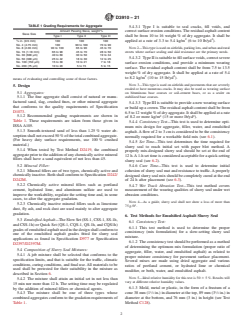
5.4.3.1 Type I is suitable to seal cracks, fill voids, and
Amount Passing Sieve, weight % correct surface erosion conditions.The residual asphalt content
Sieve Size
Type I Type II Type III shall be from 10 to 16 weight % of dry aggregate. It shall be
2 2
⁄8 in. (9.5 mm) 100 100 100 applied at a rate of 3.3 to 5.4 kg/m (6 to 10 lb/yd ).
No. 4 (4.75 mm) 100 90 to 100 70 to 90
No. 8 (2.36 mm) 90 to 100 65 to 90 45 to 70 NOTE2—Thistypeisusedonairfields,parkinglots,andurbanandrural
No. 16 (1.18 mm) 65 to 90 45 to 70 28 to 50 streets where surface sealing and skid resistance are the primary needs.
No. 30 (600 µm) 40 to 60 30 to 50 19 to 34
5.4.3.2 TypeIIissuitabletofillsurfacevoids,correctsevere
No. 50 (300 µm) 25 to 42 18 to 30 12 to 25
No. 100 (150 µm) 15 to 30 10 to 21 7 to 18
surface erosion conditions, and provide a minimum wearing
No. 200 (75 µm) 10 to 20 5 to 15 5 to 15
surface. The residual asphalt content shall be from 7.5 to 13.5
weight % of dry aggregate. It shall be applied at a rate of 5.4
2 2
to 8.2 kg/m (10 to 15 lb/yd ).
means of evaluating and controlling some of those factors.
NOTE 3—This type is used on airfields and pavements that are severely
5. Design
eroded or have numerous cracks. It may also be used as wearing surface
5.1 Aggregates: on bituminous base courses or soil-cement bases, or as a sealer on
stabilized base courses.
5.1.1 The fine aggregate shall consist of natural or manu-
factured sand, slag, crushed fines, or other mineral aggregate
5.4.3.3 Type III is suitable to provide a new wearing surface
that conforms to the quality requirements of Specification
or build up a crown. The residual asphalt content shall be from
D1073.
6.5to12weight %ofdryaggregate.Itshallbeappliedatarate
2 2
5.1.2 Recommended grading requirements are shown in
of 8.2 or more kg/m (15 or more lb/yd ).
Table 1. These requirements are taken from those given in
5.4.4 Consistency Test—This test is used to determine opti-
ISSAA105.
mum mix design for aggregate, filler, water, and emulsified
5.1.3 Smooth-textured sand of less than 1.25 % water ab-
asphalt.Aflow of 2 to 3 cm is considered to be the consistency
sorptionshallnotexceed50 %ofthetotalcombinedaggregate.
normally required for a workable field mix (see 6.1).
(For heavy duty surface requirements, use 100 % crushed
5.4.5 Set Time—This test determines the time required for
material.)
slurry seal to reach initial set with paper blot method. A
5.1.4 When tested by Test Method D2419, the combined
properly mix-designed slurry seal should be set at the end of
aggregatepriortotheadditionofanychemicallyactivemineral
12 h.A1-hsettimeisconsideredacceptableforaquick-setting
fillers shall have a sand equivalent of not less than 45.
slurry seal (see 6.2).
5.2 Mineral Filler:
5.4.6 Cure Time—This test is used to determine initial
5.2.1 Mineral fillers are of two types, chemically active and
cohesion of slurry seal mat and resistance to traffic.Aproperly
chemically inactive. Both shall conform to Specification D242/
designed slurry seal mix should be completely cured at the end
D242M.
of 24 h after placement (see 6.3).
5.2.2 Chemically active mineral fillers such as portland
5.4.7 Wet Track Abrasion Test—This test method covers
cement, hydrated lime, and aluminum sulfate are used to
measurement of the wearing qualities of slurry seal under wet
improve the workability, regulate the setting time and, in some
abrasion conditions.
cases, to alter the aggregate gradation.
NOTE 4—As a guide, slurry seal shall not show a loss of more than
5.2.3 Chemically inactive mineral fillers such as limestone
75 g⁄ft .
dust, fly ash, and rock dust are used mainly to alter aggregate
gradation.
6. Test Methods for Emulsified Asphalt Slurry Seal
5.3 EmulsifiedAsphalt—TheSlowSet(SS-1,CSS-1,SS-1h,
6.1 Consistency Test:
and CSS-1h) or Quick Set (QS-1, CQS-1, QS-1h, and CQS1h)
6.1.1 This test method is used to determine the proper
gradesofemulsifiedasphaltusedinthedesignshallconformto
consistency (mix formulation) for a slow-setting slurry seal
one of the emulsified asphalt grades fitted for slurry seal
mixture.
applications as found in Specification D977 or Specification
6.1.2 The consistency test should be performed as a method
D2397/D2397M.
of determining the optimum mix formulation (proper ratio of
5.4 Composition of Slurry Seal Mixtures:
aggregate, filler, water, and emulsified asphalt) as related to
5.4.1 A job mixture shall be selected that conforms to the
proper mixture consistency for pavement surface placement.
specification limits, and that is suitable for the traffic, climatic
Several mixes are made using dried aggregate and various
conditions, curing conditions, and final use.All materials to be
ratios of portland cement, or hydrated lime or chemical
used shall be pretested for their suitability in the mixture as
modifier, or both, water, and emulsified asphalt.
described in Section 6.
NOTE 5—Ideal relative humidity for this test is 50 6 5 %. Results will
5.4.2 The mixture shall attain an initial set in not less than
vary at different relative humidity values.
15 min nor more than 12 h. The setting time may be regulated
by the addition of mineral fillers or chemical agents. 6.1.3 Mold, metal or plastic, in the form of a frustum of a
1 1
5.4.3 The mixture shall be one of three types whose cone 38 mm (1 ⁄2 in.) in diameter at the top, 89 mm (3 ⁄2 in.) in
combined aggregates conform to the gradation requirements of diameter at the bottom, and 76 mm (3 in.) in height (see Test
Table 1. Method C128).
D3910 − 21
6.1.4 The center of a 228 by 228-mm piece of 3-mm thick obtainable remains constant. An undisturbed site on the mix-
metal plate is inscribed with a circle 89 mm in diameter. Three turepadshouldbeselectedforeachtime-intervaltest.Thetime
tofouradditionalcircles,each13mmgreaterinradiusthanthe required to reach a constant maximum torque or until the
preceding circle, are inscribed on the metal plate around the rubber foot rides freely over the mixture mat without any
center circle. In lieu of the metal plate, a paper version of a aggregate particles being dislodged, is recorded as the cure
flow scale may be used as found in ISSA Technical Bulletin time.
106 (see Note 6).
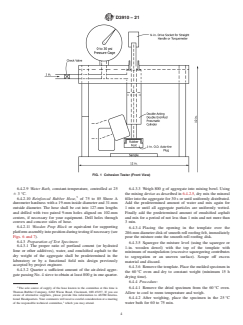
6.3.4 A cohesion tester is a lightweight, portable device
6.1.5 The mold as described in 6.1.3 is placed over the which can be adjusted to apply varying pressure to a mixture
center circle of the metal plate or flow scale paper. A 400 g to
pad (see Figs. 1 and 2). Torque can be applied with a handheld
600gtestmixture(basedondrymassofaggregate)isprepared torque tester. The cohesion tester can be used in the laboratory
and after 30 s of mixing, it is poured into the mold, completely or field and can be pressured with in-house air, a portable
filling it, and struck off to be level-full. The mold is quickly compressor, or a simple bicycle tire pump.
removed and the contents allowed to flow over the scale until
6.4 Wet Track Abrasion Test:
flow of the mixture stops. Four flow measurements (in centi-
6.4.1 Summary of Test Method:
meters) are made at 90° points along the flow scale. The
6.4.1.1 A slurry mixture of fine graded aggregate, emulsi-
average value of the four measurements is to be taken and
fied asphalt, and water is prepared to a homogeneous flowing
reportedasthe“flow.”Projectaggregateandemulsifiedasphalt
consistency (see consistency test). The mixture is formed into
grade are considered essential for proper relevancy of the
a disk by pouring in the circular opening of a specimen mold
method.
or template resting on a larger circlet of 30-lb roofing felt.
NOTE 6—Referenced ISSA Technical Bulletin No. 106 titled “Test
6.4.1.2 After removal of the template, the disk-shaped
Method for Measurement of Slurry Seal Consistency.”
specimen is dried to constant weight at 60 °C. The cured
6.2 Set Time: mixture is placed in a water bath for 1 h, then mechanically
6.2.1 Thistestmethodisusedtodeterminethetimerequired abraded under water with a rubber hose for 5 min.The abraded
for the slurry seal mat to reach initial set (resistance to paper specimeniswashedfreeofdebris,driedat60 °C,andweighed.
blot). The loss in weight expressed as grams per square metre (or
6.2.2 The slurry mixture or mixtures that provide the square foot) is reported as the wear value (WTAT loss).
desired consistency shall be repeated to determine their setting 6.4.2 Apparatus:
characteristics.Amixturepassingtheconsistencytestispoured
6.4.2.1 Balance, capable of weighing 5000 g to within
onto a 152 by 152-mm asphalt felt pad (30-lb roofing felt) and 61.0 g.
screeded to 6 mm thickness using a 6-mm template.At the end
6.4.2.2 Planetary Type Mechanical Stirrer, equipped with a
of 15 min, at 25 6 1 °C and 50 6 5 % relative humidity, a
2.27 6 0.06 kg (5 6 0.13 lb) abrasion head (holding device)
white paper towel or tissue is lightly pressed or blotted on the
with 12.7 6 0.5 mm (0.5 6 0.02 in.) free up-and-down
mixture surface. If no brown stain is transferred to the paper,
movementintheshaftsleeve(Fig.3).Themassoftheabrasion
the mixture is considered set. If a brown stain does appear,
head shall not include the mass with the rubber hose attached.
repeat the blot procedure at 15-min intervals. After 3 h of
NOTE 7—Examples of planetary mixers would be Hobart Model N-50,
blotting, 30-min (or longer) blot intervals would be suitable.
C-100, or A-120.
Record and report the time required to obtain a stain-free blot
6.4.2.3 Heavy Flat-Bottom Metal Pan—approximately
as the set time.
3.2 mm thick, 330 mm in diameter, with 51-mm vertical side
6.3 Cure Time:
walls (20 gage or heavier) having either four equally spaced
6.3.1 Total cure of a slurry mixture mat is obtained when
screw clamps capable of securing 285-mm diameter specimen
complete cohesion between asphalt-coated aggregate particles
to bottom of pan or a quick-clamp mounting plate (Fig. 4).
occurs.Acohesion testing device is used to measure cure time.
NOTE 8—The dimensions on the pan are specific to the C-100 machine.
6.3.2 Aslurrymixtureofoptimumdesignobtainedfromuse
Dimensions may vary with machine type. The quick-clamp mounting
oftheconsistencytest(see5.4.4)isscreededontoaroofingfelt
plate is shown on an N-50 machine.
pad to a thickness not exceeding the height of the largest
6.4.2.4 Mixing Bowl, durable with smooth botto
...
This document is not an ASTM standard and is intended only to provide the user of an ASTM standard an indication of what changes have been made to the previous version. Because
it may not be technically possible to adequately depict all changes accurately, ASTM recommends that users consult prior editions as appropriate. In all cases only the current version
of the standard as published by ASTM is to be considered the official document.
Designation: D3910 − 15 D3910 − 21
Standard Practices for
Design, Testing, and Construction of Slurry Seal
This standard is issued under the fixed designation D3910; the number immediately following the designation indicates the year of
original adoption or, in the case of revision, the year of last revision. A number in parentheses indicates the year of last reapproval. A
superscript epsilon (´) indicates an editorial change since the last revision or reapproval.
This standard has been approved for use by agencies of the U.S. Department of Defense.
1. Scope
1.1 These practices cover the design, testing, and construction of mixtures for surface treatment of pavements. It is written as a
guide and should be used as such. End-use specifications should be adapted to conform to job and user requirements.
1.2 The values stated in SI units are to be regarded as the standard. The non-SI units used in this standard are allowed by the
sub-committeesubcommittee for clarification in the use of the standard.
1.3 The text of this standard references notes and footnotes that provide explanatory material. These notes and footnotes
(excluding those in tables and figures) shall not be considered as requirements of the standard.
1.4 This standard does not purport to address all of the safety concerns, if any, associated with its use. It is the responsibility
of the user of this standard to establish appropriate safety safety, health, and healthenvironmental practices and determine the
applicability of regulatory limitations prior to use.
1.5 This international standard was developed in accordance with internationally recognized principles on standardization
established in the Decision on Principles for the Development of International Standards, Guides and Recommendations issued
by the World Trade Organization Technical Barriers to Trade (TBT) Committee.
2. Referenced Documents
2.1 ASTM Standards:
C128 Test Method for Relative Density (Specific Gravity) and Absorption of Fine Aggregate
D8 Terminology Relating to Materials for Roads and Pavements
D242D242/D242M Specification for Mineral Filler for Asphalt Mixtures
D977 Specification for Emulsified Asphalt
D1073 Specification for Fine Aggregate for Asphalt Paving Mixtures
D2397D2397/D2397M Specification for Cationic Emulsified Asphalt
D2419 Test Method for Sand Equivalent Value of Soils and Fine Aggregate
E145D3666 Specification for Gravity-Convection and Forced-Ventilation OvensMinimum Requirements for Agencies Testing
and Inspecting Road and Paving Materials
These practices are under the jurisdiction of ASTM Committee D04 on Road and Paving Materials and are the direct responsibility of Subcommittee D04.24 on Asphalt
Surface Treatments.
Current edition approved June 15, 2015Nov. 1, 2021. Published September 2015November 2021. Originally approved in 1980. Last previous edition approved in 20112015
as D3910 – 11.D3910 – 15. DOI: 10.1520/D3910-15.10.1520/D3910-21.
For referenced ASTM standards, visit the ASTM website, www.astm.org, or contact ASTM Customer Service at service@astm.org. For Annual Book of ASTM Standards
volume information, refer to the standard’s Document Summary page on the ASTM website.
Copyright © ASTM International, 100 Barr Harbor Drive, PO Box C700, West Conshohocken, PA 19428-2959. United States
D3910 − 21
TABLE 1 Grading Requirements for Aggregate
Amount Passing Sieve, weight %
Sieve Size
Type I Type II Type III
⁄8 in. (9.5 mm) 100 100 100
No. 4 (4.75 mm) 100 90 to 100 70 to 90
No. 4 (4.75 mm) 100 90 to 100 70 to 90
No. 8 (2.36 mm) 90 to 100 65 to 90 45 to 70
No. 8 (2.36 mm) 90 to 100 65 to 90 45 to 70
No. 16 (1.18 mm) 65 to 90 45 to 70 28 to 50
No. 16 (1.18 mm) 65 to 90 45 to 70 28 to 50
No. 30 (600 μm) 40 to 60 30 to 50 19 to 34
No. 30 (600 μm) 40 to 60 30 to 50 19 to 34
No. 50 (300 μm) 25 to 42 18 to 30 12 to 25
No. 50 (300 μm) 25 to 42 18 to 30 12 to 25
No. 100 (150 μm) 15 to 30 10 to 21 7 to 18
No. 100 (150 μm) 15 to 30 10 to 21 7 to 18
No. 200 (75μ m) 10 to 20 5 to 15 5 to 15
No. 200 (75 μm) 10 to 20 5 to 15 5 to 15
2.2 Other Documents:
ISSA A105 Recommended Performance Guidelines Forfor Emulsified Asphalt Slurry Seal
ISSA Technical Bulletin No. 139106 Test Method to Classify Emulsified Asphalt/Aggregate Mixture Systems by Modified
Cohesion Tester Measurement of Set and Cure Characteristics. for Measurement of Slurry Seal Consistency
3. Terminology
3.1 Definitions—For definitions of terms used in this standard, refer to Terminology D8.
3.2 Definitions of Terms Specific to This Standard:
3.2.1 emulsified asphalt slurry seal mixtures—as related to these practices, mixtures of fine aggregate with or without mineral
filler, with or without mixing water, uniformly mixed with emulsified asphalt.
4. Significance and Use
4.1 These slurry seal practices are written as a guide and should not be construed as specifications.
4.2 End-use specifications should be adopted to conform to job and user requirements.
NOTE 1—The quality of the results produced by this standard are dependent on the competence of the personnel performing the procedure and the
capability, calibration, and maintenance of the equipment used. Agencies that meet the criteria of Specification D3666 are generally considered capable
of competent and objective testing, sampling, inspection, etc. Users of this standard are cautioned that compliance with Specification D3666 alone does
not completely ensure reliable results. Reliable results depend on many factors; following the suggestions of Specification D3666 or some similar
acceptable guideline provides a means of evaluating and controlling some of those factors.
5. Design
5.1 Aggregates:
5.1.1 The fine aggregate shall consist of natural or manufactured sand, slag, crushed fines, or other mineral aggregate that
conforms to the quality requirements of Specification D1073.
5.1.2 Recommended grading requirements are shown in Table 1. These requirements are taken from those given in ISSA A105.
5.1.3 Smooth-textured sand of less than 1.25 % water absorption shall not exceed 50 % of the total combined aggregate. (For
heavy duty surface requirements, use 100 % crushed material.)
Available from the International Slurry Surfacing Association, 3 Church Circle, PMB 250, Annapolis, MD 21401.800 Roosevelt Road, Building C, Suite 312, Glen Ellyn,
IL 60137, http://www.slurry.org.
D3910 − 21
5.1.4 When tested by Test Method D2419, the combined aggregate prior to the addition of any chemically active mineral fillers
shall have a sand equivalent of not less than 45.
5.2 Mineral Filler:
5.2.1 Mineral fillers are of two types, chemically active and chemically inactive. Both shall conform to Specification
D242D242/D242M.
5.2.2 Chemically active mineral fillers such as portland cement, hydrated lime, and ammoniumaluminum sulfate are used to
improve the workability, regulate the setting time and, in some cases, to alter the aggregate gradation.
5.2.3 Chemically inactive mineral fillers such as limestone dust, flyash, fly ash, and rock dust are used mainly to alter aggregate
gradation.
5.3 Emulsified Asphalt—The emulsified asphalt Slow Set (SS-1, CSS-1, SS-1h, and CSS-1h) or Quick Set (QS-1, CQS-1, QS-1h,
and CQS1h) grades of emulsified asphalt used in the design shall conform to Grade SS-1h one of Specificationthe D977, for
emulsified asphalt, or Grade CSS-1h of Specificationemulsified asphalt grades fitted for slurry seal applications as D2397, for
cationic emulsifiedfound in Specification D977 asphalt.or Specification D2397/D2397M.
5.3.1 Quick-Set emulsified asphalts, QS-1h and CQS-1h may also be used. They shall conform to Specifications D977 and D2397,
respectively. Refer to the International Slurry Surfacing Association (ISSA) Bulletin No. 139.
5.4 Composition of Slurry Seal Mixtures:
5.4.1 A job mixture shall be selected that conforms to the specification limits, and that is suitable for the traffic, climatic conditions,
curing conditions, and final use. All materials to be used shall be pretested for their suitability in the mixture as described in Section
6.
5.4.2 The mixture shall attain an initial set in not less than 15 min nor more than 12 h. The setting time may be regulated by the
addition of mineral fillers or chemical agents.
5.4.3 The mixture shall be one of three types,types whose combined aggregates conform to the gradation requirements of Table
1.
5.4.3.1 Type I is suitable to seal cracks, fill voids, and correct surface erosion conditions. The residual asphalt content shall be from
2 2
10 to 16 weight % of dry aggregate. It shall be applied at a rate of 3.3 to 5.4 kg/m (6 to 10 lb/yd ). This type is used on airfields
where surface sealing and skid resistance are the primary needs.
NOTE 2—This type is used on airfields, parking lots, and urban and rural streets where surface sealing and skid resistance are the primary needs.
5.4.3.2 Type II is suitable to fill surface voids, correct severe surface erosion conditions, and provide a minimum wearing surface.
The residual asphalt content shall be from 7.5 to 13.5 weight % of dry aggregate. It shall be applied at a rate of 5.4 to 8.2 kg/m
(10 to 15 lb/yd ). This type is used on airfields and pavements that are severely eroded, or have numerous cracks. It may also be
used as wearing surface on bituminous base courses or soil-cement bases, or as a sealer on stabilized base courses.
NOTE 3—This type is used on airfields and pavements that are severely eroded or have numerous cracks. It may also be used as wearing surface on
bituminous base courses or soil-cement bases, or as a sealer on stabilized base courses.
5.4.3.3 Type III is suitable to provide a new wearing surface or build up a crown. The residual asphalt content shall be from 6.5
2 2
to 12 weight % of dry aggregate. It shall be applied at a rate of 8.2 or more kg/m (15 or more lb/yd ).
5.4.4 Consistency Test—This test is used to determine optimum mix design for aggregate, filler, water, and emulsion. emulsified
asphalt. A flow of 2 to 3 cm is considered to be the consistency normally required for a workable field mix (see 6.1).
D3910 − 21
5.4.5 Set Time—This test determines the time required for slurry seal to reach initial set with paper blot method. A properly
mix-designed slurry seal should be set at the end of 12 h. A 1 h 12 h. A 1-h set time is considered acceptable for a quick setting
quick-setting slurry seal (see 6.2).
5.4.6 Cure Time—This test is used to determine initial cohesion of slurry seal mat and resistance to traffic. A properly designed
slurry seal mix should be completely cured at the end of 24 h after placement (see 6.3).
5.4.7 Wet Track Abrasion Test—This test method covers measurement of the wearing qualities of slurry seal under wet abrasion
conditions.
NOTE 4—As a guide, slurry seal shall not show a loss of more than 75 75 g g/ft⁄ft .
6. Test Methods for Emulsified Asphalt Slurry Seal
6.1 Consistency Test:
6.1.1 This test method is used to determine the proper consistency (mix design)formulation) for a slow-setting slurry seal mixture.
6.1.2 The consistency test should be performed as a method of determining the optimum mix designformulation (proper ratio of
aggregate, filler, water, and emulsion) emulsified asphalt) as related to proper mixture consistency for pavement surface placement.
Several mixes are made using dried aggregate and various ratios of portland cement, or hydrated lime or chemical modifier, or both,
water and asphalt emulsion. Mix time shall be for no less than 1 min when mixed at 25 6 1°C.water, and emulsified asphalt.
NOTE 5—Ideal relative humidity for this test is 50 6 5 %. Results will vary at different relative humidity values.
1 1
6.1.3 Mold, metal or plastic, in the form of a frustum of a cone 38 mm (1 ⁄2 in.) in diameter at the top, 89 mm (3 ⁄2 in.) in diameter
at the bottom, and 76 mm (3 in.) in height (see Test Method C128).
6.1.4 The center of a 228 by 228-mm piece of 3-mm thick metal plate is inscribed with a circle 89 mm in diameter. Three to four
additional circles, each 13 mm greater in radius than the preceding circle, are inscribed on the metal plate around the center circle.
In lieu of the metal plate, a paper version of a flow scale may be used as found in ISSA Technical Bulletin 106 (see Note 6).
NOTE 3—Plastic plates are subject to eventual crazing and abrasion loss of the inscribed circles.
6.1.5 The mold as described in 6.1.3 is loosely filled with a test slurry mix and struck off. The mold and contents are then inverted
in the center placed over the center circle of the metal plate as described inor flow scale 6.1.4 by placing the inscribed surface of
the metal plate on the slurry-filled cone which, while holding cone and plate firmly together, is quickly inverted. paper. A 400 g
to 600 g test mixture (based on dry mass of aggregate) is prepared and after 30 s of mixing, it is poured into the mold, completely
filling it, and struck off to be level-full. The mold is quickly removed and the contents allowed to flow over the inscribed circles
scale until flow of the slurry stops. mixture stops. Four flow measurements (in centimeters) are made at 90° points along the flow
scale. The average value of the four measurements is to be taken and reported as the “flow.” Project aggregate and emulsion
emulsified asphalt grade are considered essential for proper relevancy of the method.
NOTE 6—Referenced ISSA Technical Bulletin No. 106 titled “Measurement “Test Method for Measurement of Slurry Seal Consistency.”
6.2 Set Time:
6.2.1 This test method is used to determine the time required for the slurry seal mat to reach initial set (resistance to paper blot).
6.2.2 The slurry mixmixture or mixtures that provide the desired consistency shall be repeated to determine their setting
characteristics. A mixmixture passing the consistency test is poured onto a 152 by 152-mm asphalt felt pad (30 lb (30-lb roofing
felt) and screeded to 6 mm thickness using a 6-mm template. At the end of 15 min, at 25 6 1°C1 °C and 50 6 5 % relative
humidity, a white paper towel or tissue is lightly pressed or blotted on the slurrymixture surface. If no brown stain is transferred
to the paper, the slurrymixture is considered set. If a brown stain does appear, repeat the blot procedure at 15-min intervals. After
3 h of blotting, 30-min (or longer) blot intervals would be suitable. Record and report the time required to obtain a stain-free blot
as the set time.
D3910 − 21
FIG. 1 Cohesion Tester (Front View)
6.3 Cure Time:
6.3.1 Total cure of a slurry mixture mat is obtained when complete cohesion between asphalt-coated aggregate particles occurs.
A cohesion testing device is used to measure cure time.
6.3.2 A slurry mixmixture of optimum design obtained from use of the consistency test (see 5.4.4),) is screeded onto a roofing felt
pad to a thickness not exceeding the height of the largest aggregate fragment present in the mix. A template is recommended to
obtain uniform thickness of the slurry mat.
6.3.3 After set of the slurrymixture mat has occurred (5.4.5), the mat is placed beneath the pneumatically actuated rubber foot
(25.4 mm (1 in.) in diameter) of the cohesion tester (see 6.3.4). A pressure of 200 kPa (28.5 psi) is considered to be equivalent
to that exerted by an average automobile. The rubber foot is twisted by means of a handhandheld torque tester (see 6.3.4) which
reads in kilogram-centimetres. The torque procedure is repeated at 15 to 30 min 30-min intervals until the highest torque reading
obtainable remains constant. An undisturbed site on the slurrymixture pad should be selected for each time-interval test. The time
required to reach a constant maximum torque or until the rubber foot rides freely over slurry the mixture mat without any aggregate
particles being dislodged, is recorded as the cure time.
6.3.4 Cohesion A cohesion tester is a lightweight, portable device which can be adjusted to apply varying pressure to a
slurrymixture pad (see Figs. 1 and 2). Torque can be applied with a torqometer. handheld torque tester. The cohesion tester can
be used in the laboratory or field and can be pressured with in-house air, a portable compressor, or a simple bicycle tire pump.
A suitable rubber foot, having a durometer hardness range of 50 to 70.
D3910 − 21
FIG. 2 Cohesion Tester (Side View)
6.4 Wet Track Abrasion Test:
6.4.1 Summary of Test Method:
6.4.1.1 A slurry mixture of fine graded aggregate, asphalt emulsion,emulsified asphalt, and water is prepared to a homogeneous
flowing consistency (see consistency test). The slurrymixture is formed into a disk by pouring in the circular opening of a
poly(methyl) methacrylate (PMMA)specimen mold or template resting on a larger circlet of 30-lb r
...