

ASTM D8-22a
(Terminology)Standard Terminology Relating to Materials for Roads and Pavements
General Information
- Abstract
SCOPE
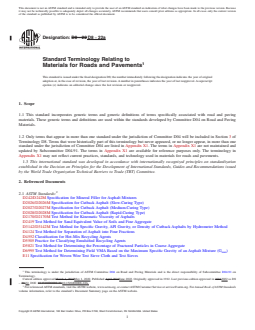
1.1 This standard incorporates generic terms and generic definitions of terms specifically associated with road and paving materials. These generic terms and definitions are used within the standards developed by Committee D04 on Road and Paving Materials.
1.2 Only terms that appear in more than one standard under the jurisdiction of Committee D04 will be included in Section 3 of Terminology D8. Terms that were historically part of this terminology but never appeared, or no longer appear, in more than one standard under the jurisdiction of Committee D04 are listed in Appendix X1. The terms in Appendix X1 are not maintained and updated by Subcommittee D04.91. The terms in Appendix X1 are available for reference purposes only. The terminology in Appendix X1 may not reflect current practices, standards, and technology used in materials for roads and pavements.
1.3 This international standard was developed in accordance with internationally recognized principles on standardization established in the Decision on Principles for the Development of International Standards, Guides and Recommendations issued by the World Trade Organization Technical Barriers to Trade (TBT) Committee.
- Status
- Published
- Publication Date
- 30-Apr-2022
- Technical Committee
- D04 - Road and Paving Materials
- Drafting Committee
- D04.91 - Terminology
Overview
ASTM D8-22a: Standard Terminology Relating to Materials for Roads and Pavements is an essential reference developed by ASTM International. This standard provides comprehensive definitions and descriptions of terms widely used in the road and paving materials industry, specifically those managed by ASTM Committee D04. By harmonizing terminology, ASTM D8-22a enables clear communication and consistency across technical documents, construction projects, specifications, and testing procedures associated with road construction and pavement materials.
This standard:
- Covers generic terms and definitions for materials such as asphalt, aggregates, emulsified asphalts, recycling agents, and mineral fillers.
- Ensures uniform language and understanding in the application, testing, and specification of paving materials.
- Facilitates international cooperation and trade by reflecting globally recognized standardization principles.
Key Topics
ASTM D8-22a addresses foundational concepts and definitions related to materials used for roads and pavements, including but not limited to:
- Asphalt and Bitumen: Definitions of asphalt, asphalt binder, asphalt modifier, and distinctions between asphalt and bitumen.
- Aggregates: Clarity on aggregate types such as coarse aggregate, fine aggregate, gravel, sand, slag, and screenings.
- Asphalt Mixes: Terminology for asphalt mix, asphalt concrete, reclaimed asphalt pavement (RAP), recycled asphalt paving mixtures, and related mixtures.
- Emulsions and Cutbacks: Distinction between anionic and cationic emulsified asphalts, cutback asphalts, and their roles in pavement construction.
- Testing and Physical Properties: Definitions surrounding test methods for viscosity, specific gravity, air voids, voids in mineral aggregate (VMA), and sand equivalent.
- Layering and Applications: Common terms for pavement structures, including prime coat, tack coat, fog seal, slurry seal, and surface treatments.
- Recycling and Sustainability: Concepts like recycling agents, recycled mixtures, and the inclusion of reclaimed materials.
- Supporting Materials: Coverage of mineral fillers, bond breakers, rubble, and materials for stabilization or patching.
The terminology also provides definitions for laboratory specimen preparation, such as lab mixed lab compacted (LMLC), plant mixed lab compacted (PMLC), and reheated mixtures, supporting accurate testing protocols.
Applications
ASTM D8-22a delivers practical value across diverse applications in the road construction and pavement materials sectors, including:
- Standards Development: Provides foundational terminology for drafting and interpreting technical standards in Committee D04's jurisdiction.
- Design and Construction: Assists engineers, specifiers, and contractors in understanding materials specifications, mix designs, and construction practices.
- Testing and Quality Control: Supports laboratory technicians and quality control personnel to accurately carry out and interpret standardized tests (e.g., kinematic viscosity, sand equivalent, specific gravity).
- Product Specification: Enables manufacturers and suppliers to label products and materials consistently, enhancing transparency in procurement and construction.
- Regulatory and Contract Documentation: Establishes a common language for contracts, regulations, and reporting, reducing the risk of misinterpretation.
- Training and Education: Serves as a key resource for training new professionals in the road and pavement materials industry.
By establishing an agreed-upon vocabulary, ASTM D8-22a helps reduce misunderstandings, improve compliance, and facilitate innovation across all phases of road and pavement infrastructure projects.
Related Standards
ASTM D8-22a is referenced by, and closely linked to, various other ASTM standards critical to road and paving materials, including:
- ASTM D242/D242M: Specification for Mineral Filler for Asphalt Mixtures
- ASTM D2026/D2026M, D2027/D2027M, D2028/D2028M: Specifications for Cutback Asphalt (various curing types)
- ASTM D2170/D2170M: Test Method for Kinematic Viscosity of Asphalts
- ASTM D2419: Test Method for Sand Equivalent Value of Soils and Fine Aggregate
- ASTM D3142/D3142M: Test Method for Specific Gravity, API Gravity, or Density of Cutback Asphalts by Hydrometer
- ASTM D4124: Test Method for Separation of Asphalt into Four Fractions
- ASTM D4552: Classification for Hot-Mix Recycling Agents
- ASTM D5505: Practice for Classifying Emulsified Recycling Agents
- ASTM D5821: Test Method for Determining the Percentage of Fractured Particles in Coarse Aggregate
- ASTM D6995: Test Method for Determining Field VMA Based on the Maximum Specific Gravity of an Asphalt Mixture
- ASTM E11: Specification for Woven Wire Test Sieve Cloth and Test Sieves
For further guidance and official usage, always consult the current version of the standard at ASTM International.
Relations
- Effective Date
- 01-Dec-2019
- Effective Date
- 01-May-2019
- Effective Date
- 01-Jan-2018
- Effective Date
- 15-Dec-2017
- Refers
ASTM D242/D242M-09(2014) - Standard Specification for Mineral Filler For Bituminous Paving Mixtures - Effective Date
- 01-Jun-2014
- Effective Date
- 01-Dec-2013
- Effective Date
- 01-Oct-2013
- Effective Date
- 01-Aug-2013
- Effective Date
- 15-Dec-2011
- Effective Date
- 01-Jun-2010
- Effective Date
- 01-Jun-2010
- Effective Date
- 01-Jan-2010
- Effective Date
- 01-Jul-2009
- Effective Date
- 01-Jun-2009
- Effective Date
- 01-Jun-2009
Get Certified
Connect with accredited certification bodies for this standard

Zavod za gradbeništvo Slovenije (ZAG) - Inšpekcija
ZAG inspection body for construction products, structures, and materials.
Sponsored listings
Frequently Asked Questions
ASTM D8-22a is a standard published by ASTM International. Its full title is "Standard Terminology Relating to Materials for Roads and Pavements". This standard covers: SCOPE 1.1 This standard incorporates generic terms and generic definitions of terms specifically associated with road and paving materials. These generic terms and definitions are used within the standards developed by Committee D04 on Road and Paving Materials. 1.2 Only terms that appear in more than one standard under the jurisdiction of Committee D04 will be included in Section 3 of Terminology D8. Terms that were historically part of this terminology but never appeared, or no longer appear, in more than one standard under the jurisdiction of Committee D04 are listed in Appendix X1. The terms in Appendix X1 are not maintained and updated by Subcommittee D04.91. The terms in Appendix X1 are available for reference purposes only. The terminology in Appendix X1 may not reflect current practices, standards, and technology used in materials for roads and pavements. 1.3 This international standard was developed in accordance with internationally recognized principles on standardization established in the Decision on Principles for the Development of International Standards, Guides and Recommendations issued by the World Trade Organization Technical Barriers to Trade (TBT) Committee.
SCOPE 1.1 This standard incorporates generic terms and generic definitions of terms specifically associated with road and paving materials. These generic terms and definitions are used within the standards developed by Committee D04 on Road and Paving Materials. 1.2 Only terms that appear in more than one standard under the jurisdiction of Committee D04 will be included in Section 3 of Terminology D8. Terms that were historically part of this terminology but never appeared, or no longer appear, in more than one standard under the jurisdiction of Committee D04 are listed in Appendix X1. The terms in Appendix X1 are not maintained and updated by Subcommittee D04.91. The terms in Appendix X1 are available for reference purposes only. The terminology in Appendix X1 may not reflect current practices, standards, and technology used in materials for roads and pavements. 1.3 This international standard was developed in accordance with internationally recognized principles on standardization established in the Decision on Principles for the Development of International Standards, Guides and Recommendations issued by the World Trade Organization Technical Barriers to Trade (TBT) Committee.
ASTM D8-22a is classified under the following ICS (International Classification for Standards) categories: 01.040.93 - Civil engineering (Vocabularies); 93.080.10 - Road construction. The ICS classification helps identify the subject area and facilitates finding related standards.
ASTM D8-22a has the following relationships with other standards: It is inter standard links to ASTM D2027/D2027M-19, ASTM D242/D242M-19, ASTM D4124-09(2018), ASTM D3142/D3142M-17, ASTM D242/D242M-09(2014), ASTM D5821-13, ASTM E11-13, ASTM D2027/D2027M-13, ASTM D3142/D3142M-11, ASTM D2027/D2027M-10, ASTM D2028/D2028M-10, ASTM D2026/D2026M-97(2010)e1, ASTM D4124-09, ASTM D2419-09, ASTM D242/D242M-09. Understanding these relationships helps ensure you are using the most current and applicable version of the standard.
ASTM D8-22a is available in PDF format for immediate download after purchase. The document can be added to your cart and obtained through the secure checkout process. Digital delivery ensures instant access to the complete standard document.
Standards Content (Sample)
This international standard was developed in accordance with internationally recognized principles on standardization established in the Decision on Principles for the
Development of International Standards, Guides and Recommendations issued by the World Trade Organization Technical Barriers to Trade (TBT) Committee.
Designation: D8 − 22a
Standard Terminology Relating to
Materials for Roads and Pavements
This standard is issued under the fixed designation D8; the number immediately following the designation indicates the year of original
adoption or, in the case of revision, the year of last revision.Anumber in parentheses indicates the year of last reapproval.Asuperscript
epsilon (´) indicates an editorial change since the last revision or reapproval.
1. Scope D2170/D2170M Test Method for Kinematic Viscosity of
Asphalts
1.1 This standard incorporates generic terms and generic
D2419 Test Method for Sand Equivalent Value of Soils and
definitions of terms specifically associated with road and
Fine Aggregate
paving materials. These generic terms and definitions are used
D3142/D3142M Test Method for Specific Gravity, API
within the standards developed by Committee D04 on Road
Gravity, or Density of Cutback Asphalts by Hydrometer
and Paving Materials.
Method
1.2 Only terms that appear in more than one standard under
D4124 Test Method for Separation of Asphalt into Four
the jurisdiction of Committee D04 will be included in Section
Fractions
3 of Terminology D8. Terms that were historically part of this
D4552 Classification for Hot-Mix Recycling Agents
terminology but never appeared, or no longer appear, in more
D5505 PracticeforClassifyingEmulsifiedRecyclingAgents
than one standard under the jurisdiction of Committee D04 are
D5821 Test Method for Determining the Percentage of
listed in Appendix X1. The terms in Appendix X1 are not
Fractured Particles in Coarse Aggregate
maintained and updated by Subcommittee D04.91. The terms
D6995 Test Method for Determining Field VMA Based on
in Appendix X1 are available for reference purposes only. The
the Maximum Specific Gravity of an Asphalt Mixture
terminology in Appendix X1 may not reflect current practices,
(G )
mm
standards, and technology used in materials for roads and
E11 Specification for Woven Wire Test Sieve Cloth and Test
pavements.
Sieves
1.3 This international standard was developed in accor-
3. Terminology
dance with internationally recognized principles on standard-
ization established in the Decision on Principles for the
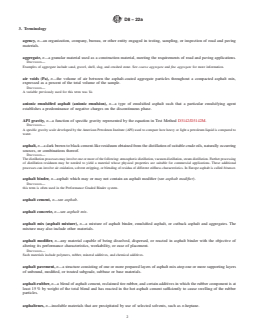
agency, n—an organization, company, bureau, or other entity
Development of International Standards, Guides and Recom-
engaged in testing, sampling, or inspection of road and
mendations issued by the World Trade Organization Technical
paving materials.
Barriers to Trade (TBT) Committee.
aggregate, n—a granular material used as a construction
2. Referenced Documents material, meeting the requirements of road and paving
2 applications.
2.1 ASTM Standards:
DISCUSSION—Examples of aggregate include sand, gravel, shell, slag,
D242/D242M Specification for Mineral Filler for Asphalt
and crushed stone. See coarse aggregate and fine aggregate for more
Mixtures
information.
D2026/D2026M Specification for Cutback Asphalt (Slow-
air voids (Pa), n—the volume of air between the asphalt-
Curing Type)
coated aggregate particles throughout a compacted asphalt
D2027/D2027M Specification for Cutback Asphalt
mix, expressed as a percent of the total volume of the
(Medium-Curing Type)
sample.
D2028/D2028M Specification for Cutback Asphalt (Rapid-
DISCUSSION—A variable previously used for this term was Va.
Curing Type)
anionic emulsified asphalt (anionic emulsion), n—a type of
emulsified asphalt such that a particular emulsifying agent
This terminology is under the jurisdiction of ASTM Committee D04 on Road
and Paving Materials and is the direct responsibility of Subcommittee D04.91 on
establishes a predominance of negative charges on the
Terminology.
discontinuous phase.
Current edition approved May 1, 2022. Published June 2022. Originally
approved in 1912. Last previous edition approved in 2022 as D8 – 22. DOI:
API gravity, n—a function of specific gravity represented by
10.1520/D0008-22A.
the equation in Test Method D3142/D3142M.
For referenced ASTM standards, visit the ASTM website, www.astm.org, or
DISCUSSION—A specific gravity scale developed by the American
contact ASTM Customer Service at service@astm.org. For Annual Book of ASTM
Petroleum Institute (API) used to compare how heavy or light a
Standards volume information, refer to the standard’s Document Summary page on
the ASTM website. petroleum liquid is compared to water.
Copyright © ASTM International, 100 Barr Harbor Drive, PO Box C700, West Conshohocken, PA 19428-2959. United States
D8 − 22a
asphalt, n—a dark brown to black cement-like residuum other bases, that is developed in a molten condition simul-
obtained from the distillation of suitable crude oils, naturally taneously with iron in a blast furnace.
occurring sources, or combinations thereof. DISCUSSION—Depending on the way of cooling of the liquid slag, it
can be distinguished between crystalline air-cooled blast furnace
DISCUSSION—The distillation processes may involve one or more of
(ACBF) slag and glassy granulated blast furnace (GBF) slag.
the following: atmospheric distillation, vacuum distillation, steam
distillation. Further processing of distillation residuum may be needed
bond breaker, n—a material applied between two adjoining
to yield a material whose physical properties are suitable for commer-
materials to prevent adhesion between them.
cial applications. These additional processes can involve air oxidation,
solvent stripping, or blending of residua of different stiffness charac-
bulk density, n—the ratio of the mass of a material to the
teristics. In Europe asphalt is called bitumen.
volume it occupies.
asphalt binder, n—asphalt which may or may not contain an
DISCUSSION—Another common phrase for this term is unit weight.
asphalt modifier (see asphalt modifier).
bulk specific gravity, n—the ratio of the mass of a given
DISCUSSION—this term is often used in the Performance Graded
volume of material, including the impermeable and perme-
Binder system.
able voids, to the mass of an equal volume of water at a
asphalt cement, n—see asphalt.
specified temperature.
DISCUSSION—This term is also sometimes referred to as relative
asphalt concrete, n—see asphalt mix.
density.
asphalt mix (asphalt mixture), n—a mixture of asphalt
cationic emulsified asphalt (cationic emulsion), n—a type of
binder, emulsified asphalt, or cutback asphalt and aggre-
emulsified asphalt such that a particular emulsifying agent
gates. The mixture may also include other materials.
establishes a predominance of positive charges on the
discontinuous phase.
asphalt modifier, n—any material capable of being dissolved,
dispersed, or reacted in asphalt binder with the objective of
cleanability, n—the ability of a raised retroreflective marker to
altering its performance characteristics, workability, or ease
keep its optical surfaces clean under traffic and environmen-
of placement.
tal conditions.
DISCUSSION—Such materials include polymers, rubber, mineral
additives, and chemical additives.
coarse aggregate, n—(1) aggregate predominantly retained on
the 4.75-mm (No. 4) sieve, or (2) the portion of aggregate
asphalt pavement, n—a structure consisting of one or more
retained on the 4.75-mm (No. 4) sieve.
prepared layers of asphalt mix atop one or more supporting
DISCUSSION—The definitions are alternatives to be applied under
layers of unbound, modified, or treated subgrade, subbase or
differing circumstances. Definition (1) is applied to an entire aggregate
base materials.
eitherinanaturalconditionorafterprocessing.Definition(2)isapplied
to a portion of an aggregate. Requirements for properties and grading
asphalt-rubber, n—a blend of asphalt cement, reclaimed tire
should be stated in the specification. Some specifying agencies use
rubber, and certain additives in which the rubber component
alternative sieve sizes to define coarse aggregate, such as the No. 8 and
is at least 15 % by weight of the total blend and has reacted 3
⁄8 in.
in thehot asphalt cement sufficiently to cause swellingofthe
cold-laid plant mix, n—a mixture of cutback asphalt, asphalt
rubber particles.
emulsion,ortarandmineralaggregatepreparedinanasphalt
asphaltenes, n—insoluble materials that are precipitated by
mixingplant,thenspreadandcompactedatthejobsitewhen
use of selected solvents, such as n-heptane. the mixture is at or near ambient temperature.
DISCUSSION—The asphaltene fraction should be identified by the
constant mass, n—the state of a specimen in which the
solvent and solvent-asphalt ratio used.
differenceinmassbetweentwoconsecutiveweighingstaken
bitumen, n—dark brown to black cement-like residuum ob-
at a specified time interval and under specified testing
tained from the distillation of suitable crude oils, naturally
conditions is considered to be negligible.
occurring sources, or combinations thereof.
DISCUSSION—Ifthetimeintervalandnegligibledifferenceinmassare
DISCUSSION—The distillation processes may involve one or more of not specified in a standard, a specimen can typically be assumed to be
the following: atmospheric distillation, vacuum distillation, steam at constant mass when the difference in mass between two consecutive
distillation. Further processing of distillation residuum may be needed weighings taken 1 h apart is less than 0.1 % of the last weighing.
to yield a material whose physical properties are suitable for commer-
crack filler, n—bituminous material used to fill and seal cracks
cial applications. These additional processes can involve air oxidation,
solvent stripping, or blending of residua of different stiffness charac- in existing pavements.
teristics. In North America bitumen is called asphalt.
cutback asphalt, n—asphalt binder which has been blended
bituminous, adj—containing or treated with bitumen (also
with hydrocarbon distillates.
bituminized).
DISCUSSION—Slow-curing materials may be made and are often
DISCUSSION—Examples: bituminous concrete, bituminized felts and referred to as road oils. See Specifications D2026/D2026M, D2027/
fabrics, bituminous pavement. D2027M, and D2028/D2028M.
blast-furnace slag, n—the nonmetallic product, consisting dense-graded aggregate, n—an aggregate that is graded from
essentially of silicates and alumino-silicates of calcium and the maximum size down to and including filler, with the
D8 − 22a
objective of targeting a lower void content in the compacted exactly 1 in. (25.4 mm) distance, including the fractional
aggregate than in an open-graded aggregate. distance between either thereof.
DISCUSSION—See Specification E11 for additional information.
emulsified asphalt (bituminous emulsion), n—(1) a suspen-
sion of minute globules of asphalt material in water or in an
mineral filler, n—finely divided mineral matter such as rock
aqueous solution, or (2) a suspension of minute globules of
dust, slag dust, hydrated lime, hydraulic cement, fly ash,
water or of an aqueous solution in a liquid asphalt material.
loess, or other material predominantly passing the 75-µm
(No. 200) sieve.
fine aggregate, n—(1) aggregate predominately passing the
DISCUSSION—See Specification D242/D242M for a description of
4.75-mm (No. 4) sieve, or (2) the portion of aggregate
suitable materials to be used as mineral filler.
passing the 4.75-mm (No. 4) sieve.
DISCUSSION—The definitions are alternatives to be applied under
mixed-in-place (road mix), n—an asphalt mixture produced
differing circumstances. Definition (1) is applied to an entire aggregate
by mechanically mixing mineral aggregate, cutback asphalt,
eitherinanaturalconditionorafterprocessing.Definition(2)isapplied
emulsified asphalt, or other asphaltic material on the road-
to a portion of an aggregate. Requirements for properties and grading
way.
should be stated in the specifications. Some specifying agencies use
alternative sieve sizes to define fine aggregate, such as the 2.36-mm
native asphalt, n—asphalt occurring as such in nature.
(No. 8) and 9.50-mm ( ⁄8-in.) sieve.
nominal maximum size (of aggregate), n—in specifications
fog seal, n—a light application of asphalt material to an
for, or descriptions of aggregate, the smallest sieve opening
existing pavement as a seal to inhibit raveling, or to seal the
through which the entire amount of the aggregate is permit-
surface, or both.
ted to pass.
DISCUSSION—Emulsified asphalts are typically used and are applied
DISCUSSION—Specifications on aggregates usually stipulate a sieve
by a spraying technique.
opening through which all of the aggregate may, but need not, pass so
fractured face, n—an angular, rough, or broken surface of an that a stated maximum proportion of the aggregate may be retained on
that sieve.Asieve opening so designated is the nominal maximum size.
aggregate particle created by crushing, by other artificial
means, or by nature.
normal temperature,
...
This document is not an ASTM standard and is intended only to provide the user of an ASTM standard an indication of what changes have been made to the previous version. Because
it may not be technically possible to adequately depict all changes accurately, ASTM recommends that users consult prior editions as appropriate. In all cases only the current version
of the standard as published by ASTM is to be considered the official document.
Designation: D8 − 22 D8 − 22a
Standard Terminology Relating to
Materials for Roads and Pavements
This standard is issued under the fixed designation D8; the number immediately following the designation indicates the year of original
adoption or, in the case of revision, the year of last revision. A number in parentheses indicates the year of last reapproval. A superscript
epsilon (´) indicates an editorial change since the last revision or reapproval.
1. Scope
1.1 This standard incorporates generic terms and generic definitions of terms specifically associated with road and paving
materials. These generic terms and definitions are used within the standards developed by Committee D04 on Road and Paving
Materials.
1.2 Only terms that appear in more than one standard under the jurisdiction of Committee D04 will be included in Section 3 of
Terminology D8. Terms that were historically part of this terminology but never appeared, or no longer appear, in more than one
standard under the jurisdiction of Committee D04 are listed in Appendix X1. The terms in Appendix X1 are not maintained and
updated by Subcommittee D04.91. The terms in Appendix X1 are available for reference purposes only. The terminology in
Appendix X1 may not reflect current practices, standards, and technology used in materials for roads and pavements.
1.3 This international standard was developed in accordance with internationally recognized principles on standardization
established in the Decision on Principles for the Development of International Standards, Guides and Recommendations issued
by the World Trade Organization Technical Barriers to Trade (TBT) Committee.
2. Referenced Documents
2.1 ASTM Standards:
D242/D242M Specification for Mineral Filler for Asphalt Mixtures
D2026/D2026M Specification for Cutback Asphalt (Slow-Curing Type)
D2027/D2027M Specification for Cutback Asphalt (Medium-Curing Type)
D2028/D2028M Specification for Cutback Asphalt (Rapid-Curing Type)
D2170/D2170M Test Method for Kinematic Viscosity of Asphalts
D2419 Test Method for Sand Equivalent Value of Soils and Fine Aggregate
D3142/D3142M Test Method for Specific Gravity, API Gravity, or Density of Cutback Asphalts by Hydrometer Method
D4124 Test Method for Separation of Asphalt into Four Fractions
D4552 Classification for Hot-Mix Recycling Agents
D5505 Practice for Classifying Emulsified Recycling Agents
D5821 Test Method for Determining the Percentage of Fractured Particles in Coarse Aggregate
D6995 Test Method for Determining Field VMA Based on the Maximum Specific Gravity of an Asphalt Mixture (G )
mm
E11 Specification for Woven Wire Test Sieve Cloth and Test Sieves
This terminology is under the jurisdiction of ASTM Committee D04 on Road and Paving Materials and is the direct responsibility of Subcommittee D04.91 on
Terminology.
Current edition approved March 1, 2022May 1, 2022. Published April 2022June 2022. Originally approved in 1912. Last previous edition approved in 20212022 as D8
– 21.22. DOI: 10.1520/D0008-22.10.1520/D0008-22A.
For referenced ASTM standards, visit the ASTM website, www.astm.org, or contact ASTM Customer Service at service@astm.org. For Annual Book of ASTM Standards
volume information, refer to the standard’s Document Summary page on the ASTM website.
Copyright © ASTM International, 100 Barr Harbor Drive, PO Box C700, West Conshohocken, PA 19428-2959. United States
D8 − 22a
3. Terminology
agency, n—an organization, company, bureau, or other entity engaged in testing, sampling, or inspection of road and paving
materials.
aggregate, n—a granular material used as a construction material, meeting the requirements of road and paving applications.
DISCUSSION—
Examples of aggregate include sand, gravel, shell, slag, and crushed stone. See coarse aggregate and fine aggregate for more information.
air voids (Pa), n—the volume of air between the asphalt-coated aggregate particles throughout a compacted asphalt mix,
expressed as a percent of the total volume of the sample.
DISCUSSION—
A variable previously used for this term was Va.
anionic emulsified asphalt (anionic emulsion), n—a type of emulsified asphalt such that a particular emulsifying agent
establishes a predominance of negative charges on the discontinuous phase.
API gravity, n—a function of specific gravity represented by the equation in Test Method D3142/D3142M.
DISCUSSION—
A specific gravity scale developed by the American Petroleum Institute (API) used to compare how heavy or light a petroleum liquid is compared to
water.
asphalt, n—a dark brown to black cement-like residuum obtained from the distillation of suitable crude oils, naturally occurring
sources, or combinations thereof.
DISCUSSION—
The distillation processes may involve one or more of the following: atmospheric distillation, vacuum distillation, steam distillation. Further processing
of distillation residuum may be needed to yield a material whose physical properties are suitable for commercial applications. These additional
processes can involve air oxidation, solvent stripping, or blending of residua of different stiffness characteristics. In Europe asphalt is called bitumen.
asphalt binder, n—asphalt which may or may not contain an asphalt modifier (see asphalt modifier).
DISCUSSION—
this term is often used in the Performance Graded Binder system.
asphalt cement, n—see asphalt.
asphalt concrete, n—see asphalt mix.
asphalt mix (asphalt mixture), n—a mixture of asphalt binder, emulsified asphalt, or cutback asphalt and aggregates. The
mixture may also include other materials.
asphalt modifier, n—any material capable of being dissolved, dispersed, or reacted in asphalt binder with the objective of
altering its performance characteristics, workability, or ease of placement.
DISCUSSION—
Such materials include polymers, rubber, mineral additives, and chemical additives.
asphalt pavement, n—a structure consisting of one or more prepared layers of asphalt mix atop one or more supporting layers
of unbound, modified, or treated subgrade, subbase or base materials.
asphalt-rubber, n—a blend of asphalt cement, reclaimed tire rubber, and certain additives in which the rubber component is at
least 15 % by weight of the total blend and has reacted in the hot asphalt cement sufficiently to cause swelling of the rubber
particles.
asphaltenes, n—insoluble materials that are precipitated by use of selected solvents, such as n-heptane.
D8 − 22a
DISCUSSION—
The asphaltene fraction should be identified by the solvent and solvent-asphalt ratio used.
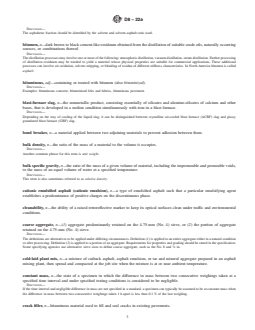
bitumen, n—dark brown to black cement-like residuum obtained from the distillation of suitable crude oils, naturally occurring
sources, or combinations thereof.
DISCUSSION—
The distillation processes may involve one or more of the following: atmospheric distillation, vacuum distillation, steam distillation. Further processing
of distillation residuum may be needed to yield a material whose physical properties are suitable for commercial applications. These additional
processes can involve air oxidation, solvent stripping, or blending of residua of different stiffness characteristics. In North America bitumen is called
asphalt.
bituminous, adj—containing or treated with bitumen (also bituminized).
DISCUSSION—
Examples: bituminous concrete, bituminized felts and fabrics, bituminous pavement.
blast-furnace slag, n—the nonmetallic product, consisting essentially of silicates and alumino-silicates of calcium and other
bases, that is developed in a molten condition simultaneously with iron in a blast furnace.
DISCUSSION—
Depending on the way of cooling of the liquid slag, it can be distinguished between crystalline air-cooled blast furnace (ACBF) slag and glassy
granulated blast furnace (GBF) slag.
bond breaker, n—a material applied between two adjoining materials to prevent adhesion between them.
bulk density, n—the ratio of the mass of a material to the volume it occupies.
DISCUSSION—
Another common phrase for this term is unit weight.
bulk specific gravity, n—the ratio of the mass of a given volume of material, including the impermeable and permeable voids,
to the mass of an equal volume of water at a specified temperature.
DISCUSSION—
This term is also sometimes referred to as relative density.
cationic emulsified asphalt (cationic emulsion), n—a type of emulsified asphalt such that a particular emulsifying agent
establishes a predominance of positive charges on the discontinuous phase.
cleanability, n—the ability of a raised retroreflective marker to keep its optical surfaces clean under traffic and environmental
conditions.
coarse aggregate, n—(1) aggregate predominantly retained on the 4.75-mm (No. 4) sieve, or (2) the portion of aggregate
retained on the 4.75-mm (No. 4) sieve.
DISCUSSION—
The definitions are alternatives to be applied under differing circumstances. Definition (1) is applied to an entire aggregate either in a natural condition
or after processing. Definition (2) is applied to a portion of an aggregate. Requirements for properties and grading should be stated in the specification.
Some specifying agencies use alternative sieve sizes to define coarse aggregate, such as the No. 8 and ⁄8 in.
cold-laid plant mix, n—a mixture of cutback asphalt, asphalt emulsion, or tar and mineral aggregate prepared in an asphalt
mixing plant, then spread and compacted at the job site when the mixture is at or near ambient temperature.
constant mass, n—the state of a specimen in which the difference in mass between two consecutive weighings taken at a
specified time interval and under specified testing conditions is considered to be negligible.
DISCUSSION—
If the time interval and negligible difference in mass are not specified in a standard, a specimen can typically be assumed to be at constant mass when
the difference in mass between two consecutive weighings taken 1 h apart is less than 0.1 % of the last weighing.
crack filler, n—bituminous material used to fill and seal cracks in existing pavements.
D8 − 22a
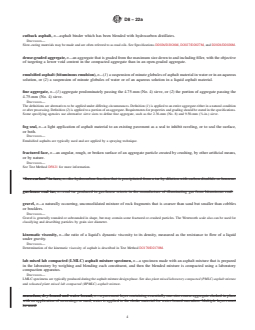
cutback asphalt, n—asphalt binder which has been blended with hydrocarbon distillates.
DISCUSSION—
Slow-curing materials may be made and are often referred to as road oils. See Specifications D2026/D2026M, D2027/D2027M, and D2028/D2028M.
dense-graded aggregate, n—an aggregate that is graded from the maximum size down to and including filler, with the objective
of targeting a lower void content in the compacted aggregate than in an open-graded aggregate.
emulsified asphalt (bituminous emulsion), n—(1) a suspension of minute globules of asphalt material in water or in an aqueous
solution, or (2) a suspension of minute globules of water or of an aqueous solution in a liquid asphalt material.
fine aggregate, n—(1) aggregate predominately passing the 4.75-mm (No. 4) sieve, or (2) the portion of aggregate passing the
4.75-mm (No. 4) sieve.
DISCUSSION—
The definitions are alternatives to be applied under differing circumstances. Definition (1) is applied to an entire aggregate either in a natural condition
or after processing. Definition (2) is applied to a portion of an aggregate. Requirements for properties and grading should be stated in the specifications.
Some specifying agencies use alternative sieve sizes to define fine aggregate, such as the 2.36-mm (No. 8) and 9.50-mm ( ⁄8-in.) sieve.
fog seal, n—a light application of asphalt material to an existing pavement as a seal to inhibit raveling, or to seal the surface,
or both.
DISCUSSION—
Emulsified asphalts are typically used and are applied by a spraying technique.
fractured face, n—an angular, rough, or broken surface of an aggregate particle created by crushing, by other artificial means,
or by nature.
DISCUSSION—
See Test Method D5821 for more information.
“free-carbon” in tars, n—the hydrocarbon fraction that is precipitated from a tar by dilution with carbon disulfide or benzene.
gas-house coal tar, n—coal tar produced in gas-house retorts in the manufacture of illuminating gas from bituminous coal.
gravel, n—a naturally occurring, unconsolidated mixture of rock fragments that is coarser than sand but smaller than cobbles
or boulders.
DISCUSSION—
Gravel is generally rounded or subrounded in shape, but may contain some fractured or crushed particles. The Wentworth scale also can be used for
classifying and describing particles by grain size diameter.
kinematic viscosity, n—the ratio of a liquid’s dynamic viscosity to its density, measured as the resistance to flow of a liquid
under gravity.
DISCUSSION—
Determination of the kinematic viscosity of asphalt is described in Test Method D2170/D2170M.
lab mixed lab compacted (LMLC) asphalt mixture specimen, n—a specimen made with an asphalt mixture that is prepared
in the laboratory by weighing and blending each constituent, and then the blended mixture is compacted using a laboratory
compaction apparatus.
DISCUSSION—
LMLC specimens are typically produced during the asphalt mixture design phase. See also plant mixed laboratory compacted (PMLC) asphalt mixture
and reheated plant mixed lab compacted (RPMLC) asphalt mixture.
macadam, dry-bound and water bound, n—a pavement layer containing essentially one-size coarse aggregate choked in place
with an application of
...