

ASTM C530-23
(Specification)Standard Specification for Structural Clay Nonloadbearing Screen Tile
General Information
- Abstract
ABSTRACT
This specification covers the standard for unglazed, structural clay nonloadbearing screen tile. This standard, however, does not cover the use of results from testing of tile extracted from masonry structures. Specimens in this standard shall be manufactured from clay, shale or similar naturally occurring substances and shall undergo firing. Two types of tiles shall be covered in this specification: the type STX and type STA. Tiles shall adhere to physical properties such durability. All the tiles shall be reasonably free from laminations and other defects.
SCOPE
1.1 This specification covers unglazed, structural clay, nonloadbearing screen tile.
1.2 The property requirements of this specification apply at the time of purchase. The use of results from testing of tile extracted from masonry structures for determining conformance or nonconformance to the property requirements (Section 6) of this specification is beyond the scope of this standard.
1.3 Tile covered by this specification are manufactured from clay, shale, or similar naturally occurring substances and subjected to a heat treatment at elevated temperatures (firing). The heat treatment must develop sufficient fired bond between the particulate constituents to provide the strength and durability requirements of this specification. (See firing and fired bond in Terminology C1232).
1.4 The text of this specification references notes and footnotes which provide explanatory material. These notes and footnotes (excluding those in tables and figures) shall not be considered as requirements of the specification.
1.5 The values stated in inch-pound units are to be regarded as standard. The values given in parentheses are mathematical conversions to SI units that are provided for information only and are not considered standard.
1.6 This international standard was developed in accordance with internationally recognized principles on standardization established in the Decision on Principles for the Development of International Standards, Guides and Recommendations issued by the World Trade Organization Technical Barriers to Trade (TBT) Committee.
- Status
- Published
- Publication Date
- 28-Feb-2023
- Technical Committee
- C15 - Masonry – Manufactured Masonry Units, Mortars and Grouts
- Drafting Committee
- C15.02 - Brick and Structural Clay Tile
Buy Documents
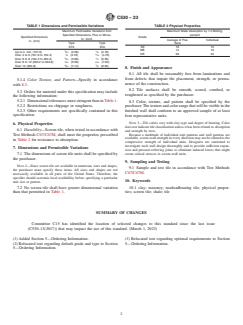


ASTM C530-23 - Standard Specification for Structural Clay Nonloadbearing Screen Tile
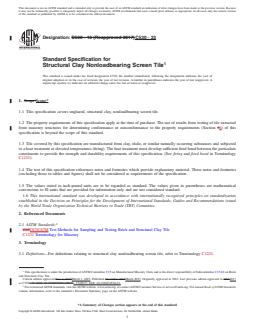
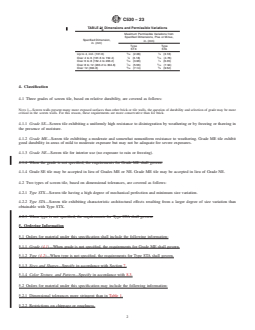

REDLINE ASTM C530-23 - Standard Specification for Structural Clay Nonloadbearing Screen Tile
Overview
ASTM C530-23: Standard Specification for Structural Clay Nonloadbearing Screen Tile provides comprehensive guidelines for unglazed structural clay screen tiles intended for nonloadbearing applications in masonry construction. Developed by ASTM International, this standard focuses on tile units manufactured from natural materials such as clay or shale, which are subjected to high-temperature firing to ensure required durability and performance. The standard also distinguishes between different types and grades of tiles, offering detailed requirements on physical properties, dimensions, appearance, and ordering options for architects, specifiers, and builders.
Key Topics
Scope and Use
ASTM C530-23 specifically covers unglazed, structural clay, nonloadbearing screen tiles used in masonry. The document does not address testing of tiles extracted from completed masonry walls.Material and Manufacturing
Screen tiles must be made from clay, shale, or similar naturally occurring substances and undergo a heat treatment (firing) to develop a strong, durable fired bond between their components.Types and Grades
The standard defines:- Three Grades based on durability:
- SE (Severe Exposure): High resistance to weathering, rain, freezing, and thawing.
- ME (Moderate Exposure): Suitable for areas with mild to moderate conditions.
- NE (No Exposure): For interior use with no exposure to rain or freezing.
- Two Types based on dimensional tolerances:
- Type STX: High mechanical precision and minimal size variation.
- Type STA: Allows more variation, providing architectural effects.
- Three Grades based on durability:
Physical Properties
Tiles must meet specific resistance to water absorption to ensure durability in their intended environment. The maximum permissible water absorption differs by grade.Dimensions and Tolerances
Permissible size variations are defined to maintain quality across the different types, with stricter tolerances for STX grades.Appearance and Finish
Tiles should be reasonably free from laminations and defects. Surface finish, color, texture, and pattern must be specified by the purchaser to match project requirements.Ordering and Optional Requirements
Orders should clearly state grade, type, sizes, shapes, color, and any additional requirements like tighter dimensional tolerances or surface conditions.
Applications
Structural clay nonloadbearing screen tiles manufactured according to ASTM C530-23 are utilized in:
- Architectural Screen Walls: Providing ventilation, partial privacy, and decorative facades in commercial and residential structures.
- Interior Partition Walls: Nonstructural divisions where loadbearing is not required.
- Aesthetic Features: Creating patterns, light screens, and shading elements for both exterior and interior uses.
- Historic Restoration: Specifying compatible materials for the renovation or repair of heritage masonry structures.
By selecting tiles that match the correct grade and type, specifiers ensure suitability for climatic exposures and design intent, helping to maintain longevity and appearance in diverse masonry applications.
Related Standards
- ASTM C67/C67M: Test Methods for Sampling and Testing Brick and Structural Clay Tile
- ASTM C1232: Terminology for Masonry
- Other ASTM Masonry Standards: Addressing loadbearing tile, fired clay products, and glazed tile requirements
These related documents provide supplementary testing methods and definitions to support compliance with ASTM C530-23, ensuring quality and performance in masonry construction.
Keywords: ASTM C530-23, structural clay tile, nonloadbearing screen tile, masonry standards, clay screen tile, tile durability, ASTM standards, screen wall, architectural masonry, tile specification.
Relations
- Effective Date
- 15-Dec-2023
- Refers
ASTM C67/C67M-19 - Standard Test Methods for Sampling and Testing Brick and Structural Clay Tile - Effective Date
- 01-Jul-2019
- Refers
ASTM C67/C67M-18 - Standard Test Methods for Sampling and Testing Brick and Structural Clay Tile - Effective Date
- 01-Feb-2018
- Effective Date
- 01-Jun-2017
- Effective Date
- 01-Sep-2015
- Effective Date
- 01-Jun-2015
- Effective Date
- 01-Jun-2012
- Effective Date
- 15-Dec-2010
- Effective Date
- 15-Jun-2010
- Effective Date
- 01-May-2010
- Effective Date
- 01-Jan-2010
- Effective Date
- 15-Dec-2009
- Effective Date
- 01-Jul-2009
- Effective Date
- 01-Feb-2009
- Effective Date
- 01-Jul-2008
Buy Documents
ASTM C530-23 - Standard Specification for Structural Clay Nonloadbearing Screen Tile
REDLINE ASTM C530-23 - Standard Specification for Structural Clay Nonloadbearing Screen Tile
Frequently Asked Questions
ASTM C530-23 is a technical specification published by ASTM International. Its full title is "Standard Specification for Structural Clay Nonloadbearing Screen Tile". This standard covers: ABSTRACT This specification covers the standard for unglazed, structural clay nonloadbearing screen tile. This standard, however, does not cover the use of results from testing of tile extracted from masonry structures. Specimens in this standard shall be manufactured from clay, shale or similar naturally occurring substances and shall undergo firing. Two types of tiles shall be covered in this specification: the type STX and type STA. Tiles shall adhere to physical properties such durability. All the tiles shall be reasonably free from laminations and other defects. SCOPE 1.1 This specification covers unglazed, structural clay, nonloadbearing screen tile. 1.2 The property requirements of this specification apply at the time of purchase. The use of results from testing of tile extracted from masonry structures for determining conformance or nonconformance to the property requirements (Section 6) of this specification is beyond the scope of this standard. 1.3 Tile covered by this specification are manufactured from clay, shale, or similar naturally occurring substances and subjected to a heat treatment at elevated temperatures (firing). The heat treatment must develop sufficient fired bond between the particulate constituents to provide the strength and durability requirements of this specification. (See firing and fired bond in Terminology C1232). 1.4 The text of this specification references notes and footnotes which provide explanatory material. These notes and footnotes (excluding those in tables and figures) shall not be considered as requirements of the specification. 1.5 The values stated in inch-pound units are to be regarded as standard. The values given in parentheses are mathematical conversions to SI units that are provided for information only and are not considered standard. 1.6 This international standard was developed in accordance with internationally recognized principles on standardization established in the Decision on Principles for the Development of International Standards, Guides and Recommendations issued by the World Trade Organization Technical Barriers to Trade (TBT) Committee.
ABSTRACT This specification covers the standard for unglazed, structural clay nonloadbearing screen tile. This standard, however, does not cover the use of results from testing of tile extracted from masonry structures. Specimens in this standard shall be manufactured from clay, shale or similar naturally occurring substances and shall undergo firing. Two types of tiles shall be covered in this specification: the type STX and type STA. Tiles shall adhere to physical properties such durability. All the tiles shall be reasonably free from laminations and other defects. SCOPE 1.1 This specification covers unglazed, structural clay, nonloadbearing screen tile. 1.2 The property requirements of this specification apply at the time of purchase. The use of results from testing of tile extracted from masonry structures for determining conformance or nonconformance to the property requirements (Section 6) of this specification is beyond the scope of this standard. 1.3 Tile covered by this specification are manufactured from clay, shale, or similar naturally occurring substances and subjected to a heat treatment at elevated temperatures (firing). The heat treatment must develop sufficient fired bond between the particulate constituents to provide the strength and durability requirements of this specification. (See firing and fired bond in Terminology C1232). 1.4 The text of this specification references notes and footnotes which provide explanatory material. These notes and footnotes (excluding those in tables and figures) shall not be considered as requirements of the specification. 1.5 The values stated in inch-pound units are to be regarded as standard. The values given in parentheses are mathematical conversions to SI units that are provided for information only and are not considered standard. 1.6 This international standard was developed in accordance with internationally recognized principles on standardization established in the Decision on Principles for the Development of International Standards, Guides and Recommendations issued by the World Trade Organization Technical Barriers to Trade (TBT) Committee.
ASTM C530-23 is classified under the following ICS (International Classification for Standards) categories: 81.080 - Refractories. The ICS classification helps identify the subject area and facilitates finding related standards.
ASTM C530-23 has the following relationships with other standards: It is inter standard links to ASTM C1232-23, ASTM C67/C67M-19, ASTM C67/C67M-18, ASTM C1232-17, ASTM C1232-15a, ASTM C1232-15, ASTM C1232-12, ASTM C1232-10c, ASTM C1232-10b, ASTM C1232-10a, ASTM C1232-10, ASTM C1232-09b, ASTM C1232-09a, ASTM C1232-09, ASTM C1232-08. Understanding these relationships helps ensure you are using the most current and applicable version of the standard.
ASTM C530-23 is available in PDF format for immediate download after purchase. The document can be added to your cart and obtained through the secure checkout process. Digital delivery ensures instant access to the complete standard document.
Standards Content (Sample)
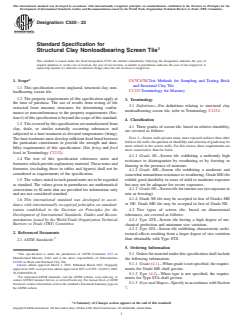
This international standard was developed in accordance with internationally recognized principles on standardization established in the Decision on Principles for the
Development of International Standards, Guides and Recommendations issued by the World Trade Organization Technical Barriers to Trade (TBT) Committee.
Designation: C530 − 23
Standard Specification for
Structural Clay Nonloadbearing Screen Tile
This standard is issued under the fixed designation C530; the number immediately following the designation indicates the year of
original adoption or, in the case of revision, the year of last revision. A number in parentheses indicates the year of last reapproval. A
superscript epsilon (´) indicates an editorial change since the last revision or reapproval.
1. Scope* C67/C67M Test Methods for Sampling and Testing Brick
and Structural Clay Tile
1.1 This specification covers unglazed, structural clay, non-
C1232 Terminology for Masonry
loadbearing screen tile.
1.2 The property requirements of this specification apply at
3. Terminology
the time of purchase. The use of results from testing of tile
3.1 Definitions—For definitions relating to structural clay
extracted from masonry structures for determining confor-
nonloadbearing screen tile, refer to Terminology C1232.
mance or nonconformance to the property requirements (Sec-
tion 6) of this specification is beyond the scope of this standard.
4. Classification
1.3 Tile covered by this specification are manufactured from
4.1 Three grades of screen tile, based on relative durability,
clay, shale, or similar naturally occurring substances and
are covered as follows:
subjected to a heat treatment at elevated temperatures (firing).
NOTE 1—Screen walls present many more exposed surfaces than other
The heat treatment must develop sufficient fired bond between
brick or tile walls, the question of durability and selection of grade may be
the particulate constituents to provide the strength and dura-
more critical in the screen walls. For this reason, these requirements are
bility requirements of this specification. (See firing and fired
more conservative than for brick.
bond in Terminology C1232).
4.1.1 Grade SE—Screen tile exhibiting a uniformly high
1.4 The text of this specification references notes and
resistance to disintegration by weathering or by freezing or
footnotes which provide explanatory material. These notes and
thawing in the presence of moisture.
footnotes (excluding those in tables and figures) shall not be
4.1.2 Grade ME—Screen tile exhibiting a moderate and
considered as requirements of the specification.
somewhat nonuniform resistance to weathering. Grade ME tile
1.5 The values stated in inch-pound units are to be regarded exhibit good durability in areas of mild to moderate exposure
as standard. The values given in parentheses are mathematical but may not be adequate for severe exposures.
conversions to SI units that are provided for information only 4.1.3 Grade NE—Screen tile for interior use (no exposure to
and are not considered standard. rain or freezing).
4.1.4 Grade SE tile may be accepted in lieu of Grades ME
1.6 This international standard was developed in accor-
or NE. Grade ME tile may be accepted in lieu of Grade NE.
dance with internationally recognized principles on standard-
ization established in the Decision on Principles for the 4.2 Two types of screen tile, based on dimensional
Development of International Standards, Guides and Recom-
tolerances, are covered as follows:
mendations issued by the World Trade Organization Technical 4.2.1 Type STX—Screen tile having a high degree of me-
Barriers to Trade (TBT) Committee.
chanical perfection and minimum size variation.
4.2.2 Type STA—Screen tile exhibiting characteristic archi-
2. Referenced Documents
tectural effects resulting from a larger degree of size variation
than obtainable with Type STX.
2.1 ASTM Standards:
5. Ordering Information
This specification is under the jurisdiction of ASTM Committee C15 on
5.1 Orders for material under this specification shall include
Manufactured Masonry Units and is the direct responsibility of Subcommittee
the following information:
C15.02 on Brick and Structural Clay Tile.
5.1.1 Grade (4.1)—When grade is not specified, the require-
Current edition approved March 1, 2023. Published March 2023. Originally
ments for Grade ME shall govern.
approved in 1963. Last previous edition approved in 2017 as C530– 13(2017). DOI:
10.1520/C0530-23.
5.1.2 Type (4.2)—When type is not specified, the require-
For referenced ASTM standards, visit the ASTM website, www.astm.org, or
ments for Type STA shall govern.
contact ASTM Customer Service at service@astm.org. For Annual Book of ASTM
5.1.3 Sizes and Shapes—Specify in accordance with Section
Standards volume information, refer to the standard’s Document Summary page on
the ASTM website. 7.
*A Summary of Changes section appears at the end of this standard
Copyright © ASTM International, 100 Barr Harbor Drive, PO Box C700, West Consho
...
This document is not an ASTM standard and is intended only to provide the user of an ASTM standard an indication of what changes have been made to the previous version. Because
it may not be technically possible to adequately depict all changes accurately, ASTM recommends that users consult prior editions as appropriate. In all cases only the current version
of the standard as published by ASTM is to be considered the official document.
Designation: C530 − 13 (Reapproved 2017) C530 − 23
Standard Specification for
Structural Clay Nonloadbearing Screen Tile
This standard is issued under the fixed designation C530; the number immediately following the designation indicates the year of
original adoption or, in the case of revision, the year of last revision. A number in parentheses indicates the year of last reapproval. A
superscript epsilon (´) indicates an editorial change since the last revision or reapproval.
1. Scope Scope*
1.1 This specification covers unglazed, structural clay, nonloadbearing screen tile.
1.2 The property requirements of this specification apply at the time of purchase. The use of results from testing of tile extracted
from masonry structures for determining conformance or nonconformance to the property requirements (Section 56) of this
specification is beyond the scope of this standard.
1.3 Tile covered by this specification are manufactured from clay, shale, or similar naturally occurring substances and subjected
to a heat treatment at elevated temperatures (firing). The heat treatment must develop sufficient fired bond between the particulate
constituents to provide the strength and durability requirements of this specification. (See firing and fired bond in Terminology
C1232).
1.4 The text of this specification references notes and footnotes which provide explanatory material. These notes and footnotes
(excluding those in tables and figures) shall not be considered as requirements of the specification.
1.5 The values stated in inch-pound units are to be regarded as standard. The values given in parentheses are mathematical
conversions to SI units that are provided for information only and are not considered standard.
1.6 This international standard was developed in accordance with internationally recognized principles on standardization
established in the Decision on Principles for the Development of International Standards, Guides and Recommendations issued
by the World Trade Organization Technical Barriers to Trade (TBT) Committee.
2. Referenced Documents
2.1 ASTM Standards:
C67C67/C67M Test Methods for Sampling and Testing Brick and Structural Clay Tile
C1232 Terminology for Masonry
3. Terminology
3.1 Definitions—For definitions relating to structural clay nonloadbearing screen tile, refer to Terminology C1232.
This specification is under the jurisdiction of ASTM Committee C15 on Manufactured Masonry Units and is the direct responsibility of Subcommittee C15.02 on Brick
and Structural Clay Tile.
Current edition approved Dec. 1, 2017March 1, 2023. Published December 2013March 2023. Originally approved in 1963. Last previous edition approved in 20132017
as C530– 13. DOI: 10.1520/C0530-13R17.– 13(2017). DOI: 10.1520/C0530-23.
For referenced ASTM standards, visit the ASTM website, www.astm.org, or contact ASTM Customer Service at service@astm.org. For Annual Book of ASTM Standards
volume information, refer to the standard’s Document Summary page on the ASTM website.
*A Summary of Changes section appears at the end of this standard
Copyright © ASTM International, 100 Barr Harbor Drive, PO Box C700, West Conshohocken, PA 19428-2959. United States
C530 − 23
TABLE 21 Dimensions and Permissible Variations
Maximum Permissible Variations from
Specified Dimensions, Plus or Minus,
Specified Dimension,
in. (mm)
in. (mm)
Type Type
STX STA
3 1
Up to 4, incl. (101.6) ⁄32 (2.38) ⁄8 (3.18)
1 3
Over 4 to 6 (101.6 to 152.4) ⁄8 (3.18) ⁄16 (4.76)
5 1
Over 6 to 8 (152.4 to 203.2) ⁄32 (3.96) ⁄4 (6.35)
7 5
Over 8 to 12 (203.2 to 304.8) ⁄32 (5.56) ⁄16 (7.94)
9 3
Over 12 (304.8) ⁄32 (7.14) ⁄8 (9.52)
4. Classification
4.1 Three grades of screen tile, based on relative durability, are covered as follows:
NOTE 1—Screen walls present many more exposed surfaces than other brick or tile walls, the question of durability and selection of grade may be more
critical in the screen walls. For this reason, these requirements are more conservative than for brick.
4.1.1 Grade SE—Screen tile exhibiting a uniformly high resistance to disintegration by weathering or by freezing or thawing in
the presence of moisture.
4.1.2 Grade ME—Screen tile exhibiting a moderate and somewhat nonuniform resistance to weathering. Grade ME tile exhibit
good durability in areas of mild to moderate exposure but may not be adequate for severe exposures.
4.1.3 Grade NE—Screen tile for interior use (no exposure to rain or freezing).
4.1.4 When the grade is not specified, the requirements for Grade ME shall govern.
4.1.4 Grade SE tile may be accepted in lieu of Grades ME or NE. Grade ME tile may be accepted in lieu of Grade NE.
4.2 Two types of screen tile, based on dimensional tolerances, are covered as follows:
4.2.1 Type STX—Screen tile having a high degree of mechanical perfection and minimum size variation.
4.2.2 Type STA—Screen tile exh
...