

ASTM C1298-21
(Guide)Standard Guide for Design and Construction of Brick Liners for Industrial Chimneys
General Information
- Abstract
SIGNIFICANCE AND USE
4.1 History:
4.1.1 For many years, brick liners have been used with an excellent record of performance. For the most part, however, the design and construction of brick liners has been based on past industry practice due to the lack of available information and knowledge of the physical properties of the brick and mortar, the thermal and seismic behavior of brick liners, and many related characteristics that were not properly or accurately defined.
4.1.2 The use of scrubbers, which lower gas temperatures and introduce highly corrosive condensates into the flue gas system, requires many new design considerations. The effect that scrubbers have on brick liners is an ongoing area of study, since a number of liners have experienced growth- and deflection-related problems which may be attributable, at least in part, to nonuniform temperature and moisture conditions within the liners.
4.2 Purpose—The recommendations contained herein represent current industry practices and serve to define the pertinent considerations that should be followed in the design and construction of brick chimney liners.
SCOPE
1.1 This guide covers procedures for the design, construction, and serviceability of brick liners for industrial chimneys. The structural design criteria are applicable to vertical masonry cantilever structures supported only at their base, either by a foundation, a concrete pedestal, or by some means from the outer concrete shell. Excluded from direct consideration are single-wythe, sectional brick linings that are supported on a series of corbels cast in the outer chimney shell.
1.2 The values stated in inch-pound units are to be regarded as the standard. The values given in parentheses are for information only.
1.3 This standard does not purport to address all of the safety concerns, if any, associated with its use. It is the responsibility of the user of this standard to establish appropriate safety, health, and environmental practices and determine the applicability of regulatory limitations prior to use.
1.4 This international standard was developed in accordance with internationally recognized principles on standardization established in the Decision on Principles for the Development of International Standards, Guides and Recommendations issued by the World Trade Organization Technical Barriers to Trade (TBT) Committee.
- Status
- Published
- Publication Date
- 31-May-2021
- Technical Committee
- C15 - Masonry – Manufactured Masonry Units, Mortars and Grouts
- Drafting Committee
- C15.05 - Masonry Assemblies
Buy Documents
ASTM C1298-21 - Standard Guide for Design and Construction of Brick Liners for Industrial Chimneys
REDLINE ASTM C1298-21 - Standard Guide for Design and Construction of Brick Liners for Industrial Chimneys
Overview
ASTM C1298-21: Standard Guide for Design and Construction of Brick Liners for Industrial Chimneys is a vital reference developed by ASTM International. This guide outlines recommended industry practices for the design, construction, and serviceability of brick chimney liners in industrial settings. Brick liners have a proven record of performance, but evolving power plant technologies and emission controls-such as wet scrubbers that alter temperature and introduce corrosive condensates-demand robust and up-to-date design considerations. This guide addresses key aspects involved in specifying, designing, and constructing brick liners, focusing on vertical masonry cantilever structures that are supported at their base.
Key Topics
Material Selection
- Guidance on selecting chemical-resistant bricks (as per ASTM C980) and compatible mortars based on the specific flue gas environment and application.
- Consideration of material properties to withstand the operational conditions, including varied temperatures and corrosive gases.
Construction Requirements
- Best practices for storing, handling, and installing bricks and mortar.
- Procedures for proper brick sizing, bonding, and joint finishing to minimize cracking and ensure liner integrity.
- Requirements for banding, tolerances, and sequencing to achieve structural stability and performance.
Design Criteria
- Guidelines for calculating masonry strength and structural loads, taking into account dead load, seismic, and wind stresses.
- Recommendations for liner geometry, such as wall thickness, segment heights, diameter-to-thickness ratios, and managing clearances.
- Standards for incorporating openings, reinforcement (bands, buckstays), and appurtenances into brick liner design.
Seismic and Thermal Analysis
- Procedures for seismic analysis using response spectrum or equivalent static lateral force methods.
- Recognition of thermal stresses and differential movements and related clearance requirements.
Serviceability and Inspection
- Ensuring long-term functionality by considering accessibility for inspection and maintenance within the annular space.
Applications
ASTM C1298-21 is designed for professionals involved in the design, specification, and construction of industrial chimney brick liners, especially in power plants, chemical processing facilities, and other industries where flue gas ductwork requires robust corrosion and temperature-resistant lining solutions. Typical applications include:
- New Construction: Establishing best practices for newly constructed masonry-lined industrial chimneys.
- Chimney Upgrades & Repairs: Guiding modifications or repairs where environmental controls (scrubbers) or operational changes impact liner requirements.
- Compliance & Safety: Supporting compliance with relevant safety, health, and environmental regulations.
- Performance Optimization: Improving longevity and durability of chimney liners, especially under variable and demanding operational conditions.
Related Standards
To achieve comprehensive compliance and best results, this guide references and should be used in conjunction with several related standards:
- ASTM C980: Specification for Industrial Chimney Lining Brick, detailing requirements for bricks suitable for industrial flue linings.
- ASTM C466 (withdrawn 2021): Specification for Chemically Setting Silicate Chemical-Resistant Mortars.
- ASTM C395 (withdrawn 2021): Specification for Chemical-Resistant Resin Mortars.
- ACI 307: Practice for the Design and Construction of Cast-In-Place Reinforced Concrete Chimneys.
- ASCE 7: Minimum Design Loads for Buildings and Other Structures, providing guidelines for seismic and wind load calculations.
- TMS 402/602: Building Code Requirements and Specifications for Masonry Structures.
- 1991 Uniform Building Code: For additional structural loading and safety provisions.
Practical Value
ASTM C1298-21 provides a comprehensive framework for the long-term reliability, serviceability, and safety of brick chimney liners in modern industrial environments. By delineating contemporary industry practices and material standards, it helps engineers, architects, and contractors design liners that meet stringent operational and environmental demands, reduce maintenance requirements, and support regulatory compliance. This standard is indispensable for ensuring that brick liners remain a durable, high-performance choice for challenging flue gas applications.
Relations
- Effective Date
- 01-Dec-2023
- Effective Date
- 01-Jun-2016
- Effective Date
- 01-Jul-2014
- Effective Date
- 15-Dec-2013
- Effective Date
- 01-Jun-2013
- Effective Date
- 01-Dec-2012
- Effective Date
- 01-Dec-2011
- Effective Date
- 01-Jun-2011
- Refers
ASTM E111-04(2010) - Standard Test Method for Young's Modulus, Tangent Modulus, and Chord Modulus - Effective Date
- 15-Sep-2010
- Effective Date
- 01-Aug-2010
- Effective Date
- 15-Jun-2010
- Effective Date
- 01-Dec-2009
- Effective Date
- 01-Jun-2007
- Effective Date
- 01-Jun-2007
- Effective Date
- 01-Jun-2004
Buy Documents
ASTM C1298-21 - Standard Guide for Design and Construction of Brick Liners for Industrial Chimneys
REDLINE ASTM C1298-21 - Standard Guide for Design and Construction of Brick Liners for Industrial Chimneys
Get Certified
Connect with accredited certification bodies for this standard

DIBt (Deutsches Institut für Bautechnik)
German Institute for Building Technology.
DIN CERTCO
DIN Group product certification.

Aboma Certification B.V.
Specialized in construction, metal, and transport sectors.
Sponsored listings
Frequently Asked Questions
ASTM C1298-21 is a guide published by ASTM International. Its full title is "Standard Guide for Design and Construction of Brick Liners for Industrial Chimneys". This standard covers: SIGNIFICANCE AND USE 4.1 History: 4.1.1 For many years, brick liners have been used with an excellent record of performance. For the most part, however, the design and construction of brick liners has been based on past industry practice due to the lack of available information and knowledge of the physical properties of the brick and mortar, the thermal and seismic behavior of brick liners, and many related characteristics that were not properly or accurately defined. 4.1.2 The use of scrubbers, which lower gas temperatures and introduce highly corrosive condensates into the flue gas system, requires many new design considerations. The effect that scrubbers have on brick liners is an ongoing area of study, since a number of liners have experienced growth- and deflection-related problems which may be attributable, at least in part, to nonuniform temperature and moisture conditions within the liners. 4.2 Purpose—The recommendations contained herein represent current industry practices and serve to define the pertinent considerations that should be followed in the design and construction of brick chimney liners. SCOPE 1.1 This guide covers procedures for the design, construction, and serviceability of brick liners for industrial chimneys. The structural design criteria are applicable to vertical masonry cantilever structures supported only at their base, either by a foundation, a concrete pedestal, or by some means from the outer concrete shell. Excluded from direct consideration are single-wythe, sectional brick linings that are supported on a series of corbels cast in the outer chimney shell. 1.2 The values stated in inch-pound units are to be regarded as the standard. The values given in parentheses are for information only. 1.3 This standard does not purport to address all of the safety concerns, if any, associated with its use. It is the responsibility of the user of this standard to establish appropriate safety, health, and environmental practices and determine the applicability of regulatory limitations prior to use. 1.4 This international standard was developed in accordance with internationally recognized principles on standardization established in the Decision on Principles for the Development of International Standards, Guides and Recommendations issued by the World Trade Organization Technical Barriers to Trade (TBT) Committee.
SIGNIFICANCE AND USE 4.1 History: 4.1.1 For many years, brick liners have been used with an excellent record of performance. For the most part, however, the design and construction of brick liners has been based on past industry practice due to the lack of available information and knowledge of the physical properties of the brick and mortar, the thermal and seismic behavior of brick liners, and many related characteristics that were not properly or accurately defined. 4.1.2 The use of scrubbers, which lower gas temperatures and introduce highly corrosive condensates into the flue gas system, requires many new design considerations. The effect that scrubbers have on brick liners is an ongoing area of study, since a number of liners have experienced growth- and deflection-related problems which may be attributable, at least in part, to nonuniform temperature and moisture conditions within the liners. 4.2 Purpose—The recommendations contained herein represent current industry practices and serve to define the pertinent considerations that should be followed in the design and construction of brick chimney liners. SCOPE 1.1 This guide covers procedures for the design, construction, and serviceability of brick liners for industrial chimneys. The structural design criteria are applicable to vertical masonry cantilever structures supported only at their base, either by a foundation, a concrete pedestal, or by some means from the outer concrete shell. Excluded from direct consideration are single-wythe, sectional brick linings that are supported on a series of corbels cast in the outer chimney shell. 1.2 The values stated in inch-pound units are to be regarded as the standard. The values given in parentheses are for information only. 1.3 This standard does not purport to address all of the safety concerns, if any, associated with its use. It is the responsibility of the user of this standard to establish appropriate safety, health, and environmental practices and determine the applicability of regulatory limitations prior to use. 1.4 This international standard was developed in accordance with internationally recognized principles on standardization established in the Decision on Principles for the Development of International Standards, Guides and Recommendations issued by the World Trade Organization Technical Barriers to Trade (TBT) Committee.
ASTM C1298-21 is classified under the following ICS (International Classification for Standards) categories: 81.080 - Refractories; 91.060.40 - Chimneys, shafts, ducts. The ICS classification helps identify the subject area and facilitates finding related standards.
ASTM C1298-21 has the following relationships with other standards: It is inter standard links to ASTM C1314-23b, ASTM C1314-16, ASTM C1314-14, ASTM C980-13a, ASTM C980-13, ASTM C1314-12, ASTM C1314-11a, ASTM C1314-11, ASTM E111-04(2010), ASTM C980-10, ASTM C1314-10, ASTM C1314-09, ASTM C980-88(2007), ASTM C1314-07, ASTM E111-04. Understanding these relationships helps ensure you are using the most current and applicable version of the standard.
ASTM C1298-21 is available in PDF format for immediate download after purchase. The document can be added to your cart and obtained through the secure checkout process. Digital delivery ensures instant access to the complete standard document.
Standards Content (Sample)
This international standard was developed in accordance with internationally recognized principles on standardization established in the Decision on Principles for the
Development of International Standards, Guides and Recommendations issued by the World Trade Organization Technical Barriers to Trade (TBT) Committee.
Designation: C1298 − 21
Standard Guide for
Design and Construction of Brick Liners for Industrial
Chimneys
This standard is issued under the fixed designation C1298; the number immediately following the designation indicates the year of
original adoption or, in the case of revision, the year of last revision. A number in parentheses indicates the year of last reapproval. A
superscript epsilon (´) indicates an editorial change since the last revision or reapproval.
1. Scope* C980 Specification for Industrial Chimney Lining Brick
C1314 Test Method for Compressive Strength of Masonry
1.1 This guide covers procedures for the design,
Prisms
construction, and serviceability of brick liners for industrial
E111 Test Method for Young’s Modulus, Tangent Modulus,
chimneys. The structural design criteria are applicable to
and Chord Modulus
vertical masonry cantilever structures supported only at their
2.2 ACI Standard:
base, either by a foundation, a concrete pedestal, or by some
307–88 Practice for the Design and Construction of Cast-In-
means from the outer concrete shell. Excluded from direct
Place Reinforced Concrete Chimneys
consideration are single-wythe, sectional brick linings that are
2.3 ASCE Standard:
supportedonaseriesofcorbelscastintheouterchimneyshell.
ASCE7-88 MinimumDesignLoadsforBuildingsandOther
1.2 The values stated in inch-pound units are to be regarded
Structures (Formerly ANSI A58.1)
as the standard. The values given in parentheses are for
2.4 Other Standard:
information only.
1991 Uniform Building Code, International Conference of
1.3 This standard does not purport to address all of the
Building Code Officials, California
safety concerns, if any, associated with its use. It is the
TMS 402⁄602 Building Code Requirements and Specifica-
responsibility of the user of this standard to establish appro-
tions for Masonry Structures
priate safety, health, and environmental practices and deter-
mine the applicability of regulatory limitations prior to use. 3. Terminology
1.4 This international standard was developed in accor-
3.1 Notations:
dance with internationally recognized principles on standard-
a = brick dimension in radial direction (in.)
ization established in the Decision on Principles for the
b = brick dimension in tangential direction (in.)
Development of International Standards, Guides and Recom-
c = brick chamfer (in.)
C = chimney deflection due to earthquake loads (in.)
e
mendations issued by the World Trade Organization Technical
d = outside diameter of brick liner (in.)
Barriers to Trade (TBT) Committee.
D = mean liner diameter at a given elevation (in.)
E = masonry modulus of elasticity as established by performing brick prism
m
test or by past experience, psi
2. Referenced Documents
f = critical liner buckling stress, psi
b
2.1 ASTM Standards: f = maximum vertical compressive stress due to dead load, psi
d
f = maximum vertical compressive stress due to the combined effect of
de
C395 Specification for Chemical-Resistant Resin Mortars
earthquake and dead load, psi
(Withdrawn 2021)
f = maximum vertical compressive stress due to the combined effect of
dw
wind and dead load, psi
C466 Specification for Chemically Setting Silicate and
3 f = average ultimate masonry compressive strength established by
m
Silica Chemical-Resistant Mortars (Withdrawn 2021)
performing brick prism test or by past experience, psi
f = maximum shear stress due to wind or earthquake, psi
v
F.S. = factor of safety
h = total liner height (ft)
This guide is under the jurisdiction ofASTM Committee C15 on Manufactured
h = height of liner above elevation being checked for buckling (ft)
e
Masonry Units and is the direct responsibility of Subcommittee C15.05 on Masonry
Assemblies.
Current edition approved June 1, 2021. Published June 2021. Originally
approved in 1995. Last previous edition approved in 2013 as C1298 – 95 (2013). Available fromAmerican Concrete Institute (ACI), 38800 Country Club Drive,
DOI: 10.1520/C1298-21. Farmington Hills, MI 48331-3439, http:// www.concrete.org.
2 5
For referenced ASTM standards, visit the ASTM website, www.astm.org, or Available from American Society of Civil Engineers (ASCE), 1801 Alexander
contact ASTM Customer Service at service@astm.org. For Annual Book of ASTM Bell Dr., Reston, VA 20191, http://www.asce.org.
Standards volume information, refer to the standard’s Document Summary page on Available from International Code Council (ICC), 500 New JerseyAvenue, 6th
the ASTM website. Floor, Washington, DC, 20001, http://www.iccsafe.org.
3 7
The last approved version of this historical standard is referenced on Available from The Masonry Society (TMS), 105 South Sunset St, Suite Q,
www.astm.org. Longmont, CO, 80501, http://www.masonrysociety.org.
*A Summary of Changes section appears at the end of this standard
Copyright © ASTM International, 100 Barr Harbor Drive, PO Box C700, West Conshohocken, PA 19428-2959. United States
C1298 − 21
alkalies (with the exception of acid fluorides and strong, hot
L = liner deflection due to earthquake loads (in.)
e
P = constructional out-of-plumbness of liner with respect to shell (in.)
caustics). Types I, II, and III brick safely will withstand
r = average mean radius of liner (ft)
continuoustemperaturesupto750°F.Generally,thebrickswill
S = shell deflection due to sun effect (in.)
withstand short-term exposure to temperatures in excess of
T = liner deflection due to differential temperature effects (in.)
t = wall thickness (in.)
750°F, but the capability of the bricks to resist higher tempera-
v = coefficient of variation in brick prism tests
tures should be studied case by case. The selection of the brick
W = shell deflection due to design wind loads (in.)
−6
type and the potential need for testing beyond the requirements
α = coefficient of thermal expansion for brick liner (use 3.5 × 10 unless
otherwise established) (in./in./°F)
of Specification C980 should be determined on an individual
project basis.
4. Significance and Use
5.2.3 Specification C980 brick Types I and II generally are
4.1 History:
available from any manufacturer who makes double-sized,
4.1.1 For many years, brick liners have been used with an
kiln-fired, solid brick for corrosion-resistant applications. The
excellent record of performance. For the most part, however,
stringent requirements for Type III brick, however, make it
the design and construction of brick liners has been based on
more difficult and expensive to manufacture. Consequently,
past industry practice due to the lack of available information
availability of Type III brick is limited; therefore, before
and knowledge of the physical properties of the brick and
specifying Type III brick, determine both the necessity of its
mortar, the thermal and seismic behavior of brick liners, and
use and its availability.
many related characteristics that were not properly or accu-
5.3 Mortar:
rately defined.
5.3.1 Unless specific application requirements dictate
4.1.2 The use of scrubbers, which lower gas temperatures
otherwise,mortarshouldconformtotherequirementsofoneof
and introduce highly corrosive condensates into the flue gas
the brick types listed herein.
system, requires many new design considerations. The effect
5.3.1.1 Specification C466—These widely-used mortars ex-
that scrubbers have on brick liners is an ongoing area of study,
hibit excellent resistance to most acids (except hydrofluoric
since a number of liners have experienced growth- and
acid), water, solvents, and temperatures to 1200°F. These
deflection-related problems which may be attributable, at least
mortars are also resistant to intermittent exposure to mild
in part, to nonuniform temperature and moisture conditions
alkalies, but their primary capability is resisting the strong
within the liners.
acids commonly found in fossil-fuel flue gas environments.
4.2 Purpose—The recommendations contained herein rep-
5.3.1.2 Specification C395—Organic resin-type mortars
resent current industry practices and serve to define the
(such as Furan mortar) have been used in brick chimney liners,
pertinent considerations that should be followed in the design
mainly due to their capacity to resist a wider variety of
and construction of brick chimney liners.
chemicals than inorganic mortars. Generally suitable for use
over a wider pH range, they resist non-oxidizing acids,
5. Materials
alkalies, salts, water, and temperatures to 350°F.
5.1 General—Theselectionofsuitablelinermaterials,those
5.3.1.3 High alumina cement (HAC) mortars, while not
capable of resisting the environment to which they will be
generally used in brick chimney linings, also are available.
exposed, should be based on an evaluation of the unique
They are usually used in conjunction with heat-resistive
operating conditions that exist in each application.Although it
aggregatesandmaybesuitableforsomechimneyapplications.
is not the intent to restrict the applicability of this guide, and
5.3.2 It is important to recognize that the selection of the
while other materials may be appropriate in some applications,
proper mortar is essential to successful functioning of a brick
the chemical-resistant brick and mortar standards set forth in
liner.Thevarioustypesofchemical-resistantmortarsshouldbe
5.2 and 5.3 define the type of materials used in the majority of
evaluated to determine which is the most suitable for a given
brick liners that are specified, designed, and erected today.All
application and set of operating conditions.
portionsofthisguidereflecttestdata,designrequirements,and
5.4 Appurtenances—Due to the availability of a wide vari-
other practices as they relate to these materials. The provisions
ety of metallic materials and the great variations in the flue gas
of this guide should be carefully reviewed for applicability if
conditions to which materials are exposed, it is beyond the
other materials are specified or used. Due to a greater knowl-
scope of this document to make recommendations regarding
edge of overall plant operation, material capabilities, and the
the suitability of materials for liner appurtenances such as
flue gas environment, the owner’s technical representative
breeching ducts, bands, lintels, buckstays, hoods, caps, and
should be responsible for selecting all liner materials.
doors. The selection of these materials can be made only by
5.2 Brick:
evaluating the specific factors and conditions that exist on each
5.2.1 Unless the specific application precludes their use,
individual project. One must evaluate the operating
brick conforming to the requirements of Specification C980
environment, projected maintenance requirements, and other
shouldbeused.SpecificationC980coverssolidkiln-firedbrick
such technical and economic evaluation factors commonly
made of clay, shale, or mixtures thereof.
associated with the process of material selection.
5.2.2 ThreetypesofbrickaredefinedinSpecificationC980:
Types I, II, and III. By definition, the brick types vary, 5.5 Field Testing—If it is determined that field testing is
respectively, in decreasing degrees of absorption and acid required for a particular project, the test methods and accep-
solubility. These bricks generally are resistant to all acids and tance criteria should be agreed upon mutually by the material
C1298 − 21
manufacturers, the contractor, and the owner’s technical rep- 6.3.2 To minimize the effects of tolerance differences be-
resentative. Certification that the materials shipped for use on tween “stretchers” (brick laid in the circumferential direction)
the project conform to the requirements of their respective and“headers”(bricklaidintheradialdirection),itisbeneficial
ASTM specifications should be obtained from the manufac- to reverse the brick bond frequently. As a minimum
turer.
requirement, the brick bond for all wall thicknesses should be
reversed, or staggered, after every three courses.
6. Construction Requirements
6.3.3 Circumferentially, brick should be staggered from
6.1 Handling and Storage of Materials:
coursetocoursetopreventthestackingofverticaljoints.Since
6.1.1 Brick pallets and the individual brick units should be
brick liners are commonly tapered, occasional vertical align-
handledaslittleaspossibletoreducethelikelihoodofcracking
ment of radial joint will inevitably occur and is considered
and chipping. While it is obviously beneficial to keep the
acceptable practice.
amount of chipping and cracking to a minimum, no criteria
6.4 Mortar Usage:
currently exist to evaluate what constitutes acceptability.
Therefore, if deemed necessary, the specifier should include
6.4.1 Mortar should be stored and used in accordance with
acceptance criteria in the project specification. Cracking is not
the manufacturer’s recommendations. Mortar manufacturers
always evident, and pallets suspected of containing cracked
generally make representatives available to assist field person-
brick should be checked closely by removing individual
nel during initial mixing and material handling operations.
samples. Badly damaged or cracked brick should not be used.
6.4.2 Chemically-setting mortars typically used in brick
6.1.2 Mortar and brick should be kept dry and free from
linersaresensitivetochangesintemperatureandhumidity,and
frost during construction. Heated storage sheds should be used
small variations in mix proportions. The builder should moni-
when the ambient temperature during construction is below
tor the mortar consistency during the course of construction.
40°F (4°C) unless otherwise recommended by the manufactur-
Anychangesinthevisualappearanceofthemortar,orchanges
ers of the brick or mortar and procedures in TMS 402/602 are
in handling, mixing, and setting characteristics immediately
followed.
should be brought to the attention of the manufacturer.
6.2 Brick Sizing:
6.4.3 The working time for a chemically-setting mortar is
6.2.1 It is standard industry practice to use chamfered brick
short compared to that for a Portland cement mortar. Only
to approximate the circular liner shape. The proper chamfer-
mortar quantities that can be used within their working time
to-diameter relationship is shown in Fig. 1. In certain cases, it
should be mixed, since retempering of these mortars is not
may be necessary to use two or more chamfers for a liner with
recommended by the manufacturers.
a larger change in diameter over its height.The proper chamfer
6.4.4 Allbrickinthemasonrychimneyliningshouldbelaid
will keep mortar joint size variation to a minimum, resulting in
with full-bed, circumferential, and radial mortar joints. Mortar
tight, acid-resistant vertical seams.
shall be applied to the brick by the use of a trowel.All mortar
3 1
6.2.2 Double-sized brick, typically 3 ⁄4 by 4 ⁄2 by 8 in., is
joints on the interior surface of the liner shall be trowel-struck.
used in brick liner construction, although any other brick size
6.5 Rate of Construction—A typical liner is constructed
that meets the recommendations of this guide is acceptable.
from a multiple-point suspension scaffold, which facilitates a
6.3 Brick Bonding:
fastrateofconstruction,eventothepointofmakingitpossible
6.3.1 The use of proper brick bonding techniques inhibits
to build greater heights of freshly laid masonry than is
delamination, resulting in stronger, more crack-resistant walls.
warranted by the setting rate of the mortar. This is particularly
A proper brick bond will limit the propagation of cracks.
true when constructing small diameter liners when the ambient
temperature is low. Building at a rate faster than is warranted
by the setting characteristics of the mortar can result in
premature cracking and deformation of the lining. The rate of
brick laying and the mortar set time should be monitored so
that partially set masonry is not damaged and tolerances are
maintained.
6.6 Banding:
6.6.1 For optimum performance, the bands should be in-
stalled snugly around the liner, recognizing that some circum-
ferential expansion will occur under thermal loading. The
bands should be positioned either by the use of vertical
supports or by placing the band on offset brick. The brick
should then be laid directly against the pre-positioned band.
Applied alone, this method of band installation should yield
adequate contact between the brick and the band around the
fullcircumference.Providedsuchamethodandgoodconstruc-
tion practices are employed, the filling of any remaining gaps
FIG. 1 Brick Chamfers between the brick and band may not be necessary.
C1298 − 21
6.6.2 In the event that post-tensioned band connections are 7.2.3.7 In the case of multiple openings in a given cross
used, the bolts should not be tightened until the mortar has set section, the cumulative width of the openings should not
up sufficiently that it will not deform under tightening. exceed one-half the inner liner circumference at that elevation.
7.2.3.8 Theopeningsdefinedaboveshouldincludeadequate
6.7 Tolerances:
clearance for breeching stiffeners, packing seals, or other
6.7.1 The brick liner should be constructed within the
pertinentdetails.Internalbracing,ifpermittedbyspecification,
following tolerances:
may be utilized to reduce the size of external stiffeners.
6.7.1.1 Vertical Alignment—The center point of the liner
should not vary from its vertical axis by more than 0.10 % of
7.3 Determination of Masonry Strength—Brick masonry
its height or 1 in., whichever is greater, at any point during
strength (f ) should be determined by one of the following
m
construction. Locally, the center point of the liner should not
methods:
vary by more than 1 in. in 10 ft.
7.3.1 Method No. 1—Standard Practice:
6.7.1.2 Diameter—The measured diameter at any elevation
7.3.1.1 Sufficienttestingonmaterialstypicallyusedinbrick
should not vary from the theoretical diameter by more than
liners has been performed to establish masonry strength (f )
m
2%.
safelyintheinstanceswhenthesematerialsareused.The f for
m
6.7.1.3 Local Deviations—The measured radius from the
brick that conforms to the minimum requirements of Specifi-
center point of the liner at any elevation should not vary by
cation C980 and mortar that conforms to the minimum
more than 2 %.
requirementsofSpecificationC466maybetakenequalto5300
6.7.1.4 Interior Surface—The maximum projection or offset
psi.
between bricks on the interior surface of the liner should not
7.3.2 Method No. 2—Brick Prism Tests:
exceed ⁄8 in.
7.3.2.1 By direct testing in a laboratory environment, deter-
6.7.1.5 Mortar Joints—All joints should be laid with ⁄8 in.
mine the average 28-day compressive strength of the brick
minimum thickness. Mortar joint width depends on the actual
masonry to be used in the design of the brick liner. Perform
brick dimensions, brick chamfer, brick warpage, bonding
testing as follows:
construction,andthecharacteristicsofthemortarbeingusedin
7.3.2.2 The prisms should be built with the same materials
the liner construction. Quality workmanship and industry
that are to be used in the construction of the liner. That is, the
practiceshouldmaintainmortarjointwidthsnotgreaterthan ⁄4
materials used for testing should meet the same minimum
in.
material specification requirements as stipulated by the project
specification,andalsobemadebythesamemanufacturerswho
7. Design of Brick Liners
produce the construction materials.
7.1 This section recommends the criteria to be used in the
7.3.2.3 All factors and conditions, such as the quality of
design of circular brick chimney liners. Included are the
workmanship, mortar consistency, and joint thickness, should
procedures to be used in determining masonry strength and
be the same as used in constructing the liner.
calculating loads and stresses in the liner. This section also
7.3.2.4 A minimum of five prisms should be constructed as
provides guidelines for establishing limits on liner geometry
shown in Fig. 2.
for special design considerations through openings and for
proper annular clearances. NOTE 1—Prism size shown was chosen as the standard prism in order
to avoid height correction factors.
7.2 General Design Considerations:
7.3.2.5 After construction, the prisms should be stored at or
7.2.1 Brick liners should be designed to resist stresses
above the minimum temperature specified for mortar usage,
resulting from the weight of the liner (including attachments),
but not less than 50°F for the duration of the curing period.
from earthquake, and from wind on projecting areas of the
liner. 7.3.2.6 Theprismsshouldbetestedat28daysinaccordance
7.2.2 The stress should be computed and combined in with the relevant provisions of Test Methods C1314.
accordance with the methods described herein and should not 7.3.2.7 When loading the prisms, strain measurement
exceed the allowable stresses specified in 7.6.
should also be taken and a stress-versus-strain curve plotted.
7.2.3 The following limitations on liner geometry are rec- The compressive modulus of elasticity (E ) of the masonry
m
ommended:
shall be determined in accordance with the provisions of Test
7.2.3.1 The minimum wall thickness should be 8 in. Method E111, using the initial tangent method and the result-
7.2.3.2 The height of any segment of liner wall of a given
ing value utilized in the final design calculations for the liner.
thickness should not exceed 250 ft.
7.3.2.8 If the coefficient of variation (v) of the prisms tested
7.2.3.3 The mean liner diameter-to-wall thickness ratio
exceeds 10 %, multiply the average compressive strength of
(D/t) at any elevation should not exceed 60.
the five prisms by the factor shown below to determine f .
m
7.2.3.4 The minimum thickness of the wall at the breeching
1 2 1.5 0.01v 2 0.10 (1)
~ !
opening location should be 12 in.
7.4 Seismic Analysis:
7.2.3.5 Wall thickness changes should be made on the
7.4.1 General:
exterior surface of the liner.
7.2.3.6 An opening width should not exceed one-half the 7.4.1.1 Brick liners shall be designed and constructed to
internaldiameterofthelinerattheopeningelevation.Theliner resist the earthquake effects determined in accordance with the
taper may be governed by this requirement. requirements of this section. The project specification should
C1298 − 21
7.4.2.3 Asite-specific response spectrum may be used when
available. The site spectrum should be established based on
elastic response with a minimum of 80 % probability of not
being exceeded in a 50-year interval. The ground motion
represented by the spectra should be based on the geologic,
tectonic, seismic recurrence information and foundation mate-
rial properties associated with the specific site. The spectra
shouldberepresentativeofmotionsthatcanbegeneratedbyall
known faults that can affect the site.The shape bounds of these
spectra should be based on mean value or a probability value
of 50 %. In lieu of the site-specific response spectra, the design
response spectra given inACI 307–88 with 5 % damping may
be used.TheACI response spectra shape is consistent with that
of the 1991 Uniform Building Code with Soil Type 1. Vertical
seismic excitation need not be considered, and only one
horizontal seismic excitation should be included in the re-
sponse spectrum analysis.
7.4.3 Equivalent Static Lateral Force Analysis Method—
Provisions for the static analysis of a brick liner under seismic
loading should be in accordance with those given in ACI
307–88. For the material defined in Section 5, the unit weight
of brick liner should be taken as 140 pcf, and the Modulus of
Elasticity should be established in the same manner as for the
Response Spectrum Method.
7.4.4 Earthquake Reduction Factor—Abrick liner designed
to resist seismic moments calculated in accordance with 7.4.2
or 7.4.3 should yield a structure that is relatively free from
structural damage after an earthquake of the specified design
FIG. 2 Standard Prism
intensity. However, applying these loads to certain brick liners
in Zone 2, and even Zone 1 areas, will result in liner designs
that do not meet the allowable stress and stability criteria
state the applicable earthquake zone in accordance with the
recommended elsewhere herein. Since the failure of a brick
ASCE 7-88 maps for seismic zones.
liner constructed within an outer concrete shell poses virtually
7.4.1.2 The seismic analysis of brick chimney liners should
no hazard to life or limb, and since such a failure also should
be based on either the dynamic response spectrum analysis
not prevent the continued operation of the plant, the use of a
method or the equivalent static lateral force analysis method. It
Moment Reduction Factor of 0.75 may be used, provided the
is expected that the dynamic response method would yield
riskforpotentiallyextensivedamageisunderstood.Becauseof
more accurate results.
the uncertainty surrounding the occurrence of seismic events
7.4.1.3 Freestanding brick liners should not be used in areas
and the fact that acid-resistant masonry may be the best
near major active faults or other strong seismicity areas,
material to resist the flue gas conditions, historically this risk
specifically Zones 3 and 4 as defined by ASCE 7-88.
has been taken. The use of this Moment Reduction Factor is
7.4.2 Dynamic Response Spectrum Analysis Method:
analogous to the lower Use Factor permitted in past editions of
7.4.2.1 The analytical model of the brick chimney liner
ACI 307–88.
should accurately represent variations in the brick liner wall
thickness and diameter over its height as well as the support 7.5 Vertical Stresses:
condition. A minimum of ten beam elements should be
7.5.1 Introduction and Method of Analysis:
included in the model. When the brick liner is supported on a
7.5.1.1 All brick liners are subject to dead load, wind (if
pedestal or by the ou
...
This document is not an ASTM standard and is intended only to provide the user of an ASTM standard an indication of what changes have been made to the previous version. Because
it may not be technically possible to adequately depict all changes accurately, ASTM recommends that users consult prior editions as appropriate. In all cases only the current version
of the standard as published by ASTM is to be considered the official document.
Designation: C1298 − 95 (Reapproved 2013) C1298 − 21
Standard Guide for
Design and Construction of Brick Liners for Industrial
Chimneys
This standard is issued under the fixed designation C1298; the number immediately following the designation indicates the year of
original adoption or, in the case of revision, the year of last revision. A number in parentheses indicates the year of last reapproval. A
superscript epsilon (´) indicates an editorial change since the last revision or reapproval.
1. Scope Scope*
1.1 This guide covers procedures for the design, construction, and serviceability of brick liners for industrial chimneys. The
structural design criteria are applicable to vertical masonry cantilever structures supported only at their base, either by a foundation,
a concrete pedestal, or by some means from the outer concrete shell. Excluded from direct consideration are single-wythe, sectional
brick linings that are supported on a series of corbels cast in the outer chimney shell.
1.2 The values stated in inch-pound units are to be regarded as the standard. The values given in parentheses are for information
only.
1.3 This standard does not purport to address all of the safety concerns, if any, associated with its use. It is the responsibility
of the user of this standard to establish appropriate safety safety, health, and healthenvironmental practices and determine the
applicability of regulatory limitations prior to use.
1.4 This international standard was developed in accordance with internationally recognized principles on standardization
established in the Decision on Principles for the Development of International Standards, Guides and Recommendations issued
by the World Trade Organization Technical Barriers to Trade (TBT) Committee.
2. Referenced Documents
2.1 ASTM Standards:
C395 Specification for Chemical-Resistant Resin Mortars (Withdrawn 2021)
C466 Specification for Chemically Setting Silicate and Silica Chemical-Resistant Mortars (Withdrawn 2021)
C980 Specification for Industrial Chimney Lining Brick
E447C1314 Test Method for Compressive Strength of Laboratory Constructed Masonry Prisms (Withdrawn 1997)
E111 Test Method for Young’s Modulus, Tangent Modulus, and Chord Modulus
2.2 ACI Standard:
307–88 Practice for the Design and Construction of Cast-In-Place Reinforced Concrete Chimneys
2.3 ASCE Standard:
ASCE 7-88 Minimum Design Loads for Buildings and Other Structures (Formerly ANSI A58.1)
This guide is under the jurisdiction of ASTM Committee C15 on Manufactured Masonry Units and is the direct responsibility of Subcommittee C15.05 on Masonry
Assemblies.
Current edition approved June 1, 2013June 1, 2021. Published June 2013June 2021. Originally approved in 1995. Last previous edition approved in 20072013 as
C1298 – 95 (2007).(2013). DOI: 10.1520/C1298-95R13.10.1520/C1298-21.
For referenced ASTM standards, visit the ASTM website, www.astm.org, or contact ASTM Customer Service at service@astm.org. For Annual Book of ASTM Standards
volume information, refer to the standard’s Document Summary page on the ASTM website.
The last approved version of this historical standard is referenced on www.astm.org.
Available from American Concrete Institute (ACI), P.O. Box 9094, 38800 Country Club Drive, Farmington Hills, MI 48333-9094, http://www.aci-int.org.48331-3439,
http:// www.concrete.org.
Available from American Society of Civil Engineers (ASCE), 1801 Alexander Bell Dr., Reston, VA 20191, http://www.asce.org.
*A Summary of Changes section appears at the end of this standard
Copyright © ASTM International, 100 Barr Harbor Drive, PO Box C700, West Conshohocken, PA 19428-2959. United States
C1298 − 21
2.4 Other Standard:
1991 Uniform Building Code, International Conference of Building Code Officials, California
TMS 402 ⁄602 Building Code Requirements and Specifications for Masonry Structures
3. Terminology
3.1 Notations:
a = brick dimension in radial direction (in.)
b = brick dimension in tangential direction (in.)
c = brick chamfer (in.)
C = chimney deflection due to earthquake loads (in.)
e
d = outside diameter of brick liner (in.)
D = mean liner diameter at a given elevation (in.)
E = masonry modulus of elasticity as established by performing brick prism
m
test or by past experience, psi
f = critical liner buckling stress, psi
b
f = maximum vertical compressive stress due to dead load, psi
d
f = maximum vertical compressive stress due to the combined effect of
de
earthquake and dead load, psi
f = maximum vertical compressive stress due to the combined effect of
dw
wind and dead load, psi
f = average ultimate masonry compressive strength established by
m
performing brick prism test or by past experience, psi
f = maximum shear stress due to wind or earthquake, psi
v
F.S. = factor of safety
h = total liner height (ft)
h = height of liner above elevation being checked for buckling (ft)
e
L = liner deflection due to earthquake loads (in.)
e
P = constructional out-of-plumbness of liner with respect to shell (in.)
r = average mean radius of liner (ft)
S = shell deflection due to sun effect (in.)
T = liner deflection due to differential temperature effects (in.)
t = wall thickness (in.)
v = coefficient of variation in brick prism tests
W = shell deflection due to design wind loads (in.)
−6
α = coefficient of thermal expansion for brick liner (use 3.5 × 10 unless
otherwise established) (in./in./°F)
4. Significance and Use
4.1 History:
4.1.1 For many years, brick liners have been used with an excellent record of performance. For the most part, however, the design
and construction of brick liners has been based on past industry practice due to the lack of available information and knowledge
of the physical properties of the brick and mortar, the thermal and seismic behavior of brick liners, and many related characteristics
that were not properly or accurately defined.
4.1.2 The use of scrubbers, which lower gas temperatures and introduce highly corrosive condensates into the flue gas system,
requires many new design considerations. The effect that scrubbers have on brick liners is an ongoing area of study, since a number
of liners have experienced growth- and deflection-related problems which may be attributable, at least in part, to nonuniform
temperature and moisture conditions within the liners.
4.2 Purpose—The recommendations contained herein represent current industry practices and serve to define the pertinent
considerations that should be followed in the design and construction of brick chimney liners.
5. Materials
5.1 General—The selection of suitable liner materials, those capable of resisting the environment to which they will be exposed,
should be based on an evaluation of the unique operating conditions that exist in each application. Although it is not the intent to
restrict the applicability of this guide, and while other materials may be appropriate in some applications, the chemical-resistant
Available from International Code Council (ICC), 5203 Leesburg Pike, Suite 600, Falls Church, VA 22041-3401, http://www.intlcode.org.500 New Jersey Avenue, 6th
Floor, Washington, DC, 20001, http://www.iccsafe.org.
Available from The Masonry Society (TMS), 105 South Sunset St, Suite Q, Longmont, CO, 80501, http://www.masonrysociety.org.
C1298 − 21
brick and mortar standards set forth in 5.2 and 5.3 define the type of materials used in the majority of brick liners that are specified,
designed, and erected today. All portions of this guide reflect test data, design requirements, and other practices as they relate to
these materials. The provisions of this guide should be carefully reviewed for applicability if other materials are specified or used.
Due to a greater knowledge of overall plant operation, material capabilities, and the flue gas environment, the owner’s technical
representative should be responsible for selecting all liner materials.
5.2 Brick:
5.2.1 Unless the specific application precludes their use, brick conforming to the requirements of Specification C980 should be
used. Specification C980 covers solid kiln-fired brick made of clay, shale, or mixtures thereof.
5.2.2 Three types of brick are defined in Specification C980: Types I, II, and III. By definition, the brick types vary, respectively,
in decreasing degrees of absorption and acid solubility. These bricks generally are resistant to all acids and alkalies (with the
exception of acid fluorides and strong, hot caustics). Types I, II, and III brick safely will withstand continuous temperatures up to
750°F. Generally, the bricks will withstand short-term exposure to temperatures in excess of 750°F, but the capability of the bricks
to resist higher temperatures should be studied case by case. The selection of the brick type and the potential need for testing
beyond the requirements of Specification C980 should be determined on an individual project basis.
5.2.3 Specification C980 brick Types I and II generally are available from any manufacturer who makes double-sized, kiln-fired,
solid brick for corrosion-resistant applications. The stringent requirements for Type III brick, however, make it more difficult and
expensive to manufacture. Consequently, availability of Type III brick is limited; therefore, before specifying Type III brick,
determine both the necessity of its use and its availability.
5.3 Mortar:
5.3.1 Unless specific application requirements dictate otherwise, mortar should conform to the requirements of one of the brick
types listed herein.
5.3.1.1 Specification C466—These widely-used mortars exhibit excellent resistance to most acids (except hydrofluoric acid),
water, solvents, and temperatures to 1200°F. These mortars are also resistant to intermittent exposure to mild alkalies, but their
primary capability is resisting the strong acids commonly found in fossil-fuel flue gas environments.
5.3.1.2 Specification C395—Organic resin-type mortars (such as Furan mortar) have been used in brick chimney liners, mainly due
to their capacity to resist a wider variety of chemicals than inorganic mortars. Generally suitable for use over a wider pH range,
they resist non-oxidizing acids, alkalies, salts, water, and temperatures to 350°F.
5.3.1.3 High alumina cement (HAC) mortars, while not generally used in brick chimney linings, also are available. They are
usually used in conjunction with heat-resistive aggregates and may be suitable for some chimney applications.
5.3.2 It is important to recognize that the selection of the proper mortar is essential to successful functioning of a brick liner. The
various types of chemical-resistant mortars should be evaluated to determine which is the most suitable for a given application and
set of operating conditions.
5.4 Appurtenances—Due to the availability of a wide variety of metallic materials and the great variations in the flue gas
conditions to which materials are exposed, it is beyond the scope of this document to make recommendations regarding the
suitability of materials for liner appurtenances such as breeching ducts, bands, lintels, buckstays, hoods, caps, and doors. The
selection of these materials can be made only by evaluating the specific factors and conditions that exist on each individual project.
One must evaluate the operating environment, projected maintenance requirements, and other such technical and economic
evaluation factors commonly associated with the process of material selection.
5.5 Field Testing—If it is determined that field testing is required for a particular project, the test methods and acceptance criteria
should be agreed upon mutually by the material manufacturers, the contractor, and the owner’s technical representative.
Certification that the materials shipped for use on the project conform to the requirements of their respective ASTM specifications
should be obtained from the manufacturer.
C1298 − 21
6. Construction Requirements
6.1 Handling and Storage of Materials:
6.1.1 Brick pallets and the individual brick units should be handled as little as possible to reduce the likelihood of cracking and
chipping. While it is obviously beneficial to keep the amount of chipping and cracking to a minimum, no criteria currently exist
to evaluate what constitutes acceptability. Therefore, if deemed necessary, the specifier should include acceptance criteria in the
project specification. Cracking is not always evident, and pallets suspected of containing cracked brick should be checked closely
by removing individual samples. Badly damaged or cracked brick should not be used.
6.1.2 Mortar and brick should be kept dry and free from frost during construction. Heated storage sheds should be used when the
ambient temperature during construction is below 40°F (4°C) unless otherwise recommended by the manufacturers of the brick
or mortar.mortar and procedures in TMS 402/602 are followed.
6.2 Brick Sizing:
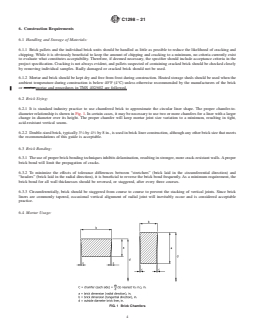
6.2.1 It is standard industry practice to use chamfered brick to approximate the circular liner shape. The proper chamfer-to-
diameter relationship is shown in Fig. 1. In certain cases, it may be necessary to use two or more chamfers for a liner with a larger
change in diameter over its height. The proper chamfer will keep mortar joint size variation to a minimum, resulting in tight,
acid-resistant vertical seams.
3 1
6.2.2 Double-sized brick, typically 3 ⁄4 by 4 ⁄2 by 8 in., is used in brick liner construction, although any other brick size that meets
the recommendations of this guide is acceptable.
6.3 Brick Bonding:
6.3.1 The use of proper brick bonding techniques inhibits delamination, resulting in stronger, more crack-resistant walls. A proper
brick bond will limit the propagation of cracks.
6.3.2 To minimize the effects of tolerance differences between “stretchers” (brick laid in the circumferential direction) and
“headers” (brick laid in the radial direction), it is beneficial to reverse the brick bond frequently. As a minimum requirement, the
brick bond for all wall thicknesses should be reversed, or staggered, after every three courses.
6.3.3 Circumferentially, brick should be staggered from course to course to prevent the stacking of vertical joints. Since brick
liners are commonly tapered, occasional vertical alignment of radial joint will inevitably occur and is considered acceptable
practice.
6.4 Mortar Usage:
FIG. 1 Brick Chamfers
C1298 − 21
6.4.1 Mortar should be stored and used in accordance with the manufacturer’s recommendations. Mortar manufacturers generally
make representatives available to assist field personnel during initial mixing and material handling operations.
6.4.2 Chemically-setting mortars typically used in brick liners are sensitive to changes in temperature and humidity, and small
variations in mix proportions. The builder should monitor the mortar consistency during the course of construction. Any changes
in the visual appearance of the mortar, or changes in handling, mixing, and setting characteristics immediately should be brought
to the attention of the manufacturer.
6.4.3 The working time for a chemically-setting mortar is short compared to that for a Portland cement mortar. Only mortar
quantities that can be used within their working time should be mixed, since retempering of these mortars is not recommended by
the manufacturers.
6.4.4 All brick in the masonry chimney lining should be laid with full-bed, circumferential, and radial mortar joints. Mortar shall
be applied to the brick by the use of a trowel. All mortar joints on the interior surface of the liner shall be trowel-struck.
6.5 Rate of Construction—A typical liner is constructed from a multiple-point suspension scaffold, which facilitates a fast rate of
construction, even to the point of making it possible to build greater heights of freshly laid masonry than is warranted by the setting
rate of the mortar. This is particularly true when constructing small diameter liners when the ambient temperature is low. Building
at a rate faster than is warranted by the setting characteristics of the mortar can result in premature cracking and deformation of
the lining. The rate of brick laying and the mortar set time should be monitored so that partially set masonry is not damaged and
tolerances are maintained.
6.6 Banding:
6.6.1 For optimum performance, the bands should be installed snugly around the liner, recognizing that some circumferential
expansion will occur under thermal loading. The bands should be positioned either by the use of vertical supports or by placing
the band on offset brick. The brick should then be laid directly against the pre-positioned band. Applied alone, this method of band
installation should yield adequate contact between the brick and the band around the full circumference. Provided such a method
and good construction practices are employed, the filling of any remaining gaps between the brick and band may not be necessary.
6.6.2 In the event that post-tensioned band connections are used, the bolts should not be tightened until the mortar has set up
sufficiently that it will not deform under tightening.
6.7 Tolerances:
6.7.1 The brick liner should be constructed within the following tolerances:
6.7.1.1 Vertical Alignment—The center point of the liner should not vary from its vertical axis by more than 0.10 % of its height
or 1 in., whichever is greater, at any point during construction. Locally, the center point of the liner should not vary by more than
1 in. in 10 ft.
6.7.1.2 Diameter—The measured diameter at any elevation should not vary from the theoretical diameter by more than 2 %.
6.7.1.3 Local Deviations—The measured radius from the center point of the liner at any elevation should not vary by more than
2 %.
6.7.1.4 Interior Surface—The maximum projection or offset between bricks on the interior surface of the liner should not exceed
⁄8 in.
6.7.1.5 Mortar Joints—All joints should be laid with ⁄8 in. minimum thickness. Mortar joint width depends on the actual brick
dimensions, brick chamfer, brick warpage, bonding construction, and the characteristics of the mortar being used in the liner
construction. Quality workmanship and industry practice should maintain mortar joint widths not greater than ⁄4 in.
7. Design of Brick Liners
7.1 This section recommends the criteria to be used in the design of circular brick chimney liners. Included are the procedures to
C1298 − 21
be used in determining masonry strength and calculating loads and stresses in the liner. This section also provides guidelines for
establishing limits on liner geometry for special design considerations through openings and for proper annular clearances.
7.2 General Design Considerations:
7.2.1 Brick liners should be designed to resist stresses resulting from the weight of the liner (including attachments), from
earthquake, and from wind on projecting areas of the liner.
7.2.2 The stress should be computed and combined in accordance with the methods described herein and should not exceed the
allowable stresses specified in 7.6.
7.2.3 The following limitations on liner geometry are recommended:
7.2.3.1 The minimum wall thickness should be 8 in.
7.2.3.2 The height of any segment of liner wall of a given thickness should not exceed 250 ft.
7.2.3.3 The mean liner diameter-to-wall thickness ratio (D/t) at any elevation should not exceed 60.
7.2.3.4 The minimum thickness of the wall at the breeching opening location should be 12 in.
7.2.3.5 Wall thickness changes should be made on the exterior surface of the liner.
7.2.3.6 An opening width should not exceed one-half the internal diameter of the liner at the opening elevation. The liner taper
may be governed by this requirement.
7.2.3.7 In the case of multiple openings in a given cross section, the cumulative width of the openings should not exceed one-half
the inner liner circumference at that elevation.
7.2.3.8 The openings defined above should include adequate clearance for breeching stiffeners, packing seals, or other pertinent
details. Internal bracing, if permitted by specification, may be utilized to reduce the size of external stiffeners.
7.3 Determination of Masonry Strength—Brick masonry strength (f ) should be determined by one of the following methods:
m
7.3.1 Method No. 1—Standard Practice:
7.3.1.1 Sufficient testing on materials typically used in brick liners has been performed to establish masonry strength (f ) safely
m
in the instances when these materials are used. The f for brick that conforms to the minimum requirements of Specification C980
m
and mortar that conforms to the minimum requirements of Specification C466 may be taken equal to 5300 psi.
7.3.2 Method No. 2—Brick Prism Tests:
7.3.2.1 By direct testing in a laboratory environment, determine the average 28-day compressive strength of the brick masonry
to be used in the design of the brick liner. Perform testing as follows:
7.3.2.2 The prisms should be built with the same materials that are to be used in the construction of the liner. That is, the materials
used for testing should meet the same minimum material specification requirements as stipulated by the project specification, and
also be made by the same manufacturers who produce the construction materials.
7.3.2.3 All factors and conditions, such as the quality of workmanship, mortar consistency, and joint thickness, should be the same
as used in constructing the liner.
7.3.2.4 A minimum of five prisms should be constructed as shown in Fig. 2.
NOTE 1—Prism size shown was chosen as the standard prism in order to avoid height correction factors.
C1298 − 21
FIG. 2 Standard Prism
7.3.2.5 After construction, the prisms should be stored at or above the minimum temperature specified for mortar usage, but not
less than 50°F for the duration of the curing period.
7.3.2.6 The prisms should be tested at 28 days in accordance with the relevant provisions of Test Methods E447C1314.
7.3.2.7 When loading the prisms, strain measurement should also be taken and a stress-versus-strain curve plotted. The
compressive modulus of elasticity (E ) of the masonry shall be determined in accordance with the provisions of Test Method E111,
m
using the initial tangent method and the resulting value utilized in the final design calculations for the liner.
7.3.2.8 If the coefficient of variation (v) of the prisms tested exceeds 10 %, multiply the average compressive strength of the five
prisms by the factor shown below to determine f .
m
12 1.5 0.01v 2 0.10 (1)
~ !
7.4 Seismic Analysis:
7.4.1 General:
7.4.1.1 Brick liners shall be designed and constructed to resist the earthquake effects determined in accordance with the
requirements of this section. The project specification should state the applicable earthquake zone in accordance with the ASCE
7-88 maps for seismic zones.
7.4.1.2 The seismic analysis of brick chimney liners should be based on either the dynamic response spectrum analysis method
or the equivalent static lateral force analysis method. It is expected that the dynamic response method would yield more accurate
results.
7.4.1.3 Freestanding brick liners should not be used in areas near major active faults or other strong seismicity areas, specifically
Zones 3 and 4 as defined by ASCE 7-88.
C1298 − 21
7.4.2 Dynamic Response Spectrum Analysis Method:
7.4.2.1 The analytical model of the brick chimney liner should accurately represent variations in the brick liner wall thickness and
diameter over its height as well as the support condition. A minimum of ten beam elements should be included in the model. When
the brick liner is supported on a pedestal or by the outer concrete shell, a dynamic analysis should be used for the design of the
brick liner. For the materials defined in Section 5, Modulus of Elasticity (E ) of the masonry wall shall be established by either
m
brick prism tests in accordance with 7.3.2.7 or should be taken equal to 2 500 000 psi.
7.4.2.2 The analysis should be performed using elastic modal methods. The total dynamic response of the chimney liner in terms
of moments, shears, and deflections should be determined using the SRSS (square root of the sum of the squares of modal maxima)
summation over a minimum of five normal modes.
7.4.2.3 A site-specific response spectrum may be used when available. The site spectrum should be established based on elastic
response with a minimum of 80 % probability of not being exceeded in a 50-year interval. The ground motion represented by the
spectra should be based on the geologic, tectonic, seismic recurrence information and foundation material properties associated
with the specific site. The spectra should be representative of motions that can be generated by all known faults that can affect the
site. The shape bounds of these spectra should be based on mean value or a probability value of 50 %. In lieu of the site-specific
response spectra, the design response spectra given in ACI 307–88 with 5 % damping may be used. The ACI response spectra
shape is consistent with that of the 1991 Uniform Building Code with Soil Type 1. Vertical seismic excitation need not be
considered, and only one horizontal seismic excitation should be included in the response spectrum analysis.
7.4.3 Equivalent Static Lateral Force Analysis Method—Provisions for the static analysis of a brick liner under seismic loading
should be in accordance with those given in ACI 307–88. For the material defined in Section 5, the unit weight of brick liner should
be taken as 140 pcf, and the Modulus of Elasticity should be established in the same manner as for the Response Spectrum Method.
7.4.4 Earthquake Reduction Factor—A brick liner designed to resist seismic moments calculated in accordance with 7.4.2 or 7.4.3
should yield a structure that is relatively free from structural damage after an earthquake of the specified design intensity. However,
applying these loads to certain brick liners in Zone 2, and even Zone 1 areas, will result in liner designs that do not meet the
allowable stress and stability criteria reco
...