

ASTM C133-24
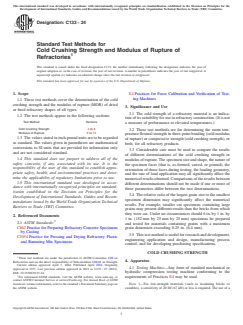
(Test Method)Standard Test Methods for Cold Crushing Strength and Modulus of Rupture of Refractories
General Information
- Abstract
SIGNIFICANCE AND USE
3.1 The cold strength of a refractory material is an indication of its suitability for use in refractory construction. (It is not a measure of performance at elevated temperatures.)
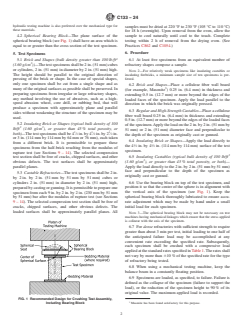
3.2 These test methods are for determining the room temperature flexural strength in three-point bending (cold modulus of rupture) or compressive strength (cold crushing strength), or both, for all refractory products.
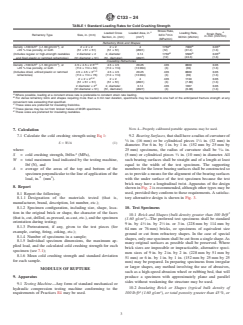
3.3 Considerable care must be used to compare the results of different determinations of the cold crushing strength or modulus of rupture. The specimen size and shape, the nature of the specimen faces (that is, as-formed, sawed, or ground), the orientation of those faces during testing, the loading geometry, and the rate of load application may all significantly affect the numerical results obtained. Comparisons of the results between different determinations should not be made if one or more of these parameters differ between the two determinations.
3.4 The relative ratio of the largest grain size to the smallest specimen dimension may significantly affect the numerical results. For example, smaller cut specimens containing large grains may present different results than the bricks from which they were cut. Under no circumstances should 6 in. by 1 in. by 1 in. (152 mm by 25 mm by 25 mm) specimens be prepared and tested for materials containing grains with a maximum grain dimension exceeding 0.25 in. (6.4 mm).
3.5 This test method is useful for research and development, engineering application and design, manufacturing process control, and for developing purchasing specifications.
SCOPE
1.1 These test methods cover the determination of the cold crushing strength and the modulus of rupture (MOR) of dried or fired refractory shapes of all types.
1.2 The test methods appear in the following sections:
Test Method
Sections
Cold Crushing Strength
4 to 8
Modulus of Rupture
9 to 13
1.3 The values stated in inch-pound units are to be regarded as standard. The values given in parentheses are mathematical conversions to SI units that are provided for information only and are not considered standard.
1.4 This standard does not purport to address all of the safety concerns, if any, associated with its use. It is the responsibility of the user of this standard to establish appropriate safety, health, and environmental practices and determine the applicability of regulatory limitations prior to use.
1.5 This international standard was developed in accordance with internationally recognized principles on standardization established in the Decision on Principles for the Development of International Standards, Guides and Recommendations issued by the World Trade Organization Technical Barriers to Trade (TBT) Committee.
- Status
- Published
- Publication Date
- 31-Mar-2024
- Technical Committee
- C08 - Refractories
- Drafting Committee
- C08.01 - Strength
Buy Documents
ASTM C133-24 - Standard Test Methods for Cold Crushing Strength and Modulus of Rupture of Refractories
REDLINE ASTM C133-24 - Standard Test Methods for Cold Crushing Strength and Modulus of Rupture of Refractories
Overview
ASTM C133-24: Standard Test Methods for Cold Crushing Strength and Modulus of Rupture of Refractories defines the procedures for determining the mechanical strength of refractory materials at room temperature. These test methods are used to measure two critical properties:
- Cold Crushing Strength (CCS): The compressive strength of a refractory specimen at room temperature.
- Modulus of Rupture (MOR): The flexural (bend) strength of a specimen under three-point loading at room temperature.
These properties are not indicators of performance at elevated temperatures but provide important data for quality control, engineering design, performance prediction, and manufacturing process optimization of refractory products.
Key Topics
Testing Procedures:
- Cold Crushing Strength: Involves compressing dried or fired refractory shapes using a calibrated testing machine until failure, recording the maximum applied load.
- Modulus of Rupture: Involves breaking the specimen by applying load at its midpoint in a three-point bending configuration.
- Specimen Preparation: Accurate results depend on consistent specimen size, shape, face finish (as-formed, cut, ground), orientation, and loading rates.
- Test Conditions: All specimens must be dried or fired as specified, and test rates (stress or strain application) must closely align with standard recommendations for reliability.
Precision and Validity:
- Interlaboratory Consistency: Significant care is required when comparing results across different labs or equipment, as specimen geometry and preparation can have a measurable impact on outcomes.
- Reporting: Complete reporting of material designation, specimen details, test conditions, and statistical results (mean, standard deviation) is essential for transparency and comparability.
Applications
ASTM C133-24 is widely employed across multiple industries for the evaluation of refractory materials, including:
- Quality Control: Assessing the suitability of refractory bricks, castables, and shapes for installation in industrial furnaces, kilns, incinerators, and reactors.
- Product Development: Supporting research and development activities aimed at enhancing the performance and durability of refractory materials.
- Specification and Procurement: Providing a standardized basis for purchasing specifications and acceptance criteria in contractual agreements.
- Process Control: Monitoring and optimizing manufacturing processes to ensure consistent mechanical properties of refractories.
- Engineering Design: Supplying essential data for the mechanical design and structural assessment of refractory linings in thermal processing equipment.
Related Standards
Several other ASTM and international standards complement or reference ASTM C133-24:
- ASTM C862: Practice for preparing refractory concrete specimens by casting.
- ASTM C1054: Practice for pressing and drying refractory plastic and ramming mix specimens.
- ASTM E4: Practices for force calibration and verification of testing machines.
Adjacent standards may address refractoriness at high temperature, thermal expansion, or other material properties critical to refractory performance. Compliance with ASTM C133-24 ensures alignment with globally recognized principles on standardization, supporting regulatory recognition and trade.
Keywords: ASTM C133, cold crushing strength, modulus of rupture, refractories, refractory testing, mechanical properties, quality control, room temperature strength, compression testing, flexural strength, ASTM standards, industrial refractory testing
Relations
- Effective Date
- 01-Apr-2024
- Referred By
ASTM C862-16(2020) - Standard Practice for Preparing Refractory Concrete Specimens by Casting - Effective Date
- 01-Apr-2024
- Effective Date
- 01-Apr-2024
- Referred By
ASTM C607-88(2016) - Standard Practice for Coking Large Shapes of Carbon-Bearing Materials - Effective Date
- 01-Apr-2024
- Effective Date
- 01-Apr-2024
- Effective Date
- 01-Apr-2024
- Effective Date
- 01-Apr-2024
- Referred By
ASTM C27-98(2022) - Standard Classification of Fireclay and High-Alumina Refractory Brick - Effective Date
- 01-Apr-2024
- Effective Date
- 01-Apr-2024
- Referred By
ASTM C401-12(2022) - Standard Classification of Alumina and Alumina-Silicate Castable Refractories - Effective Date
- 01-Apr-2024
- Referred By
ASTM F1097-17(2022) - Standard Specification for Mortar, Refractory (High-Temperature, Air-Setting) - Effective Date
- 01-Apr-2024
- Effective Date
- 01-Apr-2024
- Referred By
ASTM F1312-19(2023) - Standard Specification for Brick, Insulating, High Temperature, Fire Clay - Effective Date
- 01-Apr-2024
Buy Documents
ASTM C133-24 - Standard Test Methods for Cold Crushing Strength and Modulus of Rupture of Refractories
REDLINE ASTM C133-24 - Standard Test Methods for Cold Crushing Strength and Modulus of Rupture of Refractories
Frequently Asked Questions
ASTM C133-24 is a standard published by ASTM International. Its full title is "Standard Test Methods for Cold Crushing Strength and Modulus of Rupture of Refractories". This standard covers: SIGNIFICANCE AND USE 3.1 The cold strength of a refractory material is an indication of its suitability for use in refractory construction. (It is not a measure of performance at elevated temperatures.) 3.2 These test methods are for determining the room temperature flexural strength in three-point bending (cold modulus of rupture) or compressive strength (cold crushing strength), or both, for all refractory products. 3.3 Considerable care must be used to compare the results of different determinations of the cold crushing strength or modulus of rupture. The specimen size and shape, the nature of the specimen faces (that is, as-formed, sawed, or ground), the orientation of those faces during testing, the loading geometry, and the rate of load application may all significantly affect the numerical results obtained. Comparisons of the results between different determinations should not be made if one or more of these parameters differ between the two determinations. 3.4 The relative ratio of the largest grain size to the smallest specimen dimension may significantly affect the numerical results. For example, smaller cut specimens containing large grains may present different results than the bricks from which they were cut. Under no circumstances should 6 in. by 1 in. by 1 in. (152 mm by 25 mm by 25 mm) specimens be prepared and tested for materials containing grains with a maximum grain dimension exceeding 0.25 in. (6.4 mm). 3.5 This test method is useful for research and development, engineering application and design, manufacturing process control, and for developing purchasing specifications. SCOPE 1.1 These test methods cover the determination of the cold crushing strength and the modulus of rupture (MOR) of dried or fired refractory shapes of all types. 1.2 The test methods appear in the following sections: Test Method Sections Cold Crushing Strength 4 to 8 Modulus of Rupture 9 to 13 1.3 The values stated in inch-pound units are to be regarded as standard. The values given in parentheses are mathematical conversions to SI units that are provided for information only and are not considered standard. 1.4 This standard does not purport to address all of the safety concerns, if any, associated with its use. It is the responsibility of the user of this standard to establish appropriate safety, health, and environmental practices and determine the applicability of regulatory limitations prior to use. 1.5 This international standard was developed in accordance with internationally recognized principles on standardization established in the Decision on Principles for the Development of International Standards, Guides and Recommendations issued by the World Trade Organization Technical Barriers to Trade (TBT) Committee.
SIGNIFICANCE AND USE 3.1 The cold strength of a refractory material is an indication of its suitability for use in refractory construction. (It is not a measure of performance at elevated temperatures.) 3.2 These test methods are for determining the room temperature flexural strength in three-point bending (cold modulus of rupture) or compressive strength (cold crushing strength), or both, for all refractory products. 3.3 Considerable care must be used to compare the results of different determinations of the cold crushing strength or modulus of rupture. The specimen size and shape, the nature of the specimen faces (that is, as-formed, sawed, or ground), the orientation of those faces during testing, the loading geometry, and the rate of load application may all significantly affect the numerical results obtained. Comparisons of the results between different determinations should not be made if one or more of these parameters differ between the two determinations. 3.4 The relative ratio of the largest grain size to the smallest specimen dimension may significantly affect the numerical results. For example, smaller cut specimens containing large grains may present different results than the bricks from which they were cut. Under no circumstances should 6 in. by 1 in. by 1 in. (152 mm by 25 mm by 25 mm) specimens be prepared and tested for materials containing grains with a maximum grain dimension exceeding 0.25 in. (6.4 mm). 3.5 This test method is useful for research and development, engineering application and design, manufacturing process control, and for developing purchasing specifications. SCOPE 1.1 These test methods cover the determination of the cold crushing strength and the modulus of rupture (MOR) of dried or fired refractory shapes of all types. 1.2 The test methods appear in the following sections: Test Method Sections Cold Crushing Strength 4 to 8 Modulus of Rupture 9 to 13 1.3 The values stated in inch-pound units are to be regarded as standard. The values given in parentheses are mathematical conversions to SI units that are provided for information only and are not considered standard. 1.4 This standard does not purport to address all of the safety concerns, if any, associated with its use. It is the responsibility of the user of this standard to establish appropriate safety, health, and environmental practices and determine the applicability of regulatory limitations prior to use. 1.5 This international standard was developed in accordance with internationally recognized principles on standardization established in the Decision on Principles for the Development of International Standards, Guides and Recommendations issued by the World Trade Organization Technical Barriers to Trade (TBT) Committee.
ASTM C133-24 is classified under the following ICS (International Classification for Standards) categories: 81.080 - Refractories. The ICS classification helps identify the subject area and facilitates finding related standards.
ASTM C133-24 has the following relationships with other standards: It is inter standard links to ASTM C133-97(2021), ASTM C862-16(2020), ASTM C416-97(2022), ASTM C607-88(2016), ASTM C1171-16(2022), ASTM C1190-18(2022), ASTM C203-22, ASTM C27-98(2022), ASTM C198-09(2019), ASTM C401-12(2022), ASTM F1097-17(2022), ASTM C1685-15(2021), ASTM F1312-19(2023). Understanding these relationships helps ensure you are using the most current and applicable version of the standard.
ASTM C133-24 is available in PDF format for immediate download after purchase. The document can be added to your cart and obtained through the secure checkout process. Digital delivery ensures instant access to the complete standard document.
Standards Content (Sample)
This international standard was developed in accordance with internationally recognized principles on standardization established in the Decision on Principles for the
Development of International Standards, Guides and Recommendations issued by the World Trade Organization Technical Barriers to Trade (TBT) Committee.
Designation: C133 − 24
Standard Test Methods for
Cold Crushing Strength and Modulus of Rupture of
Refractories
This standard is issued under the fixed designation C133; the number immediately following the designation indicates the year of
original adoption or, in the case of revision, the year of last revision. A number in parentheses indicates the year of last reapproval. A
superscript epsilon (´) indicates an editorial change since the last revision or reapproval.
This standard has been approved for use by agencies of the U.S. Department of Defense.
1. Scope E4 Practices for Force Calibration and Verification of Test-
ing Machines
1.1 These test methods cover the determination of the cold
crushing strength and the modulus of rupture (MOR) of dried
3. Significance and Use
or fired refractory shapes of all types.
3.1 The cold strength of a refractory material is an indica-
1.2 The test methods appear in the following sections:
tion of its suitability for use in refractory construction. (It is not
Test Method Sections
a measure of performance at elevated temperatures.)
Cold Crushing Strength 4 to 8
3.2 These test methods are for determining the room tem-
Modulus of Rupture 9 to 13
perature flexural strength in three-point bending (cold modulus
1.3 The values stated in inch-pound units are to be regarded
of rupture) or compressive strength (cold crushing strength), or
as standard. The values given in parentheses are mathematical
both, for all refractory products.
conversions to SI units that are provided for information only
3.3 Considerable care must be used to compare the results
and are not considered standard.
of different determinations of the cold crushing strength or
1.4 This standard does not purport to address all of the
modulus of rupture. The specimen size and shape, the nature of
safety concerns, if any, associated with its use. It is the
the specimen faces (that is, as-formed, sawed, or ground), the
responsibility of the user of this standard to establish appro-
orientation of those faces during testing, the loading geometry,
priate safety, health, and environmental practices and deter-
and the rate of load application may all significantly affect the
mine the applicability of regulatory limitations prior to use.
numerical results obtained. Comparisons of the results between
1.5 This international standard was developed in accor-
different determinations should not be made if one or more of
dance with internationally recognized principles on standard-
these parameters differ between the two determinations.
ization established in the Decision on Principles for the
3.4 The relative ratio of the largest grain size to the smallest
Development of International Standards, Guides and Recom-
specimen dimension may significantly affect the numerical
mendations issued by the World Trade Organization Technical
results. For example, smaller cut specimens containing large
Barriers to Trade (TBT) Committee.
grains may present different results than the bricks from which
they were cut. Under no circumstances should 6 in. by 1 in. by
2. Referenced Documents
1 in. (152 mm by 25 mm by 25 mm) specimens be prepared
2.1 ASTM Standards:
and tested for materials containing grains with a maximum
C862 Practice for Preparing Refractory Concrete Specimens
grain dimension exceeding 0.25 in. (6.4 mm).
by Casting
3.5 This test method is useful for research and development,
C1054 Practice for Pressing and Drying Refractory Plastic
engineering application and design, manufacturing process
and Ramming Mix Specimens
control, and for developing purchasing specifications.
COLD CRUSHING STRENGTH
These test methods are under the jurisdiction of ASTM Committee C08 on
4. Apparatus
Refractories and are the direct responsibility of Subcommittee C08.01 on Strength.
Current edition approved April 1, 2024. Published April 2024. Originally
4.1 Testing Machine—Any form of standard mechanical or
approved in 1937. Last previous edition approved in 2021 as C133 – 97 (2021).
hydraulic compression testing machine conforming to the
DOI: 10.1520/C0133-24.
For referenced ASTM standards, visit the ASTM website, www.astm.org, or
requirements of Practices E4 may be used.
contact ASTM Customer Service at service@astm.org. For Annual Book of ASTM
Standards volume information, refer to the standard’s Document Summary page on NOTE 1—For low-strength materials (such as insulating bricks or
the ASTM website. castables), a sensitivity of 20 lbf (67 kN) or less is required. The use of a
Copyright © ASTM International, 100 Barr Harbor Drive, PO Box C700, West Conshohocken, PA 19428-2959. United States
C133 − 24
hydraulic testing machine is also preferred over the mechanical type for
samples must be dried at 220 °F to 230 °F (105 °C to 110 °C)
these materials.
for 18 h (overnight). Upon removal from the oven, allow the
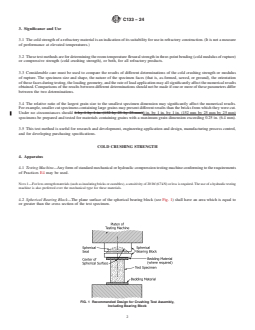
4.2 Spherical Bearing Block—The plane surface of the sample to cool naturally until cool to the touch. Complete
spherical bearing block (see Fig. 1) shall have an area which is testing within 2 h of removal from the drying oven. (See
equal to or greater than the cross section of the test specimen. Practices C862 and C1054.)
6. Procedure
5. Test Specimens
6.1 At least five specimens from an equivalent number of
5.1 Brick and Shapes (bulk density greater than 100 lb ⁄ft
refractory shapes compose a sample.
(1.60 g/cm ))—The test specimens shall be 2 in. (51 mm) cubes
or cylinders, 2 in. (51 mm) in diameter by 2 in. (51 mm) high.
NOTE 2—For relatively weak specimens like insulating castables or
The height should be parallel to the original direction of
insulating firebricks, a minimum sample size of ten specimens is pre-
pressing of the brick or shape. In the case of special shapes, ferred.
only one specimen shall be cut from a single shape and as
6.2 Brick and Shapes—Place a cellulose fiber wall board
many of the original surfaces as possible shall be preserved. In
(for example, Masonite ) 0.25 in. (6.4 mm) in thickness and
preparing specimens from irregular or large refractory shapes,
extending 0.5 in. (12.7 mm) or more beyond the edges of the
any method involving the use of abrasives, such as a high-
loaded faces of the specimen. Apply the load parallel to the
speed abrasion wheel, core drill, or rubbing bed, that will
direction in which the brick was originally pressed.
produce a specimen with approximately plane and parallel
6.3 Regular and High-Strength Castables—Place a cellulose
sides without weakening the structure of the specimen may be
fiber wall board 0.25 in. (6.4 mm) in thickness and extending
used.
0.5 in. (12.7 mm) or more beyond the edges of the loaded faces
5.2 Insulating Brick or Shapes (typical bulk density of 100
of the specimen. Apply the load on the 2 in. by 2 in. (51 mm by
3 3
lb/ft (1.60 g/cm ), or greater than 45 % total porosity, or
51 mm) or 2 in. (51 mm) diameter face and perpendicular to
1 1 1
both)—The test specimens shall be 4 ⁄2 in. by 4 ⁄2 in. by 2 ⁄2 in.
the depth of the specimen as originally cast or gunned.
or 3 in. (114 mm by 114 mm by 64 mm or 76 mm), each taken
6.4 Insulating Brick or Shapes—Apply the load directly to
from a different brick. It is permissible to prepare these
1 1
the 4 ⁄2 in. by 4 ⁄2 in. (114 mm by 114 mm) surface of the test
specimens from the half-brick resulting from the modulus of
specimen.
rupture test (see Sections 9 – 14). The selected compression
6.5 Insulating Castables (typical bulk density of 100 lb/ft
test section shall be free of cracks, chipped surfaces, and other
(1.60 g/cm ), or greater than 45 % total porosity, or both)—
obvious defects. The test surfaces shall be approximately
Apply the load directly to the 2 in. by 2 in. (51 mm by 51 mm)
parallel planes.
face and perpendicular to the depth of the specimen as
5.3 Castable Refractories—The test specimens shall be 2 in.
originally cast or gunned.
by 2 in. by 2 in. (51 mm by 51 mm by 51 mm) cubes or
6.6 Use the bearing block on top of the test specimen, and
cylinders 2 in. (51 mm) in diameter by 2 in. (51 mm) high,
prepared by casting or gunning. It is permissible to prepare one position it so that the center of the sphere is in alignment with
the vertical axis of the specimen (see Fig. 1). Keep the
specimen from each 9 in. by 2 in. by 2 in. (230 mm by 51 mm
by 51 mm) bar after the modulus of rupture test (see Sections spherical bearing block thoroughly lubricated to ensure accu-
rate adjustment which may be made by hand under a small
9 – 14). The selected compression test section shall be free of
cracks, chipped surfaces, and other obvious defects. The initial load for each specimen.
loaded surfaces shall be approximately parallel planes. All
NOTE 3—The spherical bearing block may not be necessary on test
machines having mechanical linkages which ensure that the stress applied
is colinear with the axis of the specimen.
6.7 For dense refractories with sufficient strength to require
greater than about 3 min per test, initial loading to one half of
the anticipated failure load may be accomplished at any
convenient rate exceeding the specified rate. Subsequently,
each specimen shall be crushed with a compressive load
applied at the standard rates specified in Table 1. The rates shall
not vary by more than 610 % of the specified rate for the type
of refractory being tested.
6.8 When using a mechanical testing machine, keep the
balance beam in a constantly floating position.
6.9 Specimens are loaded, as specified, to failure. Failure is
defined as the collapse of the specimen (failure to support the
load), or the reduction of the specimen height to 90 % of its
original value. The maximum applied load is recorded.
FIG. 1 Recommended Design for Crushing Test Assembly,
Including Bearing Block Masonite has been found satisfactory for this purpose.
C133 − 24
TABLE 1 Standard Loading Rates for Cold Crushing Strength
Stress Rate,
A
Loaded Cross Loaded Area, in. Loading Rate,
Strain Rate,
Refractory Type Size, in. (mm) lbf/in. /min
in./min (mm/min)
Section, in. (mm) (mm ) lbf/min (kN/min)
(MPa/min)
Refractory Brick and Shapes
3 3 B B B
Density >100 lb/ft (>1.60 gm/cm ), or 2 × 2 × 2 2 × 2 4 1750 7000 0.05
(12) (31.2) (1.3)
<45 % true porosity, or both (51 × 51 × 51) (51 × 51) (2601)
B B B
(Includes regular or high-strength castables 2 diameter × 2 2, diameter 3.14 1750 5500 0.05
(12) (24.3) (1.3)
and fired plastic or rammed refractories) (51 diameter × 51) (51, diameter) (2027)
Insulating Refractories
3 3 C,D
Density <100 lb/ft (<1.60 gm/cm ), or 4.5 × 4.5 × 2.5 4.5 × 4.5 20.25 435 8809 0.05
(114 × 114 × 64)
>45 % true porosity, or both (114 × 114) (13 064) (3) (39) (1.3)
C,D
(Includes dried, unfired plastic or rammed 4.5 × 4.5 × 3 4.5 × 4.5 20.25 435 8809 0.05
(114 × 114 × 76)
refractories) (114 × 114) (13 064) (3) (39) (1.3)
D,E
2 × 2 × 2 2 × 2 4 435 1740 0.05
(51 × 51 × 51)
(51 × 51) (2601) (3) (7.80) (1.3)
E
2 diameter × 2 2, diameter 3.14 435 1367 0.05
(51 diameter × 51) (51, diameter) (2027) (3) (6.08) (1.3)
A
Where possible, loading at a constant stress rate is preferable to constant strain rate loading.
B
For dense refractory brick and shapes requiring more than a 3 min test duration, specimens may be loaded to one half of the anticipated fracture strength at any
convenient rate exceeding that specified.
C
These sizes are preferred for insulating firebricks.
D
These pieces may be cut from broken halves of MOR specimens.
E
These sizes are preferred for insulating castables.
NOTE 4—Properly calibrated portable apparatus may be used.
7. Calculation
9.2 Bearing Surfaces, that shall have a radius of curvature of
7.1 Calculate the cold crushing strength using Eq 1:
5 1
⁄8 in. (16 mm) or be cylindrical pieces 1 ⁄4 in. (32 mm) in
S 5 W/A (1)
diameter. For 6 in. by 1 in. by 1 in. (152 mm by 25 mm by
where:
25 mm) specimens, the radius of curvature shall be ⁄16 in.
S = cold crushing strength, lbf/in. (MPa), (5 mm) or cylindrical pieces ⁄8 in. (10 mm) in diameter. All
W = total maximum load indicated by the testing machine, such bearing surfaces shall be straight and of a length at least
lbf (N), and equal to the width of the test specimen. The supporting
A = average of the areas of the top and bottom of the
members for the lower bearing surfaces shall be constructed so
specimen perpendicular to the line of application of the
as to provide a means for the alignment of the bearing surfaces
2 2
load, in. (mm
...
This document is not an ASTM standard and is intended only to provide the user of an ASTM standard an indication of what changes have been made to the previous version. Because
it may not be technically possible to adequately depict all changes accurately, ASTM recommends that users consult prior editions as appropriate. In all cases only the current version
of the standard as published by ASTM is to be considered the official document.
Designation: C133 − 97 (Reapproved 2021) C133 − 24
Standard Test Methods for
Cold Crushing Strength and Modulus of Rupture of
Refractories
This standard is issued under the fixed designation C133; the number immediately following the designation indicates the year of
original adoption or, in the case of revision, the year of last revision. A number in parentheses indicates the year of last reapproval. A
superscript epsilon (´) indicates an editorial change since the last revision or reapproval.
This standard has been approved for use by agencies of the U.S. Department of Defense.
1. Scope
1.1 These test methods cover the determination of the cold crushing strength and the modulus of rupture (MOR) of dried or fired
refractory shapes of all types.
1.2 The test methods appear in the following sections:
Test Method Sections
Cold Crushing Strength 4 to 9
Cold Crushing Strength 4 to 8
Modulus of Rupture 10 to 15
Modulus of Rupture 9 to 13
1.3 The values stated in inch-pound units are to be regarded as standard. The values given in parentheses are mathematical
conversions to SI units that are provided for information only and are not considered standard.
1.4 This standard does not purport to address all of the safety concerns, if any, associated with its use. It is the responsibility
of the user of this standard to establish appropriate safety, health, and environmental practices and determine the applicability of
regulatory limitations prior to use.
1.5 This international standard was developed in accordance with internationally recognized principles on standardization
established in the Decision on Principles for the Development of International Standards, Guides and Recommendations issued
by the World Trade Organization Technical Barriers to Trade (TBT) Committee.
2. Referenced Documents
2.1 ASTM Standards:
C862 Practice for Preparing Refractory Concrete Specimens by Casting
C1054 Practice for Pressing and Drying Refractory Plastic and Ramming Mix Specimens
E4 Practices for Force Calibration and Verification of Testing Machines
These test methods are under the jurisdiction of ASTM Committee C08 on Refractories and are the direct responsibility of Subcommittee C08.01 on Strength.
Current edition approved Feb. 1, 2021April 1, 2024. Published February 2021April 2024. Originally approved in 1937. Last previous edition approved in 20152021 as
C133 – 97 (2015).(2021). DOI: 10.1520/C0133-97R21.10.1520/C0133-24.
For referenced ASTM standards, visit the ASTM website, www.astm.org, or contact ASTM Customer Service at service@astm.org. For Annual Book of ASTM Standards
volume information, refer to the standard’s Document Summary page on the ASTM website.
Copyright © ASTM International, 100 Barr Harbor Drive, PO Box C700, West Conshohocken, PA 19428-2959. United States
C133 − 24
3. Significance and Use
3.1 The cold strength of a refractory material is an indication of its suitability for use in refractory construction. (It is not a measure
of performance at elevated temperatures.)
3.2 These test methods are for determining the room temperature flexural strength in three-point bending (cold modulus of rupture)
or compressive strength (cold crushing strength), or both, for all refractory products.
3.3 Considerable care must be used to compare the results of different determinations of the cold crushing strength or modulus
of rupture. The specimen size and shape, the nature of the specimen faces (that is, as-formed, sawed, or ground), the orientation
of those faces during testing, the loading geometry, and the rate of load application may all significantly affect the numerical results
obtained. Comparisons of the results between different determinations should not be made if one or more of these parameters differ
between the two determinations.
3.4 The relative ratio of the largest grain size to the smallest specimen dimension may significantly affect the numerical results.
For example, smaller cut specimens containing large grains may present different results than the bricks from which they were cut.
Under no circumstances should 6 by 1 by 1-in. (152 by 25 by 25-mm)6 in. by 1 in. by 1 in. (152 mm by 25 mm by 25 mm)
specimens be prepared and tested for materials containing grains with a maximum grain dimension exceeding 0.25 in. (6.4 mm).
3.5 This test method is useful for research and development, engineering application and design, manufacturing process control,
and for developing purchasing specifications.
COLD CRUSHING STRENGTH
4. Apparatus
4.1 Testing Machine—Any form of standard mechanical or hydraulic compression testing machine conforming to the requirements
of Practices E4 may be used.
NOTE 1—For low-strength materials (such as insulating bricks or castables), a sensitivity of 20 lbf (67 kN) or less is required. The use of a hydraulic testing
machine is also preferred over the mechanical type for these materials.
4.2 Spherical Bearing Block—The plane surface of the spherical bearing block (see Fig. 1) shall have an area which is equal to
or greater than the cross section of the test specimen.
FIG. 1 Recommended Design for Crushing Test Assembly,
Including Bearing Block
C133 − 24
5. Test Specimens
3 3
5.1 Brick and Shapes (bulk density greater than 100 100 lb lb/ft⁄ft (1.60 g/cm ))—The test specimens shall be 2-in. (51-mm)2 in.
(51 mm) cubes or cylinders, 2 in. (51 mm) in diameter by 2 in. (51 mm) high. The height should be parallel to the original direction
of pressing of the brick or shape. In the case of special shapes, only one specimen shall be cut from a single shape and as many
of the original surfaces as possible shall be preserved. In preparing specimens from irregular or large refractory shapes, any method
involving the use of abrasives, such as a high-speed abrasion wheel, core drill, or rubbing bed, that will produce a specimen with
approximately plane and parallel sides without weakening the structure of the specimen may be used.
3 3
5.2 Insulating Brick or Shapes (typical bulk density of 100 lb/ft (1.60 g/cm ), or greater than 45 % total porosity, or both)—The
1 1 1
test specimens shall be 4 ⁄2 in. by 4 ⁄2 in. by 2 ⁄2 in. or 3 in. (114 by 114 by 64(114 mm by 114 mm by 64 mm or 76 mm), each
taken from a different brick. It is permissible to prepare these specimens from the half-brick resulting from the modulus of rupture
test (see Sections 9 – 14). The selected compression test section shall be free of cracks, chipped surfaces, and other obvious defects.
The test surfaces shall be approximately parallel planes.
5.3 Castable Refractories—The test specimens shall be 2 by 2 by 2-in. (51 by 51 by 51-mm)2 in. by 2 in. by 2 in. (51 mm by
51 mm by 51 mm) cubes or cylinders 2 in. (51 mm) in diameter by 2 in. (51 mm) high, prepared by casting or gunning. It is
permissible to prepare one specimen from each 9 by 2 by 2-in. (230 by 51 by 51-mm)9 in. by 2 in. by 2 in. (230 mm by 51 mm
by 51 mm) bar after the modulus of rupture test (see Sections 9 – 14). The selected compression test section shall be free of cracks,
chipped surfaces, and other obvious defects. The loaded surfaces shall be approximately parallel planes. All samples must be dried
at 220220 °F to 230 °F (105(105 °C to 110 °C) for 18 h (overnight). Upon removal from the oven, allow the sample to cool
naturally until cool to the touch. Complete testing within 2 h of removal from the drying oven. (See Practices C862 and C1054.)
6. Procedure
6.1 At least five specimens from an equivalent number of refractory shapes compose a sample.
NOTE 2—For relatively weak specimens like insulating castables or insulating firebricks, a minimum sample size of ten specimens is preferred.
6.2 Brick and Shapes—Place a cellulose fiber wall board (for example, Masonite ) 0.25 in. (6.4 mm) in thickness and extending
0.5 in. (12.7 mm) or more beyond the edges of the loaded faces of the specimen. Apply the load parallel to the direction in which
the brick was originally pressed.
6.3 Regular and High-Strength Castables—Place a cellulose fiber wall board 0.25 in. (6.4 mm) in thickness and extending 0.5 in.
(12.7 mm) or more beyond the edges of the loaded faces of the specimen. Apply the load on the 2 by 2-in. (51 by 51-mm) or 2-in.
(51-mm)2 in. by 2 in. (51 mm by 51 mm) or 2 in. (51 mm) diameter face and perpendicular to the depth of the specimen as
originally cast or gunned.
1 1
6.4 Insulating Brick or Shapes—Apply the load directly to the 4 ⁄2 in. by 4 ⁄2-in. (114 by 114-mm) in. (114 mm by 114 mm)
surface of the test specimen.
3 3
6.5 Insulating Castables (typical bulk density of 100 lb/ft (1.60 g/cm ), or greater than 45 % total porosity, or both)—Apply the
load directly to the 2 by 2-in. (51 by 51-mm)2 in. by 2 in. (51 mm by 51 mm) face and perpendicular to the depth of the specimen
as originally cast or gunned.
6.6 Use the bearing block on top of the test specimen, and position it so that the center of the sphere is in alignment with the
vertical axis of the specimen (see Fig. 1). Keep the spherical bearing block thoroughly lubricated to ensure accurate adjustment
which may be made by hand under a small initial load for each specimen.
NOTE 3—The spherical bearing block may not be necessary on test machines having mechanical linkages which ensure that the stress applied is colinear
with the axis of the specimen.
6.7 For dense refractories with sufficient strength to require greater than about 3 min per test, initial loading to one half of the
Masonite has been found satisfactory for this purpose.
C133 − 24
anticipated failure load may be accomplished at any convenient rate exceeding the specified rate. Subsequently, each specimen
shall be crushed with a compressive load applied at the standard rates specified in Table 1. The rates shall not vary by more than
610 % of the specified rate for the type of refractory being tested.
6.8 When using a mechanical testing machine, keep the balance beam in a constantly floating position.
6.9 Specimens are loaded, as specified, to failure. Failure is defined as the collapse of the specimen (failure to support the load),
or the reduction of the specimen height to 90 % of its original value. The maximum applied load is recorded.
7. Calculation
7.1 Calculate the cold crushing strength using Eq 1:
S 5 W/A (1)
where:
S = cold crushing strength, lbf/in. (MPa),
W = total maximum load indicated by the testing machine, lbf (N), and
2 2
A = average of the areas of the top and bottom of the specimen perpendicular to the line of application of the load, in. (mm ).
8. Report
8.1 Report the following:
8.1.1 Designation of the materials tested (that is, manufacturer, brand, description, lot number, etc.);
8.1.2 Specimen configuration, including size, shape, location in the original brick or shape, the character of the faces (that is, cut,
drilled, as-pressed, as-cast, etc.), and the specimen orientation during testing;
8.1.3 Pretreatment, if any, given to the test pieces (for example, curing, firing, coking, etc.);
8.1.4 Number of specimens in a sample;
8.1.5 Individual specimen dimensions, the maximum applied load, and the calculated cold crushing strength for each specimen
(see 7.1);
8.1.6 Mean cold crushing strength and standard deviation for each sample.
TABLE 1 Standard Loading Rates for Cold Crushing Strength
Stress Rate,
2 A
Loaded Cross Loaded Area, in. Loading Rate,
Strain Rate,
Refractory Type Size, in. (mm) lbf/in. /min
in./min (mm/min)
Section, in. (mm) (mm ) lbf/min (kN/min)
(MPa/min)
Refractory Brick and Shapes
3 3 B B B
Density >100 lb/ft (>1.60 gm/cm ), or 2 × 2 × 2 2 × 2 4 1750 7000 0.05
(12) (31.2) (1.3)
<45 % true porosity, or both (51 × 51 × 51) (51 × 51) (2601)
B B B
(Includes regular or high-strength castables 2 diameter × 2 2, diameter 3.14 1750 5500 0.05
(12) (24.3) (1.3)
and fired plastic or rammed refractories) (51 diameter × 51) (51, diameter) (2027)
Insulating Refractories
3 3 C,D
Density <100 lb/ft (<1.60 gm/cm ), or 4.5 × 4.5 × 2.5 4.5 × 4.5 20.25 435 8809 0.05
(114 × 114 × 64)
>45 % true porosity, or both (114 × 114) (13 064) (3) (39) (1.3)
C,D
(Includes dried, unfired plastic or rammed 4.5 × 4.5 × 3 4.5 × 4.5 20.25 435 8809 0.05
(114 × 114 × 76)
refractories) (114 × 114) (13 064) (3) (39) (1.3)
D,E
2 × 2 × 2 2 × 2 4 435 1740 0.05
(51 × 51 × 51)
(51 × 51) (2601) (3) (7.80) (1.3)
E
2 diameter × 2 2, diameter 3.14 435 1367 0.05
(51 diameter × 51) (51, diameter) (2027) (3) (6.08) (1.3)
A
Where possible, loading at a constant stress rate is preferable to constant strain rate loading.
B
For dense refractory brick and shapes requiring more than a 3-min3 min test duration, specimens may be loaded to one half of the anticipated fracture strength at any
convenient rate exceeding that specified.
C
These sizes are preferred for insulating firebricks.
D
These pieces may be cut from broken halves of MOR specimens.
E
TheseThese sizes are preferred for insulating castables.
C133 − 24
MODULUS OF RUPTURE
9. Apparatus
9.1 Testing Machine—Any form of standard mechanical or hydraulic compression testing machine conforming to the requirements
of Practices E4 may be used.
NOTE 4—Properly calibrated portable apparatus may be used.
5 1
9.2 Bearing Surfaces, that shall have a radius of curvature of ⁄8 in. (16 mm) or be cylindrical pieces 1 ⁄4
...