

ASTM C1439-19
(Test Method)Standard Test Methods for Evaluating Latex and Powder Polymer Modifiers for use in Hydraulic Cement Concrete and Mortar
General Information
- Abstract
SIGNIFICANCE AND USE
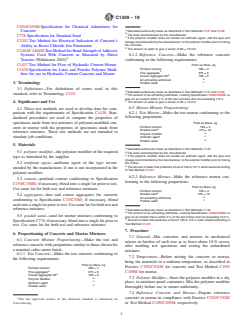
4.1 These test methods are used to develop data for comparison with the requirements of Specification C1438. Standardized procedures are used to compare the properties of specimens made from test mixtures of polymer-modified concrete or mortar with the properties of specimens made from reference mixtures. These test methods are not intended to simulate job conditions.
SCOPE
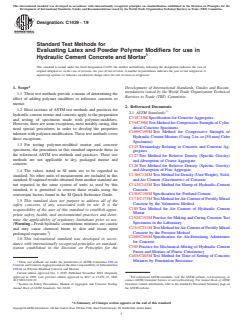
1.1 These test methods provide a means of determining the effect of adding polymer modifiers to reference concrete or mortar.
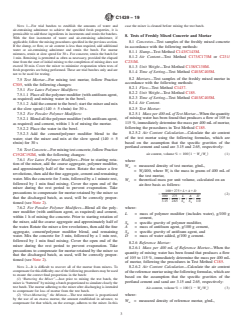
1.2 Most sections of ASTM test methods and practices for hydraulic cement mortar and concrete apply to the preparation and testing of specimens made with polymer-modifiers. However, there are some exceptions, most notably curing, that need special procedures in order to develop the properties inherent with polymer-modification. These test methods cover these exceptions.
1.3 For testing polymer-modified mortar and concrete specimens, the procedures in this standard supersede those in the referenced ASTM test methods and practices. These test methods are not applicable to dry, packaged mortar and concrete.
1.4 The values stated in SI units are to be regarded as standard. No other units of measurement are included in this standard. If required results obtained from another standard are not reported in the same system of units as used by this standard, it is permitted to convert those results using the conversion factors found in the SI Quick Reference Guide.
1.5 This standard does not purport to address all of the safety concerns, if any, associated with its use. It is the responsibility of the user of this standard to establish appropriate safety, health, and environmental practices and determine the applicability of regulatory limitations prior to use. (Warning—Fresh hydraulic cementitious mixtures are caustic and may cause chemical burns to skin and tissue upon prolonged exposure.2)
1.6 This international standard was developed in accordance with internationally recognized principles on standardization established in the Decision on Principles for the Development of International Standards, Guides and Recommendations issued by the World Trade Organization Technical Barriers to Trade (TBT) Committee.
- Status
- Published
- Publication Date
- 30-Sep-2019
- Technical Committee
- C09 - Concrete and Concrete Aggregates
- Drafting Committee
- C09.44 - Polymer-Modified Concrete and Mortars
Buy Documents
ASTM C1439-19 - Standard Test Methods for Evaluating Latex and Powder Polymer Modifiers for use in Hydraulic Cement Concrete and Mortar
REDLINE ASTM C1439-19 - Standard Test Methods for Evaluating Latex and Powder Polymer Modifiers for use in Hydraulic Cement Concrete and Mortar
Overview
ASTM C1439-19 is the internationally recognized standard titled "Standard Test Methods for Evaluating Latex and Powder Polymer Modifiers for Use in Hydraulic Cement Concrete and Mortar," developed by ASTM International. This standard provides detailed, standardized test methods for assessing the effects of various latex and powder polymer modifiers when added to hydraulic cement concrete and mortar mixtures. The guidance is essential for quality control, comparison, and verification against Specification C1438. These methods do not simulate job-site conditions but are intended for laboratory use, enabling objective comparison of polymer-modified and reference (unmodified) specimens.
Key Topics
- Polymer Modification in Concrete and Mortar: The standard covers the addition and evaluation of both latex and powder-based polymer modifiers to traditional hydraulic cement mixtures.
- Test Mixtures and Reference Mixtures: Use of standardized reference mixtures to benchmark the effects of polymer additions.
- Preparation and Proportioning: Procedures for preparing both mortar and concrete mixtures, including the use of appropriate aggregates, cement types, and any necessary admixtures or antifoaming agents.
- Mixing and Curing Exceptions: While most ASTM test methods for hydraulic cement mortar and concrete apply, ASTM C1439-19 specifies unique procedures-especially for mixing and curing-that are essential for unlocking the full benefits of polymer modifiers.
- SI Units: All measurement data must be reported using SI units, ensuring international compatibility.
- Safety and Best Practices: Emphasis on occupational health and safety due to the caustic nature of fresh hydraulic cement mixtures.
Applications
ASTM C1439-19 is invaluable throughout the construction materials sector:
- Research and Development: Material scientists and engineers use this standard to evaluate the effects of new polymer modifier formulations or brands in laboratory settings.
- Quality Control: Manufacturers of latex and powder polymer modifiers rely on these test methods to ensure their products meet the performance requirements set forth in Specification C1438.
- Performance Assessment: Concrete and mortar producers can compare the mechanical and durability properties (such as compressive strength, bond strength, setting time, and chloride ion penetration resistance) of polymer-modified mixes to standard mixes.
- Regulatory and Specification Compliance: This standard is frequently referenced in project specifications and by regulatory bodies to verify the suitability of modified concrete and mortar materials for construction projects.
- Product Comparison: Enables objective, side-by-side evaluation of different polymer modifiers, supporting purchasing decisions and material selection for demanding construction applications.
Related Standards
ASTM C1439-19 works in conjunction with several key ASTM standards, including:
- ASTM C1438: Specification for Latex and Powder Polymer Modifiers for use in Hydraulic Cement Concrete and Mortar (performance requirements).
- ASTM C33/C33M: Specification for Concrete Aggregates.
- ASTM C39/C39M: Test Method for Compressive Strength of Cylindrical Concrete Specimens.
- ASTM C109/C109M: Test Method for Compressive Strength of Hydraulic Cement Mortars.
- ASTM C192/C192M: Practice for Making and Curing Concrete Test Specimens in the Laboratory.
- ASTM C143/C143M: Test Method for Slump of Hydraulic-Cement Concrete.
- ASTM C173/C173M: Test Method for Air Content of Freshly Mixed Concrete by the Volumetric Method.
- ASTM C1404/C1404M: Test Method for Bond Strength of Adhesive Systems Used With Concrete.
Practical Value
Adherence to ASTM C1439-19 ensures reliable test results when evaluating polymer-modified concrete and mortar, facilitating material innovation and quality assurance in modern construction. This standard is central for anyone seeking to establish or verify the performance characteristics of polymer-enhanced cementitious materials in industrial, commercial, and infrastructure projects. Proper use helps teams meet project requirements, optimize material selection, and achieve higher durability and performance for concrete and mortar products.
Relations
- Effective Date
- 01-Oct-2019
- Effective Date
- 01-Jan-2024
- Effective Date
- 01-Jan-2024
- Effective Date
- 15-Dec-2023
- Refers
ASTM C39/C39M-23 - Standard Test Method for Compressive Strength of Cylindrical Concrete Specimens - Effective Date
- 01-Dec-2023
- Effective Date
- 01-Sep-2023
- Effective Date
- 15-Jul-2020
- Effective Date
- 01-Apr-2020
- Effective Date
- 15-Dec-2019
- Effective Date
- 01-Dec-2019
- Effective Date
- 01-Apr-2019
- Effective Date
- 01-Jan-2019
- Effective Date
- 01-Oct-2018
- Effective Date
- 01-Jul-2018
- Effective Date
- 01-Jul-2018
Buy Documents
ASTM C1439-19 - Standard Test Methods for Evaluating Latex and Powder Polymer Modifiers for use in Hydraulic Cement Concrete and Mortar
REDLINE ASTM C1439-19 - Standard Test Methods for Evaluating Latex and Powder Polymer Modifiers for use in Hydraulic Cement Concrete and Mortar
Get Certified
Connect with accredited certification bodies for this standard

DIBt (Deutsches Institut für Bautechnik)
German Institute for Building Technology.
DIN CERTCO
DIN Group product certification.

Aboma Certification B.V.
Specialized in construction, metal, and transport sectors.
Sponsored listings
Frequently Asked Questions
ASTM C1439-19 is a standard published by ASTM International. Its full title is "Standard Test Methods for Evaluating Latex and Powder Polymer Modifiers for use in Hydraulic Cement Concrete and Mortar". This standard covers: SIGNIFICANCE AND USE 4.1 These test methods are used to develop data for comparison with the requirements of Specification C1438. Standardized procedures are used to compare the properties of specimens made from test mixtures of polymer-modified concrete or mortar with the properties of specimens made from reference mixtures. These test methods are not intended to simulate job conditions. SCOPE 1.1 These test methods provide a means of determining the effect of adding polymer modifiers to reference concrete or mortar. 1.2 Most sections of ASTM test methods and practices for hydraulic cement mortar and concrete apply to the preparation and testing of specimens made with polymer-modifiers. However, there are some exceptions, most notably curing, that need special procedures in order to develop the properties inherent with polymer-modification. These test methods cover these exceptions. 1.3 For testing polymer-modified mortar and concrete specimens, the procedures in this standard supersede those in the referenced ASTM test methods and practices. These test methods are not applicable to dry, packaged mortar and concrete. 1.4 The values stated in SI units are to be regarded as standard. No other units of measurement are included in this standard. If required results obtained from another standard are not reported in the same system of units as used by this standard, it is permitted to convert those results using the conversion factors found in the SI Quick Reference Guide. 1.5 This standard does not purport to address all of the safety concerns, if any, associated with its use. It is the responsibility of the user of this standard to establish appropriate safety, health, and environmental practices and determine the applicability of regulatory limitations prior to use. (Warning—Fresh hydraulic cementitious mixtures are caustic and may cause chemical burns to skin and tissue upon prolonged exposure.2) 1.6 This international standard was developed in accordance with internationally recognized principles on standardization established in the Decision on Principles for the Development of International Standards, Guides and Recommendations issued by the World Trade Organization Technical Barriers to Trade (TBT) Committee.
SIGNIFICANCE AND USE 4.1 These test methods are used to develop data for comparison with the requirements of Specification C1438. Standardized procedures are used to compare the properties of specimens made from test mixtures of polymer-modified concrete or mortar with the properties of specimens made from reference mixtures. These test methods are not intended to simulate job conditions. SCOPE 1.1 These test methods provide a means of determining the effect of adding polymer modifiers to reference concrete or mortar. 1.2 Most sections of ASTM test methods and practices for hydraulic cement mortar and concrete apply to the preparation and testing of specimens made with polymer-modifiers. However, there are some exceptions, most notably curing, that need special procedures in order to develop the properties inherent with polymer-modification. These test methods cover these exceptions. 1.3 For testing polymer-modified mortar and concrete specimens, the procedures in this standard supersede those in the referenced ASTM test methods and practices. These test methods are not applicable to dry, packaged mortar and concrete. 1.4 The values stated in SI units are to be regarded as standard. No other units of measurement are included in this standard. If required results obtained from another standard are not reported in the same system of units as used by this standard, it is permitted to convert those results using the conversion factors found in the SI Quick Reference Guide. 1.5 This standard does not purport to address all of the safety concerns, if any, associated with its use. It is the responsibility of the user of this standard to establish appropriate safety, health, and environmental practices and determine the applicability of regulatory limitations prior to use. (Warning—Fresh hydraulic cementitious mixtures are caustic and may cause chemical burns to skin and tissue upon prolonged exposure.2) 1.6 This international standard was developed in accordance with internationally recognized principles on standardization established in the Decision on Principles for the Development of International Standards, Guides and Recommendations issued by the World Trade Organization Technical Barriers to Trade (TBT) Committee.
ASTM C1439-19 is classified under the following ICS (International Classification for Standards) categories: 91.100.10 - Cement. Gypsum. Lime. Mortar. The ICS classification helps identify the subject area and facilitates finding related standards.
ASTM C1439-19 has the following relationships with other standards: It is inter standard links to ASTM C1439-13, ASTM C231/C231M-24, ASTM C173/C173M-24, ASTM C109/C109M-23, ASTM C39/C39M-23, ASTM C173/C173M-23, ASTM C305-20, ASTM C185-20, ASTM C125-19a, ASTM C185-19, ASTM C150/C150M-19, ASTM C125-19, ASTM C125-18b, ASTM C1202-18, ASTM C125-18a. Understanding these relationships helps ensure you are using the most current and applicable version of the standard.
ASTM C1439-19 is available in PDF format for immediate download after purchase. The document can be added to your cart and obtained through the secure checkout process. Digital delivery ensures instant access to the complete standard document.
Standards Content (Sample)
This international standard was developed in accordance with internationally recognized principles on standardization established in the Decision on Principles for the
Development of International Standards, Guides and Recommendations issued by the World Trade Organization Technical Barriers to Trade (TBT) Committee.
Designation:C1439 −19
Standard Test Methods for
Evaluating Latex and Powder Polymer Modifiers for use in
Hydraulic Cement Concrete and Mortar
This standard is issued under the fixed designation C1439; the number immediately following the designation indicates the year of
original adoption or, in the case of revision, the year of last revision. A number in parentheses indicates the year of last reapproval. A
superscript epsilon (´) indicates an editorial change since the last revision or reapproval.
1. Scope* Development of International Standards, Guides and Recom-
mendations issued by the World Trade Organization Technical
1.1 These test methods provide a means of determining the
Barriers to Trade (TBT) Committee.
effect of adding polymer modifiers to reference concrete or
mortar.
2. Referenced Documents
1.2 Most sections of ASTM test methods and practices for
2.1 ASTM Standards:
hydraulic cement mortar and concrete apply to the preparation
C33/C33M Specification for Concrete Aggregates
and testing of specimens made with polymer-modifiers.
C39/C39M Test Method for Compressive Strength of Cylin-
However, there are some exceptions, most notably curing, that
drical Concrete Specimens
need special procedures in order to develop the properties
C109/C109M Test Method for Compressive Strength of
inherent with polymer-modification. These test methods cover
Hydraulic Cement Mortars (Using 2-in. or [50-mm] Cube
these exceptions.
Specimens)
1.3 For testing polymer-modified mortar and concrete
C125 Terminology Relating to Concrete and Concrete Ag-
specimens, the procedures in this standard supersede those in
gregates
the referenced ASTM test methods and practices. These test
C127 Test Method for Relative Density (Specific Gravity)
methods are not applicable to dry, packaged mortar and
and Absorption of Coarse Aggregate
concrete.
C128 Test Method for Relative Density (Specific Gravity)
and Absorption of Fine Aggregate
1.4 The values stated in SI units are to be regarded as
C138/C138M Test Method for Density (Unit Weight),Yield,
standard. No other units of measurement are included in this
and Air Content (Gravimetric) of Concrete
standard. If required results obtained from another standard are
C143/C143M Test Method for Slump of Hydraulic-Cement
not reported in the same system of units as used by this
standard, it is permitted to convert those results using the Concrete
C150/C150M Specification for Portland Cement
conversion factors found in the SI Quick Reference Guide.
C173/C173M Test Method forAir Content of Freshly Mixed
1.5 This standard does not purport to address all of the
Concrete by the Volumetric Method
safety concerns, if any, associated with its use. It is the
C185 Test Method for Air Content of Hydraulic Cement
responsibility of the user of this standard to establish appro-
Mortar
priate safety, health, and environmental practices and deter-
C192/C192M Practice for Making and Curing Concrete Test
mine the applicability of regulatory limitations prior to use.
Specimens in the Laboratory
(Warning—Fresh hydraulic cementitious mixtures are caustic
C231/C231M Test Method forAir Content of Freshly Mixed
and may cause chemical burns to skin and tissue upon
Concrete by the Pressure Method
prolonged exposure. )
C260/C260M Specification for Air-Entraining Admixtures
1.6 This international standard was developed in accor-
for Concrete
dance with internationally recognized principles on standard-
C305 Practice for Mechanical Mixing of Hydraulic Cement
ization established in the Decision on Principles for the
Pastes and Mortars of Plastic Consistency
C403/C403M Test Method for Time of Setting of Concrete
Mixtures by Penetration Resistance
These test methods are under the jurisdiction of ASTM Committee C09 on
Concrete and ConcreteAggregatesand are the direct responsibility of Subcommittee
C09.44 on Polymer-Modified Concrete and Mortars
Current edition approved Oct. 1, 2019. Published November 2019. Originally
approved in 1999. Last previous edition approved in 2013 as C1439–13. DOI: For referenced ASTM standards, visit the ASTM website, www.astm.org, or
10.1520/C1439-19. contact ASTM Customer Service at service@astm.org. For Annual Book of ASTM
Section on Safety Precautions, Manual of Aggregate and Concrete Testing, Standards volume information, refer to the standard’s Document Summary page on
Annual Book of ASTM Standards, Vol. 04.02. the ASTM website.
*A Summary of Changes section appears at the end of this standard
Copyright © ASTM International, 100 Barr Harbor Drive, PO Box C700, West Conshohocken, PA 19428-2959. United States
C1439−19
C494/C494M Specification for Chemical Admixtures for
A
Saturated-surface-dry basis as described in Test Methods C127 and C128.
Concrete
B
The level recommended by the manufacturer.
C778 Specification for Standard Sand
C
If the polymer modifier does not contain an antifoam agent, add the type and
C1202 Test Method for Electrical Indication of Concrete’s
dosagerecommendedbythemanufacturer,tothepolymermodifierpriortomixing
the concrete.
Ability to Resist Chloride Ion Penetration
D
The amount of water to give a slump of 90 ± 15 mm.
C1404/C1404M Test Method for Bond Strength ofAdhesive
6.1.2 Reference Concrete—Make the reference concrete
Systems Used With Concrete as Measured by Direct
conforming to the following requirements:
Tension (Withdrawn 2010)
C1437 Test Method for Flow of Hydraulic Cement Mortar
Parts by Mass, kg
Portland cement 390 ± 3
C1438 Specification for Latex and Powder Polymer Modi-
A
Fine aggregate 975±6
fiers for use in Hydraulic Cement Concrete and Mortar
A
Coarse aggregate #8 780±6
B
Air-entraining admixture
C
3. Terminology
Potable water
3.1 Definitions—For definitions of terms used in this
A
Saturated-surface-dry basis as described in Test Methods C127 and C128.
standard, refer to Terminology C125. B
The amount of air-entraining admixture, meeting Specification C260/C260M,to
give an air content within 2 % of the test concrete and not exceeding 7.0 %.
C
4. Significance and Use The amount of water to give a slump of 90 ± 15 mm.
6.2 Mortar Mixture Proportioning:
4.1 These test methods are used to develop data for com-
6.2.1 Test Mortar—Make the test mortar conforming to the
parison with the requirements of Specification C1438. Stan-
following proportions:
dardized procedures are used to compare the properties of
specimens made from test mixtures of polymer-modified con- Parts by Mass, kg
Portland cement 100 ± 2
crete or mortar with the properties of specimens made from
A
Graded sand 275±10
reference mixtures. These test methods are not intended to
B
Polymer modifier
C
simulate job conditions. Antifoam agent
D
Potable water
5. Materials
A
Saturated-surface-dry basis as described in Test Methods C128.
5.1 polymer modifier—the polymer modifier of the required B
The level recommended by the manufacturer.
C
If the polymer modifier does not contain an antifoam agent, add the type and
type as furnished by the supplier.
dosagerecommendedbythemanufacturer,tothepolymermodifierpriortomixing
5.2 antifoam agent—antifoam agent of the type recom-
the mortar.
D
Theamountofwaterthatproducesaflowof105to115 %whentestedaccording
mended by the manufacturer, if one is not incorporated in the
to Test Method C1437.
polymer modifier.
6.2.2 Reference Mortar—Make the reference mortar con-
5.3 cement—portland cement conforming to Specification
forming to the following proportions:
C150/C150M; if necessary, blend into a single lot prior to test.
Parts by Mass, kg
Use same lot for both test and reference mixtures.
Portland cement 100 ± 2
A
Graded sand 275±10
5.4 aggregates—fine and coarse aggregates for concrete
B
Air-entraining admixture
conforming to Specification C33/C33M; if necessary, blend
C
Potable water
eachintoasinglelotpriortotest.Usesamelotforbothtestand
A
reference mixtures.
Saturated-surface-dry basis as described in Test Methods C128.
B
The amount of air-entraining admixture, meeting Specification C260/C260M,to
5.5 graded sand—sand for mortar mixtures conforming to
give an air content that is within 2 % of the test mortar and not exceeding 12.0 %.
C
Specification C778; if necessary, blend into a single lot prior to Amount of water that produces a flow of 105 to 115 % when tested according to
Test Method C1437.
test. Use same lot for both test and reference mixtures.
7. Procedure
6. Proportioning of Concrete and Mortar Mixtures
7.1 General—Mix concretes and mortars in mechanical
6.1 Concrete Mixture Proportioning—Make the test and
mixers in batches of such size as to leave about 10 % excess
reference concrete with proportions similar to those shown for
after molding test specimens and testing the unhardened
a nominal cubic-meter batch.
mixtures.
6.1.1 Test Concrete—Make the test concrete conforming to
7.2 Temperature—Before mixing the concrete or mortar,
the following requirements:
bring the materials to a uniform temperature, as described in
Parts by Mass, kg
Practice C192/C192M for concrete and Test Method C109/
Portland cement 390 ± 3
A
C109M for mortar.
Fine aggregate 975±6
A
Coarse aggregate #8 780±6
B 7.3 Polymer Modifier—Store the polymer modifier in a dry
Polymer Modifier
C
Antifoam agent place, in moisture-proof containers. Mix the polymer modifier
D
Potable water
thoroughly before use to ensure uniformity.
7.4 Reference Concrete and Mortar—Prepare reference
concrete or mortar in compliance with Practice C192/C192M
The last approved version of this historical standard is referenced on
www.astm.org. or Test Method C109/C109M, respectively.
C1439−19
NOTE 1—For trial batches to establish the amounts of water and case the mixer is cleaned before mixing the test batch.
air-entraining admixture to achieve the specified fresh properties, it is
permissible to add these ingredients in increments and remix the batches.
8. Tests of Freshly Mixed Concrete and Mortar
With the first increment of water and air-entraining admixture, if
applicable, follow the mixing procedures specified in the previous section.
8.1 Concretes—Test samples of the freshly mixed concrete
If the slump, or flow, or air content is less than required, add additional
in accordance with the following methods:
water or air-entraining admixture and remix the batch. For mortar
8.1.1 Slump—Test Method C143/C143M.
mixtures, remix at slow speed for 30 s. For concrete, remix the batch for
8.1.2 Air Content—Test Method C173/C173M or C231/
1 min. Remixing is permitted as often as necessary, provided the elapsed
time from the start of initial mixing to the completion of mixing does not C231M.
exceed 30 min. Cover the mixer to minimize evaporation when tests of
8.1.3 Unit Weight—Test Method C138/C138M.
fresh properties are being performed. These are trial batches only and are
8.1.4 Time of Setting—Test Method C403/C403M.
not to be used for testing.
8.2 Mortars—Test samples of the freshly mixed mortar in
7.5 Test Mortar—For mixing test mortar, follow Practice
accordance with the following methods:
C305, with the following changes:
8.2.1 Flow—Test Method C1437.
7.5.1 For Latex Polymer Modifiers:
8.2.2 Unit Weight—Test Method C185.
7.5.1.1 Place all the polymer modifier (with antifoam agent,
8.2.3 Time of Setting—Test Method C403/C403M.
as required) and mixing water in the bowl.
8.2.4 Air Content.
7.5.1.2 Add the cement to the bowl; start the mixer
...
This document is not an ASTM standard and is intended only to provide the user of an ASTM standard an indication of what changes have been made to the previous version. Because
it may not be technically possible to adequately depict all changes accurately, ASTM recommends that users consult prior editions as appropriate. In all cases only the current version
of the standard as published by ASTM is to be considered the official document.
Designation: C1439 − 13 C1439 − 19
Standard Test Methods for
Evaluating Latex and Powder Polymer Modifiers for use in
Hydraulic Cement Concrete and Mortar
This standard is issued under the fixed designation C1439; the number immediately following the designation indicates the year of
original adoption or, in the case of revision, the year of last revision. A number in parentheses indicates the year of last reapproval. A
superscript epsilon (´) indicates an editorial change since the last revision or reapproval.
1. Scope*
1.1 These test methods provide a means of determining the effect of adding polymer modifiers to reference concrete or mortar.
1.2 Most sections of ASTM test methods and practices for hydraulic cement mortar and concrete apply to the preparation and
testing of specimens made with polymer-modifiers. However, there are some exceptions, most notably curing, that need special
procedures in order to develop the properties inherent with polymer-modification. These test methods cover these exceptions.
1.3 For testing polymer-modified mortar and concrete specimens, the procedures in this standard supersede those in the
referenced ASTM test methods and practices. These test methods are not applicable to dry, packaged mortar and concrete.
1.4 The values stated in SI units are to be regarded as standard. No other units of measurement are included in this standard.
If required results obtained from another standard are not reported in the same system of units as used by this standard, it is
permitted to convert those results using the conversion factors found in the SI Quick Reference Guide.
1.5 This standard does not purport to address all of the safety concerns, if any, associated with its use. It is the responsibility
of the user of this standard to establish appropriate safety safety, health, and healthenvironmental practices and determine the
applicability of regulatory limitations prior to use. (Warning—Fresh hydraulic cementitious mixtures are caustic and may cause
chemical burns to skin and tissue upon prolonged exposure. )
1.6 This international standard was developed in accordance with internationally recognized principles on standardization
established in the Decision on Principles for the Development of International Standards, Guides and Recommendations issued
by the World Trade Organization Technical Barriers to Trade (TBT) Committee.
2. Referenced Documents
2.1 ASTM Standards:
C33C33/C33M Specification for Concrete Aggregates
C39/C39M Test Method for Compressive Strength of Cylindrical Concrete Specimens
C109/C109M Test Method for Compressive Strength of Hydraulic Cement Mortars (Using 2-in. or [50-mm] Cube Specimens)
C125 Terminology Relating to Concrete and Concrete Aggregates
C127 Test Method for Relative Density (Specific Gravity) and Absorption of Coarse Aggregate
C128 Test Method for Relative Density (Specific Gravity) and Absorption of Fine Aggregate
C138/C138M Test Method for Density (Unit Weight), Yield, and Air Content (Gravimetric) of Concrete
C143/C143M Test Method for Slump of Hydraulic-Cement Concrete
C150C150/C150M Specification for Portland Cement
C173/C173M Test Method for Air Content of Freshly Mixed Concrete by the Volumetric Method
C185 Test Method for Air Content of Hydraulic Cement Mortar
C192/C192M Practice for Making and Curing Concrete Test Specimens in the Laboratory
C231C231/C231M Test Method for Air Content of Freshly Mixed Concrete by the Pressure Method
C260C260/C260M Specification for Air-Entraining Admixtures for Concrete
C305 Practice for Mechanical Mixing of Hydraulic Cement Pastes and Mortars of Plastic Consistency
These test methods are under the jurisdiction of ASTM Committee C09 on Concrete and Concrete Aggregatesand are the direct responsibility of Subcommittee C09.44
on Polymer-Modified Concrete and Mortars
Current edition approved Oct. 1, 2013Oct. 1, 2019. Published October 2013November 2019. Originally approved in 1999. Last previous edition approved in 20082013
as C1439 – 08a.C1439–13. DOI: 10.1520/C1439-13.10.1520/C1439-19.
Section on Safety Precautions, Manual of Aggregate and Concrete Testing, Annual Book of ASTM Standards, Vol. 04.02.
For referenced ASTM standards, visit the ASTM website, www.astm.org, or contact ASTM Customer Service at service@astm.org. For Annual Book of ASTM Standards
volume information, refer to the standard’s Document Summary page on the ASTM website.
*A Summary of Changes section appears at the end of this standard
Copyright © ASTM International, 100 Barr Harbor Drive, PO Box C700, West Conshohocken, PA 19428-2959. United States
C1439 − 19
C403/C403M Test Method for Time of Setting of Concrete Mixtures by Penetration Resistance
C494/C494M Specification for Chemical Admixtures for Concrete
C778 Specification for Standard Sand
C1202 Test Method for Electrical Indication of Concrete’s Ability to Resist Chloride Ion Penetration
C1404/C1404M Test Method for Bond Strength of Adhesive Systems Used With Concrete as Measured by Direct Tension
(Withdrawn 2010)
C1437 Test Method for Flow of Hydraulic Cement Mortar
C1438 Specification for Latex and Powder Polymer Modifiers for use in Hydraulic Cement Concrete and Mortar
3. Terminology
3.1 Definitions—For definitions of terms used in this standard, refer to Terminology C125.
4. Significance and Use
4.1 These test methods are used to develop data for comparison with the requirements of Specification C1438. Standardized
procedures are used to compare the properties of specimens made from test mixtures of polymer-modified concrete or mortar with
the properties of specimens made from reference mixtures. These test methods are not intended to simulate job conditions.
5. Materials
5.1 polymer modifier—the polymer modifier of the required type as furnished by the supplier.
5.2 antifoam agent—antifoam agent of the type recommended by the manufacturer, if one is not incorporated in the polymer
modifier.
5.3 cement—portland cement conforming to Specification C150C150/C150M; if necessary, blend into a single lot prior to test.
Use same lot for both test and reference mixtures.
5.4 aggregates—fine and coarse aggregates for concrete conforming to Specification C33C33/C33M; if necessary, blend each
into a single lot prior to test. Use same lot for both test and reference mixtures.
5.5 graded sand—sand for mortar mixtures conforming to Specification C778; if necessary, blend into a single lot prior to test.
Use same lot for both test and reference mixtures.
6. Proportioning of Concrete and Mortar Mixtures
6.1 Concrete Mixture Proportioning—Make the test and reference concrete with proportions similar to those shown for a
nominal cubic-meter batch.
6.1.1 Test Concrete—Make the test concrete conforming to the following requirements:
Parts by Mass, kg
Portland cement 390 ± 3
A
Fine aggregate 975 ± 6
A
Coarse aggregate #8 780 ± 6
B
Polymer Modifier
C
Antifoam agent
D
Potable water
A
Saturated-surface-dry basis as described in Test Methods C127 and C128.
B
The level recommended by the manufacturer.
C
If the polymer modifier does not contain an antifoam agent, add the type and dosage recommended by the manufacturer, to the polymer modifier prior to mixing the
concrete.
D
The amount of water to give a slump of 90 ± 15 mm.
6.1.2 Reference Concrete—Make the reference concrete conforming to the following requirements:
Parts by Mass, kg
Portland cement 390 ± 3
A
Fine aggregate 975 ± 6
A
Coarse aggregate #8 780 ± 6
B
Air-entraining admixture
C
Potable water
A
Saturated-surface-dry basis as described in Test Methods C127 and C128.
B
The amount of air-entraining admixture, meeting Specification C260C260/C260M, to give an air content within 2 % of the test concrete and not exceeding 7.0 %.
C
The amount of water to give a slump of 90 ± 15 mm.
6.2 Mortar Mixture Proportioning:
6.2.1 Test Mortar—Make the test mortar conforming to the following proportions:
The last approved version of this historical standard is referenced on www.astm.org.
C1439 − 19
Parts by Mass, kg
Portland cement 100 ± 2
A
Graded sand 275 ± 10
B
Polymer modifier
C
Antifoam agent
D
Potable water
A
Saturated-surface-dry basis as described in Test Methods C128.
B
The level recommended by the manufacturer.
C
If the polymer modifier does not contain an antifoam agent, add the type and dosage recommended by the manufacturer, to the polymer modifier prior to mixing the
mortar.
D
The amount of water that produces a flow of 105 to 115 % when tested according to Test Method C1437.
6.2.2 Reference Mortar—Make the reference mortar conforming to the following proportions:
Parts by Mass, kg
Portland cement 100 ± 2
A
Graded sand 275 ± 10
B
Air-entraining admixture
C
Potable water
A
Saturated-surface-dry basis as described in Test Methods C128.
B
The amount of air-entraining admixture, meeting Specification C260C260/C260M, to give an air content that is within 2 % of the test mortar and not exceeding 12.0 %.
C
Amount of water that produces a flow of 105 to 115 % when tested according to Test Method C1437.
7. Procedure
7.1 General—Mix concretes and mortars in mechanical mixers in batches of such size as to leave about 10 % excess after
molding test specimens and testing the unhardened mixtures.
7.2 Temperature—Before mixing the concrete or mortar, bring the materials to a uniform temperature, as described in Practice
C192/C192M for concrete and Test Method C109/C109M for mortar.
7.3 Polymer Modifier—Store the polymer modifier in a dry place, in moisture-proof containers. Mix the polymer modifier
thoroughly before use to ensure uniformity.
7.4 Reference Concrete and Mortar—Prepare reference concrete or mortar in compliance with Practice C192/C192M or Test
Method C109/C109M, respectively.
NOTE 1—For trial batches to establish the amounts of water and air-entraining admixture to achieve the specified fresh properties, it is permissible to
add these ingredients in increments and remix the batches. With the first increment of water and air-entraining admixture, if applicable, follow the mixing
procedures specified in the previous section. If the slump, or flow, or air content is less than required, add additional water or air-entraining admixture
and remix the batch. For mortar mixtures, remix at slow speed for 30 s. For concrete, remix the batch for 1 min. Remixing is permitted as often as
necessary, provided the elapsed time from the start of initial mixing to the completion of mixing does not exceed 30 min. Cover the mixer to minimize
evaporation when tests of fresh properties are being performed. These are trial batches only and are not to be used for testing.
7.5 Test Mortar—For mixing test mortar, follow Practice C305, with the following changes:
7.5.1 For Latex Polymer Modifiers:
7.5.1.1 Place all the polymer modifier (with antifoam agent, as required) and mixing water in the bowl.
7.5.1.2 Add the cement to the bowl; start the mixer and mix at the slow speed (140 6 5 r/min) for 30 s.
7.5.2 For Powder Polymer Modifiers:
7.5.2.1 Blend all the polymer modifier (with antifoam agent, as required) and cement, within 1 h of mixing the mortar.
7.5.2.2 Place the water in the bowl.
7.5.2.3 Add the cement/polymer modifier blend to the water; start the mixer and mix at the slow speed (140 6 5 r/min) for 30
s
7.6 Test Concrete—For mixing test concrete, follow Practice C192/C192M, with the following changes:
7.6.1 For Latex Polymer Modifiers—Prior to starting rotation of the mixer, add the coarse aggrega
...